Exploring Topic Coherence over many models and many topics
Keith Stevens1,2 Philip Kegelmeyer3 David Andrzejewski2 David Buttler2
1University of California Los Angeles; Los Angeles , California, USA 2Lawrence Livermore National Lab; Livermore, California, USA
3Sandia National Lab; Livermore, California, USA
{stevens35,andrzejewski1,buttler1}@llnl.gov
Abstract
We apply two new automated semantic eval-uations to three distinct latent topic models. Both metrics have been shown to align with human evaluations and provide a balance be-tween internal measures of information gain and comparisons to human ratings of coher-ent topics. We improve upon the measures by introducing new aggregate measures that allows for comparing complete topic models. We further compare the automated measures to other metrics for topic models, compar-ison to manually crafted semantic tests and document classification. Our experiments re-veal that LDA and LSA each have different strengths; LDA best learns descriptive topics while LSA is best at creating a compact se-mantic representation of documents and words in a corpus.
1 Introduction
Topic models learn bags of related words from large corpora without any supervision. Based on the words used within a document, they mine topic level relations by assuming that a single document cov-ers a small set of concise topics. Once learned, these topics often correlate well with human con-cepts. For example, one model might produce topics that cover ideas such as government affairs, sports, and movies. With these unsupervised methods, we can extract useful semantic information in a variety of tasks that depend on identifying unique topics or concepts, such as distributional semantics (Jurgens and Stevens, 2010), word sense induction (Van de Cruys and Apidianaki, 2011; Brody and Lapata, 2009), and information retrieval (Andrzejewski and Buttler, 2011).
When using a topic model, we are primarily con-cerned with the degree to which the learned top-ics match human judgments and help us differen-tiate between ideas. But until recently, the evalua-tion of these models has been ad hoc and applica-tion specific. Evaluaapplica-tions have ranged from fully automated intrinsic evaluations to manually crafted extrinsic evaluations. Previous extrinsic evaluations have used the learned topics to compactly represent a small fixed vocabulary and compared this distribu-tional space to human judgments of similarity (Jur-gens and Stevens, 2010). But these evaluations are hand constructed and often costly to perform for domain-specific topics. Conversely, intrinsic mea-sures have evaluated the amount of information en-coded by the topics, where perplexity is one com-mon example(Wallach et al., 2009), however, Chang et al. (2009) found that these intrinsic measures do not always correlate with semantically interpretable topics. Furthermore, few evaluations have used the same metrics to compare distinct approaches such as Latent Dirichlet Allocation (LDA) (Blei et al., 2003), Latent Semantic Analysis (LSA) (Landauer and Dutnais, 1997), and Non-negative Matrix Fac-torization (NMF) (Lee and Seung, 2000). This has made it difficult to know which method is most use-ful for a given application, or in terms of extracting useful topics.
We now provide a comprehensive and automated evaluation of these three distinct models (LDA, LSA, NMF), for automatically learning semantic topics. While these models have seen significant im-provements, they still represent the core differences between each approach to modeling topics. For our evaluation, we use two recent automated coherence measures (Mimno et al., 2011; Newman et al., 2010)
originally designed for LDA that bridge the gap be-tween comparisons to human judgments and intrin-sic measures such as perplexity. We consider several key questions:
1. How many topics should be learned? 2. How many learned topics are useful?
3. How do these topics relate to often used semantic tests? 4. How well do these topics identify similar documents? We begin by summarizing the three topic mod-els and highlighting their key differences. We then describe the two metrics. Afterwards, we focus on a series of experiments that address our four key questions and finally conclude with some overall re-marks.
2 Topic Models
We evaluate three latent factor models that have seen widespread usage:
1. Latent Dirichlet Allocation
2. Latent Semantic Analysis with Singular Value De-composition
3. Latent Semantic Analysis with Non-negative Ma-trix Factorization
Each of these models were designed with differ-ent goals and are supported by differdiffer-ent statistical theories. We consider both LSA models as topic models as they have been used in a variety of sim-ilar contexts such as distributional simsim-ilarity (Jur-gens and Stevens, 2010) and word sense induction (Van de Cruys and Apidianaki, 2011; Brody and Lapata, 2009). We evaluate these distinct models on two shared tasks (1) grouping together similar words while separating unrelated words and (2) dis-tinguishing between documents focusing on differ-ent concepts.
We distill the different models into a shared repre-sentation consisting of two sets of learned relations: how words interact with topics and how topics inter-act with documents. For a corpus withDdocuments andV words, we denote these relations in terms of T topics as
(1) aV × T matrix,W, that indicates the strength each word has in each topic, and
(2) aT × D matrix,H, that indicates the strength each topic has in each document.
T serves as a common parameter to each model.
2.1 Latent Dirichlet Allocation
Latent Dirichlet Allocation (Blei et al., 2003) learns the relationships between words, topics, and docu-ments by assuming docudocu-ments are generated by a particular probabilistic model. It first assumes that there are a fixed set of topics,T used throughout the corpus, and each topiczis associated with a multi-nomial distribution over the vocabularyΦz, which is
drawn from a Dirichlet priorDir(β). A given docu-mentDiis then generated by the following process
1. ChooseΘi∼Dir(α), a topic distribution forDi
2. For each wordwj∈Di:
(a) Select a topiczj ∼Θi (b) Select the wordwj∼Φzj
In this model, the Θ distributions represent the probability of each topic appearing in each docu-ment and the Φ distributions represent the proba-bility of words being used for each topic. These two sets of distributions correspond to ourHandW
matrices, respectively. The process above defines a generative model; given the observed corpus, we use collapsed Gibbs sampling implementation found in Mallet1to infer the values of the latent variablesΦ andΘ(Griffiths and Steyvers, 2004). The model re-lies only on two additional hyper parameters,αand
β, that guide the distributions.
2.2 Latent Semantic Analysis
Latent Semantic Analysis (Landauer and Dutnais, 1997; Landauer et al., 1998) learns topics by first forming a traditional term by document matrix used in information retrieval and then smoothing the counts to enhance the weight of informative words. Based on the original LSA model, we use the Log-Entropy transform. LSA then decomposes this smoothed, term by document matrix in order to gen-eralize observed relations between words and docu-ments. For both LSA models, we used implementa-tions found in the S-Space package.2
Traditionally, LSA has used the Singular Value Decomposition, but we also consider Non-negative Matrix Factorization as we’ve seen NMF applied in similar situations (Pauca et al., 2004) and others
1
http://mallet.cs.umass.edu/ 2
Model Label Top Words UMass UCI
High Quality Topics
LDA interview told asked wanted interview people made thought time called knew -2.52 1.29 wine wine wines bottle grapes made winery cabernet grape pinot red -1.97 1.30 NMF grilling grilled sweet spicy fried pork dish shrimp menu dishes sauce -1.01 1.98 cloning embryonic cloned embryo human research stem embryos cell cloning cells -1.84 1.46 SVD cooking sauce food restaurant water oil salt chicken pepper wine cup -1.87 -1.21 stocks fund funds investors weapons stocks mutual stock movie film show -2.30 -1.88
Low Quality Topics
LDA rates 10-yr rate 3-month percent 6-month bds bd 30-yr funds robot -1.94 -12.32 charity fund contributions .com family apartment charities rent 22d children assistance -2.43 -8.88 NMF plants stem fruitful stems trunk fruiting currants branches fence currant espalier -3.12 -12.59
farming buzzards groundhog prune hoof pruned pruning vines wheelbarrow tree clematis -1.90 -12.56 SVD city building city area buildings p.m. floors house listed eat-in a.m. -2.70 -8.03
[image:3.612.77.539.57.227.2]time p.m. system study a.m. office political found school night yesterday -1.67 -7.02
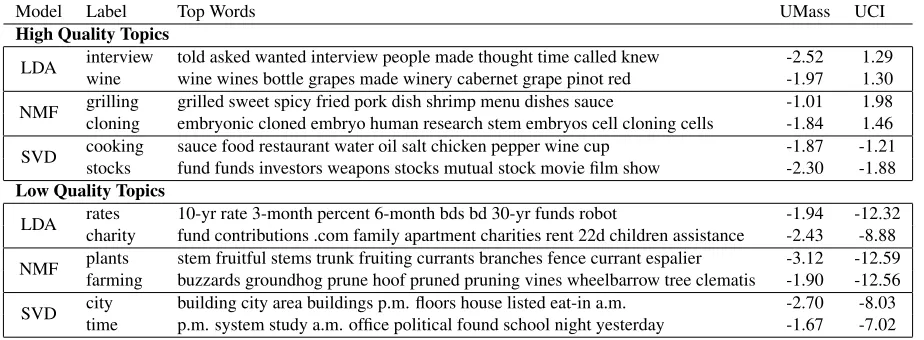
Table 1: Top 10 words from several high and low quality topics when ordered by the UCI Coherence Measure. Topic labels were chosen in an ad hoc manner only to briefly summarize the topic’s focus.
have found a connection between NMF and Proba-bilistic Latent Semantic Analysis (Ding et al., 2008), an extension to LSA. We later refer to these two LSA models simply as SVD and NMF to emphasize the difference in factorization method.
Singular Value Decomposition decomposes M
into three smaller matrices
M =UΣVT
and minimizes Frobenius norm of M’s reconstruc-tion error with the constraint that the rows ofU and
V are orthonormal eigenvectors. Interestingly, the decomposition is agnostic to the number of desired dimensions. Instead, the rows and columns inU and
VT are ordered based on their descriptive power, i.e. how well they remove noise, which is encoded by the diagonal singular value matrix Σ. As such, re-duction is done by retaining the first T rows and columns from U andVT. For our generalization, we use W = UΣ andH = ΣVT. We note that values in U andVT can be both negative and pos-itive, preventing a straightforward interpretation as unnormalized probabilities
Non-negative Matrix Factorization also
factor-izes M by minimizing the reconstruction error, but with only one constraint: the decomposed matrices consist of only non-negative values. In this respect, we can consider it to be learning an unnormalized probability distributions over topics. We use the
original Euclidean least squares definition of NMF3. Formally, NMF is defined as
M =W H
whereH andW map directly onto our generaliza-tion. As in the original NMF work, we learn these unnormalized probabilities by initializing each set of probabilities at random and update them according to the following iterative update rules
W =WW HHM HTT H=H W TM
WTW H
3 Coherence Measures
Topic Coherence measures score a single topic by measuring the degree of semantic similarity between high scoring words in the topic. These measure-ments help distinguish between topics that are se-mantically interpretable topics and topics that are ar-tifacts of statistical inference, see Table 1 for exam-ples ordered by the UCI measure. For our evalua-tions, we consider two new coherence measures de-signed for LDA, both of which have been shown to match well with human judgements of topic quality: (1) The UCI measure (Newman et al., 2010) and (2) The UMass measure (Mimno et al., 2011).
Both measures compute the coherence of a topic as the sum of pairwise distributional similarity
3
scores over the set of topic words,V. We generalize this as
coherence(V) = X
(vi,vj)∈V
score(vi, vj, )
whereV is a set of word describing the topic and
indicates a smoothing factor which guarantees that
score returns real numbers. (We will be exploring the effect of the choice of; the original authors used
= 1.)
The UCI metric defines a word pair’s score to
be the pointwise mutual information (PMI) between two words, i.e.
score(vi, vj, ) = log
p(vi, vj) +
p(vi)p(vj)
The word probabilities are computed by counting word co-occurrence frequencies in a sliding window over an external corpus, such as Wikipedia. To some degree, this metric can be thought of as an external comparison to known semantic evaluations.
The UMass metric defines the score to be based
on document co-occurrence:
score(vi, vj, ) = log
D(vi, vj) +
D(vj)
whereD(x, y)counts the number of documents con-taining words x and y and D(x) counts the num-ber of documents containing x. Significantly, the UMass metric computes these counts over the orig-inal corpus used to train the topic models, rather than an external corpus. This metric is more intrin-sic in nature. It attempts to confirm that the models learned data known to be in the corpus.
4 Evaluation
We evaluate the quality of our three topic models (LDA, SVD, and NMF) with three experiments. We focus first on evaluating aggregate coherence meth-ods for a complete topic model and consider the differences between each model as we learn an in-creasing number of topics. Secondly, we compare coherence scores to previous semantic evaluations.
Lastly, we use the learned topics in a classifica-tion task and evaluate whether or not coherent top-ics are equally informative when discriminating be-tween documents.
For all our experiments, we trained our models on 92,600 New York Times articles from 2003 (Sand-haus, 2008). For all articles, we removed stop words and any words occurring less than 200 times in the corpus, which left 35,836 unique tokens. All doc-uments were tokenized with OpenNLP’s MaxEnt4 tokenizer. For the UCI measure, we compute the PMI between words using a 20 word sliding win-dow passed over the WaCkypedia corpus (Baroni et al., 2009). In all experiments, we compute the co-herence with the top 10 words from each topic that had the highest weight, in terms of LDA and NMF this corresponds with a high probability of the term describing the topic but for SVD there is no clear semantic interpretation.
4.1 Aggregate methods for topic coherence
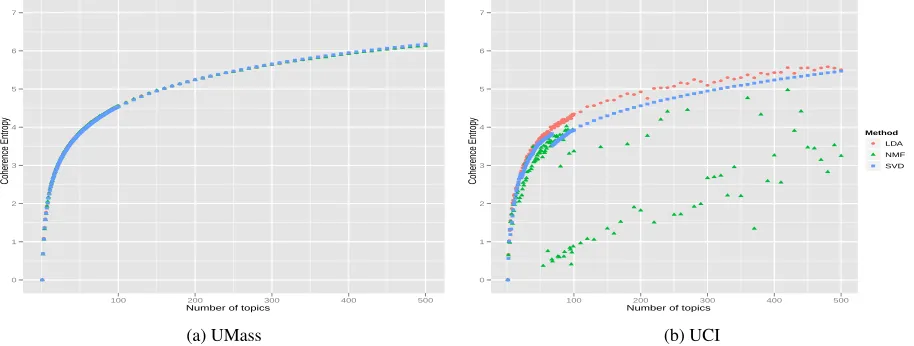
Before we can compare topic models, we require an aggregate measure that represents the quality of a complete model, rather than individual topics. We consider two aggregates methods: (1) the average coherence of all topics and (2) the entropy of the co-herence for all topics. The average coco-herence pro-vides a quick summarization of a model’s quality whereas the entropy provides an alternate summa-rization that differentiates between two interesting situations. Since entropy measures the complexity of a probability distribution, it can easily differenti-ate between uniform distributions and multimodal, distributions. This distinction is relevant when users prefer to have roughly uniform topic quality instead of a wide gap between high- and low-quality topics, or vice versa. We compute the entropy by dropping thelogandfactor from each scoring function.
Figure 1 shows the average coherence scores for each model as we vary the number of topics. These average scores indicate some simple relationships between the models: LDA and NMF have approx-imately the same performance and both models are consistently better than SVD. All of the models quickly reach a stable average score at around 100 topics. This initially suggests that learning more
4
Number of topics
Av
er
age T
opic Coherence
−5 −4 −3 −2 −1 0
100 200 300 400 500
(a) UMass
Number of topics
Av
er
age T
opic Coherence
−10 −8 −6 −4 −2 0 2
100 200 300 400 500
Method
LDA NMF SVD
[image:5.612.78.520.71.244.2](b) UCI
Figure 1: Average Topic Coherence for each model
Number of topics
Coherence Entrop
y
0 1 2 3 4 5 6 7
100 200 300 400 500
(a) UMass
Number of topics
Coherence Entrop
y
0 1 2 3 4 5 6 7
100 200 300 400 500
Method
LDA NMF SVD
(b) UCI
Figure 2: Entropy of the Topic Coherence for each model
topics neither increases or decreases the quality of the model, but Figure 2 indicates otherwise. While the entropy for the UMass score stays stable for all models, NMF produces erratic entropy results under the UCI score as we learn more topics. As entropy is higher for even distributions and lower for all other distributions, these results suggest that the NMF is learning topics with drastically different levels of quality, i.e. some with high quality and some with very low quality, but the average coherence over all topics do not account for this.
Low quality topics may be composed of highly unrelated words that can’t be fit into another topic, and in this case, our smoothing factor,, may be
[image:5.612.77.534.297.470.2]Number of topics
Av
er
age T
opic Coherence
−5 −4 −3 −2 −1 0
100 200 300 400 500
(a) UMass
Number of topics
Av
er
age T
opic Coherence
−10 −8 −6 −4 −2 0 2
100 200 300 400 500
Method
LDA NMF SVD
[image:6.612.78.520.71.244.2](b) UCI
Figure 3: Average Topic Coherence with= 10−12
Number of topics
Av
er
age Coherence of top 10%
−5 −4 −3 −2 −1 0
100 200 300 400 500
(a) UMass
Number of topics
Av
er
age Coherence of top 10%
−10 −8 −6 −4 −2 0 2
100 200 300 400 500
Method
LDA NMF SVD
(b) UCI
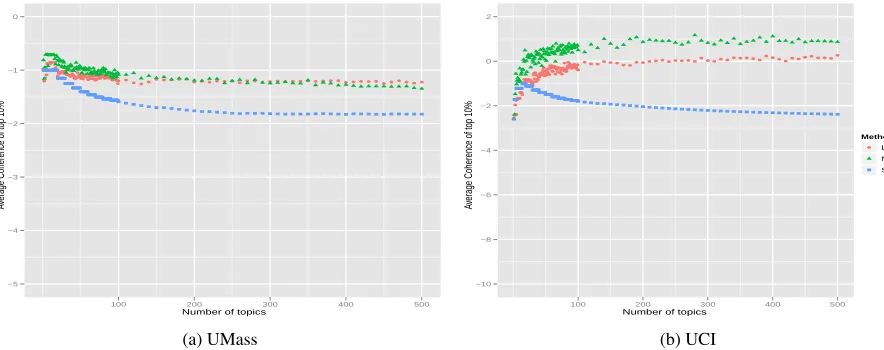
Figure 4: Average Topic Coherence of the top 10% topics with= 10−12
of topics having a low coherence, NMF appears to be learning more low quality topics once it’s learned the first 100 topics, whereas LDA learns fewer low quality topics in general.
4.2 Word Similarity Tasks
The initial evaluations for each coherence mea-sure asked human judges to directly evaluate top-ics (Newman et al., 2010; Mimno et al., 2011). We expand upon this comparison to human judgments by considering word similarity tasks that have of-ten been used to evaluate distributional semantic spaces (Jurgens and Stevens, 2010). Here, we use the learned topics as generalized semantics
describ-ing our knowledge about words. If a model’s topics generalize the knowledge accurately, we would ex-pect similar words, such as “cat” and “dog”, to be represented with a similar set of topics. Rather than evaluating individual topics, this similarity task con-siders the knowledge within the entire set of topics, the topics act as more compact representation for the known words in a corpus.
[image:6.612.79.521.295.470.2]T
score
0.0 0.1 0.2 0.3 0.4 0.5 0.6
100 200 300 400 500
model
LDA NMF SVD
(a) Rubenstein & Goodenough
T
score
0.0 0.1 0.2 0.3 0.4 0.5
100 200 300 400 500
model
LDA NMF SVD
[image:7.612.74.532.72.238.2](b) Wordsim 353/Finklestein et. al.
Figure 5: Word Similarity Evaluations for each model
Topics
Correlation
0.0 0.2 0.4 0.6
100 200 300 400 500
(a) UMass
Topics
Correlation
0.0 0.2 0.4 0.6
100 200 300 400 500
model
LDA NMF SVD
[image:7.612.77.533.296.471.2](b) UCI
Figure 7: Correlation between topic coherence and topic ranking in classification
of words and asked to rate their similarity on a scale from 0 to 4, where a higher score indicates a more similar word pair. Finkelstein et al. (2002) broadens the word similarity evaluation and asked 13 to 16 different subjects to rate 353 word pairs on a scale from 0 to 10 based on their relatedness, where relat-edness includes similarity and other semantic rela-tions. We can evaluate each topic model by comput-ing the cosine similarity between each pair of words in the evaluate set and then compare the model’s ratings to the human ratings by ranked correlation. A high correlation signifies that the topics closely model human judgments.
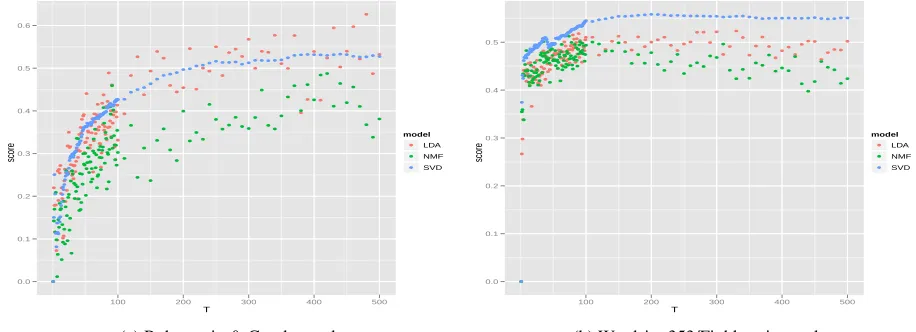
Figure 5 displays the results. SVD and LDA
both surpass NMF on the Rubenstein & Goode-nough test while SVD is clearly the best model on the Finklestein et. al test. While our first experi-ment showed that SVD was the worst model in terms of topic coherence scores, this experiment indicates that SVD provides an accurate, stable, and reliable approximation to human judgements of similarity and relatedness between word pairs in comparison to other topic models.
4.3 Coherence versus Classification
score
Correlation
0.01 0.02 0.03 0.04 0.05 0.06 0.07
−25 −20 −15 −10 −5
(a) UMass
score
Correlation
0.01 0.02 0.03 0.04 0.05 0.06 0.07
−30 −20 −10 0
model
LDA NMF SVD
[image:8.612.81.532.71.246.2](b) UCI
Figure 8: Comparison between topic coherence and topic rank with 500 topics
Topics
Accuracy
20 30 40 50 60 70 80
100 200 300 400 500
Model
[image:8.612.79.294.293.450.2]LDA NMF SVD
Figure 6: Classification accuracy for each model
coherent topics, and coherent topic models, will per-form better for classification. We address this ques-tion by performing a document classificaques-tion task using the topic representations of documents as in-put features and examine the relationship between topic coherence and the usefulness of the corre-sponding feature for classification.
We trained each topic model with all 92,600 New York Times articles as before. We use the sec-tion labels provided for each article as class labels, where each label indicates the on-line section(s) un-der which the article was published and should thus be related to the topics contained in each article. To reduce the noise in our data set we narrow down the articles to those that have only one label and whose
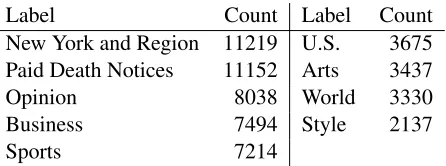
label is applied to at least 2000 documents. This re-sults in 57,696 articles with label distributions listed in Table 2. We then represent each document using columns in the topic by document matrixHlearned for each topic model.
Label Count Label Count New York and Region 11219 U.S. 3675 Paid Death Notices 11152 Arts 3437 Opinion 8038 World 3330 Business 7494 Style 2137
Sports 7214
Table 2: Section label counts for New York Times articles used for classification
For each topic model trained on N topics, we performed stratified 10-fold cross-validation on the 57,696 labeled articles. In each fold, we build an automatically-sized bagged ensemble of unpruned CART-style decision trees(Banfield et al., 2007) on 90% of the dataset5, use that ensemble to assign la-bels to the other 10%, and measure the accuracy of that assignment. Figure 6 shows the average classifi-cation accuracy over all ten folds for each model. In-terestingly, SVD has slightly, but statistically signif-icantly, higher accuracy results than both NMF and LDA. Furthermore, performance quickly increases
5
[image:8.612.317.540.369.452.2]and plateaus with well under 50 topics.
Our bagged decision trees can also determine the importance of each feature during classification. We evaluate the strength of each topic during classifi-cation by tracking the number of times each node in our decision trees observe each topic, please see (Caruana et al., 2006) for more details. Figure 8 plot the relationship between this feature ranking and the topic coherence for each topic when training LDA, SVD, and NMF on 500 topics. Most topics for each model provide little classification information, but SVD shows a much higher rank for several topics with a relatively higher coherence score. Interest-ingly, for all models, the most coherent topics are not the most informative. Figure 7 plots a more compact view of this same relationship: the Spearman rank correlation between classification feature rank and topic coherence. NMF shows the highest correlation between rank and coherence, but none of the mod-els show a high correlation when using more than 100 topics. SVD has the lowest correlation, which is probably due to the model’s overall low coherence yet high classification accuracy.
5 Discussion and Conclusion
Through our experiments, we made several excit-ing and interestexcit-ing discoveries. First, we discov-ered that the coherence metrics depend heavily on the smoothing factor. The original value,1.0 cre-ated a positive bias towards NMF from both met-rics even when NMF generated incoherent topics. The high smoothing factor also gave a significant in-crease to SVD scores. We suspect that this was not an issue in previous studies with the coherence mea-sures as LDA prefers to form topics from words that co-occur frequently, whereas NMF and SVD have no such preferences and often create low quality top-ics from completely unrelated words. Therefore, we suggest a smallervalue in general.
We also found that the UCI measure often agreed with the UMass measure, but the UCI-entropy ag-gregate method induced more separation between LSA, SVD, and NMF in terms of topic coherence. This measure also revealed the importance of the smoothing factor for topic coherence measures.
With respects to human judgements, we found that coherence scores do not always indicate a
bet-ter representation of distributional information. The SVD model consistently out performed both LDA and NMF models, which each had higher coherence scores, when attempting to predict human judge-ments of similarity.
Lastly, we found all models capable of producing topics that improved document classification. At the same time, SVD provided the most information dur-ing classification and outperformed the other mod-els, which again had more coherent topics. Our com-parison between topic coherence scores and feature importance in classification revealed that relatively high quality topics, but not the most coherent topics, drive most of the classification decisions, and most topics do not affect the accuracy.
Overall, we see that each topic model paradigm has it’s own strengths and weaknesses. Latent Se-mantic Analysis with Singular Value Decomposition fails to form individual topics that aggregate similar words, but it does remarkably well when consider-ing all the learned topics as similar words develop a similar topic representation. These topics simi-larly perform well during classification. Conversely, both Non Negative Matrix factorization and Latent Dirichlet Allocation learn concise and coherent top-ics and achieved similar performance on our evalua-tions. However, NMF learns more incoherent topics than LDA and SVD. For applications in which a hu-man end-user will interact with learned topics, the flexibility of LDA and the coherence advantages of LDA warrant strong consideration. All of code for this work will be made available through an open source project.6
6 Acknowledgments
This work was performed under the auspices of the U.S. Department of Energy by Lawrence Liv-ermore National Laboratory under Contract DE-AC52-07NA27344 (LLNL-CONF-522871) and by Sandia National Laboratory under Contract DE-AC04-94AL85000.
References
David Andrzejewski and David Buttler. 2011. Latent topic feedback for information retrieval. In
Proceed-6
ings of the 17th ACM SIGKDD international confer-ence on Knowledge discovery and data mining, KDD ’11, pages 600–608, New York, NY, USA. ACM. Robert E. Banfield, Lawrence O. Hall, Kevin W. Bowyer,
and W. Philip Kegelmeyer. 2007. A comparison of de-cision tree ensemble creation techniques. IEEE Trans-actions on Pattern Analysis and Machine Intelligence, 29(1):173–180, January.
Marco Baroni, Silvia Bernardini, Adriano Ferraresi, and Eros Zanchetta. 2009. The WaCky wide web: A collection of very large linguistically processed web-crawled corpora. Language Resources and Evalua-tion, 43(3):209–226.
David M. Blei, Andrew Y. Ng, and Michael I. Jordan. 2003. Latent dirichlet allocation. J. Mach. Learn. Res., 3:993–1022, March.
Samuel Brody and Mirella Lapata. 2009. Bayesian word sense induction. In Proceedings of the 12th Con-ference of the European Chapter of the Association for Computational Linguistics, EACL ’09, pages 103– 111, Stroudsburg, PA, USA. Association for Compu-tational Linguistics.
Rich Caruana, Mohamed Elhawary, Art Munson, Mirek Riedewald, Daria Sorokina, Daniel Fink, Wesley M. Hochachka, and Steve Kelling. 2006. Mining cit-izen science data to predict orevalence of wild bird species. In Proceedings of the 12th ACM SIGKDD international conference on Knowledge discovery and data mining, KDD ’06, pages 909–915, New York, NY, USA. ACM.
Jonathan Chang, Sean Gerrish, Chong Wang, and David M Blei. 2009. Reading tea leaves : How hu-mans interpret topic models. New York, 31:1–9. Chris Ding, Tao Li, and Wei Peng. 2008. On the
equiv-alence between non-negative matrix factorization and probabilistic latent semantic indexing. Comput. Stat. Data Anal., 52:3913–3927, April.
Lev Finkelstein, Evgeniy Gabrilovich, Yossi Matias, Ehud Rivlin, Zach Solan, Gadi Wolfman, and Eytan Ruppin. 2002. Placing search in context: the concept revisited. ACM Trans. Inf. Syst., 20:116–131, January. T. L. Griffiths and M. Steyvers. 2004. Finding scien-tific topics. Proceedings of the National Academy of Sciences, 101(Suppl. 1):5228–5235, April.
David Jurgens and Keith Stevens. 2010. The s-space package: an open source package for word space mod-els. InProceedings of the ACL 2010 System Demon-strations, ACLDemos ’10, pages 30–35, Stroudsburg, PA, USA. Association for Computational Linguistics. Thomas K Landauer and Susan T. Dutnais. 1997. A
so-lution to platos problem: The latent semantic analysis theory of acquisition, induction, and representation of knowledge. Psychological review, pages 211–240.
Thomas K. Landauer, Peter W. Foltz, and Darrell Laham. 1998. An Introduction to Latent Semantic Analysis. Discourse Processes, (25):259–284.
Daniel D. Lee and H. Sebastian Seung. 2000. Algo-rithms for non-negative matrix factorization. In In NIPS, pages 556–562. MIT Press.
David Mimno, Hanna Wallach, Edmund Talley, Miriam Leenders, and Andrew McCallum. 2011. Optimizing semantic coherence in topic models. InProceedings of the 2011 Conference on Emperical Methods in Natu-ral Language Processing, pages 262–272, Edinburgh, Scotland, UK. Association of Computational Linguis-tics.
David Newman, Youn Noh, Edmund Talley, Sarvnaz Karimi, and Timothy Baldwin. 2010. Evaluating topic models for digital libraries. InProceedings of the 10th annual joint conference on Digital libraries, JCDL ’10, pages 215–224, New York, NY, USA. ACM. V Paul Pauca, Farial Shahnaz, Michael W Berry, and
Robert J Plemmons, 2004. Text mining using nonnega-tive matrix factorizations, volume 54, pages 452–456. SIAM.
Herbert Rubenstein and John B. Goodenough. 1965. Contextual correlates of synonymy. Commun. ACM, 8:627–633, October.
Evan Sandhaus. 2008. The New York Times Annotated Corpus.
Tim Van de Cruys and Marianna Apidianaki. 2011. La-tent semantic word sense induction and disambigua-tion. InProceedings of the 49th Annual Meeting of the Association for Computational Linguistics: Hu-man Language Technologies - Volume 1, HLT ’11, pages 1476–1485, Stroudsburg, PA, USA. Association for Computational Linguistics.