Collective Cross-Document Relation Extraction Without Labelled Data
Limin Yao Sebastian Riedel Andrew McCallum University of Massachusetts, Amherst
{lmyao,riedel,mccallum}@cs.umass.edu
Abstract
We present a novel approach to relation ex-traction that integrates information across doc-uments, performs global inference and re-quires no labelled text. In particular, we tackle relation extraction and entity identifi-cation jointly. We use distant supervision to train a factor graph model for relation ex-traction based on an existing knowledge base (Freebase, derived in parts from Wikipedia). For inference we run an efficient Gibbs sam-pler that leads to linear time joint inference. We evaluate our approach both for an in-domain (Wikipedia) and a more realistic out-of-domain (New York Times Corpus) setting. For the in-domain setting, our joint model leads to 4% higher precision than an isolated local approach, but has no advantage over a pipeline. For the out-of-domain data, we ben-efit strongly from joint modelling, and observe improvements in precision of 13% over the pipeline, and 15% over the isolated baseline.
1 Introduction
Relation Extraction is the task of predicting seman-tic relations over entities expressed in structured or semi-structured text. This includes, for example, the extraction of employer-employee relations men-tioned in newswire, or protein-protein interactions expressed in biomedical papers. It also includes the prediction of entity types such as country, citytown or person, if we consider entity types as unary rela-tions.
A particularly attractive approach to relation ex-traction is based on distant supervision.1 Here in
1Also called
self training, orweak supervision.
place of annotated text, only an existing knowl-edge base (KB) is needed to train a relation extrac-tor (Mintz et al., 2009; Bunescu and Mooney, 2007; Riedel et al., 2010). The facts in the KB are heuris-tically aligned to an unlabelled training corpus, and the resulting alignment is the basis for learning the extractor.
Naturally, the predictions of a distantly supervised relation extractor will be less accurate than those of a supervised one. While facts of existing knowledge bases are inexpensive to come by, the heuristic align-ment to text will often lead to noisy patterns in learn-ing. When applied to unseen text, these patterns will produce noisy facts. Indeed, we find that extraction precision still leaves much room for improvement. This room is not as large as in previous work (Mintz et al., 2009) where target text and training KB are closely related. However, when we use the knowl-edge base Freebase (Bollacker et al., 2008) and the New York Times corpus (Sandhaus, 2008), we ob-serve very low precision. For example, the preci-sion of the top-ranked 50nationality relation instances is only 28%.
On inspection, it turns out that many of the errors can be easily identified: they amount to violations of basic compatibility constraints between facts. In particular, we observe unsatisfied selectional pref-erences of relations towards particular entity types as types of their arguments. An example is the fact that the first argument ofnationalityis always apersonwhile the second is acountry. A sim-ple way to address this is a pipeline: first predict entity types, and then condition on these when pre-dicting relations. However, this neglects the fact that relations could as well be used to help entity type prediction.
While there is some existing work on enforcing such constraints in a joint fashion (Roth and Yih, 2007; Kate and Mooney, 2010; Riedel et al., 2009), they are not directly applicable here. The difference is the amount of facts they take into account at the same time. They focus on single sentence extrac-tions, and only consider very few interacting facts. This allows them to work with exact optimization techniques such as (Integer) Linear Programs and still remain efficient.2 However, when working on a sentence level they fail to exploit the redundancy present in a corpus. Moreover, the fewer facts they consider at the same time, the lower the chance that some of these will be incompatible, and that mod-elling compatibility will make a difference.
In this work we present a novel approach that performs relation extraction across documents, en-forces selectional preferences, and needs no labelled data. It is based on an undirected graphical model in which variables correspond to facts, and factors between them measure compatibility. In order to scale up, we run an efficient Gibbs-Sampler at in-ference time, and train our model using SampleR-ank (Wick et al., 2009). In practice this leads to a runtime behaviour that is linear in the size of the cor-pus. For example, 200,000 documents take less than three hours for training and testing.
For evaluation we consider two scenarios. First we follow Mintz et al. (2009), use Freebase as source of distant supervision, and employ Wikipedia as source of unlabelled text—we will call this an in-domain setting. This scenario is somewhat arti-ficial in that Freebase itself is partially derived from Wikipedia, and in practice we cannot expect text and training knowledge base to be so close. Hence we also evaluate our approach on the New York Times corpus (out-of-domain setting).
For in-domain data we make the following find-ing. When we compare to an isolated baseline that makes no use of entity types, our joint model im-proves average precision by 4%. However, it does not outperform a pipelined system. In the out-of-domain setting, our collective model substantially outperforms both other approaches. Compared to the isolated baseline, we achieve a 15% increase in 2The pyramid algorithm of Kate and Mooney (2010) may
scale well, but it is not clear how to apply their scheme to cross-document extraction.
precision. With respect to the pipeline approach, the increase is 13%.
In the following we will first give some back-ground information on relation extraction with dis-tant supervision. Then we will present our graphi-cal model as well as the inference and learning tech-niques we apply. After discussing related work, we present our empirical results and conclude.
2 Background
In this section we will introduce the terminology and concepts we use throughout the paper. We will also give a brief introduction to relation extraction, in particular in the context of distant supervision. 2.1 Relations
We seek to extract facts about entities. Example en-tities would be the company founder BILL GATES, the company MICROSOFT, and the country USA. Arelation R is a set of tuplesc over entities. We will follow (Mintz et al., 2009) and call the term
R(c1, . . . cn) with c ∈ R a relation instance.3 It denotes the membership of the tuple c in the re-lation R. For example, founded (BILL GATES, MICROSOFT) is a relation instance denoting that BILL GATES and MICROSOFT are related in the
foundedrelation.
In the following we will always consider some set of candidate tuplesC that may or may not be re-lated. We defineCn ⊂ C to be set of alln-ary tu-ples inC. Note that while our definition considers general n-nary relations, in practice we will restrict us to unary and binary relationsC1 andC2.
Following previous work (Mintz et al., 2009; Ze-lenko et al., 2003; Culotta and Sorensen, 2004) we make one more simplifying assumption: every can-didate tuple can be member of at most one relation. 2.2 Entity Types
An entity can be of one or severalentity types. For example, BILLGATESis aperson, and a company
founder. Entity types correspond to the special case of relations with arity one, and will be treated as such in the following.
3
We care about entity types for two reasons. First, they can be important for downstream applications: if consumers of our extracted facts know the type of entities, they can find them more easily, visu-alize them more adequately, and perform opera-tions specific to these types (write emails to persons, book a hotel in a city, etc.). Second, they are use-ful for extracting binary relations due to selectional preferences—see section 2.6.
2.3 Mentions
In natural language text spans of tokens are used to refer to entities. We call such spansentity mentions. Consider, for example, the following sentence snip-pet:
(1) Political opponents of PresidentEvo Morales ofBoliviahave in recent days stepped up... Here “Evo Morales” is an entity mention of pres-ident EVO MORALES, and “Bolivia” a mention of the country BOLIVIAhe is the president of.
People often express relations between entities in natural language texts by mentioning the participat-ing entities in specific syntactic and lexical patterns. We will refer to any tuple of mentions of entities (e1, . . . en) in a sentence as candidate mention tu-ple. If such a candidate expresses the relation R, then it is arelation mentionof the relation instance
R(e1, . . . , en).
Consider again example 1. Here the pair of en-tity mentions (“Evo Morales”, “Bolivia”) is a candi-date mention tuple. In fact, in this case the candicandi-date is indeed arelation mentionof the relation instance
nationality(EVOMORALES, BOLIVIA).
2.4 Relation Extraction
We define the task of relation extraction as follows. We are given a corpus of documents and a set of target relations. Then we are asked to predict all re-lation instancesI so that for eachR(c) ∈ I there exists at least one relation mention in the given cor-pus.
The above definition covers a range of existing approaches by varying over what we define as tar-get corpus. On one end, we have extractors that process text on a per sentence basis (Zelenko et al., 2003; Culotta and Sorensen, 2004). On the other end, we have methods that take relation mentions
from several documents and use these as input fea-tures (Mintz et al., 2009; Bunescu and Mooney, 2007).
There is a compelling reason for performing re-lation extraction within a larger scope that consid-ers mentions across documents: redundancy. Often facts are mentioned in several sentences and doc-uments. Some of these mentions may be difficult to parse, or they use unseen patterns. But the more mentions we consider, the higher the probability that one does parse, and fits a pattern we have seen in the training data.
Note that for relation extraction that considers more than a single mention we have to solve the coreference problem in order to determine which mentions refer to the same entity. In the follow-ing we will assume that coreference clusters are pro-vided by a preprocessing step.
2.5 Distant Supervision
In relation extraction we often encounter a lack of explicitly annotated text, but an abundance of struc-tured data sources such as company databases or col-laborative knowledge bases like Freebase. In order to exploit this, many approaches use simple but ef-fective heuristics to align existing facts with unla-belled text. This launla-belled text can then be used as training material of a supervised learner.
One heuristic is to assume that each candidate mention tuple of a training fact is indeed expressing the corresponding relation (Bunescu and Mooney, 2007). Mintz et al. (2009) refer to this as the dis-tant supervision assumption.
Clearly, this heuristic can fail. Let us again consider thenationalityrelation between EVO MORALESand BOLIVIA. In an 2007 article of the New York Times we find this relation mention can-didate:
(2) ...the troubles faced byEvo Moralesin Bolivia...
nationality. When testing our model we then encounter a sentence such as
(3) Arrest Warrant Issued forRichard Gerein India.
that leads us to extract that RICHARDGEREis a cit-izen of INDIA.
2.6 Global Consistency of Facts
As discussed above, distant supervision can lead to noisy extractions. However, such noise can often be easily identified by testing how compatible the ex-tracted facts are to each other. In this work we are concerned with a particular type of compatibility: selectional preferences.
Relations require, or prefer, their arguments to be of certain types. For example, thenationality
relation requires the first argument to be aperson, and the second to be a country. On inspection, we find that these preferences are often not satis-fied in a baseline distant supervision system akin to Mintz et al. (2009). This often results from patterns such as “<Entity1> in <Entity2>” that fire in many cases where <Entity2> is a location, but not a
country.
3 Model
Our observations in the previous section suggest that we should (a) explicitly model compatibil-ity between extracted facts, and (b) integrate ev-idence from several documents to exploit redun-dancy. In this work we choose a Conditional Ran-dom Field (CRF) to achieve this. CRFs are a natural fit for this task: They allow us to capture correlations in an explicit fashion, and to incorporate overlapping input features from multiple documents.
The hidden output variables of our model areY= (Yc)c∈C. That is, we have one variableYcfor each candidate tuple c ∈ C . This variable can take as value any relation inCwith the same arity asc. See example relation variables in figure 1.
The observed input variablesXconsists of a fam-ily of variablesXc = X1c, . . .Xmc
m∈M for each candidate tuplec. HereXicstores relevant observa-tions we make for thei-th candidate mention tuple of cin the corpus. For example,X1
BILLGATES,MICROSOFT in figure 1 would contain, among others, the pattern “[M2] was founded by [M1]”.
3.1 Factor Templates
Our conditional probability distribution over vari-ables X and Y is defined using using a set T of factor templates. Each template Tj ∈ T defines a set of factors {(yi,xi)}, a set Kj of feature in-dices, parameters
n θjko
k∈Kj
and feature functions
n fkj
o
k∈Kj
. Together they define the following con-ditional distribution:
p(y|x) = 1
Zx
Y
Tj∈T
Y
(yi,xi)∈Tj
e
P
k∈Kjθ j kf
j k(yi,xi)
(4) In our case the set T consists of four templates we will describe below. We construct this graphical model using FACTORIE (McCallum et al., 2009), a probabilistic programming language that simplifies the construction process, as well as inference and learning.
3.1.1 Bias Template
We use a bias templateTBias that prefers certain relations a priori over others. When the template is unrolled, it creates one factor per variableYcfor candidate tuplec∈C. The template also consists of one weightθBiasr and feature functionfrBiasfor each possible relationr. fBias
r fires if the relation associ-ated with tuplecisr.
3.1.2 Mention Template
In order to extract relations from text, we need to model the correlation between relation instances and their mentions in text. For this purpose we de-fine the template TMen that connects each relation instance variableYcwith its observed mention vari-ablesXc. Crucially, this template gathers mentions from multiple documents, and enables us to exploit redundancy.
The feature functions of this template are taken from Mintz et al. (2009). This includes features that inspect the lexical content between entity mentions in the same sentence, and the syntactic path between them. One example is
f101Men(yc,xc)def=
1 yc=founded∧ ∃iwith "M2 was founded by M1"∈xic 0 otherwise
founder
Microsoft was founded by Bill Gates...
person
company
nationality
country
With Microsoft chairman
Bill Gates soon relinquishing...
Bill Gates was born in the USA in 1955
1
nationof
Elevation Partners, was founded by Roger McNamee ...
Roger McNamee,USA
Yrel
Z
1 person R McNamee country USA worksfor comp. Microsoft1
Z
11
Z
1Roger McNamee,Microsoft
functionality-factor
ner-relation-factors
relation-mention factors
Ytypel
mention factors
Elevation Partners, was founded by Roger McNamee ...
Elevation Partners, was founded by Roger McNamee ...
Figure 1: Factor Graph for joint relation mention prediction and relation type identification.
fine the following conditional distribution:
p
(
y
|
x
) =
1
Z
x�
Tj∈T
�
(yi,xi)∈Tj
e
PKjk=1θj kf
j
k(yi,xi)
(3)
In our case the set
T
consist of four templates
we will describe below. Note that to construct this
graphical model we use FACTORIE (McCallum et
al., 2009), a probabilistic programming language
that simplifies the construction process, as well as
inference and learning.
3.1.1 Bias Template
We use a bias template
T
Biasthat prefers certain
relations a priori over others. When the template is
unrolled, it creates one factor per variable
Y
cfor
can-didate tuple
c
and one weight
θ
rBiasand feature
func-tion
f
rBiasfor each possible relation
r
.
f
rBiasfires if
the relation associated with tuple
c
is
r
.
3.1.2 Mention Template
In order to extract relations from text, we need to
model the correlation between relation instances and
their mentions in text. For this purpose we define
the mention template
T
Menthat connects each
rela-tion instance variable
Y
cwith its observed variables
mention variables
X
Mc.
The feature functions of this template are taken
from (Mintz et al., 2009b) (with minor
modifica-tions). This includes features that inspect the lexical
context between entity mentions in the same
sen-tence, and the syntactic path between these. One
example is
f
101Men(
yc,
x
Mc)
def
=
1
y
c=
founder
∧
m
1", director of "
m
2∈
x
Mc0
otherwise
.
It tests whether for any of the mentions of the
can-didate tuple the sequence ", director of " appears
be-tween the mentions of the argument entites.
Crucially, these templates function on a
cross-document level. They gather all mentions of the
can-didate tuple
c
and extract features from all of these.
3.1.3 Selectional Preference Templates
To capture the correlations between entity types
and the relations the entities participate in, we
in-troduce the joint template
T
Joint. It connects a
re-lation instance variable
Y
e1,...,eato the entity type
variables
Y
e1, . . . , Y
en. To measure the
compabil-ity between relation and entcompabil-ity variables, we use
one feature
f
r,tJoint1...ta(and weight
θ
Jointr,t1...ta) for each
combination of relation and entity types
r, t
1. . . t
a.
The feature fires when the variables are in the
state
r, t
1. . . t
a. After training we would expect
a weight
θ
Jointfounder,person,companyto be larger than
θ
Jointfounder,person,country.
We also add a template
T
Pairthat measures the
compability between
Y
e1,...,eaand each
Y
eiin
iso-lation. Here we use features
f
i,r,tP airthat fire if
e
iis
1
nationof
Elevation Partners, was founded by Roger McNamee ...
Roger McNamee,USA
Yrel Z1 person R McNamee country USA worksfor comp. Microsoft 1 Z1 1 Z1
Roger McNamee,Microsoft
functionality-factor ner-relation-factors
relation-mention factors
Ytypel
mention factors
Elevation Partners, was founded by Roger McNamee ...
Elevation Partners, was founded by Roger McNamee ...
Figure 1: Factor Graph for joint relation mention prediction and relation type identification.
fine the following conditional distribution:
p
(y
|
x) =
1
Z
x�
Tj∈T
�
(yi,xi)∈Tj
e
PKjk=1θ j kfj
k(yi,xi)
(3)
In our case the set
T
consist of four templates
we will describe below. Note that to construct this
graphical model we use FACTORIE (McCallum et
al., 2009), a probabilistic programming language
that simplifies the construction process, as well as
inference and learning.
3.1.1 Bias Template
We use a bias template
T
Biasthat prefers certain
relations a priori over others. When the template is
unrolled, it creates one factor per variable
Y
cfor
can-didate tuple
c
and one weight
θ
Biasrand feature
func-tion
f
rBiasfor each possible relation
r
.
f
rBiasfires if
the relation associated with tuple
c
is
r
.
3.1.2 Mention Template
In order to extract relations from text, we need to
model the correlation between relation instances and
their mentions in text. For this purpose we define
the mention template
T
Menthat connects each
rela-tion instance variable
Y
cwith its observed variables
mention variables
X
Mc.
The feature functions of this template are taken
from (Mintz et al., 2009b) (with minor
modifica-tions). This includes features that inspect the lexical
context between entity mentions in the same
sen-tence, and the syntactic path between these. One
example is
f
101Men(
y
c,
x
Mc)
def
=
1
y
c=
founder
∧
m
1", director of "
m
2∈
x
Mc0
otherwise
.
It tests whether for any of the mentions of the
can-didate tuple the sequence ", director of " appears
be-tween the mentions of the argument entites.
Crucially, these templates function on a
cross-document level. They gather all mentions of the
can-didate tuple
c
and extract features from all of these.
3.1.3 Selectional Preference Templates
To capture the correlations between entity types
and the relations the entities participate in, we
in-troduce the joint template
T
Joint. It connects a
re-lation instance variable
Y
e1,...,eato the entity type
variables
Y
e1, . . . , Y
en. To measure the
compabil-ity between relation and entcompabil-ity variables, we use
one feature
f
r,tJoint1...ta(and weight
θ
r,tJoint1...ta) for each
combination of relation and entity types
r, t
1. . . t
a.
The feature fires when the variables are in the
state
r, t
1. . . t
a. After training we would expect
a weight
θ
Jointfounder,person,companyto be larger than
θ
Jointfounder,person,country.
We also add a template
T
Pairthat measures the
compability between
Y
e1,...,eaand each
Y
eiin
iso-lation. Here we use features
f
i,r,tP airthat fire if
e
iis
1
nationof
Elevation Partners, was founded by Roger McNamee ...
Roger McNamee,USA
Yrel Z1 person R McNamee country USA worksfor comp. Microsoft 1 Z1 1 Z1
Roger McNamee,Microsoft
functionality-factor ner-relation-factors
relation-mention factors
Ytypel
mention factors
Elevation Partners, was founded by Roger McNamee ...
Elevation Partners, was founded by Roger McNamee ...
Figure 1: Factor Graph for joint relation mention prediction and relation type identification.
fine the following conditional distribution:
p
(
y
|
x
) =
1
Z
x�
Tj∈T
�
(yi,xi)∈Tj
e
PKjk=1θ j kfj
k(yi,xi)
(3)
In our case the set
T
consist of four templates
we will describe below. Note that to construct this
graphical model we use FACTORIE (McCallum et
al., 2009), a probabilistic programming language
that simplifies the construction process, as well as
inference and learning.
3.1.1 Bias Template
We use a bias template
T
Biasthat prefers certain
relations a priori over others. When the template is
unrolled, it creates one factor per variable
Y
cfor
can-didate tuple
c
and one weight
θ
Biasrand feature
func-tion
f
rBiasfor each possible relation
r
.
f
rBiasfires if
the relation associated with tuple
c
is
r
.
3.1.2 Mention Template
In order to extract relations from text, we need to
model the correlation between relation instances and
their mentions in text. For this purpose we define
the mention template
T
Menthat connects each
rela-tion instance variable
Y
cwith its observed variables
mention variables
X
Mc.
The feature functions of this template are taken
from (Mintz et al., 2009b) (with minor
modifica-tions). This includes features that inspect the lexical
context between entity mentions in the same
sen-tence, and the syntactic path between these. One
example is
f
101Men(
y
c,
x
Mc)
def
=
1
y
c=
founder
∧
m
1", director of "
m
2∈
x
Mc0
otherwise
.
It tests whether for any of the mentions of the
can-didate tuple the sequence ", director of " appears
be-tween the mentions of the argument entites.
Crucially, these templates function on a
cross-document level. They gather all mentions of the
can-didate tuple
c
and extract features from all of these.
3.1.3 Selectional Preference Templates
To capture the correlations between entity types
and the relations the entities participate in, we
in-troduce the joint template
T
Joint. It connects a
re-lation instance variable
Y
e1,...,eato the entity type
variables
Y
e1, . . . , Y
en. To measure the
compabil-ity between relation and entcompabil-ity variables, we use
one feature
f
r,tJoint1...ta(and weight
θ
Jointr,t1...ta) for each
combination of relation and entity types
r, t
1. . . t
a.
The feature fires when the variables are in the
state
r, t
1. . . t
a. After training we would expect
a weight
θ
Jointfounder,person,companyto be larger than
θ
Jointfounder,person,country.
We also add a template
T
Pairthat measures the
compability between
Y
e1,...,eaand each
Y
eiin
iso-lation. Here we use features
f
i,r,tP airthat fire if
e
iis
g( , )�DKL( || )
g( ) = log�1−µi+µieθi �
−µieθi
. . .+wφfφ(y , y , y ) +. . .
>0
= max
y� ,y� ,y� fφ
�
y� , y� , y� �
< max
y� ,y� ,y� fφ
�
y� , y� , y� �
Φ1(y5,7,;x) = exp (. . .+w f (y;x) +. . .)
Φ (yi,j;x) = exp �
�
k
wkfk(yi,j;x) �
p(y;x) = 1 ZxΨ1(
y;x)·. . .·Ψn(y;x)
log E [Ψi]−µi
Ψi(y;x) = exp (θiφi(y;x))
µi= E [φi]
Y
Y
X1
X2
g( , )�DKL( || )
g( ) = log�1−µi+µieθi
�
−µieθi
. . .+wφfφ(y , y , y ) +. . .
>0
= max
y� ,y� ,y� fφ �
y� , y� , y� �
< max
y� ,y� ,y� fφ �
y� , y� , y� �
Φ1(y5,7,;x) = exp (. . .+w f (y;x) +. . .)
Φ (yi,j;x) = exp
� �
k
wkfk(yi,j;x)
�
p(y;x) = 1
Zx
Ψ1(y;x)·. . .·Ψn(y;x)
log E [Ψi]−µi
Ψi(y;x) = exp (θiφi(y;x))
µi= E [φi]
Y Y Y Y Y X1 X2
g( , )�DKL( || )
g( ) = log�1−µi+µieθi
�
−µieθi
. . .+wφfφ(y , y , y ) +. . .
>0
= max
y� ,y� ,y� fφ �
y� , y� , y� �
< max
y� ,y� ,y� fφ �
y� , y� , y� �
Φ1(y5,7,;x) = exp (. . .+w f (y;x) +. . .)
Φ (yi,j;x) = exp
� �
k
wkfk(yi,j;x)
�
p(y;x) = 1
ZxΨ1(y;x)·. . .·Ψn(y;x)
log E [Ψi]−µi
Ψi(y;x) = exp (θiφi(y;x))
µi= E [φi]
Y Y Y Y Y X1 X2
g( , )�DKL( || )
g( ) = log�1−µi+µieθi�−µieθi
. . .+wφfφ(y , y , y ) +. . .
>0
= max
y� ,y� ,y� fφ �
y� , y� , y� �
< max
y� ,y� ,y� fφ �
y� , y� , y� �
Φ1(y5,7,;x) = exp (. . .+w f (y;x) +. . .)
Φ (yi,j;x) = exp
� �
k
wkfk(yi,j;x)
�
p(y;x) = 1
ZxΨ1(y;x)·. . .·Ψn(y;x)
log E [Ψi]−µi
Ψi(y;x) = exp (θiφi(y;x))
µi= E [φi]
Y Y Y Y Y X1 X2
g( , )�DKL( || )
g( ) = log�1−µi+µieθi
�
−µieθi
. . .+wφfφ(y , y , y ) +. . .
>0
= max
y� ,y� ,y� fφ �
y� , y� , y� �
< max
y� ,y� ,y� fφ �
y� , y� , y� �
Φ1(y5,7,;x) = exp (. . .+w f (y;x) +. . .)
Φ (yi,j;x) = exp
� �
k
wkfk(yi,j;x)
�
p(y;x) = 1
ZxΨ1(y;x)·. . .·Ψn(y;x)
log E [Ψi]−µi
Ψi(y;x) = exp (θiφi(y;x))
µi= E [φi]
Y Y Y Y Y X1 X2
g( , )�DKL( || )
g( ) = log�1−µi+µieθi
�
−µieθi
. . .+wφfφ(y , y , y ) +. . .
>0
= max
y� ,y� ,y� fφ �
y� , y� , y� �
< max
y� ,y� ,y� fφ �
y� , y� , y� �
Φ1(y5,7,;x) = exp (. . .+w f (y;x) +. . .)
Φ (yi,j;x) = exp
� �
k
wkfk(yi,j;x)
�
p(y;x) = 1
ZxΨ1(y;x)·. . .·Ψn(y;x)
log E [Ψi]−µi
Ψi(y;x) = exp (θiφi(y;x))
µi= E [φi]
Y Y Y Y Y X1 X2
g( , )�DKL( || )
g( ) = log�1−µi+µieθi
�
−µieθi
. . .+wφfφ(y , y , y ) +. . .
>0
= max
y� ,y� ,y� fφ �
y� , y� , y� �
< max
y� ,y� ,y� fφ �
y� , y� , y� �
Φ1(y5,7,;x) = exp (. . .+w f (y;x) +. . .)
Φ (yi,j;x) = exp
� �
k
wkfk(yi,j;x)
�
p(y;x) = 1
ZxΨ1(y;x)·. . .·Ψn(y;x)
log E [Ψi]−µi
Ψi(y;x) = exp (θiφi(y;x))
µi= E [φi]
Y Y Y Y Y X1 X2
Figure 1: Factor Graph of our model that captures selectional preferences and functionality constraints. For readability we only label a subsets of equivalent variables and factors. Note that the graph shows an example assignment to variables.
It tests whether for any mentions of the candidate tuple the phrase "founded by" appears between the mentions of the argument entities.
3.1.3 Selectional Preferences Templates
To capture the correlations between entity types and relations the entities participate in, we introduce the template TJoint. It connects a relation instance variable Ye1,...,en to the individual entity type vari-ables Ye1, . . . , Yen. To measure the compatibility between relation and entity variables, we use one featurefJoint
r,t1...ta (and weightθ Joint
r,t1...ta) for each com-bination of relation and entity typesr, t1. . . ta.
fr,tJoint1...ta fires when the factor variables are in the stater, t1. . . ta. For example,ffoundedJoint ,person,company
fires ifYe1is in stateperson,Ye2in statecompany,
andYe1,e2 in statefounded.
We also add a template TPair that measures the pairwise compatibility between the relation variable
Ye1,...,ea and each entity variable Yei in isolation. Here we use featuresfi,r,tPairthat fire ifeiis thei-th ar-gument ofc, has the entity typetand the candidate tuplecis labelled as instance of relationr. For ex-ample,fPair
1,founded,person fires ifYe1(argumenti= 1)
is in stateperson, andYe1,e2in statefounded,
re-gardless of the state ofYe2.
3.2 Inference
There are two types of inference we have to perform: sampling from the posterior during training (see sec-tion 3.3), and finding the most likely configurasec-tion (aka MAP inference). In both settings we employ a Gibbs sampler (Geman and Geman, 1990) that ran-domly picks a variable Yc and samples its relation value conditioned on its Markov Blanket. At test time we decrease the temperature of our sampler in order to find an approximation of the MAP solution. 3.3 Training
Most learning methods need to calculate the model expectations (Lafferty et al., 2001) or the MAP con-figuration (Collins, 2002) before making an update to the parameters. This step of inference is usually the bottleneck for learning, even when performed approximately.
is expensive and generally intractable (Singh et al., 2009).
4 Related Work
Distant Supervision Learning to extract relations by using distant supervision has raised much interest in recent years. Our work is inspired by Mintz et al. (2009) who also use Freebase as distant supervision source. We also heuristically align our knowledge base to text by making the distant supervision as-sumption (Bunescu and Mooney, 2007; Mintz et al., 2009). However, in contrast to these previous ap-proaches, and other related distant supervision meth-ods (Craven and Kumlien, 1999; Weld et al., 2009; Hoffmann et al., 2010), we perform relation extrac-tion collectively with entity type predicextrac-tion.
Schoenmackers et al. (2008) use entailment rules on assertion extracted by TextRunner to increase re-call. They also perform cross-document probabilis-tic inference based on Markov Networks. However, they do not infer the types of entities and work in an open IE setting.
Selectional Preferences In the context of super-vised relation extraction, selectional preferences have been applied. For example, Roth and Yih (2007) have used Linear Programming to enforce consistency between entity types and extracted re-lations. Kate and Mooney (2010) use a pyramid parsing scheme to achieve the same. Riedel et al. (2009) use Markov Logic to model interactions be-tween event-argument relations for biomedical event extraction. However, their work is (a) supervised, and (b) performs extraction on a per-sentence basis. Carlson et al. (2010) also use selectional prefer-ences. However, instead of exploiting them for train-ing a graphical model ustrain-ing distant supervision, they use selectional preferences to improve a ping process. Here in each iteration of bootstrap-ping, extracted facts that violate compatibility con-straints will not be used to generate additional pat-terns in the next iteration.
5 Experiments
We set up experiments to answer the following ques-tions: (i) Does the explicit modelling of selectional preferences improve accuracy? (ii) Can we also per-form joint entity and relation extraction in a pipeline
and achieve similar results? (iii) How does our cross-document approach scale?
To answer these questions we carry out experi-ments on two data sets, Wikipedia and New York Times articles, and use Freebase as distant supervi-sion source for both.
5.1 Experimental Setup
We follow Mintz et al. (2009) and perform two types of evaluation: held-out and manual. In both cases we have a training and a test corpus of documents, and training and test sets of entities. For held-out evaluation we split the set of entities in Freebase into training and test sets. For manual evaluation we use all Freebase entities during training. For testing we use all entities that appear in the test document cor-pus.
For both training and testing we then choose the candidate tuplesCthat may or may not be relation instances. To pick the entitiesC1we want to predict entity types for, we choose all entities that are men-tioned at least once in the train/test corpus. To pick the entity pairsC2 that we want to predict the rela-tions of, we choose those that appear at least once together in a sentence.
The set of candidatesC will contain many tuples which are not related in any Freebase relations. For efficiency, we filter out a large fraction of these neg-ative candidates for training. The number of neg-ative examples we keep is chosen to be about 10 times the number of positive candidates. This num-ber stems from trading-off the accuracy it leads to and the increased training time it requires.
For both manual and held-out evaluation we rank extracted test relation instances in the MAP state of the network. This state is found by sampling 20 iter-ations with a low temperature of 0.00001. The rank-ing is done accordrank-ing to the log linear score that the assigned relation for a candidate tuple gets from the factors in its Markov Blanket. For optimal perfor-mance, the score is normalized by the number of re-lation mentions.
their average, and their average weighted by the pro-portion of predicted instances for the given relation. 5.1.1 Data preprocessing
We preprocess our textual data as follows: We first use the Stanford named entity recog-nizer (Finkel et al., 2005) to find entity mentions in the corpus. The NER tagger segments each docu-ment into sentences and classifies each token into four categories: PERSON, ORGANIZATION, LO-CATION and NONE. We treat consecutive tokens which share the same category as single entity men-tion. Then we associate these mentions with Free-base entities. This is achieved by performing a string match between entity mention phrases and the canonical names of entities as present in Freebase.
For each candidate tuple c with arity 2 and each of its mention tuplesiwe extract a set of featuresXi
c similar to those used in (Mintz et al., 2009): lexical, Part-Of-Speech (POS), named entity and syntactic features, i.e. features obtained from the dependency parsing tree of a sentence. We use the openNLP POS tagger4 to obtain POS tags and employ the Malt-Parser (Nivre et al., 2004) for dependency parsing. For candidate tuples with arity 1 (entity types) we use the following features: the entity’s word form, the POS sequence, the head of the entity in the de-pendency parse tree, the Stanford named entity tag, and the left and right words to the current entity mention phrase.
5.1.2 Configurations
We apply the following configurations of our fac-tor graphs. As our baseline, and roughly equivalent to previous work (Mintz et al., 2009), we pick the templatesTBiasandTMen. These describe a fully dis-connected graph, and we will refer to this configu-ration asisolated. Next, we add the templatesTJoint andTPairto model selectional preferences, and refer to this setting asjoint.
In addition, we evaluate how well selectional pref-erences can be captured with a simplepipeline. For this pipeline we first train an isolated system for en-tity type prediction. Then we use the output of the entity type prediction system as input for the relation extraction system.
4available at http://opennlp.sourceforge.net/
5.1.3 Entity types and Relation types
Freebase contains many relation types and only a subset of those relation types occur frequently in the corpus. Since classes with very few training instances are generally hard to learn, we restrict ourselves to the 54 most frequently mentioned relations. These include, for ex-ample, nationality, contains, founded
and place_of_birth. Note that we con-vert two Freebase non-binary temporal relations to binary relations: employment_tenure and
place_lived. In both cases we simply disregard the temporal information in the Freebase data.
As our main focus is relation extraction, we re-strict ourselves to entity types compatible with our selected relations. To this end we inspect the Free-base schema information provided for each relation, and include those entity types that are declared as arguments of our relations. This leads to 10 entity types including person, citytown, country, andcompany.
Note that a Freebase entity can have several types. We pick one of these by choosing the most specific one that is a member of our entity type subset, or
MISCif no such member exists. 5.2 Wikipedia
In our first set of experiments we train and test using Wikipedia as the text corpus. This is a comparatively easy scenario because the facts in Freebase are partly derived from Wikipedia, hence there is an increased chance of properly aligning training facts and text. This is similar to the setting of Mintz et al. (2009). 5.2.1 Held Out Evaluation
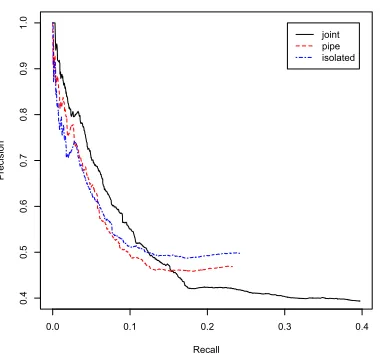
We split 1,300,000 Wikipedia articles into train-ing and test sets. Table 1 shows the statistics for this split. The last row provides the number of negative relation instances (candidates which are not related according to Freebase) associated with each data set. Figure 2 shows the precision-recall curves of re-lation extraction for held-out data of various config-urations. We notice a slight advantage of the joint approach in the low recall area. Moreover, the joint model predicts more relation instances, as can be seen by its longer line in the graph.
Wikipedia NYT Train Test Train Test
#Documents 900K 400K 177K 39K
#Entities 213K 137K 56K 27K
#Positive 36K 24K 5K 2K
[image:8.612.82.291.53.135.2]#Negative 219K 590K 64K 94K
Table 1: The statistics of held-out evaluation on Wikipedia and New York Times.
0.0 0.1 0.2 0.3 0.4
0.4
0.5
0.6
0.7
0.8
0.9
1.0
Recall
Pre
ci
si
on
[image:8.612.328.530.54.122.2]joint pipe isolated
Figure 2: Precision-recall curves for various setups in Wikipedia held-out setting.
this observation is somewhat misleading. Many of the predictions of the joint model are not in the held-out test set derived from Freebase, but never-theless correct. Hence, to understand if one system really outperforms another, we need to rely on man-ual evaluation.
Note that the figure only considers binary relations—for entity types all configurations per-form similarly.
5.2.2 Manual Evaluation
As mentioned above, held-out evaluation in this context suffers from false negatives in Freebase. Ta-ble 2 therefore shows the results of our manual eval-uation. They are based on the average, and weighted average, of the precisions for the relation instances of the most frequent relations. We notice that here
Isolated Pipeline Joint
Wikipedia 0.82 0.87 0.86
Wikipedia (w) 0.95 0.94 0.95
NYT 0.63 0.65 0.78
NYT (w) 0.78 0.82 0.94
Table 2: Average and weighted (w) average preci-sion over frequent relations for New York Times and Wikipedia data, based on manual evaluation.
all systems perform comparably for weighted aver-age precision. For averaver-age precision we see an ad-vantage for both the pipeline and the joint model over the isolated system.
One reason for similar weighted average preci-sions is the fact that all approaches accurately pre-dict a large number ofcontainsinstances. This is due to very regular and simple patterns in Wikipedia. For example, most articles on towns start with “A is a municipality in the district of B in C, D.” For these sentences, the relative position of two location men-tions is a very good predictor ofcontains. When used as a feature, it leads to high precision for all models. And sincecontainsinstances are most frequent, and we take the weighted average, results are generally close to each other.
To summarize: in this in-domain setting, mod-elling compatibility between entity types and rela-tions helps to improve average precision, but not weighted average precision. This holds for both the joint and the pipeline model. However, we will see how this changes substantially when moving to an out-of-domain scenario.
5.3 New York Times
For our second set of experiments we use New York Times data as training and test corpora. As we argued before, this is expected to be the more difficult—and more realistic—scenario.
5.3.1 Held-out Evaluation
We choose all articles of the New York times dur-ing 2005 and 2006 as traindur-ing corpus. As test corpus we use the first 6 months of 2007.
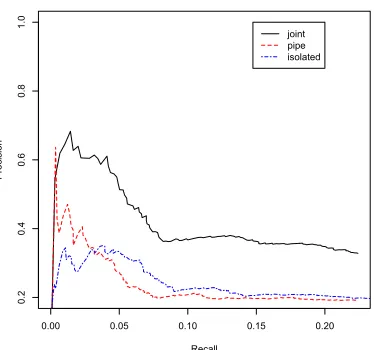
[image:8.612.88.280.204.381.2]0.00 0.05 0.10 0.15 0.20
0.2
0.4
0.6
0.8
1.0
Recall
Pre
ci
si
on
joint
pipe
[image:9.612.329.524.54.175.2]isolated
Figure 3: Precision-recall curves for various setups in New York Times held-out setting.
types and relations helps to improve precision. Due to the smaller overlap between Freebase and NYT data, figure 3 also has to be taken with more caution. The systems may predict correct relation instances that just do not appear in Freebase. Hence manual evaluation is even more important.
When evaluating entity precision we find that for both models it is about 84%. This raises the ques-tion why the joint entity type and relaques-tion extrac-tion model outperforms the pipeline on relaextrac-tions. We take a close look at the entities which partici-pate in relations and find that joint model performs better on most entity types, for example,country
and citytown. We also look at the relation in-stances which are predicted by both systems and find that the joint model does predict correct entity types when the pipeline mis-predicts. And exactly these mis-predictions lead the pipeline astray. Consider-ing binary relation instances where the pipeline fails but the joint model does not, we observe an entity precision of 76% for the pipeline and 86% for our joint approach. The joint model fails to correctly predict some entity types that the pipeline gets right, but these tend to appear in contexts where relation instances are easy to extract without considering
en-Relation Type Iso. Pipe Joint
contains 0.92 0.98 0.96
nationality 0.28 0.64 0.82
plc_lived 0.88 0.70 0.96
plc_of_birth 0.32 0.20 0.25
works_for 0.96 0.98 0.98
plc_of_death 0.24 0.40 0.42
children 1.00 0.92 0.98
[image:9.612.89.276.73.248.2]founded 0.42 0.34 0.71
Table 3: Precision at 50 for the most frequent rela-tions on New York Times
tity types.5
5.3.2 Manual Evaluation
Manually evaluated precision for New York Times data can be seen in table 2. In contrast to the Wiki setting, here modelling entity types and rela-tions jointly makes a substantial difference. For av-erage precision, our joint model improves over the isolated baseline by 15%, and over the pipeline by 13%. Similar improvements can be observed for weighted average precision.
Let us look at a break-down of precisions with respect to different relations shown in table 3. We see dramatic improvements fornationalityand
foundedwhen applying the joint model. Note that
the nationality relation takes a larger part in
the predicted relation instances of the joint model and hence contributes significantly to the weighted average precision.
5.4 Scalability
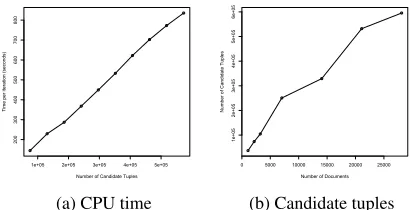
We propose to perform joint inference for large scale information extraction. An obvious concern in this scenario is scalability. In practice we find that infer-ence (and hinfer-ence learning) in our model scales lin-early with the number of candidate tuples. This can be seen in figure 4a. It is to be expected since the number of candidates equals the number of variables the sampler has to process in each iteration.
The above observation also means that our ap-proach scales linearly with corpus size. To illustrate
5
1e+05 2e+05 3e+05 4e+05 5e+05
200
300
400
500
600
700
800
Number of Candidate Tuples
T
ime
p
er
ite
ra
tio
n
(se
co
nd
s)
(a) CPU time
0 5000 10000 15000 20000 25000
1e
+0
5
2e
+0
5
3e
+0
5
4e
+0
5
5e
+0
5
6e
+0
5
Number of Documents
N
umb
er
of
C
an
di
da
te
T
up
le
s
[image:10.612.79.284.73.178.2](b) Candidate tuples
Figure 4: CPU time for one iteration per candidate tuple, and candidate tuples per document.
this, figure 4b shows how the number of candidates scales with the number of documents. Again we ob-serve a linear behavior. Since both are linear, we can say that our joint approach is linear in the number of documents.
Total training and test times are moderate, too. For example, the held-out experiments with 200,000 NYT documents finish within three hours.
6 Conclusion
This paper presents a novel approach to extracting relational facts from text. Akin to previous work in relation extraction with distant supervision, we re-quire no annotated text. However, instead extract-ing facts in isolation, we model interactions between facts in order to improve precision. In particular, we capture selectional preferences of relations. These preferences are modelled in a cross-document fash-ion using a large scale factor graph. We show in-ference and learning can be efficiently performed in linear time by Gibbs Sampling and SampleRank. When applied to out-of-domain text, this approach leads to a 15% increase in precision over an isolated baseline, and a 13% improvement over a pipelined system.
A crucial aspect of our approach is its extensibil-ity. Since it is exclusively framed in terms of an undirected graphical model, it is conceptually easy to extend it to other types of compatibilities, such as functionality constraints. It could also be ex-tended to tackle coreference resolution. Eventually we seek to model the complete process of the
au-tomatic construction of KB within this framework, and capture dependencies between extractions in a joint and principled fashion. As we have seen here, in particular when learning is less supervised and extractions are noisy, capturing such interactions is paramount.
Acknowledgements
This work was supported in part by the Center for Intelligent Information Retrieval, in part by The Central Intelligence Agency, the National Secu-rity Agency and National Science Foundation un-der NSF grant #IIS-0326249, and in part by UPenn NSF medium IIS-0803847. The University of Mas-sachusetts also gratefully acknowledges the support of Defense Advanced Research Projects Agency (DARPA) Machine Reading Program under Air Force Research Laboratory (AFRL) prime contract no. FA8750-09-C-0181. Any opinions, findings, and conclusion or recommendations expressed in this material are those of the author(s) and do not necessarily reflect the view of the DARPA, AFRL, or the US government.
References
Kurt Bollacker, Colin Evans, Praveen Paritosh, Tim Sturge, and Jamie Taylor. 2008. Freebase: a collabo-ratively created graph database for structuring human knowledge. InSIGMOD ’08: Proceedings of the 2008 ACM SIGMOD international conference on Manage-ment of data, pages 1247–1250, New York, NY, USA. ACM.
Razvan C. Bunescu and Raymond J. Mooney. 2007. Learning to extract relations from the web using min-imal supervision. InProceedings of the 45rd Annual Meeting of the Association for Computational Linguis-tics (ACL ’07).
Andrew Carlson, Justin Betteridge, Richard Wang, Es-tevam Hruschka, and Tom Mitchell. 2010. Cou-pled semi-supervised learning for information extrac-tion. InThird ACM International Conference on Web Search and Data Mining (WSDM ’10).
Koby Crammer and Yoram Singer. 2003. Ultraconserva-tive online algorithms for multiclass problems. Jour-nal of Machine Learning Research, 3:951–991. M. Craven and J. Kumlien. 1999. Constructing
biolog-ical knowledge-bases by extracting information from text sources. InProceedings of the Seventh Interna-tional Conference on Intelligent Systems for Molecular Biology, pages 77–86, Germany.
Aron Culotta and Jeffery Sorensen. 2004. Dependency tree kernels for relation extraction. In 42nd Annual Meeting of the Association for Computational Linguis-tics, Barcelona, Spain.
Jenny Rose Finkel, Trond Grenager, and Christopher Manning. 2005. Incorporating non-local informa-tion into informainforma-tion extracinforma-tion systems by gibbs sam-pling. InProceedings of the 43rd Annual Meeting of the Association for Computational Linguistics (ACL ’05), pages 363–370, June.
S. Geman and D. Geman. 1990. Stochastic relaxation, gibbs distributions, and the bayesian restoration of im-ages. pages 452–472.
Raphael Hoffmann, Congle Zhang, and Daniel S. Weld. 2010. Learning 5000 relational extractors. InACL. Rohit J. Kate and Raymond J. Mooney. 2010. Joint
en-tity and relation extraction using card-pyramid pars-ing. InProceedings of the 12th Conference on Com-putational Natural Language Learning (CoNLL’ 10). John D. Lafferty, Andrew McCallum, and Fernando
Pereira. 2001. Conditional random fields: Proba-bilistic models for segmenting and labeling sequence data. InInternational Conference on Machine Learn-ing (ICML).
Andrew McCallum, Karl Schultz, and Sameer Singh. 2009. Factorie: Probabilistic programming via imper-atively defined factor graphs. In Y. Bengio, D. Schuur-mans, J. Lafferty, C. K. I. Williams, and A. Culotta, ed-itors,Advances in Neural Information Processing Sys-tems 22, pages 1249–1257.
Mike Mintz, Steven Bills, Rion Snow, and Daniel Juraf-sky. 2009. Distant supervision for relation extrac-tion without labeled data. InProceedings of the Joint Conference of the 47th Annual Meeting of the ACL and the 4th International Joint Conference on Natu-ral Language Processing of the AFNLP (ACL ’09), pages 1003–1011. Association for Computational Lin-guistics.
J. Nivre, J. Hall, and J. Nilsson. 2004. Memory-based dependency parsing. InProceedings of CoNLL, pages 49–56.
Sebastian Riedel, Hong-Woo Chun, Toshihisa Takagi, and Jun’ichi Tsujii. 2009. A markov logic approach to bio-molecular event extraction. InProceedings of the Natural Language Processing in Biomedicine NAACL 2009 Workshop (BioNLP ’09), pages 41–49.
Sebastian Riedel, Limin Yao, and Andrew McCallum. 2010. Modeling relations and their mentions without labeled text. InProceedings of the European Confer-ence on Machine Learning and Knowledge Discovery in Databases (ECML PKDD ’10).
D. Roth and W. Yih. 2007. Global inference for en-tity and relation identification via a linear program-ming formulation. In Lise Getoor and Ben Taskar, ed-itors, Introduction to Statistical Relational Learning. MIT Press.
Evan Sandhaus, 2008. The New York Times Annotated Corpus. Linguistic Data Consortium, Philadelphia. Stefan Schoenmackers, Oren Etzioni, and Daniel S.
Weld. 2008. Scaling textual inference to the web. In EMNLP ’08: Proceedings of the Conference on Empirical Methods in Natural Language Processing, pages 79–88, Morristown, NJ, USA. Association for Computational Linguistics.
Sameer Singh, Karl Schultz, and Andrew McCallum. 2009. Bi-directional joint inference for entity res-olution and segmentation using imperatively-defined factor graphs. InEuropean Conference on Machine Learning and Principles and Practice of Knowledge Discovery in Databases (ECML PKDD), pages 414– 429.
Daniel S. Weld, Raphael Hoffmann, and Fei Wu. 2009. Using wikipedia to bootstrap open information extrac-tion. InACM SIGMOD Record.
Michael Wick, Khashayar Rohanimanesh, Aron Culotta, and Andrew McCallum. 2009. Samplerank: Learning preferences from atomic gradients. In Neural Infor-mation Processing Systems (NIPS), Workshop on Ad-vances in Ranking.