2937
Enhancing Key-Value Memory Neural Networks
for Knowledge Based Question Answering
Kun Xu1, Yuxuan Lai2, Yansong Feng2,3, Zhiguo Wang4
1Tencent AI Lab
2ICST, Peking University
3The MOE Key Laboratory of Computational Linguistics, Peking University
4Amazon
{erutan,fengyansong}@pku.edu.cn
Abstract
Traditional Key-value Memory Neural Net-works (KV-MemNNs) are proved to be effec-tive to support shallow reasoning over a col-lection of documents in domain specific Ques-tion Answering or Reading Comprehension tasks. However, extending KV-MemNNs to Knowledge Based Question Answering (KB-QA) is not trivia, which should properly de-compose a complex question into a sequence of queries against the memory, and update the query representations to support multi-hop reasoning over the memory. In this paper, we propose a novel mechanism to enable con-ventional KV-MemNNs models to perform in-terpretable reasoning for complex questions. To achieve this, we design a new query up-datingstrategy to mask previously-addressed memory information from the query repre-sentations, and introduce a novelSTOP strat-egy to avoid invalid or repeated memory read-ing without strong annotation signals. This also enables KV-MemNNs to produce struc-tured queries and work in a semantic pars-ing fashion. Experimental results on bench-mark datasets show that our solution, trained with question-answer pairs only, can provide conventional KV-MemNNs models with better reasoning abilities on complex questions, and achieve state-of-art performances.
1 Introduction
Memory Neural Networks (MemNNs) [Westonet al., 2014; Sukhbaatar et al., 2015b] are a fam-ily of neural network models that aim to learn how to reason with a long-term memory com-ponent and various inference comcom-ponents. The memory component serves as a knowledge base to recall facts from the past. MemNNs have been successfully applied in many natural lan-guage processing applications such as question
question
text Embedding AddressingKey query
representation
Hashing k1 k2 k3 … kN
v1 v2 v3 … vN
memory slots
Value Reading
query update
Ranking
answer representation
Embedding candidate answer
representation answer
text
answer candidates
[image:1.595.308.537.224.369.2]+
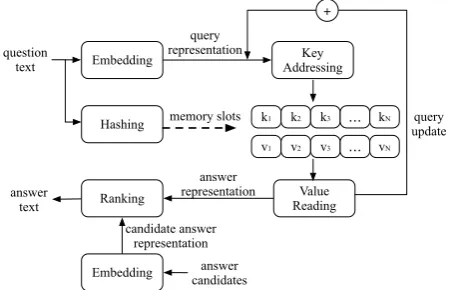
Figure 1: The Key-Value Memory Neural Network Ar-chitecture.
answering and reading comprehension (RC). Re-cently, Miller et al. [2016] proposed a variant of MemNNs, namely Key-Value Memory Neural Networks (KV-MemNNs), which generalizes the original MemNNs by storing facts in a key-value structured memory. Figure 1illustrates the basic architecture of KV-MemNNs, which consists of five components. The question is first fed to the
Rank-ingcomponent.
The KV-MemNNs have been shown to support shallow reasoning in domain-specific knowledge based question answering (KB-QA) tasks such as MovieQA [Tapaswiet al.,2016]. However, when applied to a more challenging scenario, e.g., open domain KB-QA, the KV-MemNNs models do not perform as well as expected, possibly due to two reasons. First of all, the focus of conventional KV-MemNNs is about understanding the facts in the memory rather than properly understanding the questions, where the latter requires incrementally decomposing a complex natural language ques-tion into a set of focused queries with the help of the facts in the memory. However, in open do-main KB-QA, questions are usually more compli-cated, e.g., multi-relation questions such as who does maggie grace play in taken, where more than one entity and relation are mentioned. Secondly, as shown in Figure1, KV-MemNNs usually work in an information retrieval (IR) fashion, which first retrieve a set of candidate answers from KB, then rank them by computing the similarity between the value representation and candidates, and fi-nally select the top one or a fixed number of top candidates as the answer. We can imagine that it is not trivial for such IR-styled KV-MemNNs to properly resolve complex constraints from natu-ral language questions, or to handle questions with multiple answers.
We believe that an ideal framework for open do-main KB-QA should first understand the natural language questions, explicitly represent the mean-ing, and make the answer retrieval process more interpretable. To build such an interpretable KV-MemNN KB-QA model, we need to deal with the following challenges: (1) KV-MemNNs often read the memory repeatedly since they do not know when to stop; (2) during multiple memory read-ings, conventional KV-MemNNs often fail to pre-cisely update the queries for multi-relation ques-tions; (3) strong annotations are usually required to train an interpretable QA model, e.g., the su-pervision for the memory selection at each hop. To address the challenges, we propose a novel so-lution to make conventional KV-MemNNs feasi-ble to open domain KB-QA. In particular, we in-troduce a flexible KV-MemNN solution that can work in both the IR and semantic parsing style with large-scale memory. To this end, we first present a novel query updating method that is able
to decompose complex questions and precisely ad-dress a relevant key at each hop. Secondly, we introduce a new STOP strategy during memory readings, which imports a special keySTOPinto the memory and guides our model to avoid re-peated or invalid memory readings. In addition, our proposed model can learn to reason over mem-ory slots with weak supervision, e.g., question-answer pairs only, opposing the strong supervision that most current neural semantic parsers demand, which incurs high labor costs. Experimental re-sults on two benchmark datasets show that our proposed model can not only enhance the reason-ing capability of KV-MemNNs, but also be flex-ible enough to work as a semantic parser, with state-of-the-art performances.
2 Related Work
There are usually two main challenges in the open domain KB-QA task: (1) it often requires the abil-ity to properly analyze and represent the natural language questions against knowledge bases, es-pecially for those involving multiple entities and relations, which we also call as reasoning over the KBs; (2) training such interpretable question un-derstanding models requires considerable strong annotations, which is expensive to obtain in prac-tice. Existing works address these using either the information retrieval (IR) based solutions or the semantic paring (SP) based approaches. The IR-based models [Yao and Van Durme, 2014; Yao, 2015;Bast and Haussmann, 2015; Bordes et al., 2015; Dong et al., 2015; Jain, 2016; Lai et al., 2019] tackle the KB-QA task by developing var-ious ranking models towards the candidate an-swers, which implicitly meet the reasoning re-quirements during the candidate-searching step or in designing the ranking functions. In contrast, the SP-based approaches [Berant et al., 2013; Kwiatkowskiet al.,2013;Berant and Liang,2014; Reddy et al., 2014; Yih et al., 2015; Xu et al., 2016] explicitly represent the meaning of ques-tions as logical forms or structured queries that naturally support reasoning over structured KBs.
2016] further proposed the Key-Value Memory Network, which generalizes the MemNN by stor-ing facts in a key-value structured memory. Both of the two models could perform shallow reason-ing over the memory, since they can find answers by consecutively making predictions over multiple memory slots. Compared to the flat memory slots in MemNNs, the Key-Value design can precisely accommodate more complex structured resources, e.g., discriminating subjects and objects in struc-tured KBs, thus makes KV-MemNNs more flexi-ble and better fit to different applications. These neural networks models are often trained in an end-to-end fashion, making the models relatively less interpretable.
Conceptually similar to our STOP strategy, Shen et al. [2017] propose the termination gate mechanism based on a random variable gener-ated from the internal state for reading compre-hension. In contrast, our model attempts to learn a general STOP key embedding based on the in-crementally updated query representations, which can be learned from question-answer pairs only and lead to more explicit reasoning interpretations over structured KBs. This make our model poten-tially suit more real scenarios.
Our work is also related to [Jain, 2016;Bao et al.,2016], which are designed to support reason-ing for multi-relation questions by explorreason-ing the relation path and certain KB schema, e.g., CVT nodes, in the Freebase. The former also consid-ers previously-addressed keys during query updat-ing, but ignores the value representations. Thus, it still requires predefined rules and threshold to ar-tificially add intermediate value representations to update the query. The latter also relies on a set of predefined rules to perform reasoning over Free-base. In contrast, our model incorporates both the key and value representations into the query rep-resentations, and update in a more uniform way, thus is more general and supports more reasoning scenarios in KB-QA.
3 Our Model
For a given questionx, a knowledge baseKBand the question’s answery, we aim to learn a model such that
F(x,KB) = ˆy→y
whereyˆis the predicted answer. In standard KV-MemNNs, the function F can be composed of five components, i.e., key hashing, key
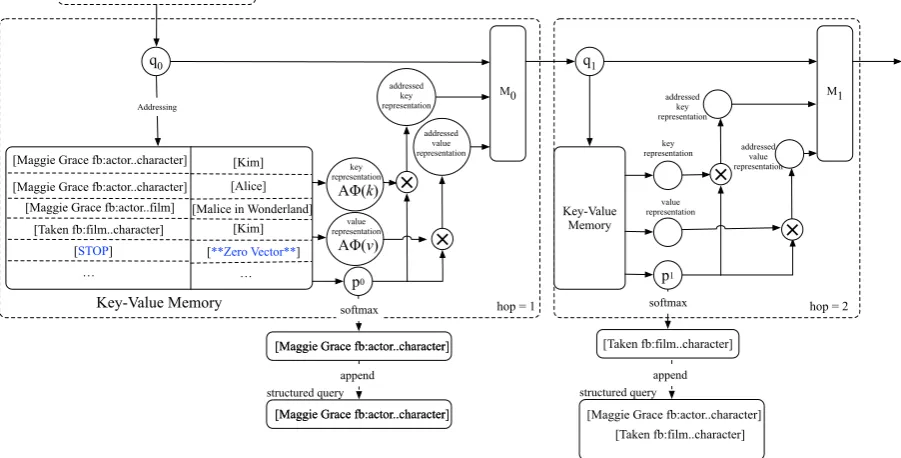
address-ing, value readaddress-ing, query updating and answer pre-diction. Next, we will introduce how we design a novel mechanism upon those components to equip KV-MemNNs with more powerful reasoning abil-ity. The architecture of our model is shown in Fig-ure2.
3.1 Key Hashing
The knowledge facts inKB are usually organized in a triple <subject, relation, object>, such as
<Maggie Grace, fb:actor character, Kim>. In KV-MemNNs, these facts are stored in a key-value structured memory, where the keykis composed of the left-hand side entity (subject) and the re-lation, e.g., Maggie Gracefb:actor character, and the valuev is the right-hand side entity (object), e.g., Kim. Traditional KV-MemNNs first pre-select a list of candidate KB facts(k1,v1),...,(kn,vn)
to compose the key-value memory. Particularly, one can first detect entity mentions in the ques-tion, and include all KB facts that contains with one of those entities as subject into the memory. In our experiments, we directly use the entity linking results ofXuet al.[2016] and filter out their rela-tions that have more than100objects. In practice, we find this strategy could effectively avoid the memory exploding for popular entities. In order to help the model avoid repeated or invalid memory reading, we introduce a special key, STOP, into the memory for all questions. The corresponding value of the STOP key is a special symbol rep-resented by an all-zero vector. The STOP key is designed to tell our model that we has already ac-cumulated sufficient facts at hand to answer the question, so there is no need to find other knowl-edge facts from the memory in later hops.
3.2 Key Addressing & Value Reading
Key addressing is basically a matching process, aiming to find the most suitable key for a given query. It can be formulated as a function that computes the relevance probabilitypibetween the
questionxand each keyki:
pi = Softmax(AΦ(x)·AΦ(ki))
whereΦis a feature map of dimensionD,Ais a
d×Dmatrix. The values of memories are then read by taking their weighted sum using the rel-evance probabilities, and the value representation
who does maggie grace play in taken
q0
[Maggie Grace fb:actor..character] [Kim] [Maggie Grace fb:actor..character] [Alice]
[Maggie Grace fb:actor..film] [Taken fb:film..character]
[Malice in Wonderland] [Kim]
… …
[STOP] [**Zero Vector**]
Addressing
p0 key representation
AΦ(k)
×
Key-Value Memory
addressed key representation
value representation
AΦ(v)
×
addressed value representation
M0
q1
hop = 1
Key-Value Memory
value representation
p1
×
addressed key representation
addressed value representation key
representation
M1
×
hop = 2
[Maggie Grace fb:actor..character]
[Maggie Grace fb:actor..character] [Taken fb:film..character] softmax
[Maggie Grace fb:actor..character] [Maggie Grace fb:actor..character]
append structured query
append structured query
[image:4.595.73.524.74.303.2][Maggie Grace fb:actor..character] [Taken fb:film..character] softmax
Figure 2: A running example of our key-value memory network model to answer the questionwho does maggie grace play in taken.
query for further memory addressing:
o=X
i
piAΦ(vi)
There are many methods to represent ques-tions and memory slots, including keys and val-ues. Here we simply use the Bag-of-Words model to produce the representations, where we sum the embedding of each word in the question or mem-ory slot together to obtain their vector representa-tions.
3.3 Query Updating
After reading the addressed memory, the initial query representationq=AΦ(x)should be updated so that the new evidenceocollected in the current hop can be properly considered to retrieve more pertinent information in later steps. Traditional KV-MemNNs simply add the initial query q and the returned value o, then perform a linear trans-formation to obtain the new query representation. This updating strategy is effective in the RC task, since the questions in RC are relatively simple, and their main emphasis is to select proper mem-ory values to change the focus of the query, un-til reaching the answer. However, the questions in open domain KB-QA tasks are more compli-cated, usually involved with multiple relations or constraints.
Take the question “who does maggie grace play in taken” as an example, the expected answer
should follow two constraints: (1)Maggie Grace plays this answer; and (2) this answer is from the movie Taken. To answer this question, the model needs to perform two hops of in-ference consecutively, i.e., matching two keys
Maggie Grace fb:actor..character
and Taken fb:film..character in the memory. Conventional query updating methods, e.g., addingqando, may not be helpful in guiding the model to predict the other key in later hops, and possibly even hurt the performance, since it may introduce unrelated information into the new query. Intuitively, in KB-QA, masking previously-addressed keys from the query could benefit latter inference, since the model will be able to focus on the next hop, e.g., the movie Taken. Therefore, we take into account the query and addressed memories at the t-th hop when updating the queryqt+1for the next hop:
qt+1 =Mt·(qt⊕
X
i
ptiAΦ(ki)
| {z }
addressed key
⊕X
i
ptiAΦ(vi)
| {z }
addressed value )
where⊕denotes the concatenation of vectors. The query updating step is parameterized with a differ-ent matrixMton thet-th hop, which is designed
3.4 Answer Prediction
Conventional KV-MemNNs use the valueoat the final hop of inference to retrieve the answers, by simply computing the similarity between o and all candidate answers. This may be of risk for our task. First of all, many questions in the open domain KB-QA have multiple answers, but, KV-MemNNs are supposed to select the candidate with the highest similarity score as the only an-swer. Secondly, the value representation at the fi-nal step may not fully capture the answer informa-tion throughout the whole inference process. For example, for multi-constraint questions, the model may address different constraints at different hops, which requires the model to take the value repre-sentations in every hop into consideration in order to produce the final answer representation from a global view.
We therefore propose to accumulate the value representations of all hops to make the resulting answer representation lean more on satisfying all constraints. We compute the answer representa-tionmat each hop by adding the value representa-tions of both the current hop and the previous one:
mt+1=ot+1+ot,m0 =o0.
With the finalm at hand, we could follow tra-ditional IR-based methods to use the finalAnswer
Representation to find the best match over all pos-sible candidate values in the memory, namely the
AR approach. Instead, we can also collect all the best matched keys at every hop to construct aStructuredQuery and execute it over the KB to obtain all qualified answers, namely the SQ ap-proach. Specifically, the structured query can be constructed as: we select the keys that have the highest relevance probabilities in every hop, re-sulting a sequence of keys sk0,.... Starting from
sk0, we append the key ski into the final struc-tured query until we see theSTOPkey for the first time at thek-th hop, i.e.,SQ={sk0, ..., skk−1}.
Apparently, the SQ approach can easily output all qualified answers through excuting the queries over the KB, while the AR approach still has difficulties in selecting multiple answers from a ranked list. However, keep in mind that, we do not have gold-standard structured queries for training. As a result, we have to adopt different strategies to find answers in the training and test phases. During training, after a fixed number
H hops, we follow the AR approach to use the final mH to compute a prediction over possible
candidates, and we train the model by minimizing the cross-entropy between the prediction and gold-standard answers. Duringtesting, we follow the SQ approach to collect the final answers by constructing and executing the structured queries over the KB to obtain all answers. As illustrated in Figure 2, for the example question who does maggie grace play in taken, our model selects three keys, i.e., [<maggie grace, fb:actor..character>, <taken, film..character>, and <STOP>]. We combine the previous two triples to construct the structured query, which is then executed over the KB to get the answer. We should point out that our model could still use the AR approach to predict the answers just like in the training phase. And as far as we know, our model is the first one that is suitable to tackle the KB-QA task in both the information retrieval and semantic parsing fashions.
3.5 Objective Function and Learning
Given an input question x, the network with pa-rameters θ uses the answer representationmhx to perform the prediction over candidate answers at hoph, resulting a prediction vectorahx, where the
i-th component is respect to the probability of can-didate answer i. We denote tx as the target dis-tribution vector. We compute the standard cross-entropy loss betweenah
xandtx, and further define
the objective function over all training data:
L(θ) =X
x H
X
h=1
txlogahx+λ||θ||2
whereλ is a vector of regularization parameters. Intuitively, this loss function makes our model generate shorter paths to reach answers from the question. On the other hand, it encourages the query updating method to mask the information already addressed in previous hops for the next query representation. This design, together with the query updating method, are the keys to learn the STOP strategy.
4 Experiments
Semantic Paring Method AnswerF1
Berantet al.[2013] 35.7% [Berant and Liang,2014] 39.9%
Yihet al.[2015] 52.5%
Bast and Haussmann[2015] 49.4%
Xuet al.[2016] (KB Only) 47.1%
Baoet al.[2016] 54.4%
CQU + AR (a) 42.0%
KVQU + AR (b) 43.2%
CQU + SQ (c) 39.6%
[image:6.595.98.265.61.216.2]KVQU + SQ (d) 41.8% STOP + CQU + AR (e) 43.3% STOP + CQU + SQ (f) 45.8% STOP + KVQU + AR (g) 48.6% STOP + KVQU + SQ (h) 54.6%
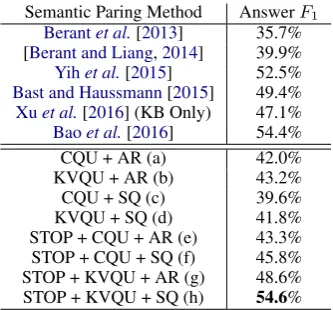
Table 1: The performance of different models on the test set of WebQuestions.
4.1 Settings
We use the WebQuestions dataset [Berant et al., 2013] as our main dataset, which contains 5,810 question-answer pairs. This dataset is built on Freebase [Bollacker et al., 2008] and all answers are Freebase entities. We use the same training, development and test split as [Berantet al.,2013], containing 3000, 778 and 2032 questions, respec-tively.
Our model is trained using the Adam optimizer [Kingma and Ba, 2014] with mini-batch size 60. The learning rate is set to 0.001. The complexity of model was penalized by adding L2 regulariza-tion to the cross entropy loss funcregulariza-tion. Gradients are clipped when their norm is bigger than 20. The hop size is set to 3. We initialize word embed-dings using pre-trained word representations from Turian et al. [2010] and the dimension of word embedding is set to 50.
We use the average question-wise F1 as our evaluation metric. We compare our model with representative IR based KB-QA models, and sev-eral state-of-the-art semantic parsing models. We also include different variants of our model for comparisons to shed light on the advantages of our proposed strategies, especially our three important building blocks - the STOP strategy, how to update a query, and how to obtain the answers.
CQU+AR: uses the Conventional Query
Updating method (CQU) which performs a lin-ear transformation over the sum of the query and value representations. This method adopts the AR approach to predict answers where the one with highest probability is selected as the answer.
KVQU+AR: applies the approach introduced in this paper that additionally considers both the Key and Value representations in the Query
Updating (KVQU). This method updates the query representation after reading the memory values at each hop of inference. Note that this model can be seen as a variant ofJain[2016], which is essen-tially an IR-based approach.
CQU+SQ: uses the CQU method to update the query representations, and applies the SQ ap-proach to obtain the answers.
KVQU+SQ:uses the KVQU method to update the query representations, and adopts the SQ ap-proach to obtain the answers.
STOP+CQU+AR: introduces the STOP key into the memory, but still uses the conventional query updating method and answer representa-tions to find the answers.
STOP+CQU+SQ: introduces the STOP key and uses the conventional query updating method, but uses the SQ approach to obtain the answers.
STOP+KVQU+AR: introduces the STOP key to the memory, uses the KVQU approach to up-date the query representations, and adopts the AR approach to retrieve the answers.
STOP+KVQU+SQ:is ourmain modelthat in-troduces the STOP key, applies the KVQU query updating method, and retrieves answers using the post-constructed structured queries.
4.2 Results and Discussion
Table 1 summarizes the performance of various methods on the test set of WebQuestions. We can see that our main model (STOP+KVQU+SQ) performs the best among all its variations, and sig-nificantly outperforms the state-of-the-art meth-ods on WebQuestions (with one-tailed t-test sig-nificance of p < 0.05). We can also see that even the conventional KV-MemNN model (i.e., model (a)) could still outperform traditional se-mantic parsing models [Berant et al., 2013; Be-rant and Liang, 2014], showing the effective-ness of memory networks in organizing and uti-lizing structured data. By replacing the CQU method with our proposed KVQU method, the KV-MemNN model (i.e., model (b)) could further gain an improvement of 1.2%, indicating a proper query representation updating method is critical to KV-MemNNs. After introducing the STOP strat-egy, the KV-MemNN model is capable to perform proper multi-hop reasoning over the memory, thus outperform most existing methods by a large mar-gin exceptBaoet al.[2016].
state-Question Addressed Key
who did armie hammer play in the social network
Armie Hammer fb:award nominations..award nominee
before Armie Hammer fb:award nominations..award nominee
Armie Hammer fb:award nominations..award nominee Armie Hammer fb:actor..character
after Social Network fb:film..character
STOP
who is the governor of India 2009
Indiana fb:governing officials..office holder
before Indiana fb:governing officials..office holder
Indiana fb:governing officials..office holder Indiana fb:governing officials..office holder
after Indiana fb:governing officials..from
STOP
what team did david beckham play for in 2011
David Beckham fb:loans..borrowing team
before David Beckham fb:player..team
David Beckham fb:player..team David Beckham fb:player..team
after
[image:7.595.80.517.58.258.2]STOP STOP
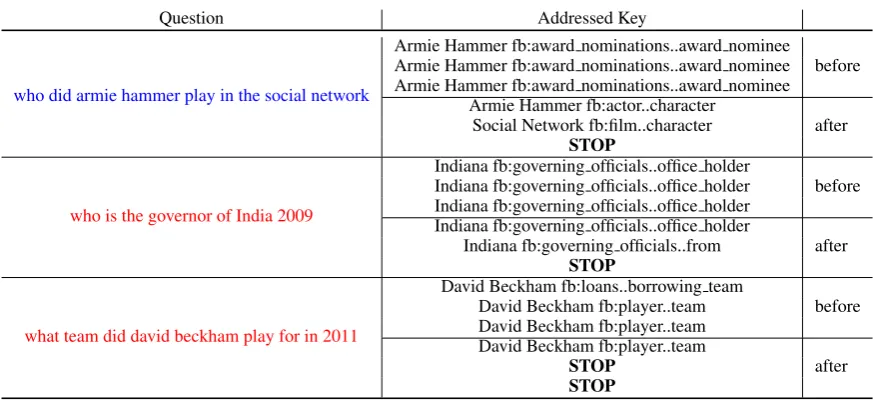
Table 2: Running examples of addressed keys and corresponding relevance probabilities before and after introduc-ing the STOP strategy. The question withbluecolor is correctly answered by introducing the STOP strategy while theredones are still not resolved (see discussion in Session4.8).
of-the-art performance on the WebQuestions by explicitly addressing the multi-constraint ques-tions. Specifically, Bao et al. [2016] designs a multi-constraint graph for such questions based on the Freebase schema, and introduces a set of predefined rules to solve complex representations such as max, min, top-X and so on. On the other hand, our model only requires the KB facts to be stored in a Key-Value memory, independent of certain KB schemas. Although those complex expressions in WebQuestions could be easily cov-ered by hand-crafted rules as many did, our model does not work upon such rules, and we think it is crucial to properly enhance KV-MemNNs with such more advanced reasoning abilities, which we leave for future work.
4.3 Impact of the STOP Key
As shown Table 1, we can see that when intro-ducing the STOP strategy, almost all models im-prove by around 4%, not only in the SQ setting (e.g., from (d) to (f)), but also in the AR setting (e.g., from (a) to (e)). This is not surprising, since the STOP key is introduced to help our model learn to determine when it should stop reading the memory to avoid repeated or invalid addressing. This apparently will lead to more accurate key ad-dressing at each hop, and produce more accurate structured queries. And, better key addressing can also help to generate better value representations at each hop, and finally better answer representa-tion at the last hop. Keep in mind that we obtain such improvement in the case that we do not have gold-standard annotations for the STOP key, but
with question-answer pairs only.
To better investigate how the STOP key works, we randomly select 200 questions from the test set and manually analyze the structured queries gen-erated by our model. We find that, for 184 ques-tions (92%) our model predicts the STOP key af-ter one hop of inference and continuously predicts STOP keys in later hops. For the remaining ques-tions, our model predicts two distinct keys before predicting the STOP key. Among these 184 ques-tions, 178 questions (96.7%) can be resolved us-ing exactly a one-triple query. For the remainus-ing 6 questions, it requires two distinct triples to find the answers. This indicates that our model can successfully utilize the STOP strategy to avoid re-peated or invalid reading over the memory, at least, for simple questions.
4.4 Query Updating
In KV-MemNNs, it is important to properly up-date the query representation after each hop, since the updated query will be used to address more fo-cused information in the next hop, which is espe-cially crucial to support multi-hop reasoning over the memory. We experimented with two query updating approaches, the traditional adding-based method, CQU, and our proposed KVQU, which additionally considers the addressed key represen-tations in previous hops to update the query rep-resentation. From Table 1, we can see that no matter which techniques are used to retrieve the final answers, our model can always benefit from replacing the CQU with our KVQU. The main reason may be that KVQU learns to mask al-ready addressed information and retain those un-touched, which leads to more accurate key ad-dressing and more expressive answer representa-tions. But, we also observe that by switching from AR to SQ, STOP+KVQU+SQ achieves more improvement than STOP+CQU+SQ. One possible reason is that the KVQU method, together with the STOP strategy, can help address the most relevant keys (i.e., top#1 key) more accurately than CQU does at each hop, which results in more accurate structured queries.
We randomly select 50 multi-constraint ques-tions from the test set of WebQuesques-tions and an-alyze the addressed keys at each hop. We find that for 48 questions, the model with CQU (model (f)) repeatedly selects the same keys that have the highest relevance probabilities at the first two hops. However, when replacing CQU with KVQU, the model addresses different keys at the first two hops (examples shown in Table2). One possible reason is that, in contrast to the CQU that only uses the value representation of current hop to update the query, KVQU additionally considers the addressed keys in the current hop, and aims to mask the already addressed information, so that in later hops, the model will focus on the remaining untouched part of the question.
4.5 Candidate Ranking v.s. Structured Query
We investigate two different answer retrieval methods, the IR styled method AR and the se-mantic parsing styled method SQ, in the experi-ments. By comparing CQU+AR (a) and CQU+SQ (c) in Table1, we can see that replacing the answer
Hop Size STOP + KVQU + SQ STOP + KVQU + AR
1 38.7% 35.6%
2 45.9% 41.2%
3 53.2% 50.4%
4 53.1% 46.7%
5 53.0% 44.2%
Table 3: Performance (answer F1) of
STOP+KVQU+SQ and STOP+KVQU+AR with different hop sizes on the development set of WebQuestions.
retrieval method does not boost the performance, but actually hurts. This is not surprising, because with the vanilla CQU, the model does not know how to stop reading the memory, thus may se-lect repeated/invalid keys after the first hop, which will produce incorrect structured queries. Simi-larly, the KVQU+SQ also suffers from the incor-rect structured queries.
After introduce the STOP key into the mem-ory, we find that no matter which query updat-ing methods are used, the models usupdat-ing struc-tured queries (STOP+*+SQ) significantly outper-form their corresponding versions using the rank-ing based method (STOP+*+AR). Despite of the STOP strategy, the improvement may come from two aspects. First, the structured queries in SQ are built from the best key at every hop, thus have cap-tured more global information throughout the rea-soning procedure, while the AR method only uses theoin the last hop to retrieve answers. Secondly, the models with SQ can easily output multiple qualified answers from the KB, while the meth-ods with AR can only output the top one from a ranked list in the memory. Moreover, from a prac-tical perspective, the SQ methods provide more in-terpretability than the ranking based methods.
4.6 Impact of the Hop Size
signifi-cantly, but almost remains unchanged. We think the reason may be that the model with the AR method keeps predicting the keys as the hop size increasing, which inevitably introduces noise to the answer representations. On the other hand, the model with the SQ method is less sensitive to the hop size, since once it sees the STOP key, the lat-ter predictions do not affect the resulted structured query.
4.7 Results on QALD-4
To further examine our model under different con-ditions, besides WebQuestions, we also evaluate our main model on the QALD-4 dataset [Unger
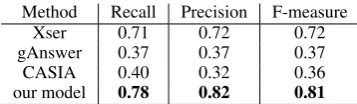
et al.], which is built upon another KB, DBpe-dia [Auer et al., 2007]. Like Freebase, DBpe-dia stores real world facts in the triple format, making it easier for our model to adapt to this new KB. The QALD-4 dataset consists of three QA datasets, namely, Multilingual QA, Biomed-ical QA and Hybrid QA. Here we evaluate our model on the multilingual QA dataset which con-tains 250 English question-SPARQL pairs, where 200 questions (80%) are used for training and 50 questions for testing. These questions are more complicated than those of WebQuestions, e.g., all QALD-4 questions require at least two hops of in-ference over the KB to answer. Table 4lists the results of our model and other participated sys-tems [Unger et al.]. We can see that our model can achieve the best performance on this dataset, without importing extra rules.
4.8 Error Analysis
We analyze the errors of our main model on the development set of WebQuestions. Around 80% errors are caused by incorrect key addressing. The key addressing errors are mainly due to (1) the en-tities in the addressed keys are incorrect. Entity linking itself is a challenging task and we do not employ any existing entity linking tools to incor-porate the linking confidence score, which may further improve our model; (2) the relations in the addressed keys are incorrect, which is mainly caused by insufficient context in the question. For example, in what is duncan bannatyne, the in-formation from the question is quite limited for our model to predict the correct keyfb:profession. Although the STOP strategy proves to be effec-tive on most questions, there are still some ques-tions where the STOP strategy does not work, e.g., what team did david beckham play for in 2011
Method Recall Precision F-measure
Xser 0.71 0.72 0.72
gAnswer 0.37 0.37 0.37
CASIA 0.40 0.32 0.36
[image:9.595.326.505.61.113.2]our model 0.78 0.82 0.81
Table 4: Results of the models on the test set of QALD.
shown in Table 2. We failed to perform reason-ing over the time constraint 2011due to limited context left for 2011after we addressedplay for in earlier hops. Also due to this same reason, our model can not correctly answer the second ques-tion in Table2,who is the governor of India 2009. Keep in mind that, we actually do not have an-notated addressed keys at each hop to explicitly teach our model. The remaining cases also in-clude failures in deep analysis according to spe-cific KBs. For example, in who is the mother of prince michael jackson, our model only matches the triple michael jackson fb:parents, but fail to spotfemalein the next hop.
5 Conclusions
In this paper, we propose to apply the KV-MemNNs as a semantic parsing module to ap-proach the open-domain KB-QA task. We in-troduce a novel STOP strategy to derive struc-tured queries with flexible number of query triples during multi-hop memory reading, and present a new query updating method, which considers the already-addressed keys in previous hops as well as the value representations. Experimental re-sults show that the STOP strategy not only enables multi-hop reasoning over the memory, but also acts as the key to construct the structured queries, which help our model achieve the state-of-the-art performances on two benchmark datasets.
Acknowledgement
References
S¨oren Auer, Christian Bizer, Georgi Kobilarov, Jens Lehmann, Richard Cyganiak, and Zachary G. Ives. Dbpedia: A nucleus for a web of open data. In ISWC/ASWC, 2007.
Jun-Wei Bao, Nan Duan, Zhao Yan, Ming Zhou, and Tiejun Zhao. Constraint-based question answering with knowledge graph. InProceedings of the Inter-national Conference on Computational Linguistics (COLING 2016), pages 2503–2514, 2016.
Hannah Bast and Elmar Haussmann. More accurate question answering on freebase. InCIKM, 2015.
Jonathan Berant and Percy Liang. Semantic parsing via paraphrasing. In Proceedings of the 52nd An-nual Meeting of the Association for Computational Linguistics, ACL 2014, June 22-27, 2014, Baltimore, MD, USA, Volume 1: Long Papers, 2014.
Jonathan Berant, Andrew Chou, Roy Frostig, and Percy Liang. Semantic parsing on freebase from question-answer pairs. In Proceedings of the 2013 Confer-ence on Empirical Methods in Natural Language Processing (EMNLP 2013), 2013.
Kurt D. Bollacker, Colin Evans, Praveen Paritosh, Tim Sturge, and Jamie Taylor. Freebase: a collabora-tively created graph database for structuring human knowledge. InSIGMOD, 2008.
Antoine Bordes, Nicolas Usunier, Sumit Chopra, and Jason Weston. Large-scale simple question answer-ing with memory networks. CoRR, abs/1506.02075, 2015.
Li Dong, Furu Wei, Ming Zhou, and Ke Xu. Question answering over freebase with multi-column convo-lutional neural networks. In Proceedings of the 53rd Annual Meeting of the Association for Compu-tational Linguistics and the 7th International Joint Conference on Natural Language Processing (Vol-ume 1: Long Papers), 2015.
Sarthak Jain. Question answering over knowledge base using factual memory networks. In Proceed-ings of the Student Research Workshop, SRW@HLT-NAACL 2016, The 2016 Conference of the North American Chapter of the Association for Computa-tional Linguistics: Human Language Technologies, San Diego California, USA, June 12-17, 2016, pages 109–115, 2016.
Diederik Kingma and Jimmy Ba. Adam: A method for stochastic optimization. arXiv preprint arXiv:1412.6980, 2014.
Tom Kwiatkowski, Eunsol Choi, Yoav Artzi, and Luke S. Zettlemoyer. Scaling semantic parsers with on-the-fly ontology matching. InProceedings of the 2013 Conference on Empirical Methods in Natural Language Processing (EMNLP 2013), 2013.
Yuxuan Lai, Yansong Feng, Xiaohan Yu, Zheng Wang, Kun Xu, and Dongyan Zhao. Lattice cnns for matching based chinese question answering. Pro-ceedings of the 33rd AAAI Conference on Artificial Intelligence (AAAI 2019), 2019.
Alexander Miller, Adam Fisch, Jesse Dodge, Amir-Hossein Karimi, Antoine Bordes, and Jason We-ston. Key-value memory networks for directly read-ing documents. arXiv preprint arXiv:1606.03126, 2016.
Siva Reddy, Mirella Lapata, and Mark Steedman. Large-scale semantic parsing without question-answer pairs. Transactions of the Association of Computational Linguistics, pages 377–392, 2014.
Yelong Shen, Po-Sen Huang, Jianfeng Gao, and Weizhu Chen. Reasonet: Learning to stop reading in machine comprehension. InProceedings of the 23rd ACM SIGKDD International Conference on Knowl-edge Discovery and Data Mining, pages 1047–1055. ACM, 2017.
Sainbayar Sukhbaatar, Arthur Szlam, Jason Weston, and Rob Fergus. End-to-end memory networks. In NIPS, 2015.
Sainbayar Sukhbaatar, Jason Weston, Rob Fergus, et al. End-to-end memory networks. InAdvances in neu-ral information processing systems, pages 2440– 2448, 2015.
Makarand Tapaswi, Yukun Zhu, Rainer Stiefelhagen, Antonio Torralba, Raquel Urtasun, and Sanja Fidler. Movieqa: Understanding stories in movies through question-answering. In IEEE Conference on Com-puter Vision and Pattern Recognition (CVPR), 2016.
Joseph P. Turian, Lev-Arie Ratinov, and Yoshua Ben-gio. Word representations: A simple and general method for semi-supervised learning. In Proceed-ings of the 48th Annual Meeting of the Association for Computational Linguistics (ACL 2010), pages 384–394, 2010.
Christina Unger, Corina Forascu, Vanessa L´opez, Axel-Cyrille Ngonga Ngomo, Elena Cabrio, Philipp Cimiano, and Sebastian Walter. Question answering over linked data (QALD-4). InWorking Notes for CLEF 2014 Conference, Sheffield, UK, September 15-18, 2014.
Jason Weston, Sumit Chopra, and Antoine Bordes. Memory networks. arXiv preprint arXiv:1410.3916, 2014.
Xuchen Yao and Benjamin Van Durme. Information extraction over structured data: Question answering with freebase. In Proceedings of the 52nd Annual Meeting of the Association for Computational Lin-guistics, ACL 2014, June 22-27, 2014, Baltimore, MD, USA, Volume 1: Long Papers, 2014.
Xuchen Yao. Lean question answering over freebase from scratch. In Proceedings of the 2015 Confer-ence of the North American Chapter of the Associ-ation for ComputAssoci-ational Linguistics: Human Lan-guage Technologies (NAACL 2015), 2015.