Answer Sequence Learning with Neural Networks for Answer Selection in
Community Question Answering
Xiaoqiang Zhou Baotian Hu Qingcai Chen∗ Buzhou Tang Xiaolong Wang
Intelligent Computing Research Center
Harbin Institute of Technology, Shenzhen Graduate School
{xiaoqiang.jeseph,baotianchina,qingcai.chen,tangbuzhou}@gmail.com [email protected]
Abstract
In this paper, the answer selection problem in community question answering (CQA) is regarded as an answer sequence label-ing task, and a novel approach is proposed based on the recurrent architecture for this problem. Our approach applies convo-lution neural networks (CNNs) to learn-ing the joint representation of question-answer pair firstly, and then uses the joint representation as input of the long short-term memory (LSTM) to learn the answer sequence of a question for labeling the matching quality of each answer. Experi-ments conducted on the SemEval 2015 C-QA dataset shows the effectiveness of our approach.
1 Introduction
Answer selection in community question answer-ing (CQA), which recognizes high-quality re-sponses to obtain useful question-answer pairs, is greatly valuable for knowledge base construc-tion and informaconstruc-tion retrieval systems. To rec-ognize matching answers for a question, typi-cal approaches model semantic matching between question and answer by exploring various fea-tures (Wang et al., 2009a; Shah and Pomerantz, 2010). Some studies exploit syntactic tree struc-tures (Wang et al., 2009b; Moschitti et al., 2007) to measure the semantic matching between question and answer. However, these approaches require high-quality data and various external resources which may be quite difficult to obtain. To take advantage of a large quantity of raw data, deep learning based approaches (Wang et al., 2010; Hu et al., 2013) are proposed to learn the distribut-ed representation of question-answer pair directly. One disadvantage of these approaches lies in that
∗
* Corresponding author
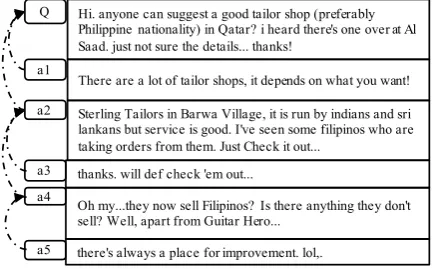
Hi. anyone can suggest a good tailor shop (preferably Philippine nationality) in Qatar? i heard there's one over at Al Saad. just not sure the details... thanks!
There are a lot of tailor shops, it depends on what you want!
Sterling Tailors in Barwa Village, it is run by indians and sri lankans but service is good. I've seen some filipinos who are taking orders from them. Just Check it out...
thanks. will def check 'em out...
Oh my...they now sell Filipinos? Is there anything they don't sell? Well, apart from Guitar Hero...
there's always a place for improvement. lol,. Q
a1
a2
a3 a4
[image:1.595.307.527.211.347.2]a5
Figure 1: An Example of the Answer Sequence for a Question. The dashed arrows depict the relation-ships of the answers in the sequence.
semantic correlations embedded in the answer se-quence of a question are ignored, while they are very important for answer selection. Figure 1 is a example to show the relationship of answers in the sequence for a given question. Intuitively, other answers of the question are beneficial to judge the quality of the current answer.
Recently, recurrent neural network (RNN), especially Long Short-Term Memory (LST-M) (Hochreiter et al., 2001), has been proved su-periority in various tasks (Sutskever et al., 2014; Srivastava et al., 2015) and it models long term and short term information of the sequence. And also, there are some works on using convolution-al neurconvolution-al networks (CNNs) to learn the represen-tations of sentence or short text, which achieve state-of-the-art performance on sentiment classi-fication (Kim, 2014) and short text matching (Hu et al., 2014).
In this paper, we address the answer selection problem as a sequence labeling task, which iden-tifies the matching quality of each answer in the answer sequence of a question. Firstly, CNNs are used to learn the joint representation of question answer (QA) pair. Then the learnt joint
sentations are used as inputs of LSTM to predic-t predic-the qualipredic-ty (e.g., Good, Bad and Potential) of each answer in the answer sequence. Experiments conducted on the CQA dataset of the answer se-lection task in SemEval-20151 show that the pro-posed approach outperforms other state-of-the-art approaches.
2 Related Work
Prior studies on answer selection generally treat-ed this challenge as a classification problem via employing machine learning methods, which re-ly on exploring various features to represent QA pair. Huang et al. (2007) integrated textual fea-tures with structural feafea-tures of forum threads to represent the candidate QA pairs, and used sup-port vector machine (SVM) to classify the can-didate pairs. Beyond typical features, Shah and Pomerantz (2010) trained a logistic regression (L-R) classifier with user metadata to predict the qual-ity of answers in CQA. Ding et al. (2008) pro-posed an approach based on conditional random fields (CRF), which can capture contextual fea-tures from the answer sequence for the semantic matching between question and answer. Addition-ally, the translation-based language model was al-so used for QA matching by transferring the an-swer to the corresponding question (Jeon et al., 2005; Xue et al., 2008; Zhou et al., 2011). The translation-based methods suffer from the infor-mal words or phrases in Q&A archives, and per-form less applicability in new domains.
In contrast to symbolic representation, Wang et al. (2010) proposed a deep belief nets (DBN) based semantic relevance model to learn the dis-tributed representation of QA pair. Recently, the convolutional neural networks (CNNs) based sen-tence representation models have achieved suc-cesses in neural language processing (NLP) tasks. Yu et al. (2014) proposed a convolutional sentence model to identify answer contents of a question from Q&A archives via means of distributed rep-resentations. The work in Hu et al. (2014) demon-strated that 2-dimensional convolutional sentence models can represent the hierarchical structures of sentences and capture rich matching patterns be-tween two language objects.
1http://alt.qcri.org/semeval2015/task3/
question answer-sequence
LSTM
[image:2.595.311.532.64.176.2]CNNs
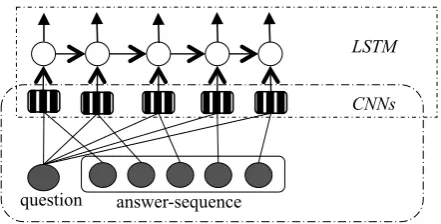
Figure 2: The architecture of R-CNN
3 Approach
We consider the answer selection problem in CQA as a sequence labeling task. To label the matching quality of each answer for a given question, our approach models the semantic links between suc-cessive answers, as well as the semantic relevance between question and answer. Figure 2 summa-rizes the recurrent architecture of our model (R-CNN). The motivation of R-CNN is to learn the useful context to improve the performance of an-swer selection. The anan-swer sequence is modeled to enrich semantic features.
At each step, our approach uses the pre-trained word embeddings to encode the sentences of QA pair, which then is used as the input vectors of the model. Based on the joint representation of QA pair learned from CNNs, the LSTM is applied in our model for answer sequence learning, which makes a prediction to each answer of the question with softmax function.
3.1 Convolutional Neural Networks for QA Joint Learning
Given a question-answer pair at the stept, we use convolutional neural networks (CNNs) to learn the joint representationptfor the pair. Figure 3
illus-trates the process of QA joint learning, which in-cludes two stages: summarizing the meaning of the question and an answer, and generating the joint representation of QA pair.
To obtain high-level sentence representations of the question and answer, we set 3 hidden layers in two convolutional sentence models respective-ly. The output of each hidden layer is made up of a set of 2-dimensional arrays called feature map pa-rameters (wm, bm). Each feature map is the
Encoding conv&pooling
…
…
Joint Representation
answer question
"
↓$
Figure 3: CNNs for QA joint learning
Eq. 1:
Hm =σ(pool(wmHm−1+bm)) (1)
Here, H0 is one real-value matrix after sentence semantic encoding by concatenating the word vec-tors with sliding windows. It is the input of deep convolution and pooling, which is similar to that of traditional image input.
Finally, we combine the two sentence models by adding an additional layerHton the top. The
learned joint representationptfor QA pair is
for-malized as Eq. 2:
pt=σ(wtHt+bt) (2)
where σ is an activation function, and the input vector is constructed by concatenating the sen-tence representations of question and answer.
3.2 LSTM for Answer Sequence Learning
Based on the joint representation of QA pair, the LSTM unit of our model performs answer se-quence learning to model semantic links between continuous answers. Unlike the traditional recur-rent unit, the LSTM unit modulates the memory at each time step, instead of overwriting the states. The key component of LSTM unit is the memo-ry cell ctwhich has a state over time, and the
L-STM unit decides to modify and add the memory in the cell via the sigmoidal gates: input gateit,
forget gateftand output gateot. The
implemen-tation of the LSTM unit in our study is close the one discussed by Graves (2013). Given the joint representationpt at time t, the memory cellctis
updated by the input gate’s activation it and the
forget gate’s activationft. The updating equation
is given by Eq. 3:
ct=ftct−1+ittanh(Wxcpt+Whcht−1+bc) (3)
Data #question #answer length
training 2600 16541 6.36
development 300 1645 5.48
test 329 1976 6.00
[image:3.595.312.523.62.133.2]all 3229 21062 6.00
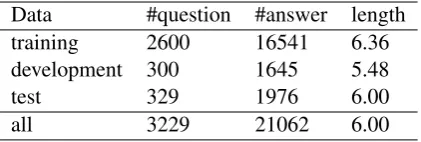
Table 1: Statistics of experimental dataset
The LSTM unit keeps to update the context by discarding the useless context in forget gateftand
adding new content from input gate it. The
ex-tents to modulate context for these two gates are computed as Eq. 4 and Eq. 5:
it=σ(Wxipt+Whih(t−1)+Wcict−1+bi) (4)
ft=σ(Wxfpt+Whfht−1+Wcfct−1+bf) (5)
With the updated cell state ct, the final output
from LSTM unithtis computed as Eq 6 and Eq 7:
ot=σ(Wxopt+Whoht−1+Wcoct+bo) (6)
ht=ottanh(ct) (7)
Note that (W∗, b∗) is the parameters of LSTM
unit, in which Wcf, Wci , and Wco are diagonal
matrices.
According to the output ht at each time step,
our approach estimates the conditional probability of the answer sequence over answer classes, it is given by Eq. 8:
P(y1, ..., yT|c, p1, ..., pt−1) =
T
Y
t=1
p(yt|c, y1, ..., yt−1) (8)
Here, (y1, ..., yT) is the corresponding label
se-quence for the input sese-quence(p1, ..., pt−1), and the class distributionp(yt|c, y1, ..., .yt−1)is repre-sented by a softmax function.
4 Experiments
4.1 Experiment Setup
and contains 3,229 questions with 21,062 answer-s. The answers falls into three classes:Good,Bad, andPotential, accounting for 51%, 39%, and 10% respectively. The statistics of the dataset are sum-marized in Table 1, where #question/answer de-notes the number of questions/answers, and length stands for the average number of answers for a question.
Competitor Methods:We compare our approach against the following competitor methods:
SVM (Huang et al., 2007): An SVM-based method with bag-of-words (textual features), non-textual features, and features based on topic model (i.e., latent Dirichlet allocation, LDA).
CRF (Ding et al., 2008): A CRF-based method using the same features as the SVM approach.
DBN (Wang et al., 2010): Taking bag-of-words representation, the method applies deep belief net-s to learning the dinet-stributed reprenet-sentation of QA pair, and predicts the class of answers using a lo-gistic regression classifier on the top layer.
mDBN (Hu et al., 2013): In contrast to DBN, multimodal DBN learns the joint representations of textual features and non-textual features rather than bag-of-words.
CNN: Using word embedding, the CNNs based model in Hu et al. (2014) is used to learn the rep-resentations of questions and answers, and a logis-tic regression classifier is used to predict the class of answers.
Evaluation Metrics: The evaluation metric-s include Macro − precision(P), Macro − recall(R), Macro−F1(F1), and F1 scores of the individual classes. According to the evalua-tion results on the development set, all the hyper-parameters are optimized on the training set.
Model Architecture and Training Details: The CNNs of our model for QA joint representation learning have 3 hidden layers for modeling ques-tion and answer sentence respectively, in which each layer has 100 feature maps for convolution and pooling operators. The window sizes of con-volution for each layer are[1×1,2×2,2×2], the window sizes of pooling are[2×2,2×2,1×1]. For the LSTM unit, the size of input gate is set to 200, the sizes of forget gate, output gate, and
memory cellare all set to 360.
Stochastic gradient descent (SGD) algorithm vi-a bvi-ack-propvi-agvi-ation through time is used to trvi-ain the model. To prevent serious overfitting, early stopping and dropout (Hinton et al., 2012) are used
Methods P R F1
[image:4.595.335.499.62.160.2]SVM 50.10 54.43 52.14 CRF 53.89 54.26 53.40 DBN 55.22 53.80 54.07 mDBN 56.11 53.95 54.29 CNN 55.33 54.73 54.42 R-CNN 56.41 56.16 56.14
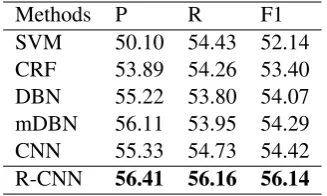
Table 2: Macro-averaged results(%)
during the training procedure. The learning rate λis initialized to be 0.01 and is updated dynam-ically according to the gradient descent using the ADADELTA method (Zeiler, 2012). The activa-tion funcactiva-tions (σ, γ) in our model adopt the rec-tified linear unit (ReLU) (Dahl et al., 2013). In addition, the word embeddings for encoding sen-tences are pre-trained with the unsupervised neu-ral language model (Mikolov et al., 2013) on the Qatar Living data2.
4.2 Results and Analysis
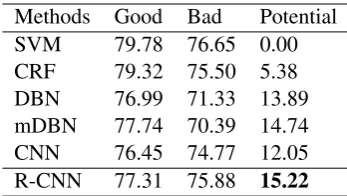
Table 2 summarizes the Macro-averaged results. The F1 scores of the individual classes are present-ed in Table 3.
It is clear to see that the proposed R-CNN ap-proach outperforms the competitor methods over the Macro-averaged metrics as expected from Ta-ble 2. The main reason lies in that R-CNN takes advantages of the semantic correlations between successive answers by LSTM, in addition to the semantic relationships between question and an-swer. The joint representation of QA pair learnt by CNNs also captures richer matching patterns between question and answer than other methods. It is notable that the methods based on deep learning perform more powerful than SVM and CRF, especially for complicate answers (e.g., Po-tentialanswers). In contrast, SVM and CRF using a large amount of features perform better for the answers that have obvious tendency (e.g., Good
and Bad answers). The main reason is that the distributed representation learnt from deep learn-ing architecture is able to capture the semantic re-lationships between question and answer. On the other hand, the feature-engineers in both SVM and CRF suffer from noisy information of CQA and the feature sparse problem for short questions and answers.
Methods Good Bad Potential SVM 79.78 76.65 0.00 CRF 79.32 75.50 5.38 DBN 76.99 71.33 13.89 mDBN 77.74 70.39 14.74 CNN 76.45 74.77 12.05 R-CNN 77.31 75.88 15.22
Table 3: F1 scores for the individual classes(%)
Compared to DBN and mDBN, CNN and R-CNN show their superiority in modeling QA pair. The convolutional sentence models, used in CN-N and R-CCN-NCN-N, can learn the hierarchical struc-ture of language object by deep convolution and pooling operators. In addition, both R-CNN and CNN encode the sentence into one tensor, which makes sure the representation contains more se-mantic features than the bag-of-words representa-tion in DBN and mDBN.
The improvement achieved by R-CNN over C-NN demonstrates that answer sequence learning is able to improve the performance of the answer lection in CQA. Because modeling the answer se-quence can enjoy the advantage of the shared rep-resentation between successive answers, and com-plement the classification features with the learn-t useful conlearn-texlearn-t from previous answers. Furlearn-ther- Further-more, memory cell and gates in LSTM unit modify the valuable context to pass onwards by updating the state of RNN during the learning procedure.
The main improvement of R-CNN against with the competitor methods comes from thePotential
answers, which are much less than other two type of answers. It demonstrates that R-CNN is able to process the unbalance data. In fact, thePotential
answers are most difficult to identify among the three types of answers asPotentialis an intermedi-ate cintermedi-ategory (M`arquez et al., 2015). Nevertheless, R-CNN achieves the highest F1 score of 15.22% on Potential answers. In CQA, Q&A archives usu-ally form one multi-parties conversation when the asker gives feedbacks (e.g., “ok” and “please”) to users responses, indicating that the answers of one question are sematic related. Thus, it is easy to un-derstand that R-CNN performs better performance than competitor methods, especially on the recal-l. The reason is that R-CNN can model semantic correlations between successive answers to learn the context and the long range dependencies in the answer sequence.
5 Conclusions and Future Work
In this paper, we propose an answer sequence learning model R-CNN for the answer selection task by integrating LSTM unit and CNNs. Based on the recurrent architecture of our model, our ap-proach is able to model the semantic link between successive answers, in addition to the semantic rel-evance between question and answer. Experimen-tal results demonstrate that our approach can learn the useful context from the answer sequence to im-prove the performance of answer selection in C-QA.
In the future, we plan to explore the method-s on training the unbalance data to improve the overall performances of our approach. Based on this work, more research can be conducted on topic recognition and semantic roles labeling for human-human conversations in real-world.
Acknowledgments: This work was support-ed in part by National 863 Program of China (2015AA015405), NSFCs (National Natural Sci-ence Foundation of China) (61402128, 61473101, 61173075 and 61272383). We thank the anony-mous reviewers for their insightful comments.
References
George E. Dahl, Tara N. Sainath, and Geoffrey E. Hin-ton. 2013. Improving deep neural networks for lvc-sr using rectified linear units and dropout. In ICAS-SP, pages 8609–8613. IEEE.
Shilin Ding, Gao Cong, Chin yew Lin, and Xiaoyan Zhu. 2008. Using conditional random fields to ex-tract contexts and answers of questions from online forums. InIn Proceedings of ACL-08: HLT.
Alex Graves. 2013. Generating sequences with recur-rent neural networks. CoRR, abs/1308.0850.
Geoffrey E. Hinton, Nitish Srivastava, Alex Krizhevsky, Ilya Sutskever, and Ruslan Salakhut-dinov. 2012. Improving neural networks by preventing co-adaptation of feature detectors. CoRR, abs/1207.0580.
Sepp Hochreiter, Yoshua Bengio, Paolo Frasconi, and J¨urgen Schmidhuber. 2001. Gradient flow in recur-rent nets: the difficulty of learning long-term depen-dencies.
Baotian Hu, Zhengdong Lu, Hang Li, and Qingcai Chen. 2014. Convolutional neural network archi-tectures for matching natural language sentences. In Advances in Neural Information Processing Systems 27, pages 2042–2050.
Jizhou Huang, Ming Zhou, and Dan Yang. 2007. Ex-tracting chatbot knowledge from online discussion forums. In Proceedings of the 20th International Joint Conference on Artifical Intelligence, IJCAI’07, pages 423–428.
Jiwoon Jeon, W. Bruce Croft, and Joon Ho Lee. 2005. Finding similar questions in large question and an-swer archives. InProceedings of the 14th ACM In-ternational Conference on Information and Knowl-edge Management, CIKM ’05, pages 84–90. Yoon Kim. 2014. Convolutional neural networks for
sentence classification. CoRR, abs/1408.5882. Llu´ıs M`arquez, James Glass, Walid Magdy,
Alessan-dro Moschitti, Preslav Nakov, and Bilal Randeree. 2015. Semeval-2015 task 3: Answer selection in community question answering. In Proceedings of the 9th International Workshop on Semantic Evalu-ation (SemEval-2015).
Tomas Mikolov, Kai Chen, Greg Corrado, and Jeffrey Dean. 2013. Efficient estimation of word represen-tations in vector space.CoRR, abs/1301.3781. Alessandro Moschitti, Silvia Quarteroni, Roberto
Basili, and Suresh Manandhar. 2007. Exploiting syntactic and shallow semantic kernels for question answer classification. In Proceedings of the 45th Annual Meeting of the Association of Computational Linguistics, pages 776–783.
Chirag Shah and Jefferey Pomerantz. 2010. Evaluat-ing and predictEvaluat-ing answer quality in community qa. In Proceedings of the 33rd International ACM SI-GIR Conference on Research and Development in Information Retrieval, SIGIR ’10, pages 411–418. Nitish Srivastava, Elman Mansimov, and Ruslan
Salakhutdinov. 2015. Unsupervised learning of video representations using lstms. CoRR, ab-s/1502.04681.
Ilya Sutskever, Oriol Vinyals, and Quoc V. Le. 2014. Sequence to sequence learning with neural network-s.CoRR, abs/1409.3215.
Baoxun Wang, Bingquan Liu, Chengjie Sun, Xiaolong Wang, and Lin Sun. 2009a. Extracting chinese question-answer pairs from online forums. InIEEE International Conference on Systems, Man, and Cy-bernetics (SMC), pages 1159–1164.
Kai Wang, Zhaoyan Ming, and Tat-Seng Chua. 2009b. A syntactic tree matching approach to finding sim-ilar questions in community-based qa services. In Proceedings of the 32Nd International ACM SIGIR Conference on Research and Development in Infor-mation Retrieval, SIGIR ’09, pages 187–194.
Baoxun Wang, Xiaolong Wang, Chengjie Sun, Bingquan Liu, and Lin Sun. 2010. Modeling se-mantic relevance for question-answer pairs in web social communities. InProceedings of the 48th An-nual Meeting of the Association for Computational Linguistics, ACL ’10, pages 1230–1238.
Xiaobing Xue, Jiwoon Jeon, and W. Bruce Croft. 2008. Retrieval models for question and answer archives. In Proceedings of the 31st Annual International ACM SIGIR Conference on Research and Devel-opment in Information Retrieval, SIGIR ’08, pages 475–482.
Lei Yu, Karl Moritz Hermann, Phil Blunsom, and Stephen Pulman. 2014. Deep learning for answer sentence selection. CoRR, abs/1412.1632.
Matthew D. Zeiler. 2012. ADADELTA: an adaptive learning rate method. CoRR, abs/1212.5701. Guangyou Zhou, Li Cai, Jun Zhao, and Kang Liu.