3718
Decay-Function-Free Time-Aware Attention to Context and Speaker
Indicator for Spoken Language Understanding
Jonggu Kim
Computer Science and Engineering, Pohang University of Science and
Technology (POSTECH) Pohang, Republic of Korea [email protected]
Jong-Hyeok Lee
Computer Science and Engineering, Pohang University of Science and
Technology (POSTECH) Pohang, Republic of Korea [email protected]
Abstract
To capture salient contextual information for spoken language understanding (SLU) of a di-alogue, we propose time-aware models that automatically learn the latent time-decay func-tion of the history without a manual time-decay function. We also propose a method to identify and label the current speaker to im-prove the SLU accuracy. In experiments on the benchmark dataset used in Dialog State Tracking Challenge 4, the proposed models achieved significantly higher F1 scores than the state-of-the-art contextual models. Finally, we analyze the effectiveness of the introduced models in detail. The analysis demonstrates that the proposed methods were effective to improve SLU accuracy individually.
1 Introduction
Spoken language understanding (SLU) is a com-ponent that understands the user’s utterance of a dialogue system. Given an utterance, SLU gen-erates a structured meaning representation of the utterance; i.e., a semantic frame. SLU can be de-composed into several subtasks such as domain identification, intent prediction and slot filling; these subtasks can be jointly assigned using a single model (Hakkani-T¨ur et al., 2016;Liu and Lane,2016;Chen et al.,2016b). The accuracy of SLU is important for the dialogue system to gen-erate an appropriate response to a user.
To improve the accuracy of SLU, much work has used contextual information of dialogues to al-leviate the ambiguity of recognition of the given utterance. In SLU, selecting important history in-formation is crucial, and it directly influences the improvement of SLU accuracy. To summarize this history, content-aware models (Chen et al.,2016a; Kim et al., 2017) similar to attention models in machine translation (Bahdanau et al., 2014) have
been proposed. However, content-aware models are likely to select the wrong history when the histories are similar in content. To alleviate this problem, time-aware models (Chen et al., 2017; Su et al., 2018a,b) which pay attention to recent previous utterances by using the temporal distance between a previous utterance and a current utter-ance are being considered; the models are based on mathematical formulas, time-decay functions, which are formulated by human, and decomposed into trainable parameters.
However, the previous time-aware models may not be sufficiently accurate. In the models, ei-ther a single time-decay function is used or a lim-ited number of time-decay functions are linearly combined; these manual functions may not be suf-ficiently flexible to learn an optimal time-decay function.
In this paper, we propose flexible and effective time-aware attention models to improve SLU ac-curacy. The proposed models do not need any manual decay function, but learn a time-decay tendency directly by introducing a trainable distance vector, and therefore have good SLU ac-curacy. The proposed models do not use long short-term memory (LSTM) to summarize his-tories, and therefore use fewer parameters than previous time-aware models. We also propose current-speaker modeling by using a speaker in-dicator that identifies the current speaker.
To the best of our knowledge, this is the first method that shows improvement by considering the identity of the current speaker. This informa-tion may be helpful for modeling multi-party con-versations in addition to human-human conversa-tions.
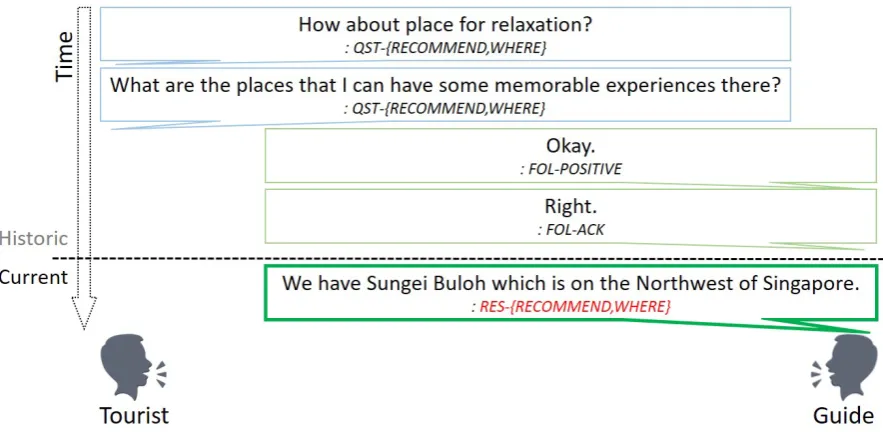
rele-Figure 1: An example of utterances with their semantic labels (speech acts combined with associated attributes) from DSTC 4. The semantic labels are italicized.
vant utterance to the current utterance; the most relevant utterance is “What are the places that I can have some memorable experiences there?”. If we do not know the current speaker isGuide, we cannot easily assess the relative importance of the nearest histories of the two speakers. We believe that the proposed ‘speaker indicator’ can help our model to identify such information.
In experiments on the Dialog State Tracking Challenge 4 (DSTC 4) dataset, the proposed mod-els achieved significantly higher accuracy than the state-of-the-art contextual models for SLU. Also, we examine how the proposed methods affect the SLU accuracy in detail. This result shows that the proposed methods were effective to improve SLU accuracy individually. Our contributions are as follows:
• We propose a decay-function-free time-aware attention model that automatically learn the latent time-decay function of the history without a manual time-decay func-tion. The proposed model achieves a new state-of-the-art F1 score.
• We propose a current-speaker modeling method that uses a speaker indicator to iden-tify the current speaker. We present how to incorporate speaker indicator in the proposed attention model for further improvement of SLU accuracy.
• We propose a model that is aware of content
as well as time, which also achieved a higher F1 score than the state-of-the-art contextual models.
• We analyze the effectiveness of proposed methods in detail.
Our source code to reproduce the experimental results is available at https://github.com/jgkimi/
Decay-Function-Free-Time-Aware.
2 Related Work
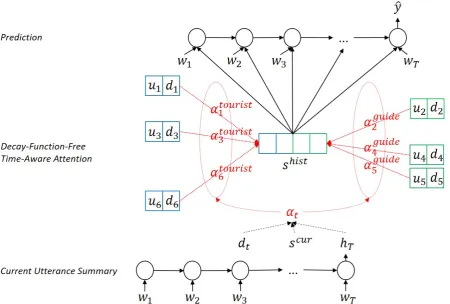
[image:2.595.80.522.62.278.2]Figure 2: Overall architecture of the decay-function-free time-aware attention with speaker indicator (role-level). w1, ..., wT are word vectors of the current utterance,dtis thetthdistance vector,utis thetthutterance vector, scuris the current speaker indicator,h
T is the current utterance summary vector andαtis the importance of the tthhistoric utterance. For simplicity, we represent bidirectional LSTM layers as unidirectional LSTM layers.
Other research on SLU uses context informa-tion. A model based on support vector machine and a hidden Markov model uses contextual mation to show the importance of contextual infor-mation in SLU tasks, intent prediction and slot de-tection (Bhargava et al.,2013). RNN-based mod-els can exploit context to classify domains (Xu and Sarikaya, 2014), and have been combined with previously-estimated intent and slot labels to pre-dict domain and intent (Shi et al.,2015). A mem-ory network that contains historic utterance vec-tors encoded by RNN has been used to select the most relevant history vector by multiplicative soft-attention (Chen et al.,2016a); the selected vector is fed to an RNN-based slot tagger as context in-formation.
A memory network can be regarded as use of content-based similarity between the current utter-ance and previous utterutter-ances. A memory network can be separated to capture historic utterances for each speaker independently (Kim et al.,2017), and a contextual model can use different LSTM layers to separately encode a history summary for each
speaker (Chi et al., 2017). For another task, ad-dressee and response selection in multi-party con-versations, a distinct RNN-based encoder for each speaker-role (sender, addressee, or observer) has been used to generate distinct history summaries (Zhang et al.,2018).
3 Proposed Model
We propose a time-aware model that includes a speaker indicator (Figure 2). In addition, we propose a content-and-time-aware model that in-cludes a speaker indicator. The models are trained in an end-to-end way, in which every model pa-rameter is automatically learned based on a down-stream SLU task. The objective of the proposed models are to optimize the conditional probabil-ity of labels of SLU, given the current utterance p(ˆy|x), by minimizing the cross-entropy loss.
The following description of the proposed model considers three steps: current utterance summary, context summary, and prediction.
3.1 Current Utterance Summary
To select salient parts of contextual histories, the current utterance is used. To summarize a current utterance matrixU that consists of wordswi as a
vector (i.e.,U = {w1 ,w2,..., wT}), U is fed to
bidirectional LSTMs, and the final hidden vector hT ∈ Rdim is taken as a current utterance sum-mary.
3.2 Decay-Function-Free Time-Aware Attention
In this subsection, we introduce a decay-function-free time-aware attention model. To summarize contexts, we use a time difference (distance) be-tween a historic utterance and the current utter-ance; this distance represents the interval between the historic utterance and the current utterance. We use the distance of thetthhistory from the cur-rent utterance as an index to select a dense vector from a distance-embedding matrixD∈Rdim×|D|, then use the vector as thetthdistance vectordt.
To compute the importance αt of the tth
his-tory, both in the sentence-level attention and in the role-level attention, our time-aware attention uses the current utterance summaryhT and the history
distancedtsimultaneously and additively:
αt=wTattσ hT +dt+batt
, (1)
wherewattT is the transpose of a trainable weight vector for the attention,battis a trainable bias
vec-tor for the attention, and σ is the hyperbolic tan-gent function.
Computing a time-aware context summary vec-tor shist
time depends on whether the role-level or
sentence-level attention is considered. For the role-level attention, we use the softmax operation
applied to allαtof the same speaker, either a guide
or a tourist, to obtain a role-level probabilistic im-portance αrolet of tth history. We then multiply αrolet by tthhistory vector, which is a concatena-tion of the corresponding intent-dense vector ut
and the distance vector dt. We use the
element-wise sum of the vectors of the same speaker to construct two summary vectorssguidetime andstouristtime . Finally, sguidetime and stouristtime are concatenated to form a time-aware history summary vector shisttime as:
αrolet =sof tmaxrole(αt), (2)
sroletime =X
t
αrolet (ut⊕dt), (3)
shisttime =sguidetime ⊕stouristtime , (4)
where⊕represents a concatenation operation. For the sentence-level attention to obtain a sentence-level probabilistic importance αsentt of tth history, we use the softmax operation applied
to allαt regardless of the speaker, then multiply
αsentt by thetthhistory vector, which is a concate-nation of the corresponding intent dense vectorut
and the distance vector dt. We use the
element-wise sum of the vectors to construct a time-aware summary vectorshist
timeas:
αsentt =sof tmaxsent(αt), (5)
shisttime =X
t
αsentt (ut⊕dt). (6)
Then,shisttimeis used as a context summaryshist in the prediction step.
3.3 Decay-Function-Free
Content-and-Time-Aware Attention
Although a time-aware attention model is pow-erful by itself, content can be considered at the same time to improve accuracy. We propose an-other contextual attention model that is aware of content, in addition to time. This model is called content-and-time-aware attention. The model uses an importance valueβtfor thetthhistory. To
com-puteβt, we uses the trainable parameterswattand
battof the time attention as:
βt=wTattσ hT +ut+batt
, (7)
whereut is the intent dense vector oftth history,
Then,βtis used in the same way asαt, but
in-dependently. shisttime is computed as in the previ-ous subsection,βtis used to computeshistcontfor the
role-level attention as:
βtrole =sof tmaxrole(βt), (8)
srolecont=X
t
βtrole(ut⊕dt), (9)
shistcont=sguidecont ⊕stouristcont . (10)
To compute shistcont for the sentence-level atten-tion,βtis used as:
βtsent =sof tmaxsent(βt), (11)
shistcont=X
t
βtsent(ut⊕dt). (12)
Finally, the time-aware history summary shist time
and the content-aware history summary shistcont are concatenated to generate a history summaryshist regardless of the attention level:
shist=shisttime⊕shistcont. (13)
3.4 Speaker Indicator
Speaker indicator is a trainable vector scur ∈
Rdim which indicates the identity of the current speaker; i.e., either a tourist or a guide in DSTC 4. An embedding lookup method is used after a speaker embedding matrix S ∈ Rdim×|S| is de-fined. The speaker embedding matrix is randomly initialized before the model is trained.
To use speaker indicator scur in the proposed attentions, Eq.1is rewritten as:
αt=wTattσ hT +dt+scur+batt
, (14)
and Eq.7is rewritten as:
βt=wTattσ hT +ut+scur+batt
. (15)
3.5 Prediction
To predict the true label in spoken language under-standing, our model consumes the current utter-anceUagain. We use another bidirectional LSTM layer which is distinct from that of the current ut-terance summary. To prepare fortthinputvtof the
LSTM layer, we concatenatetthword vectorwtof
the current utteranceU with the history summary vectorshist:
vt=wt⊕shist. (16)
Then, we feed each vt to the LSTM layer
sequentially, and the final hidden vector of the LSTM layer is used as an input of a feed-forward layer to predict the true labelyˆ.
4 Experiments
To test the proposed models, we conducted language-understanding experiments on a dataset of human-human conversations.
4.1 Dataset and Settings
We conducted experiments on the DSTC 4 dataset which consists of 35 dialogue sessions on touris-tic information for Singapore; they were collected from Skype calls of three tour guides with 35 tourists. The 35 dialogue sessions total 21 h, and include 31,034 utterances and 273,580 words (Kim et al.,2016). DSTC 4 is a suitable bench-mark dataset for evaluation, because all of the dia-logues have been manually transcribed and anno-tated with speech acts and semantic labels at each turn level. a semantic label consists of a speech act and associated attribute(s). The speaker informa-tion (guide and tourist) is also provided. Human-human dialogues contain rich and complex Human-human behaviors and bring much difficulty to all tasks that are involved in SLU. We used the same train-ing dataset, the same test dataset and the same validation set as in the DSTC 4 competition: 14 dialogues as the training dataset, 6 dialogues as the validation dataset, and 9 dialogues as the test dataset.
We used Adam (Kingma and Ba, 2015) as the optimizer in training the model. We set the batch size to 256, and used pretrained 200-dimensional word embeddings GloVe (Pennington et al.,2014). We applied 30 training epochs with early stopping. We set the sizedimof every hidden layer to 128, and the context length to 7. We used the ground truth intents (semantic labels) to form an intent-dense vector like previous work. To evaluate SLU accuracy, we used the F1 score, which is the har-monic mean of precision and recall. To validate the significance of improvements, we used a one-tailed t-test. We ran each model ten times, and report their average scores.
F1 score
Model Sent.-Level Role-Level
DSTC 4 - Best 61.4
No Context 65.06
LSTM-Used Context Summary without Attention 72.15
LSTM-Used Content-Aware Attention 71.27 71.84
Speaker Role Modeling (Chi et al.,2017) 66.8 70.1
Convex Time-Aware Attention (Chen et al.,2017) 74.6 74.2
Universal Time-Aware Attention (Su et al.,2018a) 74.22 74.12 Universal Content + Time Attention (Su et al.,2018a) 74.40 74.33 Context-Sensitive Time Attention (Su et al.,2018b) 74.20 73.53 Decay-Function-Free Time-Aware Attention 75.58∗∗ 75.58∗∗
with Speaker Indicator 75.95∗∗ 76.56∗∗
Decay-Function-Free Content-and-Time-Aware Attention 75.59∗∗ 75.30∗∗
[image:6.595.90.509.62.269.2]with Speaker Indicator 76.11∗∗ 76.14∗∗
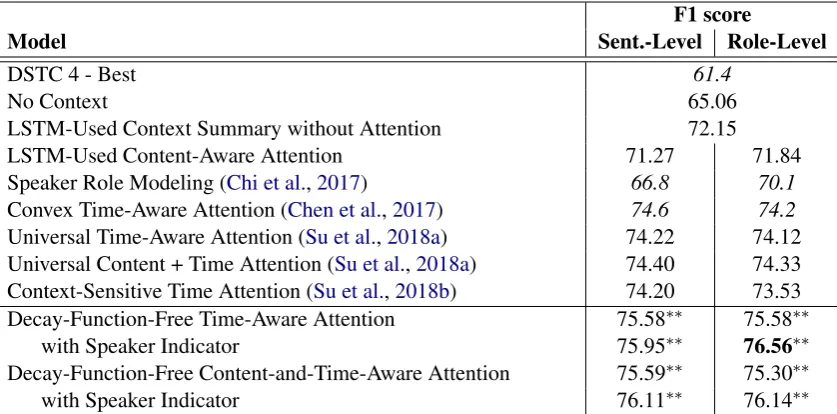
Table 1: SLU accuracy on DSTC 4. ∗: p < 0.05;∗∗,p <0.01compared to all the baseline models. Italicized scores are reported in the references. Model names are described in the text.
reported in the papers1. We ran three additional baseline models in which the prediction stage is the same: (1) ‘No Context’ uses no context sum-mary; (2) ‘LSTM-Used Context Summary with-out Attention’ uses the context summary of bidi-rectional LSTM without an attention mechanism, and (3) ‘LSTM-Used Content-Aware Attention’ uses context summary of bidirectional LSTM af-ter content-aware attention is applied to histories, as in previous approaches.
4.2 Results
We conducted an experiment to compare the pro-posed models with the baseline models in the SLU accuracy (Table 1). All of the proposed mod-els achieved significant improvements compared to all the baseline models.
We conducted an experiment to identify de-tails of how possible combinations of the proposed methods affect the SLU accuracy (Table2). In ad-dition to the combinations of the proposed meth-ods, we tested another content-and-time-aware at-tention method (Content x Time) which computes attention values using both intent and distance at a time, and shares the values to compare with the proposed content-and-time-aware attention.
1
Su et al.(2018a) andSu et al.(2018b) specified that they used different training/valid/test datasets that had been ran-domly selected from the whole DSTC 4 data with different rates for the experiments. Therefore, we do not use the re-ported score in our comparison, but produced the results un-der the same conditions by using the open-source code.
5 Discussion
In the first subsection, we analyze the effective-ness of the decay-function-free time-aware at-tention and decay-function-free content-and-time-aware attention by comparison with others. In the next subsection, we analyze the effectiveness of the proposed methods in their possible combina-tions. We also analyze the effectiveness of the use of a distance vector in the history representa-tion under the various condirepresenta-tions. Finally, we ana-lyze attention weights of the proposed models in a qualitative way to convince of the effectiveness of them.
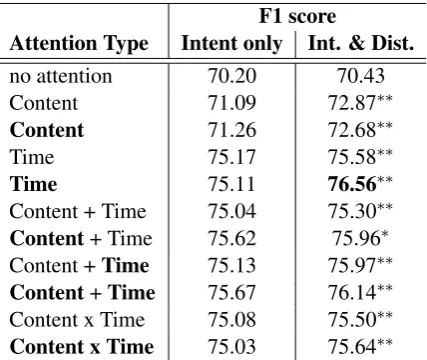
We also conducted an experiment to show the effectiveness of the use of a distance vector in the history representation under the same condition as in the role-level attention (Table3). Although we propose to use both intent and distance by concate-nating them as a history representation, intent can be used alone; this approach is more intuitive than using both intent and distance.
5.1 Comparison with Baseline Models
F1 score
Attention Type Sent.-Level Role-Level
no attention 70.49 70.43
Content 73.03 72.87
Content 73.05 72.68
Time 75.58 75.58
Time 75.95∗∗ 76.56∗∗
[image:7.595.74.288.77.261.2]Content + Time 75.59 75.30 Content+ Time 75.83 75.96∗∗ Content +Time 75.94∗ 75.97∗∗ Content+Time 76.11∗∗ 76.14∗∗ Content x Time 75.59 75.50 Content x Time 75.63 75.64
Table 2: SLU accuracy of possible combinations of the proposed methods. “no attention”: sum of all history vectors without calculating α, “Content” is content-aware attention (Decay-Function-Free Content-Aware Attention), “Time” is the proposed time-aware at-tention (Decay-Function-Free Time-Aware Atat-tention), “Content + Time” is the proposed content-and-time-aware attention (Decay-Function-Free Content-and-Time-Aware Attention), “Content x Time” is variant content-and-time-aware attention (Decay-Function-Free Inseparate Content-and-Time-Aware Attention).
∗: p < 0.05; ∗∗,p < 0.01compared to the same
at-tention without speaker indicator. An atat-tention type in bold is the speaker-involved part.
F1 score
Attention Type Intent only Int. & Dist.
no attention 70.20 70.43
Content 71.09 72.87∗∗
Content 71.26 72.68∗∗
Time 75.17 75.58∗∗
Time 75.11 76.56∗∗
Content + Time 75.04 75.30∗∗ Content+ Time 75.62 75.96∗ Content +Time 75.13 75.97∗∗ Content+Time 75.67 76.14∗∗ Content x Time 75.08 75.50∗∗ Content x Time 75.03 75.64∗∗
Table 3: SLU accuracy of possible combinations of the proposed methods in role-level attention with different history representations. Int. used intent vector; Dist. used distance vector. ∗: p <0.05;∗∗,p <0.01 com-pared to using intent only. Other codes are as in Table
2.
5.2 Detailed Analysis on Proposed Methods
The proposed methods had good SLU accuracy (Table 2). Every time-aware attention with and without speaker indicator (rows 4 to 11) improved the F1 score compared to the content-aware at-tention with and without speaker indicator (rows 2 and 3) and to no attention (row 1). This result means that the proposed time-aware attention was effective to improve the SLU accuracy. Any of the content-and-time-aware attention with or without speaker indicator (rows 6 to 11) did not improve the F1 score compared to the time-aware attention with and without speaker indicator (rows 4 and 5). This result means that incorporating content could not make further improvement of the accu-racy. Also, without speaker indicator, all the time-aware attention (rows 4, 6 and 10) achieved similar F1 scores.
Use of speaker indicator also showed tenden-cies. It did not significantly improve the SLU accuracy of Decay-Function-Free Content-Aware Attention (rows 2 and 3) or Decay-Function-Free Inseparate Content-and-Time-Aware At-tention (rows 10 and 11), but did improve the accuracy of the proposed models, Decay-Function-Free Time-Aware Attention (rows 4 and 5) and Decay-Function-Free Content-and-Time-Aware Attention (rows 6 to 9). Decay-Function-Free Content-and-Time-Aware Attention with speaker indicator (rows 7 to 9) were more accurate than Decay-Function-Free Inseparate Content-and-Time-Aware Attention with speaker indicator (row 11). This result means that using speaker in-dicator, separation of content and time improved the accuracy. The improvement in the role-level tended to be greater than that in the sentence-level. The improvement was greatest when speaker in-dicator was involved in the proposed role-level Decay-Function-Free Time-Aware Attention (row 5).
5.3 Effectiveness of Use of Distance in History Representation
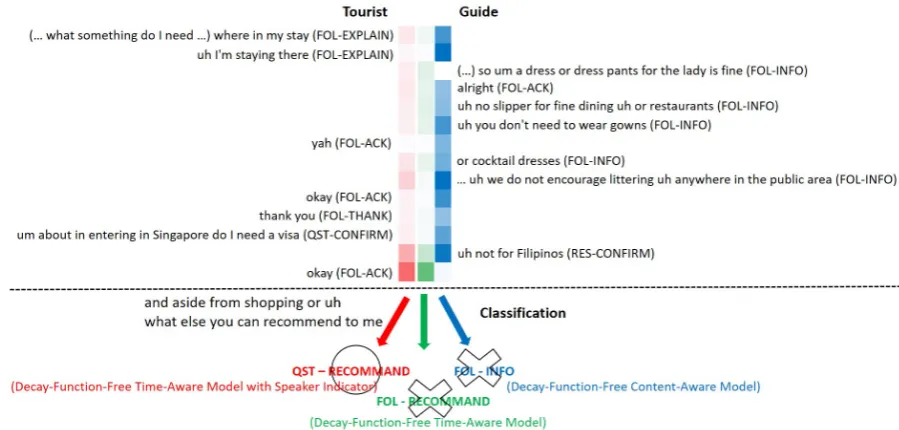
[image:7.595.75.289.482.662.2]Figure 3: The visualization of the attention weights of the proposed models and the baseline content-aware model. Color gradient indicates intensity given a single datum after training. The color gradient at the left side indicates attention intensities of Decay-Function-Free Time-Aware Model with Speaker Indicator, the color gradient in the center indicates attention intensities of Decay-Function-Free Time-Aware Model without Speaker Indicator, and the color gradient at the right side indicates attention intensities of Decay-Function-Free Content-Aware Model.
5.4 Qualitative Analysis
To assess whether the proposed time-aware atten-tion and speaker indicator can learn a time-decay tendency of the history effectively, we inspected the weights trained in Decay-Function-Free Time-Aware Attention with and without the speaker indicator. We also inspected Decay-Function-Free Content-Aware Attention to compare with them. We observed (Figure3) that the weights of the proposed models were trained well compared to Decay-Function-Free Content-Aware Attention. The proposed time-aware attention with/without speaker indicator tended to pay attention to re-cent histories, whereas the content-aware attention does not. As a result, Decay-Function-Free Time-Aware Attention with speaker indicator could generate the true label, QST-RECOMMEND, by avoiding noisy contextual information like “uh I’m staying there (FOL-EXPLAIN)” or “... uh we do not encourage littering uh anywhere in the pub-lic area (FOL-INFO)”.
6 Conclusion
In this paper, we propose decay-function-free time-aware attention models for SLU. These models summarize contextual information by taking advantage of temporal information without a manual time-decay function. We also propose
a current-speaker detector that identifies the current speaker. In experiments on the DSTC 4 benchmark dataset, the proposed models achieved a state-of-the-art SLU accuracy. Detailed analysis of effectiveness of the proposed methods demon-strated that the proposed methods increase the accuracy of SLU individually.
Acknowledgments
We would like to thank the reviewers for their in-sightful and constructive comments on this paper.
References
Dzmitry Bahdanau, Kyunghyun Cho, and Yoshua Ben-gio. 2014. Neural machine translation by jointly learning to align and translate. arXiv preprint arXiv:1409.0473.
A. Bhargava, A. Celikyilmaz, D. Hakkani-T¨ur, and R. Sarikaya. 2013. Easy contextual intent prediction and slot detection. In2013 IEEE International Con-ference on Acoustics, Speech and Signal Processing (ICASSP), pages 8337–8341.
P. Chen, T. Chi, S. Su, and Y. Chen. 2017. Dynamic time-aware attention to speaker roles and contexts
for spoken language understanding. In2017 IEEE
Yun-Nung Chen, Dilek Hakkani-T¨ur, Gokhan Tur, Jianfeng Gao, and Li Deng. 2016a. End-to-end memory networks with knowledge carryover for multi-turn spoken language understanding. In Inter-speech 2016, pages 3245–3249.
Yun-Nung (Vivian) Chen, Dilek Hakkani-Tur, Gokhan Tur, Asli Celikyilmaz, Jianfeng Gao, and Li Deng. 2016b. Syntax or semantics? knowledge-guided
joint semantic frame parsing. IEEE Workshop on
Spoken Language Technology (SLT 2016).
Ta-Chung Chi, Po-Chun Chen, Shang-Yu Su, and Yun-Nung Chen. 2017. Speaker role contextual model-ing for language understandmodel-ing and dialogue policy learning. In Proceedings of the The 8th Interna-tional Joint Conference on Natural Language Pro-cessing (IJCNLP), pages 163–168.
Dilek Hakkani-T¨ur, Gokhan Tur, Asli Celikyilmaz, Yun-Nung Chen, Jianfeng Gao, Li Deng, and Ye-Yi Wang. 2016. Multi-domain joint semantic frame parsing using bi-directional rnn-lstm. InInterspeech 2016, pages 715–719.
Seokhwan Kim, Rafael E Banchs Luis Fer-nando DHaro, Jason D Williams, and Matthew Henderson. 2016. The fourth dialog state tracking challenge. InProceedings of IWSDS.
Young-Bum Kim, Sungjin Lee, and Ruhi Sarikaya. 2017. Speaker-sensitive dual memory networks for
multi-turn slot tagging. In 2017 IEEE Automatic
Speech Recognition and Understanding Workshop (ASRU), pages 541–546.
Diederik P. Kingma and Jimmy Ba. 2015. Adam: A method for stochastic optimization. InProceedings of 3rd International Conference on Learning Repre-sentations (ICLR).
Bing Liu and Ian Lane. 2016. Attention-based recur-rent neural network models for joint intent detection and slot filling. InInterspeech 2016, pages 685–689.
Jeffrey Pennington, Richard Socher, and Christopher Manning. 2014. Glove: Global vectors for word
representation. In Proceedings of the 2014
Con-ference on Empirical Methods in Natural Language Processing (EMNLP), pages 1532–1543. Associa-tion for ComputaAssocia-tional Linguistics.
Y. Shi, K. Yao, H. Chen, Y. Pan, M. Hwang, and B. Peng. 2015. Contextual spoken language
un-derstanding using recurrent neural networks. In
2015 IEEE International Conference on Acous-tics, Speech and Signal Processing (ICASSP), pages 5271–5275.
Shang-Yu Su, Pei-Chieh Yuan, and Yun-Nung Chen. 2018a. How time matters: Learning time-decay at-tention for contextual spoken language understand-ing in dialogues. InProceedings of The 16th Annual Conference of the North American Chapter of the Association for Computational Linguistics: Human Language Technologies (NAACL-HLT).
Shang-Yu Su, Pei-Chieh Yuan, and Yun-Nung Chen. 2018b. Learning context-sensitive time-decay at-tention for role-based dialogue modeling. arXiv preprint arXiv:1809.01557.
P. Xu and R. Sarikaya. 2014. Contextual domain clas-sification in spoken language understanding systems using recurrent neural network. In2014 IEEE Inter-national Conference on Acoustics, Speech and Sig-nal Processing (ICASSP), pages 136–140.
Rui Zhang, Honglak Lee, Lazaros Polymenakos, and Dragomir Radev. 2018. Addressee and response se-lection in multi-party conversations with speaker
in-teraction rnns. InThe Thirty-Second AAAI