Improving Arabic Diacritization through Syntactic Analysis
Anas Shahrour, Salam Khalifa and Nizar HabashComputational Approaches to Modeling Language Lab New York University Abu Dhabi
United Arab Emirates
{anas.shahrour,salamkhalifa,nizar.habash}@nyu.edu
Abstract
We present an approach to Arabic auto-matic diacritization that integrates syntac-tic analysis with morphological tagging through improving the prediction of case and state features. Our best system in-creases the accuracy of word diacritization by 2.5% absolute on all words, and 5.2% absolute on nominals over a state-of-the-art baseline. Similar increases are shown on the full morphological analysis choice. 1 Introduction
Modern Standard Arabic (MSA) orthography generally omits diacritical marks which encode lexical as well as syntactic (case) information. The task of Arabic automatic diacritization is about the automatic restoration of the missing diacritics. Diacritization improvement in Arabic has impor-tant implications for downstream processing for Arabic natural language processing, e.g. speech recognition (Ananthakrishnan et al., 2005; Biadsy et al., 2009), speech synthesis (Elshafei et al., 2002), and machine translation (Diab et al., 2007; Zbib et al., 2010).
Previous efforts on diacritization utilized mor-phological tagging techniques to disambiguate word forms. Habash et al. (2007a) observe that while such techniques work relatively well on lex-ical diacritics (located on word stems), they are much worse for syntactic case diacritics (typically word final). They suggest that syntactic anal-ysis may help with automatic diacrtization, but stop short of testing the idea, and instead demon-strate that complex linguistic features and rules are needed to model complex Arabic case using gold syntactic analyses. In this paper, we develop an approach for improving the quality of automatic Arabic diacritization through the use of automatic syntactic analysis. Our approach combines hand-written rules for case assignment and agreement with machine learning of case and state adjustment on the output of a state-of-the-art morphological tagger. Our best system increases the accuracy of
word diacrtization by 2.5% absolute overall, and 5.2% absolute on nominals over a state-of-the-art baseline.
2 Linguistic Background
Arabic automatic processing, and specifically dia-critization is hard for a number of reasons.
First, Arabic words are morphologically rich. The morphological analyzer we use represents Arabic words with 15 features (Pasha et al., 2014).1 We focus on case and state in this paper.
In our data set, case has five values: nominative (n), accusative (a), genitive (g), undefined (u) and not applicable (na). Casesn,aandgare usually expressed with an overt morpheme. Caseuis used to mark words without an overt morpheme expres-sion of case (e.g., invariable nouns such as
ø ñº
šakwaý‘complaint’), or those not assigned a case in the manual annotations. Most of the missing assignments are for foreign proper nouns, which often do not receive case markers. However, this is not done consistently in the training data we use. Casenais used for non-nominals. Stateis a nom-inal feature that has four values: definite (d), in-definite (i), construct (c) and not applicable (na). State generally reflects the definiteness in nomi-nals (dvsi) and whether a nominal is the head of genitive construction (akaIdafa) (c). State na is used for non-nominals.2 For the most part, caseand state realize as a single word-final morpheme, e.g., the suffix
@
AãinAK.AJ»
kitAbAã3is a morphemeindicating the word is (cas:a, stt:i).
Second, undiacritized Arabic words are highly ambiguous: in our training data, words had an av-erage of 12.8 analyses per word, most of which are associated with different diacritizations. Some diacritization differences reflect different analysis 1Lemma (lex), Part-of-Speech (pos), Gender (gen),
Num-ber (num), Case (cas), State (stt), Person (per), Aspect (asp), Voice (vox), Mood (mod), four proclitics (prcn), and one en-clitic (enc0).
2For a detailed discussion of Arabic case and state, see
(Smrž, 2007; Habash et al., 2007a).
3Arabic transliteration is presented in the
Habash-Soudi-Buckwalter scheme (Habash et al., 2007b).
lemmas; while others are due to morpho-syntactic differences. For example, the undiacritized ver-sion of the word we used above (
AK.AJ»
ktAbA) has two other diacritizations and analyses:AK.A
J»
kut∼AbAã(cas:astt:i) ‘writers’ (different lemma) andAK.AJ»
kitAbA(cas:nstt:cnum:d) ‘two books of [...]’ (different features).Third, Arabic has complex case/state assign-ment and agreeassign-ment patterns that interact with the sentence’s syntax. For example, a noun may get its case by being subject of a verb and its state by being the head of an idafa construction; while ad-jectives modifying this noun agree with it in its case, their state is determined by the state of the last element in the idafa chain the noun heads.
For more information on Arabic orthography, morphology, and syntax, see Habash (2010).
3 Related Work
Much work has been done on Arabic diacritization (Vergyri and Kirchhoff, 2004; Nelken and Shieber, 2005; Zitouni et al., 2006; Habash and Rambow, 2007; Alghamdi and Muzafar, 2007; Rashwan et al., 2009; Bebah et al., 2014; Hadj Ameur et al., 2015; Abandah et al., 2015; Bouamor et al., 2015). We refer the reader to the extensive literature re-view by Abandah et al. (2015), and focus on sys-tems we compare with.
Most of the previous approaches cited above utilize different sequence modeling techniques that use varying degrees of knowledge from shal-low letter and word forms to deeper morphologi-cal information; none to our knowledge make use of syntax. Habash and Rambow (2007) approach diacritization as a part of the morphological dis-ambiguation problem, where they select the opti-mal full morphological tag for Arabic in context and use it to select from a list of possible analyses produced by a morphological analyzer. They use independent taggers for all features; and language models for lemmas and diacritized surface forms. Their work is part of the state-of-the-art Ara-bic morphological tagger MADAMIRA (Pasha et al., 2014). Our paper is most closely related to Habash and Rambow (2007) and Pasha et al. (2014). We extend their work using additional syntactic features to improve morphological dis-ambiguation accuracy. We demonstrate improve-ments in terms of both full morphological analysis choice (lemmatization, tokenization, all features) as well as word diacritization.
Most recently, Abandah et al. (2015) presented
a recurrent neural network approach to diacritize full sentences with impressive results. We do not compare to their effort here but we note that they use an order of magnitude more diacritized data than we do, and they focus on diacritization only as opposed to full morphological analysis.
In related work on modeling Arabic case and syntax, Habash et al. (2007a) compared rule-based and machine learning approaches to capture the complexity of Arabic case assignment and agree-ment. They demonstrated their results on gold syntactic analyses showing that given good syn-tactic representations, case prediction can be done at a high degree of accuracy. Alkuhlani et al. (2013) later extended this work to cover all mor-phological features, including state. Additionally, Marton et al. (2013) demonstrated that in the con-text of syntactic dependency parsing, case is the best feature to usein gold settingsand is the worst feature to usein predicted settings. In this paper we use automatic (i.e. not gold) syntactic features to improve case prediction, which improves mor-phological analysis and word diacrtization. 4 Approach
Motivation We are motivated by an error analysis we conducted of 1,200 words of the MADAMIRA system output. We found a large number of surprisingsyntactically impossiblecase errors such as genitive nouns following verbs or construct nouns followed by non-genitives. We explain these errors by MADAMIRA’s contextual models being limited to a small window of neigh-boring words and with no modeling of syntax, which leads to a much worse performance on case and diacritization compared to lemmas and POS (almost 10% absolute drop from 96% to 86%).
Proposed Solution Our approach is to provide better prediction of case and state using models with access to additional information, in partic-ular syntactic analysis and rules. The predicted case and state values are then used to re-tag the MADAMIRA output by selecting the best match in its ranked morphological analyses. We limit our retagging to nominals. Since what we are learning to predict is how to correct MADAMIRA’s base-line choice (as opposed to a generative model of case-state), we also re-apply the model on its out-put to fix primarily propagated agreement errors in a manner similar to Habash et al. (2007a)’s agree-ment classifier.4
4We optimized for a re-application limit, which we found
experi-5 Experimental Results
We present next our experimental results and com-pare five case-state prediction techniques. The results for these techniques are compared to our state-of-the-art baseline system, which has been compared to a number of other approaches.
5.1 Experimental Setup
Data We used the Penn Arabic Treebank (PATB, parts 1, 2 and 3) (Maamouri et al., 2004; Maamouri et al., 2006; Maamouri et al., 2009) split intoTrain,Devand (blind)Testalong the rec-ommendations of Diab et al. (2013) which were also used in the baseline system. The morpho-logical feature representations we use are derived from the PATB analyses following the approach used in the MADA and later MADAMIRA sys-tems (Habash and Rambow, 2005; Habash and Rambow, 2007; Pasha et al., 2014). We further divide Dev into two parts with equal number of sentences: DevTrain(30K words) for training our case-state classifiers, andDevTest(33K words) for development testing. TheTestset has 63K words.5 Evaluation Metrics We report our accuracy in terms of two metrics: a. Diac, the percentage of correctly fully diacrtized words; and b. All, the percentage of words for which a full morpho-logical analysis (lemma, POS, all inflectional and clitic features, and diacritization) is correctly pre-dicted. We report the results on all words (All Words) as well as on nominals6 with no u case
in the gold (henceforth,Nominals). We do not re-port on case and state prediction accuracy, nor on the character-level diacritization.
Morphological Analysis, Baseline and Topline
For our baseline, we use the morphological analy-sis and disambiguation tool MADAMIRA (Pasha et al., 2014), which produces a contextually ranked list of analyses for each word. We com-puted an oracular topline using the PATB gold case and state values in the retagging process.
ments. We do not report more on this due to space limitations. Because of the need to have the same of number of parse tree tokens for reapplication in the models using syntax, we constrain the retagging to maintain the same clitic signature (number of clitics) in the MADAMIRA baseline top analysis.
5To address the concern that we are using more
"train-ing" data than our baseline, we compared the performance of MADAMIRA’s release (baseline) to a version that was trained on Train +DevTrain. The small increase in training data made no significant difference from the baseline system in terms of our metrics.
6Nominals consists of nouns (including noun_quant and
noun_num), adjectives, proper nouns, adverbs, and pronouns.
All Words Nominals
System Diac All Diac All
[image:3.595.311.521.62.190.2]Oracle Topline 96.2 94.2 98.0 95.7 Baseline 87.4 85.0 81.9 78.2 Morphology Rules 88.0 85.5 83.1 79.4 Morphology Classifier 88.4 85.9 83.7 80.1 Syntax Rules 87.4 84.6 86.4 82.2 Syntax Classifier 89.1 86.6 85.2 81.4 Syntax Rules+Classifier 89.7 87.1 86.4 82.5
Table 1: Results onDevTest.
Syntactic Analysis For syntactic features, we trained an Arabic dependency parser using Malt-Parser (Nivre et al., 2007) on the Columbia Arabic Treebank (CATiB) version of the PATB (Habash and Roth, 2009). The Train data followed the same splits mentioned above. The Nivre "eager" algorithm was used in all experiments. The CATiB dependency tree has six simple POS tags and eight relations (Habash and Roth, 2009; Habash et al., 2009). The PATB tokenization as well as the CATiB POS tags were produced by the base-line system MADAMIRA and used as input to the parser. We also used the well performing yet simple CATiBex expansion of the CATiB tags as implemented in the publicly available parsing pipeline from Marton et al. (2013). Our parser’s performance on the PATBDev set is comparable to Marton et al. (2013): 84.2% labeled attachment, 86.6% unlabeled attachment, and 93.6% label ac-curacy.
Machine Learning Technique Given the small size of DevTrain, we opted to train unlexical-ized models that we expect to capture morpho-syntactic abstractions. We tried a number of ma-chine learning techniques and settled on using the J48 Decision tree classifier with its default settings in WEKA (Hall et al., 2009; Quinlan, 1993) for all of the classification experiments in this paper.
5.2 Case and State Classification Techniques
We detail and report on five case-state classifica-tion techniques we experimented with. All results on theDevTestare presented in Table 1.
post-verbal genitive nouns are changed to the first non-genitive analysis available from MADAMIRA; (ii) post-construct state non-genitive nouns should be-come genitive; and (iii) adjectives agreeing with the nouns they follow in gender, number, and def-initeness, but not in case should match the nouns’ case. The collective improvement of all the rules applied in the order presented above adds up to 0.6% absolute on All Word Diac, and 1.2% abso-lute on Nominal Diac.
Morphology-based Classifier We trained a classifier to predict a correction of the baseline case and state of a word using the DevTrain data set. For features, we included all the non-lexical morphological features (all features men-tioned infootnote 1except for lemma). Clitic fea-ture values were binarized to indicate if a clitic is present or not. We used Nil values for all out-of-vocabulary words in MADAMIRA. BOS and EOS placeholders were used for sentence bound-aries. We excluded all DevTrain words whose predicted POS switches from nominal to non-nominal or vice versa, but kept them as part of other words’ context. This minimizes noise and sparsity in the training data, especially given its small size and the rarity of such examples. We ex-perimented with adding features from neighboring words within a window size of +/- 2 words. The best performing setup was with window size +/- 1. This classifier makes around 0.5% absolute gain over the simple word morphology rules.
Syntax Rules Inspired by Habash et al. (2007a)’s simple set of rules for determining case on gold dependency trees, we re-implemented these rules to work with our different dependency representation and extended them to include state assignment in a manner similar to Alkuhlani et al. (2013).7 These rules improve over the baseline
by 4.5% absolute in Nominal Diac accuracy, but produce no gains in All Words setting. An investigation of the error patterns reveals the main 7For nominal case assignment, our rules are: (i) default
case isa; (ii) children ofrootaren; (iii) object of prepo-sition and idafa children are assignedg; (iv) predicates not headed by verbs are assignedn; and (v) subjects and top-ics not headed (or grand-headed) by a class of words called Ân∼a and her sistersare assigned n. After case assign-ment, we apply two case agreement rules: (i) for all nom-inals modifying case-assigned nomnom-inals (i.e., with tree rela-tionmod), copy the case of the modified nominal; and (ii) for all nominals conjoined to case-assigned nominals (i.e., with tree chainnominal-conjunction-nominal), copy the case of the heading nominal. For state, we assigndto words with the definite article proclitic, andcto words heading an idafa construction. All other nominals are assigned statei.
reason to be the rules’ inability to predict the problematicucase.
Syntax-based Classifier We trained a classifier to predict a correction of the case and state of a word on a parsed version of theDevTraindata set. Since the syntactic parse separates most clitics in the PATB tokenization, we align the tree tokens with the word morphology before extracting clas-sifier features. The features we used are the to-ken’s morphological features (same as those used for words in the morphology-based classifier), the parent and grandparent’s features, the relations be-tween token and parent, and bebe-tween parent and grandparent, and the features of the neighboring +/-ntokens. The tokenized clitics are only used as context features (tree and surface). We tested all combinations of values of nas 0, 1, 2, and 3 and of including parent and grandparent features. The best performing setting was with including the parent and grandparent as well as a window of +/- 1 tokens. The syntax-based classifier improves over the morphology-based classifier but it trails behind syntax rules in terms of Nominal Diac. Its All Word Diac accuracy is the highest so far.
Combination of Syntax Rules and Classifier
We combine the last two approaches to exploit their complementary performance by including the syntax rule predictions as features in the syntax-based classifier. The resulting system is our best performer achieving DevTest accuracy improvements of 2.3% absolute (All Word Diac), and 4.5% absolute (Nominal Diac).
5.3 Blind Test Results
The results of applying the best approach and set-tings on our blind Test set are presented in Ta-ble 2. While the baseline onTestis slightly higher than DevTest, the performance on all metrics are comparable. The increase in Diac accuracy on All Words is 2.5% absolute and on Nominals is 5.2% absolute. The corresponding relative reductions in error to the oracle toplines are 30% and 34%. Sim-ilar increases are shown on the full morphological analysis choice.
All Words Nominals
System Diac All Diac All
Oracle Topline 96.3 94.4 97.9 95.6 Baseline 88.1 86.0 82.4 79.4 Syntax Rules+Classifier 90.6 88.5 87.6 84.5
(a)
YJ k. àA JJ.Ë ú ¯ áÓB@ à@ úæ AB@ ù®JʪK
tςlyqy AlÂsAsy Ân AlÂmn fy lbnAn jay∼id˜u My main comment is that security in Lebanon is goodWord Dependency Gold Baseline Best System
YJk.
jyd PRD of Ân ‘that’ jay∼id˜u [NOM] jay∼id˜ı [GEN] jay∼id˜u [NOM](b)
ú æÒJË@ è YK Õç 'A « àAg. àA¿
kAn jAnγAnm ydh Alymný Jean Ghanem was his right handWord Dependency Gold Baseline Best System
èYK
ydh PRD of kAn ‘was’ yadahu [ACC] yadihi [GEN] yadahu [ACC]ú æÒJË@
Alymný MOD of yd ‘hand’ Alyum.naý [U] Alyamaniy∼i [GEN] Alyum.naý [U] (c)AK.ðPð
@ ©Ó éKXA J¯B@ HA¯CªË@ P QªJ
syςzz AlςlAqAt AlAqtSAdy¯hmςÂwrwbAIt will reinforce the economic relations with Europe
Word Dependency Gold Baseline Best System
HA¯CªË@
OBJ of AlςalAqAti AlςalAqAti AlςalAqAti AlςlAqAt yςzz ‘reinforce’ [ACC] [GEN] [ACC]éKXAJ¯B@
MOD of AlAiqtiSAdiy∼a¯ha AlAiqtiSAdiy∼a¯hi AlAiqtiSAdiy∼a¯ha AlAqtSAdy¯h AlςlAqAt ‘relations’ [ACC] [GEN] [ACC](d)
... A ®K@ à@ øQKQmÌ'@ J ¯P Z@P PñË@ K P Ó
@ éKA®Ë QK@ àAjJÊ ¯ ÉAK. XAJ¯B@ QK Pð Y»@
Âkd wzyr AlAqtSAd bAsl flyHAn ˇAθr lqAˆyh Âms rˆyys AlwzrA’ rfyq AlHryry Ân AtfAq ...Following his meeting with the Prime Minister Rafiq Alhariri, the Minister of Economy Basil Flaihan has confirmed that the agreement ...
Word Dependency Gold Baseline Best System
[image:5.595.95.507.60.347.2]KP
rˆyys SBJ of Âkd ‘confirmed’ raˆyiysa [ACC] raˆyiysa [ACC] raˆyiysu [NOM]Figure 1: Examples of corrections from our best performing system.
5.4 Error Analysis and Examples
We manually investigated the types of errors in the first 100 errors in the DevTest in our best system’s output. In about a quarter of the cases (23%), all of which proper nouns, the gold refer-ence was not fully diacritized, making it impossi-ble to evaluate. In an additional 7%, typographi-cal errors in the input including missing sentence breaks led to bad parses which are the likely cause of error. The rest of the errors are system fail-ures: 31% are connected with syntactic tree errors (although a third of these are due to agreement-propagated errors over correct trees); 28% are due to other morphological analysis issues (half are out-of-vocabulary and 4% are no-analysis cases); and 11% are other case selection errors unrelated to the above-mentioned issues.
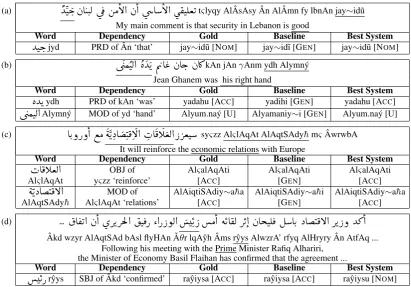
Figure 1 shows four examples from theDevTest where the analysis of our best system for the un-derlined words is different from baseline. Exam-ples (a), (b), and (c) are cases where our best sys-tem’s analysis matched the gold. The dependency relation also matched the gold and was the likely cause of correction. In example (d), our best sys-tem incorrectly changed the correct baseline anal-ysis in agreement with the wrong dependency re-lation provided by the parser, which is the likely cause of error.
6 Conclusion and Future Work
We have demonstrated the value of using auto-matic syntactic analysis as part of the task of au-tomatic diacritization and morphological tagging of Arabic. Our best solution is a hybrid approach that combines statistical parsing and manual syn-tactic rules as part of a machine learning model for correcting case and state features.
In the future, we plan to investigate the develop-ment of joint morphological disambiguation and syntactic parsing models. We will also work on improving the quality of Arabic parsing which is behind many of the errors according to our er-ror analysis. Other possible directions include using more sophisticated machine learning tech-niques and richer lexical features. We also plan to host a demo and make our system available through the website of the Computational Ap-proaches to Modeling Language (CAMeL) Lab:
www.camel-lab.com.
Acknowledgments
References
Gheith A Abandah, Alex Graves, Balkees Al-Shagoor, Alaa Arabiyat, Fuad Jamour, and Majid Al-Taee. 2015. Automatic diacritization of Arabic text us-ing recurrent neural networks.International Journal on Document Analysis and Recognition (IJDAR), 18(2):183–197.
Mansour Alghamdi and Zeeshan Muzafar. 2007. KACST Arabic diacritizer. In First International Symposium on Computers and Arabic Language, pages 25–28.
Sarah Alkuhlani, Nizar Habash, and Ryan Roth. 2013. Automatic morphological enrichment of a morpho-logically underspecified treebank. InHLT-NAACL, pages 460–470.
S. Ananthakrishnan, S. Narayanan, and S. Bangalore. 2005. Automatic diacritization of Arabic transcripts for ASR. InProceedings of ICON, Kanpur, India, December.
Mohamed Bebah, Chennoufi Amine, Mazroui Azzed-dine, and Lakhouaja Abdelhak. 2014. Hybrid ap-proaches for automatic vowelization of Arabic texts.
arXiv preprint arXiv:1410.2646.
Fadi Biadsy, Nizar Habash, and Julia Hirschberg. 2009. Improving the Arabic Pronunciation Dic-tionary for Phone and Word Recognition with Linguistically-Based Pronunciation Rules. In Pro-ceedings of Human Language Technologies: The 2009 Annual Conference of the North American Chapter of the Association for Computational Lin-guistics, pages 397–405, Boulder, Colorado. Houda Bouamor, Wajdi Zaghouani, Mona Diab,
Os-sama Obeid, Kemal Oflazer, Mahmoud Ghoneim, and Abdelati Hawwari. 2015. A pilot study on Arabic multi-genre corpus diacritization. In Pro-ceedings of the Second Workshop on Arabic Natural Language Processing, pages 80–88, Beijing, China, July. Association for Computational Linguistics. Mona Diab, Mahmoud Ghoneim, and Nizar Habash.
2007. Arabic Diacritization in the Context of Sta-tistical Machine Translation. In Proceedings of Machine Translation Summit (MT-Summit), Copen-hagen, Denmark.
Mona Diab, Nizar Habash, Owen Rambow, and Ryan Roth. 2013. LDC Arabic treebanks and associ-ated corpora: Data divisions manual. arXiv preprint arXiv:1309.5652.
Moustafa Elshafei, Husni Al-Muhtaseb, and Mansour Al-Ghamdi. 2002. Techniques for high qual-ity Arabic speech synthesis. Information sciences, 140(3):255–267.
Nizar Habash and Owen Rambow. 2005. Arabic Tok-enization, Part-of-Speech Tagging and Morphologi-cal Disambiguation in One Fell Swoop. In Proceed-ings of the 43rd Annual Meeting of the Association for Computational Linguistics (ACL’05), pages 573– 580, Ann Arbor, Michigan.
Nizar Habash and Owen Rambow. 2007. Arabic Dia-critization through Full Morphological Tagging. In
Proceedings of the 8th Meeting of the North Amer-ican Chapter of the Association for Computational Linguistics/Human Language Technologies Confer-ence (HLT-NAACL07).
Nizar Habash and Ryan M Roth. 2009. CATiB: The Columbia Arabic Treebank. InProceedings of the ACL-IJCNLP 2009 Conference Short Papers, pages 221–224. Association for Computational Linguis-tics.
Nizar Habash, Ryan Gabbard, Owen Rambow, Seth Kulick, and Mitchell P Marcus. 2007a. Deter-mining case in Arabic: Learning complex linguis-tic behavior requires complex linguislinguis-tic features. In
EMNLP-CoNLL, pages 1084–1092.
Nizar Habash, Abdelhadi Soudi, and Tim Buckwalter. 2007b. On Arabic Transliteration. In A. van den Bosch and A. Soudi, editors, Arabic Computa-tional Morphology: Knowledge-based and Empiri-cal Methods. Springer.
Nizar Habash, Reem Faraj, and Ryan Roth. 2009. Syn-tactic Annotation in the Columbia Arabic Treebank. InProceedings of MEDAR International Conference on Arabic Language Resources and Tools, Cairo, Egypt.
Nizar Habash. 2010. Introduction to Arabic Natural Language Processing. Morgan & Claypool Publish-ers.
Mohamed Seghir Hadj Ameur, Youcef Moulahoum, and Ahmed Guessoum. 2015. Restoration of Ara-bic diacritics using a multilevel statistical model. In
Computer Science and Its Applications, volume 456 of IFIP Advances in Information and Communica-tion Technology, pages 181–192. Springer Interna-tional Publishing.
Mark Hall, Eibe Frank, Geoffrey Holmes, Bernhard Pfahringer, Peter Reutemann, and Ian H Witten. 2009. The WEKA data mining software: an update.
ACM SIGKDD explorations newsletter, 11(1):10– 18.
Mohamed Maamouri, Ann Bies, Tim Buckwalter, and Wigdan Mekki. 2004. The Penn Arabic Treebank: Building a Large-Scale Annotated Arabic Corpus. In NEMLAR Conference on Arabic Language Re-sources and Tools, pages 102–109, Cairo, Egypt. Mohamed Maamouri, Ann Bies, and Seth Kulick.
2006. Diacritization: A challenge to Arabic tree-bank annotation and parsing. InProceedings of the Conference of the Machine Translation SIG of the British Computer Society.
Mohamed Maamouri, Ann Bies, and Seth Kulick. 2009. Creating a Methodology for Large-Scale Cor-rection of Treebank Annotation: The Case of the Arabic Treebank. InProceedings of MEDAR Inter-national Conference on Arabic Language Resources and Tools, Cairo, Egypt.
Rani Nelken and Stuart Shieber. 2005. Arabic Di-acritization Using Weighted Finite-State Transduc-ers. In Proceedings of the Workshop on Compu-tational Approaches to Semitic Languages at 43rd Meeting of the Association for Computational Lin-guistics (ACL’05), pages 79–86, Ann Arbor, Michi-gan.
Joakim Nivre, Johan Hall, Jens Nilsson, Atanas Chanev, Gülsen Eryigit, Sandra Kübler, Svetoslav Marinov, and Erwin Marsi. 2007. MaltParser: a language-independent system for data-driven de-pendency parsing. Natural Language Engineering, 13(02):95–135.
Arfath Pasha, Mohamed Al-Badrashiny, Ahmed El Kholy, Ramy Eskander, Mona Diab, Nizar Habash, Manoj Pooleery, Owen Rambow, and Ryan Roth. 2014. MADAMIRA: A Fast, Comprehensive Tool for Morphological Analysis and Disambiguation of Arabic. InIn Proceedings of LREC, Reykjavik, Ice-land.
Ross Quinlan. 1993. C4.5: Programs for Machine Learning. Morgan Kaufmann Publishers, San Ma-teo, CA.
Mohsen Rashwan, Mohammad Al-Badrashiny, Mo-hamed Attia, and S Abdou. 2009. A hybrid sys-tem for automatic Arabic diacritization. InThe 2nd International Conference on Arabic Language Re-sources and Tools. Citeseer.
Otakar Smrž. 2007. Functional Arabic Morphology. Formal System and Implementation. Ph.D. thesis, Charles University in Prague, Prague, Czech Repub-lic.
Dimitra Vergyri and Katrin Kirchhoff. 2004. Auto-matic Diacritization of Arabic for Acoustic Mod-eling in Speech Recognition. In Ali Farghaly and Karine Megerdoomian, editors, COLING 2004 Workshop on Computational Approaches to Ara-bic Script-based Languages, pages 66–73, Geneva, Switzerland.
Rabih Zbib, Spyros Matsoukas, Richard Schwartz, and John Makhoul. 2010. Decision trees for lexical smoothing in statistical machine translation. In Pro-ceedings of the Joint Fifth Workshop on Statistical Machine Translation and MetricsMATR, pages 428– 437, Uppsala, Sweden, July. Association for Com-putational Linguistics.