386
A Variational Approach to Weakly Supervised Document-Level
Multi-Aspect Sentiment Classification
Ziqian Zeng1, Wenxuan Zhou2, Xin Liu1, and Yangqiu Song1 1Department of CSE, Hong Kong University of Science and Technology, HK
2Department of CS, University of Southern California, CA, USA
1{
zzengae, xliucr, yqsong}@cse.ust.hk
2{
zhouwenx}@usc.edu
Abstract
In this paper, we propose a variational ap-proach to weakly supervised document-level multi-aspect sentiment classification. Instead of using user-generated ratings or annotations provided by domain experts, we use target-opinion word pairs as “supervision.” These word pairs can be extracted by using depen-dency parsers and simple rules. Our objec-tive is to predict an opinion word given a tar-get word while our ultimate goal is to learn a sentiment polarity classifier to predict the sen-timent polarity of each aspect given a docu-ment. By introducing a latent variable, i.e., the sentiment polarity, to the objective func-tion, we can inject the sentiment polarity clas-sifier to the objective via the variational lower bound. We can learn a sentiment polarity clas-sifier by optimizing the lower bound. We show that our method can outperform weakly super-vised baselines on TripAdvisor and BeerAd-vocate datasets and can be comparable to the state-of-the-art supervised method with hun-dreds of labels per aspect.
1 Introduction
Document-level multi-aspect sentiment classifica-tion (DMSC) aims to predict the sentiment polar-ity of each aspect given a document which con-sists of several sentences describing one or more aspects (Wang et al.,2010,2011;Yin et al.,2017). Solving the DMSC task is useful for providing both recommendations for users and suggestions for business owners on customer review platforms. Aspect based sentiment classification (Tang et al., 2016a,b; Wang et al., 2016b; Chen et al., 2017;Ma et al.,2017;Wang et al.,2018) was usu-ally done by supervised learning, where aspect-level annotations should be provided. Aspect-aspect-level annotations are not easy to obtain. Even when the platform provides the function to rate for different aspects, users are less likely to submit all of them.
For example, about 37% of the aspect ratings are missing onTripAdvisor. If we can solve DMSC task without using aspect-level annotations, it can save human effort to annotate data or collect user-generated annotations on the platform.
Existing weakly supervised approaches (Wang et al.,2010,2011) use overall polarities instead of aspect polarities as “supervision.” Compared with the polarity of each aspect, it is relatively easy to obtain overall polarities. Specifically, they min-imize the square loss between the overall polar-ity and the weighted sum of all aspect polarities. However, when users only care about a particu-lar rare aspect, e.g., childcare services, these ap-proaches cannot estimate parameters of the rare aspect incrementally. They have to re-collect doc-uments which mentioned this rare aspect and es-timate parameters of all aspects based on the new corpus. In addition, these approaches assume the document is a bag-of-words, which neglects the order of the words and fails to capture the similar-ity between words.
In this paper, we propose to use target-opinion word pairs as “supervision.” Target-opinion word pairs can be helpful with our ultimate goal which is to learn a classifier to predict the sentiment po-larity of each aspect given a document. For ex-ample, in a document “The bedroom is very spa-cious,” if we can extract the target-opinion pair “bedroom-spacious,” the sentiment polarity of the aspect room is likely to be positive. Hence, we propose to achieve the polarity classification goal by accomplishing another relevant objective: to predict an opinion word given a target word.
sec-ond sub-task is to predict the opinion word given a target word and a sentiment polarity predicted by the first sub-task. For example, knowing the fact that the sentiment polarity of the aspectroom ispositive, it predicts the opinion word associated with the target word “room” to be “spacious.” By introducing a latent variable, i.e., the sentiment po-larity of an aspect, to the opinion word prediction objective, we can inject the polarity classification goal (the first sub-task) into the objective via the variational lower bound which also incorporates the second sub-task. In this sense, our training ob-jective is only based on the target-opinion word pairs which can be extracted by using dependency parsers and some manually designed rules. We consider our approach as weakly supervised learn-ing because there is no direct supervision from po-larity of each aspect.
In other words, our model includes two classi-fiers: a sentiment polarity classifier and an opinion word classifier. In the sentiment polarity classi-fier, it predicts the sentiment polarity given a doc-ument. In the opinion word classifier, it predicts an opinion word based on a target word and a sentiment polarity. Compared with previous ap-proaches (Wang et al.,2010,2011), our approach can get rid of the assumption that the overall po-larity should be observed and it is a weighted sum of all aspect polarities. Moreover, our approach can estimate parameters of a new aspect incre-mentally. In addition, our sentiment polarity clas-sifier can be more flexible to capture dependen-cies among words beyond the bag-of-words rep-resentation if we use a deep neural network ar-chitecture to extract features to represent a docu-ment. We conducted experiments on two datasets, TripAdvisor (Wang et al., 2010) and BeerAdvo-cate (McAuley et al.,2012), to illustrate the effec-tiveness of our approach.
Our contributions are summarized as follows,
• We propose to solve DMSC task in a nearly unsupervised way.
•We propose to learn a classifier by injecting it into another relevant objective via the variational lower bound. This framework is flexible to incor-porate different kinds of document representations and relevant objectives.
[image:2.595.335.501.63.217.2]• We show promising results on two real datasets and we can produce comparable results to the supervised method with hundreds of labels per aspect.
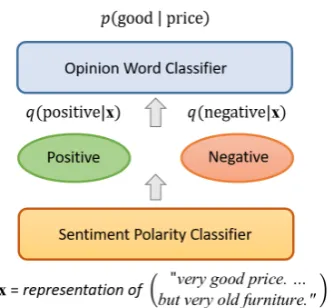
Figure 1: A sentiment polarity classifier and an opinion word classifier associated with the aspectprice.
Code and data for this paper are avail-able on https://github.com/HKUST-KnowComp/ VWS-DMSC.
2 VWS-DMSC Approach
In this section, we describe our variational ap-proach to weakly supervised DMSC (VWS-DMSC). In the next section, we present how we obtain target-opinion word pairs by using a rule-based extraction approach.
2.1 Overview
Our model consists of a sentiment polarity clas-sifier and an opinion word clasclas-sifier. Our task is document-level multi-aspect sentiment classifica-tion. For each aspect, we train a sentiment polar-ity classifier and an opinion word classifier. The input of the sentiment polarity classifier of each aspect is the same, i.e., a representation of a docu-ment. The target-opinion word pairs used in opin-ion word classifiers are different for different as-pects.
Figure 1 shows the relation between two clas-sifiers (on the aspect price). The input x of the sentiment polarity classifier is a representation of a document, e.g., bag-of-words or a representa-tion learned by recurrent neural networks. The sentiment polarity classifier takes x as input and produces a distribution of sentiment polarity Ra
of an aspect a, denoted as q(Ra|x). If Ra only
has two possible values, i.e., positive and negative, then outputs of the classifier areq(positive|x)and q(negative|x) respectively. The opinion word classifier takes a target word (“price”) and a pos-sible value of the sentiment polarityra as input,
train-ing objective is to maximize the log-likelihood of an opinion word given a target word, e.g., p(“good”|“price”). The likelihood is estimated based on the sentiment polarity classifier and the opinion word classifier.
2.2 Sentiment Polarity Classifier
The sentiment polarity classifier aims to estimate a distribution of sentiment polarityq(Ra|x), where
Ra is a discrete random variable representing the
sentiment polarity andxis a feature representation of a document. We use a simple Softmax classi-fier here. We denoteraas a possible value of the
random variableRa, representing a possible
senti-ment polarity. The model estimates the probability of classraas
q(Ra=ra|x) =
exp wTrax
P
r0
aexp w T r0
ax
, (1)
where wra is a vector associated with sentiment
classrafor aspecta.
Document Representation The representation of a document x can be different using different feature extraction approaches. Traditional doc-ument representations of sentiment classification would be bag-of-words, n-gram, or averaged word embeddings. Recently, end-to-end recurrent neu-ral network based models demonstrate a powerful capacity to extract features of a document. The state-of-the-art model in DMSC task is (Yin et al., 2017). We use it as the document representation in our model.
2.3 Opinion Word Classifier
The opinion word classifier aims to estimate the probability of an opinion wordwo given a target
wordwtand a sentiment polarityra:
p(wo|ra, wt) =
exp ϕ(wo, wt, ra)
P
w0
oexp ϕ(w 0
o, wt, ra)
, (2)
where ϕ is a scoring function related to opinion word wo, target wordwt, and sentiment polarity
ra. Here we use the dot product as the scoring
function:
ϕ(wo, wt, ra) =I (wt, wo)∈ P, wt∈ Ka
·cTrawo , (3) wherewois the word embedding of opinion word
wo,cra is a vector associated withra,P is the set
of pairs extracted from the document,Kais the set
of target words associated with aspecta, andI(·)
is an indicator function where I(true) = 1 and I(f alse) = 0.
Given a target wordwtand a sentiment polarity
ra, we aim to maximize the probability of
opin-ion words highly related to them. For example, opinion word “good” is usually related to target word “price” for aspect valuewith sentiment po-laritypositive, and opinion word “terrible” is usu-ally related to target word “traffic” for aspect loca-tionwith sentiment polaritynegative.
2.4 Training Objective
The objective function is to maximize the log-likelihood of an opinion word wo given a target
word wt. As we mentioned before, the objective
function can be decomposed into two sub-tasks. The first one corresponds to the sentiment polarity classifier. The second one corresponds to the opin-ion word classifier. After introducing a latent vari-able, i.e., the sentiment polarity, to the objective function, we can derive a variational lower bound of the log-likelihood which can incorporate two classifiers:
L= logp(wo|wt)
= logX
ra
p(wo, ra|wt)
= logX
ra
q(ra|x)
hp(wo, ra|wt) q(ra|x)
i
≥X
ra
q(ra|x)
h
logp(wo, ra|wt)
q(ra|x)
i
=Eq(Ra|x)
logp(wo|ra, wt)p(ra|wt)
+H(q(Ra|x))
=Eq(Ra|x)
logp(wo|ra, wt)p(ra)
+H(q(Ra|x)), (4)
where H(·) refers to the Shannon entropy. By applying Jensen’s inequality, the log-likelihood is lower-bounded by Eq. (4). The equality holds if and only if the KL-divergence of two distribu-tions, q(Ra|x) andp(Ra|wt, wo), equals to zero.
Maximizing the variational lower bound is equiv-alent to minimizing the KL-divergence. Hence, we can learn a sentiment polarity classifier which can produce a similar distribution to the true poste-riorp(Ra|wt, wo). Compared withp(Ra|wt, wo),
q(Ra|x)is more flexible since it can take any kind
a target wordwtand a sentiment polarityraare
dependent since the polarity assignment is not in-fluenced by the target word. We also assume that the sentiment polarity Ra follows a uniform
dis-tribution, which meansp(ra)is a constant. We
re-move it in Eq. (4) to get a new objective function as follows:
Eq(Ra|x)[logp(wo|ra, wt)] +H(q(Ra|x)). (5)
2.4.1 Approximation
The partition function of Eq. (2) requires the sum-mation over all opinion words in the vocabulary. However, the size of opinion word vocabulary is large, so we use the negative sampling technique (Mikolov et al., 2013) to approximate Eq. (2). Specifically, we substitutelogp(wo|ra, wt) in the
objective (5) with the following objective func-tion:
logσ ϕ(wo, wt, ra)
+ X
w0
o∈N
logσ −ϕ(w0o, wt, ra)
,
(6) where wo0 is a negative sample of opinion words in the vocabulary, N is the set of negative sam-ples andσis the sigmoid function. Then our final objective function is rewritten as:
Eq(Ra|x)
logσ ϕ(wo, wt, ra)
+ X
w0
o∈N
logσ −ϕ(w0o, wt, ra)
+αH(q(Ra|x)),
(7)
where α is a hyper-parameter which can adjust the expectation and entropy terms into the same scale (Marcheggiani and Titov,2016).
3 Target Opinion Word Pairs Extraction
Target-opinion word pairs extraction is a well studied problem (Hu and Liu,2004;Popescu and Etzioni, 2005; Bloom et al., 2007; Qiu et al., 2011). We designed five rules to extract potential target-opinion word pairs. Our method relies on Stanford Dependency Parser (Chen and Manning, 2014). We describe our rules as follows.
Rule 1: We extract pairs satisfying the grammatical relation amod (adjectival modi-fier) (De Marneffe and Manning, 2008). For ex-ample, in phrase “very good price,” we extract “price” and “good” as a target-opinion pair.
Rule 2: We extract pairs satisfying the gram-matical relation nsubj (nominal subject), and the
Dataset TripAdvisor BeerAdvocate
# docs 28,543 27,583
# target words 3,737 3,088 # opinion words 12,406 9,166
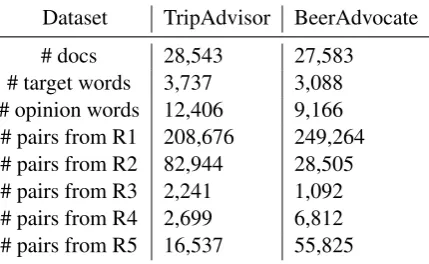
[image:4.595.309.524.64.196.2]# pairs from R1 208,676 249,264 # pairs from R2 82,944 28,505 # pairs from R3 2,241 1,092 # pairs from R4 2,699 6,812 # pairs from R5 16,537 55,825
Table 1: Statistics of extracted target-opinion pairs .
head word is an adjective and the tail word is a noun. For example, in a sentence “The room is small,” we can extract “room” and “small” as a target-opinion pair.
Rule 3: Some verbs are also opinion words and they are informative. We extract pairs satisfying the grammatical relationdobj(direct object) when the head word is one of the following four words: “like”, “dislike”, “love”, and “hate”. For example, in the sentence “I like the smell,” we can extract “smell” and “like” as a target-opinion pair.
Rule 4: We extract pairs satisfying the gram-matical relation xcomp (open clausal comple-ment), and the head word is one of the follow-ing word: “seem”,“look”, “feel”, “smell”, and “taste”. For example, in the sentence “This beer tastes spicy,” we can extract “taste” and “spicy” as a target-opinion pair.
Rule 5: If the sentence contains some adjec-tives that can implicitly indicate aspects, we man-ually assign them to the corresponding aspects. According to (Lakkaraju et al., 2014), some ad-jectives serve both as target words and opinion words. For example, in the sentence “very tasty, and drinkable,” the previous rules fail to extract any pair. But we know it contains a target-opinion pair, i.e., “taste-tasty.” Most of these adjectives have the same root form with the aspects they indi-cated, e.g., “clean” (cleanliness), and “overpriced” (price). This kind of adjective can be extracted first and then we can obtain more similar adjec-tives using word similarities. For example, given “tasty,” we could get “flavorful” by retrieving sim-ilar words.
5 can be removed to save human effort. The effect of removing rule 5 is shown in experiments.
After extracting potential target-opinion word pairs, we need to assign them to different aspects as supervision signals. We select some seed words to describe each aspect, and then calculate simi-larities between the extracted target (or opinion) word and seed words, and assign the pair to the aspect where one of its seed words has the high-est similarity. The similarity we used is the cosine similarity between two word embeddings trained by word2vec (Mikolov et al., 2013). For exam-ple, suppose seed words {“room”, “bed”} and
{“business”, “Internet”} are used to describe the aspect room and business respectively, and the candidate pair “pillow - soft” will be assigned to the aspectroomif the similarity between “pillow” and “bed” is highest among all combinations.
4 Experiment
In this section, we report average sentiment clas-sification accuracies over all aspects on binary DMSC task.
4.1 Datasets
We evaluate our model on TripAdvisor (Wang et al., 2010) and BeerAdvocate (McAuley et al., 2012;Lei et al., 2016;Yin et al., 2017) datasets, which contain seven aspects (value, room, loca-tion, cleanliness, check in/front desk, service, and business) and four aspects (feel, look, smell, and taste) respectively. We run the same preprocess-ing steps as (Yin et al.,2017). Both datasets are split into train/development/test sets with propor-tions 8:1:1. All methods can use development set to tune their hyper-parameters. Ratings of TripAd-visor and BeerAdvocate datasets are on scales of
1to5 and0to5respectively. But in BeerAdvo-cate, 0 star is rare, so we treat the scale as 1 to
5. We convert original scales to binary scales as follows: 1 and 2 stars are treated as negative, 3 is ignored, and 4 and 5 stars are treated as positive. In BeerAdvocate, most reviews have positive po-larities, so to avoid the unbalanced issue, we per-form data selection according to overall polarities. After data selection, the number of reviews with negative overall polarities and that with positive overall polarities are equal.
4.2 Compared Methods
To demonstrate the effectiveness of our method, we compare our model with following baselines:
Majorityuses the majority of sentiment polari-ties in training sets as predictions.
Lexiconmeans using an opinion lexicon to as-sign sentiment polarity to an aspect (Read and Carroll, 2009;Pablos et al., 2015). We combine two popular opinion lexicons used byHu and Liu (2004) andWilson et al.(2005) to get a new one. If an opinion word from extracted pairs is in positive (negative) lexicon, it votes for positive (negative). When the opinion word is with a negation word, its polarity will be flipped. Then, the polarity of an aspect is determined by using majority voting among all opinion words associated with the as-pect. When the number of positive and negative words is equal, we adopt two different ways to re-solve it. ForLexicon-R, it randomly assigns a po-larity. ForLexicon-O, it uses the overall polarity as the prediction. Since overall polarities can also be missing, for both Lexicon-R and Lexicon-O, we randomly assign a polarity in uncertain cases and report both mean and std based on five trials of random assignments.
Assign-Omeans directly using the overall po-larity of a review in the development/test sets as the prediction for each aspect.
LRRassumes the overall polarity is a weighted sum of the polarity of each aspect (Wang et al., 2010). LRR can be regarded as the only existing weakly supervised baseline where both algorithm and source code are available.
BoW-DMSC-A is a simple softmax classifier using all annotated training data where the input is a bag-of-words feature vector of a document.
N-DMSC-A is the state-of-the-art neural net-work based model (Yin et al., 2017) (N-DMSC) in DMSC task using all annotated training data, which serves an upper bound to our method.
N-DMSC-Ois to use overall polarities as “su-pervision” to train an N-DMSC and apply it to the classification task of each aspect at the test time.
N-DMSC-{50,100,200,500,1000} is the N-DMSC algorithm using partial data. In order to see our method is comparable to supervised methods using how many labeled data, we use
Dataset TripAdvisor BeerAdvocate
DEV TEST DEV TEST
Mean Std Mean Std Mean Std Mean Std
Majority 0.6286 – 0.6242 – 0.6739 – 0.6726 –
Lexicon-R 0.5914 0.0021 0.5973 0.0018 0.5895 0.0020 0.5881 0.0025 Lexicon-O 0.7153 0.0012 0.7153 0.0015 0.6510 0.0023 0.6510 0.0021 Assign-O 0.7135 0.0016 0.7043 0.0020 0.6652 0.0028 0.6570 0.0034
N-DMSC-O 0.7091 – 0.7064 – 0.6386 – 0.6493 –
LRR 0.6915 0.0045 0.6947 0.0024 0.5976 0.0110 0.5941 0.0113
VWS-DMSC (Our) 0.7577 0.0016 0.7561 0.0012 0.7502 0.0058 0.7538 0.0066
N-DMSC-50 0.7255 0.0231 0.7270 0.0204 0.7381 0.0143 0.7442 0.0157 N-DMSC-100 0.7482 0.0083 0.7487 0.0069 0.7443 0.0126 0.7493 0.0145 N-DMSC-200 0.7531 0.0040 0.7550 0.0043 0.7555 0.0096 0.7596 0.0092 N-DMSC-500 0.7604 0.0028 0.7616 0.0040 0.7657 0.0066 0.7713 0.0070 N-DMSC-1000 0.7631 0.0054 0.7638 0.0042 0.7708 0.0066 0.7787 0.0053
N-DMSC-A 0.8281 – 0.8334 – 0.8576 – 0.8635 –
[image:6.595.79.517.64.307.2]BoW-DMSC-A 0.8027 – 0.8029 – 0.8069 – 0.8089 –
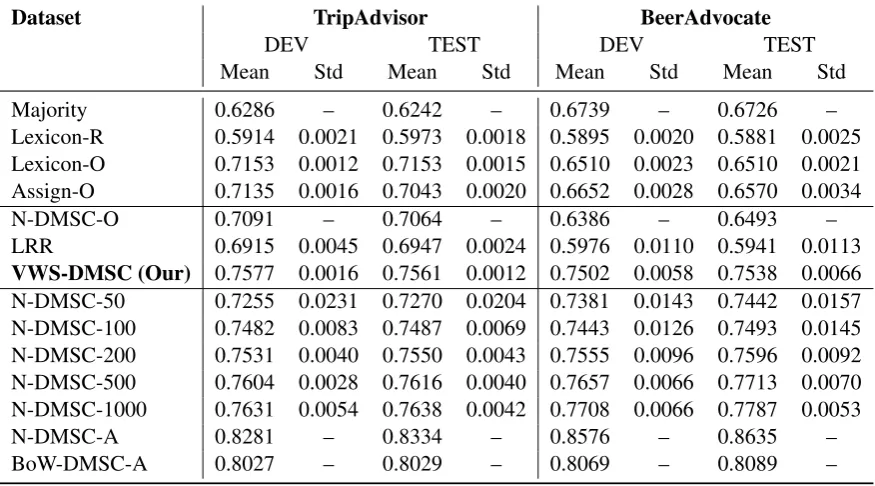
Table 2: Averaged accuracies on DMSC of unsupervised, weakly supervised, and supervised methods on TripAd-visor and BeerAdvocate. Methods involve randomness also report standard deviation.
Since the sampled labeled data may vary for dif-ferent trials, we perform five trials of random sam-pling and report both mean and std of the results.
For our method, denoted as VWS-DMSC, the document representation we used is obtained from N-DMSC (Yin et al., 2017). They proposed a novel hierarchical iterative attention model in which documents and pseudo aspect related ques-tions are interleaved at both word and sentence-level to learn an aspect-aware document represen-tation. The pseudo aspect related questions are represented by aspect related keywords. In or-der to benefit from their aspect-aware represen-tation scheme, we train an N-DMSC to extract the document representation using only overall polarities. In the iterative attention module, we use the pseudo aspect related keywords of all as-pects released by Yin et al. (2017). One can also use document-to-document autoencoders (Li et al.,2015) to generate the document representa-tion. In this way, our method can get rid of using overall polarities to generate the document repre-sentation. Hence, unlike LRR, it is not necessary for our method to use overall polarities. Here, to have a fair comparison with LRR, we use the over-all polarities to generate document representation. For our method, we do not know which state is positive and which one is negative at training time, so the Hungarian algorithm (Kuhn,1955) is used to resolve the assignment problem at the test time.
4.3 Results and Analysis
We show all results in Table2, which consists of three blocks, namely, unsupervised, weakly super-vised, and supervised methods.
For unsupervised methods, our method can out-perform majority on both datasets consistently. But other weakly supervised methods cannot out-perform majority on BeerAdvocate dataset, which shows these baselines cannot handle unbalanced data well since BeerAdvocate is more unbal-anced than TripAdvisor. Our method outperforms Lexicon-R and Lexicon-O, which shows that pre-dicting an opinion word based on a target word may be a better way to use target-opinion pairs, compared with performing a lexicon lookup using opinion words from extract pairs. Good perfor-mance of Lexicon-O and Assign-O demonstrates the usefulness of overall polarities in develop-ment/test sets. N-DMSC-O trained with the over-all polarities cannot outperform Assign-O since N-DMSC-O can only see overall polarities in train-ing set while Assign-O can see overall polarities for both development and test sets and does not involve learning and generalization.
be-Dataset TripAdvisor BeerAdvocate
Rule DEV TEST DEV TEST
[image:7.595.72.288.64.253.2]R1 0.7215 0.7174 0.7220 0.7216 R2 0.7172 0.7180 0.6864 0.6936 R3 0.6263 0.6187 0.6731 0.6725 R4 0.6248 0.6279 0.6724 0.6717 R5 0.5902 0.5856 0.7095 0.7066 - R1 0.7538 0.7481 0.7458 0.7474 - R2 0.7342 0.7368 0.7504 0.7529 - R3 0.7418 0.7397 0.7565 0.7558 - R4 0.7424 0.7368 0.7518 0.7507 - R5 0.7448 0.7440 0.7550 0.7548 All 0.7577 0.7561 0.7502 0.7538
Table 3: Averaged accuracies on DMSC. “R1 – R5” means only using a rule while “-R1 – -R5” means re-moving a rule from all the rules.
cause it only uses overall polarities as “supervi-sion,” and we still outperform it significantly. It is interesting that LRR is worse than N-DMSC-O. We guess that assuming that the overall polarity is a weighted sum of all aspect polarities may not be a good strategy to train each aspect’s polarity or the document representation learned by N-DMSC is better than the bag-of-words representation.
For supervised block methods, BoW-DMSC-A and N-DMSC-BoW-DMSC-A are both supervised methods using all annotated data, which can be seen as the upper bound of our algorithm. N-DMSC-A outperforms BoW-DMSC-N-DMSC-A, which shows that the document representation based on neural net-work is better than the bag-of-words representa-tion. Hence, we use the neural networks based document representation as input of the sentiment polarity classifier. Our results are comparable to N-DMSC-200 on TripAdvisor and N-DMSC-100 on BeerAdvocate.
4.4 Ablation Study
To evaluate effects of extracted rules, we per-formed an ablation study. We run our algorithm VWS-DMS with each rule kept or removed over two datasets. If no pairs extracted for one aspect in training set, the accuracy of this aspect will be 0.5, which is a random guess. From the Table3we can see that, the rule R1 is the most effective rule for both datasets. Rules R3/R4/R5 are less effec-tive on their own. However, as a whole, they can still improve the overall performance. When con-sidering removing each of rules, we found that our algorithm is quite robust, which indicates
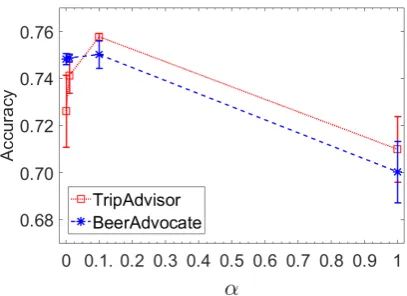
miss-Figure 2: Parameter sensitivity analysis.
ing one of the rules may not hurt the performance much. Hence, if human labor is a major concern, rule 5 can be discarded. We found that sometimes removing one rule may even result in better accu-racy (e.g., “-R3” for BeerAdvocate dataset). This means this rule may introduce some noises into the objective function. However, “-R3” can result in worse accuracy for TripAdvisor, which means it is still complementary to the other rules for this dataset.
4.5 Parameter Sensitivity
We also conduct parameter sensitivity analysis of our approach. The parameter α in Equation (7) adjusts the expectation and entropy terms on the same scale. We testα={0,0.01,0.1,1}for both of the datasets. As we can see from Figure2,α = 0.1is a good choice for both datasets.
4.6 Implementation Details
We implemented our models using TensorFlow (Abadi et al.,2016). For N-DMSC and LRR, we used code released byYin et al.(2017) andWang et al. (2010) respectively and followed their pre-processing steps and optimal settings.
Parameters are updated by using ADADELTA (Zeiler, 2012), an adaptive learning rate method. To avoid overfitting, we impose weight decay and drop out on both classifiers. The regularization coefficient and drop out rate are set to 10−3 and
[image:7.595.310.514.71.219.2]probability of a pair being selected is proportional to the frequency of the opinion word to the power of −0.25. In this way, opinion words with low frequency are more likely to be selected compared to the uniform sampling. In order to initialize both classifiers better, the word embeddings are retrofitted (Faruqui et al.,2015) using PPDB ( Gan-itkevitch et al.,2013) semantic lexicons.
5 Related Work
In this section, we review the related work on document-level multi-aspect sentiment classifica-tion, target-opinion word pairs extracclassifica-tion, and variational methods.
Document-level Multi-Aspect Sentiment Clas-sification. Wang et al. (2010) proposed a LRR model to solve this problem. LRR assumes the overall polarity is a weighted sum of all aspect po-larities which are represented by word frequency features. LRR needs to use aspect keywords to perform sentence segmentation to generate the representation of each aspect. To address the lim-itation of using aspect keywords, LARAM (Wang et al.,2011) assumes that the text content describ-ing a particular aspect is generated by sampldescrib-ing words from a topic model corresponding to the latent aspect. Both LRR and LARAM can only access to overall polarities in the training data, but not gold standards of aspect polarities. Meng et al. (2018) proposed a weakly supervised text classification method which can take label sur-face names, class-related keywords, or a few la-beled documents as supervision. Ramesh et al. (2015) developed a weakly supervised joint model to identify aspects and the corresponding senti-ment polarities in online courses. They treat as-pect (sentiment) related seed words as weak super-vision. In the DMSC task which is a fine-grained text classification task, the label surface names or keywords for some aspects would be very simi-lar. Given that the inputs are the same and the su-pervisions are similar, weakly supervised models cannot distinguish them. So we do not consider them as our baselines. Yin et al.(2017) modeled this problem as a machine comprehension prob-lem under a multi-task learning framework. It also needs aspect keywords to generate aspect-aware document representations. Moreover, it can access gold standards of aspect polarities and achieved state-of-the-art performance on this task. Hence, it can serve as an upper bound. Some
sentence-level aspect based sentiment classification meth-ods (Wang et al.,2016b,2018) can be directly ap-plied to the DMSC task, because they can solve aspect category sentiment classification task. For example, given a sentence “the restaurant is ex-pensive,” the aspect category sentiment classifica-tion task aims to classify the polarity of the aspect category “price” to be negative. The aspect cat-egories are predefined which are the same as the DMSC task. Some of them (Tang et al.,2016a,b; Chen et al.,2017;Ma et al.,2017) cannot because they are originally designed for aspect term senti-ment classification task. For example, given a sen-tence “I loved their fajitas,” the aspect term senti-ment classification task aims to classify the polar-ity of the aspect term “fajitas” to bepositive. The aspect terms appearing in the sentence should be provided as inputs.
Target Opinion Word Pairs Extraction. There are two kinds of methods, namely, rule based methods and learning based methods to solve this task. Rule based methods extract target-opinion word pairs by mining the dependency tree paths between target words and opinion words. Learn-ing based methods treat this task as a sequence la-beling problem, mapping each word to one of the following categories: target, opinion, and other.
(Hu and Liu,2004) is one of earliest rule based methods to extract target-opinion pairs. An opin-ion word is restricted to be an adjective. Tar-get words are extracted first, and then an opinion word is linked to its nearest target word to form a pair. Popescu and Etzioni (2005) and Bloom et al. (2007) manually designed dependency tree path templates to extract target-opinion pairs. If the path between a target word candidate and an opinion word candidate belongs to the set of path templates, the pair will be extracted. Qiu et al. (2011) identified dependency paths that link opin-ion words and targets via a bootstrapping process. This method only needs an initial opinion lexicon to start the bootstrapping process. Zhuang et al. (2006) adopted a supervised learning algorithm to learn valid dependency tree path templates, but it requires target-opinion pairs annotations.
and Lam,2017) to predict the label (target, opin-ion or other) of each word. Jakob and Gurevych (2010) andLi et al.(2012) extracted target-opinion pairs without using using any labeled data in the domain of interest, but it needs lots of labeled data in another related domain.
In this paper, we only use very simple rules to extract target-opinion pairs to validate the effec-tiveness of our approach. If better pairs can be extracted, we can further improve our results.
Variational Methods. Variational autoen-coders (Kingma and Welling, 2014; Rezende et al., 2014) (VAEs) use a neural network to parameterize a probability distribution. VAEs consists of an encoder which parameterizes posterior probabilities and a decoder which parameterizes the reconstruction likelihood given a latent variable. VAEs inspire many interesting works (Titov and Khoddam, 2015;Marcheggiani and Titov, 2016; ˇSuster et al., 2016; Zhang et al.,2018;Chen et al.,2018) which are slightly different from VAEs. Their encoders produce a discrete distribution while the encoder in VAEs yields a continuous latent variable. Titov and Khoddam (2015) aimed to solve semantic role labeling problem. The encoder is essentially a semantic role labeling model which predicts roles given a rich set of syntactic and lexical features. The decoder reconstructs argument fillers given predicted roles. Marcheggiani and Titov (2016) aimed to solve unsupervised open domain relation discovery. The encoder is a feature-rich relation extractor, which predicts a semantic relation between two entities. The decoder reconstructs entities relying on the predicted relation. ˇSuster et al. (2016) tried to learn multi-sense word embeddings. The encoder uses bilingual context to choose a sense for a given word. The decoder predicts context words based on the chosen sense and the given word. Zhang et al. (2018) aimed to solve knowledge graph powered question answering. Three neural networks are used to parameterize probabilities of a topic entity given a query and an answer, an answer based on a query and a predicted topic, and the topic given the query. Chen et al. (2018) aimed to infer missing links in a knowledge graph. Three neural networks are used to parameterize probabilities of a latent path given two entities and a relation, a relation based on two entities and the chosen latent path, and the relation given the latent
path. Our method also uses neural networks to parameterize two discrete distributions but aims to solve the DMSC task.
6 Conclusion
In this paper, we propose a variational ap-proach to weakly supervised DMSC. We extract many target-opinion word pairs from dependency parsers using simple rules. These pairs can be “supervision” signals to predict sentiment polar-ity. Our objective function is to predict an opin-ion word given a target word. After introducing the sentiment polarity as a latent variable, we can learn a sentiment polarity classifier by optimizing the variational lower bound. We show that we can outperform weakly supervised baselines by a large margin and achieve comparable results to the su-pervised method with hundreds of labels per as-pect, which can reduce a lot of labor work in prac-tice. In the future, we plan to explore better target-opinion word extraction approaches to find better “supervision” signals.
Acknowledgments
This paper was supported by the Early Career Scheme (ECS, No. 26206717) from Research Grants Council in Hong Kong. Ziqian Zeng has been supported by the Hong Kong Ph.D. Fellow-ship. We thank Intel Corporation for supporting our deep learning related research. We also thank the anonymous reviewers for their valuable com-ments and suggestions that help improve the qual-ity of this manuscript.
References
Martin Abadi, Paul Barham, Jianmin Chen, Zhifeng Chen, Andy Davis, Jeffrey Dean, Matthieu Devin, Sanjay Ghemawat, Geoffrey Irving, Michael Isard, Manjunath Kudlur, Josh Levenberg, Rajat Monga, Sherry Moore, Derek G. Murray, Benoit Steiner, Paul Tucker, Vijay Vasudevan, Pete Warden, Martin Wicke, Yuan Yu, and Xiaoqiang Zheng. 2016. Ten-sorflow: A system for large-scale machine learning. InProceedings of OSDI, pages 265–283.
Kenneth Bloom, Navendu Garg, Shlomo Argamon, et al. 2007. Extracting appraisal expressions. In
Proceedings of NAACL-HLT, pages 308–315.
Peng Chen, Zhongqian Sun, Lidong Bing, and Wei Yang. 2017. Recurrent attention network on mem-ory for aspect sentiment analysis. InProceedings of EMNLP, pages 452–461.
Wenhu Chen, Wenhan Xiong, Xifeng Yan, and William Wang. 2018. Variational knowledge graph reason-ing. In Proceedings of NAACL-HLT, pages 1823– 1832.
Marie-Catherine De Marneffe and Christopher D Man-ning. 2008. Stanford typed dependencies manual. Technical report, Technical report, Stanford Univer-sity.
Manaal Faruqui, Jesse Dodge, Sujay K. Jauhar, Chris Dyer, Eduard Hovy, and Noah A. Smith. 2015. Retrofitting word vectors to semantic lexicons. In
Proceedings of NAACL-HLT, pages 1606–1615.
Juri Ganitkevitch, Benjamin Van Durme, and Chris Callison-Burch. 2013. Ppdb: The paraphrase database. In Proceedings of NAACL-HLT, pages 758–764.
Minqing Hu and Bing Liu. 2004. Mining and summa-rizing customer reviews. InProceedings of KDD, pages 168–177.
Niklas Jakob and Iryna Gurevych. 2010. Extracting opinion targets in a single- and cross-domain setting with conditional random fields. InProceedings of EMNLP, pages 1035–1045.
Diederik P Kingma and Max Welling. 2014. Auto-encoding variational Bayes. InICLR.
Harold W Kuhn. 1955. The hungarian method for the assignment problem. Naval Research Logistics, 2(1-2):83–97.
John D. Lafferty, Andrew McCallum, and Fernando C. N. Pereira. 2001. Conditional random fields: Probabilistic models for segmenting and labeling se-quence data. In Proceedings of ICML, pages 282– 289.
Himabindu Lakkaraju, Richard Socher, and Chris Man-ning. 2014. Aspect specific sentiment analysis us-ing hierarchical deep learnus-ing. In Proceedings of NIPS workshop on Deep Learning and Representa-tion Learning.
Tao Lei, Regina Barzilay, and Tommi Jaakkola. 2016. Rationalizing neural predictions. InProceedings of EMNLP, pages 107–117.
Fangtao Li, Sinno Jialin Pan, Ou Jin, Qiang Yang, and Xiaoyan Zhu. 2012. Cross-domain co-extraction of sentiment and topic lexicons. In Proceedings of ACL, pages 410–419.
Jiwei Li, Minh-Thang Luong, and Dan Jurafsky. 2015. A hierarchical neural autoencoder for paragraphs and documents. In Proceedings of ACL, pages 1106–1115.
Xin Li and Wai Lam. 2017. Deep multi-task learning for aspect term extraction with memory interaction. InProceedings of EMNLP, pages 2886–2892.
Pengfei Liu, Shafiq Joty, and Helen Meng. 2015. Fine-grained opinion mining with recurrent neural net-works and word embeddings. In Proceedings of EMNLP, pages 1433–1443.
Dehong Ma, Sujian Li, Xiaodong Zhang, and Houfeng Wang. 2017. Interactive attention networks for aspect-level sentiment classification. In Proceed-ings of IJCAI, pages 4068–4074.
Diego Marcheggiani and Ivan Titov. 2016. Discrete-state variational autoencoders for joint discovery and factorization of relations. Transactions of the Asso-ciation for Computational Linguistics, 4:231–244.
Julian McAuley, Jure Leskovec, and Dan Jurafsky. 2012. Learning attitudes and attributes from multi-aspect reviews. In Proceedings of ICDM, pages 1020–1025.
Yu Meng, Jiaming Shen, Chao Zhang, and Jiawei Han. 2018. Weakly-supervised neural text classification. InProceedings of the 27th ACM International Con-ference on Information and Knowledge Manage-ment, pages 983–992. ACM.
Tomas Mikolov, Ilya Sutskever, Kai Chen, Greg S Cor-rado, and Jeff Dean. 2013. Distributed representa-tions of words and phrases and their compositional-ity. InProceedings of NIPS, pages 3111–3119.
Aitor Garc´ıa Pablos, Montse Cuadros, and German Rigau. 2015. V3: Unsupervised aspect based sen-timent analysis for semeval2015 task 12. In Pro-ceedings of SemEval, pages 714–718.
Ana-Maria Popescu and Orena Etzioni. 2005. Extract-ing product features and opinions from reviews. In
Proceedings of EMNLP-HLT, pages 339–346.
Guang Qiu, Bing Liu, Jiajun Bu, and Chun Chen. 2011. Opinion word expansion and target extrac-tion through double propagaextrac-tion. Computational linguistics, 37:9–27.
Arti Ramesh, Shachi H Kumar, James Foulds, and Lise Getoor. 2015. Weakly supervised models of aspect-sentiment for online course discussion forums. In
Proceedings of ACL, pages 74–83.
Jonathon Read and John Carroll. 2009. Weakly super-vised techniques for domain-independent sentiment classification. InProceedings of CIKM workshop on Topic-sentiment Analysis for Mass Opinion, pages 45–52. ACM.
Danilo Jimenez Rezende, Shakir Mohamed, and Daan Wierstra. 2014. Stochastic backpropagation and ap-proximate inference in deep generative models. In
Simon ˇSuster, Ivan Titov, and Gertjan van Noord. 2016. Bilingual learning of multi-sense embeddings with discrete autoencoders. In Proceedings of NAACL-HLT, pages 1346–1356.
Duyu Tang, Bing Qin, Xiaocheng Feng, and Ting Liu. 2016a. Effective lstms for target-dependent senti-ment classification. In Proceedings of COLING, pages 3298–3307.
Duyu Tang, Bing Qin, and Ting Liu. 2016b. Aspect level sentiment classification with deep memory net-work. InProceedings of EMNLP, pages 214–224.
Ivan Titov and Ehsan Khoddam. 2015. Unsupervised induction of semantic roles within a reconstruction-error minimization framework. In Proceedings of NAACL-HLT, pages 1–10.
Hongning Wang, Yue Lu, and Chengxiang Zhai. 2010. Latent aspect rating analysis on review text data: a rating regression approach. InProceedings of KDD, pages 783–792.
Hongning Wang, Yue Lu, and Chengxiang Zhai. 2011. Latent aspect rating analysis without aspect keyword supervision. In Proceedings of KDD, pages 618– 626.
Jingjing Wang, Jie Li, Shoushan Li, Yangyang Kang, Min Zhang, Luo Si, and Guodong Zhou. 2018. As-pect sentiment classification with both word-level and clause-level attention networks. InIJCAI, pages 4439–4445.
Wenya Wang, Sinno Jialin Pan, Daniel Dahlmeier, and Xiaokui Xiao. 2016a. Recursive neural conditional random fields for aspect-based sentiment analysis. InProceedings of EMNLP, pages 616–626.
Wenya Wang, Sinno Jialin Pan, Daniel Dahlmeier, and Xiaokui Xiao. 2017. Coupled multi-layer attentions for co-extraction of aspect and opinion terms. In
Proceedings of AAAI, pages 3316–3322.
Yequan Wang, Minlie Huang, Li Zhao, et al. 2016b. Attention-based lstm for aspect-level sentiment clas-sification. InProceedings of EMNLP, pages 606– 615.
Theresa Wilson, Janyce Wiebe, and Paul Hoffmann. 2005. Recognizing contextual polarity in phrase-level sentiment analysis. InProceedings of EMNLP-HLT, pages 347–354.
Bishan Yang and Claire Cardie. 2012. Extracting opin-ion expressopin-ions with semi-markov conditopin-ional ran-dom fields. In Proceedings of EMNLP-CoNLL, pages 1335–1345.
Yichun Yin, Yangqiu Song, and Ming Zhang. 2017. Document-level multi-aspect sentiment classifica-tion as machine comprehension. InProceedings of EMNLP, pages 2034–2044.
Matthew D Zeiler. 2012. Adadelta: an adaptive learn-ing rate method.arXiv preprint arXiv:1212.5701.
Yuyu Zhang, Hanjun Dai, Zornitsa Kozareva, Alexan-der J Smola, and Le Song. 2018. Variational reason-ing for question answerreason-ing with knowledge graph. InProceedings of AAAI, pages 6069–6076.