Real-Word Spelling Correction using Google Web 1T 3-grams
Aminul Islam
Department of Computer Science University of Ottawa Ottawa, ON, K1N 6N5, Canada [email protected]
Diana Inkpen
Department of Computer Science University of Ottawa Ottawa, ON, K1N 6N5, Canada
Abstract
We present a method for detecting and correcting multiple real-word spelling er-rors using the Google Web 1T 3-gram data set and a normalized and modified ver-sion of the Longest Common Subsequence (LCS) string matching algorithm. Our method is focused mainly on how to im-prove the detection recall (the fraction of errors correctly detected) and the correc-tion recall (the fraccorrec-tion of errors correctly amended), while keeping the respective precisions (the fraction of detections or amendments that are correct) as high as possible. Evaluation results on a standard data set show that our method outperforms two other methods on the same task.
1 Introduction
Real-word spelling errors are words in a text that occur when a user mistakenly types a correctly spelled word when another was intended. Errors of this type may be caused by the writer’s igno-rance of the correct spelling of the intended word or by typing mistakes. Such errors generally go unnoticed by most spellcheckers as they deal with words in isolation, accepting them as correct if they are found in the dictionary, and flagging them as errors if they are not. This approach would be sufficient to detect the non-word errormyssin “It doesn’t know what themyssis all about.” but not the real-word errormuss in “It doesn’t know what themuss is all about.” To detect the latter, the spell-checker needs to make use of the sur-rounding context such as, in this case, to recog-nise thatfussis more likely to occur thanmussin the context ofall about. Ironically, errors of this type may even be caused by spelling checkers in the correction of non-word spelling errors when theauto-correctfeature in some word-processing
software sometimes silently change a non-word to the wrong real word (Hirst and Budanitsky, 2005), and sometimes when correcting a flagged error, the user accidentally make a wrong selection from the choices offered (Wilcox-O’Hearn et al., 2008). An extensive review of real-word spelling cor-rection is given in (Pedler, 2007; Hirst and Budan-itsky, 2005) and the problem of spelling correction more generally is reviewed in (Kukich, 1992).
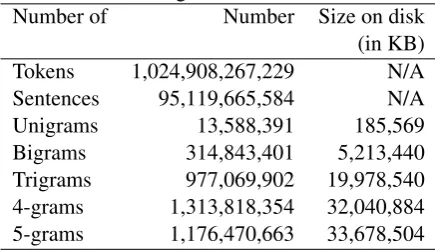
[image:1.595.307.525.553.679.2]The Google Web 1T data set (Brants and Franz, 2006), contributed by Google Inc., contains En-glish word n-grams (from unigrams to 5-grams) and their observed frequency counts calculated over 1 trillion words from web page text col-lected by Google in January 2006. The text was tokenised following the Penn Treebank tokenisa-tion, except that hyphenated words, dates, email addresses and URLs are kept as single tokens. The sentence boundaries are marked with two spe-cial tokens<S>and</S>. Words that occurred fewer than 200 times were replaced with the spe-cial token<UNK>. Table 1 shows the data sizes of the Web 1T corpus. The n-grams themselves
Table 1: Google Web 1T Data Sizes Number of Number Size on disk
(in KB) Tokens 1,024,908,267,229 N/A Sentences 95,119,665,584 N/A Unigrams 13,588,391 185,569 Bigrams 314,843,401 5,213,440 Trigrams 977,069,902 19,978,540 4-grams 1,313,818,354 32,040,884 5-grams 1,176,470,663 33,678,504
must appear at least 40 times to be included in the Web 1T corpus1. It is expected that this data will be useful for statistical language modeling, e.g.,
1Details of the Google Web 1T data set can be found at
www.ldc.upenn.edu/Catalog/docs/LDC2006T13/readme.txt
for machine translation or speech recognition, as well as for other uses.
In this paper, we present a method for detecting and correcting multiple real-word spelling errors using the Google Web 1T 3-gram data set, and a normalized and modified version of the Longest Common Subsequence (LCS) string matching al-gorithm (details are in section 3.1). Bymultiple er-rors, we mean that if we havenwords in the input sentence, then we try to detect and correct at most n-1 errors. We do not try to detect and correct an error, if any, in the first word as it is not compu-tationally feasible to search in the Google Web 1T 3-grams while keeping the first word in the 3-gram as a variable. Our intention is to focus on how to improve the detection recall (the fraction of errors correctly detected) or correction recall (the frac-tion of errors correctly amended) while maintain-ing the respective precisions (the fraction of de-tections or amendments that are correct) as high as possible. The reason behind this intention is that if the recall for any method is around 0.5, this means that the method fails to detect or correct around 50 percent of the errors. As a result, we can not com-pletely rely on these type of methods, for that we need some type of human interventions or sugges-tions to detect or correct the rest of the undetected or uncorrected errors. Thus, if we have a method that can detect or correct almost 80 percent of the errors, even generating some extra candidates that are incorrect is more helpful to the human.
This paper is organized as follow: Section 2 presents a brief overview of the related work. Our proposed method is described in Section 3. Eval-uation and experimental results are discussed in Section 4. We conclude in Section 5.
2 Related Work
Work on real-word spelling correction can roughly be classified into two basic categories: methods based on semantic information or human-made lexical resources, and methods based on machine learning or probability information. Our proposed method falls into the latter category.
2.1 Methods Based on Semantic Information The ‘semantic information’ approach first pro-posed by Hirst and St-Onge (1998) and later devel-oped by Hirst and Budanitsky (2005) detected se-mantic anomalies, but was not restricted to check-ing words from predefined confusion sets. This
approach was based on the observation that the words that a writer intends are generally seman-tically related to their surrounding words, whereas some types of real-word spelling errors are not, such as (using Hirst and Budanitsky’s example), “It is my sincere hole (hope) that you will recover swiftly.” Such “malapropisms” cause “a pertur-bation of the cohesion (and coherence) of a text.” Hirst and Budanitsky (2005) use semantic distance measures in WordNet (Miller et al., 1993) to de-tect words that are potentially anomalous in con-text - that is, semantically distant from nearby words; if a variation in spelling results in a word that was semantically closer to the context, it is hypothesized that the original word is an error (a “malapropism”) and the closer word is its correc-tion.
2.2 Methods Based on Machine Learning Machine learning methods are regarded as lexical disambiguation tasks and confusion sets are used to model the ambiguity between words. Normally, the machine learning and statistical approaches rely on pre-defined confusion sets, which are sets (usually pairs) of commonly confounded words, such as{their,there,they’re}and{principle, prin-cipal}. The methods learn the characteristics of typical context for each member of the set and de-tect situations in which one member occurs in con-text that is more typical of another. Such meth-ods, therefore, are inherently limited to a set of common, predefined errors, but such errors can in-clude both content and function words. Given an occurrence of one of its confusion set members, the spellchecker’s job is to predict which mem-ber of that confusion set is the most appropriate in the context. Golding and Roth (1999), an exam-ple of a machine-learning method, combined the Winnow algorithm with weighted-majority voting, using nearby and adjacent words as features. An-other example of a machine-learning method is that of Carlson et al. (2001).
2.3 Methods Based on Probability Information
varia-tion, then we hypothesize that the original is an error and the variation is what the user intended.
Wilcox-O’Hearn et al. (2008) analyze the ad-vantages and limitations of Mays et al. (1991)’s method, and present a new evaluation of the al-gorithm, designed so that the results can be com-pared with those of other methods, and then con-struct and evaluate some variations of the algo-rithm that use fixed-length windows. They con-sider a variation of the method that optimizes over relatively short, fixed-length windows instead of over a whole sentence (except in the special case when the sentence is smaller than the window), while respecting sentence boundaries as natural breakpoints. To check the spelling of a span of dwords requires a window of length d+4 to ac-commodate all the trigrams that overlap with the words in the span. The smallest possible window is therefore 5 words long, which uses 3 trigrams to optimize only its middle word. They assume that the sentence is bracketed by twoBoSand two EoSmarkers (to accommodate trigrams involving the first two and last two words of the sentence). The window starts with its left-hand edge at the first BoS marker, and the Mays et al. (1991)’s method is run on the words covered by the tri-grams that it contains; the window then movesd words to the right and the process repeats until all the words in the sentence have been checked. As Mays et al. (1991)’s algorithm is run separately in each window, potentially changing a word in each, Wilcox-O’Hearn et al. (2008)’s method as a side-effect also permits multiple corrections in a single sentence.
Wilcox-O’Hearn et al. (2008) show that the trigram-based real-word spelling-correction method of Mays et al. (1991) is superior in per-formance to the WordNet-based method of Hirst and Budanitsky (2005), even on content words (“malapropisms”), especially when supplied with a realistically large trigram model. Wilcox-O’Hearn et al. (2008) state that their attempts to improve the method with smaller windows and with multiple corrections per sentence were not successful, because of excessive false positives.
Verberne (2002) proposed a trigram-based method for real-word errors without explicitly us-ing probabilities or even localizus-ing the possible er-ror to a specific word. This method simply as-sumes that any word trigram in the text that is attested in the British National Corpus (Burnard,
2000) is correct, and any unattested trigram is a likely error. When an unattested trigram is ob-served, the method then tries the spelling varia-tions of all words in the trigram to find attested trigrams to present to the user as possible correc-tions. The evaluation of this method was carried out on only 7100 words of the Wall Street Journal corpus, with 31 errors introduced (i.e., one error in every approximately 200 words) obtaining a re-call of 0.33 for correction, a precision of 0.05 and a F-measure of 0.086.
3 Proposed Method
The proposed method first tries to determine some probable candidates and then finds the best one among the candidates or sorts them based on some weights. We consider a string similarity function and a normalized frequency value function in our method. The following sections present a detailed description of each of these functions followed by the procedure to determine some probable dates along with the procedure to sort the candi-dates.
3.1 Similarity between Two Strings
We use the longest common subsequence (LCS) (Allison and Dix, 1986) measure with some nor-malization and small modifications for our string similarity measure. We use the same three differ-ent modified versions of LCS that we (Islam and Inkpen, 2008) used, along with another modified version of LCS, and then take a weighted sum of these2. Kondrak (2005) showed that edit distance and the length of the longest common subsequence are special cases of n-gram distance and similarity, respectively. Melamed (1999) normalized LCS by dividing the length of the longest common subse-quence by the length of the longer string and called it longest common subsequence ratio (LCSR). But LCSR does not take into account the length of the shorter string which sometimes has a significant impact on the similarity score.
Islam and Inkpen (2008) normalized thelongest common subsequenceso that it takes into account the length of both the shorter and the longer string and called it normalized longest common
subse-2We (Islam and Inkpen, 2008) use modified versions
quence(NLCS) which is:
v1=NLCS(si, sj) = len(LCS(si, sj))
2
len(si)×len(sj) (1) While in classical LCS, the common subse-quence needs not be consecutive, in spelling cor-rection, a consecutive common subsequence is im-portant for a high degree of matching. We (Is-lam and Inkpen, 2008) usedmaximal consecutive longest common subsequence starting at charac-ter1,MCLCS1 andmaximal consecutive longest common subsequence starting at any charactern, MCLCSn. MCLCS1 takes two strings as input
and returns the shorter string or maximal consec-utive portions of the shorter string that consecu-tively match with the longer string, where match-ing must be from first character (character1) for both strings. MCLCSn takes two strings as in-put and returns the shorter string or maximal secutive portions of the shorter string that con-secutively match with the longer string, where matching may start from any character (char-acter n) for both of the strings. We normal-ized MCLCS1 andMCLCSn and called it
nor-malized MCLCS1 (NMCLCS1) and normalized
MCLCSn(NMCLCSn), respectively.
v2 =NMCLCS1(si, sj) = len(MCLCS1(si, sj))
2
len(si)×len(sj) (2) v3 =NMCLCSn(si, sj) = len(MCLCSn(si, sj))
2
len(si)×len(sj) (3) Islam and Inkpen (2008) did not consider consecu-tive common subsequences ending at the last char-acter, though MCLCSn sometimes covers this, but not always. We argue that the consecutive common subsequence ending at the last character is as significant as the consecutive common sub-sequence starting at the first character. So, we introduce the maximal consecutive longest com-mon subsequence ending at the last character, MCLCSz (Algorithm 1). Algorithm 1, takes two strings as input and returns the shorter string or the maximal consecutive portions of the shorter string that consecutively matches with the longer string, where matching must end at the last character for both strings. We normalizeMCLCSz and call it
normalizedMCLCSz(NMCLCSz).
v4 =NMCLCSz(si, sj) = len(MCLCSz(si, sj))
2
len(si)×len(sj) (4)
We take the weighted sum of these individual valuesv1,v2,v3, andv4 to determine string
simi-larity score, whereα1,α2,α3,α4 are weights and
α1+α2+α3+α4 = 1. Therefore, the similarity
of the two strings,S ∈[0,1]is:
S(si, sj) =α1v1+α2v2+α3v3+α4v4 (5)
We heuristically set equal weights for our ex-periments3. Theoretically, v3 ≥ v2 andv3 ≥ v4. To give an example, considersi = albastru and sj =alabasteru, then
LCS(si, sj) =albastru MCLCS1(si, sj) =al MCLCSn(si, sj) =bast MCLCSz(si, sj) =ru
NLCS(si, sj) = 82/(8×10) = 0.8 NMCLCS1(si, sj) = 22/(8×10) = 0.05 NMCLCSn(si, sj) = 42/(8×10) = 0.2 NMCLCSz(si, sj) = 22/(8×10) = 0.05
The string similarity,S=α1v1+α2v2+α3v3+
α4v4 = 0.25×0.8 + 0.25×0.05 + 0.25×0.2 +
0.25×0.05 = 0.275
3.2 Normalized Frequency Value
We determine the normalized frequency value of each candidate word for a single position with re-spect to all other candidates for the same position. If we findnreplacements of a wordwi which are
{wi1, wi2,· · ·, wij,· · ·, win}, and their frequen-cies {fi1, fi2,· · · , fij,· · · , fin}, where fij is the frequency of a 3-gram (where any candidate word wijis a member of the 3-gram), then we determine the normalized frequency value of any candidate word wij, represented as F(wij) ∈ (0,1], as the frequency of the 3-gram havingwij over the maxi-mum frequency among all the candidate words for that position:
F(wij) = max(f fij
i1, fi2,· · ·, fij,· · ·, fin) (6)
3.3 Determining Candidate Words
Our task is to correct real-word spelling error from an input text using Google Web 1T 3-gram data set. Let us consider an input text W which
3We use equal weights in several places in this paper in
Algorithm 1: MCLCSz ( Maximal Consec-utive LCS ending at the last character)
input : si,sj /* si and sj are input
strings where |si| ≤ |sj| */ output: str /* str is the Maximal
Consecutive LCS ending at the last character */
str←NULL
1
c←1
2
while|si| ≥cdo
3
x←SubStr(si,−c,1) /* returns
4
cth character of si from the
end */
y←SubStr(sj,−c,1) /* returns
5
cth character of sj from the
end */
ifx=ythen
6
str←SubStr(si,−c, c)
7
else
8
returnstr
9
end
10
incrementc
11
end
12
after tokenization4 has m words, i.e., W =
{w1, w2, . . . , wm}. Our method aims to correct m-1 spelling errors, for all m-1 word positions, except for the first word position, as we do not try to correct the first word. We use a slight differ-ent way to correct the first word (i.e.,w2) and the
last word (i.e.,wm) among thosem-1words, than for the rest of the words. First, we discuss how we find the candidates for a word (saywi, where
2<i<m) which is not eitherw2 orwm. Then, we discuss the procedure to find the candidates for ei-ther w2 or wm. Our method could have worked for the first word too. We did not do it here due 4We need to tokenize the input sentence to make the
3-grams formed using the tokens returned after the tokeniza-tion consistent with the Google 3-grams. The input sentence is tokenized in a manner similar to the tokenization of the Wall Street Journal portion of the Penn Treebank. Notable exceptions include the following:
- Hyphenated word are usually separated, and hyphen-ated numbers usually form one token.
- Sequences of numbers separated by slashes (e.g., in dates) form one token.
- Sequences that look like urls or email addresses form one token.
to efficiency reasons. Google 3-grams are sorted based on the first word, then the second word, and so on. Based on this sorting, all Google 3-grams are stored in 97 different files. All the 97 Google 3-gram files could have been needed to access a single word, instead of accessing just one 3-gram file as we do for any other words. This is because when the first word needs to be corrected, it might be in any file among those 97 Google 3-gram files. No error appears in the first position among 1402 inserted malapropisms. The errors start appearing from the second position till the last position. 3.3.1 Determining Candidate Words forwi
(2< i < m) We use the following steps:
1. We define the termcut off frequencyfor word wi or word wi+1 as the frequency of the
3-gramwi−1wiwi+1in the Google Web 1T
3-grams, if the said 3-gram exists. Otherwise, we set thecut off frequency ofwi as 0. The intuition behind using the cut off frequency
is the fact that, if the word is misspelled, then the correct one should have a higher fre-quency than the misspelled one. Thus, using thecut off frequency, we isolate a large num-ber of candidates that we do not need to pro-cess.
2. We find all the 3-grams (where only wi is changed while wi−1 and wi+1 are
un-changed) having frequency greater than the
cut off frequency of wi (determined in step 1). Let us consider that we find n replacements of wi which are R1 = {wi1, wi2,· · ·, win} and their frequencies F1 ={fi1, fi2,· · ·, fin}wherefij is the fre-quency of the 3-gramwi−1wij wi+1.
3. We determine thecut off frequencyfor word wi−1 or word wi as the frequency of the 3-gramwi−2wi−1wiin the Google Web 1T 3-grams, if the said 3-gram exists. Otherwise, we set thecut off frequencyofwias 0.
4. We find all the 3-grams (where only wi is changed while wi−2 and wi−1 are
un-changed) having frequency greater than the
F2 ={fi1, fi2,· · ·, fin}wherefij is the fre-quency of the 3-gramwi−2wi−1wij. 5. For each wij ∈ R1, we calculate the string
similarity betweenwij andwiusing equation (5) and then assign a weight using the follow-ing equation (7) only to the words that return the string similarity value greater than 0.5.
weight=βS(wi, wij)+(1−β)F(wij) (7)
Equation (7) is used to ensure a balanced weight between the string similarity function and the normalized frequency value function whereβ refers to how much importance we give to the string similarity function with re-spect to the normalized frequency value func-tion5.
6. For each wij ∈ R2, we calculate the string
similarity between wij and wi using equa-tion (5), and then assign a weight using the equation (7) only to the words that return the string similarity value greater than 0.5. 7. We sort the words found in step 5 and in step
6 that were given weights, if any, in descend-ing order by the assigned weights and keep only one word as candidate word6.
3.3.2 Determining Candidate Words forw2
We use the following steps:
1. We determine thecut off frequencyfor word w2 as the frequency of the 3-gramw1w2 w3
in the Google Web 1T 3-grams, if the said 3-gram exists. Otherwise, we set thecut off frequencyofw2as 0.
2. We find all the 3-grams (where only w2 is
changed while w1 and w3 are unchanged)
having frequency greater than thecut off fre-quencyofw2 (determined in step 1). Let us
consider that we find n replacements of w2
which are R1 = {w21, w22,· · ·, w2n}, and their frequencies F1 = {f21, f22,· · · , f2n}, 5We give more importance to string similarity function
with respect to frequency value function throughout the sec-tion of ‘determining candidate words’ to have more candidate words so that the chance of including the target word into the set of candidate words gets higher. For this reason, we heuris-tically setβ=0.85 in equation (7) instead of settingβ=0.5.
6Sometimes the top candidate word might be either a
plu-ral form or a past participle form of the original word. Or even it might be a high frequency function word (e.g.,the). We omit these type of words from the candidacy.
wheref2j is the frequency of the 3-gramw1
w2jw3.
3. For eachw2j ∈ R1, we calculate the string
similarity between w2j and w2 using
equa-tion (5), and then assign a weight using the following equation only to the words that re-turn the string similarity value greater than 0.5.
weight=βS(w2, w2j) + (1−β)F(w2j)
4. We sort the words found in step 3 that were given weights, if any, in descending order by the assigned weights and keep only one word as candidate word.
3.3.3 Determining Candidate Words forwm We use the following steps:
1. We determine thecut off frequencyfor word wm as the frequency of the 3-gram wm−2
wm−1 wm in the Google Web 1T 3-grams, if the said 3-gram exists. Otherwise, we set thecut off frequencyofwmas 0.
2. We find all the 3-grams (where only wm is changed while wm−2 and wm−1 are
un-changed) having frequency greater than the
cut off frequency of wm (determined in step 1). Let us consider that we find n replacements of wm which are R2 = {wm1, wm2,· · · , wmn}and their frequencies F2 = {fm1, fm2,· · ·, fmn}, where fmj is the frequency of the 3-gram wm−2 wm−1
wmj.
3. For eachwmj ∈ R2, we calculate the string
similarity betweenwmj andwm using equa-tion (5) and then assign a weight using the following equation only to the words that re-turn the string similarity value greater than 0.5.
weight=βS(wm, wmj) + (1−β)F(wmj)
4 Evaluation and Experimental Results We used as test data the same data that Wilcox-O’Hearn et al. (2008) used in their evaluation of Mays et al. (1991) method, which in turn was a replication of the data used by Hirst and St-Onge (1998) and Hirst and Budanitsky (2005) to evalu-ate their methods.
The data consisted of 500 articles (approxi-mately 300,000 words) from the 1987−89 Wall Street Journal corpus, with all headings, identi-fiers, and so on removed; that is, just a long stream of text. It is assumed that this data contains no er-rors; that is, the Wall Street Journal contains no malapropisms or other typos. In fact, a few typos (both non-word and real-word) were noticed dur-ing the evaluation, but they were small in number compared to the size of the text.
Malapropisms were randomly induced into this text at a frequency of approximately one word in 200. Specifically, any word whose base form was listed as a noun in WordNet (but regardless of whether it was used as a noun in the text; there was no syntactic analysis) was potentially replaced by any spelling variation found in the lexicon of the
ispellspelling checker7. Aspelling variationwas defined as any word with anedit distanceof 1 from the original word; that is, any single-character in-sertion, deletion, or substitution, or the transposi-tion of two characters, that results in another real word. Thus, none of the induced malapropisms were derived from closed-class words, and none were formed by the insertion or deletion of an apostrophe or by splitting a word. The data con-tained 1402 inserted malapropisms.
Because it had earlier been used for evaluat-ing Mays et al. (1991)’s trigram method, which operates at the sentence level, the data set had been divided into three parts, without regard for article boundaries or text coherence: sen-tences into which no malapropism had been in-duced; the original versions of the sentences that received malapropisms; and the malapropized sentences. In addition, all instances of num-bers of various kinds had been replaced by tags such as <INTEGER>, <DOLLAR VALUE>, 7Ispell is a fast screen-oriented spelling checker that
shows you your errors in the context of the original file, and suggests possible corrections when it can figure them out. The original was written in PDP-10 assembly in 1971, by R. E. Gorin. The C version was written by Pace Willisson of MIT. Geoff Kuenning added the international support and created the current release.
and <PERCENTAGE VALUE>. Actual (ran-dom) numbers or values were restored for these tags. Some spacing anomalies around punctuation marks were corrected. A detailed description of this data can be found in (Hirst, 2008; Wilcox-O’Hearn et al., 2008).
SUCCESSFUL CORRECTION:
The Iran revelations were particularly disturbing to the Europeans because they came on the heels of the Reykjavik summit between President Rea-gan and Sovietreader →leader [leader] Mikhail Gorbachev.
Even the now sainted Abraham Lincoln was of-ten reviled while inofficer→office [office], some-times painted by cartoonists and editorial writers as that baboon in the White House.
FALSE POSITIVE:
· · · by such public displays of interest inLatinos →Latin [Latinos], many undocumented· · ·
The southeast Asian nation was one reported
contributor → contribution [contributor] to the Nicaraguans.
FALSE NEGATIVE:
Kevin Mack, Geldermann president and chief executive officer, didn’t return calls for comment on the Claytonpurchaser[purchase].
U.S. manufactures [manufacturers], in short, again are confronting a ball game in which they will be able to play.
TRUE POSITIVE DETECTION, FALSE POSI-TIVE CORRECTION:
Hawkeye also is known torear→reader [fear] that a bankruptcy-law filing by the parent com-pany, which theoretically shouldn’t affect the op-erations of its member banks, would spark runs on the banks that could drag down the whole entity.
The London Daily News has quoted sources saying as many as 23 British mercenaries were en-listed by KMS tolid→slide [aid] the Contras.
Table 2: Examples of successful and unsuccessful corrections. Italics indicate observed word, arrow indicates correction, square brackets indicate in-tended word.
Some examples of successful and unsuccessful corrections using our proposed method are shown in Table 2.
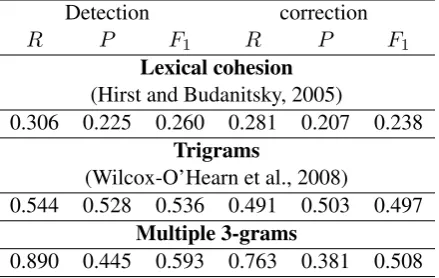
Detection correction
R P F1 R P F1
Lexical cohesion (Hirst and Budanitsky, 2005)
0.306 0.225 0.260 0.281 0.207 0.238 Trigrams
(Wilcox-O’Hearn et al., 2008)
0.544 0.528 0.536 0.491 0.503 0.497 Multiple 3-grams
[image:8.595.73.293.64.203.2]0.890 0.445 0.593 0.763 0.381 0.508
Table 3: A comparison of recall, precision, andF1
score for three methods of malapropism detection and correction on the same data set.
and the lexical cohesion method of Hirst and Bu-danitsky (2005). The data shown here for tri-gram method are not from (Wilcox-O’Hearn et al., 2008), but rather are later results following some corrections reported in (Hirst, 2008). We have not tried optimizing our adjustable parameters: β and αs, because the whole data set was used as test-ing set by the other methods we compare with. To keep the comparison consistent, we did not use any portion of the data set for training purpose. Having optimized parameters could lead to a bet-ter result. The performance is measured using Re-call(R),Precision(P) andF1:
R= true positivestrue positives+false negatives
P = true positivestrue positives+false positives
F1 = P2P R+R
The fraction of errors correctly detected is the de-tection recall and the fraction of detections that are correct is the detection precision. Again, the fraction of errors correctly amended is the correc-tion recall and the fraction of amendments that are correct is the correction precision. To give an example, consider a sentence from the data set: “The Philippine president, in her commencement address at the academy, complained that the U.S. wasliving→giving [giving] advice instead of the
aid → said [aid] it pledged.”, where italics indi-cate the observed word, arrow indiindi-cates the correc-tion and the square brackets indicate the intended word. The detectionrecallof this sentence is 1.0 and theprecision is 0.5. The correctionrecallof this sentence is 1.0 and theprecision is 0.5. For
both cases, theF1 score is 0.667.
We loose some precision because our method tries to detect and correct errors for all the words (except the first word) in the input sentence, and, as a result, it generates more false positives than the other methods. Even so, we get better F1
scores than the other competing methods. Ac-cepting 8.3 percents extra incorrect detections, we get 34.6 percents extra correct detections of errors, and similarly, accepting 12.2 percents extra inrect amendments, we get 27.2 percents extra cor-rect amendments of errors compared with the tri-grams method (Wilcox-O’Hearn et al., 2008)8.
5 Conclusion
The Google 3-grams proved to be very useful in detecting real-word errors, and finding the correc-tions. We did not use the 4-grams and 5-grams because of data sparsity. When we tried with 5-grams the results were lower than the ones pre-sented in Section 4. Having sacrificed a bit the precision score, our proposed method achieves a very good detection recall (0.89) and correction recall (0.76). Our attempts to improve the detec-tion recall or correcdetec-tion recall, while maintaining the respective precisions as high as possible are helpful to the human correctors who post-edit the output of the real-word spell checker. If there is no postediting, at least more errors get corrected automatically. Our method could also detect and correct misspelled words, not only malapropisms, without any modification. In future work, we plan to extend our method to allow for deleted or in-serted words, and to find the corrected strings in the Google Web 1T n-grams. In this way we will be able to correct grammar errors too. We also plan more experiments using the 5-grams, but backing off to 4-grams and 3-grams when needed.
Acknowledgments
This work is funded by the Natural Sciences and Engineering Research Council of Canada. We want to thank Professor Graeme Hirst from the Department of Computer Science, University of Toronto, for providing the evaluation data set.
8We can run our algorithm on subsets of data to check for
References
L. Allison and T.I. Dix. 1986. A bit-string longest-common-subsequence algorithm. Information Pro-cessing Letters, 23:305–310.
Thorsten Brants and Alex Franz. 2006. Web 1T 5-gram corpus version 1.1. Technical report, Google Research.
Lou Burnard, 2000. Reference Guide for the British National Corpus (World Edition), October. www.natcorp.ox.ac.uk/docs/userManual/urg.pdf. Andrew J. Carlson, Jeffrey Rosen, and Dan Roth.
2001. Scaling up context-sensitive text correction. InProceedings of the Thirteenth Conference on In-novative Applications of Artificial Intelligence Con-ference, pages 45–50. AAAI Press.
Andrew R. Golding and Dan Roth. 1999. A winnow-based approach to context-sensitive spelling correc-tion. Machine Learning, 34(1-3):107–130.
Graeme Hirst and Alexander Budanitsky. 2005. Cor-recting real-word spelling errors by restoring lex-ical cohesion. Natural Language Engineering, 11(1):87–111, March.
Graeme Hirst and David St-Onge, 1998. WordNet: An electronic lexical database, chapter Lexical chains as representations of context for the detection and correction of malapropisms, pages 305–332. The MIT Press, Cambridge, MA.
Graeme Hirst. 2008. An evaluation of the contextual spelling checker of microsoft office word 2007, Jan-uary. http://ftp.cs.toronto.edu/pub/gh/Hirst-2008-Word.pdf.
Aminul Islam and Diana Inkpen. 2008. Semantic text similarity using corpus-based word similarity and string similarity. ACM Transactions on Knowledge Discovery from Data, 2(2):1–25.
G. Kondrak. 2005. N-gram similarity and distance. In Proceedings of the 12h International Conference on String Processing and Information Retrieval, pages 115–126, Buenos Aires, Argentina.
Karen Kukich. 1992. Technique for automatically correcting words in text. ACM Comput. Surv., 24(4):377–439.
Eric Mays, Fred J. Damerau, and Robert L. Mercer. 1991. Context based spelling correction. Informa-tion Processing and Management, 27(5):517–522. I. D. Melamed. 1999. Bitext maps and alignment
via pattern recognition. Computational Linguistics, 25(1):107–130.
G.A. Miller, R. Beckwith, C. Fellbaum, D. Gross, and K.J. Miller. 1993. Introduction to wordnet: An on-line lexical database. Technical Report 43, Cognitive Science Laboratory, Princeton University, Princeton, NJ.
Jennifer Pedler. 2007. Computer Correction of Real-word Spelling Errors in Dyslexic Text. Ph.D. thesis, Birkbeck, London University.
Suzan Verberne. 2002. Context-sensitive spell check-ing based on word trigram probabilities. Master’s thesis, University of Nijmegen, February-August. L. Amber Wilcox-O’Hearn, Graeme Hirst, and