Arabic Spelling Correction using Supervised Learning
Youssef Hassan
Dept Computer Engineering Cairo University
Giza, Egypt
Mohamed Aly
Dept Computer Engineering Cairo University
Giza, Egypt
Amir Atiya
Dept Computer Engineering Cairo University
Giza, Egypt
Abstract
In this work, we address the problem of spelling correction in the Arabic lan-guage utilizing the new corpus provided by QALB (Qatar Arabic Language Bank) project which is an annotated corpus of sentences with errors and their corrections. The corpus contains edit, add before, split, merge, add after, move and other error types. We are concerned with the first four error types as they contribute more than 90% of the spelling errors in the corpus. The proposed system has many models to address each error type on its own and then integrating all the models to provide an efficient and robust system that achieves an overall recall of 0.59, precision of 0.58 and F1 score of 0.58 including all the error types on the development set. Our system participated in the QALB 2014 shared task ”Automatic Arabic Error Correction” and achieved an F1 score of 0.6, earning the sixth place out of nine participants.
1 Introduction
The Arabic language is a highly inflected natural language that has an enormous number of possi-ble words (Othman et al., 2003). And although it is the native language of over 300 million people, it suffers from the lack of useful resources as op-posed to other languages, specially English and until now there are no systems that cover the wide range of possible spelling errors. Fortunately the QALB corpus (Zaghouani et al., 2014) will help enrich the resources for Arabic language generally and the spelling correction specifically by provid-ing an annotated corpus with corrected sentences from user comments, native student essays, non-native data and machine translation data. In this work, we are trying to use this corpus to build an
error correction system that can cover a range of spelling errors.
This paper is a system description paper that is submitted in the EMNLP 2014 conference shared task ”Automatic Arabic Error Correction” (Mohit et al., 2014) in the Arabic NLP workshop. The challenges that faced us while working on this sys-tem was the shortage of contribution in the area of spelling correction in the Arabic language. But hopefully the papers and the work in this shared task specifically and in the workshop generally will enrich this area and flourish it.
Our system targets four types of spelling errors, edit errors, add before errors, merge errors and split errors. For each error type, A model is built to correct erroneous words detected by the error detection technique. Edit errors and add before errors are corrected using classifiers with contex-tual features, while the merge and split errors are corrected by inserting or omitting a space between words and choosing the best candidate based on the language model score of each candidate.
The rest of this paper is structured as follows. In section 2, we give a brief background on re-lated work in spelling correction. In section 3, we introduce our system for spelling correction with the description of the efficient models used in the system. In section 4, we list some experimental re-sults on the development set. In section 5, we give some concluding remarks.
2 Related Work
The work in the field of spelling correction in the Arabic language is not yet mature and no sys-tem achieved a great error correction efficiency. Even Microsoft Word, the most widely used Ara-bic spelling correction system, does not achieve good results. Our work was inspired by a num-ber of papers. (Shaalan et al., 2012) addressed the problem of Arabic Word Generation for spell checking and they produced an open source and
large coverage word list for Arabic containing 9 million fully inflected surface words and applied language models and Noisy Channel Model and knowledge-based rules for error correction. This word list is used in our work besides using lan-guage models and Noisy Channel Model.
(Shaalan et al., 2010) proposed another sys-tem for cases in which the candidate genera-tion using edit algorithm only was not enough, in which candidates were generated based on transformation rules and errors are detected using BAMA (Buckwalter Arabic Morphological Ana-lyzer)(Buckwalter, 2002).
(Khalifa et al., 2011) proposed a system for text segmentation. The system discriminates between waw wasl and waw fasl, and depending on this it can predict if the sentence to be segmented at this position or not, they claim that they achieved 97.95% accuracy. The features used in this work inspired us with the add before errors correction.
(Schaback, 2007) proposed a system for the En-glish spelling correction, that is addressing the edit errors on various levels: on the phonetic level us-ingSoundexalgorithm, on the character level us-ing edit algorithm with one operation away, on the word level using bigram language model, on the syntactic level using collocation model to deter-mine how fit the candidate is in this position and on the semantic level using co-occurrence model to determine how likely a candidate occurs within the given context, using all the models output of candidate word as features and using SVM model to classify the candidates, they claim reaching re-call ranging from 90% for first candidate and 97% for all five candidates presented and outperform-ing MS Word, Aspell, Hunspell, FST and Google.
3 Proposed System
We propose a system for detecting and correct-ing various spellcorrect-ing errors, includcorrect-ing edit, split, merge, and add before errors. The system consists of two steps: error detection and error correction. Each word is tested for correctness. If the word is deemed incorrect, it is passed to the correction step, otherwise it remains unchanged. The correc-tion step contains specific handling for each type of error, as detailed in subsection 3.3.
3.1 Resources
Dictionary: Arabic wordlist for spell checking1
is a free dictionary containing 9 million Ara-bic words. The words are automatically generated from the AraComLex2 open-source finite state
transducer.
The dictionary is used in the generation of candidates and using a special version of MADAMIRA3(Pasha et al., 2014) created for the
QALB shared task using a morphological database based on BAMA 1.2.14(Buckwalter, 2002).
Fea-tures are extracted for each word of the dictionary to help in the proposed system in order that each candidate has features just like the words in the corpus.
Stoplist: Using stop words list available on sourceforge.net5. This is used in the collocation
algorithm described later.
Language Model: We use SRILM (Stolcke, 2002) to build a language model using the Ajdir Corpora6 as a corpus with the vocabulary from
the dictionary stated above. We train a language model containing unigrams, bigrams, and trigrams using modified Kneser-Ney smoothing (James, 2000).
QALB Corpus: QALB shared task offers a new corpus for spelling correction. The corpus contains a large dataset of manually corrected Ara-bic sentences. Using this corpus, we were able to implement a spelling correction system that targets the most frequently occurring error types which are(a) edit errorswhere a word is replaced by another word, (b) add before errors where a word was removed, (c) merge errors where a space was inserted mistakenly and finally(d) split errors where a space was removed mistakenly. The corpus provided also has three other error types but they occur much less frequently happen which are(e) add after errors which is like the add before but the token removed should be put af-ter the word,(f) move errorswhere a word should be moved to other place within the sentence and
(g) other errorswhere any other error that does 1http://sourceforge.net/projects/
arabic-wordlist/
2http://aracomlex.sourceforge.net/ 3MADAMIRA-release-20140702-1.0
4AraMorph 1.2.1 - http://sourceforge.net/
projects/aramorph/
5http://sourceforge.net/projects/
arabicstopwords/
6http://aracorpus.e3rab.com/
not lie in the six others is labeled by it.
3.2 Error Detection
The training set, development set and test set pro-vided by QALB project come with the ”columns file” and contains very helpful features generated by MADAMIRA. Using the Buckwalter morpho-logical analysis (Buckwalter, 2002) feature, we determine if a word is correct or not. If the word has no analysis, we consider the word asincorrect and pass it through the correction process.
3.3 Edit Errors Correction
The edit errors has the highest portion of total er-rors in the corpus. It amounts to more than 55% of the total errors. To correct this type of errors, we train a classifier with features like the error model probability, collocation and co-occurrence as fol-lows:
Undiacriticized word preprocessed: Utilizing the MADAMIRA features of each word, the undi-acriticized word fixes some errors like hamzas, the pair of haa and taa marboutah and the pair of yaa and alif maqsoura.
We apply some preprocessing on the undiacrit-icized word to make it more useful and fix the is-sues associated with it. For example we remove the incorrect redundant characters from the word e.g (
È@@@Ag.QË@
→ÈAg.QË@
, AlrjAAAAl → AlrjAl). We also replace the Roman punctuation marks by the Arabic ones e.g (?→?
).Language Model: For each candidate, A un-igram, bigram and trigram values from the lan-guage model trained are retrieved. In addition to a feature that is the product of the unigram, bigram and trigram values.
Likelihood Model: The likelihood model is trained by iterating over the training sentences counting the occurrences of each edit with the characters being edited and the type of edit. The output of this is called a confusion matrix.
The candidate score is based on the Noisy Channel Model (Kernighan et al., 1990) which is the multiplication of probabilty of the proposed edit using the confusion matrix trained which is called the error model, and the language model score of that word. The language model used is unigram, bigram and trigram with equal weights. Add-1 smoothing is used for both models in the counts.
Score=p(x|w).p(w)
wherexis the wrong word andwis the candidate correction.
For substitution edit candidates, we give higher score for substitution of a character that is close on the keyboard or the substitution pair belongs to the same group of letter groups (Shaalan et al., 2012) by multiplying the score by a constant greater than one.
,(h. ,h ,p) ,(H. , H , H , à ,ø) ,(@ ,
@ ,@ ,@)
,( , ) ,( , ) ,( ,
) ,(P , P) ,(X , X)
.(ø ,ø) ,(ð ,ð) ,(è ,è) ,( ¬ , ) ,(¨ , ¨)
(|, <,>, A), (y, n, v, t, b), (x, H, j), (*, d), (z, r), ($, s), (D, S), (Z, T), (g, E), (q, f), (p h), (&, w), (Y, y)
For each candidate , the likelihood score is com-puted and added to the feature vector of the candi-date.
Collocation: The collocation model targets the likelihood of the candidate inside the sentence. This is done using the lemma of the word and the POS tags of words in the sentence.
We use the algorithm in (Schaback, 2007) for training the collocation model. Specifically, by re-trieving the 5,000 most occurring lemmas in the training corpus and put it in listL. For each lemma inL, three lists are created, each record in the list is a sequence of three POS tags around the target lemma. For training, we shift a window of three POS tags over the training sentence. If a lemma belongs toL, we add the surrounding POS tags to the equivalent list of the target lemma depending on the position of the target lemma within the three POS tags.
Given a misspelled word in a sentence, for each candidate correction, if it is in theLlist, we count the number of occurrences of the surrounding POS tags in each list of the three depending on the po-sition of of the candidate.
The three likelihoods are stored in the feature vector of the candidate in addition to the product of them.
Co-occurrence: Co-occurrence is used to mea-sure how likely a word fits inside a context. Where
Lis the same list of most frequent lemmata from collocation.
Aî E@ AÖß. éJËAmÌ'@ éÓñºmÌ'@ð PAÒªJB@ áK. Q ¯B IJk
Hyv l>frq byn AlAstEmAr wAlHkwmp AlHAlyp bmA>nhA
After removing stop-words and replacing the remaining words by their lemma form we end up with:
úÍAg éÓñºk PAÒªJ@ Q ¯
@
>frq AstEmAr Hkwmp HAly which formsC.
From thatC, we get all lemmata that appear in the radius of 10 words around the target lemma
bwhere bbelongs toL. We count the number of occurrences of each lemma in that contextC.
By using the above model, three distances are calculated for target lemmab: d1, the ratio of ac-tually found context words inCand possibly find-able context words. This describes how similar the trained context and the given context are for can-didate b; d2 considers how significant the found context lemmata are by summing the normalized frequencies of the context lemmata. As a third fea-ture;d3(b)that simply measures how big the vec-tor space model for lemmabis.
For each candidate, the model is applied and the three distances are calculated and added to the fea-ture vector of that candidate.
The Classifier: After generating the candidate corrections within 1 and 2 edit operations (insert, delete, replace and transpose) distance measured by Levenshtein distance (Levenshtein, 1966), we run them through a Naive-Bayes classifier using python NLTK’s implementation to find out which one is the most likely to be the correction for the incorrect word.
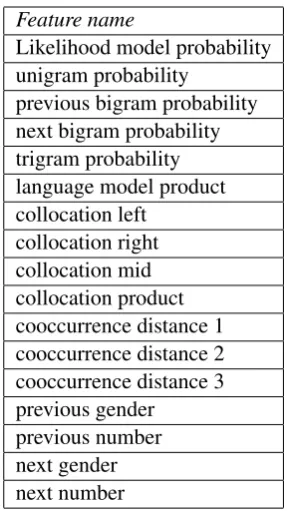
The classifier is trained using the training set provided by QALB project. For each edit correc-tion in the training set, all candidates are gener-ated for the incorrect word and a feature vector (as shown in table1) is calculated using the tech-niques aforementioned. If the candidate is the cor-rect one, the label for the training feature vector is correct else it is incorrect.
Then using the trained classifier, the same is done on the development set or the test set where we replace the incorrect word with the word sug-gested by the classifier.
3.4 Add before Errors Correction
[image:4.595.343.487.105.361.2]The add before errors are mostly punctuation er-rors. A classifier is trained on the QALB training
Table 1: The feature set used by the edit errors classifier.
Feature name
Likelihood model probability unigram probability
previous bigram probability next bigram probability trigram probability language model product collocation left
collocation right collocation mid collocation product cooccurrence distance 1 cooccurrence distance 2 cooccurrence distance 3 previous gender
previous number next gender next number
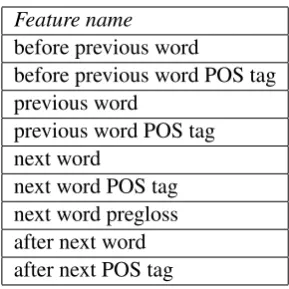
corpus. A classifier is implemented with contex-tual featuresC.Cis a 4-gram around the token be-ing investigated. Each word of these four has the two features: The token itself and Part-of-speech tag and for the next word only pregloss because if the word’s pregloss is ”and” it is more prob-able that a new sentence began. Those features are available thanks to MADAMIRA features pro-vided with the corpus and the generated for dictio-nary words.
The classifier is trained on the QALB training set. We iterate over all the training sentences word by word and getting the aforementioned features (as shown in table 2) and label the training with the added before token if there was a matching add before correction for this word or the label will be an empty string.
For applying the model, the same is done on the QALB development sentences after removing all punctuations as they are probably not correct and the output of the classifier is either empty or sug-gested token to add before current word.
3.5 Merge Errors Correction
Table 2: The feature set used by the add before errors classifier.
Feature name before previous word
before previous word POS tag previous word
previous word POS tag next word
next word POS tag next word pregloss after next word after next POS tag
Arabic word and rank it with the language model score.
3.6 Split Errors Correction
The split errors occurs due to the deletion of a space between two words. The approach is sim-ply getting all the valid partitions of the word and try to correct both partitions and give them a rank using the language model score. The partition is at least two characters long.
4 Experimental Results
In order to know the contribution of each error type models to the overall system performance, we adopted an incremental approach of the models. We implemented the system using python7 and
NLTK8(Loper and Bird, 2002) toolkit. The
mod-els are trained on the QALB corpus training set and the results are obtained by applying the trained models on the development set. Our goal was to achieve high recall but without losing too much precision. The models were evaluated using M2 scorer (Dahlmeier and Ng, 2012).
First, we start with only the preprocessed un-diacriticized word, then we added our edit error classifier. Adding the add before classifier was a great addition to the system as the system was able to increase the number of corrected errors signif-icantly, notably the add before classifier proposed too many incorrect suggestions that decreased the precision. Then we added the merging correction technique. Finally we added the split error cor-rection technique. The system corrects 9860 errors versus 16659 golden error corrections and
pro-7https://www.python.org/ 8http://www.nltk.org/
[image:5.595.316.513.157.223.2]posed 17057 correction resulting in the final sys-tem recall of 0.5919, precision of 0.5781 and F1 score of 0.5849. Details are shown in Table 3.
Table 3: The incremental results after adding each error type model and applying them on the devel-opment set.
Model name Recall Precision F1 score Undiacriticized 0.32 0.833 0.4715 + Edit 0.3515 0.7930 0.5723 + Add before 0.5476 0.5658 0.5567 + Merge 0.5855 0.5816 0.5836 + Split 0.5919 0.5781 0.5849
We tried other combinations of the models by removing one or more of the components to get the best results possible. Noting that all the systems results are using the undiacriticized word. Details are shown in Table 4
Table 4: The results of some combinations of the models and applying them on the development set. The models are abbreviated as Edit E, Merge M, Split S, and Add before A.
Model name Precision Recall F1 score M Only 0.8441 0.3724 0.5167
S Only 0.7838 0.338 0.5167
A Only 0.6008 0.4887 0.539 E Only 0.8143 0.3472 0.4868 M & S 0.8121 0.3814 0.5191 E & S 0.62 0.3542 0.4508 M & E 0.6184 0.5403 0.5767 S & M & A 0.6114 0.5396 0.5733 M & E & A 0.6186 0.5404 0.5768 E & S & A 0.5955 0.507 0.5477 E & S & M 0.6477 0.3969 0.4922 E & S & M & A 0.5919 0.5781 0.5849
5 Conclusion and Future Work
[image:5.595.313.518.370.507.2]References
Tim Buckwalter. 2002. Buckwalter arabic morpholog-ical analyzer version 1.0. November.
Daniel Dahlmeier and Hwee Tou Ng. 2012. Bet-ter evaluation for grammatical error correction. In Proceedings of the 2012 Conference of the North American Chapter of the Association for Computa-tional Linguistics: Human Language Technologies, NAACL HLT ’12, pages 568–572, Stroudsburg, PA, USA. Association for Computational Linguistics. Frankie James. 2000. Modified kneser-ney smoothing
of n-gram models. RIACS.
Mark D. Kernighan, Kenneth W. Church, and William A. Gale. 1990. A spelling correction pro-gram based on a noisy channel model. In Proceed-ings of the 13th Conference on Computational Lin-guistics - Volume 2, COLING ’90, pages 205–210, Stroudsburg, PA, USA. Association for Computa-tional Linguistics.
Iraky Khalifa, Zakareya Al Feki, and Abdelfatah Farawila. 2011. Arabic discourse segmentation based on rhetorical methods.
VI Levenshtein. 1966. Binary Codes Capable of Cor-recting Deletions, Insertions and Reversals. vol-ume 10, page 707.
Edward Loper and Steven Bird. 2002. NLTK: The Natural Language Toolkit.
Behrang Mohit, Alla Rozovskaya, Nizar Habash, Wa-jdi Zaghouani, and Ossama Obeid. 2014. The First QALB Shared Task on Automatic Text Correction for Arabic. InProceedings of EMNLP Workshop on Arabic Natural Language Processing, Doha, Qatar, October.
Eman Othman, Khaled Shaalan, and Ahmed Rafea. 2003. A chart parser for analyzing modern standard arabic sentence. InTo appear in In proceedings of the MT Summit IX Workshop on Machine Transla-tion for Semitic Languages: Issues and Approaches, Louisiana, U.S.A.
Pasha, Arfath, Mohamed Al-Badrashiny, Mona Diab, Ahmed El Kholy, Ramy Eskander, Nizar Habash, Manoj Pooleery, Owen Rambow, and Ryan M. Roth. 2014. Madamira: A fast, comprehensive tool for morphological analysis and disambiguation of ara-bic. InIn Proceedings of the Language Resources and Evaluation Conference (LREC), Reykjavik, Ice-land.
Johannes Schaback. 2007. Multi-level feature extrac-tion for spelling correcextrac-tion. Hyderabad, India. K. Shaalan, R. Aref, and A Fahmy. 2010. An approach
for analyzing and correcting spelling errors for non-native arabic learners. InInformatics and Systems (INFOS), 2010 The 7th International Conference on, pages 1–7, March.
Khaled Shaalan, Mohammed Attia, Pavel Pecina, Younes Samih, and Josef van Genabith. 2012. Ara-bic word generation and modelling for spell check-ing. In Nicoletta Calzolari (Conference Chair), Khalid Choukri, Thierry Declerck, Mehmet Uur Doan, Bente Maegaard, Joseph Mariani, Asuncion Moreno, Jan Odijk, and Stelios Piperidis, editors, Proceedings of the Eight International Conference on Language Resources and Evaluation (LREC’12), Istanbul, Turkey, may. European Language Re-sources Association (ELRA).
A. Stolcke. 2002. Srilm – an extensible language mod-eling toolkit. InProc. Intl. Conf. on Spoken Lan-guage Processing, Denver,U.S.A.