Multilingual Syntactic-Semantic Dependency Parsing with Three-Stage
Approximate Max-Margin Linear Models
Yotaro Watanabe, Masayuki Asahara and Yuji Matsumoto Graduate School of Information Science
Nara Institute of Science and Technology 8916-5 Takayama, Ikoma, Nara, Japan, 630-0192
{yotaro-w, masayu-a, matsu}@is.naist.jp
Abstract
This paper describes a system for syntactic-semantic dependency parsing for multiple lan-guages. The system consists of three parts: a state-of-the-art higher-order projective depen-dency parser for syntactic dependepen-dency pars-ing, a predicate classifier, and an argument classifier for semantic dependency parsing. For semantic dependency parsing, we ex-plore use of global features. All components are trained with an approximate max-margin learning algorithm.
In the closed challenge of the CoNLL-2009 Shared Task (Hajiˇc et al., 2009), our system achieved the 3rd best performances for En-glish and Czech, and the 4th best performance for Japanese.
1 Introduction
In recent years, joint inference of syntactic and se-mantic dependencies has attracted attention in NLP communities. Ideally, we would like to choose the most plausible syntactic-semantic structure among all possible structures in that syntactic dependencies and semantic dependencies are correlated. How-ever, solving this problem is too difficult because the search space of the problem is extremely large. Therefore we focus on improving performance for each subproblem: dependency parsing and semantic role labeling.
In the past few years, research investigating higher-order dependency parsing algorithms has found its superiority to first-order parsing algo-rithms. To reap the benefits of these advances, we
use a higher-order projective dependency parsing al-gorithm (Carreras, 2007) which is an extension of the span-based parsing algorithm (Eisner, 1996), for syntactic dependency parsing.
In terms of semantic role labeling, we would like to capture global information about predicate-argument structures in order to accurately predict the correct predicate-argument structure. Previous re-search dealt with such information usingre-ranking (Toutanova et al., 2005; Johansson and Nugues, 2008). We explore a different approach to deal with such information using global features. Use of global features for structured prediction problem has been explored by several NLP applications such as sequential labeling (Finkel et al., 2005; Krishnan and Manning, 2006; Kazama and Torisawa, 2007) and dependency parsing (Nakagawa, 2007) with a great deal of success. We attempt to use global fea-tures for argument classification in which the most plausible semantic role assignment is selected using both local and global information. We present an approximate max-margin learning algorithm for ar-gument classifiers with global features.
2 Dependency Parsing
As in previous work, we use a linear model for de-pendency parsing. The score function used in our dependency parser is defined as follows.
s(y) = ∑
(h,m)∈y
F(h, m,x) (1)
where handm denote the head and the dependent
of the dependency edge in y, and F(h, m,x) is a
Factorthat specifies dependency edge scores.
We used a second-order factorization as in (Car-reras, 2007). The second-order factorF is defined
as follows.
F(h, m,x) =w·Φ(h, m,x) +w·Φ(h, m, ch,x)
+w·Φ(h, m, cmi,x) +w·Φ(h, m, cmo,x) (2)
wherewis a parameter vector,Φis a feature vector,
chis the child ofhin the span[h...m]that is closest
tom,cmiis the child ofmin the span[h...m]that is
farthest frommandcmois the child ofmoutside the
span[h...m]that is farthest fromm. For more details
of the second-order parsing algorithm, see (Carreras, 2007).
For parser training, we use the Passive Aggres-sive Algorithm (Crammer et al., 2006), which is an approximate max-margin variant of the perceptron algorithm. Also, we apply an efficient parameter av-eraging technique (Daum´e III, 2006). The resulting learning algorithm is shown in Algorithm 1.
Algorithm 1A Passive Aggressive Algorithm with parameter averaging
inputTraining setT = {xt,yt}Tt=1, Number of iterations
N and Parameter C
w←0,v←0,c←1
fori←0toNdo
for(xt,yt)∈ T do ˆ
y= arg maxyw·Φ(xt,y) +ρ(yt,yˆ)
τt= min“C,w·Φ(xt,yˆ)−w·Φ(xt,yt)+ρ(yt,ˆy)
||Φ(xt,yt)−Φ(xt,yˆ)||2
”
w←w+τt(Φ(xt,yt)−Φ(xt,yˆ))
v←v+cτt(Φ(xt,yt)−Φ(xt,yˆ)) c←c+ 1
end for end for
return w−v/c
We set ρ(yt,y)ˆ as the number of incorrect head
predictions in theyˆ, and C as 1.0.
Among the 7 languages of the task, 4 languages (Czech, English, German and Japanese) contain non-projective edges (13.94 %, 3.74 %, 25.79 % and 0.91 % respectively), therefore we need to deal with non-projectivity. In order to avoid losing the benefits of higher-order parsing, we considered ap-plying pseudo-projective transformation (Nivre and Nilsson, 2005). However, growth of the number of dependency labels by pseudo-projective transforma-tion increases the dependency parser training time, so we did not adopt transformations. Therefore, the
parser ignores the presence of non-projective edges in the training and the testing phases.
The features used for our dependency parser are based on those listed in (Johansson, 2008). In addi-tion, distance features are used. We use shorthand notations in order to simplify the feature represen-tations: ’h’, ’d’, ’c’, ’l’, ’p’, ’−1’ and ’+1’
cor-respond to head, dependent, head’s or dependent’s child, lemma , POS, left position and right position respectively.
First-order Features
Token features: hl,hp,hl+hp,dl,dpanddl+dp.
Head-Dependent features: hp+dp, hl+dl, hl+dl,
hl+hp+dl, hl+hp+dp, hl+dl+dp, hp+dl+dp and
hl+hp+dl+dp.
Context features: hp+hp+1+dp−1+dp,
hp−1+hp+dp−1+dp, hp+hp+1+dp+dp+1 and hp−1+hp+dp+dp+1.
Distance features: The number of tokens between the head and the dependent.
Second-order Features
Head-Dependent-Head’s or Dependent’s Child: hl+cl,hl+cl+cp,hp+cl,hp+cp,hp+dp+cp,dp+cp,
dp+cl+cp,dl+cp,dl+cp+cl
3 Semantic Role Labeling
Our SRL module consists of two parts: a predicate classifier and an argument classifier. First, our sys-tem determines the word sense for each predicate with the predicate classifier, and then it detects the highest scored argument assignment using the argu-ment classifier with global features.
3.1 Predicate Classification
The first phase of SRL in our system is to detect the word sense for each predicate. WSD can be for-malized as a multi-class classification problem given lemmas. We created a linear model for each lemma and used the Passive Aggressive Algorithm with pa-rameter averaging to train the models.
3.1.1 Features for Predicate Classification Word features: Predicted lemma and the predicted POS
of the predicate, predicate’s head, and its conjunc-tions.
Dependency label sequence: The concatenation of the dependency labels of the predicate dependents.
Since effective features for predicate classifica-tion are different for each language, we performed greedy forward feature selection.
3.2 Argument Classification
In order to capture global clues of predicate-argument structures, we consider introducing global features for linear models. Let A(p) be a joint assignment of role labels for argument candidates given the predicatep. Then we define a score func-tions(A(p))for argument label assignments A(p).
s(A(p)) =∑
k
Fk(x,A(p)) (3)
We introduce two factors: Local Factor FL and
Global FactorFGdefined as follows.
FL(x, a(p)) =w·ΦL(x, a(p)) (4)
FG(x,A(p)) =w·ΦG(x,A(p)) (5)
whereΦL, ΦG denote feature vectors for the local
factor and the global factor respectively.FLscores a
particular role assignment for each argument candi-date individually, andFG treats global features that
capture what structure the assignmentA has. Re-sulting scoring function for the assignmentA(p) is as follows.
s(A(p)) = ∑
a(p)∈A(p)
w·ΦL(x, a(p))+w·ΦG(x,A(p))
(6) Use of global features is problematic, because it becomes difficult to find the highest assignment ef-ficiently. In order to deal with the problem, we use a simple approach, n-best relaxation as in (Kazama and Torisawa, 2007). At first we generate n-best as-signments using only the local factor, and then add the global factor score for each n-best assignment, fi-nally select the best scoring assignment from them. In order to generate n-best assignments, we used a beam-search algorithm.
3.2.1 Learning the Model
As in dependency parser and predicate classifier, we train the model using the PA algorithm with pa-rameter averaging. The learning algorithm is shown
in Algorithm 2. In this algorithm, the weights cor-respond to local factor featuresΦLand global factor
featuresΦGare updated simultaneously.
Algorithm 2Learning with Global Features for Ar-gument Classification
inputTraining setT ={xt,At}Tt=1, Number of iterations
N and Parameter C
w←0,v←0,c←1
fori←0toNdo
for(xt,At)∈ T do
letΦ(xt,A) =Pa∈AΦL(xt, a) + ΦG(xt,A) generate n-best assignments{An
}usingFL ˆ
A= arg maxA∈{An}w·Φ(xt,A) +ρ(At,A)
τt= min“C,w·Φ(xt,Aˆ)−w·Φ(xt,At)+ρ(At,Aˆ)
||Φ(xt,At)−Φ(xt,Aˆ)||2
”
w←w+τt(Φ(xt,At)−Φ(xt,Aˆ))
v←v+cτt(Φ(xt,At)−Φ(xt,Aˆ)) c←c+ 1
end for end for
return w−v/c
We set the margin valueρ(A,Aˆ) as the number
of incorrect assignments plusδ(A,Aˆ), and C as 1.0. The delta function returns 1 if at least one assign-ment is different from the correct assignassign-ment and0
otherwise.
The model is similar to re-ranking (Toutanova et al., 2005; Johansson and Nugues, 2008). However in contrast to re-ranking, we only have to prepare one model. The re-ranking approach requires other training datasets that are different from the data used in local model training.
3.2.2 Features for Argument Classification
The local features used in our system are the same as our previous work (Watanabe et al., 2008) except for language dependent features. The global features that used in our system are based on (Johansson and Nugues, 2008) that used for re-ranking.
Local Features
Word features: Predicted lemma and predicted POS of the predicate, predicate’s head, argument candidate, argument candidate’s head, leftmost/rightmost de-pendent and leftmost/rightmost sibling.
Dependency label: The dependency label of predicate, argument candidate and argument candidate’s de-pendent.
Average Catalan Chinese Czech English German Japanese Spanish
Macro F1 Score 78.43 75.91 73.43 81.43 86.40 69.84 84.86 77.12
(78.00*) (74.83*) (73.43*) (81.38*) (86.40*) (68.39*) (84.84*) (76.74*) Semantic Labeled F1 75.65 72.35 74.17 84.69 84.26 63.66 77.93 72.50
(75.17*) (71.05*) (74.17*) (84.66*) (84.26*) (61.94*) (77.91*) (72.25*) Labeled Syntactic Accuracy 81.16 79.48 72.66 78.17 88.54 75.85 91.69 81.74
(80.77*) (78.62*) (72.66*) (78.10*) (88.54*) (74.60*) (91.66*) (81.23*)
Macro F1 Score 84.30 84.79 81.63 83.08 87.93 83.25 85.54 83.94
[image:4.612.73.536.57.170.2]Semantic Labeled F1 81.58 80.99 79.99 86.67 85.09 79.46 79.03 79.85 Labeled Syntactic Accuracy 87.02 88.59 83.27 79.48 90.77 87.03 91.96 88.04
Table 1: Scores of our system.
Position: The position of the head of the dependency re-lation with respect to the predicate position in the sentence.
Pattern: The left-to-right chain of the predicted POS/dependency labels of the predicate’s children.
Path features: Predicted lemma, predicted POS and de-pendency label paths between the predicate and the argument candidate.
Distance: The number of dependency edges between the predicate and the argument candidate.
Global Features
Predicate-argument label sequence: The sequence of the predicate sense and argument labels in the predicate-argument strucuture.
Presence of labels defined in frame files: Whether the semantic roles defined in the frame present in the predicate-argument structure (e.g. MISSING:A1 or CONTAINS:A1.)
3.2.3 Argument Pruning
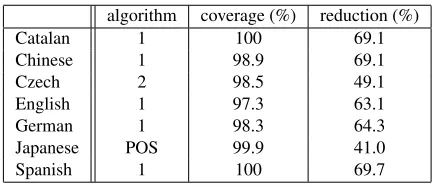
We observe that most arguments tend to be not far from its predicate, so we can prune argument candi-dates to reduce search space. Since the characteris-tics of the languages are slightly different, we apply two types of pruning algorithms.
Pruning Algorithm 1: LetS be an argument candi-date set. Initially setS ← ϕand start at predicate node. Add dependents of the node toS, and move current node to its parent. Repeat until current node reaches to ROOT.
Pruning Algorithm 2: Same as the Algorithm 1 ex-cept that added nodes are its grandchildren as well as its dependents.
The pruning results are shown in Table 2. Since we could not prune arguments in Japanese accu-rately using the two algorithms, we pruned argument candidates simply by POS.
algorithm coverage (%) reduction (%)
Catalan 1 100 69.1
Chinese 1 98.9 69.1
Czech 2 98.5 49.1
English 1 97.3 63.1
German 1 98.3 64.3
Japanese POS 99.9 41.0
Spanish 1 100 69.7
Table 2: Pruning results.
4 Results
The submitted results on the test data are shown in the upper part of Table 1. Due to a bug, we mistak-enly used the gold lemmas in the dependency parser. Corrected results are shown in the part marked with *. The lower part shows the post evaluation results with the gold lemmas and POSs.
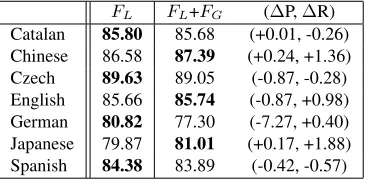
For some of the 7 languages, since the global model described in Section 3.2 degraded perfor-mance compare to a model trained with only FL,
we did NOTuse the model for all languages. We used the global model for only three languages: Chi-nese, English and Japanese. The remaining lan-guages (Catalan, Czech, German and Spanish) used a model trained with onlyFL.
4.1 Dependency Parsing Results
[image:4.612.315.531.212.306.2]FL FL+FG (∆P,∆R)
[image:5.612.322.526.57.149.2] [image:5.612.92.277.58.148.2]Catalan 85.80 85.68 (+0.01, -0.26) Chinese 86.58 87.39 (+0.24, +1.36) Czech 89.63 89.05 (-0.87, -0.28) English 85.66 85.74 (-0.87, +0.98) German 80.82 77.30 (-7.27, +0.40) Japanese 79.87 81.01 (+0.17, +1.88) Spanish 84.38 83.89 (-0.42, -0.57)
Table 3: Effect of global features (semantic labeled F1).
∆P and∆R denote the differentials of labeled precision and labeled recall betweenFLandFL+FGrespectively.
has especially low accuracy (92.3%). The POS ac-curacy may affect the parsing performances.
4.2 SRL Results
In order to highlight the effect of the global fea-tures, we compared two models. The first model is trained with only the local factor FL. The
sec-ond model is trained with both the local factorFL
and the global factorFG. The results are shown in
Table 3. In the experiments, we used the develop-ment data with gold parse trees. For Chinese and Japanese, significant improvements are obtained us-ing the global features (over +1.0% in labeled re-call and the slightly better labeled precision). How-ever, for Catalan, Czech, German and Spanish, the global features degraded the performance in labeled F1. Especially, in German, the precision is substan-tially degraded (-7.27% in labeled F1). These results indicate that it is necessary to introduce language de-pendent features.
4.3 Training, Evaluation Time and Memory Requirements
Table 4 and 5 shows the training/evaluation times and the memory consumption of the second-order dependency parsers and the global argument classi-fiers respectively. The training times of the predi-cate classifier were less than one day, and the testing times were mere seconds.
As reported in (Carreras, 2007; Johansson and Nugues, 2008), training and inference of the second-order parser are very expensive. For Chinese, we could only complete 2 iterations.
In terms of the argument classifier, since N-best generation time account for a substantial proportion of the training time (in this workN = 100),
chang-iter hrs./iter sent./min. mem.
Catalan 9 14.6 9.0 9.6 GB
Chinese 2 56.5 3.7 16.2 GB
Czech 8 14.6 20.5 12.6 GB
English 7 22.0 13.4 15.1 GB
German 4 12.3 59.1 13.1 GB
Japanese 7 11.2 21.8 13.0 GB
[image:5.612.331.516.258.303.2]Spanish 7 19.5 7.3 17.9 GB
Table 4: Training, evaluation time and memory require-ments of the second-order dependency parsers. The ’iter’ column denote the number of iterations of the model used for the evaluations. Catalan, Czech and English are trained on Xeon 3.0GHz, Chinese and Japanese are trained on Xeon 2.66GHz, German and Spanish are trained on Opteron 2.3GHz machines.
train (hrs.) sent./min. mem.
Chinese 6.5 453.7 2.0 GB
English 13.5 449.8 3.2 GB
Japanese 3.5 137.6 1.1 GB
Table 5: Training, evaluation time and memory require-ments of the global argument classifiers. The classifiers are all trained on Opteron 2.3GHz machines.
ingN affects the training and evaluation times
sig-nificantly.
All modules of our system are implemented in Java. The required memory spaces shown in Table 4 and 5 are calculated by subtracting free memory size from the total memory size of the Java VM. Note that we observed that the value fluctuated dras-tically while measuring memory usage, so the value may not indicate precise memory requirements of our system.
5 Conclusion
In this paper, we have described our system for syn-tactic and semantic dependency analysis in multilin-gual. Although our system is not a joint approach but apipelineapproach, the system is comparable to the top system for some of the 7 languages.
A further research direction we are investigating is the application of various types of global features. We believe that there is still room for improvements since we used only two types of global features for the argument classifier.
types of joint approaches have been proposed: N-best based approach (Johansson and Nugues, 2008), synchronous joint approach (Henderson et al., 2008), and a joint approach where parsing and SRL are performed simultaneously (Llu´ıs and M`arquez, 2008). We attempted to perform N-best based joint approach, however, the expen-sive computational cost of the 2nd-order projective parser discouraged it. We would like to investigate syntactic-semantic joint approaches with reasonable time complexities.
Acknowledgments
We would like to thank Richard Johansson for his advice on parser implementation, and the CoNLL-2009 organizers (Hajiˇc et al., CoNLL-2009; Taul´e et al., 2008; Palmer and Xue, 2009; Hajiˇc et al., 2006; Sur-deanu et al., 2008; Burchardt et al., 2006; Kawahara et al., 2002; Taul´e et al., 2008).
References
Aljoscha Burchardt, Katrin Erk, Anette Frank, Andrea Kowalski, Sebastian Pad´o, and Manfred Pinkal. 2006. The SALSA corpus: a German corpus resource for lexical semantics. In Proc. of LREC-2006, Genoa, Italy.
Xavier Carreras. 2007. Experiments with a higher-order projective dependency parser. In Proc. of EMNLP-CoNLL 2007.
Koby Crammer, Ofer Dekel, Joseph Keshet, Shai Shalev-Shwartz, and Yoram Singer. 2006. Online passive-aggressive algorithms.JMLR, 7:551–585.
Hal Daum´e III. 2006. Practical Structured Learning Techniques for Natural Language Processing. Ph.D. thesis, University of Southern California, Los Ange-les, CA, August.
Jason Eisner. 1996. Three new probabilistic models for dependency parsing. InProc. of ICCL 1996.
Jenny Rose Finkel, Trond Grenager, and Christopher Manning. 2005. Incorporating non-local information into information extraction systems by gibbs sampling. InProc. of ACL 2005.
Jan Hajiˇc, Jarmila Panevov´a, Eva Hajiˇcov´a, Petr Sgall, Petr Pajas, Jan ˇStˇep´anek, Jiˇr´ı Havelka, Marie Mikulov´a, and Zdenˇek ˇZabokrtsk´y. 2006. Prague De-pendency Treebank 2.0.
Jan Hajiˇc, Massimiliano Ciaramita, Richard Johans-son, Daisuke Kawahara, Maria Ant`onia Mart´ı, Llu´ıs M`arquez, Adam Meyers, Joakim Nivre, Sebastian
Pad´o, Jan ˇStˇep´anek, Pavel Straˇn´ak, Mihai Surdeanu, Nianwen Xue, and Yi Zhang. 2009. The CoNLL-2009 shared task: Syntactic and semantic dependen-cies in multiple languages. InProc. of CoNLL-2009, Boulder, Colorado, USA.
James Henderson, Paola Merlo, Gabriele Musillo, and Ivan Titov. 2008. A latent variable model of syn-chronous parsing for syntactic and semantic dependen-cies. InProc. of CoNLL 2008.
Richard Johansson and Pierre Nugues. 2008. Dependency-based syntactic-semantic analysis with propbank and nombank. In Proc. of CoNLL 2008.
Richard Johansson. 2008. Dependency-based Semantic Analysis of Natural-language Text. Ph.D. thesis, Lund University.
Daisuke Kawahara, Sadao Kurohashi, and Kˆoiti Hasida. 2002. Construction of a Japanese relevance-tagged corpus. In Proc. of LREC-2002, pages 2008–2013, Las Palmas, Canary Islands.
Jun’Ichi Kazama and Kentaro Torisawa. 2007. A new perceptron algorithm for sequence labeling with non-local features. InProc. of EMNLP-CoNLL 2007. Vijay Krishnan and Christopher D. Manning. 2006. An
effective two-stage model for exploiting non-local de-pendencies in named entity recognition. InProc. of ACL-COLING 2006.
Xavier Llu´ıs and Llu´ıs M`arquez. 2008. A joint model for parsing syntactic and semantic dependencies. InProc. of CoNLL 2008.
Tetsuji Nakagawa. 2007. Multilingual dependency pars-ing uspars-ing global features. In Proc. of the CoNLL Shared Task Session of EMNLP-CoNLL 2007. Joakim Nivre and Jens Nilsson. 2005. Pseudo-projective
dependency parsing. InProc. of ACL 2005.
Martha Palmer and Nianwen Xue. 2009. Adding seman-tic roles to the Chinese Treebank. Natural Language Engineering, 15(1):143–172.
Mihai Surdeanu, Richard Johansson, Adam Meyers, Llu´ıs M`arquez, and Joakim Nivre. 2008. The CoNLL-2008 shared task on joint parsing of syntactic and se-mantic dependencies. InProc. of CoNLL-2008. Mariona Taul´e, Maria Ant`onia Mart´ı, and Marta
Re-casens. 2008. AnCora: Multilevel Annotated Corpora for Catalan and Spanish. InProc. of LREC-2008, Mar-rakesh, Morroco.
Kristina Toutanova, Aria Haghighi, and Christopher D. Manning. 2005. Joint learning improves semantic role labeling. InProc. of ACL 2005.