1
2
Abstract
Scholars of public and foreign policy have emphasized the role of decision processes in the
creation of policy failures and fiascoes and have demonstrated the importance that
psychological factors play in policy mistakes. Using Ulrich Beck’s notion of world risk
society and drawing on advances in our understanding of a key psychological factor central to
decision-making pathologies – cognitive dissonance – this article explores the ways in which
features of the risk era could alter important decision dynamics and increase decision-making
mistakes. In combination with the catastrophic potential of world risk society, this would
suggest an increase in the frequency of policymaking fiascoes. Bridging the gap between the
“macro” conditions of globalisation and the “micro” processes of decision-making also
challenges our conception of both the nature and sources of policymaking mistakes and
suggests that our scholarly understanding of “decision-making mistakes” may need
rethinking.
3
Introduction
A general consensus has emerged that many policy failures and fiascoes can be linked
to problems within decision-making processes. While various organisational and institutional
sources have been identified as contributing to policymaking errors, psychological factors
(e.g. heuristics and biases; the framing of prospects; small group dynamics) play a key role.
While such “micro-processes” can influence decisions, they always occur within a larger
context that shapes their impact on policy outcomes. Sensitive to this, researchers have
argued for an interplay between individual psychological factors and the broader
organisational context within which they occur. Janis’s Groupthink is an early example of
work that incorporated both ‘structural faults’ (e.g. insulation of the group) and a
‘provocative context’ (e.g. external threats and situational complexity) as antecedents to
psychological pitfalls and poor decision-making processes (Janis, 1982).
The broadest sociological context and contours of the international system, however,
have rarely been examined with regard to their impact on the psychological dynamics of
decision-making. Local conditions have had pride of place. In practice they are linked, but
analytically they are all too often examined separately. Yet arguments abound regarding the
prevalence of dramatic changes at the broadest levels of international society, ranging from
‘globalisation’, to the rise of civilizational fissures defining the future of conflict (cf.
Huntington, 1996), to the development of global civil society (cf. Kumar, 2008), but little
work has systematically linked such ‘macro’ international conditions to ‘micro’
decision-making processes. This omission is important, as a sociological perspective can enhance any
enquiry.
This article offers one approach to connecting broad international changes in the “age
4
upon prominent sociologist Ulrich Beck’s world risk society (WRS) thesis (Beck 1992, 1999;
Beck & Cronin 2009), arguing that his view of the changing global context should also create
specific cognitive dynamics that promote decision-making mistakes and contribute to policy
fiascos. A key aspect of this argument is that risk decisions – decisions involving significant
uncertainty and the need to prevent self-generated, unpredictable, uncontrollable outcomes
with global catastrophic potential – specifically activate a range of sources of cognitive
dissonance, the reduction of which is at the heart of a wide variety of decision-making
mistakes. I begin by offering a brief overview of Beck’s WRS thesis followed by a brief
introduction to the theory of cognitive dissonance. I then connect key features of WRS to
dynamics of cognitive dissonance and associated decision-making mistakes that are
increasingly likely to occur in the age of risk, referring in particular to the post-September 11
“war on terror” policy responses and the 2003 Iraq war to illustrate the argument. I end the
paper with some observations about the future study of policymaking mistakes and fiascoes.
Risk and World Risk Society: Overview
Scholarship on risk has burgeoned over the last few decades, despite the concept of
risk not having a commonly agreed definition (Garland 2003). While a variety of major
sociological approaches to risk exist (Zinn 2006), I will focus on the WRS thesis of Ulrich
Beck (Beck, 1999). Beck’s work has generated an avalanche of scholarship following from
his Risk Society (1992), but it has also drawn heavy criticism (Scott 2000; Mythen 2004;
Elliott 2002). Beck’s WRS thesis, however, offers some important features that lend it to the
type of theorizing relevant here, such as its explicit focus on decisions as a source of the
5
critiqued inclusion of terrorism, which I use for my illustrations. I recognize, however, that
WRS is a much-contested assertion, to which I will briefly return in my conclusions.
According to Beck, modern industrial society has been successful in addressing
individuals’ needs by greatly reducing scarcity and providing the necessary governance and
resources to foster technological progress and provide material improvements. But society
now faces a transformation where these widespread successes are altering key social
institutions and practices (e.g. class, sex roles, the nuclear family) and even beginning to
undermine themselves. “The term risk society…epitomizes an era of modern society that no
longer merely casts off traditional ways of life but rather wrestles with the side effects of
successful modernization…” (Beck & Cronin, 2009: 8). Beck sees the success of modernity
as having created a transformation to a second modernity, a period he calls ‘reflexive
modernity’ that has itself resulted in the uncontrollable risks we now face. The irony is that
the remarkable human progress encapsulated within the scientific and technological
breakthroughs of the modern era (which Beck essentially celebrates) has also resulted in
widespread risks such as financial meltdown, the effects of climate change, and international
terrorism.
A key distinction Beck makes is between ‘hazards’ and ‘risks’. Hazards represent
catastrophes that happen to humanity which have essentially been ever-present – such as
tsunamis, earthquakes, and volcanic eruptions. Risks represent, on the other hand, potential
catastrophes that humanity has itself created,. These, in turn, are rooted in decision-making
that has included a sense of acceptability of some risk in exchange for benefits. ‘[R]isks
presume industrial, that is, techno-economic decisions and considerations of utility.…They
differ from pre-industrial natural disasters by their origin in decision-making…” (Beck 1992:
98). These conditions also give rise to great uncertainty, as society shifts toward the
techno-6
scientific realities rather than the “linear rationality” of pursuing positive goals. Reflexive
modernisation thus represents a condition wherein there is awareness of, and effort to reduce,
the self-generated risks of modern industrial society through processes of regulation and
employing the precautionary principle.
In sum, the WRS thesis describes a context wherein the types of problems that
policymakers are grappling with are replete with uncertainty, self-generated, catastrophic in
potential, causally elusive, difficult to predict, and largely uncontrollable. These risks are not
localised but can become global in scope, their probabilities incalculable and their
consequences uninsurable (Beck, 2008). States face the difficulty of not knowing the nature,
source, and magnitude of the next international crisis to which they must attend, alongside
heightened accountability by publics that demand to feel secure from the anxiety of unknown
risks without possibility of compensation. Moreover, the source of such crises will
increasingly be non-state and even ‘non-actor’ in nature (e.g. nuclear meltdown, global
financial collapse, disease outbreak, global terrorist networks), generated by the very actors
tasked with dealing with the consequences. I will argue that these very conditions affect
policymakers by heightening cognitive dissonance, which negatively impacts the quality of
their decision-making.
Cognitive Dissonance Theory: Overview
Despite the frequent casual use of the term, “dissonance” is a sophisticated and
detailed psychological theory that is one of the most influence within the field of social
psychology (Harmon-Jones & Mills, 1999; Randles et al, 2015) and continues to generate
much research. Festinger (1957) proposed that cognitions, when brought together, could
either be consonant or dissonant with one another. Dissonant pieces of knowledge give rise
to an unpleasant, aversive feeling within the individual, motivating dissonance reduction (and
7
individuals that arises due to inconsistencies (Gawronski, 2012), and such inconsistencies can
originate from various cognitions, including cognitions about the world, the self, and
behaviours, and dissonance can vary in intensity with a correspondingly intense motivation to
reduce it.
Dissonance can be reduced in various ways, such as by the rational but comparatively
rare behavioural changes (‘I smoke. I know smoking causes cancer. I’ll quit smoking’), to
more moderate cognitive distortions (‘I smoke, but not as much as somebody who might get
cancer’), to full blown denial (‘They say smoking causes cancer, but it really doesn’t’).
Reducing dissonance can be very functional and adaptive for an individual, motivating us to
reduce our cognitive workload, protect our sense of self worth, or even resolve internal
conflicts so that behaviour can occur (Harmon-Jones, Harmon-Jones, & Levy 2015).
Dissonance reduction, however, most often results in some level of distortion, self-deception,
and infidelity between our beliefs about the world and the world itself. In the majority of
cases the reduction of dissonance is achieved by altering information used to form beliefs,
preferences, and make decisions which can result in reasoning errors and mistakes in
individuals’ perceptions and judgments.
While Festinger’s original conception of dissonance has been robust, there have been
several advances in our understanding of the sources of dissonance that have relevance to
decision making in the age of risk. Nearly sixty years of research have found that dissonance
is associated with commitment to difficult choices, can be enhanced by uncertainty,
implicates the ‘self’, is intensified by ethical failure, and involves the desire to reduce the
impact of aversive consequences. These features make dissonance theory remarkably apt for
8
World Risk Society, Dissonance, and Decision-Making
World Risk Society entails several factors that should activate cognitive dissonance in
decision-makers, increasing the likelihood of several types of decision-making errors.
Combined with the catastrophic potential of WRS, this could result in a recipe for policy
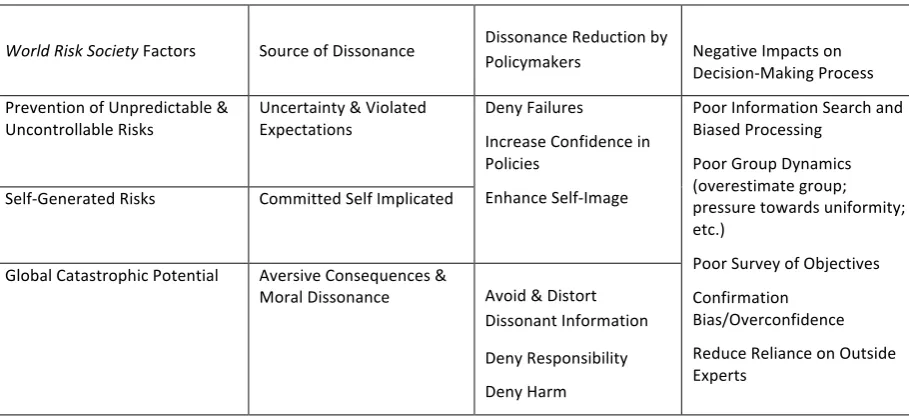
fiascoes. Table 1 presents a summary of the key ‘World Risk Society Factors’ proposed to be
relevant to policy decision making (column 1). Associated with each of these is the proposed
‘Source of Dissonance’ that should become activated, according to cognitive dissonance
theory (column 2), and the ‘Dissonance Reduction by Policymakers’ likely utilised by
decision-makers to alleviate the uncomfortable feeling of dissonance (column 3) will be
discussed. Finally, the ‘Negative Impacts on Decision-Making Process’ likely to follow from
dissonance and its reduction are offered (column 4). Each of these connections will be
clarified in the following sections.
I will primarily draw examples from the “war on terror” and the US-led invasion of
Iraq. These are not meant to test my argument, but rather as plausible illustrations for
purposes of clarity. The “war on terror” is well suited for this purpose. Beck explicitly
focuses on “terrorism” (Beck 2002, 2003), and a large body of scholarship has emerged
exploring risk society and aspects of terrorism and counter-terrorism (cf. Aradau & van
Munster 2007; Heng 2002, 2006; Krahmann 2011). The policy responses to 9-11 are
arguably a good example of risk society dynamics. “Just as war against terror is a global war,
risk society is amongst other things a paradigm of globalization, and as such is particularly
suited to the interpretation of the response to September 11 2001, and its effects.” (Spence,
2005: 284). Moreover, the decision to incorporate Iraq into the “war on terror” has itself
been scrutinized for the presence of decision-making mistakes (Badie 2010; Mintz & Wayne
9
illustration of the ways in which cognitive dissonance might operate within the realm of
policymaking and contribute to policymaking mistakes and fiascoes.
[image:9.595.70.525.214.422.2]
Table 1: World Risk Society, Dissonance, and Decision-making
World Risk Society Factors Source of Dissonance Dissonance Reduction by Policymakers Negative Impacts on Decision-Making Process Prevention of Unpredictable &
Uncontrollable Risks
Uncertainty & Violated Expectations
Deny Failures Increase Confidence in Policies
Enhance Self-Image
Poor Information Search and Biased Processing
Poor Group Dynamics (overestimate group; pressure towards uniformity; etc.)
Poor Survey of Objectives Confirmation
Bias/Overconfidence Reduce Reliance on Outside Experts
Self-Generated Risks Committed Self Implicated
Global Catastrophic Potential Aversive Consequences &
Moral Dissonance Avoid & Distort Dissonant Information
Deny Responsibility Deny Harm
World Risk Society Factors and Sources of Dissonance
Prevention of Unpredictable & Uncontrollable Risks/Uncertainty & Violated Expectations:
The first major dimension of WRS likely to give rise to dissonance is uncertainty.
Beck argues that the “regime of non-knowing” is created when policymakers cannot discern
the agents of threat, their potential, or their intentions (Beck & Cronin, 2009). “World risk
society is confronted with the awkward problem of having to make decisions about life and
death and war and peace on the basis of a more or less frank lack of knowledge” (Beck 2008:
6). Risks are not only difficult to predict or control (Beck, 1999; Beck & Cronin, 2009), but
they are also uninsurable and beyond compensation. Governments thus turn to the
precautionary principle and seek to prevent risks from materialising in the first instance
10
uncertainty, which involves committed efforts to prevent the worst from happening, and
defining “success” as “non-failure”.
There is little definitive information that confirms the effectiveness of chosen policies
when trying to “prevent a bad outcome” instead of trying to “create a good outcome”, so
policymakers live in a sort of continuous informational limbo which in turn drives the need to
convince themselves that actions or policies have indeed resulted in the expected prevention.
This should create information-based dissonance, as no real consonant information can
demonstrate policy success. Decision-makers must increasingly plan for the unexpected, the
unknown. Risk management’s preventive orientation only specifies that dangers exist and
may materialise, but the time and place of those dangers is unclear. For policymakers, there is
significant inconsistency between their claims of having successfully caused non-events and
the attributions of policy failure when an event occurs despite their efforts to prevent it. The
nearly impossible prevention of negative outcomes should more frequently and reliably
generate violated expectations.
Conditions of uncertainty and violated expectations are particularly prone to
producing dissonance. Cognitive dissonance theory has been directly linked to uncertainty
(Heine, Proulx, & Vohs 2006), in that they both “…describe inconsistent cognitions or
unexpected events as leading to an aversive arousal state, which leads to predictable
behavioural change in the service of reducing the arousal” (Randles et al, 2015). Violated
expectations themselves were seen by Festinger (1957) as central to dissonance. He recounts
a fringe cult that incorrectly predicted the end of the world and struggled to reconcile their
intense commitment to the cause with the reality of their continued existence. The group’s
leader reduced dissonance in the unexpected morning by reporting to the others that their
steadfast commitment was what prevented the destruction of the Earth (Festinger, Riecken, &
11
dissonance. More recently, Proulx and colleagues (Proulx, Inzlicht, & Harmon-Jones 2012)
have proposed an “…integrative perspective [that] construes ‘inconsistencies’ as any detected
expectancy violation…” (285), thus placing expectations as the central dynamic producing
aversive arousal and efforts to reduce it.
Dissonance Reduction by Policymakers
Dissonance by its very nature motivates the reduction of intra-psychic uncertainty.
We should expect to see an increased tendency for decision makers to deny that events
represent a failure of policy, focusing instead on positive outcomes and indicators of success.
Beck sees the political motivations of elites as they grapple with the challenge of providing
security in the context of WRS, suggesting that they can essentially “feign control” and claim
that they have successfully managed risks. “Given their task of averting dangers, politicians,
in particular, may easily find themselves compelled to proclaim that the observance of
security standards is assured even though such guarantees are impossible. They do so
nonetheless because the political costs of omission are much higher than those of an
overreaction” (Beck & Cronin, 2009: 53-54). While realised crises may present such
opportunities to frame policy (Boin et al., 2009), they are also an opportunity to reduce
dissonance by re-framing them as positive outcomes. Even many years after the fact, former
National Security Advisor Condoleeza Rice hints, for example, that the Arab uprisings would
have been impossible without the administration having removed Hussein from power in Iraq
(USA Today 2011).
In order to reduce dissonance associated with the lack of information supporting
preventive policies, policymakers will likely seek information in a biased fashion to support
their expectations (Scherer, Windschitl, & Smith 2013; Johnson & Tierney 2011). This may
have been evident in former Vice-President Dick Cheney’s assertion, just prior to the
12
opposed to Hussein indicated that it would happen. Pointing to discussions with Kanan
Makiya, whom he notes is part of the resistance to the Hussein regime, Cheney indicates that
“[t]he read we get on the people of Iraq is there is no question but what they want to get rid of
Saddam Hussein and they will welcome as liberators the United States when we come to do
that” (Cheney, Meet the Press interview, 2003).
We can also see overconfidence in advance of a policy as an effort to mobilise
support. Maor (2012) explicitly examines policy ‘overreaction’ from a psychological point
of view, and argues that “…policy-makers may look for proactive framings of crisis
management, especially the use of non-language in the form of highly visual and dramatic
information that is easily remembered…” (243). Secretary of State Colin Powell’s crucial
speech at the United Nations in advance of the Iraq war is illustrative, involving his holding
up a mock vial of anthrax and displaying charts of mobile production facilities (Vogel 2008).
When policies fail to prevent an unexpected outcome, dissonance may prompt the seeking of
enhanced feelings of self-worth and self-affirmations. Indeed, we may even see more
overconfidence (Blanton, et al. 2001) and an enhanced belief in the ability to predict and
control events as a dissonance reduction compensation for policy failures. As is often the case
with dissonance reduction, disconfirming information results in bolstering beliefs instead of
challenging them. Early on, the Bush administration was keen to argue that the invasion was
successful, reducing the threat of nuclear weapons falling into the hands of terrorists (CNN,
2003). When counter-attacks began to occur in Iraq and elsewhere, the focus shifted to
changing the measures of success, a task that befuddled key policymakers like Secretary of
Defense Donald Rumsfeld (USAToday, 2003).
Self-Generated Risks/Committed Self Implicated: The second major dimension of WRS with
13
generated by deliberate techno-scientific decisions, and this directly implicates those
responsible when such decisions result in unintended crises. He notes that “…with the origin
of industrial risks in decision-making the problem of social accountability and responsibility
irrevocably arises….As we sociologists say, the social roots of risks block the
‘externalizability’ of the problem of accountability.” (Beck 1992: 98). In some instances
specific decision makers are directly implicated in choices that have been made, and at other
times governments carry forward policies of their predecessors – such as maintaining reliance
on nuclear energy or supporting a set of financial regulatory practices. The first instance
represents a direct commitment to an action or decision, while the second instance can be
viewed from the ‘induced compliance’ dissonance paradigm wherein individuals willingly
but reluctantly engage in counter-attitudinal behavior. In either case policymakers become
connected to the policy in question.
Under such circumstances, the ‘self’ is implicated as being responsible for outcomes
by having committed – even if reluctantly – to a course of action. Scholars have
demonstrated this to be central for the arousal of dissonance (Cooper 2007). Although Beck
has been critiqued for his stark distinction between “natural hazards” and “manufactured
risks” (Furedi 2002; Mythen 2004), from a dissonance perspective it is the degree to which
events follow from prior decision that matters most. Indeed, self-consistency theory
(Aronson, 1999), as an approach to cognitive dissonance, says the self must be involved to
arouse dissonance. Steele’s “self-affirmation” theory (1988) goes further in saying that we
want to see ourselves as good, competent people, and the “drive” associated with
inconsistencies is better understood as the pursuit of self-esteem and self-worth. If our
actions are responsible for a negative outcome, then dissonance is likely to arise – even if the
14
Global Catastrophic Potential/Aversive Consequences & Moral Dissonance: The third major
dimension of WRS that arguably evokes cognitive dissonance involves its catastrophic
potential. Governments are tasked with preventing risks from materialising that are
potentially catastrophic in nature, indiscriminate in consequence, and global in scope.7 These
include regional or global catastrophes such as Chernobyl, Fukushima or the global financial
collapse, alongside the more calculated but equally ‘non-state’ threats of global terrorism.
Beck views these as so significant that they move beyond the realm of compensation, such
that they are uninsurable and, indeed, incalculable (Beck 2008). Even when such crises do
not materialize, they are anticipated and constructed as potential threats to be prevented. The
desire to avoid catastrophic consequences is a key feature of WRS.
Cognitive dissonance is centrally concerned with the avoidance of negative
consequences, and several approaches to dissonance emphasize that it is not merely about
cognitive inconsistencies, but rather the desire to make unwanted consequence less aversive
(Cooper & Fazio, 1984; Scher & Cooper, 1989; Johnson, Kelly, and LeBlanc 1995). The
significant negative consequences also mean that moral implications of policy fiascoes are
profound, and combined with the self-generated nature of these risks, the moral culpability of
policymakers is evident. As Adams notes, ‘[r]isk-management decisions are moral decisions
made in the face of uncertainty’ (Adams 2003:87). The uninsurable nature of these risks
further highlights the moral implications, as governments can no longer exchange failed
security from risks for compensation. In such circumstances individuals are more likely to
experience ‘ethical dissonance’, connecting their own shortcomings and decision-making
errors with the outcome.
Steel’s self affirmation theory rests not only on self-esteem but also on the idea that
“seeing oneself as good and moral is the objective” (Cooper, 2007: 98). Barkan and
15
defined as an inconsistency between one’s drive to preserve a moral self-image and an
individual’s immoral acts. They argue that in addition to the violation of social norms
(Cooper & Fazio, 1984), when individuals behave in ways contrary to their own belief and
values (Aronson, 1992; Thibodeau & Aronson, 1992) and additionally are responsible for
behaving in ways that threaten their self-integrity (Spencer, Josephs, & Steele, 1993; Steele,
1988), dissonance is even more likely (Barkan et. al., 2012; Shu, Gino, & Bazerman, 2012).
Dissonance Reduction by Policymakers
Both the “self-generated risks” and “global catastrophic potential” of WRS appear
particularly likely generate dissonance. Associated with each of these are dissonance
reduction strategies designed to alleviate the attendant psychological discomfort. These have
also been noted by scholars as aspects of the policymaking and management process. When
formulating policies in dissonance-arousing contexts, decision makers are generally more
likely to avoid inconsistent information or to distort information to make it consistent with
their views or preferred policies. When a serious risk becomes a reality (e.g. Fukushima), or
becomes a prominent feature of political discourse (e.g. global warming), dissonance
reduction techniques such as denying culpability will be most prominent (Gosling, Denizeau,
& Oberlé 2006). Dissonance reduction offers another perspective on “blame avoidance
behaviour” by policymakers (Hinterleitner & Sager 2015; Hood 2010; Waever 1986). While
the “blame game” results from a wide variety of organisational, political, and even individual
difference factors (Boin et al., 2010), dissonance and its reduction can help to account for
some of the underlying psychological dynamics that lead individuals to deny personal
responsibility for failures and mistakes. Although such denials and rationalisations can be
politically-motivated, there is some recent evidence that the desire to reduce dissonance can
16
psychological explanation for why policymakers might claim to have supported (or opposed)
policies that they in fact did not.
Additionally, there will be efforts to deny or diminish the magnitude of negative
consequences, and decision-makers may engage in systematic rationalisations in order to
justify their policies or reduce negative reactions to their decisions. Dissonance can motivate
policymakers to alter their view of harmful consequences, making them seem less negative,
as ‘…the motivation for dissonance reduction arises from the perception of aversive
consequences and that changes of attitudes that generally follow from dissonance arousal are
at the service of rendering those consequences nonaversive’ (Cooper, 1999: 150). The Bush
administration, for example, grossly underestimated costs of invading Iraq in advance of the
actual invasion (The Guardian 2013), despite credible higher estimates available at the time.
After the invasion, when the swift victory and ‘mission accomplished’ sensibilities began to
fade in the face of stiff resistance in Iraq, the administration continued to minimize the sense
of negative consequences, such as by offering low estimates of Iraqi casualties (The
Washington Post 2005).
Negative Impacts on Decision-Making Processes
In general the nature of decision-making mistakes prompted by dissonance and its
reduction should not be dissimilar to those already familiar to scholars of policymaking.
Dissonance reduction will most often result in some level of distortion of information,
selective information avoidance, and various other techniques for re-aligning inconsistencies
among beliefs, preferences, and behaviours. But given the nature of policymaking described
by WRS, we can see some aspects of these types of mistakes in a new light.
The “linear rationality” of modernity focuses on achieving objectives by applying
17
Schafer & Crichlow 2010). But the “reflexive rationality” of WRS suggests that specifying
objectives and determining appropriate alternative courses of action are much broader in
nature, being built around prevention of “bad outcomes”. In a sense, this places “normal”
policymaking more squarely in the realm of grand strategy, with overly broad objectives and
underspecified means. The challenge of addressing such ill-structured problems (Sylvan &
Voss 1998) is compounded by the dissonance associated with a risk management, reflexive
approach and will likely result in excessive cognitive simplifications designed to simplify
ill-structured problems and to align information with a limited range of policy objectives.
Decision makers may seek experts to help overcome the complexities of a given risk,
which could be viewed as a positive strategy as both knowledge and experience are factors
that have been associated with more effective decision-making (Schafer & Crichlow, 2010).
For Beck, however, risk society greatly reduces confidence in expertise, as the complexity
and unpredictability of techno-scientific risks eludes expert control. The BP oil spill in the
Gulf of Mexico in 2010 is illustrative, as the crisis spun out of control and the technological
complexity of trying to plug the oil deep underwater gave way to hapless efforts with comical
names such as ‘top kill’ and ‘junk shot’ and involved complex challenges around the use of
expertise (cf. Mills & Koliba, 2015). For complex and unbounded risks ‘…there is typically
little data or evidence on which to base management decision and practices, and there is little
confidence that management strategies will actually reduce the risk in a tangible way’
(Handmer & James, 2007: 129).
While cognitive dissonance has generally been considered intra-personal,
decision-makers rarely grapple with policymaking alone, and Beck explicitly recognizes this fact
(Beck 1992:98). Festinger himself considered the social group to be a source for the
experience (and alleviation) of dissonance (Festinger, 1957).8 Recently scholars have
18
2009; McKimmie 2015), and studies have observed dissonance reduction through diffusion
of responsibility within groups (Cooper & Stone 2000) and have found that consensus
following disagreement among group members is a source of dissonance reduction (Matz &
Wood 2005).9 But the nature of decision-making in WRS may actually increase dissonance.
‘t Hart (1990) indicates that intensive competition with an out-group is likely to influence
‘…high group cohesiveness and anticipatory compliance in the face of strong
leadership…[and] symptoms of groupthink, such as a belief in the inherent morality of the
group and stereotypes of out-groups’ (105).10 Facing crises that originate in the backlash of techno-scientific progress, however, the ability to ‘scapegoat’ the source of risk onto the
‘other’ will be difficult and implicate the self. Efforts to reduce dissonance may intensify and
result in cognitive distortions that reduce personal responsibility, perhaps even by creating an
‘other’ to which negative outcomes can be attributed – such as mistaking Saddam Hussein to
be colluding with al Qaida and to be the source of risks associated with weapons of mass
destruction and international terrorism (Badie 2010).
Conclusions
I have argued from a “process conception” of mistakes, connecting the conditions of
WRS to the dynamics of decision-making through the vehicle of cognitive dissonance (for
alternative approaches to mistakes, see [others] this issue). Alongside the behavioural and
institutional changes that Beck argues accompany WRS, we should also consider the impact
on policy decision-making dynamics, as the types of decision scenarios increasingly likely to
be facing governments may fundamentally influence the “micro processes” of
decision-making. Even if the WRS thesis is not itself fully empirically accurate (Jarvis 2007), the more
recent expansion of risk bureaucracies, risk regulation regimes, and political risk analysis
itself suggests that many governments are indeed taking a reactive and preventive approach
19
to decision-making processes highlights the possible influence of the broadest sociological
context on decision-making mistakes and emphasizes different dynamics and decision
pathologies that can occur when policymakers are dealing with WRS-type events and crises.
Other psychological approaches to the study of risk and policy decision-making exist,
of course, such as framing (cf. Kahneman & Tversky 1979), individual personality
differences (cf. Kowert & Hermann 1997), and cultural beliefs in relation to risk perceptions
(cf. Douglas & Wildavsky, 1982; Dingwall 2000; Wildavsky & Dake, 1990). What has been
missing is a direct connection to the more marco international context. While there has been
some speculation that international features are fundamentally related to psychological
processes, such as cognitive capitalism (Moulier-Boutang 2012), or the more general
systemic effects on the information processing of foreign policy makers (Jervis 1998), little
work has tried to directly connect broad sociological features to the psychological
foundations of decision making mistakes. While cognitive dissonance is not itself a theory of
risk or risk-taking, it is instead a more generally applicable theory of how people respond to
inconsistencies and is particularly well suited to examining “mistakes and failures” and how
we deal with them (Tavris & Aronson 2008). Moreover, psychologists are beginning to
reinterpret many of their findings in the light of dissonance theory, recognizing that ‘…the
basic notion of cognitive consistency can integrate a wide range of social psychological
phenomena that have rarely been analysed from a consistency perspective’ (Gawronski,
2012: 653; see also Gawronski & Strack, 2012). Combined with the concepts of WRS, then,
dissonance offers a compelling connection to policy mistakes and fiascoes.
By its very nature – connecting the “marco-level” to the “micro-cognitive level” – the
empirical demonstration of these effects is extremely difficult. Indeed, idiosyncratic features
of any choice situation will continue to be a primary influence on the prevalence of
20
decision makers are likely to make, since it does not in itself specify the nature of dissonance
reduction that will be utilised in any particular situation. Individuals are relatively free to
deny events, distort information to put it in line with beliefs and behaviours, bolster their
beliefs, enhance their sense of self-worth or self-esteem, and even (though more rarely)
change their behaviour in response to the arousal of dissonance. The gritty work of
examining decision-making remains essential for scholars interested in such process
explanations of policies, mistakes, and fiascoes.
Word Count: 7429
References
Adams, J. (2003). Risk and Morality: Three Framing Devices. In R. V. Ericson, A. Doyle (Eds.), Risk and morality (pp. 87-103). Green College Thematic Lecture Series.
Aradau, Claudia and van Munster, Rens (2007). Governing terrorism through risk: Taking precautions, (un)knowing the future. European Journal of International Relations, 13(1), pp. 89–115.
Aronson, E. (1999). Dissonance, hypocrisy, and the self-concept. In E. Harmon-Jones, J. Mills, E. Harmon-Jones, J. Mills (Eds.) , Cognitive dissonance: Progress on a pivotal theory in social psychology (pp. 103-126). Washington, DC, US: American Psychological
Association.
Aronson, E. (1992) ‘The return of the repressed: dissonance theory makes a comeback,’ Psychological inquiry, 3(4): 303-311.
Badie, D. (2010). Groupthink, Iraq, and the War on Terror: Explaining US Policy Shift toward Iraq. Foreign Policy Analysis, 6(4), 277-296.
Barkan, R., Ayal, S., Gino, F., & Ariely, D. (2012). The Pot Calling the Kettle Black: Distancing Response to Ethical Dissonance. Journal Of Experimental Psychology: General,
141(4), 757-773.
Beck, U. (1992). Risk society : towards a new modernity / Ulrich Beck ; translated by Mark Ritter. London : Sage, 1992.
21
Beck, U. (2002). The terrorist threat world risk society revisited. Theory, Culture & Society,
19(4), 39-55.
Beck, U. (2003). The Silence of Words: On Terror and War. Security Dialogue, 34(3), 255.
Beck, U. (2008). World at Risk: The New Task of Critical Theory. Development and Society, 37(1), 1-21.
Beck, U. (2009). World Risk Society and Manufactured Uncertainties. Iris: European Journal Of Philosophy & Public Debate, 1(2), 291.
Beck, U., & Cronin, C. (2009). World at risk / Ulrich Beck ; translated by Ciaran Cronin. Cambridge : Polity, c2009.
Beck, U., & Lau, C. (2005). Second Modernity as a Research Agenda: Theoretical and Empirical Explorations in the 'Meta-Change' of Modern Society. The British Journal Of Sociology, (4), 525.
Blanton, H., Pelham, B. W., DeHart, T., & Carvallo, M. (2001). Overconfidence as dissonance reduction. Journal Of Experimental Social Psychology, 37(5), 373-385.
Boin, A., 't Hart, P., & McConnell, A. (2009). Crisis exploitation: political and policy impacts
of framing contests. Journal of European Public Policy, 16(1), 81-106.
Boin, A., Hart, P., McConnel, A., & Preston, T. (2010). ‘Leadership Style, Crisis Response, and Blame Management: The Case of Hurricane Katrina. Public Administration, 88(3), 707-723.
Caplan, Pat (2000). Risk Revisited. London: Pluto Press.
CNN.com International/US. ‘Bush makes historic speech aboard warship’ (2003, May 2). Retrieved March 30, 2015 from http://edition.cnn.com/2003/US/05/01/bush.transcript/
Cooper, Joel. (1999) ‘Unwanted Consequences and the Self: In Search of the Motivation for Dissonance Reduction’ in Harmon-Jones & Mills
Cooper, Joel. (2007) Cognitive Dissonance: 50 years of a classic theory. Sage Publications.
Cooper, J., and Fazio, R. H. (1984). A New Look at Dissonance Theory. Advances In Experimental Social Psychology, 17229-266.
Cooper, J., & Stone, J. (2000). Cognitive dissonance and the social group. In D. J. Terry, M. A. Hogg, D. J. Terry, M. A. Hogg (Eds.) , Attitudes, behavior, and social context: The role of norms and group membership (pp. 227-244). Mahwah, NJ, US: Lawrence Erlbaum
Associates Publishers.
Dingwall, Robert (2000) ‘Risk Society: The Cult of Theory and the Millennium’, in Nick Manning and Ian Shaw (eds) New Risks, New Welfare: Signposts for Social Policy, pp. 137– 54. London: Blackwell.
Douglas, Mary, and Aaron Wildavsky. (1982). "Risk and culture: An essay on the selection
22
Elliott, Anthony (2002) ‘Beck’s Sociology of Risk: A Critical Assessment’, Sociology 36: 293–315.
Festinger, L. (1957) A Theory of Cognitive Dissonance. Evanston, IL: Row, Peterson.
Festinger, L., Riecken, H. W., & Schachter, S. (1956). When prophecy fails: A social and psychological study of a modern group that predicted the end of the world.
Festinger, L. & Thibau, J. (1951). Inteerpersonal communication in small groups. Journal of Abnormal and Social Psychology, 46, 92-99.
Furedi, Frank (2002). Culture of Fear: Risk Taking and the Morality of Low Expectation. London: Continuum.
Garland, D. (2003). The Rise of Risk. In R. V. Ericson, A. Doyle (Eds.) , Risk and morality (pp. 48-86). Green College Thematic Lecture Series.
Gawronski, B. (2012). Back to the Future of Dissonance Theory: Cognitive Consistency as a Core Motive. Social Cognition, 30(6), 652-668.
Gawronski, B., & Strack, F. (Eds.). (2012). Cognitive consistency: A fundamental principle in social cognition. New York: Guilford.
Gosling, P., Denizeau, M., & Oberlé, D. (2006). Denial of responsibility: A new mode of dissonance reduction. Journal Of Personality And Social Psychology, 90(5),
Handmer, J. J., & James, P. P. (2007). Trust us and be scared: The changing nature of contemporary risk. Global Society, 21(1), 119-130.
Harmon-Jones, E., Harmon-Jones, C., & Levy, N. (2015). An action-based model of cognitive-dissonance processes. Current Directions In Psychological Science, 24(3), 184-189.
Harmon-Jones, E., & Mills, J. (1999). An introduction to cognitive dissonance theory and an overview of current perspectives on the theory. In E. Jones, J. Mills, E. Harmon-Jones, J. Mills (Eds.) , Cognitive dissonance: Progress on a pivotal theory in social psychology (pp. 3-21). Washington, DC, US: American Psychological Association.
Hart, P. ‘t. (1990) Groupthink in government: A study of small groups and policy failure. Amsterdam: Swets and Zeitlinger.
Heine, S. J, Proulx, T., & Vohs, K.D. (2006). The Meaning Maintenance Model: On the Coherence of Social Motivations. Personality and Social Psychology Review, 10(2), 88-110.
Heng, Y. K. (2002). Unravelling the 'war' on terrorism: A risk-management exercise in war clothing?. Security Dialogue, 33(2), 227-242.
23
Hinterleitner, M., & Sager, F. (2015). Avoiding Blame-A Comprehensive Framework and the Australian Home Insulation Program Fiasco. Policy Studies Journal, 43(1), 139-161.
Hood, C. (2010). The Blame Game : Spin, Bureaucracy, and Self-Preservation in Government. Princeton: Princeton University Press.
Hood, C., Rothstein, H., & Baldwin, R. (2001). The government of risk: Understanding risk
regulation regimes. Oxford University Press.
Huntington, S. P. (1996). The clash of civilizations and the remaking of world order. New York: Simon & Schuster.
Janis, I. L. (1982) Groupthink: psychological studies of policy decisions and fiascoes. Boston: Houghton Mifflin.
Janis, I. L. (1972) Victims of Groupthink: a psychological study of foreign policy decisions and fiascoes. Oxford, England: Houghton Mifflin.
Jarvis, D. L. (2007). Risk, Globalisation, and the State: A Critical Appraisal of Ulrich Beck and the World Risk Society Thesis. Global Society 21(1), 23-46.
Jarvis, D. L., & Griffiths, M. (2007). Learning to Fly: The Evolution of Political Risk Analysis. Global Society: Journal Of Interdisciplinary International Relations, 21(1), 5-21.
Jervis, Robert. System effects: Complexity in political and social life. Princeton University
Press, 1998.
Johnson, R. W., Kelly, R. J., & LeBlanc, B. A. (1995). Motivational basis of dissonance: Aversive consequences of inconsistency. Personality And Social Psychology Bulletin, 21(8), 850-855.
Johnson, D., & Tierney, D. (2011). The Rubicon Theory of War: How the Path to Conflict Reaches the Point of No Return. International Security, 36(1), 7.
Kahneman, D., & Tversky, A. (1979). Prospect Theory: An Analysis of Decision under Risk. Econometrica, (2). 263.
Kowert, P. A., & Hermann, M. G. (1997). Who Takes Risks? Daring and Caution in Foreign Policy Making. The Journal of Conflict Resolution, (5). 611.
Krahmann, E. (2011). Beck and beyond: selling security in the world risk society. Review Of International Studies, 37(1), 349-372.
Kumar, K. (2008). Civil Society, Globalization, and Global Civil Society. Journal Of Civil Society, 4(1), 15.
Maor, M. (2012). Policy overreaction. Journal Of Public Policy, 32(3), 231-259.
Matz, D. C., & Wood, W. (2005). Cognitive Dissonance in Groups: The Consequences of Disagreement. Journal Of Personality And Social Psychology, 88(1), 22-37.
24
McKimmie, B. M., Terry, D. J., & Hogg, M. A. (2009). Dissonance reduction in the context of group membership: The role of metaconsistency. Group Dynamics: Theory, Research, And Practice, 13(2), 103-119.
Meet the Press interview, Dick Cheney, March 16, 2003. Retrieved March 29, 2015 from www.mtholyoke.edu/acad/intrel/bush/cheneymeetthepress.htm
Mills, R. W., & Koliba, C. J. (2015). The challenge of accountability in complex regulatory networks: The case of the Deepwater Horizon oil spill. Regulation & Governance, 9(1), 77-91.
Mintz, A., & Wayne, C. (2014). Group decision making in conflict: From groupthink to polythink in the war in Iraq. In P. T. Coleman, M. Deutsch, E. C. Marcus (Eds.), The
handbook of conflict resolution: Theory and practice (3rd ed.) (pp. 331-352). San Francisco, CA, US: Jossey-Bass.
Moulier-Boutang, Yann. Cognitive capitalism. Polity, 2012.
Mythen, G. (2004). Ulrich Beck: A critical Introduction to the Risk Society. London: Pluto Press.
Orwell, G. (2006). 1984. Editions Underbahn Ltd.
Proulx, T., Inzlicht, M., & Harmon-Jones, E. (2012). Review: Understanding all inconsistency compensation as a palliative response to violated expectations. Trends In Cognitive Sciences, 16285-291.
Randles, D., Inzlicht, M., Proulx, T., Tullett, A. M., & Heine, S. J. (2015). Is dissonance reduction a special case of fluid compensation? Evidence that dissonant cognitions cause compensatory affirmation and abstraction. Journal Of Personality And Social Psychology, 108(5), 697-710.
Rodriguez, D. N., & Strange, D. (2015). False memories for dissonance inducing events. Memory, 23(2), 203-212.
Schafer, M. and Crichlow, S. (2010) Groupthink: High –quality decision making in
international relations. Colombia University Press.
Scher, S. J. and Cooper, J. (1989) ‘Motivational basis of dissonance: the singular role of
behavioral consequences,’ Journal of Personality and Social PsychologyI, 56, 899-906.
Scherer, A., Windschitl, P., & Smith, A. (2013). Hope to be right: Biased information seeking following arbitrary and informed predictions. Journal Of Experimental Social Psychology, 49(1), 106-112.
Scott, Alan (2000) ‘Risk Society or Angst Society? Two Views of Risk, Consciousness and Community’, in Barbara Adam, Ulrich Beck and Joost van Loon (eds) The Risk Society and Beyond: Critical Issues for Social Theory, pp. 33–46.
London: Sage.
25
Spence, K. (2005). World risk society and war against terror. Political Studies, 53(2), 284-302.
Spencer, S. J., Josephs, R. A., and Steele, C. M. (1993) ‘Low self-esteem: the uphill struggle for self-integrity’ in Roy F. Baumeister (ed.) Self esteem: the puzzle of low self-regard.
Springer US.
Steele, C. M. (1988) ‘The psychology of self-affirmation: sustaining the integrity of the self,’ in L. Berkowitz (ed.), Advances in Experimental Social Psychology, vol. 21. San Diego, CA: Academic Press, pp. 261-302.
Sylvan, Donald A., and James F. Voss. Problem representation in foreign policy
decision-making. Cambridge University Press, 1998.
Tavris, C., & Aronson, E. (2008). Mistakes were made (but not by me): why we justify foolish beliefs, bad decisions and hurtful acts. London: Pinter & Martin.
The Guardian, “How the US Public was defrauded by the hidden costs of the Iraq war.’ (March 11, 2013). Retrieved July 23, 2015 from
http://www.theguardian.com/commentisfree/2013/mar/11/us-public-defrauded-hidden-cost-iraq-war
The Washington Post, ‘What’s the story behind 30,000 Iraqi deaths?’ (December 18, 2005). Retrieved July 23, 2015 from
http://www.washingtonpost.com/wp-dyn/content/article/2005/12/17/AR2005121700017.html
Thibodeau, R. and Aronson, E. (1992) ‘Taking a closer look: reasserting the role of the self-concept in dissonance theory,’ Personality and Social Psychology Bulletin, 18: 591-602.
USAToday Washington/Politics. ‘Rumsfeld’s war-on-terror memo’ (2003, October 16). Retrieved April 1, 2015 from
http://usatoday30.usatoday.com/news/washington/executive/rumsfeld-memo.htm
USA Today interview, Condoleeza Rice. (October 31, 2011). Retrieved March 30, 2015 from usatoday30.usatoday.com/news/Washington/story/2011-10-31/Condoleezza-rice-memoir-bush/51006960/1
Vogel, K. M. (2008). 'Iraqi Winnebagos of death': imagined and realized futures of US bioweapons threat assessments. Science & Public Policy (SPP), 35(8), 561.
Weaver, R. (1986). The Politics of Blame Avoidance. Journal of Public Policy, 6, 371-398.
Western, J. (2013). From Wars of Choice to the Mistakes of Wars: Presidential Decision Making and the Limits of Democratic Accountability. Perspectives On Politics, 11(2), 532.
Wildavsky, A., & Dake, K. (1990). Theories of Risk Perception: Who Fears What and Why?. Daedalus, (4). 41.
Zanna M, Sande G. (1987). The effects of collective actions on the attitudes of individual group members: A dissonance analysis. Social influence: The Ontario symposium, Vol. 5 . Hillsdale, NJ, England: Lawrence Erlbaum Associates, Inc. :151-163.
26
7 For a critique of Beck’s assertions regarding the ‘global’ nature of risks society, see Caplan 2000.
8 Festinger himself was deeply interested in group dynamics, having published on it prior to his formal presentation of cognitive dissonance (Festinger & Thibau, 1951).
9 Even Janis (1972) may have recognised aspects of dissonance within his concept of groupthink, and perhaps saw groupthink as a space absent of dissonance. He notes that the term ‘groupthink’ is Orwellian in origin and of the same order as terms like ‘doublethink’, which Orwell’s book 1984 (1949/2006) presents as the ability to hold two completely contradictory beliefs in mind simultaneously and to believe them both equally without doubt or hesitation – a remarkable description of the complete absence of dissonance.
10 Interestingly, the majority of the case studies of groupthink, groupthink-avoidance, and those that have helped to move us ‘beyond groupthink’ are grounded in decisions that