airport ground movement algorithm
Stefan Ravizza and Jason A. D. Atkin
Presented at the International Conference on Operations Research (OR 2011), Zurich, Switzerland, 2011.
AbstractGuiding aircraft around the airport’s surface while ensuring conflict-free routings is an important problem at airports. Sequential routing and scheduling algo-rithms can be advantageous for providing fast online solutions for decision support systems to help controllers. However, the effectiveness of such algorithms can de-pend upon the sequence of consideration of the aircraft, which is often chosen to be first-come-first-served. This research analyses the effects of different heuristics to find better sequences. Results are presented, utilising real data from Zurich Airport. These show that sophisticated heuristics can substantially improve the solution with comparatively little additional computational time. Furthermore, one approach aims to modify relatively few existing routes as it progresses, in order to minimise the workload of the controllers in communicating changes in an online environment.
1 Introduction
Airport controllers are faced with complex tasks every day to ensure safe opera-tions at airports while meeting the various different objectives. There is already a need for sophisticated decision support systems to help controllers to handle the complexity of their tasks if the benefits of their work are to be maximised. This is likely to become even more important in future, with the expected growth in the air transportation sector. One of the challenging tasks which are faced is the airport ground movement problem: guiding aircraft around the airport’s surface to their destinations. Since online solutions are often needed (requiring fast solution speed and the ability to cope with a changing situation), sequential routing and scheduling algorithms, which consider one aircraft at a time, can be favourable.
Previous research on ground movement included sequential approaches by Got-teland et al. [7], Lesire [8], and Atkin et al. [2] and they seem to fulfil the
compu-Stefan Ravizza (corresponding author) and Jason A. D. Atkin School of Computer Science, University of Nottingham Jubilee Campus, Nottingham, NG8 1BB, UK
e-mail: [email protected], [email protected]
tational time criterion better than mixed integer programming formulations, such as that presented by Roling and Visser [10]. The major drawback of sequential routing approaches is that the solution quality can depend upon the sequence of considera-tion of the aircraft. This is often chosen to be first-come-first-served to comply with the aim of fairness at airports as well as for algorithmic performance reasons. It is often necessary to move earlier aircraft out of the way before later can move, and moving later aircraft first may not leave a sufficient gap to fit in the earlier aircraft movements.
This paper explores the effect of different heuristics to decrease the total taxi time by changing the sequence in which aircraft are considered. One successful approach also aims to modify as few existing routes as possible, to minimise the controller’s workload in communicating changes.
The remainder of this paper is structured as follows: Section 2 provides a brief description of the airport ground movement problem and the utilised algorithm for this analysis. Next, several approaches to improve the solution quality are discussed in Section 3. The results are then presented together with the discussion in Section 4, before ending the paper with some conclusions.
2 Sequential ground movement algorithm
Ground movement consists of guiding aircraft on the airport’s surface from their gate/stand to the runway, or vice versa. Importantly, conflict-free routings have to be found where aircraft meet specified time constraints, both during the taxiing process and at the start/end of the route. Within this current research, landing times (for arrivals) and take-off times (for departures) at the runway are assumed to be fixed inputs, resulting from runway sequencing optimisation. A comprehensive review of current ground movement algorithms can be found in Atkin et al. [1].
The Quickest Path Problem with Time Windows (QPPTW) algorithm proposed for ground movement by Atkin et al. [2] is used here to explore the benefits of differ-ent orderings of consideration of the aircraft. This sequdiffer-ential routing and schedul-ing algorithm utilises a representation of the airport layout as a graph where edges represent parts of a taxiway and nodes the intersections or intermediate points of taxiways. Very short computational times were reported for the QPPTW algorithm, showing the potential for it to be used in an online environment. Furthermore, the approach guarantees conflict-free routings, is not fixed to a set of predefined routes and can incorporate additional constraints to model the real world problem in a more realistic manner than most other published approaches.
3 Approaches to improve the solution quality
The aim of this section is to introduce sophisticated heuristics which are used to improve the quality of the utilised aircraft sequence. Gotteland et al. [7] applied the concept of genetic algorithms to attempt to find better orderings. A major drawback of such an approach is that there is no control about the final sequence and a lot of communication between controllers in the tower and pilots is potentially needed to change the routes of all of the affected aircraft.
The concept of a ‘causer aircraft’ is introduced first in this section, based on ideas from the Master’s dissertation of Ravizza [9]. Afterwards, different heuristics are explained in order to improve the solution quality, as far as reduction in total taxi time is concerned, while staying close to the original natural sequencing, to maintain an element of fairness.
Finding a causer aircraft The QPPTW algorithm sequentially routes new aircraft whilst respecting previous reservations by other aircraft. The time needed by each aircraft to complete its route is compared to the time which would have been needed if the aircraft had been routed in isolation (using Dijkstra’s algorithm [3, 6] to find the shortest route). If the difference is bigger than a certain threshold value the algo-rithm attempts to find a better sequence. An already routed aircraft will have caused this delay and this aircraft is classified as the causer aircraft. If several aircraft are affecting an aircraft, the one affecting the current aircraft’s route the earliest is seen as the causer aircraft.
There are two cases to consider when detecting a causer aircraft. Firstly, an air-craft can need to wait during taxiing because another airair-craft is blocking the next part of the route and causes the delay. Secondly, an aircraft could be forced to do a detour, leading to a delay which is longer than the threshold value. In this case, the computed route is compared to the shortest route and from the separation point on, a look-ahead mechanism on the shortest route is used to determine the causer aircraft. The blocking of a part of the taxiway can potentially be further on the short-est route, since the QPPTW algorithm finds a way on a detour which leads to the destination faster, so a detour may diverge earlier than the blocker requires if this creates a shorter route.
Swap heuristic The simplest (but very effective) heuristic involves using the swap-operator. As explained before, the aircraft are initially sequenced in the natural or-dering. If a route of a new aircraft has a delay longer than the threshold value, the approach tests another sequence and uses the better one. In the case of the swap heuristic, the route of the causer aircraft is taken out of the solution and the new aircraft is then routed and scheduled based on the QPPTW algorithm, before re-routing the causer aircraft. All of the other routes and schedules are fixed in order to maintain fairness and to aim for reduced communication requirements.
re-routed all the intermediate aircraft and tested whether this lead to a reduced total taxi time compared to adding the new aircraft to the end of the old sequence.
Shift heuristic A shift-operator is used here instead of a swap-operator. In contrast to the previous heuristic, the new aircraft is added just before the causer aircraft in the aircraft’s sequence. Obviously, all of the aircraft afterwards may have to be re-routed to find a feasible overall solution of the problem.
Best-shift heuristic Both of the above heuristics aim for a better overall solution by considering routing the new aircraft earlier than the causer aircraft. Hence, the concept of a causer aircraft is the main idea behind the improvements. This heuristic works in a different way and is based on the concept of Constrained Position Shifting (CPS) [4,5]. CPS allows the shifting of an aircraft by at most a predefined number of positions in the sequence. All of the possibilities which meet the CPS are explored for a new aircraft in our heuristic and the best is chosen. Again, all of the aircraft after the new position may have to be re-routed to guarantee a feasible solution.
Off-line heuristic To provide a baseline for all of the online heuristics discussed so far, the sequence was explored using an off-line approach. An initial sequence was used and swap- and shift-operators were randomly applied to delayed aircraft to find a better sequence, using a hill-climbing approach: the new sequence replaced the old sequence if the new sequence had a better overall quality.
4 Results for Zurich Airport
The heuristics were tested on data from Zurich Airport (ZRH), which is the largest airport in Switzerland. The considered data included all of the necessary information for an entire day’s operations for the 19th of October 2007, with 679 movements in total (337 arrivals and 342 departures) as in the paper by Atkin et al. [2]. The threshold value to accept a small delay was set very low, to 5 seconds.
Table 1 Analysis of ordering heuristics
FCFS swap shift best-shift off-line
Difference from lower bound 4391s 2771s 2494s 2450s 2305s
Reduction of gap 0.0% 36.9% 43.2% 44.2% 47.5%
Approximation ratio 1.022 1.014 1.012 1.012 1.011
Solution time 11.6s 60.1s 13.2min 49.8h
-Solution time per aircraft 17.1ms 88.5ms 1.2s 4.4min
would increase the computational time even more) and finally the solution from the off-line heuristic (starting from the best solution found by the other approaches).
As reported in the paper by Atkin et al. [2], the total taxi time for the FCFS ordering applied to the Zurich Airport dataset is 207723 seconds and a lower bound of the problem is 203332 seconds implying that the optimality gap is at most 4391 seconds, with an approximation ratio of 1.022.
The results for the different approaches for improving the solution quality were ordered by their complexity. It can be seen that a reduction of 37.0% of the gap between the initial solution and the lower bound was found by applying the swap heuristic. Surprisingly small further improvements were found when using any of the other approaches. The solution times for ordering an entire sequence were in the opposite order. The swap heuristic needed more time due to the fact that the approach first had to check whether a route had any delay and find the causer aircraft before trying the swapped sequence. The two shift heuristics needed much longer since all of the intermediate aircraft had to be re-routed, which would also imply more communication for the pilots and controllers.
The off-line approach used once the sequence which resulted from the best-shift heuristic. The presented solution was found after 3320 iterations of swap- or shift-operators, which corresponded to around 22 hours of calculation. Another additional 20000 iterations did not improve the solution any further and it is very likely that the approach had found a local optimum.
Results are not shown for the variations of the swap heuristic which were previ-ously discussed since none had a better reduction in the taxi time compared to their solution time and the number of affected aircraft than the other approaches.
580 590 600 610 620 630 640 650 660 670
0 20 40 60 80 100 120 140 160
Aircraft
Delay [s]
FCFS swap shift off−line
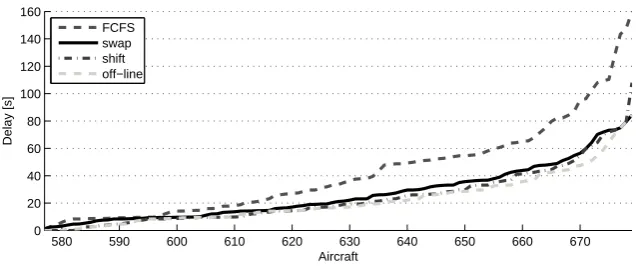
Fig. 1 Sorted delay for each aircraft from the different heuristics
[image:5.595.145.464.403.536.2]seen that the heuristics can improve the solution massively and that the simple but effective swap heuristic reduced the longest delay from 160 seconds to 84 seconds.
5 Conclusion
This paper explored the potential of different ordering heuristics for the sequential ground movement problem. The most promising approach is by using a simple but effective swap-operator. The quality of the solution was shown to be substantially improved with comparatively little additional computational time, making it suitable for real time use at airports. Very few changes in the initial sequence are needed, hence the communication between controllers and pilots is kept to a minimum.
Acknowledgements The authors wish to thank the Engineering and Physical Sciences Research Council (EPSRC) for providing the funding which made this research possible. We would also like to thank Flughafen Z¨urich AG who provided the real dataset.
References
1. Atkin, J.A.D., Burke, E.K., Ravizza, S.: The airport ground movement problem: Past and current research and future directions. In: Proceedings of the 4th International Conference on Research in Air Transportation (ICRAT 2010), Budapest, Hungary, pp. 131–138 (2010) 2. Atkin, J.A.D., Burke, E.K., Ravizza, S.: A more realistic approach for airport ground
move-ment optimisation with stand holding. In: Proceedings of the 5th Multidisciplinary Interna-tional Scheduling Conference (MISTA 2011), Phoenix, Arizona, USA (2011)
3. Cormen, T.H., Leiserson, C.E., Rivest, R.L., Stein, C.: Introduction to Algorithms, 2nd edn. MIT Press and McGraw-Hill (2001)
4. Dear, R.: The dynamic scheduling of aircraft in the near terminal area. Tech. rep., Flight Transportaiton Laboratory, M.I.T., Cambridge, Massachusets, U.S. (1976)
5. Dear, R.G., Sherif, Y.S.: An algorithm for computer assisted sequencing and scheduling of terminal area operations. Transportation Research Part A: General25(2-3), 129–139 (1991). DOI 10.1016/0191-2607(91)90132-A
6. Dijkstra, E.W.: A note on two problems in connexion with graphs. Numerische Mathematik
1, 269–271 (1959)
7. Gotteland, J.B., Durand, N., Alliot, J.M., Page, E.: Aircraft ground traffic optimization. In: Proceedings of the 4th USA/Europe Air Traffic Management Research and Development Sem-inar, Santa Fe, NM, USA (2001)
8. Lesire, C.: Iterative planning of airport ground movements. In: Proceedings of the 4th Interna-tional Conference on Research in Air Transportation (ICRAT 2010), Budapest, Hungary, pp. 147–154 (2010)
9. Ravizza, S.: Control of automated guided vehicles (AGVs). Master’s thesis, ETH Zurich, Switzerland (2009)