arXiv:1808.09870v1 [cs.PL] 29 Aug 2018
¨
Ozg¨ur Akg¨un, Ruth Hoffmann, and Susmit Sarkar
School of Computer Science, University of St Andrews, UK {ozgur.akgun, rh347, ss265}@st-andrews.ac.uk
Abstract. Memory consistency models (MCMs) are at the heart of con-current programming. They represent the behaviour of concon-current pro-grams at the chip level. To test these models small program snippets called litmus test are generated, which show allowed or forbidden be-haviour of different MCMs. This paper is showcasing the use of constraint programming to automate the generation and testing of litmus tests for memory consistency models. We produce a few exemplary case studies for two MCMs, namely Sequential Consistency and Total Store Order. These studies demonstrate the flexibility of constrains programming in this context and lay foundation to the direct verification of MCMs against the software facing cache coherence protocols.
Keywords: Memory Consistency·Concurrent Programming ·Litmus Tests·Constraints Programming·Modelling.
1
Introduction
be many different final states of the litmus test, as they depend on the concurrent interleaving of the programs from each processor. Another reason for the variety of final states is the relaxation of the order of execution of the programs within the processors. These relaxations are defined for each MCM differently, and we will discuss them for our two chosen MCMs in Section 2.1 and Section 2.2.
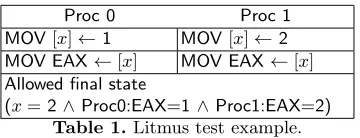
Example 1 Table 1 shows a litmus test. This test is over two processors, Proc 0 andProc 1. Each of them is executing a load and a store operation. The load operation is written as MOV EAX← [x] and means that the variable xis read into the register EAX of a processor. The store operation is written as MOV [x]←2 and means that the value 2 is stored into the variable x. The variablex is globally visible to all processors. The final state for this litmus test is given as an allowed state. We can expect the variable xto contain the value 2, and the register EAXonProc0will contain the value 1, while the registerEAXonProc1 will contain the value 2.
Proc 0 Proc 1 MOV[x]←1 MOV[x]←2
MOV EAX←[x] MOV EAX←[x]
Allowed final state
[image:2.612.219.399.315.384.2](x=2∧Proc0:EAX=1∧Proc1:EAX=2) Table 1.Litmus test example.
Amongst other case studies, this paper will model MCMs as constraint mod-els, and will generate litmus tests which adhere to those models as well as finding all possible final states of variables and registers.
There are currently tools which are approaching the litmus test generation through simulations of MCMs [4]. The usage of the toolset provided through
diy7 and herd7 is complex and required deep knowledge of the MCMs one
wants to work with. The herd7toolset is designed to generate and test newly designed MCMs, which are defined in terms of relations between the operations and executions. The TriCheck tool [9] verifies the whole system from language to the architecture level, which aids with the evaluation of the compiler. Both approaches do not use constraint programming, which is our contribution, as the constraint model descriptions for MCMs are short and follow the simple defini-tions of the MCMs. The models are written inConjure [1,2,3] and translated to input suitable for the constraint solver Minion and the SAT solver lingeling bySavile Row [8].
SC TSO
This paper will contain thesequential consistency (SC) model which we dis-cuss in Section 2.1 and the total store order (TSO) model in Section 2.2. TSO is a relaxation of the SC model and thus will allow for more behaviour than SC. This is reflected in the number of allowed final states from the litmus tests and the number of tests for a given final state. Figure 1 is an illustration of the sets of valid final states of litmus tests depending on the MCM, comparing SC to TSO. We buildEssencemodels of these MCMs, and we will use them to
– simulate litmus test executions, for given allowed final state for each MCM
– generate litmus tests for given allowed final states, for each MCM
– generate all valid executions and all allowed final states, for each MCM
– compare litmus tests with allowed behaviour for a MCM against the stricter MCM.
These case studies are a stepping stone towards using constraint models to directly and automatically verify MCMs against CCPs.
2
Memory Consistency Model
MCMs are describing the observed behaviour of concurrent programs on the hardware chips. The programs consist of basic load and store operations to and from memory registers. Depending on the MCM architecture there can be more operations, such as fences, but for our two selected MCMs (SC and TSO) it suffices to only consider loads and stores. MCMs describe in general the ordering of the operations on a processor level, but also on an execution level. These two orderings are calledprogram order andmemory order respectively.
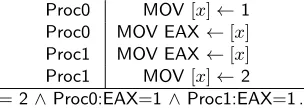
Example 2 The litmus test in Example 1 shows the program order for both Proc0andProc1. It is the order that the operations are given to the processor, in both cases that is a store followed by a load. An possible execution of that litmus test is
Proc0 MOV[x]←1
Proc0 MOV EAX←[x]
Proc1 MOV[x]←2
Proc1 MOV EAX←[x] x=2∧Proc0:EAX=1∧Proc1:EAX=2 .
This execution results in the expected final state ofx=2 ∧Proc0:EAX=1∧ Proc1:EAX=2. Another possible execution of the litmus test is
Proc0 MOV[x]←1
Proc1 MOV[x]←2
Proc0 MOV EAX←[x]
This execution still upholds the program order of both processors, but it vio-lates the expected final state as stipulated in Table 1.
The set of allowed final states of litmus tests is highly dependent on the chosen MCM. It is possible that we cannot find a valid execution that will lead to the expected allowed final state, within the given restrictions on the ordering of the operations.
2.1 Sequential Consistency
SC is the most restrictive MCM, as it upholds the exact order of operations from the processors to the execution. Lamport defines in [7] sequential consistency (SC) to be “the result of any execution [which] is the same as if the operations of all the processors were executed in some sequential order, and the operations of each individual processor appear in this sequence in the order specified by its program.”
We can look at this in the following way, the order of any two operations has to be kept in the same way as they occur in the litmus test. It will still allow for the interleaving between the operations of different processors, but not more than that. This means that both executions as shown in Example 2, are valid SC executions, while having different final states, and thus failing the litmus test in Table 1
Example 3 In addition to the two executions shown in Example 2, below are all executions that can happen in SC when executing the litmus test in Table 1.
Proc0 MOV[x]←1
Proc1 MOV[x]←2
Proc1 MOV EAX←[x]
Proc0 MOV EAX←[x] x=2∧Proc0:EAX=2∧Proc1:EAX=2 .
Proc1 MOV[x]←2
Proc1 MOV EAX←[x]
Proc0 MOV[x]←1
Proc0 MOV EAX←[x] x=1∧Proc0:EAX=1∧Proc1:EAX=2 .
Proc1 MOV[x]←2
Proc0 MOV[x]←1
Proc1 MOV EAX←[x]
Proc0 MOV EAX←[x] x=1∧Proc0:EAX=1∧Proc1:EAX=1 .
Proc1 MOV[x]←2
Proc0 MOV[x]←1
Proc0 MOV EAX←[x]
Proc1 MOV EAX←[x] x=1∧Proc0:EAX=1∧Proc1:EAX=2 .
2.2 Total Store Order
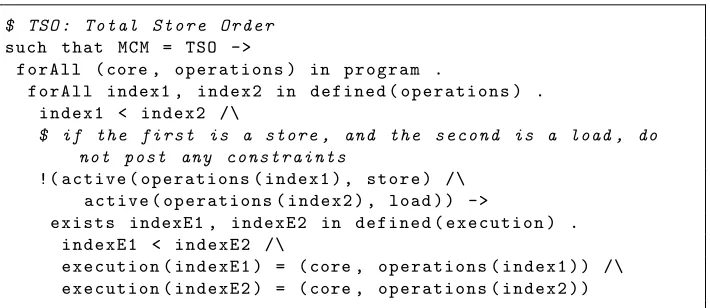
memory order but the Store → Load program order can be disregarded in the memory order. This relaxation allows for more possible executions and more allowed final states of litmus tests.
Example 4 As TSO is a relaxation of SC, it will still observe the same execu-tions of the litmus test in Example 1, as listed in Example 2 and Example 3. In addition it can observe the following execution (amongst others)
Proc0 MOV[x]←1
Proc0 MOV EAX←[x]
Proc1 MOV EAX←[x]
Proc1 MOV[x]←2 x=2∧Proc0:EAX=1∧Proc1:EAX=1 .
It is impossible to find a valid SC execution of the litmus test in Example 1 that will result in this final state.
We do note that this simple, yet formal description of TSO is still stricter than what is observed on some TSO architecture (for example x86). As we do not implement fences in our current constraint model of TSO we will stick to the textbook definition of TSO as given above.
[image:5.612.235.387.223.277.2]3
A Generic MCM Model
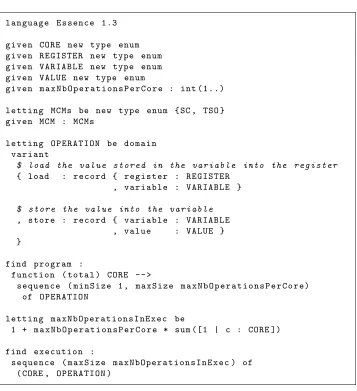
Figure 2 shows the initial setup of the various components needed for any MCM constraint model. Each constraint model that we create for any MCM is defined over a finite number of cores (or processors), registers per core, variables and a finite number of values for the variables. We also have to define the maximal number of operations that we can have in a litmus test, per processor. As men-tioned above the only operations that we consider are stores and loads. Each store assigns a value to a global variable, and each load loads the variable into a processor’s register. Depending on the goal of the model, we will either generate a program (litmus test), or find an execution of a litmus test. Each program consists of a sequence of operations for each core. Whereas an execution is a se-quence of all operations in all cores combined. The maximal size of an execution of a litmus test will be the number of processors times the maximal number of operations per processors. Note that we use core and processor, and program and litmus test synonymously here.
where the left-hand-side of the implication determines which tag is active and the right-hand-side posts a constraint assuming that particular tag to be active. Syntactical support for a switch-case style discriminator for variant types does not exist in Essenceyet.
language Essence 1.3
given CORE new type enum given REGISTER new type enum given VARIABLE new type enum given VALUE new type enum
given m a x N b O p e r a t i o n s P e r C o r e : int (1..)
letting MCMs be new type enum { SC , TSO } given MCM : MCMs
letting OPERATION be domain variant
$ load the value stored in the variable into the register
{ load : record { register : REGISTER , variable : VARIABLE }
$ store the value into the variable
, store : record { variable : VARIABLE , value : VALUE } }
find program :
function ( total ) CORE -->
sequence ( minSize 1 , maxSize m a x N b O p e r a t i o n s P e r C o r e) of OPERATION
letting maxNbOper at i on s I nE x ec be
1 + m a x N b O p e r a t i o n s P e r C o r e * sum ([1 | c : CORE ])
find execution :
[image:6.612.130.487.174.565.2]sequence ( maxSize maxNbOpera t i on s In E x ec ) of ( CORE , OPERATION )
Fig. 2.Initial setup of variables and programs for any MCM.
addition, there is the implied constraint which states that when every operation in the program is occurring exactly once in an execution then the length of the execution is exactly the number of all operations of all cores in the program.
$ every operation in program has to exist once in execution
such that
forAll ( core , operations ) in program . forAll ( index , operation ) in operations .
1 = ( sum ( indexE , ( coreE , operationE ) ) in execution . toInt ( core = coreE /\ operation = operationE ) )
$ the length of execution in terms of the length of program
[image:7.612.133.480.178.294.2] [image:7.612.131.486.435.568.2]such that
| execution | = sum ([ | ops | | (c , ops ) <- program ])
Fig. 3.Restrictions on execution of litmus tests.
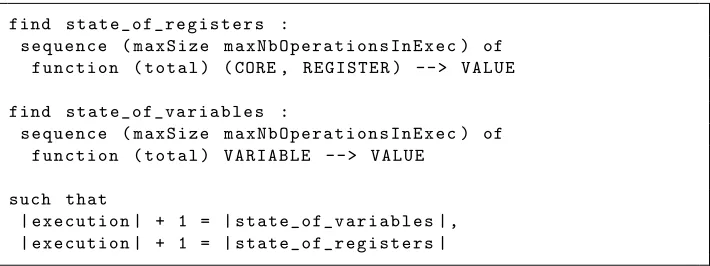
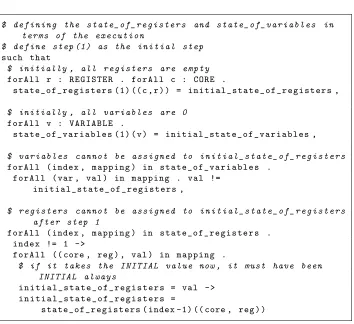
As the execution progresses we need to keep track of the registers and vari-ables. Each operation might alter the state of them. We also need to note that both variables and registers start off in an independent initial state, which is why in Figure 4 the length of the sequences of all states of variables and registers is one longer than the execution, as the initial state exists before the execution starts.
find state_of_re g is t er s :
sequence ( maxSize maxNbOpera t i on s In E x ec ) of function ( total ) ( CORE , REGISTER ) --> VALUE
find state_of_va r ia b le s :
sequence ( maxSize maxNbOpera t i on s In E x ec ) of function ( total ) VARIABLE --> VALUE
such that
| execution | + 1 = | state_of_v ar i ab l es | , | execution | + 1 = | state_of_r eg i st e rs |
Fig. 4.Registers and variables setup.
$ defining the state_of_re gi s te r s and state_of_v a ri a bl es in
terms of the execution
$ define step (1) as the initial step such that
$ initially , all registers are empty forAll r : REGISTER . forAll c : CORE .
state_of_re g is t er s (1) (( c , r ) ) = initial_state_ of _r eg i st er s ,
$ initially , all variables are 0 forAll v : VARIABLE .
state_of_va r ia b le s (1) ( v ) = initial_stat e_ of _v ar ia bl es ,
$ variables cannot be assigned to i n i t i a l _ s t a t e _ o f _ r e g i s t e r s
forAll ( index , mapping ) in state_of_va ri a bl e s . forAll ( var , val ) in mapping . val !=
initial_state_ of _r eg is te rs ,
$ registers cannot be assigned to i n i t i a l _ s t a t e _ o f _ r e g i s t e r s after step 1
forAll ( index , mapping ) in state_of_re gi s te r s . index != 1 ->
forAll (( core , reg ) , val ) in mapping .
$ if it takes the INITIAL value now , it must have been INITIAL always
i n i t i a l _ s t a t e _ o f _ r e g i s t e r s = val -> i n i t i a l _ s t a t e _ o f _ r e g i s t e r s =
[image:8.612.134.488.103.427.2]state_of_r eg i st e rs ( index -1) (( core , reg ) )
Fig. 5.Variable and register initialisations.
in the course of a program, whereas the initial value of the register cannot be re-attained.
Figure 6 describes what happens to the variables and registers when an op-eration occurs. If the opop-eration is a load, there is no change to the variables. Only the register on the core that the load has been called from changes. The next state of that register will contain the variable loaded. If the operation is a store, there is not change to any of the registers. Only the variable that the store occurs on will change. The next state of that variable will contain the value assigned to it in the store.
$ defining the state_of_re gi s te r s and state_of_v a ri a bl es $ in terms of the execution
$ define step ( index +1) in terms of step ( index )
$ and execution ( index ) such that
forAll ( index , ( core , operation ) ) in execution . and ([
active ( operation , load ) ->
and ([ state_of_r eg i st e rs ( index +1) (( core , operation [ load ][ register ]) ) =
state_of_v ar i ab l es ( index ) ( operation [ load ][ variable ]) $ all other registers on this core stay the same
, forAll r : REGISTER .
r != operation [ load ][ register ] ->
state_of_r eg is t er s ( index +1) (( core , r ) ) = state_of_r eg i st e rs ( index ) (( core , r ) ) $ all variables stay the same
, forAll v : VARIABLE .
state_of_v ar ia b le s ( index +1) ( v ) = state_of_v a ri a bl e s ( index ) ( v )
])
, active ( operation , store ) ->
and ([ state_of_v ar i ab l es ( index +1) ( operation [ store ][ variable ]) =
operation [ store ][ value ]
$ all registers on this core stay the same , forAll r : REGISTER .
state_of_r eg is t er s ( index +1) (( core , r ) ) = state_of_r eg i st e rs ( index ) (( core , r ) ) $ all other variables stay the same
, forAll v : VARIABLE .
v != operation [ store ][ variable ] ->
state_of_v ar ia b le s ( index +1) ( v ) = state_of_v a ri a bl e s ( index ) ( v )
])
$ all registers on other cores stay the same , forAll c : CORE . c != core ->
forAll r : REGISTER .
state_of_re g is t er s ( index +1) (( c , r ) ) = state_of_re g is t er s ( index ) (( c , r ) )
[image:9.612.132.489.136.612.2]])
$ a way to post constraints on the initial and the final
$ values that are stored in each register and variable $ doesn ’ t have to mention all registers .
given initial_state_ of _r e gi st er s , i n i t i a l _ s t a t e _ o f _ v a r i a b l e s : VALUE
given f i n a l _ s t a t e _ o f _ r e g i s t e r s : function ( CORE , REGISTER ) --> VALUE
such that
forAll (( c , r ) ,v ) in f i n a l _ s t a t e _ o f _ r e g i s t e r s .
state_of_re g is te r s (| state_of_r eg i st e rs |) (( c , r ) ) = v given f i n a l _ s t a t e _ o f _ v a r i a b l e s : function VARIABLE --> VALUE such that
forAll ( var , val ) in f i n a l _ s t a t e _ o f _ v a r i a b l e s .
state_of_va r ia bl e s (| state_of_v ar i ab l es |) ( var ) = val
[image:10.612.128.484.93.409.2]given include_pro gr am s : set of function ( total ) CORE --> sequence of OPERATION
such that | include_pro g ra ms | > 0 -> program in include_pr og ra m s
given exclude_pro gr am s : set of function ( total ) CORE --> sequence of OPERATION
such that !( program in exclude_pro gr a ms )
branching on [ program ]
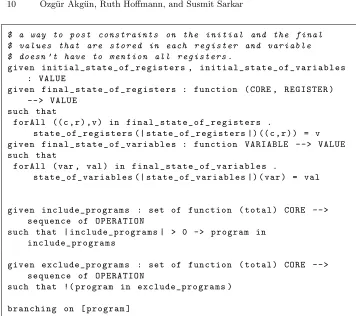
Fig. 7.Final allowed state.
each other. We will generate a larger set of litmus tests that all hold for the relaxed TSO and filter out the tests that do not hold in the stricter SC model.
3.1 Sequential Consistency
As introduced in Section 2.1 SC defines that any two operations of a core will occur in an execution in the same order as they are written in the program for each core. In Figure 8 we define the constraints which enforces SC in the execution of a litmus test. We use the index of the execution, which is a sequence of operations, to track the ordering of the operations in relation to their index in the program on the core. Operations from other cores can be interleaved.
3.2 Total Store Order
$ SC : Sequential Consistency
$ Every pair of operation from the program will have the same
order in execution such that MCM = SC ->
forAll ( core , operations ) in program .
forAll index1 , index2 in defined ( operations ) . index1 < index2 ->
exists indexE1 , indexE2 in defined ( execution ) . indexE1 < indexE2 /\
[image:11.612.138.487.159.298.2]execution ( indexE1 ) = ( core , operations ( index1 ) ) /\ execution ( indexE2 ) = ( core , operations ( index2 ) )
Fig. 8.Constraints defining sequential consistency in the execution.
$ TSO : Total Store Order such that MCM = TSO ->
forAll ( core , operations ) in program .
forAll index1 , index2 in defined ( operations ) . index1 < index2 /\
$ if the first is a store , and the second is a load , do not post any constraints
!( active ( operations ( index1 ) , store ) /\ active ( operations ( index2 ) , load ) ) ->
exists indexE1 , indexE2 in defined ( execution ) . indexE1 < indexE2 /\
execution ( indexE1 ) = ( core , operations ( index1 ) ) /\ execution ( indexE2 ) = ( core , operations ( index2 ) )
[image:11.612.133.488.432.586.2]4
Case Studies
All the files generated and experiments mentioned can be found in a github repository1 and can be reproduced using Conjure, Essence, Savile Row, lingeling and theherd7toolsets.
4.1 Litmus Test Simulation
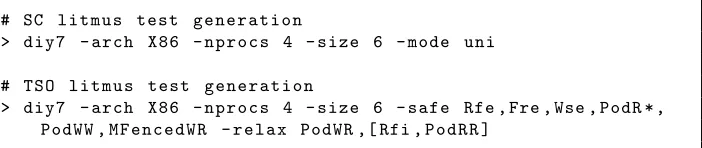
We used theherd7toolset [4] to generate litmus tests for TSO and SC. Figure 10 shows the commands used for the litmus test generation usingdiy7. The litmus tests generated for TSO included tests with fences, which we ignored. This re-sulted in 65 litmus tests.
# SC litmus test generation
> diy7 - arch X86 - nprocs 4 - size 6 - mode uni
# TSO litmus test generation
[image:12.612.135.486.290.364.2]> diy7 - arch X86 - nprocs 4 - size 6 - safe Rfe , Fre , Wse , PodR * , PodWW , MFencedWR - relax PodWR ,[ Rfi , PodRR ]
Fig. 10.diy7litmus test generation commands.
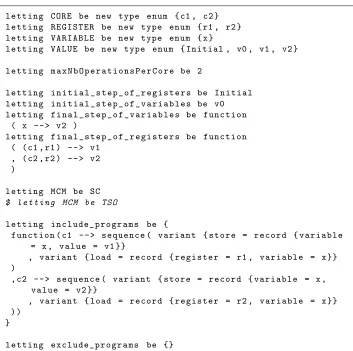
We translated the litmus tests into aEssenceparameter file. The litmus test in Example 1 is the generatedSB000a litmus test. The correspondingEssence parameter file is shown in Figure 11. We set the cores, registers, variables and available values, and we limit the maximal number of operations per core. The initial states of both the registers and the variables are also given. We take the final states of the registers and variables from the generated litmus test. We can choose which MCM we want to check against. In include programs we have the litmus test, which consists of the sequence of operations per core. The
exclude programsset is empty, as it is only used when checking a larger set of
litmus tests that can be generated and are valid in one MCM against a more restrictive MCM.
We used these 65 tests to simulate and check our implementation of the SC and TSO. We have found that our constraint model of SC (Figure 8) is valid on the same 29 tests as theherd7SC model described in terms of the relations between operations in Figure 12.
Similarly, our TSO model in Figure 9 corresponds to a more restricted version of the x86-TSO model, as we currently still restrict the ordering of stores followed by loads from external cores. This is apparent by running theherd7TSO model in Figure 13 which accepts the same 51 tests as ourEssenceTSO model.
letting CORE be new type enum { c1 , c2 } letting REGISTER be new type enum { r1 , r2 } letting VARIABLE be new type enum { x }
letting VALUE be new type enum { Initial , v0 , v1 , v2 }
letting m a x N b O p e r a t i o n s P e r C o r e be 2
letting i n i t i a l _ s t e p _ o f _ r e g i s t e r s be Initial letting i n i t i a l _ s t e p _ o f _ v a r i a b l e s be v0 letting f i n a l _ s t e p _ o f _ v a r i a b l e s be function
( x --> v2 )
letting f i n a l _ s t e p _ o f _ r e g i s t e r s be function ( ( c1 , r1 ) --> v1
, ( c2 , r2 ) --> v2 )
letting MCM be SC $ letting MCM be TSO
letting include_pro gr a ms be {
function ( c1 --> sequence ( variant { store = record { variable = x , value = v1 }}
, variant { load = record { register = r1 , variable = x }} )
, c2 --> sequence ( variant { store = record { variable = x , value = v2 }}
, variant { load = record { register = r2 , variable = x }} ) )
}
[image:13.612.130.483.121.472.2]letting exclude_pro gr a ms be {}
Fig. 11.Essenceparameter file of a litmus test.
include " fences . cat " include " cos . cat "
(* Atomic *)
empty rmw & ( fre ; coe ) as atom
[image:13.612.129.486.531.630.2](* Sequential consistency *) acyclic po | fr | rf | co as sc
include " cos . cat "
(* Communication relations that order events *) let com - tso = rf | co | fr
(* Program order that orders events *) let po - tso = po & ( W * W | R * M )
(* TSO global - happens - before *) let ghb = po - tso | com - tso acyclic ghb as tso
[image:14.612.129.486.114.247.2]show ghb
Fig. 13.Strict TSO model inherd7.
4.2 Litmus Test Generation
Having shown that our SC and TSO models are correctly reflecting the be-haviour, we have gone further to generate more litmus test using constraint solvers. Having a greater number of litmus tests allows for a greater coverage of possible behaviour exhibited by an MCM. We produced sets of litmus tests which were given a static number of cores, registers, variables, values and a maximal number of operations per core. In addition, we specified the allowed final state of the litmus test. We let the solvers generate a set of litmus tests that had at least one valid execution in TSO with the allowed final state. Then we filtered those tests to see which would still have a valid execution in SC. We have done this for two different scenarios. Both have 2 cores, 2 registers per core, 2 variables and 2 possible values.
In the first scenario each core can have up to 2 operations, and we have set the final state of the registers to be that one register on one core contains an initial value and one register of the other core contains the value 1. For TSO this resulted in a total of 160 litmus test, of which 132 have a valid SC execution.
The second scenario has for each core up to 3 operations and the final state for the registers is restricted to the first register of both cores having the value 0 and the second register on both cores to have the value 1. We generated 1154 litmus test with a valid execution in TSO, and thereof 776 have a valid execution in SC.
4.3 Output Generation
states, which are a combination of both variables and registers and do not have to be enforced on all variables and registers available.
We find that for all litmus tests there is always a valid execution with a valid final state, for both SC and TSO.
The highest number of distinct final states for a litmus test is 72 (IRIW000). This number of distinct final states is true for both TSO and SC. The litmus test with the next highest number of possible final states (63) for TSO is 3.SB000, which only has 7 distinct final states for SC.
For SC most litmus tests have less than 10 distinct final states. While this observation can be also made for TSO, there are fewer litmus tests which have only 1 distinct final state.
5
Conclusion
We have shown that using constraint programming to model MCMs and to use them to generate litmus tests is a viable alternative to algorithms and other tools. Constraint programming is a highly flexible way to re-use the models for different scenarios and different uses. We also find that the models created are a lot smaller than what can be created with model checking. As in that context the models face the state explosion problem. Our aim with this work is to be able to implement cache coherence protocols along side the MCMs and to directly verify these two models against each other. Work in this direction but using model checking and a few additional manual proofs were done in [5]. We believe constraint programming to be an ideal contender for this problem, as our current models suggest to be smaller than the model checking models.
References
1. Akg¨un, ¨O.: Extensible automated constraint modelling via refinement of abstract problem specifications. Ph.D. thesis, University of St Andrews (2014)
2. Akg¨un, ¨O., Frisch, A.M., Gent, I.P., Hussain, B.S., Jefferson, C., Kotthoff, L., Miguel, I., Nightingale, P.: Automated symmetry breaking and model selection in conjure. In: International Conference on Principles and Practice of Constraint Pro-gramming. pp. 107–116. Springer (2013)
3. Akg¨un, ¨O., Miguel, I., Jefferson, C., Frisch, A.M., Hnich, B.: Extensible automated constraint modelling. In: Proceedings of theTwenty-Fifth AAAI Conference on Ar-tificial Intelligence. pp. 4–11. AAAI Press (2011)
4. Alglave, J., Maranget, L., Tautschnig, M.: Herding cats: Modelling, simulation, test-ing, and data mining for weak memory. ACM Transactions on Programming Lan-guages and Systems (TOPLAS)36(2), 7 (2014)
5. Banks, C., Elver, M., Hoffmann, R., Sarkar, S., Jackson, P., Nagarajan, V.: Verifi-cation of a lazy cache coherence protocol against a weak memory model. In: Pro-ceedings of the 17th Conference on Formal Methods in Computer-Aided Design (FMCAD). ACM (2017)
7. Lamport, L.: How to make a multiprocessor computer that correctly exe-cutes multiprocess programs. IEEE Trans. Computers 28(9), 690–691 (1979). https://doi.org/10.1109/TC.1979.1675439
8. Nightingale, P., Akg¨un, ¨O., Gent, I.P., Jefferson, C., Miguel, I., Spracklen, P.: Au-tomatically improving constraint models in savile row. Artificial Intelligence 251, 35–61 (2017)