Engaging Students with Profound
and Multiple Disabilities Using Humanoid Robots
Penny Standen1, David Brown2, Jess Roscoe1, Joseph Hedgecock1, David Stewart3, Maria Jose Galvez Trigo2, and Elmunir Elgajiji2
1 University of Nottingham, Nottingham, UK
{p.standen,mzyjr,mzyjh1} @nottingham.ac.uk 2 Nottingham Trent University, Nottingham, UK
{maria.trigo2013,elmunir.elgajiji2012}@my.ntu.ac.uk 3 Oak Field School and Sports College, Nottingham, UK
Abstract. Engagement is the single best predictor of successful learning for children with intellectual disabilities yet achieving engagement with pupils who have profound or multiple disabilities (PMD) presents a challenge to educators. Robots have been used to engage children with autism but are they effective with pupils whose disabilities limit their ability to control other technology? Learning objectives were identified for eleven pupils with PMD and a humanoid robot was programmed to enable teachers to use it to help pupils achieve these objectives. These changes were evaluated with a series of eleven case studies where teacher-pupil dyads were observed during four planned video recorded sessions. Engagement was rated in a classroom setting and during the last session with the robot. Video recordings were analysed for duration of engagement and teacher assistance and number of goals achieved. Rated engagement was significantly higher with the robot than in the classroom. Observations of engagement, assistance and goal achievement remained at the same level throughout the sessions suggesting no reduction in the novelty factor.
Keywords: Robots, education, engagement, profound and multiple intellectual disabilities, case studies, video analysis.
1
Introduction
associated medical conditions usually neurological, sensory or physical impairments [3]. This makes it almost impossible for them to benefit from available educational provision and new ways are needed to foster their learning. According to Iovannone et al. [4] engagement is “the single best predictor” of learning for children with intel-lectual disabilities. Discussing children with complex needs, Carpenter [5] writes that “Sustainable learning can occur only when there is meaningful engagement. The process of engagement is a journey which connects a child and their environment (including people, ideas, materials and concepts) to enable learning and achievement” (p35). Can computer technology help to foster engagement in these learners?
Most educational interventions using computer technology have been designed for the more able. A recent systematic review [6] on the use of iPods, iPod Touch and iPads in teaching programs for people with developmental disabilities noted an ab-sence of studies on individuals with profound and multiple disabilities. They con-cluded that this group presents unique challenges with respect to the design of technology-based interventions, a major one being their lack of sufficient motor control to activate the device and software.
There have been some attempts to circumvent this problem of motor control. Work by Lancioni [7] has demonstrated there is a way for almost anyone to activate a micro-switch, the most common being a push micro-switch, which is activated by applying pressure to a large button. However they can also be triggered by pressure sensors on the armrest of a wheelchair, by chin or eyelid movement [8] or by vocalisation [9]. This then allows the user to exert environmental control, activate a piece of equipment which may produce speech on their behalf, or begin a pleasurable stimulus for the user.
There have also been attempts to capture gesture or body movements using infrared sensor-based systems to enable those with multiple disabilities to control multimedia [10]. A more recent development that can allow a profoundly disabled person to interact with their environment has been enabled by the appearance of low cost headsets that enable gamers to interact with games using their own brain activity [11].
Work with typically developing children has shown that robots can help attainment in a wide range of areas, particularly by motivating children [12,13]. A wide range of robots has already been used with children with disabilities [14], although the majority of these have focussed on children with autism [15]. Studies involving children with intellectual disabilities are promising but focus on those who are more able. Klein et al. [16] showed that working with a robot increased “playfulness” and therefore engagement in two out of the three young children with developmental disabilities in their study. Introducing a mobile robotic platform to eight children with either autism, Downs syndrome or severe learning disabilities showed high levels of motivation and engagement in all the children [17].
However, he had problems with perseveration so the aim of the sessions was to help him learn to perform the action only once and to stop when the robot did what he wanted. The case studies were video recorded and recordings analysed to measure engagement, teacher assistance and goal achievement. A questionnaire completed by the pupils’ teachers was also used to compare engagement in class to engagement within the final session. Analysis of the interviews highlighted the importance of having an appropriate input device to make the robot accessible, for example by mak-ing it sensitive to vocalisations, gestures or switch operations: whatever was favoured by the child. Teachers also emphasised the importance of “productive learning” ie that leads to being able to achieve something important for the pupil rather than being seen as just play and of designing sessions tailored to individuals’ needs and interests. In the case studies, pupils showed significantly higher engagement when working with a robot when compared to not working with a robot.
The teachers in this study came up with many more possible uses for the robot than it could perform. This indicated a need for the robot to be able to perform a greater range of actions as a reward or cue that could be personalised for individual students. What the study also showed was that the robot needed a greater range of ways to be controlled to enable a wider range of pupils to use it. The aims of the present study were:
1. To produce adjustments to the robot’s programming in order to
a. make it controllable by other input devices (eg switches, joystick) b. enable it to emit a greater range of behaviours (eg different dances,
tunes etc)
2. To evaluate the new repertoire with a series of case studies.
2 Me th od s
2 . 1 D e s i g n
Changes to the robot’s programming were informed by results from the previous study [18] and from discussions with teachers. Changes were evaluated using a series of single case studies where teacher-pupil dyads were observed during four planned video recorded sessions with a robot. Engagement was rated in a classroom setting and during the last session with the robot.
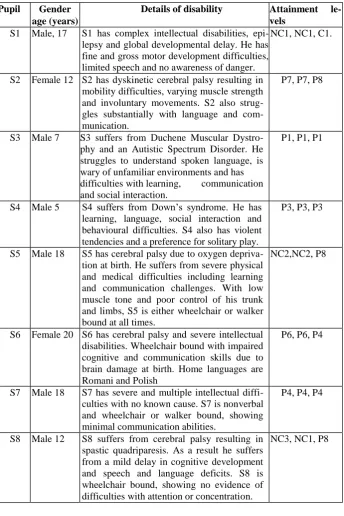
2.2 Participants
Table 1. Characteristics of participants
Pupil Gender age (years)
Details of disability Attainment le- vels
S1 Male, 17 S1 has complex intellectual disabilities, epi- lepsy and global developmental delay. He has fine and gross motor development difficulties, limited speech and no awareness of danger.
NC1, NC1, C1.
S2 Female 12 S2 has dyskinetic cerebral palsy resulting in mobility difficulties, varying muscle strength and involuntary movements. S2 also strug-gles substantially with language and com-munication.
P7, P7, P8
S3 Male 7 S3 suffers from Duchene Muscular Dystro- phy and an Autistic Spectrum Disorder. He struggles to understand spoken language, is wary of unfamiliar environments and has difficulties with learning, communication and social interaction.
P1, P1, P1
S4 Male 5 S4 suffers from Down’s syndrome. He has learning, language, social interaction and behavioural difficulties. S4 also has violent tendencies and a preference for solitary play.
P3, P3, P3
S5 Male 18 S5 has cerebral palsy due to oxygen depriva- tion at birth. He suffers from severe physical and medical difficulties including learning and communication challenges. With low muscle tone and poor control of his trunk and limbs, S5 is either wheelchair or walker bound at all times.
NC2,NC2, P8
S6 Female 20 S6 has cerebral palsy and severe intellectual disabilities. Wheelchair bound with impaired cognitive and communication skills due to brain damage at birth. Home languages are Romani and Polish
P6, P6, P4
S7 Male 18 S7 has severe and multiple intellectual diffi- culties with no known cause. S7 is nonverbal and wheelchair or walker bound, showing minimal communication abilities.
P4, P4, P4
S8 Male 12 S8 suffers from cerebral palsy resulting in spastic quadriparesis. As a result he suffers from a mild delay in cognitive development and speech and language deficits. S8 is wheelchair bound, showing no evidence of difficulties with attention or concentration.
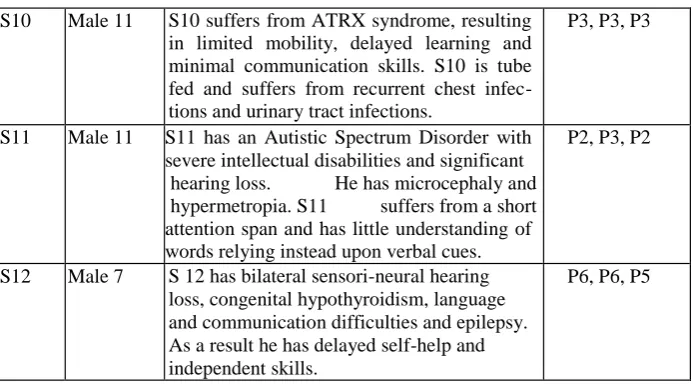
Table 1. (continued)
S10 Male 11 S10 suffers from ATRX syndrome, resulting in limited mobility, delayed learning and minimal communication skills. S10 is tube fed and suffers from recurrent chest infec-tions and urinary tract infecinfec-tions.
P3, P3, P3
S11 Male 11 S11 has an Autistic Spectrum Disorder with severe intellectual disabilities and significant
hearing loss. He has microcephaly and hypermetropia. S11 suffers from a short attention span and has little understanding of words relying instead upon verbal cues.
P2, P3, P2
S12 Male 7 S 12 has bilateral sensori-neural hearing loss, congenital hypothyroidism, language and communication difficulties and epilepsy. As a result he has delayed self-help and independent skills.
P6, P6, P5
Attainment levels are given in the form of either National Curriculum levels (NC) or Performance Scales (P levels). P levels are a performance measure for children with Special Educational Needs, who do not meet the criteria for the lowest national curriculum level 1 [19]. P levels range from 1 to 8 with 1 being the lowest level of attainment. Pupils in the study are described in terms of their attainment levels for English, Maths and ICT.
2.3 Intervention
The robot used in this project was a NAO NextGen (Model H25, Version 4) humanoid robot, which is commercially available from robotics manufacturer Aldebaran Ro-botics. NAO is manufactured with a wide range of behaviours, including walking, standing up and sitting down, dancing, and recognising speech, sounds and objects as well as producing speech from text and playing sound files. These behaviours can all be programmed into the robot using Choregraphe [20], a user-friendly graphical inter-face that allows users to control the robot and create sequences of complex beha-viours. Following the interviews with teaching staff in the previous study [18] and the collection of feedback from other staff at the school, changes were made to allow the control of the robot by Jellybean switches (see Figure 1) and a joystick thus allowing pupils to interact with the robot using a method suitable to their needs.
Fig. 1. Four Jellybean switches labelled with the symbols representing the micro-switches’ action
or a joystick. In this way, executing the program corresponding to the server and run-ning the appropriate behaviour in Choregraphe it was possible to tele-operate the robot with different input devices.
There were three ways to increase the range of behaviours from those already of-fered by Choregraphe. First of all, there were some routines freely available for down-load from the internet. Secondly, favourite pieces of music could be transformed into .wav files and then included as a complete instruction in Choregraphe. Finally, more complex behaviours such as kicking a football, were first of all broken down into components for which script was written in Python and then included as a complete instruction in Choregraphe.
2.4 Outcome Measures
As in the previous study [18] engagement was rated using the scale developed by the Special Schools and Academies Trust [21] as part of a classroom tool for teachers of children with complex disabilities. The pupil is given a rating between 0 (no focus) and 4 (fully sustained) for each factor, giving a total score out of 28, with a higher score indicating greater engagement. Video recordings of sessions were analysed to measure three variables: duration of pupil engagement, duration of assistance from staff, and the frequency of goals attained. These were converted to a percentage of the session to take account of the variation in session length.
2 .5 P ro ce d ur e
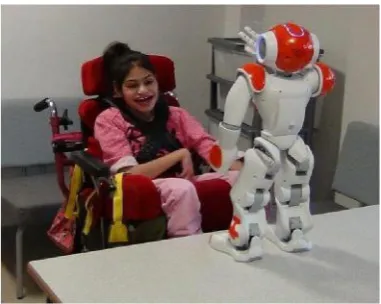
[image:6.439.130.322.29.171.2]Fig. 2. A pupil working with the robot
discuss how this may be achieved. Information from these discussions was then used to individually design the sessions for each pupil, focussing on their interests and learning style, to help them achieve their learning objective. Figure 2 shows an exam-ple of how a pupil might be positioned to interact with the robot. Initial plans for the sessions were finalised with the teachers. However, depending on how sessions pro-ceeded, plans could be refined. The main objective to be achieved over the four ses-sions could be broken down into smaller goals for each session.
Five sessions were conducted with each teacher-pupil dyad, all of which were digitally video recorded although the first session was intended to familiarise the pupil with the arrangements and to judge whether any adjustments to plans were required. Session length depended upon each child’s ability to maintain focus, varying from seven to fifty minutes with a mean duration of twenty-two minutes. Sessions were scheduled at regular intervals over three weeks at times convenient to the teachers. Sessions were carried out in a room with just the pupil, researcher and a member of staff present.
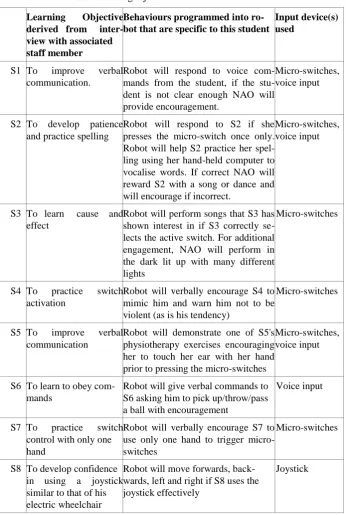
Table 2. Learning objectives of sessions and robot actions
Learning Objective derived from inter- view with associated staff member
Behaviours programmed into ro- bot that are specific to this student
Input device(s) used
S1 To improve verbal communication.
Robot will respond to voice com- mands from the student, if the stu- dent is not clear enough NAO will provide encouragement.
Micro-switches, voice input
S2 To develop patience and practice spelling
Robot will respond to S2 if she presses the micro-switch once only. Robot will help S2 practice her spel-ling using her hand-held computer to vocalise words. If correct NAO will reward S2 with a song or dance and will encourage if incorrect.
Micro-switches, voice input
S3 To learn cause and effect
Robot will perform songs that S3 has shown interest in if S3 correctly se-lects the active switch. For additional engagement, NAO will perform in the dark lit up with many different lights
Micro-switches
S4 To practice switch activation
Robot will verbally encourage S4 to mimic him and warn him not to be violent (as is his tendency)
Micro-switches
S5 To improve verbal communication
Robot will demonstrate one of S5's physiotherapy exercises encouraging her to touch her ear with her hand prior to pressing the micro-switches
Micro-switches, voice input
S6 To learn to obey com- mands
Robot will give verbal commands to S6 asking him to pick up/throw/pass a ball with encouragement
Voice input
S7 To practice switch control with only one hand
Robot will verbally encourage S7 to use only one hand to trigger micro-switches
Micro-switches
S8 To develop confidence in using a joystick similar to that of his electric wheelchair
Robot will move forwards, back- wards, left and right if S8 uses the joystick effectively
Fig. 3. Medians, quartiles and ranges for ratings of engagement and behaviours from video analysis
Table 2. (continued)
S10 To learn cause and effect
For S10, Robot has been pro-Micro grammed with a wider range of songs. One of NAOs switches will be inactive for S10 to learn cause and effect and not simply press random switches
-switches
S11 To practice holding objects for a long pe- riod of time
Robot will walk towards S11 once the switch is pressed and hand him an object (initially food) to hold
A single micro-switch
S12 To improve verbal communication
Robot will respond to voice com- mands from the student, if the stu-dent is not clear enough NAO will provide encouragement as with S1
Voice input
3
Results
[image:9.439.48.393.324.570.2]significantly (t = 4.9, df 10, p<0.001) higher than when in the classroom (mean = 8.64, SD = 4.11). All but one of the pupils showed higher engagement when working with the robot: one received 28 points, the maximum score possible indicating full engagement throughout the entire session with the robot, compared with minimal engagement (9 points) in the classroom setting. Video analysis indicated that pupils were spending a high percentage of the time scored as showing engagement and al-though comparing scores from the first recorded session with those from the last ses-sion indicated an increase with time, this did not reach significance. Similarly, there was no significant change in either teacher assistance or goal attainment from first to last sessions
4 D i s c u s s i o n
The first aim of the study was to enable the robot to be controlled remotely by micro-switches and a joystick and to enlarge its range of behaviours to allow it to support the learning of a wider range of pupils. This was successful to the extent that eleven pupils who varied considerably in ability, needs and interests had sessions with the robot tailored to their learning objectives. In evaluating these interventions, one of the hopes in using the robot was to improve pupil engagement given the importance of this quality in learning in pupils with intellectual disabilities. The higher ratings of engagement during the final session with the robot than in the classroom suggest that this was indeed the case. This is only a preliminary study and the rating scale results are potentially open to bias as it was not possible to carry them out without knowing which condition the pupil was in. Video analysis also showed high levels of engage-ment and these did not decline over time suggesting that the novelty factor of working with a robot had not waned at least for the duration of the study. Goals continued to be achieved at a steady level throughout suggesting that productive learning was taking place and this goal achievement did not require a great deal of teacher assistance.
While this might appear to be an expensive way of supporting learning, it was jus-tified by one teacher in the earlier study [18] who commented that, for children with considerable physical disabilities, even maintaining their position requires considera-ble physical work. If you are then asking them to learn a new response, a considerably attractive reward is going to be necessary. For children who may spend the majority of their time in a wheelchair that they cannot move independently, active involvement in learning is very difficult for the teacher to engineer. In addition to providing an active element, this would also provide a sense of empowerment for individuals who have very little control over their surroundings.
References
2. Salt, T.: Salt Review: Independent Review of Teacher Supply for Pupils with Severe, Pro-found and Multiple Learning Difficulties (SLD and PMLD) Ruddington (2010),
http://www.thedyslexia-spldtrust.org.uk/
media/downloads/inline/the-salt-review.1298547606.pdf
3. Bellamy, G., Croot, L., Bush, A., Berry, H., Smith, A.: A study to define: profound and multiple learning disabilities (PMLD). Journal of Intellectual Disabilities 14(3), 221–235 (2010)
4. Iovannone, R., Dunlap, G., Huber, H., Kincaid, D.: Effective Educational Practices for Students With Autism Spectrum Disorders. Focus on Autism and Other Developmental Disabilities 18(3), 150–165 (2003)
5. Carpenter, B.: Overview of the research project: steps and impact. Paper to the Complex Learning Difficulties and Disabilities Dissemination Conference. London (March 24, 2011),
http://complexld.ssatrust.org.uk/uploads/ SEN54%20complex%20needs.pdf
6. Kagohara, D., van der Meer, M., Ramdoss, L., O’Reilly, S., Lancioni, M.F., Davis, G.E., Rispoli, T.N., Lang, M., Marschik, R., Sutherland, P.B., Green, D., Sigafoos, V.A., Using, J.: iPods and iPads in teaching programs for individuals with developmental disabilities: A systematic review. Research in Developmental Disabilities 34, 147–156 (2013)
7. Lancioni, G.E., O’Reilly, M.F., Singh, N.N., Sigafoos, J., Oliva, D., Antonucci, M., Tota, A., Basili, G.: Microswitch-based programs for persons with multiple disabilities: an over-view of some recent developments. Perceptual and Motor Skills 106, 355–370 (2008) 8. Lancioni, G.E., O’Reilly, M.F., Singh, N.N., Oliva, D., Coppa, M.M., Montironi, G.: A
new microswitch to enable a boy with minimal motor behaviour to control environmental stimulation with eye blinks. Behavioral Interventions 20, 147–153 (2005)
9. Lancioni, G.E., O’Reilly, M.F., Oliva, D., Coppa, M.M.: A microswitch for vocalization responses to foster environmental control in children with multiple disabilities. Journal of Intellectual Disability Research 45(3), 271–275 (2001)
10. Brooks, A.L.: Soundscapes: the evolution of a concept, apparatus and method where ludic engagement in virtual interactive space is a supplemental tool for therapeutic motivation. PhD thesis (2011), http://vbn.aau.dk/files/55871718/PhD.pdf
11. Welton. T., Brown, D.J., Evett, L., Sherkat, N. A Brain-Computer Interface for the Dasher Alternative Text Entry System. Special Issue of Journal of Universal Access in the Information Society: 3rd generation accessibility: Information and Communication Technologies towards universal access (In press)
12. Barker, B.S., Ansorge, J.: Robotics as means to increase achievement scores in an informal learning environment. Journal of Research on Technology in Education 39(3), 229 (2007) 13. Johnson, J.: Children, robotics, and education. Artificial Life and Robotics 7(1-2), 16–21
(2003)
14. Salter, T., Werry, I., Michaud, F.: Going into the wild in child–robot interaction studies: issues in social robotic development. Intelligent Service Robotics 1(2), 93–108 (2008) 15. Robins, B., Dautenhahn, K., te Boekhorst, R., Billard, A.: Robotic Assistants in
Therapy and Education of Children with Autism: Can a Small Humanoid Robot Help Encourage Social Interaction Skills? Universal Access in the Information Society 4(2),105–120 (2005)
16. Klein, T., Gelderblom, G.J., de Witte, L., Vanstipelen, S.: Evaluation of short term effects of the IROMEC robotic toy for children with developmental disabilities. Paper presented at the IEEE International Conference on Rehabilitation Robotics, ICORR (2011),
17.Ibrani, L., Allen, T., Brown, D., Sherkat, N., Stewart, D.: Supporting Students with Learn-ing and Physical Disabilities usLearn-ing a Mobile Robot Platform. Paper presented at the Inter-active Technologies and Games (ITAG), Nottingham, UK (2011),
http://itag.gamecity.org/proceedings/2011-2/
18.Hedgecock, J.: Can working with a robot enhance learning in pupils with intellectual dis-abilities? B Med. Sci. Dissertation submitted to the University of Nottingham (2013) 19.Department for Education (2012),
http://www.education.gov.uk/schools/teachingandlearning/
assessment/a00203453/about-the-p-scales (accessed January 29, 2014)
20.Aldebaran Robotics. Solutions for Autism, Paris, France: Aldebaran Robotics (2006),
http://www.aldebaran-robotics.com/en/Solutions/
For-Autism/NAO.html (accessed January 11, 2013)
21.The Special Schools and Academies Trust. The Complex Learning Difficulties and Dis-abilities Research Project: Developing Meaningful Pathways to Personalised Learning. Executive Summary. London: Schools Network (2011),