Dynamical energy analysis on mesh grids: a new tool
for describing the vibro-acoustic response of complex
mechanical structures
D.J. Chappella,∗, D. L¨ochelb, N. Søndergaardb, G. Tannerc
aSchool of Science and Technology, Nottingham Trent University, Nottingham NG11 8NS, UK
binuTech GmbH, F¨urther Str. 212, 90429 N¨urnberg, Germany
cSchool of Mathematical Sciences, University of Nottingham, Nottingham NG7 2RD, UK
Abstract
We present a new approach for modelling noise and vibration in complex
mechanical structures in the mid-to-high frequency regime. It is based on a
dynamical energy analysis (DEA) formulation which extends standard
tech-niques such as statistical energy analysis (SEA) towards non-diffusive wave
fields. DEA takes into account the full directionality of the wave field and
makes sub-structuring obsolete. It can thus be implemented on mesh grids
commonly used, for example, in the finite element method (FEM). The
result-ing mesh based formulation of DEA can be implemented very efficiently usresult-ing
discrete flow mapping(DFM) as detailed in [1] and described here for
applica-tions in vibro-acoustics. A mid-to-high frequency vibro-acoustic response can
be obtained over the whole modelled structure. Abrupt changes of material
parameter at interfaces are described in terms of reflection/transmission
ma-trices obtained by solving the wave equation locally. Two benchmark model
∗Corresponding author
systems are considered: a double-hull structure used in the ship-building
industry and a cast aluminium shock tower from a Range Rover. We
demon-strate that DEA with DFM implementation can handle multi-mode wave
propagation effectively, taking into account mode conversion between shear,
pressure and bending waves at interfaces, and on curved surfaces.
Keywords: Statistical Energy Analysis, Ray Tracing, Transfer operators
1. Introduction
A vast range of numerical methods have been developed for solving noise
and vibration problems in mechanical structures. Popular tools include
fi-nite element methods, fifi-nite volume methods, boundary element methods
and various spectral methods. There are, however, basic limitations when
approximating the solutions of wave equations directly: the size of the
as-sociated linear system increases with decreasing wavelength and numerical
schemes become inefficient when the local wavelengths are orders of
magni-tude smaller than typical dimensions of the physical system. One therefore
moves to high frequency methods, such as ray tracing. However, tracking
rays including multiple reflections on boundaries can become cumbersome,
in particular on curved surfaces and when including mode conversion at
in-terfaces.
These problems can partly be circumvented by using statistical approaches.
Dividing the structure into a set of substructures and assuming diffuse wave
fields and quasi-equilibrium conditions in each of the resulting subsystems
leads to greatly simplified set of equations based only on coupling constants
(SEA) [2], which has found widespread applications in the automotive and
aviation industry, as well as in architectural acoustics. The disadvantage of
SEA is that the underlying assumptions are often hard to verify a-priori, or
are only justified when an additional averaging over equivalent subsystems
is considered. These shortcomings have been addressed by Langley [3] and
more recently by Le Bot [4, 5]. A computational tool based on a linear
oper-ator approach for propagating ray densities called dynamical energy analysis
(DEA) has been proposed in [6]. DEA systematically interpolates between
SEA and full ray tracing. The name points at the similarities with SEA but
stresses at the same time the importance of non-diffusive transport along
the ray dynamics. In particular, in DEA we have much more freedom in
sub-structuring the total system and variations of the energy density across
sub-structures can be resolved.
The implementation of DEA as presented in [6, 7] corresponds to a
spec-tral boundary integral method; the integral equations are expanded using
or-thogonal basis approximations and the resulting matrix equations are solved
for the coefficients of the basis expansion of the solution. In [8], it has been
shown that using a boundary element method for the spatial variable and
a basis function expansion in the momentum coordinate leads to efficiency
gains. In DEA, coupling between subsystems is described in terms of
re-flection/transmission matrices. These matrices are obtained by solving the
wave equation locally in the coupling region. The interfaces can be, for
exam-ple, line junctions between plates of different thickness or junctions between
plates and stiff components, where the local wavelength is of the same order
We will demonstrate that the method can be implemented efficiently on a
mesh with thousands of subelements including multi-mode wave propagation.
Due to the geometric simplicity of typical (planar) mesh elements, DEA can
be modified using the method of Discrete Flow Mapping (DFM) [1] which
gives rise to huge efficiency gains. DEA provides then detailed resolution of
the energy density variation throughout the structure under consideration.
The method is applied to benchmark problems provided by Germanischer
Lloyd (part of a double-hull structure of a large ship) [9] and Jaguar Land
Rover (cast aluminium shock tower of a Range Rover). In these examples,
mode mixing between in-plane and bending modes is incorporated.
2. Dynamical energy analysis – a brief overview
2.1. From ray tracing to flow equations - an operator formulation
We present a brief overview of the problem set-up and methodology, for
more details see [6, 7, 8, 10]. We consider linear wave problems driven by a
distribution of sources at a fixed angular frequencyω; a generalisation to
fre-quency band excitation is straightforward and is discussed below. The total
system is defined on a domain Ω, which is divided into a set of sub-domains
Ωj, j = 1, . . . , NΩ, such as the elements of a mesh grid. The material
param-eters and hence the local wave speeds are assumed to be constant in each
sub-domain, but may vary between sub-domains. Damping is incorporated
through a complex-valued damping term µ, which may depend on ω. In
general, one needs to determine the solution u of a wave equation (where u
Figure 1: Ray tracing including reflection at boundaries
a fluid) of the form
ˆ
H+ω2u(r) =−f(r). (1)
Here, ˆH corresponds to a linear operator describing the vibro-acoustic
dy-namics including dissipation, and f represents an excitation driving the
sys-tem. Appropriate boundary conditions apply at the outer boundaries and at
the interfaces between sub-domains. The wave energy density at a point r
is then proportional to the modulus-square of the wave amplitude |u|, that
is,
(r, ω)∝ |u(r, ω)|2. (2)
The linear wave equation (1) can in a natural way be associated with the
ray dynamics via the Eikonal approximation expressing the wave function u
in terms of ray contributions [6, 8] with associated amplitude Aj and phase
energy density of the form
(r, ω) ∝X
j,j0
Aj(r, ω)Aj0(r, ω) cos(ω(ψj(r)−ψj0(r)))
=X
j
Aj(r, ω)2+
X
j6=j0
Aj(r, ω)Aj0(r, ω) cos(ω(ψj(r)−ψj0(r))).
(3)
Taking the average over a frequency band centered onω0such that the second
summation becomes negligibly small, then the mean wave energy density is
well approximated by the density of rays ρ(r, p, ω0) passing through a point
r, hence
¯
(r, ω0) ∝
X
j
¯
Aj(r, ω0)2
=
Z
ρ(r, p;ω0)dp,
(4)
where p is the direction (or momentum) vector, the magnitude of which is
related to the wavenumber. From hereon we consider problems with a fixed
frequency excitation, where this frequency must be interpreted as the centre
frequency ω0 of a band average. The system is excited by one or more point
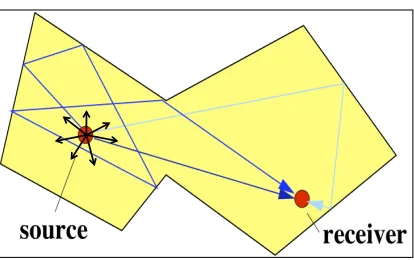
sources from which rays emerge uniformly and undergo reflections at
bound-aries as well as absorption processes, see Fig. 1. It is therefore possible to
relate wave energy densities to classical flow equations and thus
thermody-namical concepts, which are at the heart of SEA and DEA treatments. Note
that different mode types such as shear, pressure or bending modes in plates
are treated as rays with different local wave speed. Mode coupling at
bound-aries or interfaces leads to mode-conversion of rays, that is, the classical flow
of rays will undergo ray-splitting. The conversion rates between rays
of an interface scattering matrix. Likewise, the transmission/reflection
prob-abilities between sub-domains are given by the ratios of the outgoing normal
power fluxes to the incoming normal power flux at the interface, which can
again be obtained from the scattering matrix.
DEA is based on the observation that these flow equations for ray densities
can also be described using linear partial differential equations, namely the
phase space Liouville equation (LE) [8]. In order to solve the stationary
flow problem we rewrite the LE in boundary integral form; the boundary
can be the physical boundary of the system and/or the union of interfaces
between the sub-domains. Note that when implemented on a mesh grid,
the total boundary consists of the union of all mesh element boundaries.
For simplicity, let us first consider a single domain with boundary Γ. We
map the ray density emanating continuously from the source points onto the
boundary. The resulting boundary density is equivalent to a source density
on the boundary producing the same ray field in the interior as the original
source field after one reflection.
Ray densitiesρemanating from the boundary are transported to the next
intersection with the boundary by the operator B,
B[ρ](Xs) :=w(Xs)ρ(ϕ−1(Xs)) =
Z
w(Ys)δ(Xs−ϕ(Ys))ρ(Ys)dYs. (5)
Here Xs = (s, ps) (and Ys) represent phase-space coordinates on the
bound-ary, that is,s parameterises the boundary Γ and psdenotes the direction (or
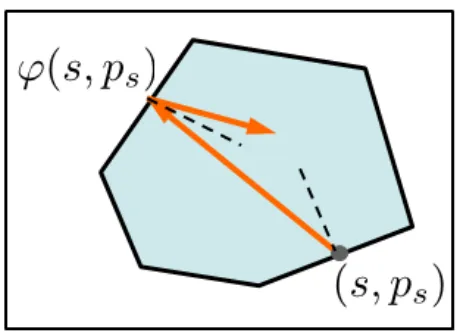
momentum) component tangential to Γ at s. Also ϕ is the boundary map
(see fig. 2); it takes a ray from a boundary point s with tangential direction
component ps along the straight line path to the next intersection with the
Figure 2: Transfer of ray densities by the boundary mapϕ
functionw(Xs) contains absorption factors as well as reflection/transmission
coefficients. The stationary density on the boundary induced by an initial
boundary distribution ρ0
Γ(Xs) is then obtained using
ρΓ =
∞
X
n=0
Bn[ρ0
Γ] = (I − B)
−1[ρ0
Γ], (6)
where Bn contains trajectories undergoing n reflections at the boundary.
The density distribution in the interior region can then be obtained from the
boundary densityρΓ. One obtains the density (4) after projecting down onto
coordinate space.
Note that the treatment sketched above is formally equivalent to ray
trac-ing. A generalisation to multi-domain problems with sub-domains Ωj, j =
1, . . . , NΩ is straightforward by introducing a multi-domain boundary map
ϕij and weight functionwij describing the flow from the boundary of domain
Ωi to the boundary of Ωj. The operator B is then constructed from the set
2.2. A basis representation for the ray tracing operator B
In the following we restrict our discussion to two-dimensional problems,
an implementation for the three-dimensional case is described in [10]. In
order to evaluate (6), a finite dimensional approximation of the operator B
is constructed. We approximate the boundary density using basis functions.
For the spatial variables, piecewise constant boundary element functions on
the (discretised) boundary are used [8, 10]. For the approximation in the
momentum argument we choose a Legendre polynomial basis. Note that in
two dimensions, the variable ps ∈(−|p|,|p|) in general with|p|on the energy
surface defined throughH(p, r) = ω2
0, where the HamiltonianH is related to
the wave operator ˆH in (1). We thus write ρΓ in the form
ρΓ(Xs)≈ ne X
α=1 N
X
β=0
ρ(α,β)bα(s) ˜Pβ(ps). (7)
Here, N is the order of the basis expansion, ne is the number of elements
in the boundary mesh, ˜Pβ is a scaled Legendre polynomial of order β and
bα denotes the piecewise constant boundary element basis function. The
coefficient vector ρ(α,β) in (7) is labelled in terms of the multi-index (α, β).
The matrix approximation B of the ray tracing operator B is obtained by
writing (5) in a weak Galerkin form using the basis approximation (7) and the
orthonormal inner product for Legendre polynomials, see [8, 10] for details.
Legendre polynomials are chosen since they do not require periodicity for
convergence (cf. a Fourier basis) and are relatively simple to implement.
For these reasons the method directly extends to an hp - boundary element
method as described in [8].
evaluated using (6) by solving
(I−B)ρ(α,β) =ρ0(α,β). (8)
Here the source coefficients ρ0
(α,β) are obtained by projecting ρ0Γ onto the
finite dimensional space spanned by the basis functions as described in [8].
An approximation for the density distributionρΓon the boundary is obtained
after substitutingρ(α,β) back into (7). This distribution is then mapped back
into the interior region and after projecting onto position space we obtain
an approximation for the energy density in (4), see [8] for details. Frequency
band calculations are obtained by sampling the results over the frequency
band considered.
Recall the splitting into sub-domains Ωj, j = 1, . . . , NΩ introduced
ear-lier. Each sub-domain represents one subsystem for each mode of wave
propagation. Coupling between subsystems will be treated as losses in one
subsystem and source terms in another. Typical subsystem interfaces are
surfaces between the mesh elements of a grid, which may give rise to
reflec-tion/transmission due to, for example, sudden changes in material
param-eters, local boundary conditions or curvature effects. Alternatively, a total
transmission of wave energy may occur, for example, when the transmission is
between two sub-domains within a homogeneous flat region. We describe the
full dynamics in terms of subsystem boundary operators Bij. Flow between
Ωi and Ωj is possible only if these sub-domains share a common boundary.
We introduce a weight functionwij in (5), which contains (in addition to the
usual damping term) reflection and transmission coefficients characterising
the coupling between subsystems i and j at the interface. When restricting
for triangulated surfaces, there is a very efficient way of evaluating the
op-erators Bij in terms of the so-called discrete flow mapping (DFM) technique
as described in [1].
Note that the reflection/transmission coefficients depend in general on the
angle of incidence of the incoming/outgoing wave and thus on the momentum
of the incoming/outgoing ray. In the case of total transmission, the angles
of incidence of the incoming and outgoing ray coincide and the transmission
coefficient is equal to one. DEA thus incorporates coherent, directed wave
transmission through interfaces. This is in contrast to SEA, which assumes
diffusive wave fields in each subsystem, that is, wave fields consisting of a
uniform superposition of waves from all directions. We will discuss the details
about the implementation of interface scattering matrices in a DEA approach
in Sec. 2.3. Representing the operator Bij in a basis function expansion
spanning all subsystems leads again to a matrix equation, see [7, 10].
2.3. Interface scattering matrices for plate junctions
Reflection/transmission coefficients are obtained by calculating interface
scattering matrices. We focus here on interfaces forming junctions between
plates of varying thickness, a setting which is relevant for the benchmark
problems discussed in Sec. 3. For DEA, we require local wave solutions taking
into account the angle dependence of the corresponding wave scattering. To
find the transmission/reflection coefficients of a set of plates being coupled
at a common interface (such as depicted in Fig. 3), we follow [11, 12]. In
particular, we consider the connection between plates as line junctions, that
is, the interior properties of the junction are not modelled and the mass and
Figure 3: A selection of plate junction configurations depicting an incoming ray at angle
φ(dashed blue line) and reflected/transmitted rays of the three mode types (solid lines).
Let us consider a line junction which couplesn different plates, assuming
semi-infinite plates for simplicity. The boundary conditions at the line
junc-tion correspond to dynamic condijunc-tions involving stresses and moments, and
kinematic conditions for the displacement and rotation of all plates. To
con-struct the transmission coefficients we calculate the response of the system
with respect to excitation due to an incoming plane wave meeting the
inter-face at an angle φ (see fig. 3). The incoming wave has a fixed wavenumber
and a characteristic mode, that is, it is of bending (b), pressure (p) or shear
(s) type. The outgoing waves typically have components in all plates and are
a mixture of all mode types. An evanescent b mode is included to complete
the description. Thus, for each plate we have 4 unknown amplitudes for the
4 different wave types. Possible material differences between the plates can
lead to different wavenumbers in different plates. For a given forcing with
a particular incoming mode in a particular plate, we can solve for the
un-known modal coefficients in all plates. In practice, we find the transmission
power fluxes.
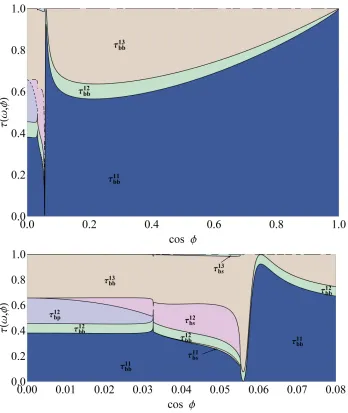
Fig. 4 shows transmission coefficients calculated with the method
devel-oped in [11], here for the T-joint in Fig. 3 with material properties described
in Sec. 3. In particular, we plot the individual transmission coefficients for a
bending mode excitation on the vertical plate in Fig. 3 (a). The coefficients
τxyij represent the transmission from a wave mode x in plate i to a mode y
in plate j with x, y = b,p,s and i, j = 1,2,3. The plates are numbered as
shown in Fig. 3(a), that is, 1 for the vertical plate containing the incident
ray, 2 for the horizontal plate and 3 for the other vertical plate. The plot
shows the dependence of the coefficients on the (cosine of the) angle φof the
incoming ray to the interface. Fig. 4 shows in particular that there is little
mode mixing between bending and in-plane modes, and bending modes are
predominantly reflected at T-junctions.
In the next section we implement this theory for predicting interface
re-flection/transmission properties to model wave energy transport in test
struc-tures provided by Germanischer Lloyd and Jaguar Land Rover. The results
displayed in Fig. 4 are incorporated as part of the weight function w in the
finite dimensional approximation of the DEA kernel (5). We assume that the
transmission coefficients depend only on the incoming momentumps via the
angle of incidence φ. The outgoing angle is given by Snell’s law taking into
Figure 4: Reflection/transmission coefficients at 200 Hz for a steel T-joint (see fig. 3a) with
thickness 8 mm across the two coplanar plates and 16 mm for the perpendicular plate. The
normal fluxτij
xy of the outgoing bending (y=b), pressure (y=p) and shear (y=s) modes
in each platej = 1,2,3 is shown for an incoming bending wave (x=b) in platei= 1. φ
denotes the angle between the incoming ray and the tangent to the plate boundary (see
Figure 5: Germanischer Lloyd benchmark example with 40 bending point sources
ran-domly placed within a sub-domain. Shown are the DEA results for the energy density of
the bending mode (including verification against FEM) (a), the pressure mode (b) and
the shear mode (c). Energies are displayed on a logarithmic scale, positions are given in
3. Numerical results
3.1. Double-hull structure
We apply the method to a stiffened double bottom test structure
pro-vided by Germanischer Lloyd [9] consisting of 8 mm steel plates with 200 mm
×16 mm stiffeners, see Fig. 5. The distance between the upper and lower
plates is 1.5 m and the distance between the side walls is 3 m. The following
material parameters for steel are used: Young’s modulus E = 2.1·1011Pa,
Poisson ratio 0.3, and the material density is 7800 kg/m3. We furthermore use hysteretic damping with a damping loss factor 0.03 for all three mode
types.
In order to compute the DEA kernel efficiently using DFM techniques,
the structure is divided along plate intersections into N = 212 rectangular
sub-domains as shown in Fig. 5. We further subdivide the boundary of
each sub-domain using a boundary mesh with element size 0.2 m or less.
In the momentum coordinate we employ an 8th order Legendre basis. The
transmission/reflection coefficients are obtained as discussed in Sec. 2.3 and
computed directly when evaluating the integrals in (5). Note that due to the
regularity of the test structure, we only need to consider the three different
types of line joints displayed in Fig. 3. Here the T-joints consist of stiffeners
and plates, where the stiffener has twice the thickness of the steel plates. The
structure is excited by a set of 40 randomly placed point sources exciting
bending degrees of freedom at 200 Hz on the upper part of the structure, see
Fig. 5 (a).
It should be noted that since the in-plane modes have wavelengths of
valid provided the average is over a wide enough frequency band to include
sufficiently many structural modes. The benchmark problem considered here
can at 200 Hz also be handled using FEM, see the right hand side of Fig. 5
(a). For full ship structures, 200 Hz is already in the high frequency regime
and beyond the range that can be simulated using FEM due to the sheer size
of the structure.
The computation was done on a quad-core processor machine (Intel core
i5-2540M cpu 2.60 GHz) with a total computation time of 6.5 minutes. The
computation of the matrix coefficients in the 194 562×194 562 sparse matrix
with 309 434 904 nonzero entries took 3.5 minutes, solving the linear system
with Gauss-Seidel iteration took 2.5 minutes.
Fig. 5 shows the structure and the wave energy density in each of the
three modes on a logarithmic scale. The first two rows display (a) the energy
stored in the bending mode including the excitation region. The calculations
are verified against an FEM result over a frequency band centred on 200
Hz. The agreement is clearly very good, although oscillations on the scale
of the wavelength remain in the averaged FEM result that are not captured
by our ray model. The energy density in the pressure waves is shown in
(b) and the shear energy in (c). As expected, the energy density decreases
with the distance to the excitation points due to damping and most energy is
contained in the bending mode. However, there are also striking differences
in the behaviour shown for the different mode types. The damping in the
bending mode is stronger than for the in-plane modes. The transfer from
bending energy in the excited plate into pressure wave energy takes place
(p) waves is then surprisingly directional and is dominated by propagation
along the side walls in both the xand ydirections (as depicted in Fig. 5). In
contrast, the bending and shear waves show more uniform behaviour without
strong preferential directionality.
3.2. Range Rover shock tower
We now consider the transport of high frequency wave energy in thin
shells. High frequency vibro-acoustic models based on an SEA treatment
will be unsuitable in these circumstances since complex geometrical features
are difficult to include in SEA; obtaining a subdivision of the model into
well separated subsystems is thus highly challenging for large moulded
cast-ings. DEA can overcome these problems since it can be easily applied in the
framework of existing grids for finite element models, requires no choice of
subsystem division and incorporates the full geometry and directionality of
the energy flow.
We consider the elements of a surface triangulation as our DEA
sub-domains. Here, the power of the DEA-method together with the DFM
im-plementation becomes obvious as we can immediately work with the meshes
provided by the manufacturer, here Jaguar Land Rover, to perform the
calcu-lations. Any pre-processing in terms of finding adequate subsystems becomes
obsolete. Applying thin shell theory [13], the rays travel along geodesics on
the curved surface (provided the radius of curvature is large compared to the
wavelength). Ray tracing along geodesics can be implemented on the
trian-gulated surface following [14] by choosing incoming angle equal to outgoing
angle at each interface (independent of the angle of intersection of the mesh
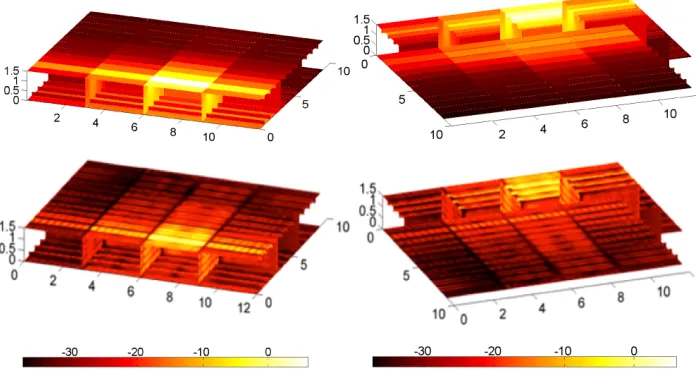
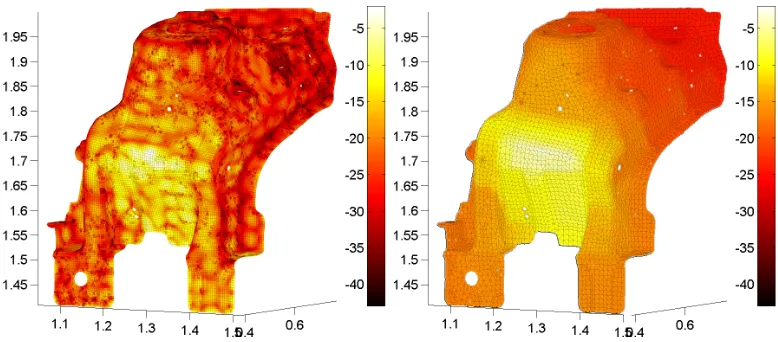
Figure 6: Energy density on a thin aluminium shell (Range Rover shock tower) estimated
using an averaged full wave finite element model (left) and a DEA model (right) for 3%
hysteretic damping.
strong curvature, we interpret the mesh elements (triangles) as a set of plane
plate segments intersecting at the mesh boundaries. The angle of intersection
enters into the computation of the scattering matrix giving rise to reflection,
transmission and mode conversion as described in Sec. 2.3. Note that the
need to deal with non-straight boundaries on the curved surface is avoided
by instead working with the triangulation where all boundaries are straight.
The right hand side of Fig. 6 shows the response of a thin moulded
alu-minium car component (shock tower of a Range Rover) to a point force
applied perpendicular to the surface using DEA. The results are compared
against a finite element simulation for the full wave model performed using
Nastran. In order to maintain a tractable model size for the finite element
simulation and to study frequency ranges of industrial interest, the
compu-tation is performed at frequencies between 8 kHz and 10 kHz. This
wave kinetic energy is computed in Nastran using shell elements and
aver-aged over 41 evenly spaced frequencies spanning the prescribed range with a
typical hysteretic damping level of 3%. The Nastran grid contains 40 670
ele-ments comprising a mix of piecewise linear triangles and quadrilaterals. The
DEA computation is performed on a much coarser mesh consisting of 11 623
triangles and a 6th order Legendre polynomial basis in direction space.
As would be expected one sees more oscillation in the full wave model.
The prediction of the overall energy flow with DEA is good both in the regions
of high and low curvature. In particular, it can be noted in both models that
high curvature regions act as barriers for the energy flow. Such geometric
features would be entirely absent from SEA-type models and represent a
major advance in the simulation of large-scale high frequency vibro-acoustics.
The computations in this section were performed with the same quad-core
processor machine as in the previous section in 15 minutes.
4. Conclusions
We have presented an approach for modelling the transport of wave
en-ergy through complex structures. The proposed method, DEA, interpolates
between SEA and ray tracing, taking account of the ray dynamics within
the structure and including reflection/transmission and mode conversion at
interfaces. Coupling coefficients for more complicated subsystem junctions,
such as junctions connecting several plates, have been calculated using a
scattering approach and then incorporated into the DEA framework. We
have shown that DEA can be implemented on existing mesh grids using the
In particular, DEA was applied to a model vibrational energy
distribu-tions in a ship structure provided by Germanischer Lloyd and in a Range
Rover body part. Results for a system with several thousand sub-domains
and including all three wave modes in plates have been obtained in a
com-petitive computing time-scale of a few minutes. Large scale effects due to
non-diffusive wave transport were observed throughout. Our numerical
re-sults demonstrate the advantages of a DEA treatment compared to SEA.
Damping, directionality and curvature effects can all be modelled providing
a detailed analysis in each wave mode with high resolution across the entire
structure.
Acknowledgement
The authors wish to thank Christian Cabos and Mark Wilken from
Ger-manischer Lloyd, and Stephen Fisher from Jaguar Land Rover for providing
the benchmark problems and for helpful discussions. Support from the EU
(FP7 IAPP grant MIDEA) is also gratefully acknowledged.
[1] D.J. Chappell, G. Tanner, D. L¨ochel and N. Søndergaard, Discrete flow
mapping: Transport of ray densities on triangulated surfaces, Proc. R.
Soc. A,469, 20130153, 2013.
[2] R. H. Lyon and R. G. DeJong,Theory and Application of statistical energy
analysis(2nd edn.). Butterworth-Heinemann, Boston MA, 1995.
[3] R. S. Langley, A wave intensity technique for the analysis of high
[4] A. Le Bot and A. Bocquillet, Comparison of an integral equation on
energy and the ray-tracing technique for room acoustics, J. Acoust. Soc.
Am.108, 1732-1740, 2000.
[5] A. Le Bot, Energy transfer for high frequencies in built-up structures, J.
Sound. Vib. 250, 247–275, 2002.
[6] G. Tanner, Dynamical energy analysis – Determining wave energy
dis-tributions in vibro-acoustical structures in the high-frequency regime, J.
Sound Vib. 320, 1023-1038, 2009.
[7] D. J. Chappell, S. Giani and G. Tanner, Dynamical energy analysis for
built-up acoustic systems at high frequencies , J. Acoust. Soc. Am., 130, 1420-1429, 2011.
[8] D. J. Chappell and G. Tanner, Solving the stationary Liouville Equation
via a Boundary Element Method, J. Comp. Phys. 234, 487-498, 2013.
[9] C. Cabos, H. G. Matthies, The Energy Finite Element Method Noise
FEM. in Proc. IUTAM Symp. Vib. Analysis of Structures with
Uncer-tainties, St Petersburg, 2009, Eds.: A. K. Belyaev and R. S. Langley,
IUTAM series27 (Springer, Heidelberg, 2011).
[10] D.J. Chappell, S. Giani and G. Tanner, Boundary element dynamical
energy analysis: a versatile method for solving two or three dimensional
wave problems in the high frequency limit, J. Comp. Phys.231, 6181-6191, 2012.
[11] R. S. Langley and K. H. Heron, Elastic wave transmission through
[12] R. J. M. Craik, I. Bosmans, C. Cabos, K. H. Heron, E. Sarradj, J. A.
Steel and G. Vermeir,Structural transmission at line junctions: a
bench-marking exercise, J. Sound Vib. 272, 1086, 2004.
[13] A. N. Norris and D. A. Rebinsky, Membrane and Flexural Waves on
Thin Shells, ASME J. Vib. Acoust.116, 457-467, 1994.
[14] R. Kimmel and J. A. Sethian, Computing geodesic paths on manifolds,