Bachelor thesis
ENHANCING PASSWORD-BASED
USER AUTHENTICATION:
IMPLICIT MOTOR SEQUENCE
LEARNING IN THE SISL TASK
Sanne van Waveren
S1233920HUMAN FACTORS AND ENGINEERING COGNITIVE PSYCHOLOGY AND ERGONOMICS UNIVERSITY OF TWENTE, THE NETHERLANDS
Abstract ─ The serial interception sequence learning (SISL) task is used in a user
authentication system based on implicit motor sequence learning (Bojinov, Sanchez, Reber,
Boneh & Lincoln, 2014). This study aims to investigate the influence of training length on
performance of the SISL task. Participants were distributed across three conditions: a
training phase of 480 trials, 960 trials and 1,440 trials. Experiment 1 comprised two phases:
a training phase and a test phase. In the former, participants substantially trained on a fixed
sequence, in the latter, sequence knowledge was tested, using both the trained sequence and
new, random sequences. Results showed that participants performed significantly better on
the trained sequence at both experiments and that training length did not significantly
influence SISL task performance. From this, it can be concluded that a SISL-based
authentication system could be successful in practice. This is supported by a performed
security analysis. However, future research should explore the robustness of the SISL-based
authentication system.
Key words: serial interception sequence learning task, implicit learning, user authentication system
Samenvatting ─ De serial interception sequence learning (SISL) taak is gebruikt voor
gebruikersauthenticatie gebaseerd op het impliciet leren van motor sequenties (Bojinov,
Sanchez, Reber, Boneh & Lincoln, 2014). In dit onderzoek is de invloed van trainingsduur
op de prestatie op de SISL taak onderzocht. Deelnemers waren verdeeld over drie condities:
een trainingsfase van 480 trials, 960 trials en 1440 trials. Experiment 1 bestond uit twee
fases: een trainingsfase en een testfase. In de eerste trainden deelnemers op een vaste
sequentie en in de laatste werd getest op sequentiekennis door de sequentie af te wisselen
met nieuwe, willekeurige sequenties. In experiment 2 voltooiden deelnemers na vijf weken
nogmaals een testfase om te kijken of sequentiekennis aanwezig blijft. Resultaten lieten zien
dat proefpersonen in beide experimenten significant beter presteerden op de getrainde
sequentie en dat de trainingsduur geen significante invloed op had SISL taak prestatie. Uit
de resultaten kan worden geconcludeerd dat een beveiligingssysteem op basis van de SISL
taak zou kunnen werken in de praktijk. Dit wordt ondersteund door een uitgevoerde
beveiligingsanalyse. Echter, toekomstig onderzoek zal moeten worden uitgevoerd om de
robuustheid van dit beveiligingssysteem in kaart te brengen.
TABLE OF CONTENTS
I. INTRODUCTION ... 4
1.1. User authentication ... 6
1.2. Human memory ... 8
1.4. Language acquisition ... 10
1.5. Motor skill ... 10
1.6. The serial interception sequence learning (SISL) task authentication system .... 10
1.7. Current study ... 14
II. METHOD ... 16
1. Experiment 1 ... 16
1.1. Participants ... 16
1.2. Apparatus ... 16
1.3. Task and procedure ... 16
2. Experiment 2 ... 17
2.1. Participants ... 17
2.2. Apparatus ... 17
2.3. Task and procedure ... 18
III. RESULTS ... 19
1. Experiment 1 ... 19
1.1. SISL performance ... 19
1.2. Recognition score ... 21
1.3. Recall score ... 21
2. Experiment 2 ... 21
2.1. SISL performance ... 21
2.2. Recognition score ... 23
2.3. Recall score ... 23
IV. DISCUSSION ... 24
4.1. Security analysis ... 27
4.2. SISL-based authentication system (SAS) protocol ... 29
4.3. Password guessing attacks ... 33
4.4. Conclusion ... 34
ACKNOWLEDGEMENTS ... 35
V. REFERENCES ... 36
I.
INTRODUCTION
A significant part of our daily lives is spent online. For instance, social networking
sites such as Facebook and Twitter are incredibly popular, with more than 1.4 billion and 288
million users each month worldwide respectively (Statista, 2015). Besides social networking
sites, there is an increase in the use of e-mail, online banking and other online services. With
this, there has been a drastic growth in the amount of personal data that is shared digitally.
The information distributed via these media should be considered as sensitive and
requires both confidentiality and integrity. This means, limited access to authorized users and
preservation of the original information that is transmitted without it being changed by others.
These accounts therefore often require usernames and passwords as authentication.
However, with the rise of the internet, weaknesses and deficits of password
protection have often become apparent. For instance, an 18-year-old hacker recently hacked
multiple Twitter accounts, including Barack Obama’s, performing a brute force attack
(exhaustive search of all password possibilities) using an automated password-guesser (Zetter,
2009). Furthermore, the social networking sites accounts of multiple institutions, such as
Delta Airlines and U.S. Central Command, were recently hacked and in some cases, the
hackers even modified the content into provoking messages (Mosendz, 2015; Rosenfeld,
2015; Stampler, 2015). It has been speculated that this could have been prevented using solid
password protection (Rogers, 2015).
Besides the advantages provided by the internet, there is a major drawback as well.
With the extensive use of social networking sites, a lot of personal information about its users
can be found online. Including information that is often used to create a password, such as a
date of birth of a pets name. The use of personal items as part of passwords may be a result of
convenience. Given the fact that on average an internet user possesses 19 passwords (Cyber
Streetwise, 2014), it seems no surprise that people tend to choose easy to remember
passwords, and that the majority of people use just one password for multiple services (van
Ammelooy, 2015). The need to remember seems to be incompatible with ensuring strong
digital security (van Ammelooy, 2015).
The worst passwords of 2014 have been presented (SplashData, n.d.), leading to the
following top three: 1. 123456. 2. password. 3. 12345. This was confirmed by the famous
Adobe security breach, that revealed the most commonly used passwords of Adobe users: 1.
used by 345,834 users (Newman, 2013). From this, it becomes apparent that weak passwords
often play a major role in making it feasible for adversaries to hack digital systems. It may
only take three seconds to crack an eight letters long password using password guessing
technologies (van Ammelooy, 2015).
In addition, several social engineering techniques may be used to obtain personal or
sensitive data from users. These techniques make use of psychological tricks instead of
computer programs and other technologies (Thompson, 2006). An event at the DEFCON
computer security convention called Capture the Flag challenges social engineers to extract
sensitive information from companies by phone. In the 2010 edition of Capture the Flag,
people were persuaded during a phone call to go to a particular website in only 20 minutes
from which the social engineer could extract details about the computer that the person was
using (Gold, 2010). The same happened at DEFCON 2012, when a social engineer called a
manager of Wal-Mart. With a simple lie, the social engineer extracted among others several
details about the store, moments that managers were on a break, and about the computer, web
browser and antivirus software the manager was using (Cowley, 2012). Other companies that
at least gave a bit of information away while being called by a social engineer were for
instance, Shell, Cisco, Hewlett-Packard and FedEx (Cowley, 2012). These examples clearly
show the power of social engineering techniques.
One social engineering method is called rubber hose attacks. A rubber hose attack
relies on the use of non-technical means such as persuasion and emotional manipulation
(Bojinov et al., 2014; Thompson, 2006). For instance, an adversary coerces a user to reveal
their password by aiming a weapon or making threats. This is a stressful situation, in which
individuals tend to make a quick, disorganized evaluation of the situation (Keinan, 1987).
Moreover, this influences the emotional state of the person that is being coerced, as they
might experience pressure and fear, as well as their behavior, as they might reveal their secret
under pressure, whereas they would not have revealed their secret if not being coerced. These
attacks are a serious threat to security, mostly of high security facilities with authentication
systems that require physical presence. Bojinov et al. (2014) claim that this kind of attacks is
often the easiest way to outsmart user authentication.
Because of this, Bojinov et al. (2014) proposed an authentication system that should
provide better security against rubber hose attacks. This authentication system enables users
to unconsciously learn a password, so that it cannot be revealed under pressure. However, it
may also be a way to prevent brute force attacks, because it is an alternative way of
The aim of the current study is to further investigate the use of implicit passwords to
enhance security of password-based user authentication systems. In this chapter, the concepts
and relevance of user authentication, human memory, explicit and implicit knowledge,
language acquisition and motor skill are explained. Also, the purpose of the current study and
the proposed authentication system are reported. In chapter 2 the method are described. Next,
in chapter 3 the results of this study are reported. Finally, in chapter 4 the findings of the
current study and suggestions for further research are discussed.
1.1. User authentication
In order to investigate the new password-based user authentication method described
above, it is important to first consider what is meant by user authentication. User
authentication is commonly used in systems that need to protect personal and sensitive
information. One way to ensure this essential part of computer security is through
password-based user authentication (Ives, Walsh & Schneider, 2004; Adams & Sasse, 1999). This
comprises an identification and an authentication phase. The first identifies the user and the
latter verifies that the user is not a fraud, but a legitimate owner of the identity presented in
the first phase (Adams & Sasse, 1999).
With the emergence of the web, a need arose for numerous systems that require
secure use to protect personal and sensitive data (Renaud & De Angeli, 2004). For instance,
online banking typically requires a username and password in order to access accounts
(Mannan & van Oorschot, 2007). Password-based user authentication helps digital systems to
facilitate data confidentiality, which is the protection of sensitive data from passive attacks,
such as wire tapping and eavesdropping. This keeps sensitive data from falling into
unintended hands, because a person is only allowed to consult data they are supposed to see
(“Data Classification, Access, Transmittal, and Storage”, 2014). However, despite the
widespread use, password-based user authentication carries a high potential risk for identity
theft for the following reasons.
Firstly, users do not change their initial passwords (Adams & Sasse, 1999). This
way, an adversary only needs to figure out a password once, instead of a set of passwords.
However, regularly changing passwords compromises security as well. Adams and Sasse
(1999) argue that due to limitations of human memory, having to remember multiple
passwords is a complex process, and therefore users tend to write down their passwords.
Secondly, passwords generate the secret key in password-based user authentication.
requires passwords to be as long and random as possible and thus hard to remember. Most
users tend to choose meaningful, language-based passwords, which in turn reduces
randomness (Smart, 2003).
Thirdly, users tend to choose easy passwords, “(…) ‘password’ may be the most commonly selected password, where it is allowed…” (Burr, Dodson & Polk, 2004, p. 45).
Typically, users minimize the characters used in their passwords (Adams & Sasse, 1999).
Given the length and simplicity, passwords are vulnerable to several attacks including
guessing and use of dictionaries of common passwords (Burr et al., 2013). A solution against
dictionary attacks may be to select a random password from the total password-space k.
However, this is again user unfriendly and may increase the likelihood of users writing down
their passwords, which in turn compromises security (Davies & Ganesan, 1993). It becomes
apparent that security involves both technology and people, but that the latter are often
forgotten (Brostoff & Sasse, 2002).
Moreover, Davies and Ganesan (1993) argue that passwords are often chosen from a
small password-space k1 that is part of k. This small size of k1 allows adversaries to efficiently
do an exhaustive search of the password-space (Davies & Granesan, 1993). In an exhaustive
search, the attacker simply checks all possible passwords until the correct one is found.
Although the attacker still needs to consider several possible passwords, there are relatively
few possibilities and therefore this search becomes feasible. For instance, the password “pass”
contains only lowercase characters and no numeric values or symbols. Therefore, there are
only:
,
possibilities to explore in an exhaustive search.
Also, a small password-space k causes the Shannon entropy of passwords to be low.
Shannon entropy is hereinafter referred to as entropy. Burr et al. (2013) define entropy as “a
measure of the amount of uncertainty that an attacker faces to determine the value of a secret”
(p. 9). If a password is written in binary (0 or 1), the entropy H is the average number of
binary digits required per character of the password. Burr et al. (2013) and Smart (2003) give
the following mathematical definition of entropy with the probability that X has the value xi
(for i in xiit holds that 1 ≤ i ≤ n), with a probability distribution pi= p(X = xi):
For instance, a password “PASS” with event space C:
C = {P, A, S, S},
with the probabilities based on frequency of occurrence:
and
The entropy of C can be calculated as follows:
This means there are around one and a half bits of information about the password to
be found (Smart, 2003). A small password-space causes entropy to be low, which in turn
makes it feasible for an adversary to retrieve the password.
Last, as a user is consciously aware of a password, describing it to others is relatively
easy. Several social engineering techniques are available, such as persuasion, in order to
coerce someone to revealing their password (Weinshall & Kirkpatrick, 2004). If someone is
aware of a password they may reveal it in some way when being coerced by an adversary.
1.2. Human memory
Usually, users tend to consciously know their passwords. In order to understand the
difference between unconscious and conscious knowledge it is important to explain the
mechanisms of the human memory first.
In cognitive psychology, knowledge is defined as information about the world that is
stored in memory (Smith & Kosslyn, 2007). There is a distinction between long-term,
short-term and working memory. The first has a vast capacity to store knowledge for over years,
such as information about ten years ago. Short-term memory has a capacity of approximately
four to seven items and depends on rehearsal (Kalat, 2013). For instance, information about
this morning. Working memory involves actively processing information, such as holding a
thought in your mind. If information is somehow lost from working memory, it has to be
retrieved from short-term or even long-term memory (Smith & Kosslyn, 2007). This process
also takes place in password-based user authentication. A password is often stored in
long-term memory as it is used for a long time and possibly with long time intervals in between.
individual’s head right at that moment. When the password cannot be retrieved from working
memory, short-term or even long-term memory should be consulted.
Within long-term memory, two forms of memory have been distinguished:
declarative memory and non-declarative memory (Squire, Knowlton & Musen, 1993).
Declarative memory can be divided into episodic memory and semantic memory. The first
encompasses memory of events in the past and the latter general knowledge about things in
the world and their meaning.
Language based passwords may be seen as part of the declarative memory, as they
often can be described verbally. This type of memory is depending on the medial temporal
lobe (MTL) memory system (Scoville & Milner, 1957; Reber, 2013; Bojinov et al., 2014).
Studies have shown that damage to the MTL memory system, including stroke or amnesia,
impairs the ability to acquire declarative knowledge. However, in case of such damage, the
ability to acquire non-declarative knowledge remains intact (Bojinov et al., 2014; Squire &
Zola-Morgan, 1991). Therefore, non-declarative knowledge seems to be independent of the
MTL (Reber, 2013).
1.3. Implicit and explicit knowledge
Memory systems research has shown different types of long-term memory (Bojinov
et al., 2014; Squire & Zola-Morgan, 1991; Reber, 2013). On the one hand, declarative,
conscious, explicit knowledge, which often can be described verbally. On the other hand,
non-declarative, implicit knowledge, which is expressed through performance and cannot be
described verbally (Reber, 1976; Squire & Zola-Morgan, 1991). For instance, the knowledge
that the big yellow circle in the sky is called the sun is learned explicitly and can be described
consciously. However, riding a bicycle is a process that can be carried out efficiently, but
cannot be described verbally. This is done implicitly: it is clear what is done, but not how it is
done. DeShon and Alexander (1996) argue that explicit knowledge is acquired by first
developing an internal representation. Explicit learning requires conscious thinking about a problem’s initial state, goal state and the steps to get from the first to the latter (DeShon &
Alexander, 1996). Implicit learning, however, depends on frequent repetition with no
1.4. Language acquisition
As mentioned earlier, passwords commonly comprise, among others, existing words,
dates and derivatives of words from natural languages (Davies & Granesan, 1993). Since
passwords have a language-based content, the process of learning a password may be
compared to the process of learning a language.
Language is based on fundamental links between sentence form and meaning
(Gertner, Fisher & Eisengart, 2006). General knowledge on word meanings belongs to so
called conceptual knowledge or semantic memory (Patterson, Nestor & Rogers, 2007).
Languages are composed of complex rules and regularities. Knowledge of these rules and
regularities is essential in order to master a language, but native speakers are often not aware
of the underlying rules of the language (Batterink, Oudiette, Reber & Paller, 2014). The
underlying principles about grammar can be acquired implicitly, which means that this
knowledge is unconsciously abstracted from the environment (Reber, 1976; Ellis, 2008).
However, an important difference between the type of knowledge that is language and the
knowledge of passwords, is that a user learns a password explicitly, as it can often be verbally
described by the user (Ellis, 2008).
1.5. Motor skill
Many daily activities consist of a variety of motor skills that can gradually be
acquired by practice. This holds for basic as well as complex motor behaviors (Doyon,
Penhune & Ungerleider, 2003; Savion-Lemieux & Penhune, 2005; Verwey, Lammens &
Honk, 2001; Abrahamse, van der Lubbe & Verwey, 2009; Tzvi, Münte & Krämer, 2014).
Learning motor skills, both explicitly and implicitly, has been studied extensively. Studies on
motor sequence learning, like typing or playing the guitar, have shown that motor skills can
be acquired implicitly (Schendan, Searl, Melrose & Stern, 2003; Bojinov et al., 2014;
Abrahamse, van der Lubbe & Verwey, 2009; Tzvi et al., 2014; Rüsseler & Rösler, 2000).
1.6. The serial interception sequence learning (SISL) task authentication system
Because of the large amount of personal information we share digitally,
password-based user authentication is very important nowadays. However, it have shown to be
vulnerable to attacks.
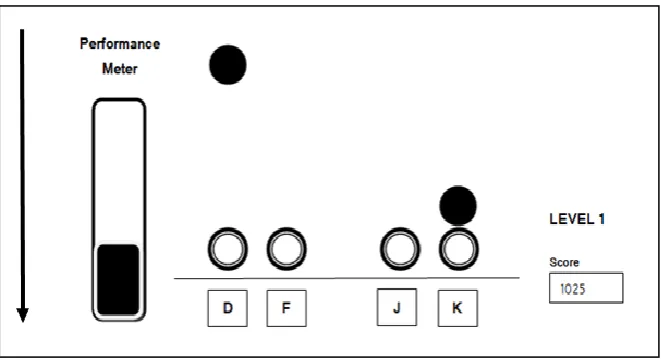
Bojinov et al. (2014) proposed an authentication system based on implicit learning in
Figure 1. Schematic representation of the four-button serial
interception sequence learning (SISL) task. The buttons ‘d’, ‘f’, ‘j’
and ‘k’ on a keyboard are used for data registration. The filled circles
move downwards the screen. Participants need to press the
corresponding key accurately when the filled circles are at the position
of the open circles.
attacks. The SISL task, first introduced by Sanchez, Gobel and Reber (2010), lets participants
train a particular sequence by repetition, but acquiring explicit knowledge is difficult. The
task is similar to the popular game Guitar Hero, and moving cues should be intercepted by
pressing corresponding keys (see Figure 1).
Bojinov et al. (2014) focused on high security facilities using local password-based
user authentication which requires physical presence of users. In this scenario, if an attacker
captures the user and coerces him or her to reveal their password, the user cannot do this as
the trained sequence is learned implicitly.
Moreover, a SISL-based user authentication system may also provide a solution to
the deficiencies of traditional password-based user authentication, because it has higher
entropy than most commonly used passwords. The implicitly learned passwords comprise of
motor skill sequences. A motor sequence that consists of 12 characters will have an entropy of
8 bits, as is calculated below. Whereas a traditional password of 12 characters, for instance, the word “degradations”, has only 3.25 (for a detailed explanation on the calculation, see
paragraph 1.1.).
As mentioned earlier, social networking accounts may also contain sensitive,
personal information, but these accounts are often hacked. To prevent against brute force
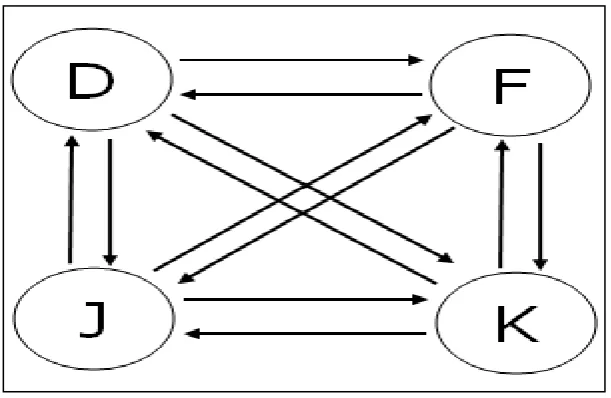
[image:11.595.129.460.69.249.2]Figure 2. A set of Euler cycles in a directed graph. From this set
12-character sequences are generated.
The SISL task makes use of motor sequences. All these sequences are designed to
minimize recognition and to avoid easy to remember patterns. This is done by using a set ∑ of
all sequences that correspond to an Euler cycle, this means that all vertices in the graph have
an even degree of non-zero degree and are connected (see Figure 2), and the characters used
for the sequences are taken from set S {d, f, j, k}. An Euler cycle is a cycle that traverses each
edge of a directed graph exactly once (Dickman, 1996). So, all sequences are made of six
bi-grams (such as ‘df’ and ‘fk’) that are never repeated within a sequence (Bojinov et al., 2014).
An example of a sequence with the property that every non-repeating bigram over ‘S’ appears
exactly once is “djfkdkjkfdfj”.
Bojinov et al. (2014) describe the computation of the number of keys with the BEST theorem and Cayley’s formula. Cayley’s formula states how many different trees (an
undirected graph in which any two vertices are connected by exactly one path) can be
constructed on n vertices. On every tree there can be multiple Eulerian circuits. For instance,
when vertices switch places, the possible routes change and with this, the possible Eulerian
circuits. In this formula (see Formula 1.2), for every positive integer m ∈ ℤ, where ℤ denotes
the set of all integers, the number of trees on n labelled vertices is (Casarotte, 2006):
(1.2)
The BEST theorem can be used to count the number of Eulerian circuits in a directed graph
(Brightwell & Winkler, 2004):
In this formula (see Formula 1.3), . Every vertex’s in-degree is
denoted by and has the value 3 in the graph in Figure 2. For the Euler graph in figure
2 corresponding to a four-button SISL task the BEST theorem gives:
# Keys = . (1.4)
Thus, the trained sequence in the SISL task has about 8 bits of entropy (see Formula
1.4). Although this entropy is significantly smaller than with the six-button SISL task (which
has 38 bits of entropy), it is still higher than the entropy of traditional language-based
password. For instance, the commonly used password “password” has only 2.75 bits of
entropy. This holds for passwords including numbers and symbols as well. For instance, the password “Pas$w0rD2O!0” has only 3.42 bits of entropy, which is far less than the 8 bits of
the sequence in the SISL task.
The SISL-based authentication protocol used in the current study is almost similar to the
one used by Bojinov et al. (2014). However, it used three 12-character sequences: the trained
sequence and two random sequences. Then, the protocol used in this study looks as follows:
- Let k0be the trained 12-character sequence and let k1 and k2 be two random sequences
chosen from .
- The system presents the user with a SISL task with the following sequence of 540
items = 45 x 12 characters. Every sequence is repeated five times in a row and
followed by the next sequence until every sequence is repeated fifteen times: k0, k0, k0,
k0, k0,k1, k1, k1, k1, k1, k2, k2, k2, k2, k2, …, k2, k2, k2, k2, k2. Where k0 is the trained
sequence.
- For i = 0, 1, 2, let pi be the percentage correct on the sequence ki during the
authentication. Authentication is successful if
p0 > mean (p1, p2) + σ. (1.5)
In this formula σ > should cover the possibility that the performance gap occurred by
chance. However, the exact size of σ still needs to be determined as this has not been done yet
1.7. Current study
The current study aims to investigate use of SISL-based authentication in which
users implicitly learn their secret key: a motor sequence. This authentication may provide
several advantages to original password-based authentication: 1) higher entropy compared to
original password-based user authentication, 2) inability of users to reveal the secret key.
Up until now, the length of the training phase for learning motor sequences
implicitly, did not receive much attention. The six-button SISL task used by Bojinov et al.
(2014) requires at least 30-45 minutes of training before a user can be authenticated. As has
been described earlier, users tend to be complacent when it comes to passwords. Once chosen,
they do not change their passwords and they tend to use easy and predictable passwords. This
way, creating and managing passwords takes as little time as needed. Therefore, it is
important to reduce training time as much as possible, to increase the practical use of
sequence-based passwords.
In this study a four button SISL task was used with 12-character sequences to reduce
training time. As a consequence, entropy was lower compared to a six-button SISL task using
30-character sequences. However, the SISL-based authentication system presented here aimed
to improve original password-based user authentication, and therefore did not require very
high entropy. To investigate the influence of training length on SISL task performance, three
different training phase lengths were compared in an experiment with the four-button SISL
task. The longest training length consisted of 1,440 trials, the middle training length consisted
of 960 trials and the shortest training length consisted of 480 trials. Possibly, there is a
minimum length the training phase needs to have in order to facilitate implicit learning of a
motor sequence. This study intended to answer the following main question:
1. What is the influence of training time on the extent of implicit motor sequence
learning in a four-button SISL task?
Motor sequence learning was expressed by the percentage correct on the trained
sequence compared to the percentage correct on untrained sequences. It was expected that
participants perform better on the trained sequences compared to random sequences. To
ensure motor sequence learning was implicit, the nature of sequence knowledge of the
participants was evaluated. Two tasks checked for any explicit knowledge about the sequence
trained in the experiment. The recognition task required participants to rate sequences on
familiarity and the recall task required participants to reproduce their trained sequence. This
Hypothesis 1. Performance, expressed in percentage correct, on a trained
sequence on a four-button SISL task differs across the three conditions;
Hypothesis 2. Average recall score differs across the three conditions;
Hypothesis 3. Average recognition score differs across the three conditions.
Implicit learning tasks have shown an increase in performance with practice (e.g.,
Bojinov et al., 2014; Doyon et al., 2003; Savion-Lemieux & Penhune, 2005; Verwey et al.,
2001; Abrahamse et al., 2009; Tzvi, Münte & Krämer, 2014), and therefore, it was expected
that performance increases with training length. Moreover, it was expected that the ability to
recognize and to recall the trained sequences increased with training time, because it is
reasonable that, although knowledge remains implicit, participants do create a stronger
association with practice.
It is important for an authentication system not to use one-time only passwords
(OTP), and therefore it was investigated whether users can authenticate over time. To check if
sequence knowledge remains implicitly in memory, a follow-up experiment was done five
weeks after the first experiment, in which participants complete authentication and a
II.
METHOD
1. Experiment 1
1.1. Participants
37 adults living in the Netherlands participated in this experiment. One participant
was excluded from the study, because of software malfunctioning, which resulted in a group
of 36 participants (19 male and 17 female). Participants were selected through convenience
sampling. The participants were between 18 and 60 years of age (mean age = 24.1, SD = 8.7).
All participants were tested individually. Prior to the study, all participants gave their written
informed consent. 50% were psychology students from the university of Twente and 17
participants received course credits for their participation. The study was approved by the
ethics committee of the Faculty of Behavioral Sciences at the University of Twente.
1.2. Apparatus
Matlab R2014b was used to present the stimuli and register data. Psychtoolbox was
installed in order to visualize the stimuli and to record responses. The experiment ran on a HP
ProBook 4530s laptop. The ‘d’, ‘j’, ‘f’ and ‘k’ keys of a regular QWERTY-keyboard were
used for data registration.
1.3. Task and procedure
The task involved a serial interception sequence learning task in which a
12-character sequence was pressed in response to sequence-specific visual cues.
Prior to the experiment, a 24-trial demo was run to make the participants familiar
with the four-button SISL task. Then, the actual experiment was run. Subsequently, a
recognition and a recall task were executed.
In the experiment, participants placed their left middle, left index, right index and right middle finger on the ‘d’, ‘f’, ‘j’ and ‘k’ keys of a QWERTY-keyboard respectively. The
experiment started with instructions presented in the middle of the screen. The participant had
to press any key to continue to the first training level. Each trial started with a blue circle (cue
circle) at the vertical position of one of the four dashed yellow rings (target circles), with an
interval of 500 ms in between consecutive trials. The cues circles scrolled from the top to the
bottom of the screen. They initially scrolled with a speed of 10 cm/s, however, speed was
made adaptive to keep participants challenged during the task. A good performance caused
in 2.0 s, travelling a total distance of 25 cm from the top to the bottom of the screen in 2.5 s.
Participants received immediate feedback on their responses, however it might have been
difficult to pay attention to upcoming cues and the given feedback simultaneously. Whenever
the participants pressed a key, the initially yellow target circles temporally changed color. The
target circles turned red or green for incorrect and correct responses, respectively. A response
was counted as correct if the participant pressed the corresponding key while a cue circle
overlapped with the target circle as much as possible. Incorrect responses, multiple
simultaneous responses and non responses were counted as errors.
Participants were randomly distributed over three conditions. During the training
phase, condition S had to perform a training phase of one level, condition M had to perform a
training phase of two levels, and condition L had to perform a training phase of three levels.
One level consisted of 8 blocks in which the trained sequence repeated five times, giving a
total of 480 trials per training level. After completion of the training phase, all participants
completed a test phase of one level. In this test level, the repeated sequence and two foil
sequences were all repeated 15 times, with a total of 540 trials. Between levels participants
were offered a self-paced break.
2. Experiment 2
2.1. Participants
15 of the participants of the initial experiment (7 male and 8 female) participated in
the follow-up study five weeks after the initial experiment. The participants were between 18
and 60 years of age (mean age = 26.7, SD = 12.9). Three participants were initially in
condition S, four in condition M and eight were in condition L. All participants were tested
individually. Prior to the study, all participants gave their written informed consent, which
was approved by the local ethics committee. Two participants received course credits for their
participation.
2.2. Apparatus
Matlab R2014b was used to present the stimuli and register data. Psychtoolbox was
installed in order to visualize the stimuli and to record responses. The experiment ran on a HP ProBook 4530s laptop. The ‘d’, ‘j’,. ‘f’ and ‘k’ keys of a regular QWERTY-keyboard were
2.3. Task and procedure
Five weeks after initially participating in the first experiment, participants completed
the follow-up experiment. The task involved a serial interception sequence learning task
similar to the one in the initial experiment. A 12-character sequence was pressed in response
to sequence-specific visual cues. The task was the same as in the initial experiment, except for
the initial speed, which was set to the final speed of the participant in the initial experiment.
The follow-up experiment consisted of 180 random trials as a warm up, followed by a
retention test of 540 trials of 15 times the trained sequence, 15 times a random sequence used
in the initial experiment and 15 times a random sequence.
After the test level was finished, the participants again completed the recognition
III.
RESULTS
1. Experiment 1
1.1. SISL performance
1.1.1. training phase.
During the training phase the average performance (percent correct) was 65.76%, with an
average performance of 68.45% in condition S, 64.69% in condition M and 64.15% in
condition L. There was a significant better average performance in condition S compared to
the conditions M and L, F(2, 35) = 5.47, p < 0.010, 95% CI [0.002, 0.074] and [0.007, 0.079]
respectively.
Learning effects were analyzed with a repeated measures ANOVA with Time (2;
first block versus last block) as within-subjects factor and Group (3; S, M and L) as
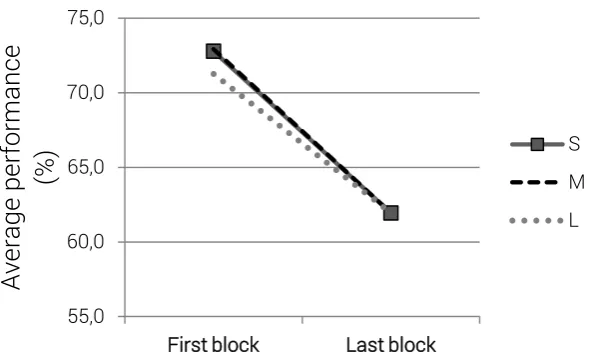
between-subjects factor. This produced significant main effect of Time (See Figure 3), F(1, 33) = 9.10,
p < 0.010, indicating that participants’ average performance on the first block in all three
conditions significantly differed from average performance on the last block they completed.
The difference is expressed in decreased performance in the last block compared to the first
block.
Figure 3. Average performance (%) in the first block and the last
block for all three conditions S, M and L on the four-button SISL task.
1.1.2. Test phase
The test phase (authentication) comprised of the last level of the SISL task, in which
both the trained sequence and two random sequences are presented to participants 15 times
each, resulting in a level of 540 trials.
55,0 60,0 65,0 70,0 75,0
First block Last block
Ave
rage
p
erfo
rm
ance
(%)
[image:19.595.144.446.445.625.2]A one-way between groups ANOVA showed a non-significant effect for training
length on average performance on the trained sequence, F(2, 35) = 0.30, p = 0.743; for
random sequences, F(2, 25) = 2.57, p = 0.092; and for trained and random performance
together represented as SISL score, F(2, 35) = 0.34, p = 0.712.
Analysis of the average percentage correct on the trained sequences and the average
percentage correct on the two random sequences in the test level showed that all participants
performed at an average rate of 63.63% (SD 14.37%) correct for the trained sequence, and on
average 57.65% (SD = 9.84%) correct on random sequences. The overall performance was on
average 59.64%. A paired-samples t-test showed a significant difference between
performance on the trained sequence compared to average performance on the random
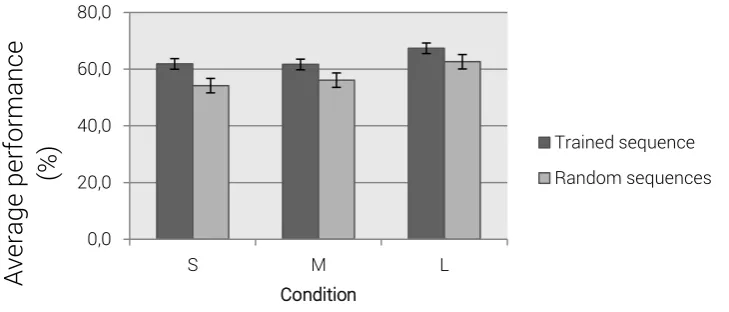
sequences, t(35) = 3.02, p < 0.01, indicating that participants performed significantly different
[image:20.595.120.485.324.480.2]on the trained sequence compared to the random sequences (See Figure 4).
Figure 4. Average performance (%) on the trained sequence and random sequences of all
participants in the three conditions S, M and L on the four-button SISL task in the test
level. Error bars represent standard errors.
A one-way ANOVA was conducted to compare the SISL score for all three
conditions. The SISL score is calculated by subtracting the mean performance on the two
random sequences from the mean performance on the trained sequence. There was not a
significant difference between the conditions, F(2, 35) = 0.19, p = 0.832, indicating that
training length did not significantly influence performance on the trained sequence compared
to random sequences (SISL score) reliably. The average SISL score was 5.98. Analysis of the
three conditions showed that participant’s difference in average performance on the trained
sequence and random sequences was greatest in condition S, followed by condition M and
with smallest difference in condition L (See Table 1). However, this difference between the
conditions was not significant, F(2, 35) = 0.19, p = 0.832. 0,0
20,0 40,0 60,0 80,0
S M L
1.2. Recognition score
Five participants rated their trained sequence correctly with certainty (a score of 10).
Participants rated the trained sequence moderately positive familiar with an average score of
3.58 (SD = 5.60). The random sequences were rated moderately negative familiar with an
average score of -2.05 (SD = 2.98). The average recognition score was 5.63 (SD = 6.88). A
one-sample t-test showed it was significantly greater than zero, t(35) = 4.91, p < 0.001,
indicating some explicit sequence knowledge of the participants. However, expression of
sequence knowledge (high recognition score) did not correlate with SISL task performance,
r(34) = 0.23, p = 0.170. Also, expression of sequence knowledge did not reliably predict
performance on the SISL task, R² = 0.05, F(1, 35) = 1.97, p = 0.170. There was no significant
difference in sequence knowledge between the three conditions.
1.3. Recall score
The recall score consists of the largest chunk of trials participants could recall (for instance, ‘djk’ is a chunk of three). The average recall score for the trained sequence was 4.47
(SD = 1.65). However, a high recall score did not correlate with performance, r(34) = 0.11, p
= 0.509. Also, expression of sequence knowledge did not significantly predict performance on
the SISL task (R² = 0.01, F(1, 35) = 0.45, p = 0.509).
2. Experiment 2
2.1. SISL performance
After a warming up of 180 random trials to let participants adapt to the speed, all
[image:21.595.66.520.155.231.2]three 12-character sequences are presented 15 times, resulting in a level of 720 trials. One
Table 1
Mean performance (%) on trained sequence and random sequences and
difference between them for all three conditions (S, M and L)
Condition Trained sequence (%) Random sequences (%) Difference (%)
S
M
L
61.85
62.78
66.25
54.19
56.20
62.55
7.66
6.58
sequence was the trained sequence, one a new random sequence and one a random sequence
that was used in the initial experiment.
A one-way between groups ANOVA was conducted in order to compare the effect of
training length on performance on the trained sequence in the test level of the four-button
SISL task in the three conditions S, M and L. There was not a significant effect of training
length on performance, F(2, 14) = 1.35, p = 0.297. Participants did not perform significantly
different on the trained sequence in the three conditions.
Analysis of the average percentage correct on the trained sequences and the average
percentage correct on the two random sequences in the test level showed that all participants
performed at an average rate of 69.63% (SD 8.09%) correct for the trained sequence, and on
average 61.09% (SD = 4.40%) correct on random sequences. The overall performance was on
average 63.94% (SD = 2.79%). A paired-samples t-test showed there was not a significant
difference in performance on the two random sequences in the authentication, t(14) = -0.10, p
= 0.926. However, a paired-samples t-test showed a significant difference between
performance on the trained sequence compared to average performance on the random
sequences, t(14) = 3.00, p = 0.009, indicating that participants performed significantly
different on the trained sequence compared to the random sequences (See Table 2). In an
analysis of mean performances, condition M showed with 13 percent the biggest difference
between performance on the trained sequence and the random sequences.
A one-way ANOVA was conducted to compare the SISL score for all three
conditions. The SISL score is calculated by subtracting the mean performance on the two
random sequences from the mean performance on the trained sequence. There was not a
significant difference between the conditions, F(2, 14) = 1.73, p = 0.219, indicating that
training length did not significantly influence performance on the trained sequence compared
[image:22.595.64.523.280.358.2]to random sequences (SISL score). The average SISL score was 8.54.
Table 2
Mean performance (%) on trained sequence and random sequences and
difference between them for all three conditions (S, M and L)
Condition Trained sequence (%) Random sequences (%) Difference (%)
2.1.1. Retention
A paired-samples t-test was used to compare average performance on the trained
sequence, random sequences and the calculated SISL score from the first experiment and the
follow-up experiment. This showed that only performance on the random sequences in the
follow-up was significantly higher compared to the first experiment, t(14) = 2.65, p = 0.019,
95% CI [0.85, 8.00]. The average SISL score in the first experiment was 5.98, and in the
follow-up it was 8.54.
2.2. Recognition score
Three participants rated their trained sequence correctly with absolute certainty (a
score of 10). Participants rated the trained sequence moderately positive familiar with an
average score of 5.33 (SD = 6.86). The random sequences were rated moderately negative
familiar with an average score of -3.10 (SD = 5.25). The average recognition score was 8.43
(SD = 8.45). A one-sample t-test showed the recognition score was significantly greater than
zero, t(14) = 3.87, p = 0.002, indicating some explicit sequence knowledge. However,
expressed sequence knowledge (high recognition score) did not significantly predict
performance on the SISL task, R² = 0.05, F(1, 14) = 0.03, p = 0.873. Expression of sequence
knowledge also did not correlate with SISL task performance, r(13) = 0.05, p = 0.873. There
was no significant difference in average recognition score between the first experiment and
the follow-up, t(14) = 0.98, p = 0.343.
2.3. Recall score
The recall score consists of the largest chunk of trials participants could recall (for
instance, ‘djk’ is a chunk of three). The average recall score for the trained sequence was 5.07
(SD = 2.31), which was in the first experiment 4.47 (SD = 1.65). However, a high recall score
did not correlate with performance, r(13) = 0.03, p = 0.896. Also, expression of sequence
knowledge did not reliably predict performance on the SISL task (R² = 0.03, F(1, 14) = 0.02,
p = 0.896). There was not a significant difference between average recall score of the first
IV.
DISCUSSION
The goal of the current study was to determine the influence of training length on
SISL task performance in a four-button SISL task. The study shows that training length does
not influence performance of the SISL task. Below, the implications of these findings are
discussed.
Performance in training phase. Firstly, both experiments show that participants
performed less than the 70% correct that was aimed for in the task by adapting the speed of
the moving cues, which is not in line with the performance found by Bojinov et al. (2014).
This implies participants do not learn the trained sequence perfectly, nor do they become so
familiar with task that they can perform it with a 100% correct rate. The 70% correct that
was aimed for by adapting speed in this study was taken from the study by Bojinov et al.
(2014), however, there are two more important requirements that performance needs to meet
for the SISL-based authentication system to work: a) performance is not perfect, because
perfect performance may imply that participants have obtained explicit sequence knowledge
and would negate the SISL-based authentication system, and b) a difference exists between
trained and random sequences.
Secondly, experiment 1 shows there is no learning effect during the training phase in
the sense that average performance on the trained sequence does not improve. Average
performance was expected to enhance with practice, given the motor skill required to perform
the SISL task (Doyon et al., 2003; Savion-Lemieux & Penhune, 2005; Verwey et al., 2001;
Abrahamse et al., 2009; Tzvi, Münte & Krämer, 2014), but in fact the opposite is the case as
performance reduced over time. This contradicts earlier findings in a study by Gobel, Sanchez
& Reber (2011) which showed an enhanced performance on a four-button SISL task in 1,440
trials (similar to the condition L in this study). There is an important difference that should be
considered in the design of the experiments. Learning in the study by Gobel et al. (2011) was
shown by significant drops in performance when switched from trained sequence to random
trials and not by an overall improvement of performance on the trained sequence. In this
study, this was shown in the test phase, which included the trained sequence and random
sequences. It seems plausible to assume that participants perform less well on random
sequences compared to trained sequences after practice. Also, it is plausible that this would
have been the case in this study if training phase would contain not only a trained sequence
(constantly repeating), but also made a comparison with random sequences. This is not tested
prioritized. Therefore, the training phase consists of the trained sequence only. Considering
this fact, there is a learning effect in this study as well. It is just defined differently: learning
effect is shown by trained sequence advantage.
Performance in authentication phase. Firstly, results from both experiments
converged with previous findings (Bojinov et al., 2014) that showed the presence of a
learning effect, which is expressed in the difference in performance on trained and random
sequences. Average performance on the trained sequence is significantly higher when
compared to average performance on random sequences. Training length did not influence
performance significantly, disproving hypothesis 1. Experiment 2 shows that a random
sequence from earlier authentication can be reused in next authentication, because there was
no performance difference is found between the reused and a new random sequence. This
indicates that the authentication system could use the same sequences over and over again,
and there is no need to change them.
Secondly, despite the significant difference between the trained sequence and
random sequences, the average performance of participants was only 59.64% in experiment
1 and 63.93% in experiment 2. This finding contradicts the notion that adapting the speed
could keep the aimed average performance at a correctness rate of 70% correct (Bojinov et
al., 2014). In condition L the training phase consisted of 1,140 trials, which is similar to the
training phase in a study by Gobel et al. (2011), but performance of participants in condition
L was often poorer than performance of participants in the study by Gobel et al. (2011). This
relatively poor performance may not be an issue, it implies that users of the SISL-based user
authentication system do not learn the task nor the trained sequence perfectly. With this,
there is little likelihood of gaining explicit knowledge by performing the task. It was
expected that authentication success rate is based on training, but this study showed that
there is no significant difference between the three different training lengths. Thus, a
training length of 480 trials, approximately four minutes, can be sufficient for this
authentication system.
Interestingly, results show that participants improve over a period of 5 weeks (an
increase in average overall performance of 4.30%). It can be speculated that participants
were more familiar with the SISL task the second time they performed the task. However, it
is very important to consider that only 15 participants from experiment 1 also participated in
experiment 2. The data shows that participants in study 2 did not perform better on average
than in study 1, so the difference was not caused by a selection bias. It may be that
consolidation (Brashers-Krug, Shadmehr & Bizzi, 1996; Walker, Brakefield, Morgan,
Hobson & Stickgold, 2002; Karni et al., 1997). Further research can investigate SISL task
performance over time and on more than two separate occasions.
Furthermore, study data indicates that recognition and recall scores do not seem to
significantly predict SISL performance. This is consistent with findings from previous studies
by Gobel et al. (2011), Sanchez et al. (2010) and Bojinov et al. (2014). Moreover, these scores
do not depend on training length. Explicit sequence knowledge does not seem to increase with
training length, disproving hypotheses 2 and 3. These results support the notion that users do
not gain explicit knowledge of the trained sequence during authentication. As mentioned
earlier, performance does not seem to reach to point of perfect hit rate. Therefore, it is
unlikely that explicit knowledge of the trained sequence develops. In addition, if the
SISL-based authentication system is used for social networking sites and users authenticate
themselves on a daily basis, based on previous research, it can be argued that knowledge on
the sequences remains implicit (e.g., Karni et al., 1997; Walker et al., 2002). However, it is
important to note that the motor sequences used in this study are build from characters
referring to particular keys on a regular keyboard. As the sequence is only 12 characters long
and also related to keys ( ‘d’, ‘j’, ‘f’ and ‘k’), it may be feasible for users to memorize the
sequence explicitly if they repeatedly authenticate themselves. On the one hand, findings from
a previous study by Bojinov et al. (2014) showed that users do not obtain explicit sequence
knowledge as they show no ability to recall the sequence after a training phase of 3780 trials.
On the other hand, items in the beginning and end of a sequence are remembered more
accurately than items in other positions (Nevins, 2010). If the sequence in the SISL-based
authentication system is deliberately linked to meaningful characters, it could become explicit
knowledge. It is also known that memory is limited to seven items plus minus two items
(Miller, 1956) and a 12-character sequence can easily be memorized, or divided into either six
chunks of two items or four chunks of three items. Moreover, healthy participants are able to
report (parts of) the sequence verbally, if the sequence is relatively short (four or twelve
items). This is shown in both previous research and the current study (Reber & Squire, 1998).
Thus, memorization of the sequence may be a potential limitation of SISL-based user
authentication and future research can investigate this.
Moreover, the SISL scores (trained sequence advantage) on both experiments do not
significantly differ (6 in experiment 1 and 8.5 in experiment 2). This indicates that users are
still able to authenticate after a 5-weeks delay. There is no decrease in SISL score over time,
To conclude, a SISL-based user authentication system seems to have several
implications and limitations that should be considered before its implementation into practice.
Firstly, training length does not seem to influence performance and therefore, it must
be investigated what is the actual antecedents of the learning effect expressed in trained
sequence advantage. The current study shows that, if a significant difference between
performance on the trained sequence and random sequences is sufficient for authentication,
the SISL task may be suitable for authentication. However, it is important to further
investigate performance on the SISL task with an even shorter training, because an even
shorter training may already be sufficient. This increases usability, as is known that people do
not want to put too much effort in managing their passwords (Adams & Sasse, 1999).
However, as motor skill is acquired by practice, it seems unlikely that very short training
would be sufficient. Nevertheless, this study shows there is no influence of training length on
SISL scores and therefore, it is important not to prematurely dismiss this possibility.
In addition, the process of consolidation is important in the sense that future research
should determine what amount of training is followed by what amount of memory
consolidation and what level of implicit sequence knowledge is sufficient to accurately
authenticate users.
Thirdly, memorization is important to take into account, because the implicitly
trained sequence cannot become explicit knowledge for the sake of security. This also
includes the aspect of performance, because it seems highly likely that knowledge becomes
explicit if performance is perfect.
Lastly, it is important to consider that experiments were conducted in an
experimental setting using a select group of individuals. Password-based user authentication
is used in different, real life circumstances and by many different people. To create better
external and ecological validity, it is highly recommendable, before implementing this new
authentication system, to test it with a large group of individuals in a natural environment.
4.1. Security analysis
First, it is important to consider potential implications and mitigations of the
authentication system to ensure security ─ this is done in the current paragraph. Then, in
paragraph 4.2. the newly proposed authentication system protocol is described in detail. In
paragraph 4.3. a possible password guessing attack is considered. Last, in paragraph 4.4. a
Although it is difficult for an adversary to remember the sequences at the speed of
the task and it seems hard to construct the sequence, Bojinov et al. (2014) propose the use of
fragments of sequences to create a chance of that an attacker who slows down on random
sequences will pass the test. However, this is inadvisable when using sequences of only 12
characters long, as fragments with a length of less than five do not accurately assess sequence
knowledge (Bojinov et al., 2014). Then, the sequence could be split in two. This creates two
fragments of the trained sequence and four fragments of random sequences. Moreover,
Bojinov et al. (2014) propose a system that switches to a random-mode if it observes that the
user is not able to demonstrate a significant trained sequence advantage. Still, if an adversary
authenticates multiple times, it is possible to learn the fragments of the sequence. Therefore,
Bojinov et al. (2014) propose a system that shuts down when knowledge on only a subset of
fragments of the trained sequence is shown. In addition, the authentication protocol may start
with a random sequence of random length, which makes it harder to distinguish the start and
end of the actual sequence. Despite these design measures to make it more difficult for an
adversary to hack the authentication system, there are some potential implications and
mitigations to take into consideration.
Firstly, if the system blocks a user, how could this be undone? With this, an
important question is: Is performance consistent enough in order for this to be a good
authentication system that rules out denying a legitimate user having a bad day or being under
a lot of stress (for instance, someone who is in a hurry)? These circumstances should be
investigated, because the authentication system is based on performance and performance is
known for its sensitivity for manipulations (e.g., Lazarus, Deese & Osler, 1952). Also, would
performance be consistent over and over again? Should previous performances be considered?
In the protocol the success of the authentication is based on p0 > mean (p1, p2) + σ, in which σ
needs to be determined. Future research needs to concentrate on the value of σ for this
formula.
Secondly, the system shuts down after it detects a lack of trained sequence
advantage. Because of this, the attacker could obtain little bits of knowledge every time he or
she attempts to unlock the device. A possibility to prevent this is to use honey passwords,
which presents a dishonest user with a fake SISL task when an incorrect key is used. Using
honey passwords, the attacker does not get to see the real SISL task at all. If a user is coerced
to enter their credentials and play the game, so that the adversary can watch a trained user to
honey passwords see the next section of the newly proposed SISL-based authentication
protocol.
Thirdly, at some point in the procedure, the sequence needs to be visualized to the
user. This should be done either with encrypted sequences, when they need to be stored or
visualization should be possible without storage of the sequences. It is important to consider
this and to design authentication software that is capable of handling the visualization in this
way.
4.2. SISL-based authentication system (SAS) protocol
This section extends upon the short description on the SISL-based authentication
system (SAS) given in the introduction and the authentication system described by Bojinov et
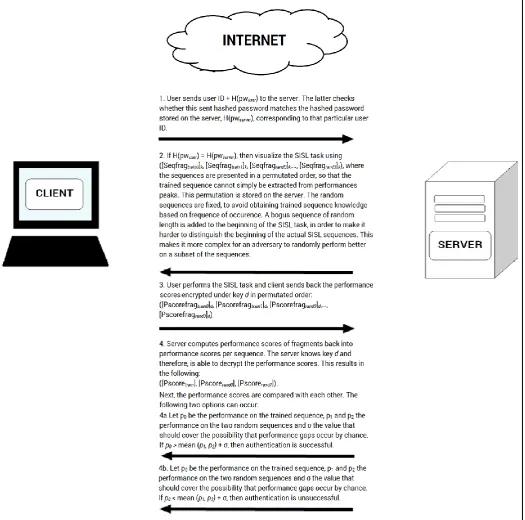
al. (2014). Below, the protocol is described and a schematic representation is given (see
Figure 5).
When the user first uses the SAS, a trained sequence and two random sequences need
to be created. This happens at the client-side, because the protocol is designed in such a way
that the sequences are never revealed in the clear to outsiders or the server. This is to prevent
from so called man-in-the-middle attacks (an attack in which data is intercepted during
transfer), such as eavesdropping (Yoon, Shin, Jeon & Yoo, 2010). To identify him- or herself,
the user needs to enter a user ID and a password, the latter is hashed by a hash function. A
hash function is a cryptographic function which outputs encrypted data, but is practically
impossible to revert (Dimitriou, 2005). Because of this, the password is never known by
anyone besides the user him- or herself. The client sends the user ID and hashed password to
the server, which then checks if this matches the hashed password that belongs to that
particular user ID stored on the server. If this matches, the server sends back an acceptance
code and the client gets permission to create the sequences. The sequences are all immediately
encrypted under key k, which is derived from the password that is entered by the user. The
creation of sequences happens only the first time, when the user becomes a trained user. The
system presents the user with the secret sequence and lets him or her train on this sequence.
After this, users enter their user ID and passwords in order for authentication to start.
Then, if a registered user wants to authenticate, the user enters a user ID and
password. The client computes a hashed password = h(pw), in which h() is a one-way hash
function. If the hashed password matches the one stored on the server for that user ID, then
the server sends the encrypted sequences that were stored during registration of that particular