© 2019, IRJET | Impact Factor value: 7.211 | ISO 9001:2008 Certified Journal
| Page 882
Experimental Investigation of an Activated Carbon-Methanol Solar
Powered Adsorption Refrigeration System Utilizing Metallic Additives
H. H. El-Ghetany
1, Wael I.A. Aly
2, Mohamed H. Ahmed
1, M. Helmy
11
Solar Energy Department, National Research Centre, Dokki, 12622, Giza, Egypt
2
Department of Refrigeration and Air Conditioning Technology, Faculty of Industrial Education,
Helwan University, 11282, Cairo, Egypt
.
---***---Abstract -
The present paper presents an experimental investigation of the thermal performance of solar powered activated carbon/methanol based adsorption refrigeration system working under the climate condition in Cairo, Egypt. Copper filings with mass concentration of 20% are utilized as a metallic additive to enhance the thermal performance of the system. Moreover, the effect of hot water flow rate is studied. Results indicated that the addition of 20 % metallic copper filings to the activated carbon lowered the evaporator temperature to reach -5 and -10 °C for heating water flow rates 3 and 2 LPM, respectively. Also, the addition of copper filing enhances the cycle COP of the system by 49% and 46% at hot water flow rates of 3 and 2 LPM, respectively. The highest cycle COP of the current system reached was 0.92 for the condition 20% additives at 2 LPM hot water flow rate.Owning the feature of great solar energy availability and the long daily sunny hours, solar-powered adsorption cooling systems have promising potential applications in EgyptKey Words: adsorption refrigeration, solar energy, activated carbon, metallic additives, COP
1. INTRODUCTION
The adsorption refrigeration system has received more attention and developed very fast in recent years. This system is considered as one of the renewable new technology for using solar energy at the refrigerating system that will be widely introduced to the industrial sector. The adsorption cooling cycles presented are similar to traditional systems, replacing the compression with an adsorption-desorption system. This type of cooling has certain advantages over prevailing systems, vapor compression system for refrigeration, because they do not generate noise, has a long functional life, low maintenance cost and utilizes low-grade waste heat or renewable energy as the main driving energy and thus have a large energy saving potential [1, 2]. An adsorption refrigeration system with activated carbon-methanol is considered one of the most promising refrigeration systems as it can be powered by low-grade temperature heat source, such as solar radiation. As the methanol has several advantages like the low freezing point, high latent heat of evaporation and noncorrosive to copper and steel at the working temperature below 100 °C make it reliable and working well with activated carbon. Due to the low-grade temperature utilization, solar energy can be
effectively utilized in such systems. Methanol system operation is based on an intermittent cycle, or single direction, where no heat recovery. The cycle consists of two phases: one characterized by the adsorption process, where there is evaporation of the working fluid (the adsorbate), and the other, regeneration of the porous medium (the adsorbent) by thermal conversion of solar energy in which the adsorbate is condensed. For cooling applications, the adsorbent must have high adsorptive capacity at room temperature and low pressure. Whereas the system must operate with negative temperatures for the production of ice, the activated carbon-methanol pair is the one with the best features for this purpose [3]. Li et al. [4] evaluated the performance of a solar-powered refrigeration system. The used a double flat-plate solar collector with an area of 1.5 m2. The generator was loaded with activated carbon (AC) and the evaporator was filled with methanol as a refrigerant. Quartz lamps were used to simulate solar. By exposing the solar collector to radiation of 28– 30 MJ, the refrigeration system was able to produce ice of 7–10 kg .
A small scale solar-powered adsorption refrigeration system was investigated by Khattab [5]. She designed, fabricated and tested a prototype in Cairo (30 °N). The locally produced activated carbon and methanol were used. Small pieces of blackened steel were used as a metallic additive to augment the heat transfer rate. The daily ice production was claimed to be 6.9 and 9.4 kg/m2 and COP was 0.13 and 0.159 for winter and summer climate, respectively. Ahmed and Abd-Latef [6] constructed solar adsorption system for ice production in remote areas with activated carbon-methanol and added reflector mirror to concentrate solar radiation on the adsorber bed. This reflector increased the regeneration temperature from 75 to 110 °Cat solar noon. They also improved the performance of the condenser by reducing the condenser through direct evaporating of water around the condenser; these modifications improved the cooling effect and produced 3.25 kg of ice /m2. Since the thermal conductivity value of activated carbon ranges from 0.17 to 0.28 W/m K, most of the researchers [7-12] classified activated carbon as “a non-thermally conductive material”, and found that combining the activated carbon with a suitable additive can increase its conductivity.
© 2019, IRJET | Impact Factor value: 7.211 | ISO 9001:2008 Certified Journal
| Page 883
alumina and activated carbon as an adsorbent. Four cases experiments were carried out; the generator was filled by 100% activated alumina, by a mixture of 75% activated alumina and 25% activated carbon, a mixture of 25% activated alumina and 75% activated carbon, and 100% activated carbon. The results show that the average COP of the investigated cases was 0.054, 0.056, 0.06, and 0.074, respectively. Results indicated that the pair of activated carbon and methanol is better than activated alumina. Wang et al. [14] presented a novel prototype of a solar adsorption refrigeration system with enhanced mass transfer based on an ideal basic solid adsorption refrigeration cycle with activated carbon-methanol as the working pair. They found the maximum COP and maximum ice-making capacity of the novel system were 0.142 and 7 kg, respectively. Moreover, they found that the average COP of the novel system showed an improvement of 35.9% compared with the average COP of the natural mass transfer adsorption refrigeration system when the input radiation energy was not less than 14.7 MJ.
Wang et al. [15] presented an experimental investigation of an activated carbon-methanol solar-powered adsorption refrigeration system with the enhancing desorption”, They performed some different comparative tests under different weather conditions to evaluate the system performance. They found that there is an improvement in the coefficient of performance, the mass of desorption and desorption rate, and the characters of the solar adsorption refrigeration system can be a benefit to further application.
The aim of this work is to investigate the daily average performance of a solar powered activated carbon/methanol based adsorption refrigeration system working under the real climate conditions of Cairo, Egypt. A novel design of the generator/ adsorbing bed will be applied and studied. Also, the effect of utilizing copper filings as a metallic additive to the activated carbon in the adsorbing bed on the thermal performance of the adsorption refrigeration system will be investigated. Moreover, the effect of the hot water flow rate on the generator temperature, evaporating temperature, and the overall system performance will be studied.
2. EXPERIMENTAL SETUP AND PROCEDURES
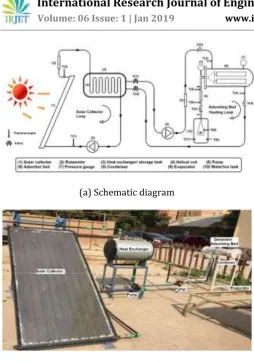
The activated carbon-methanol adsorption refrigeration system consists of three loops; the solar loop, the adsorbing bed heating loop, and the adsorption refrigeration cycle. A schematic diagram and a photographic view of the system are shown in Fig. 1. The solar loop consists of five main parts, the first one is the solar flat plate collector with 0.9 m width and 2.5 m height supported on a metallic frame structure facing south and has 30o tilt angle. Its absorber plate is made from copper tubes and embedded with copper fins along its 2.25 m2 area, this copper-to-copper configuration of the tubes and adjacent fins enhance the conductive heat transfer that has finally increased the thermal energy outlet from the collector. The second part of
the solar loop is the hot water circulating pump which is used to circulate the heat transfer fluid and overcome the pressure drop in the solar heating circuit. The third part is the heat exchanger/heat storage buffer tank which is responsible to exchange the thermal energy gained from the solar collector to the adsorbing bed heating loop. The function of the heat storage/buffer tank is to damp the effect of the unexpected change in climate condition which affects the cooling capacity and to enhance the system performance at late hours of the day via its thermal inertia [16]. The heat exchanger of the type shell-and-coil consists of a stainless steel inner tank of 50 liters capacity that has water quantity to be heated and circulated to the adsorbing bed heating loop via another circulating pump and the hot water outlet from the solar collector is passed through a helical copper coil where convective and conductive heat transfer mechanism is occurring. The heat exchanger raw materials are purchased and a rolling process is made to form the cylindrical shape and then by using the welding process, the inner vessel is formed. All the required inlet and outlet openings are made. The coil is made from copper tube which formed as a helical coil to increase the heat transfer surface area. A thick layer with 10 cm glass wool insulation is placed on the outer surface of the inner tank to minimize the heat losses to surrounding and finally, a galvanized steel sheet covered the insulation layer to form the final shape of the heat exchanger. The fourth part of the solar loop is the heat transfer fluid loop associated with the piping connection between the solar loop components. The heat transfer fluid in the current research is distilled water. While the fifth part of the solar loop is the measuring device to measure the total solar radiation falling on the collector surface by using digital solar pyranometer with spectral response: 400 to 1000 nm, solar range up to 2000 W/m2 and accuracy ± 5%.
The ambient temperature, the water inlet, and outlet temperature across the collector, heat storage buffer tank, and the adsorbing be shell, evaporator temperature, and water/ice temperature around the evaporator are measured using thermocouples type T and recorded using data logger. Also, the flow rate of the working fluid inside the solar loop and adsorbing bed loop are measured using rotameters with a range of 0-20 l/min and an accuracy of ±0.05 %.
© 2019, IRJET | Impact Factor value: 7.211 | ISO 9001:2008 Certified Journal
| Page 884
(a) Schematic diagram
(b) Photographic view
Fig. 1. Experimental setup
Also a backup electric heater is fixed in the shell to do the indoor experiments. A 3D schematic diagram for the novel design of the adsorbing bed is shown in Fig. 2(a). Moreover, Figs. 2(b-c) show photographs for the adsorbing bed assembly process and the used activated carbon and copper filings. It consists of four copper tubes of 2" diameter with 0.5 m length each. The activated carbon is placed inside these tubes, in the middle of these tubes a perforated copper tube of 3/4" is fixed, so the activated carbon is placed in the annular space between the two tubes while the heating via hot water will be on the outer surface of the activated carbon tube. The four tubes are welded together to produce one output tube to be connected to the condenser.
The present work studies the effect of using metallic additive items to enhance the thermal conductivity of the activated carbon ,therefore, another group of activated carbon tubes are prepared by adding 20% copper filings to investigate the improvement of heat transfer level on the cooling effect. The homogeneous activated carbon used in the system is of the elliptical shape with average dimension of 3mm x 4 mm. While the homogeneous copper filings grain size of elliptical shape with average dimension of 2mm x 4 mm. A metallic mesh with holes diameter less than the diameter of activated carbon and copper filings was put on
the inner surface of the perforated tube to prevent any parts to pass through the perforated tube. By this scenario, the gain of increasing the heat transfer area of the bed which
Fig. 2(a) Schematic diagram for the novel design of the adsorbing bed
[image:3.595.34.289.53.416.2] [image:3.595.312.556.140.329.2] [image:3.595.317.552.378.732.2]© 2019, IRJET | Impact Factor value: 7.211 | ISO 9001:2008 Certified Journal
| Page 885
Fig. 2(c) Photograph of the used activated carbon and copper filings
improves the thermal conductivity is more significant than the decrease of the quantity of activated carbon adsorbing area. During the test day, the glass tube evaporator is placed inside a cube of stainless steel with 10 cm insulation thickness. A thermocouple probe is fixed on the evaporator tube surface to measure the evaporator surface temperature. Moreover, two thermocouples are used to measure the water/ice temperature around the glass tube evaporator. The condenser is made of copper tube of 1" and the evaporator is made from a graduated glass tube of 1.5" diameter. The adsorber contains 1.3 kg of activated carbon (AC) and the evaporator contains (0.35 liter) of methanol . The natural convection air-cooled condenser is finned with a number of copper circular rings by welding with size of double the tube diameter to increase the heat transfer surface area. Pre-tests are carried out by using a plain tube as a condenser, then adding different numbers of rings (6, 8, and 10). It is found that the condenser with 8 rings provided the maximum condensate of desorbed methanol. Moreover, increasing the number of rings more than 8 has no significant effect. It is also observed that the plain tube condensed only half the methanol quantity.
3. RESULTS AND DISCUSSION
The behaviors of the solar adsorption cooling system were investigated experimentally through carrying out several tests under the real conditions of Cairo, Egypt (30.06° N, 31.23° E) during the period from June to August 2018. The experiments were classified into indoor and outdoor tests. Figure 3 shows the variation of the generator and the evaporator temperature with time through the adsorption and desorption processes, respectively, for the indoor experiment. From the figure it can be observed that the generator temperature increase from 25 to 89 °C with time, through 13 hours, as a result of the heating process. The adsorption process followed by the desorption process as the temperature of the evaporator decreases gradually due to the evaporation of the methanol.
Fig. 3. Adsorption and desorption temperature distribution variation in the indoor experiment
The evaporator temperature decreased from 28 to -1.5 °C through 12 hours.
[image:4.595.298.553.52.272.2] [image:4.595.307.560.595.775.2]© 2019, IRJET | Impact Factor value: 7.211 | ISO 9001:2008 Certified Journal
| Page 886
Fig. 4. Adsorption and desorption temperature distribution variation in the outdoor test rig with 0% metallic additives at hot water flow rate of (a) 2 LPM (b) 3
LPM
While in case of hot water flow rate of 2 LPM, the inlet hot water temperatures reach its maximum value of 85 °C as shown in Fig. 4(a). The evaporator temperature decreases at a high rate through the first two hours, then the rate became very low through the next two hours.
The effect of adding copper filings to the AC on the evaporator temperature is presented in Fig. 5. The effect of adding copper filings to the activated carbon with a ratio of 20 % is evident on the evaporator temperatures. The evaporator temperature decreased with higher rate compared to the 0% metallic additive case. Where the evaporator temperature decrease from 20 to 1.8 ° C through the first two hours, then decreased with a low rate to -5 °C through the next two hours. The figure shows that, increasing the mass flow rate of the hot water from 2 LPM to 3 LPM results in a decrease in the adsorption bed temperatures. This affects the evaporator temperature where the minimum evaporator temperature decreased from -5 to -10 °C for hot water flow rate ranges from 2 LPM to 3 LPM, respectively.
Fig. 5. Adsorption and desorption temperature distribution variation in the outdoor test rig with 20% metallic additives at hot water flow rate of (a) 2 LPM (b) 3
LPM
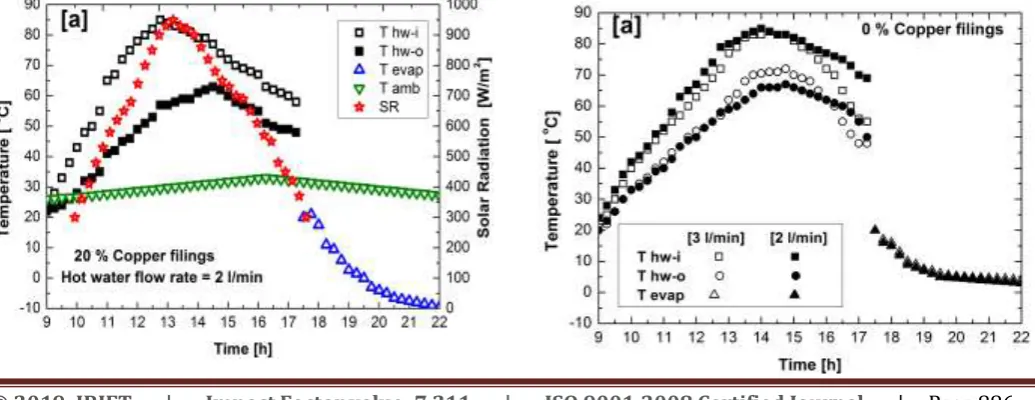
The effects of the hot water flow rate on the outlet temperature from the absorber bed are illustrated for 0 and 20 % copper filings additives in Fig. 6. It can be seen that the hot water inlet temperature to the adsorption refrigeration system has a higher value with a low flow rate of 2 LPM than that of 3 LPM. Consequently, the evaporator temperature value is lower for the case of low flow rate than that of the higher flow rate.
[image:5.595.41.559.585.785.2]© 2019, IRJET | Impact Factor value: 7.211 | ISO 9001:2008 Certified Journal
| Page 887
Fig. 6. Comparing the temperature distribution variation in the outdoor test rig with (a) with 0%
metallic additives (b) 20% metallic additives
Fig. 7. Comparing the evaporating temperature distribution variation in the outdoor test rig with and without metallic additives at flow rates of 2 LPM and 3
LPM
The performance of the adsorption refrigeration system is evaluated by estimating the coefficient of performance (COP). The COP is calculated using the following equation:
0
0
, , ,
cycle f
cycle
cycle f
cycle
t
cw p w w fg i p i i t
evap
cycle t
gen
hw hw hw t
m c T h c T dt
Q COP
Q
m c T dt
(1)
Where 0 cycle
t and tcyclef denote to the beginning and the end of
cucle time, Qevap is the total heat extracted in the evaporator from water to convert to ice where m represents the mass,
cp is specific heat, ΔT is temperature variation and hfg is latent heat of solidification; w and i refer to water and ice, respectively. It should be highlighted that, in Eq. (1), the electrical consumption of hot water pump is small and thus neglected; and Qgen denotes the total heat absorbed in the adsorber bed via hot water.
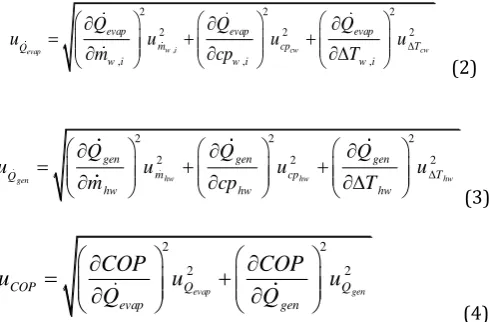
Based on the measurements of different variables, the uncertainties in the measurement of the cooling capacity, the heat absorbed by adsorbing bed/ generator, and the COP were calculated using the method described in details in [17]:
,
2 2 2
2 2 2
, , ,
w i cw cw
evap
evap evap evap
m cp T
Q
w i w i w i
Q Q Q
u u u u
m cp T
(2)
2 2 2
2 2 2
hw hw hw
gen
gen gen gen
m cp T
Q
hw hw hw
Q Q Q
u u u u
m cp T
(3)
2 2
2 2
evap gen
COP Q Q
evap gen
COP
COP
u
u
u
Q
Q
(4)The accuracy of the thermocouple was ±0.1 K. The maximum uncertainty of the temperature difference was 0.14 K. The uncertainties of the temperature dependent thermophysical properties 0.12 %, and mass flow rate 2.5%. Therefore, the maximum uncertainties of the cooling capacity, heat transfer rate to the generator and COP were evaluated to be 2.0%, 2.87% and 3.5%, respectively.
[image:6.595.42.281.340.519.2]© 2019, IRJET | Impact Factor value: 7.211 | ISO 9001:2008 Certified Journal
| Page 888
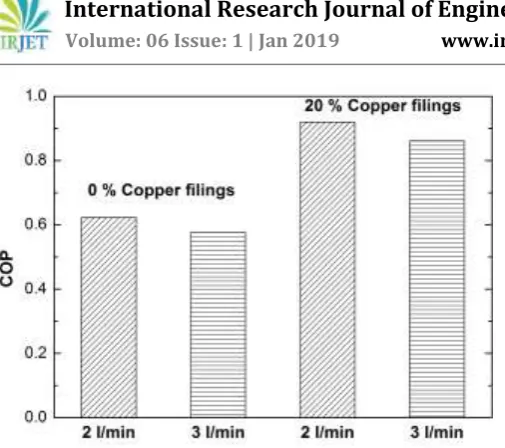
Fig. 8. The effect of metallic filings additives on the coefficient of performance of performance at different
flow rates
4.
CONCLUSIONS
In this paper an experimental test rig was installed and a prototype of a new design for the solar powered adsorption cooling system was manufactured and tested with two flow rates of heating water. Also, different experimental tests were carried out with and without adding copper filings as a metallic additive to the adsorbent material. The main conclusions can be summarized as follows:
Decreasing the hot water flow rate for the desorption process without metallic additives has a small effect on the performance of the cooling unit where the minimum evaporator temperature reached was 3 °C.
Adding 20 % of metallic copper filings to the activated carbon proved good performance and a significant decrease in the evaporator temperature where the minimum evaporator temperature recorded values of -5 and -10 °C for heating water flow rates 3 and 2 LPM, respectively.
Without metallic additives, the cycle COP of the system improved from 0.577 to 0.623 with decreasing the heating water flow rate from 3 LPM to 2 LPM, respectively.
Addition of 20 % copper filings to the activate carbon increased the cycle COP of the system to 0.86 and 0.92 for hot water flow rates of 3 and 2 LPM, , respectively.
Owning the feature of great solar energy availability and the long daily sunny hours, solar-powered adsorption cooling systems have promising potential applications in Egypt.
NOMENCLATURE
REFERENCES
[1] N.V. Ogueke, E.E. Anyanwu. Design improvements for a collector/generator/adsorber of a solid adsorption solar refrigerator. Renewable Energy. 33 (2008) 2428-40. [2] A.A. Askalany, M. Salem, I.M. Ismail, A.H.H. Ali, M.G. Morsy. A review on adsorption cooling systems with adsorbent carbon. Renewable and Sustainable Energy Reviews. 16 (2012) 493-500.
[3] A.P.F. Leite, M. Daguenet. Performance of a new solid adsorption ice maker with solar energy regeneration. Energy Conversion and Management. 41 (2000) 1625-47.
[4] M. Li, R.Z. Wang. Heat and mass transfer in a flat plate solar solid adsorption refrigeration ice maker. Renewable Energy. 28 (2003) 613-22.
[5] N.M. Khattab. A novel solar-powered adsorption refrigeration module. Applied Thermal Engineering. 24 (2004) 2747-60.
[6] M. Ahmed, M. Abd-Latef. Experimental study for the performance of modified solar ice maker. J App Sci Res. 8 (2012) 4645e55.
[7] H. Kuwagaki, T. Meguro, J. Tatami, K. Komeya, K. Tamura. An improvement of thermal conduction of activated carbon by adding graphite. Journal of Materials Science. 38 (2003) 3279-84.
Ac solar collector surface area (m2) cp specific heat capacity (J kg-1 k-1) hfg latent heat of fusion (J kg-1) m' mass flow rate (kg s-1) Qevap cooling capacity (W)
Qgen heat absorbed in adsorber bed (W) SR intensity of solar irradiance (W m-2) t time (s)
T temperature (oC) Greek Symbol
difference Acronyms
AC activated carbon
COP coefficient of performance LPM liter per minute
Subscripts c collector e evaporator g generator hw hot water
cw cold/chilled water i ice
© 2019, IRJET | Impact Factor value: 7.211 | ISO 9001:2008 Certified Journal
| Page 889
[8] X.H. Li, X.H. Hou, X. Zhang, Z.X. Yuan. A review on development of adsorption cooling—Novel beds and advanced cycles. Energy Conversion and Management. 94 (2015) 221-32.
[9] X. Py, E. Daguerre, D. Menard. Composites of expanded natural graphite and in situ prepared activated carbons. Carbon. 40 (2002) 1255-65.
[10] Z. Tamainot-Telto, R.E. Critoph. Monolithic carbon for sorption refrigeration and heat pump applications. Applied Thermal Engineering. 21 (2001) 37-52.
[11] L.W. Wang, S.J. Metcalf, R.E. Critoph, Z. Tamainot-Telto, R. Thorpe. Two types of natural graphite host matrix for composite activated carbon adsorbents. Applied Thermal Engineering. 50 (2013) 1652-7.
[12] L.W. Wang, J.Y. Wu, R.Z. Wang, Y.X. Xu, S.G. Wang, X.R. Li. Study of the performance of activated carbon–methanol adsorption systems concerning heat and mass transfer. Applied Thermal Engineering. 23 (2003) 1605-17.
[13] H. Ambarita, H. Kawai. Experimental study on solar-powered adsorption refrigeration cycle with activated alumina and activated carbon as adsorbent. Case Studies in Thermal Engineering. 7 (2016) 36-46.
[14] Y. Wang, M. Li, X. Ji, Q. Yu, G. Li, X. Ma. Experimental study of the effect of enhanced mass transfer on the performance improvement of a solar-driven adsorption refrigeration system. Applied Energy. 224 (2018) 417-25. [15] Y. Wang, M. Li, W. Du, X. Ji, L. Xu. Experimental investigation of a solar-powered adsorption refrigeration system with the enhancing desorption. Energy Conversion and Management. 155 (2018) 253-61.
[16] I.I. El-Sharkawy, H. AbdelMeguid, B.B. Saha. Potential application of solar powered adsorption cooling systems in the Middle East. Applied Energy. 126 (2014) 235-45. [17] J. Holman. Experimental methods for engineers. Eighth ed. McGraw-Hill, New York, 2012.
BIOGRAPHIES
Hamdy El-Ghetany is a Professor of Solar Energy, Head of Solar Energy Department, National Research Centre, Cairo, Egypt. Dr Hamdy awarded his doctoral degree graduated from Tohoku University, Japan 2000. He has an extensive experience in the field of mechanical engineering for 32 years either academically or professionally. Professionally, he is an electromechanical designer and reviewer for the pipe lines, storage tanks, heat exchanger, water treatment and solar energy systems of several projects. Academically, he is recognized both internationally and nationally in the area of solar energy applications. He is the author of more
than 40 scientific research articles published in leading international journals and international and national conferences.
Wael Aly, is an Associate Professor and the head of the Refrigeration and Air-Conditioning Technology Department, Faculty of Industrial Education, Helwan University, Cairo, Egypt. He obtained his B.Sc. (1994) in Mechanical Power Engineering from Benha University, Egypt and M.Sc.(1997) from Eindhoven University, The Netherlands. He obtained also the PhD (2007) from Okayama University, Japan. He has about 30 papers in the fields of Thermofluids, RHVAC, and CFD.
Mohamed H. Ahmed received the B.Sc. degree in mechanical power engineering from the Faculty of Engineering, Cairo University in 1990. He received the M.Sc. degree and the Ph.D. degree in mechanical power engineering (heat transfer & solar energy) from the Faculty of Engineering, Cairo University in 1997 and 2003, respectively. He is an associate professor in Solar Energy Departments, National Research Center, Giza, Egypt and he works as a researcher. His researches include solar drying, cooling, energy storage and solar thermal power plant.