A Thesis Submitted for the Degree of PhD at the University of Warwick
http://go.warwick.ac.uk/wrap/36865
This thesis is made available online and is protected by original copyright. Please scroll down to view the document itself.
Shakespeare in Thailand
by
Paradee Tungtang
A thesis submitted in partial fulfilment of the
requirements for the degree of
Doctor of Philosophy in Theatre Studies and Translation
Studies
School of Theatre, Performance and Cultural Policy
Studies, University of Warwick
Table of Contents
Page
Table of Contents i
List of Illustrations v
Acknowledgements xi
Declaration xiii
Abstract xiv
Preface xvi
Introduction 1
Part One: Translating Shakespeare in Thailand
Chapter I Shakespeare’s Introduction to Thailand: An Overview 39 King Vajiravudh and His Literary and Dramatic Activities 45 Chapter II An Analysis of King Vajiravudh’s Translations and
Adaptations of Shakespeare
57
Basic Thai Verse Types 59
Case Study: Phraya Ratchawangsan, King Vajiravudh’s
Adaptation of Shakespeare’s Othello
70
Phraya Ratchawangsan’s characters and plot summary 76 Staging Phraya Ratchawangsan in the Siamese dance drama style 79 Phraya Ratchawangsan following the convention of Siamese
dance drama
84
Introductory word use 86
Types of Bot (passages of narration) in Siamese dance
drama scripts
89
Part Two: Staging Shakespeare in Thailand
Chapter III Shakespeare in the Dichotomy of Thai Theatre 108 Shakespearean productions in the Siamese court tradition
(1910-1930)
109
Shakespeare on the Elizabethan and Jacobean Stage: the popular
tradition
113
The Dichotomy of Theatre and Dramatic Aesthetics 116 The Dichotomy of Thai Theatre and Dramatic Aesthetics 121 Shakespeare and the Dichotomy of Thai Theatre 125 Chapter IV Classical Forms of Siamese Traditional Drama 128
Lakhon nai 138
Lakhon nok 139
Characteristics and Basic Elements of Siamese Dance Drama:
Forming Thai Dramatic Tastes
142
Music 144
Players 145
Settings and costumes 146
Playscripts and common plots 147
Characters 152
The Siamese popular audience 153
Chapter V Transformation of Thai Theatre from Traditional Dance Drama to Spoken Drama
156
Lakhon Dukdamban 158
Lakhon Phan Thang 162
Lakhon Rong 164
Introduction of Lakhon Phud (Spoken Play) by King Vajiravudh 167 Chapter VI The Development of Thai commercial theatre and
modern drama after the major political revolution in 1932
169
Historical Background 169
Lakhon rong and commercial theatre in Thailand 181 Modern drama and university drama: the new beginning of
modern day commercial theatre
186
Chulalongkorn University 186
Thammasat University 191
Commercial Theatre in Thailand from the 1980s to the present day 193 Chapter VII Shakespeare on the Public Stage in Thailand 197
Staging Shakespeare in the Thai Commercial Theatre in the 20th
Century
197
Macbeth the Traitor: Phagawalee Theatre Troupe (Approx.
1947-1956)
202
Hamlet the Musical: Troupe 28 (1995) 208
Chapter VIII Shakespearean Productions in Thai University Theatres
221
Chulalongkorn University productions
Hunsa Ratree (Twelfth Night production in 1989)
Tam Jai Tan (As You Like It productions in 1991 and 1993)
Ratree Nimit Klang Kimhun (A Midsummer Night's Dream
production in 1997)
Payu Pirote (The Tempest production in 2007)
221 223 229 234
240
Thammasat University productions 250
Chapter IX Shakespeare in Thai Popular Culture and Thai Mass Media in the Late 20th and the early 21st Centuries
260
What is Shakespeare doing in Thai contemporary popular culture? 260
Likayand its dramatic elements 270
Chapter X Thai Popular Soaps and the Use of Allusions to Shakespeare
283
Soap operas in Thai society 283
The Use of Shakespeare’s Plots in Thai Soap Operas 298 The Use of Allusions to Shakespeare in Thai Soap Operas 309
Bibliography 328 Appendix
Chronology of Shakespeare Translations in Thailand 348 Chronology of Shakespeare Productions in Thailand 353 Shakespeare as a major influence on King Vajiravudh’s literary
works
List of Illustrations
Page Figure 1. Promotional poster for Hamlet: the Techno Drama (4-15
March 2009, at the New Theatre Society and Crescent Moon Space,
Bangkok, Thailand).
http://www.wikalenda.com/Hamlet-The-Techno-Drama-050622.html
[Accessed on 20 May 2009].
xviii
Figure 2. Shylock from Shakespeare’s The Merchant of Venice and Jujaka Brahmin from Vessantara Jataka.
http://www.pbs.org/wgbh/masterpiece/merchant/ei_shylock.html and
http://www.oknation.net/blog/print.php?id=302962 [Accessed on 15
October 2010].
xxvii
Figure 3. King Vajiravudh of Siam (1881-1925).
http://commons.wikimedia.org/wiki/File:King_Vajiravudh_portrait_phot
ograph.jpg [Accessed on 2 February 2007].
46
Figure 4. The first edition of Tam Jai Tan, King Vajiravudh’s translation of Shakespeare’s As You Like It.
55
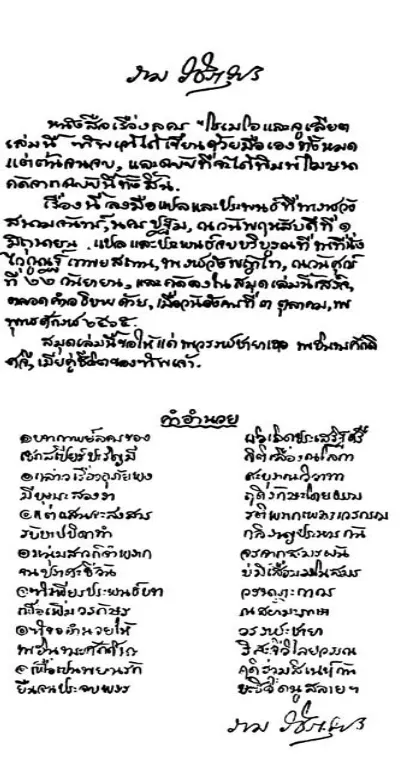
Figure 5. King Vajiravudh’s preface (written in both prose and verse forms) in his own handwriting, to his translation of Shakespeare’s Romeo
and Juliet.
http://www.kingvajiravudh.org/main/images/stories/saranukrom/p101
[Accessed on 27 January 2010].
70
Mattani Ratnin, ‘Laksana Thai: Sillapa karn sadaeng’ [Thai Characters:
Performing Arts], Laksana Thai [Thai Characters], ed. by Kukrit Pramoj
and Ni-on Sanitwong na Ayuthaya, Thai Texts, (Bangkok:
Thaiwattanaphanit, 2008), p. 68.
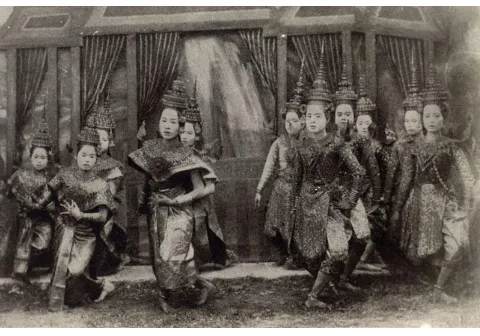
Figure 7. A scene from Ramakien (Indian Ramayana) in the form of lakhon dukdamban.
Mattani Ratnin, ‘Laksana Thai: Sillapa karn sadaeng’ [Thai Characters:
Performing Arts], Laksana Thai [Thai Characters], ed. by Kukrit Pramoj
and Ni-on Sanitwong na Ayuthaya, Thai Texts, (Bangkok:
Thaiwattanaphanit, 2008), p. 77.
161
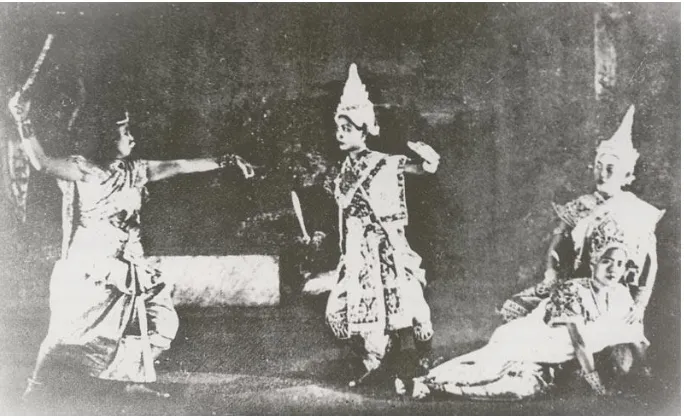
Figure 8. A production of The Arabian Nights in a form of lakhon phan thang.
Mattani Ratnin, ‘Laksana Thai: Sillapa karn sadaeng’ [Thai Characters:
Performing Arts], Laksana Thai [Thai Characters], ed. by Kukrit Pramoj
and Ni-on Sanitwong na Ayuthaya, Thai Texts, (Bangkok:
Thaiwattanaphanit, 2008), p. 95.
163
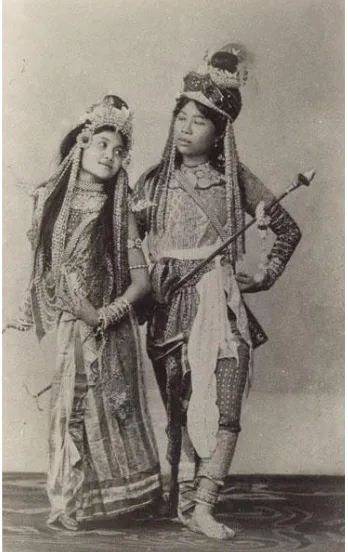
Figure 9. A production of Sao Khrua Fah (an adaptation of Madame Butterfly) in a form of lakhon rong.
Mattani Ratnin, ‘Laksana Thai: Sillapa karn sadaeng’ [Thai Characters:
Performing Arts], Laksana Thai [Thai Characters], ed. by Kukrit Pramoj
and Ni-on Sanitwong na Ayuthaya, Thai Texts, (Bangkok:
Thaiwattanaphanit, 2008), p. 95.
166
Figure 10. King Vajiravudh in one of his lakhon phud productions. Mattani Ratnin, ‘Laksana Thai: Sillapa karn sadaeng’ [Thai Characters:
Performing Arts], Laksana Thai [Thai Characters], ed. by Kukrit Pramoj
and Ni-on Sanitwong na Ayuthaya, Thai Texts, (Bangkok:
Thaiwattanaphanit, 2008), p. 140.
Figure 11. Sarunyoo Wongkrajang in Hamlet the Musical.
Jukkrit Duangpatra, Plae, Plang, Lae Prae roop bot lakhon [Translation,
Adaptation, and Transmutation of Literary Works], Thai Texts
(Bangkok: Sum Nak Pim Siam, 2001), p. 43.
214
Figure 12. Chulalongkorn University’s production of Hunsa Ratree. Jukkrit Duangpatra, Plae, Plang, Lae Prae roop bot lakhon [Translation,
Adaptation, and Transmutation of Literary Works], Thai Texts
(Bangkok: Sum Nak Pim Siam, 2001), p. 52.
226
Figure 13. Malvolio (played by Chonprakal Chandrueng), Olivia and Maria in Chulalongkorn University’s production of Hunsa Ratree.
Jukkrit Duangpatra, Plae, Plang, Lae Prae roop bot lakhon [Translation,
Adaptation, and Transmutation of Literary Works], Thai Texts
(Bangkok: Sum Nak Pim Siam, 2001), p. 52.
229
Figure 14. Production of Tam Jai Tan [As You Like It] by a cast of professional actors (in the illustration, Sarunyoo Wonkrajang as Orlando,
Lalita Panyopas as Rosalind, Nussaba Vanit-ungkool as Celia) in 1991.
Jukkrit Duangpatra, Plae, Plang, Lae Prae roop bot lakhon [Translation,
Adaptation, and Transmutation of Literary Works], Thai Texts
(Bangkok: Sum Nak Pim Siam, 2001), p. 27.
230
Figure 15. Chulalongkorn University’s production of Ratree Nimit Klang Kimhun [A Night’s Dream in a Midsummer] in 1997.
Jukkrit Duangpatra, Plae, Plang, Lae Prae roop bot lakhon [Translation,
Adaptation, and Transmutation of Literary Works], Thai Texts
(Bangkok: Sum Nak Pim Siam, 2001), p. 50.
Figure 16. Ratree Nimit Klang Kimhun [A Night’s Dream in a Midsummer], Chulalongkorn University Production, Act 5 Scene 1.
Ritirong Jiwakanon, ‘Ratree Nimit Klang Kimhun: Costume Design
under Thai Cultural Context’, Humanities and Social Sciences Journal,
Thai Texts, 19 Volume 4, July-September 2002 (Khon Kaen: Khon Kaen
University Press, 2002), p. 20.
239
Figure 17. Miranda and Ferdinand in Payu Pirote (The Tempest), Chulalongkorn University Production in 2007.
http://thaitempest.multiply.com/ [Accessed on 30 September 2007].
247
Figure 18. Prospero and Caliban in Payu Pirote (The Tempest), Chulalongkorn University Production in 2007.
http://thaitempest.multiply.com/ [Accessed on 30 September 2007].
248
Figure 19. Stephano and Trinculo in Payu Pirote (The Tempest), Chulalongkorn University Production in 2007.
http://thaitempest.multiply.com/ [Accessed on 30 September 2007].
250
Figure 20. Thammasat University Production of Mongpa Maha Burut [The Great Man Mongpa], an adaptation of Shakespeare’s Macbeth, in
1982.
Jukkrit Duangpatra, Plae, Plang, Lae Prae roop bot lakhon [Translation,
Adaptation, and Transmutation of Literary Works], Thai Texts
(Bangkok: Sum Nak Pim Siam, 2001), p. 125.
Figure 21. Thammasat University Production of Fun Khong Juliet [Juliet’s Dream], inspired by Shakespeare’s Romeo and Juliet in 1994.
Jukkrit Duangpatra, Plae, Plang, Lae Prae roop bot lakhon [Translation,
Adaptation, and Transmutation of Literary Works], Thai Texts
(Bangkok: Sum Nak Pim Siam, 2001), p. 90.
258
Figure 22. Traditional likay costumes.
Mattani Ratnin, ‘Laksana Thai: Sillapa karn sadaeng’ [Thai Characters:
Performing Arts], Laksana Thai [Thai Characters], ed. by Kukrit Pramoj
and Ni-on Sanitwong na Ayuthaya, Thai Texts, (Bangkok:
Thaiwattanaphanit, 2008),p. 162.
278
Figure 23. Rak Nai Roi Kaen [Love in Vengeance] poster (1993). 299 Figure 24. The climax from Rak Nai Roy Kaen (1993). Still from the
television drama Rak Nai Roy Kaen.
303
Figure 25. Cast from the Thai soap Taddao Bussaya (2009). 308 Figure 26. Scenes from Shakespeare’s Romeo and Juliet portrayed in the
Thai soap Chao Sao Klua Fon (2004). Still from the television drama
Chao Sao Klua Fon.
313
Figure 27. Rehearsal of a scene from Shakespeare’s Romeo and Juliet in the Thai soap opera, Sakoonka (2009). Still from the television drama
Sakoonka.
315
Figure 28. A scene from Shakespeare’s Romeo and Juliet in the Thai soap opera, Sakoonka (2009). Still from the television drama Sakoonka.
317
television drama Jan Aey Jan Jao.
Figure 31. A scene (Shakespeare’s The Merchant of Venice, Venice Court scene) from Jan Aey Jan Jao (2006). Still from the television
drama Jan Aey Jan Jao.
321
Figure 32. A death scene from Shakespeare’s Romeo and Juliet in Thai soap opera, Baan Sai Thong (2000). Still from the television drama Baan
Sai Thong.
ACKNOWLEDGEMENTS
It is my great pleasure to convey my sincere gratitude to those who made this thesis possible. Without their valuable guidance, contribution and support in a number of ways, this study would never have been completed.
First and foremost, my deepest gratitude to my supervisor, Dr. Margaret Shewring whose kindness, guidance and encouragement I will never forget. I am grateful in every possible way for Dr. Shewring having accepted me to be under her supervision when I was transferred from the Centre of Translation and Cultural Studies to the Department of Theatre and Performance Studies during my final year of study. I would definitely be lost without her. I have also benefited by her extraordinary experiences and expertise in the subject as she provided me with valuable sources of materials, apart from her moral support in various ways during my writing-up period. I could not wish for a better or friendlier supervisor.
I also owe my sincerest gratitude to Dr. Lynne Long, my first supervisor at the Department of Translation and Cultural Studies for her advice and guidance from the very early stage of this study. With her patience and knowledge whilst allowing me some room to work in my own way, it enabled me to develop an understanding of the subject. I grew up a lot and learned a lot from her. Without Dr. Long, this thesis, too, would not have been completed.
I am indebted to Associate Professor Jukkrit Duangpattra, for his expertise in Thai Drama. Despite the distance, he has offered much advice and insight throughout my work and kindly provided invaluable copies of translated manuscripts of Shakespeare’s works by many Thai translators. Also, I am heartily thankful to Associate Professor Nopamat Veohong and Assistant Professor Sorawanee Sukhumwat for not only giving me an opportunity to interview them personally but also kindly providing me with copies of their translated manuscripts of Shakespeare’s plays.
I would also like to acknowledge the SOAS library (School of Oriental and African Studies, University of London), National Library of Thailand, libraries and rare book collections at Chulalongkorn University and Thammasat University on where most of my valuable materials are based. Thanks all librarians for their advice and their willingness to help providing and finding documents I needed.
I also would like to give special thanks to Mr. Narupon Sonsri and his family for their kind hospitality. Without him being my best friend, I could not have been through such a hard time in the completion of this research work. Also without him providing some research materials I needed from Thailand and accommodation in Bangkok, I could not have obtained all the relevant information I needed for my writing.
I would like to thank my colleagues and teaching staff in the Faculty of Humanities and Social Sciences, Khon Kaen University, for always encouraging me to pursue professional growth and for giving me moral support.
I would also like to thank Mrs. Ruth Grafton and Miss Jane Grafton wholeheartedly for accepting me to be ‘part of the family’. With their friendship and kind hospitality during my stay in the UK, I learned a great deal about English culture and English people. It is one of the nicest feelings to feel at home here and to know that I always have a family I can lean on.
Last but certainly not the least, this thesis is dedicated to my family in Thailand – my parents, my sister and her family – who have always believed in, stood by and given me the strength to go on with their unconditional love and support throughout my life. With their love, I survive.
Paradee Tungtang
DECLARATION
“I hereby declare that this submission is my own work and that, to the best of my
knowledge and belief, it contains no material previously published or written by
another person nor material which has been accepted for the award of any other
degree or diploma of the university or other institute of higher learning, except
where due acknowledgment has been made in the text”
Paradee Tungtang
ABSTRACT
TITLE Shakespeare in Thailand AUTHOR Paradee Tungtang SCHOOL
School of Theatre, Performance and Cultural Policy
Studies, University of Warwick
Unlike most Asian nations to which Shakespeare was imported with the
colonizers during the mid-1800s to impose Western literary culture on the
colonized, in the case of Thailand, it is the other way round. Thailand (or Siam as
it was called then) managed to escape colonization by Western powers, but during
this politically unstable period, Siam felt the urgent need to westernize the
country. A period of intensive westernization thus began. Shakespeare arrived as
one of several significant elements of the nation’s self-westernization in literary
education. In 1916, the name of Shakespeare became widely known in Siam as
one of his plays, The Merchant of Venice, was translated by King Vajiravudh
(1881-1925), who is highly regarded as a prolific dramatist and all-around man of
letters in the country. The King himself initiated Western literary translation by
translating three plays by Shakespeare, namely The Merchant of Venice (1916),
As You Like It (1921), and Romeo and Juliet (1922), and also by adapting
Shakespeare’s Othello (1925) into a Siamese conventional dance drama playtext.
Although there were some other attempts before and after the King to translate
Shakespeare, none of them has been successful in leaving a memorable impact in
Thai literary circles as much as the King’s version. Translating and staging
Shakespeare’s works in Thailand became rare, practised only within a small circle
of literary scholars. During the first few decades of the twentieth century, there
have been a handful of attempts to translate and stage Shakespearean plays by
commercial Thai theatre practitioners. To stage Shakespeare’s plays in Thailand
similar difficulty, that of bridging the gap to bring Shakespeare to Thai popular
audiences who embrace different backgrounds in dramatic practice and aesthetics.
The main purposes of this study are, therefore, to examine how
Shakespeare has been translated, staged, and received by Thai readers and
audiences from the late nineteenth century when Shakespeare was introduced in
Siam until today, and to locate his influences and impact on Thai literary and
theatrical culture. This study is designed to shed light on the history of Thai
translations of Shakespeare and also to provide an analysis of the translation
strategies adopted by early Thai translators to domesticate Shakespeare into the
Thai context. So the thesis examines the process of text appropriation and
domestication adopted by Thai translators and theatre practitioners to make
Shakespeare accessible to Thai readers and popular audiences. The use of
Shakespeare’s plots and allusions to Shakespeare’s plays in contemporary Thai
television soap operas is also another main focus of the study. This study also
suggests that the domestication process applied to Shakespeare both in translation
and in staging is influenced by the changes in the social, political and aesthetic
contexts of each different period; furthermore, the process of domestication
obviously becomes less problematic the further the country moves towards
Preface
We can perhaps more usefully think of Shakespeare
as a kind of engine of cultural appropriation.
Anthony B. Dawson
‘For God’s sake, we go to a [Buddhist] temple not a church, how on earth
is it possible that we will understand Shakespeare? [My translation]’1 Such an
astute comment made by Pichet Klunchun, one of the most renowned
contemporary Thai stage performers, who is both a well-trained traditional Thai
dance dramatist and an independent dance company director, is hardly to be
ignored. This is particularly the case when such a comment comes from one
among a very few Thai performers who has extensive experience of performing in
many intercultural theatre projects, including some Asian Shakespeare
productions, outside his native country.2 Despite his performing background
playing major roles in some adaptations of Shakespeare’s work, Pichet3 expresses
his disappointment regarding the fact that most stage productions in Thailand,
mainly for marketing reasons, are likely to opt for staging ‘big-name’ western
1
Santi Taepanit, ‘Interview with Pichet Klunchun’, Tua Ku Khong Ku [Me and Myself], Thai Texts (Bangkok: Hui Lae Hui Press, 2009), p. 23.
2
Pichet Klunchunperformed the role of Gertrude in Ong Keng Sen’sintercultural Shakespeare’s adaptation, ‘Search: Hamlet’ in Denmark from August to Septemberin 2002and performed a leading role in the contemporary dance adaptation of
Shakespeare's The Tempest’, deconstructed by internationally-renowned
choreographersMarcia Haydee and Ismael Ivo, in Bangkok, Thailand, 13-14 January 2004.
3
plays, including Shakespeare’s, rather than newly-creating their own innovative
productions. He also suggests that Thai audiences are somehow ‘fooled’ by the
so-called ‘international culture’, which is actually a part of a global marketing
strategy, into believing that Shakespeare is the world’s greatest dramatist whose
works they must see at least once in their lifetime. ‘But do we understand him?
No, because every aspect of our [dramatic culture] is different from those of
Shakespeare’s’ [My translation].4
According to Pichet’s viewpoint, Shakespeare in Thailand is like a
signpost for being civilised and intellectualised according to Western standards.
Some Thai audiences may want to see Shakespearean productions in order to
acquire a sense of being ‘high-class’, exhibiting their ostensibly refined dramatic
tastes, without any profound understanding of Shakespeare’s dramatic philosophy
or of his artistic expressions. Although productions of Shakespeare’s work, both
traditional stagings and innovatively experimental projects, occur in vast numbers
around the globe, his work is only staged sporadically in Thailand. His name,
which is usually regarded globally as a strong selling-point, hardly has the same
effect in this country. On the other hand, Shakespeare’s reputation and his iconic
literary image may cause some Thai audiences to shy away from the theatre. In a
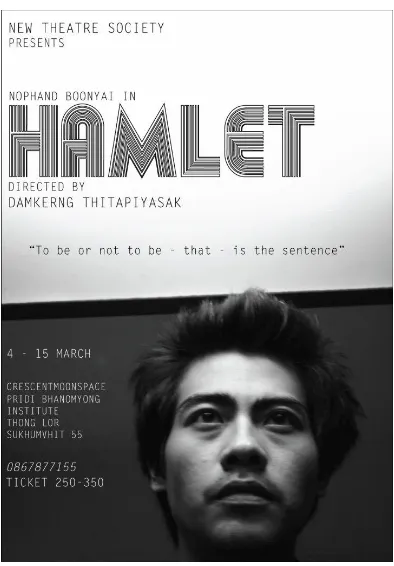
recent stage production of a Thai Shakespearean adaptation of Hamlet: the Techno
Drama (2009), the director Damkerng Thitapiyasak admits that in terms of public
relations and marketing plans, Shakespeare’s name is not the selling point when
compared to the famous name of his leading actor.5 This is probably the main
4
Taepanit, p. 23.
5
Interview with Damkerng Thitapiyasak, the director of Hamlet: the Techno Drama
reason why in the promotional posters, apart from the play’s title in the biggest
characters, the names of the actor, the director, and the theatre company are
shown in big letters, while the name of ‘the world’s greatest playwright’
[image:20.595.213.410.218.501.2]disappears completely.
Figure 1 – Poster of Hamlet: the Techno Drama (2009), an adaptation of Shakespeare’s Hamlet performed solo by Nophand Boonyai
Shakespeare’s plays, especially when adapted and staged in the Thai
language, are commonly rendered in archaic words and sometimes in very strict
Thai traditional poetic forms, in order to maintain a sense of the ‘Shakespearean
rhetorical style’. There are no records of productions in Thailand that have staged
the whole of any of Shakespeare’s original plays without massive scene deletions
and lines being cut or condensed; for when Shakespeare’s plays are rendered in
Thai poetic forms, they could become double the length of the original scripts.
Most Thai translators have attempted to keep the essence of Shakespeare’s
original linguistic style by imitating or even inventing appropriate archaic
language. Use of poetic words based on the Pali and Sanskrit languages is a
common practice. Translating ‘the world’s greatest poet’ thus becomes an activity
confined within a very small circle of Thai scholars whose excellent knowledge of
the English language seems insufficient to claim creditability in translating
Shakespeare. They are required, indeed expected, to have demonstrated their
rhetorical aptitude; in other words, they are asked to prove themselves to be poets
in order to be able to translate Shakespeare.Furthermore, faithfully translating the
texts written by world-wide famous writers is the way in which Thai translators
can show respect for the source texts. Wit Siwasariyanon, a Thai literary scholar
and translation critic, points out that the reputation of the writers of the source text
is a crucial factor in deciding how the texts will be treated in the translated
version. If the source texts are merely general texts written by a common writer,
the translators might feel that they are given some space to exercise their artistic
license by arranging, deleting, or editing the text the way they think it is
appropriate in the target language. On the other hand, if the texts are written by
world-wide famous writers (such as Shakespeare, Tolstoy and Rabindranath
Tagore), editing the texts is regarded as showing no respect to the great writers;
such practice is unacceptable in the Thai literary circle.6
6
Quoted in Natthawan Anusasanan, ‘Translation techniques in Romeo and Juliet
Shakespeare, therefore, is hard not only when he is read in his original old
English language, but he is equally hard to understand in most Thai translated
versions. Pawit Mahasarinand, the director of a recent Thai Shakespeare
production of Payu Pirote [The Tempest] in 2007, recalled that one of his
audience said that seeing his Shakespeare production, even though it was in the
Thai language, gave the exact same impression as seeing a foreign film so that:
‘subtitles would be preferable’.7 However, some modern Thai dramatists agree
that Shakespeare should not be too easy to understand as it is a good thing to let
the audiences strain a little to understand the words of the great poet. If to get to
the essence of Shakespeare’s plays means that the audiences have to struggle ‘a
little’ with his words, then one might also query whether Shakespeare without his
language is still Shakespeare, when many sources seem to suggest that the real
dramatic essence of Shakespeare’s plays lies solely in the richness of his
language. What do we say about those productions of Shakespeare presented in
the forms of silent films and ballets in the West or dance drama in some Asian
countries?8 How is it possible for Shakespeare to fit into the dramatic culture –
the Thai dramatic tradition, in particular – in which words are regarded as less
significant than visual elements?
Like other Asian countries, Thailand (formerly known as Siam before the
political revolution in 1932) has its own rich dramatic culture in which theatre
performance has been created and shaped within the frame of social and religious
7
Interview with Pawit Mahasarinand, the director of Payu Pirote (translated from Shakespeare’s The Tempest), on 25 January 2007.
8
See more in Kevin J. Wetmore, ‘Samritechak and Intercultural Shakespeare in
norms. The indigenous form of Siamese drama is developed from the dance
drama tradition which James R. Brandon calls ‘total theatre’ in the sense that all
performance aspects are fused into a single form.9 The perfect balance among its
dramatic components is the essence of its dramatic style. Apart from that, Siamese
theatre serves mainly to entertain its ‘viewers’ visually rather than orally. Visual
impression is the core of artistic creation which Siamese drama aims to achieve.
Moreover, staged performances are more likely to be seen as part of a festive
occasion. Siamese people are not regular theatre-goers as in the Western sense.
Before the advent of commercial theatre in the late-nineteenth century, stage
performing was occasional, and to be an artist was not regarded as a serious
occupation. As is usual for celebrations and festive events, theatre performance is
deemed to have no responsibility to serve as a means for community education,
nor do native audiences go to theatre seeking for intellectual enlightenment.
Performance is purely to entertain and may, by chance, demonstrate some social
and moral norms which conform to Buddhist doctrines. In order to fit
Shakespearean theatre and Western dramatic philosophy into this Thai dramatic
scenario, a wide gap has to be filled and extensive adaptation has to be
undertaken.
As in many other countries in Asia, Western entrepreneurs and colonial
administrations brought popular forms of Western arts, including literature and
theatre, into Siam. However, unlike most other Asian nations, Siam has never
become a Western colony. The country managed to get through the peak
9
politically-threatening period of colonization and maintain its national
sovereignty. Nevertheless, the impact of colonization could not possibly be
avoided for a defenceless nation. Siam had to westernize itself in order to show to
the Western powers that the country was on its way to civilization according to
Western standards. Studies of Western literature and translations of Western
classics were then naturally embraced as a part of this self-westernization plan.
Due to the fact that Siam was not an official Western colony, the freedom to select
what did and what did not fit into its indigenous culture through educational
reformation was wider than that of formal Western colonies. As the main
objective was to give the impression of Western civilization, the study of Western
culture was not taken seriously nor was it deep. Western culture, including
Western languages, literature and drama, became an exotic sign of modern fashion
and the symbol of good taste, while at a deeper level, the essence of ‘Thainess’
and Siamese aesthetics were still the core of most cultural practices.
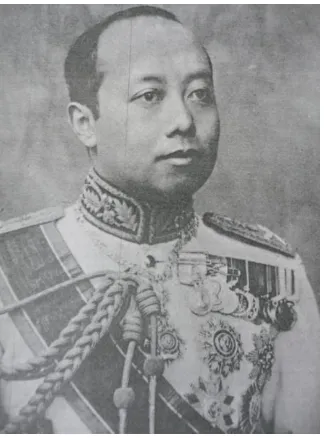
Shakespeare was first introduced in Siam around a century ago by the
most important figure of the nation at that time, King Vajiravudh of Siam
(1881-1925).10 After many years of education in England, King Vajiravudh had
developed his ardent passion for Western literature and its arts of theatre. When
he returned to Siam, along with his state duty as the leader of the nation, the King
demonstrated his artistic interests as an enthusiastic literary translator and
dramatist. Translating three of Shakespeare’s plays, adapting one play of
Shakespeare into a Siamese traditional dance drama playscript and being inspired
10
by some of Shakespeare’s plots and rhetorical style to develop his own dramatic
creations, the dramatic works of the King, especially his translations of
Shakespeare, are regarded as some of the best examples of translation practice.
His translations set a high standard for later-generation translators who may want
to try their hand translating Shakespeare. The King’s works are famous and
widely read so that, to some extent, the King’s name overshadows that of the
original playwright; his translated works ostensibly become ‘original’ in their own
right and are studied nowadays as classic pieces of Thai literature. That
Shakespeare has become the most popular and best-known name among other
Western writers in Thailand today owes much to the fact that his name was
closely associated with the King as one of the King’s favourite writers.
The image of the old Siam, particularly during the period of the advent of
pre-westernization in the mid-nineteenth century, was introduced world-wide and
perceptions of its life were coloured by the huge success of Rogers and
Hammerstein’s Broadway musical, The King and I, in 1951. Inspired by the
memoirs of Anna Leonowens, an English teacher who taught English in King
Mongkut's court in the 1860s, the musical (later produced in a film version in
1956 and in a remade, non-musical version called Anna and the King in 1999) has
had a huge impact on Siam and the Siamese image in Western perspectives. For
Western audiences, Siam was portrayed as a land full of wonders, enchantment
and peculiarities. With an exotic, oriental beauty presented through its people,
costumes, a golden palace, and a huge Buddha image in The King and I, Western
audiences have formed some fixed attitudes about this small country in the Far
the films11 are renowned worldwide, the Thai government banned these shows
and every version of its cinematic incarnation.12 Thai authorities had complained
that The King and I and the film versions have several scenes that distort Siamese
history and insult the King (King Mongkut of Siam) by presenting the Siamese
monarch and the King as a buffoon and denigrating Thai culture as inferior to
Western. Thus, the film(s) were declared illegal under a 1930 law of ‘lese
majeste’ prohibiting filmmakers from portraying the Thai monarchy in a
disrespectful way.13 In Western perspectives, the action of the Thai government
may seem to be ‘a somewhat ludicrous overreaction’14 for such an issue as
film-making but, on a deeper level, the banning was an act to prevent the spread of
some sensitive political confusions and offences regarding the highest institution
and the symbolic head of the country – the Thai monarchy.
The production of The King and I, for Western theatre practitioners, was
perhaps created without a malicious political intention. In fact, it was common
practice for dramatists in every dramatic culture to find new sources of exotic
ingredients to spice up their theatre productions. A taste of exotic culture seen
through unusual costumes and make-ups, bizarre actions and gestures of the actors
(who were, of course, non-natives of the original culture being portrayed), and
11
Including the 1956 Yul Brynner movie, the 1999 animated feature, and the 1999 remade version starring Jody Foster as Anna Leonowens.
12
Noy Thrupkaew, ‘The King and Thai: A Contested History Gets the Royal Treatment’,
The American Prospect, Vol. 8, Issue 14, September 2003 <http://wwww. questia.com> [accessed January 2007], para. 3 of 10.
13
Carol Divjak and Peter Symonds, ‘Why are the Thai authorities so sensitive about Anna and the King?’, World Socialist Website,
<http://www1.wsws.org/articles/2000/apr2000/thai-a03.shtml> [accessed 5 February 2011] para. 3-9 of 26.
14
glamorous scenes and settings have been sought after by Western dramatists for a
long period of time. Madame Butterfly, The King and I, and Miss Saigon are a few
examples of these ‘exotic’ oriental tastes in Western theatre productions. All of
them portray the picture of the East through Westerners’ eyes. In Siamese theatre,
this practice was also common, starting from adapting folk-tales from neighboring
countries in the region into traditional Siamese dance drama and developing into
adapting Western plays and their theatrical style to shape modern Thai drama
today. However, this theatrical practice, when presented without careful thought
and consideration, can somehow result in a misunderstanding between two
cultures; it may widen the gap and draw the distinctive line between the ‘us’ and
the ‘other’. The image of Siam seen through the perspective of the non-native
Western producers may not be completely accurate, especially when it is seen
through the eyes of native audiences. The King and I was hugely successful and
entertaining to watch by Western audiences as it depicted the story of a Western
teacher and her civilizing influence on a savage king.15 But for Thai audiences, it
was difficult to embrace the distorted image of the highly-respected King
Mongkut (who, in reality, spent 27 years as a devoted Buddhist monk and was
nearing 60 when Anna worked for him) sharing a secret love interest with and
being politically advised by an English woman.16
Similarly, when it comes to staging Shakespeare’s plays by Thai
dramatists, the process of selecting some ‘exotic’ Western materials which were
appropriate and conformed to Thai cultural aspects was completely dependent on
15
Thrupkaew, para. 4 of 10.
16
Thai perspectives. Shakespeare as Thai audiences see him is, of course, different
from Shakespeare as seen from Western audiences’ perspectives. Thai people
always find their own way to adapt all kinds of foreign influences making them
more Thai. Philip Cornwel-Smith marks his observation in Very Thai: Everyday
Popular Culture saying that, ‘Thai things have less to do with things than with an
attitude towards them: an aesthetic, a palette, a line, all conveyed with a blend of
serenity and fun. Anything given time enough to steep here can end up very
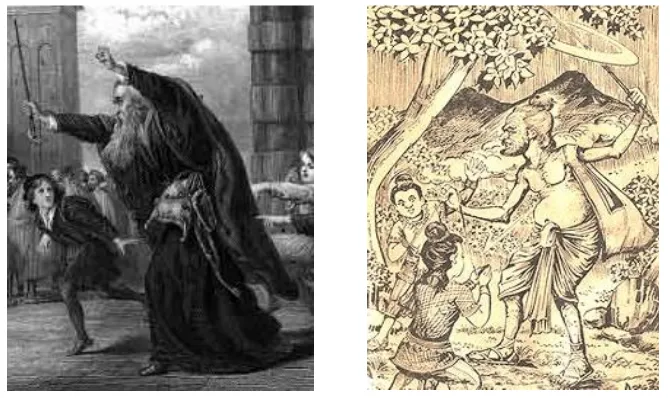
Thai.’17 Translating and staging Shakespeare are of course no exception. Staging
Shakespeare’s The Merchant of Venice in the traditional Thai dramatic style is a
good example. The role of Shylock in particular, when performed by a Thai actor
trained in the dance drama tradition, becomes something very different from the
original script. The Thai interpretation of the role of Shylock originated when the
play was performed in the early twentieth century by court dance dramatists.
There is a story that circulated within a circle of traditional dance dramatists that
the role of the Thai Shylock was firstly performed by a local dance drama master
who based the character of Shylock on the famous character of Jujaka, a greedy
old Brahmin beggar from Vessantara Jataka – the story of Buddha’s past life
(which is very well-known to most Buddhist Thai audiences). Shakespeare’s
Shylock who was a rich but mean Jewish moneylender, therefore became a
guileful, ill-mannered and disgusting villain. When performed by a student from
the Thai Dance Academy School Theatre Troupe in 1990, the Thai Shylock
somehow still showed his unmannerly behaviour by getting into the habit of
17
scratching his body (his bottom, his neck, his head, etc.) while conversing with
other characters, to give an impression to the audiences that he was a
[image:29.595.142.477.170.369.2]discourteous, filthy old man.
Figure 2 – Shylock from Shakespeare’s The Merchant of Venice and Jujaka Brahmin from Vessantara Jataka
Study of Shakespeare in Thailand is still mainly limited to students who
study English language and English literature as their majors. Translations of
Shakespeare’s plays, particularly the versions translated by King Vajiravudh, are
more commonly known as some of them are studied in Thai literature courses in
compulsory education. The study of Shakespeare, including translating and
staging Shakespeare in Thai, is apparently slight, especially from the perspective
of Thai literary and dramatic studies. The main purpose of this study, therefore, is
to give historical background and contextual understanding to the translating and
staging of Shakespeare in Thailand. It also highlights some questions and issues
related to literary translating and staging practices, all of which inspire this
in the first place?’; ‘What sort of domestication (sometimes replaced by the terms
transformation, adaptation, recreation) strategies have been adopted by the
translators to make Shakespeare’s plays less foreign in their translations?’; ‘What
is the most appropriate relation of ‘Shakespeare’ to indigenous performance
traditions?’; ‘What impact has Shakespearean drama had on Thai literary and
theatrical cultures?’; ‘What are the response and reception of Thai readers and
audiences to Shakespearean dramatic style?’ The thesis aims to examine how
Shakespeare’s work has been translated, produced, and received in Thailand both
as literary texts and dramatic performances since the pioneering attempt in the
1900s to the present day, and also to provide an analysis of the translation
strategies adopted by early Thai translators in the process of domesticating
Shakespeare into the Thai context. The history of Thai Shakespeare theatrical
performances, including both adapted and so-called ‘authentic’ versions, is
chronologically listed and delineated, with special focus on some very recent
stage productions in the Thai commercial theatre. Apart from an essential
knowledge of Thai traditional drama which can lead to a general comparison
between Shakespearean drama and Thai drama, the study also concentrates on the
use of allusions to Shakespeare’s plays and the exploitation of Shakespeare’s
dramatic plots in the modern Thai mass media. This is all done in the hope of
shedding light on the future of Shakespearean activities in Thai literary and
Theories and Research Methodology
Translation theories
By the time that Shakespeare was introduced into Siam in the
late-nineteenth century, writing in narrative prose style was not recognized and not
regarded as a proper form of literary writing in Siam. Siamese writers and readers
were used to writing and reading poetic narrative tales in which the writers were
required to follow strict literary conventions. Translating Shakespeare was no
exception. His works were, therefore, adapted by using Siamese traditional poetic
forms. In other words, at the beginning of his journey into Siamese literary circles,
Shakespeare was completely transformed into a style of Siamese traditional
writing which concealed his true literary identity. To provide analytical comment
for the translation strategies adapted by Thai translators in translating
Shakespeare’s works, some translation theories are selected as the framework of
this research, including polysystem theory, skopos theory and the concept of
translation as rewriting. The thesis is based on the ideology that a translation is
not the transcoding of words at a lexical level from one language into another, but
an intricate form of cultural implantation. The translator acts as a medium in a
multi-level approach to transfer information from a source text, influenced by his
linguistic background and socio-cultural context, and tries to maintain both word
and sense of the original as far as possible. In translating a literary text, which is
itself created and conditioned by a particular socio-cultural context, the translator
must see some relation between the source culture and his own target culture.
decides on which texts should be translated and which should not. In other words,
the selection of source texts to be translated depends on the purpose of the
translator; moreover, his translation strategies are influenced by various
socio-cultural factors from each different period.
Drama theories
Staging Shakespeare’s plays in Thailand is another main focus in this
thesis. The thesis provides an explanation of the Thai (Siamese) traditional dance
drama from which Thai dramatic culture has shaped itself, the transformation of
traditional dance drama and the influence of Western dramatic style, Shakespeare
and his influence in Thai dramatic transformation, a historical review of
Shakespeare productions staged in Thailand, and the use of Shakespeare and
allusions to his works in Thai popular culture. This thesis also discusses the
position of Shakespeare, who is central to the Western literary canon, in
contemporary Thai popular culture. To analyse the Thai entertainments both
traditional and contemporary forms, background knowledge of Thai dramatic
context has to be provided. In Thailand, the division of dichotomous sets between
‘High’ and ‘Low’ cultures is distinctive. Evolving through different socio-political
settings of the nation in different periods, Thai dramatic convention has always
been divided into two groups, mainly based on the social status of the target
audience. Although the dichotomous sets are referred to differently in different
periods as Court versus Popular, Urban versus Rural, Central versus Periphery,
the target audiences of each set always stay the same in terms of social class being
front row of the ‘High’ literary and dramatic culture, in spite of the fact that his
plays are well-equipped with excellent dramatic elements which are totally suited
to Thai popular culture. This thesis thus tries to demonstrate that by side-lining
Shakespeare’s fame and canonical image, Thai audiences belonging to the
so-called ‘Low’ culture can also appreciate his plays from the context of all sorts of
contemporary popular media.
On the subject of staging Shakespeare’s plays in Thailand, the concepts of
drama adaptation and cultural aesthetic theory are used as the foundations of the
content analysis. The thesis supports the ideology that artistic aesthetics, that is
the perception of beauty in the arts which is sometimes referred to as ‘artistic
taste’, is what people enjoy at any particular period and that it can be influenced
and newly-shaped when alterations in political, social and cultural factors take
place. This research disagrees with the concept of an absolute set of aesthetic
standards which can be applied universally to works of art in different societies. In
creating artistic products for mass target audiences, in theatre for instance,
dramatists need to take into consideration the target audiences’ artistic taste in
order to live up to audiences’ expectation. Those dramatists may sometimes have
to compromise their own artistic tastes. Hence adaptation and appropriation play
a vital role, especially in the staging of foreign plays.
Staging Shakespeare’s plays in modern Thai society is more challenging
and innovative than the staging of his plays in the past when dramatic
appropriation techniques were practised intensively to make Shakespeare less
foreign to the Thai audiences’ perception. But since the country has also been
gradually lessened in all aspects of life including theatrical practices. Thai
audiences, especially those of Western education and familiar with the
Western-influenced entertainment in metropolitan Bangkok, no longer expect much help
from the production team to bridge the cultural gap between West and East; on the
other hand, they are more open to new theatrical practices, including new
interpretations and presentations of Western classics. However, bearing in mind
that the target audience who would be willing to pay for tickets to see a
Shakespeare production in Thailand is restricted, most production teams still have
to overcome a similar difficulty, that of bringing Shakespeare down from his
sacred altar to make his work accessible to broader Thai audiences, most of whom
still embrace their different cultural background in dramatic conventions and
taste.
This study is based largely on documentary research and personal
interviews. The collections of Shakespeare translations in Thai by different
translators, both published and unpublished, are examined. While part of the
documentary research was done at the University of Warwick and in the SOAS
Library (School of Oriental and African Studies) of the University of London,
further archival research and interviews with translators and theatre practitioners,
who have recently translated and staged Shakespeare’s plays, have been
conducted in Thailand. Some translated Shakespeare scripts, which have not yet
been published but which were used to stage commercial productions, have also
been consulted. Likewise, stage productions even though they are practised by an
amateur theatre group (e.g. some university productions in Bangkok) are also
created by academics for educational purposes, mainly for teaching, are excluded
Introduction
One of the most difficult words to define in the contemporary literary
world is the word „Shakespeare‟, not because we know so little about the man to
whom the name refers, but because the knowledge we have accumulated about
him is too vast and too profound. Despite the fact that scholars today are left with
very scarce historical evidence relating to Shakespeare‟s original works and his
personal life, Shakespeare is still the subject of numerous detailed studies. No
other writer in the world has been written about as much as Shakespeare has. The
word „Shakespeare‟ represents multi-layered meanings which vary from person to
person across different parts of the globe. In England, Shakespeare-upon-Avon
can simply refer to a local boy from the small village of Stratford who earned his
living and made his name in show business by acting and writing playscripts in
the Elizabethan and Jacobean periods. The journey has taken four hundred years
to transform him from a plausibly forgotten Elizabethan poet to a deified literary
figure
.
He is, as Thomas Carlyle (1840) puts it in simple terms, „the Peasant WhoBecame a Prophet‟.1 The word „Shakespeare‟ in contemporary recognition also
refers to a subject of study in Western Literary Classics, which is established at all
levels of education ranging from primary school to university level. In an abstract
literary sense according to Shakespeare enthusiast and writer Stanley Wells in
Shakespeare for All Time, the word may also refer to „an impression of the
1
constantly evolving mind and imagination from which all the works emanated‟.2
In the hybrid, intercultural theatre of the twenty-first century, Shakespeare can
also be referred to as a brand name or a marketing gimmick in the „Bardmart‟
theatre business. Among these countless representations of the word, perhaps the
best definition of the word „Shakespeare‟ in contemporary perception is by
Jonathan Bate in the introduction to his book Soul of the Age: The Life, Mind, and
World of William Shakespeare:
[Shakespeare means] a body of words, characters, ideas and stage images that
have remained alive for four centuries because of their endless capacity for
renewal and adaptation through the work of succeeding generations of actor and
spectators, appreciative readers, and creative artists in every conceivable
medium.3
Shakespeare at the Centre of the Western Literary Canon
Whatever sense the name Shakespeare may represent to different people,
Shakespeare is commonly accepted as one of the best known writers to grace the
planet. Today, in readers‟ and audiences‟ perceptions, Shakespeare‟s name
becomes synonymous with „great literature‟, in the same manner that the name
„Einstein‟ is synonymous with „great intelligence‟ or „genius.‟ Shakespeare‟s
name has been the most referenced, the most cross-referenced, the most analyzed,
2
Stanley Wells, Shakespeare for All Time (London: Macmillan, 2002), p. 169.
3
Jonathan Bate, Soul of the Age: The Life, Mind, and World of William Shakespeare
the most written about, and his plays have been the most performed.4 Despite very
scant historical evidence, every tiny segment of his works, not to mention his
personal life, is investigated and analysed from various perspectives in every
possible field of study. This is not only in language and literary studies but from
the study of education to psychology. Shakespeare has secured his position as the
global literary icon and has become his nation‟s pride, representing English
culture and language. G.B. Harrison declares boldly that Shakespeare, as
generally acknowledged, symbolizes English culture: „no household in the
English-speaking world is properly furnished unless it contains copies of the Holy
Bible and of The Works of William Shakespeare. […] They must be presented as
symbols of Religion and Culture.‟5
Shakespeare has been credited for centuries as the writer who has achieved
greatly in promoting English language and culture. Numerous expressions in
English derive from, and have their origins in, his works. He has also been a
source of aesthetic pleasure and intellectual stimulus to millions of readers and
audiences around the world for four centuries.6 His works have influenced writers
and artists of every generation; and the influence is not, of course, confined only
within his own country but has spread to every corner of the world where the
English language is learned and spoken. His plays, both in English and in
translated languages, are central to the international theatrical repertoire and are
performed around the globe in countless local dialects. Ben Crystal records in his
4
Ben Crystal, Shakespeare on Toast: Getting a Taste for the Bard (London: Icon Books Ltd., 2008), p. 32.
5
recent book Shakespeare on Toast: Getting a Taste for the Bard that at the
Edinburgh Fringe Festival in 2007, which ran for only 22 days, there were over 30
productions, either of Shakespeare‟s plays or of shows that used Shakespeare‟s
plays as a starting point.7 Modern forms of media – pop music, films, musicals,
and television series – still carry his name for marketing purposes; his words are
quoted in numberless movie and television scripts and song lyrics. To name a few,
Elvis quotes him in his No. 1 hit „Are You Lonesome Tonight?‟; also in a very
recent hit modern musical production, „Legally Blonde the Musical‟, his name
and his words are quoted in the last scene of the show. The record also shows that,
in 2005 alone, there were sixteen films made of his plays.8
Many Shakespeare scholars try to fathom the singular excellence of
Shakespeare – the difference in kind as well as in degree – which makes him
stand out from all other writers. How did Shakespeare become „the Bard‟ as we
know him today? The answers, of course, vary. In The Western Canon: the books
and school of the ages, Harold Bloom suggests that the outstanding qualities of
Shakespeare which place him at the centre of the Western canon lie within three
significant areas: his cognitive acuity, his linguistic energy, and his power of
invention.9
His cognitive acuity – in other words, his understanding of human nature –
is often mentioned as the first and foremost reason for Shakespeare being placed
at the centre of the Western canon. Though it may sound like a cliché,
6
Wells, Shakespeare for All Time, p. 403.
7
Crystal, p. 8.
8
Shakespeare exceeds all other Western writers in his profound understanding of
human nature. An influential English poet, John Dryden, calls him the poet who
„had the largest and most comprehensive soul‟.10 Samuel Johnson, in his preface
to the Shakespeare of 1765, also calls him „the poet of nature, the poet that holds
up to his readers a faithful mirror of manners and of life‟.11 These notions reflect
Shakespeare‟s stories and plots which could be shared in a heart felt manner by all
human beings across language boundaries. As Stanley Wells puts it, Shakespeare
generally writes about
things that matter to most people in most places at most times, they give classic
dramatic and poetic expression to great commonplaces of human existence – love
and friendship, hatred and malice, family relationships, parting and reunion,
success and failure, loneliness and community, joy and grief, aggression and fear,
good and bad government of both the self and the commonwealth.12
Another Shakespeare scholar, Laurie Maguire, furthers this view in her
recent book Where There’s A Will, There’s A Way. She writes that each of
Shakespeare‟s plays depicts a human predicament and attempts a solution so
readers and audience can easily relate to Shakespeare as they see some parts of
themselves encounter similar dilemmas in their lives and find the ways to deal
9
Harold Bloom, The Western Canon: the books and school of the ages (New York and London: Harcourt Brace, 1994), p. 46.
10
Wells, Shakespeare for All Time, p. 206.
11
Bloom, p. 63.
12
with them as do most of Shakespeare‟s characters.13 Through Shakespeare‟s
plays, Maguire notes, „[we] hear their expression of our pain‟.14 This outstanding
quality of Shakespeare‟s stories certainly creates the ease of transference across
boundaries. In other words, Shakespeare, as in his contemporary socio-cultural
context, claims multi-cultural accessibility and universality due to his ability to
get to people‟s hearts and souls across language, cultural and national boundaries.
Through Shakespeare‟s plays audiences, despite their diverse cultural
backgrounds, can easily see themselves through his characters. As Bloom records:
Students and friends have described for me Shakespeare as they have seen him in
Japanese, Russian, Spanish, Indonesian, and Italian, and the general report has
been that the audiences were as one in finding that Shakespeare represented them
upon the stage.15
Apart from Shakespeare‟s outstanding insight, Bloom continues to
illustrate Shakespeare‟s linguistic power, which among Western writers, „has no
equal‟.16 It is hard to deny that Shakespeare has a vital influence in English
language development. Francis Meres praised him highly as a significant poet by
whom „the English tongue is mightily enriched and gorgeously invested in rare
13
Laurie Maguire, Where There’s A Will, There’s A Way (London: Penguin Group, 2006), p. 2.
14
Maguire, p. 194.
15
Bloom, p. 51.
16
ornaments and resplendent habiliments‟.17 It has been calculated that Shakespeare
uses an exceptionally large vocabulary of between 20,000 and 30,000 words.18
Many of them are Shakespeare‟s original inventions which are still used today.
Shakespeare is also renowned for his mastery of blank verse. His poetic signature
– Shakespearean blank verse as we commonly call it – is an outcome of his
lifetime of creation and of the continual development of his exercising of blank
verse. If we are to compare his mastery in blank verse with a weapon – perhaps a
firearm – the real bullet would definitely be his figurative language. His use of
figurative language is distinctive. Bloom is convinced that, „no more awesome
panoply of metaphor exists‟.19 During Shakespeare‟s time most plays, including
Shakespeare‟s, had to make use of Latin tags and references to Latin literature.
Latin, at that time, was regarded as a more developed language than English;
therefore it was an important requirement for educated scholars and writers to be
fluent in the language. In writing, most Elizabethan scholars and writers would
create their metaphor by drawing most of their images from Latin classics.
Shakespeare‟s metaphorical style is, however, different. His rhetorical style
consists largely of an individual use of myths, symbols, and images; all of which
mostly spring from his own personality, life experience, and his power of
representation of human character.20 This would not have been possible, had he
not been immensely interested in, and an observer of, human behaviour.
Shakespeare, though a less learned poet, is far more original in illustrating images
17
Quoted in Wells, Shakespeare for All Time, p. 147.
18
Wells, Shakespeare for All Time, p. 147.
19
than elite authors of his time. His brilliant use of figurative language makes him
stand out from other well-read poets. Without the need for the audience to refer
back to Latin classics in order to understand the images, Shakespeare‟s figurative
language can be vividly visualized and understood. Perhaps this explains why
audiences from different circles, not to mention different parts of the world, can
easily embrace Shakespeare‟s figurative images.
For Shakespeare‟s devoted fans, high praises are also aimed at his
unmatched ability of story invention. Although some of Shakespeare‟s plots were
apparently borrowed from Greek and Latin classics, Shakespeare innovatively
adapted them all to suit his audiences‟ dramatic tastes. While most playwrights of
his time held firmly onto the Greek dramatic model, for example the Aristotelian
rules for tragedy which Sir Phillip Sidney explained, „The stage should always
represent but one place, and the uttermost time presupposed in it should be, both
by Aristotle‟s precept and common reason, but one day‟, Shakespeare chose to
ignore them and searched for his own innovative ways to represent the old
stories.21 Shakespeare, in contrast, set most of his stories in diverse settings and
places in a broad span of time. It is very less likely that Shakespeare was not
aware of these rules, than that he ignored them, suggests Fintan O‟Toole. This was
„because they [the rules] were not good enough to deal with the complexities of
the world he was living in.‟22 Shakespeare‟s inventions of exceptional and
memorable characters are in particular the focus of attraction and admiration.The
20
Harrison, p. 24.
21
Quoted in Fintan O‟Toole, Shakespeare is hard but so is life: A radical guide of Shakespearian Tragedy (London and New York: Granta Books, 2002), p. 18.
22
characters that Shakespeare creates portray realistic human representations which
are open to the audiences so that they explore the characters‟ psychological sides.
Shakespeare‟s representation of characters, according to Bloom, „gives us a
stronger illusion that each character speaks with a different voice from the others
[…] His uncanny ability to present consistent and different actual-seeming voices
of imaginary beings stems in part from the most abundant sense of reality ever to
invade literature.‟23 In the article „Shakespeare in a Strange Land‟, Todd London
furthers Bloom‟s observation on Shakespeare‟s outstanding invention of his
characters by adding that the significant quality which makes these characters so
true to life is not only that each of them sounds clearly distinctive from one
another, but also the sense that they „appear to be self-conscious – as if able to
“overhear” themselves.‟24 The ability of „self-overhearing‟ of the characters
allows the access of multiple perspectives, which become analytical instruments
for judging oneself. Bloom goes on illustrating how different types of audience
could feel specially connected to Shakespeare‟s particular characters:
If you are a moralist, Falstaff outrages you; if you are rancid, Rosalind exposes
you; if you are dogmatic, Hamlet evades you forever. And if you are an
explainer, the great Shakespearean villains will cause you to despair. 25
23
Bloom, p. 64.
24
Todd London, „Shakespeare in a Strange Land‟, in American Theatre, Vol. 15, Issue 6, July-August 1998 <http://www. questia.com> [accessed 15 August 2008]
25