
Effect of evening primrose oil on biochemical
parameters of thoroughbred horses under maximal
training conditions
K. Mikešová
1, H. Härtlová
2, L. Zita
3, E. Chmelíková
2, M. Hůlková
2,
R. Rajmon
21Department of Microbiology, Nutrition and Dietetics, Faculty of Agrobiology,
Food and Natural Resources, Czech University of Life Sciences Prague, Prague, Czech Republic
2Department of Veterinary Sciences, Faculty of Agrobiology, Food and Natural Resources,
Czech University of Life Sciences Prague, Prague, Czech Republic
3Department of Animal Husbandry, Faculty of Agrobiology, Food and Natural Resources,
Czech University of Life Sciences Prague, Prague, Czech Republic
ABSTRACT: The antioxidative effect of evening primrose oil (EPO) administration on the oxidative stress of race horses during their regular training period was determined. The eight-week experiment was performed on ten clinically healthy thoroughbred horses. All the horses were enrolled in a regular training program. Eight weeks before the experiment, the horses were fed a diet which remained the same for the following eight weeks, only supplemented with 150 ml EPO (blood samplings 3 times). Total antioxidant reactivity (TAS), thiobarbituric acid reacting substances (TBARS), uric acid (UA) levels, activities of muscle enzymes – aspartate aminotransferase (AST), creatine kinase (CK), and parameters of fatty acid metabolism such as triacylglycerols (TAG) and nonesterified fatty acids (NEFA) were determined. Average values of TAS after supplementation with EPO rose gradually and were detected at significantly higher levels (P ≤ 0.05) in the sixth week in com-parison with the control. The concentration of malondialdehyde, measured as TBARS, decreased significantly (P ≤ 0.05) compared with the untreated control. The activities of AST and CK fluctuated, but no disturbance was demonstrated in muscle homeostasis. The present results indicate that the total antioxidant activity of the thoroughbred horses fed a diet supplemented with EPO was higher, and it helped stabilize the permeability of the muscle cell membranes in the horses at full workload.
Keywords: horse training program; oxidative stress; tissue damage; antioxidative effect
INTRODUCTION
Physical exercise increases tissue demand for oxygen and cell respiration, resulting in the gen-eration of free radicals and reactive oxygen spe-cies (Jenkins 1998). Overproduction of oxidants exceeding the cellular antioxidant capacity results in oxidative stress (Gomes et al. 2012). Oxidative stress leads to tissue damage of a wide range of biomolecules and causes metabolic changes that consequently influence performance (Kirschvink et al. 2002). To protect against oxidative stress, the body has an effective antioxidant defence system,
including non-enzymatic and enzymatic compo-nents (Deaton and Marlin 2003; Kinnunen et al. 2005; Shaliutina-Kolesova et al. 2013).
Mof-farts et al. 2005; Hartlova et al. 2008). Human, as well as veterinary medicine, is currently focused on natural substances with a distinct antioxida-tive effect. One of these is oil from Oenothera biennis – evening primrose. The effect of evening primrose oil (EPO) on oxidative stress includes the inhibitory effect on lipid peroxidation and also its enhancement of the glutation-dependent antioxidative defence system (Benatti et al. 2004). EPO contains a high amount of unsaturated fatty acids – 74.6% of linoleic acid, 9.6% of gamma linoleic acid, 6.6% of palmic acid, and 6.1% of oleic acid. These fatty acids create a substrate for cyclooxygenase and lipooxygenase enzymes on plasma membranes that convert these into local hormones – eicosanoids. Eicosanoids subsequently influence a range of metabolic activities of the organism, such as platelets aggregation, inflam-mation, bleeding, vasoconstriction, vasodilatation, blood pressure or immune functions (Christie 1999; Benatti et al. 2004; Lisiak et al. 2013). EPO is unique because it contains a high percentage of gamma-linoleic acid and many antioxidants, such as catechin, epicatechin, gallic acid, and α-tocopherol (Christie 1999).
It has been shown that supplementing PMO to the diet of laboratory animals can increase the antioxidative ability of organisms (Kanbur et al. 2011; Zaitone et al. 2011). For this reason it is also used as an alternative therapy in humans when treating systemic illnesses (O’Connor et al. 2012). Dietary administration of essential oils and un-saturated fatty acids was used for the treatment of canine atopic dermatitis and other serious illnesses (hyperlipidaemia, cardiovascular, renal, and neu-rological diseases), with positive results (Tretter and Mueller 2011; Gunal et al. 2013; Kubelkova et al. 2013; Lenox and Bauer 2013). Furthermore, the positive effect of PMO on ruminal fermentation activity was monitored in beef cattle, sheep, and goats (Varadyova et al. 2007; Cieslak et al. 2009; Szumacher-Strabel et al. 2009), and in addition its effect on fatty acids in muscle tissue, sperm fertil-ity and motilfertil-ity was observed in poultry (Cerolini et al. 2003).
The diet supplementation with oils in sport and racing horses is common (Harris and Harris 2005; Nielsen 2009). Supplementing the horse diet exclusively with EPO has not yet been objectively monitored. In our study, we investigated the ef-fect of EPO supplementation on the degree of lipid peroxidation and antioxidant activity
mea-sured by thiobarbituric acid reacting substances (TBARS) and total antioxidant reactivity (TAS) of thoroughbred horses during intensive training.
MATERIAL AND METHODS
Animals. The experiment was performed from June to October 2012on 10 clinically healthy thor-oughbred horses (5 male, 5 female, age 3–5 years, weight470 ± 30 kg). All the horses had been in a regular training program prior to the study, with maximal workload.
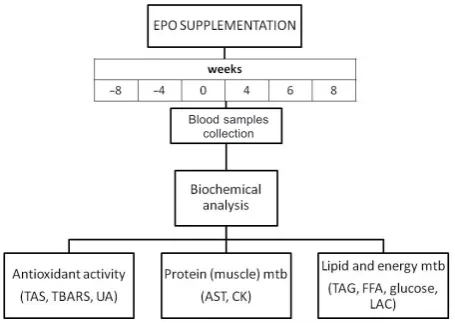
[image:2.595.305.533.506.669.2]EPO treatment. The diet dosage, 8 weeks prior to and 8 weeks during the experiment, corre-sponded with the requirements of NRC (2007) for thoroughbred horses of a certain weight and maximal physical load. All the horses were fed the same diet, supplemented with 150 ml of EPO (Solio Kft., Fadd, Hungary; digestible energy for horses (DEh) 35.7 MJ) from day 0 of the experi-ment to 8 weeks (scheme of EPO suppleexperi-mentation, blood sample collection, and parameters analyzed in blood samples is given in Figure 1). The diet was based on oats, meadow hay, and extruded supplemental feed mixture for horses: Fitmin Horse House müsli, Fitmin Horse Opti, Fitmin Horse Energy (all Dibaq a.s., Helvíkovice, Czech Republic) and a supplement of vitamins and min-erals Equistro (Vétoquinol s.r.o., Nymburk, Czech Republic) (Table 1). The examination of the diet compounds was performed by the laboratory of
Figure 1. Evening primrose (EPO) supplementation sched-ule and parameters analyzed in horse blood samples
TAS = total antioxidant reactivity, TBARS = thiobarbituric acid reacting substances, UA = uric acid, AST = aspartate aminotransferase, CK = creatine kinase, TAG = triacylglycer-ols, FFA = free fatty acids, LAC = lactate, mtb = metabolism
the Czech University of Life Sciences Prague. The horses had free access to water. Feeding doses were related to the rate of maximal workload.
Blood sample collection. The blood samples were collected into polyethylene tubes (Vacutainer BD, Heidelberg, Germany) 8 and 4 weeks before the experiment, on day 0, and 4, 6, and 8 weeks after the EPO application, at 6.30 h. The samples were immediately processed in the laboratory and serum wasstored at –70°C until analysis.
Laboratory analysis. Biochemical parameters were determined using commercial kits (Erba Lachema s.r.o., Brno, Czech Republic), TAS was determined with a commercial kit (Randox Lab-oratories Ltd., Crumlin, UK) on an automatic analyser XL-200 (Erba Lachema s.r.o.). TBARS were detected by an OxiSelectTM TBARS Assay
kit (Cell Biolabs, Inc., San Diego, USA), based on the method principle presented by Esterbauer and Zollner (1989).
Statistical analysis. The data was first subjected to repeated measures, split-plot design analysis of variance using the SAS software package (Sta-tistical Analysis System, Version 9.1, 2009), and
the treatment alignments were conducted using the Least Squaressignificant difference method (Duncan’s Multiple Range Test). The level of sig-nificance was 0.05 for all the statisticalanalyses.
RESULTS
[image:3.595.64.535.102.272.2]EPO supplementation results in increased antioxidant activity in race horses. To test the antioxidant effect of EPO, TAS was measured 8 and 4 weeks before and 4, 6, and 8 weeks after EPO treatment (Figure 1). The values of TAS showed a significant (P ≤ 0.05) increase after 6 weeks of EPO supplementation. The longer period of sup-plementation did not show any significant change of TAS compared with the previous experimental weeks, indicating that EPO treatment reached its saturation level after 6 weeks of supplementation (Table 2). Next, we determined cell membrane lipoperoxidation by detection of malondialdehyde in serum by TBARS assay. We discovered that EPO supplementation gradually reduced the TBARS level within a period of 8 weeks of the supplemen-tation, showing a significant (P ≤ 0.05) reduction
Table 1. Composition of feed ratio for horses in experiment
Meadow
hay Oats Horse Opti EnergyHorse Horse House Müsli EPO ∑ Total Σ Total + EPO
Nutrients (kg) 7.00 4.00 0.50 0.80 1.00 0.15
Dry matter (g) 6 521.20 3 569.20 468.85 744.56 905.00 0.00 12 208.81 12 208.81
Crude protein (g) 398.30 472.00 75.00 64.00 100.00 0.00 1 109.30 1 109.30
DEh (MJ) 7.90 50.20 7.00 12.40 13.00 3.60 90.50 94.10
Ash (g) 364.00 128.00 40.65 10.80 59.20 0.00 602.65 602.65
Ether extract (g) 114.10 157.20 33.50 81.60 49.20 0.00 435.60 435.60
Fibre (g) 2 695.00 389.20 26.00 14.56 55.00 0.00 3 179.76 3 179.76
Vitamin A (I.U.) 176.00 7 610.00 672.00 0.00 8 458.00 8 458.00
Vitamin E (I.U.) 60.00 80.00 9.00 0.00 149.00 149.00
Se (mg) 0.84 0.04 0.02 0.00 0.90 0.90
EPO = evening primrose oil, DEh = digestible energy for horses
Table 2. Serum oxidant and antioxidant parameters in racehorses (n = 10) in intense training before (week 8, 4, day 0) and after (week 4, 6, 8) the application of 150 ml of evening primrose oil (EPO) (means ± SD)
Measurements Sampling
8 weeks before 4 weeks before day 0 4 weeks EPO 6 weeks EPO 8 weeks EPO
TAS (mmol/l) 0.65 ± 0.14B 0.69 ± 0.12B 0.89 ± 0.08B 0.79 ± 0.11B 1.25 ± 0.49A 1.16 ± 0.42A
TBARS (µm) 56.39 ± 1.007C,D 80.48 ± 18.46A,B 92.94 ± 19.13A 74.45 ± 20.52B,C 69.65 ± 32.99B,C 42.90 ± 12.47D UA (µmol/l) 7.70 ± 6.58B 7.40 ± 2.76B 12.90 ± 6.20A 10.70 ± 2.79A,B 10.50 ± 2.55A,B 11.00 ± 4.66A,B
A–Ddifferent superscripts within the lines indicate statistically significant differences (P ≤ 0.05)
[image:3.595.62.533.652.722.2]of cell membrane lipid peroxidation (Table 2). To monitor the metabolic activity of the horses, we measured the uric acid (UA) levels. The levels of UA did not change in comparison with untreated controls (Table 2).
EPO does not disturb muscle homeostasis in race horses. To examine the muscle homeostasis of race horses after EPO supplementation, the levels of muscle enzymes AST and CK in the serum of race horses with or without EPO supplementation were compared. There were no significant differ-ences in AST activities after EPO supplementation, whereas CK levels were slightly higher compared with the control, indicating that muscle homeo-stasis was not disturbed (Table 3).
EPO supplementation reduces lipolysis in race horses. To observe the effect of EPO sup-plementation on lipid and energy metabolism, we determined the levels of triacylglycerols (TAG), free fatty acids (FFA), glucose, and lactate (LAC). As a result, we discovered significantly (P ≤ 0.05) increased TAG and glucose levels after physical activities, but without any effect of EPO (Table 4). On the other hand, levels of FFAand LAC signifi-cantly (P ≤ 0.05) decreased after physical exercise supplementation with EPO. Moreover, EPO sup-plementation almost diminished FFA levels in serum, showing the decreased effect of EPO on lipolysis (Table 4).
DISCUSSION
The aim of this study was to examine the antioxi-dant effect of EPO supplementation in the diet of racehorse at full workload, and thus its ability to lower oxidative stress. Maximal workload is associated with an increase in the production of free radicals and reactive oxygen species, which can consequently lead to imbalance between pro-oxidants and anti-oxidants and the formation of oxidative stress (Art and Lekeux 2005, Kinnunen et al. 2005).
[image:4.595.63.532.130.186.2]Antioxidant activity measuring by TBARS showed a statistically significant reduction in lipid per-oxidation after 8 weeks of EPO administration in monitored thoroughbreds under the maximal workload. These results indicate that EPO as a very important antioxidant effectively reduced the rate of oxidative stress generated during the workload of racehorses. Consistent with our study, Chiaradia et al. (1998) showed that the elimina-tion of lipid peroxidaelimina-tion is a slow process, and if the workload is not compensated with e.g. a suf-ficient rest period, it can lead to the accumulation of these dangerous substances and ultimately to tissue damage. Moreover, the effect of EPO with a higher content of gamma-linoleic acid and sev-eral antioxidants (Lu and Foo 1995; Wettasinghe and Shahidi 2002) significantly increased TAS in weeks 6 and 8 of EPO saturation.
Table 4. Blood parameters of fat and energy metabolism in racehorses (n = 10) at intense training before (week 8, 4, day 0) and after (week 4, 6, 8) application of 150 ml of evening primrose oil (EPO) (means ± SD)
Measurements (mmol/l)
Sampling
8 weeks before 4 weeks before day 0 4 weeks EPO 6 weeks EPO 8 weeks EPO
TAG 0.41 ± 0.11A,B 0.52 ± 0.15A 0.38 ± 0.06B 0.53 ± 0.15A 0.42 ± 0.11A,B 0.50 ± 0.15A,B
NEFA 0.03 ± 0.02B 0.07 ± 0,03A 0.05 ± 0.01A 0.07 ± 0.04A 0.02 ± 0.01B 0.01 ± 0.01B
Glucose 5.95 ± 0.32B,C 6.14 ± 0.31B 5.38 ± 0.48D 6.05 ± 0.39B,C 5.56 ± 0.30B,C 7.14 ± 1.12A
Lactate 0.87 ± 0.20D 1.40 ± 0.25B,C 1.81 ± 0.64A 1.32 ± 0.47C 1.74 ± 0.39A 1.17 ± 0.18A,B
A–Ddifferent superscripts within the lines indicate statistically significant differences (P ≤ 0.05)
[image:4.595.64.533.636.722.2]TAG = triacylglycerols, NEFA = nonesterified fatty acids
Table 3. Serum activity enzymes aspartate aminotransferase (AST) and creatine kinase (CK) in racehorses (n = 10) at intense training before (week 8, 4, day 0) and after (week 4, 6, 8) application of 150 ml of evening primrose oil (EPO) (means ± SD)
Measurements Sampling
8 weeks before 4 weeks before day 0 4 weeks EPO 6 weeks EPO 8 weeks EPO
AST (µkat/l) 5.94 ± 1.01B 7.01 ± 0.97A 5.83 ± 1.06B 7.33 ± 0.89A 5.96 ± 0.88B 6.51 ± 0.91A,B
CK (µkat/l) 1.54 ± 0.30B 2.03 ± 0.77B 3.99 ± 1.08A,B 3.21 ± 0.85A,B 3.68 ± 1.21A,B 3.89 ± 1.21A,B
A positive correlation among products of lipid peroxidation and activities of blood muscle en-zymes AST and CK is well documented (Valberg 2009). Despite the variability in the activities of AST and CK enzymes during the experiment, these values did not show a disturbance in muscle homeostasis (Williams et al. 2004).
The lipid and energy metabolism of the race-horses was monitored, too. Increased serum levels of TAG of racehorses that were not compensated by the EPO supplementation were found. The increased levels of TAG had a small impact on energetic metabolism of skeletal muscle, which could be a result of the length and the intensity of the exercise correlating with the intensity of lipolysis activity. Nevertheless, the other marker of lipolysis, NEFA, was found significantly decreased after the EPO supplementation. This data suggest that the extent of lipolysis was not affected by the physical activity of horses (Turcotte 1999).
The serum levels of glucose and lactate correlated with the workload of the racehorses and were not affected by the EPO treatment. The individual differences in the values of serum glucose could have been affected by the time of the last meal (Frank et al. 2010).
In summary, our study has shown that the in-take of the antioxidant EPO is beneficial and can compensate the oxidative stress generated during the maximum physical workload, without signifi-cant disruption of musculoskeletal disorders of thoroughbred horses.
Acknowledgement. We are grateful to the Race-horse stable at Bošovice, namely to trainer Václav Luka for his technical support.
REFERENCES
Art T., Lekeux P. (2005): Exercise-induced physiological adjustments to stressful conditions in sport horses. Live-stock Production Science, 92, 101–111.
Benatti P., Peluso G., Nicolai R., Calvani M. (2004): Poly-unsaturated fatty acids: biochemical, nutritional and epigenetic properties. Journal of the American College of Nutrition, 23, 281–302.
Cerolini S., Pizzi F., Gliozzi T., Maldjiani A., Zaniboni L., Parodi L. (2003): Lipid manipulation of chicken semen by dietary means and its relation to fertility: a review. World’s Poultry Science Journal, 59, 65–75.
Chiaradia E., Avellini L., Rueca F., Spaterna A., Porciello F., Antonioni M.T., Gaiti A. (1998): Physicial exercise,
oxidative stress and muscle damage in racehorses. Com-parative Biochemistry and Physiology, B-Biochemistry and Molecular Biology, 119, 833–836.
Christie W.W. (1999): The analysis of evening primrose oil. Industrial Crops and Products, 10, 73–83.
Cieslak A., Varadyova Z., Kisidayova S., Szumacher-Strabel M. (2009): The effects of linoleic acid on the fermentation parameters, population density, and fatty-acid profile of two rumen ciliate cultures, Entodinium caudatum and
Diploplastron affine. Acta Protozoologica, 48, 51–61.
Deaton C.A., Marlin D.J. (2003): Exercise-associated oxi-dative stress. Clinical technique in Equine Practice, 3, 278–291.
de Moffarts B., Kirschvink N., Art T., Pincemail J., Lekeux P. (2005): Effect of oral antioxidant supplementation on blood antioxidant status in trained thoroughbred horses. Veterinary Journal, 169, 65–74.
Esterbauer H., Zollner H. (1989): Methods for determi-nation of aldehydic lipid peroxidation products. Free Radicals Biology and Medicine, 7, 197–203.
Frank N., Geor R.J., Bailey S.R. (2010): Equine metabolic syndrome. Veterinary Internal Medicine, 24, 467–475. Gomes E.C., Silva A.N., de Oliveira M.R. (2012): Oxidants,
antioxidants, and the beneficial roles of exercise-induced production of reactive species. Oxidative Medicine and Cellular Longevity, ID756132.
Gunal M., Ishlak A., Abughazaleh A.A. (2013): Evaluating the effects of six essential oils on fermentation and bio-hydrogenation in in vitro rumen batch cultures. Czech Journal of Animal Science, 6, 243–252.
Harris P.A., Harris R.C. (2005): Ergogenic potential of nu-tritional strategies and substances in the horse. Livestock Production Science, 92, 147–165.
Hartlova H., Dorflerova A., Zita L., Rehak D., Rosmus J., Sindelar M. (2008): Effect of dietary supplementation with vitamin E and selenium in thoroughbred horses on the concentration of F2-isoprostanes in the blood plasma as a marker of lipid peroxidation. Acta Veterinaria Brno, 77, 335–340.
Jenkins R.R. (1998): Free radical chemistry. Relationship to exercise. Sports Medicine, 5, 156–170.
Kanbur M., Eraslan G., Sarica Z.S., Aslan O. (2011): The effects of evening primrose oil on lipid peroxidation in-duced by subacute aflatoxin exposure in mice. Food and Chemical Toxicology, 49, 1960–1964.
Kinnunen S., Atalay M., Hyyppa S., Lehmuskero A., Han-ninen O., Oksala N. (2005): Effects of prolonged exercise on oxidative stress and antioxidant defense in endur-ance horse. Journal of Sports Science and Medicine, 4, 415–421.
mark-ers of blood oxidant status and physiological variables in healthy and heaves-affected horses exercise. Equine Veterinary Journal, 34, 159–164.
Kubelkova P., Jalc D., Homolka P., Cermak B. (2013): Effect of dietary supplementation with treated amaranth seeds on fermentation parameters in an artificial rumen. Czech Journal of Animal Science, 4, 159–166.
Lenox C.E., Bauer J.E. (2013): Potential adverse effects of omega-3 fatty acids in dogs and cats. Journal of Veterinary Internal Medicine, 27, 217–226.
Lisiak D., Grzeskowiak E., Borzuta K., Raj S., Janiszewski P., Skiba G. (2013): Effects of supplementary vegetable and animal fats on the slaughter values of fatteners, meat quality, and fatty acid profile in pigs. Czech Journal of Animal Science, 11, 497–511.
Lu F., Foo L.Y. (1995): Phenolic antioxidant components of evening primrose oil. In: Ong A.S.H., Niki E., Packer L. (eds): Nutrition, Lipids, Health and Disease. AOCS Press, Champaign, USA, 86–95.
Nielsen B.D. (2009): Effects of diet and feeding regimes on performance. In: Lindner A. (ed.): Applied Equine Nutrition and Training: Equine Nutrition and Training Conference (ENUTRACO) 2009. Wageningen Academic Publishers, Wageningen, the Netherlands, 107–116. NRC (2007): Nutrient Requirements of Horse. 6th Ed. The
National Academies Press, Washington, USA.
O’Connor K., Weinstock-Guttman B., Carl E., Kilanowski C., Zivadinov R., Ramanathan M. (2012): Patterns of dietary and herbal supplement use by multiple sclerosis patients. Journal of Neurology, 259, 637–644.
Shaliutina-Kolesova A., Gazo I., Cosson J., Linhart O. (2013): Comparison of oxidant and antioxidant status of seminal plasma and spermatozoa of several fish species. Czech Journal of Animal Science, 7, 313–320.
Szumacher-Strabel M., Cieslak A., Nowakowska A. (2009): Effect of oils rich in linoleic acid on in vitro rumen fer-mentation parameters of sheep, goats and dairy cows. Journal of Animal and Feed Sciences, 18, 440–452.
Tretter S., Mueller R.S. (2011): The influence of topical unsaturated fatty acids and essential oils on normal and atopic dogs. Journal of the American Animal Hospital Association, 47, 236–240.
Turcotte L.P. (1999): Role of fats in exercise. Types and qual-ity. Clinicals and Sports Medicine, 18, 485–498. Valberg S.J. (2009): The musculoskeletal system. Heritable
muscle disease. In: Robinson N.E., Sprayberry K.A. (eds): Current Therapy in Equine Medicine. Saunders Elsevier, St. Louis, USA, 461–468.
Varadyova Z., Kisidayova S., Siroka P., Jalc D. (2007): Fatty acid profiles of rumen fluid from sheep fed diets sup-plemented with various oils and effect on the rumen ciliate population. Czech Journal of Animal Science, 52, 399–406.
Wettasinghe M., Shahidi F. (2002): Iron (II) chelation ac-tivity of extracts of borage and evening primrose meals. Food Research International, 35, 65–71.
White A., Estrada M., Walker K., Wisnia P., Filgueira G., Valdes F., Araneda O., Behn C., Martinez R. (2001): Role of exercise and ascorbate on plasma antioxidant capacity in thoroughbred race horses. Comparative Biochemistry and Physiology, A – Molecular and Integrative Physiol-ogy, 128, 90–104.
Williams C.A., Kronfeldt D.S., Hess T.M., Saker K.E., Wal-dron J.N., Crandell K.M., Hoffman R.M., Harris P.A. (2004): Antioxidant supplementation and subsequent oxidative stress of horses during an 80-km endurance race. Journal of Animal Science, 82, 588–594.
Zaitone S.A., Moustafa Y.M., Mosaad S.M., El-Orabi N.F. (2011): Effect of evening primrose oil and omega-3 poly-unsaturated fatty acids on the cardiovascular risk of celecoxib in rats. Journal of Cardiovascular Pharmacol-ogy, 58, 72–79.
Received: 2014–02–26 Accepted after corrections: 2014–08–08
Corresponding Author
MVDr. Helena Härtlová, CSc., Czech University of Life Sciences Prague, Faculty of Agrobiology, Food and Natural Resources, Department of Veterinary Science, 165 21 Prague 6-Suchdol, Czech Republic
Těšnov 17, 117 05 Prague 1, Czech Republic workplace: Slezská 7, 120 00 Prague 2, Czech Republic
e-mail: [email protected]
Tel.: + 420 227 010 427, Fax: + 420 227 010 116 Account No. 86634011/0100 KB
IBAN CZ41 0100 0000 0000 8663 4011; SWIFT KOMBCZPPXXX
Th e Czech Academy of Agricultural Sciences publishes scientifi c journals dealing with the problems of agriculture, forestry and food sciences and technology. Th e periodicals are published in English.
Number Yearly subscription
Journal of issues per year in USD
Plant, Soil and Environment 12 720
Czech Journal of Animal Science 12 720
Agricultural Economics (Zemědělská ekonomika) 12 680
Journal of Forest Science 12 580
Veterinární medicína (Veterinary Medicine – Czech) 12 790
Czech Journal of Food Sciences 6 620
Plant Protection Science 4 175
Czech Journal of Genetics and Plant Breeding 4 175
Horticultural Science 4 195
Research in Agricultural Engineering 4 155
Soil and Water Research 4 175


![1 (p Bromophenyl) 5 p tosylperhydropyrrolo[3,4 b]pyrrole](data:image/gif;base64,R0lGODlhAQABAIAAAP///wAAACH5BAEAAAAALAAAAAABAAEAAAICRAEAOw==)