http://wrap.warwick.ac.uk
Original citation:
Rajpoot, Nasir M. (Nasir Mahmood), Wilson, Roland, 1949-, Meyer, F. G. and Coifman,
R. R. (2001) A new basis selection paradigm for wavelet packet image coding. In:
International Conference on Image Processing (ICIP 2001), Thessaloniki, Greece ,
07-10 Oct 2001. Published in: Proceedings. 2001 International Conference on Image
Processing, 2001. , Volume 3 pp. 816-819.
Permanent WRAP url:
http://wrap.warwick.ac.uk/10311
Copyright and reuse:
The Warwick Research Archive Portal (WRAP) makes this work by researchers of the
University of Warwick available open access under the following conditions. Copyright ©
and all moral rights to the version of the paper presented here belong to the individual
author(s) and/or other copyright owners. To the extent reasonable and practicable the
material made available in WRAP has been checked for eligibility before being made
available.
Copies of full items can be used for personal research or study, educational, or not-for
profit purposes without prior permission or charge. Provided that the authors, title and
full bibliographic details are credited, a hyperlink and/or URL is given for the original
metadata page and the content is not changed in any way.
Publisher’s statement:
“© 2001 IEEE. Personal use of this material is permitted. Permission from IEEE must be
obtained for all other uses, in any current or future media, including reprinting
/republishing this material for advertising or promotional purposes, creating new
collective works, for resale or redistribution to servers or lists, or reuse of any
copyrighted component of this work in other works.”
A note on versions:
The version presented here may differ from the published version or, version of record, if
you wish to cite this item you are advised to consult the publisher’s version. Please see
the ‘permanent WRAP url’ above for details on accessing the published version and note
that access may require a subscription.
A NEW BASIS SELECTION PARADIGM FOR WAVELET PACKET IMAGE CODING
Nasir M. Rajpoot
∗, Roland G. Wilson
∗, Franc¸ois G. Meyer
†, Ronald R. Coifman
‡Corresponding Author:
[email protected]ABSTRACT
In this paper, work on a new wavelet packet basis selection paradigm is reported which emphasizes the crucial role of quantization strategy being used. This paradigm is coupled with a new Markov chain based estimation of the cost of ze-rotree quantization to develop a progressive wavelet packet image coder which gives better results than its wavelet coun-terpart.
1. INTRODUCTION
The last decade or so has seen a surge of interest in wavelet transform based image coding methods [1, 2]. These meth-ods, however, perform much better on images consisting of smooth regions with well-defined boundaries than on more complex or textured images. Wavelet packets were invented [3] to pinpoint the signal phenomena occurring locally in the frequency domain, and wavelet packet image coding methods such as [4, 5] have established their superiority over wavelet based methods for complex images and par-ticularly those containing oscillatory patterns.
Various basis selection methods [6, 7] have been pro-posed to select the best basis among a library of available wavelet packet bases. The use of different cost functions may result in different best bases which, in turn, may pro-duce different coding results using the same quantization method. It is, therefore, important to take into account the quantization strategy at the time of basis selection to ensure that the basis chosen by employing certain criterion will ac-tually result in better performance in terms of coding gains. In this paper, a new wavelet packet coding paradigm is ad-vocated which unites both basis selection and quantization for compression purposes.
2. WAVELET PACKET IMAGE CODING
2.1. Wavelet Packets
In order to represent a signalf using the wavelet transform,
the space Vj of its approximation at a resolution 2−j is
∗Computer Science, University of Warwick, UK
†Electrical & Computer Engineering, University of Colorado, USA.
‡Mathematics, Yale University, USA.
decomposed into a lower resolution spaceVj+1 and a
de-tail spaceWj+1by dividing the orthonormal basis{φj(t−
2jn)}
n∈ZofVjinto two new orthonormal bases{φj+1(t−
2j+1n)}
n∈Z ofVj+1and{ψj+1(t−2j+1n)}n∈Z ofWj+1
using lowpass and highpass filters h[n] and g[n]
respec-tively. Coifman and Meyer [3] proved that if{ψi
j(t−2jn)}n∈Z
is an orthonormal basis of a general spaceWi
j (withψ
0
j =
φj andψ1j =ψj), thenWjican be decomposed into two
or-thogonal subspacesW2i
j andW
2i+1
j usingh[n]andg[n]
fil-ters respectively such that{ψ2i j+1(t−2
j+1
n)}and{ψj2+1i+1(t−
2j+1n)}
n∈Z are orthonormal bases ofWj2i andW
2i+1
j
re-spectively, andWi
j =W
2i j ⊕W
2i+1
j .
The discrete wavelet packet transform coefficients of a
signalx = {xn}0≤n<N of lengthN = 2−J can be
com-puted as follows
w2n,j+1,l = X
k
hk−2lwn,j,k 0≤l<N2J−j−1
w2n+1,j+1,l = X
k
gk−2lwn,j,k 0≤l<N2J−j−1
w0,J,l = xl 0≤l<N
wherewn,j,l is the transform coefficient corresponding to
the wavelet packet having support size2−j,nandldenote
the frequency and position indices respectively. The trans-form is invertible if appropriate dual filtersh˜[n], ˜g[n]are used on the synthesis side.
2.2. Basis Selection
Since this library of wavelet packet basis functions consists
of a huge collection (more than22Dpossible bases for a tree
of depthD), various algorithms [6, 7] have been proposed
to compute the cost of a decomposition (split) and decide whether such a split should be retained or the decomposed coefficients should be merged back to the previous level. Dynamic programming offers an efficient solution to this
optimization problem. LetB={bm}1≤m≤N denote a
ba-sis used to represent signalf of lengthN, where {bm}is
a set of basis vectors corresponding toN wavelet packets.
LetIM denote the set of indices of theMlargest magnitude
transform coefficients so that the remainingN−M
resulting error is given by
[M] =kf k2− X
m∈IM
|< f, bm>|2.
LetC(f,B)denote the cost of representingf in a basisB.
The best basisB∗from a collectionDof different bases with
respect toCis the one which satisfies the following relation,
C(f,B∗)≤ C(f,B) ∀B∈D, B6=B∗.
Selection of the best basisB∗fromDensures that there is
no other basis inDwhich can representf with a smaller
cost (when using the cost functionC). It does not, however,
ensure that there is no other basis from another library of
bases that can representfwith a smaller cost. Neither does
it guarantee that there is no other cost functionC0which can
be used to select another basisB0 which is better than all
other bases (includingB∗) inD(with respect toC0) [8].
2.3. Zerotree Quantization
Zerotree quantization is an effective way of exploiting the self-similarities among high frequency subbands at various resolutions. Wavelet based zerotree image coding meth-ods [1, 2] have proved their superiority over other wavelet based methods in terms of both computational complexity and compression performance. Moreover, enabling the em-bedded (progressive) transmission (reconstruction), which is required in many applications, using a zerotree method is quite straightforward. These motivating factors led to the development of a general zerotree structure, termed
com-patible zerotrees, for wavelet packet transforms [9]. IfX
andY denote two random variables representing the
signif-icance of child and parent coefficients respectively, then the following relation
H(X|Y) =H(X)−I(X, Y),
tells us that encoding the conditioned significance is usu-ally more efficient than just encoding the individual coeffi-cients’ significance. The performance of zerotree encoding
depends largely upon the value ofI(X, Y)for a given basis.
The larger the value of this measure, the more efficient the
encoding is. Given a basisBfor an image, this value
de-termines how friendly the basisBwould be to the zerotree
quantization method.
3. NEW PARADIGM FOR BASIS SELECTION
An important issue that needs to be taken into account while selecting the best basis is that of the strategy used to en-code the basis coefficients. Consider, for instance, the most commonly used encoding strategy which employs some sort
of quantizationQ(to suppress unimportant coefficients or
some parts of them) followed by an entropy coding method.
The encoding error[M]is now given by
([M])Q=||f||2
− X
m∈IM
|Q(< f, bm>)|2
forM = 1, . . . , N. Suppose two different quantizersQα
andQγ, followed by an entropy coder, are used to encode
the coefficients of same wavelet packet basisB. Let([M])α
and([M])γdenote the encoding errors encountered due to
using quantizersQαandQγ(respectively) for encoding the
coefficients ofB. In general, there exists M∈[1, N]such
that
([M])Qα6=([M]) Qγ.
Now consider two different basesB0
andB1
used to
repre-sentf. Suppose the quantizersQαandQγ are utilized to
encode the coefficients ofB0
andB1
(respectively). If there existM1, M2∈[1, N]such that
(0
[M1])Qα <(1[M1]) Qγ
and
(0
[M2])Qα >(1[M2]) Qγ,
then neitherB0
norB1
is a better basis than the other. In
other words, if it happens that the basis coefficients ofB0
when encoded byQαcannot always produce less error than
the coefficients ofB1
encoded byQγ, neither ofB0
andB1
is a better basis than the other. To emphasize the crucial role of the quantization strategy at the time of basis selection, let us re-define the best basis as follows.
Definition: A basisBi belonging to a collection of bases
D = {Bk}
k=1,2,... is the best basis with respect to a cost
functionCand a quantization strategyQif
C(f,Bi)≤C(f,Bj)
and
(i[M])
Q≤(j[M])Q for allj6=iandM∈[1, N].
4. MARKOV CHAIN BASED COST ESTIMATION
One way of taking into account the mutual information be-tween the parent and children subbands in this compati-ble zerotree organization is to estimate the cost of zerotree quantization without actually encoding the coefficients. The
costC(f,B)of encoding the coefficients of aD-level wavelet
packet basisBcan be written as
C(f,B) =
nX−1
i=0
whereTi =T0/2i is the threshold value used at theith
it-eration, ndenotes the number of stages of encoding, and
Csm andCredenote the costs of encoding the significance
map and the refinement information. It was observed that the symbol used to encode the refinement information us-ing Shapiro’s method is nearly random, which leads to the conclusion that it would suffice to estimate the first term in
the above expression. The costCsm can be estimated by
computing the entropy of a discrete random variable whose value is drawn from the set of codewords used to encode the
significance map. These codewords include two symbols (0
and1) to represent whether a coefficient is significant or not,
and a zerotree symbol whose probability can be computed as follows.
Due to the fact that the significance of child coefficients in a subband is related only to the significance of their parent coefficient, the subbands (nodes) belonging to each family of compatible zerotrees can be modelled as a non-homo-geneous discrete-time Markov chain (MC) with time re-placed by node depth in the tree (ie, the root compatible
zerotree). LetXj denote a random variable corresponding
to the coefficients of all nodes at tree depthj. The sample
space for these random variablesX1, X2, . . . , XD (where
Ddenotes depth of the tree or the number of transform
lev-els) is{0,1}, where a value of0denotes that the coefficient
is insignificant with respect to a threshold and1denotes its
magnitude being larger than the threshold.
Let Pk(0) denote P r(Xk = 0), the probability of a
coefficient belonging to subband nodes at tree depthk
be-ing insignificant, andPj,i(0|0)denote the probability of all
child coefficients at depthj to be insignificant given all of
their corresponding parent coefficients at the previous depth
iare insignificant. It was observed that given a coefficient
and all its child coefficients are insignificant, it is very likely that its siblings and all their children are insignificant too.
The probabilityPj,i(0|0) can, therefore, be approximated
by the probability of all four child coefficients at depthj
being insignificant given their parent coefficient at depthi
is insignificant.
LetPk(0)denote the joint probability of all the
coeffi-cients originating from nodes at tree depthkand all their
child coefficients being insignificant. In other words, it
de-notes the probability of a zerotree of lengthD−k, which
consists of(4D−k+1−1)coefficients in a wavelet zerotree.
According to the multidimensional pmf theorem of Markov chainsPk(0)is given by
Pk(0) =Pk(0)Pk+1,k(0|0)Pk+2,k+1(0|0)· · ·PD,D−1(0|0)
(1) or
Pk(0) =Pk(0) DY−1
i=k
Pi+1,i(0|0) (2)
Zerotrees of lengthl, however, contain all zerotrees of
lengthl−1and less. A recursive update of the following
sort is, therefore, required to adjust the number of zerotrees of different lengths.
Pi(0)←−Pi(0)−Pi−1(0) (3)
fori = D−1, D−2, . . . ,2. The cost Csm can now be
computed as follows
Csm =Hs− D X
k=1
Pk(0)logPk(0) (4)
where
Hs=− D X
k=1
(Pk(0)logPk(0) +Pk(1)logPk(1)) (5)
gives the entropy of the one and zero codewords identifying respectively the position of significant coefficients and those insignificant coefficients which are not contained in any of the zerotrees.
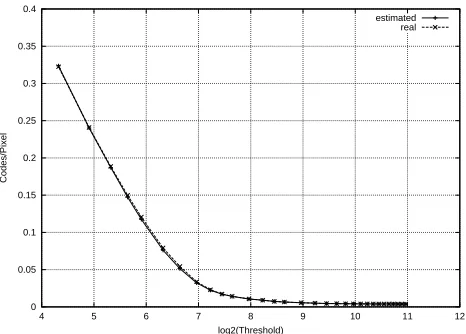
Fig. 1 shows the graph of the cost of encoding the sig-nificance map (both estimated and real) plotted against vari-ous threshold values for the Barbara image. The MC based computation of the cost of encoding the significance map proves to be a good estimate, particularly at large threshold values which correspond to low bit rates.
0 0.05 0.1 0.15 0.2 0.25 0.3 0.35 0.4
4 5 6 7 8 9 10 11 12
Codes/Pixel
log2(Threshold)
[image:4.595.310.543.414.581.2]estimated real
Fig. 1. Estimated and real cost of encoding the significance
map vs. threshold for Barbara
5. EXPERIMENTAL RESULTS
the cost estimate described in the previous section, a sim-ple heuristic can be devised to select what can be termed as a zerotree friendly wavelet packet basis. The complexity
of wavelet packet transform for an image of sizeM×N is
O(M N D)whereDis the number of transform levels or the depth of full wavelet packet tree. Moreover, the new basis selection algorithm needs to compute the estimated cost of
quantization(4D−1−1)/3times.
The idea of compatible zerotree quantization was com-bined with the wavelet packet basis for progressive image
coding and its performance was tested on two standard8
-bit greyscale512×512images - Barbara and Fingerprints
- using both a wavelet basis and a zerotree friendly wavelet packet basis. The latter of these bases was selected using the cost estimate discussed earlier in Section 4 in order to
maximize the mutual informationI(X, Y). For all the
ex-periments, the factorized 9-7 biorthogonal filters [5] were used for efficiently computing the wavelet packet transform. Results for the performance of both variations of the CZQ
coder - that is, with the wavelet basis CZQ-WVand with the
wavelet packet basis CZQ-WP- for both the test images are
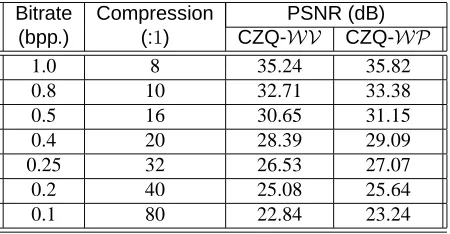
presented in Tables 1-2. The measure used to describe the performance of each coder is the peak-signal-to-noise-ratio (PSNR).
Bitrate Compression PSNR (dB)
(bpp.) (:1) CZQ-WV CZQ-WP
1.0 8 35.14 36.15
0.8 10 32.64 33.91
0.5 16 30.28 31.60
0.4 20 28.41 29.85
0.25 32 27.12 28.12
0.2 40 25.25 26.64
[image:5.595.308.546.191.304.2]0.1 80 23.64 24.27
Table 1. Coding results for Barbara
Bitrate Compression PSNR (dB)
(bpp.) (:1) CZQ-WV CZQ-WP
1.0 8 35.24 35.82
0.8 10 32.71 33.38
0.5 16 30.65 31.15
0.4 20 28.39 29.09
0.25 32 26.53 27.07
0.2 40 25.08 25.64
0.1 80 22.84 23.24
Table 2. Coding results for Fingerprints
While being capable of progressively reconstructing the encoded image and being relatively faster than other wavelet
packet coders [5], the CZQ-WP coder performs
compara-bly well. The coding gains achieved by it on top of CZQ-WV are0.6-1.5dB for Barbara, and0.4-0.7dB for
Finger-prints.
A closer look at the reconstructed images encoded at
0.25bpp. reveals that CZQ-WPyields better visual quality
than the state-of-the-art SPIHT [2] image coder. Note, for instance, the quality of a portion (table cloth) of the
recon-structed Barbara image encoded by CZQ-WP and SPIHT
as shown in Fig. 2.
[image:5.595.57.285.369.486.2](a) CZQ-WP (28.12dB) (b) SPIHT (27.58dB)
Fig. 2. Portion of Barbara encoded at0.25bpp.
6. CONCLUSIONS
A new paradigm for the wavelet packet basis selection was presented which emphasized that the role of quantization strategy should be taken into account at the time of basis selection. An analysis of the popular zerotree quantization method based on the Markov chains was presented. The ex-perimental results show that the unification of this paradigm of basis selection with quantization yields better coder per-formance.
7. REFERENCES
[1] J.M. Shapiro, “Embedded image coding using zerotrees of wavelet coefficients,” IEEE Trans. on Signal Proc., vol. 41, no. 12, pp. 3445–3462, Dec. 1993.
[2] A. Said and W.A. Pearlman, “A new fast and
effi-cient image codec based on set partioning in hierarchi-cal trees,” IEEE Trans. on Cir. & Sys. for Video Tech., vol. 6, pp. 243–250, Jun. 1996.
[3] R.R. Coifman and Y. Meyer, “Othornormal wave packet
bases,” preprint, Deptt. of Maths., Yale Uni., USA,
1990.
[image:5.595.59.284.530.647.2][5] F.G. Meyer, A.Z. Averbuch, and J-O. Stromberg, “Fast
adaptive wavelet packet image compression,” IEEE
Trans. on Image Proc., vol. 9, no. 5, May 2000.
[6] R.R. Coifman and M.V. Wickerhauser, “Entropy-based algorithms for best basis selection,” IEEE Trans. on
Info. Th., vol. 38, no. 2, pp. 713–718, Mar. 1992.
[7] K. Ramchandran and M. Vetterli, “Best wavelet packet bases in a rate-distortion sense,” IEEE Trans. on Image
Proc., vol. 2, no. 2, pp. 160–175, Apr. 1993.
[8] N.M. Rajpoot, Algorithms for Adaptive Wavelet Image
Coding, Ph.D. thesis, Deptt. of Comp. Sc., Uni. of
War-wick, UK, Jan. 2000.