A 4D modeling method to
visualize how asbestos affects
construction projects
Master Thesis
Construction Management and Engineering
at the University of Twente, Enschede, The Netherlands by Siemen Zijlstra, BSc.
Colophon
This document is a Master Thesis for the completion of the Master Construction Management and Engineering at the University of Twente, Enschede, The Netherlands.
Title: A 4D modeling method to visualize how asbestos
affects construction projects
Version: Final Version
Date: 12–02–2016
Author: Siemen Zijlstra, BSc
Student No. 1505475
University: University of Twente
Postbus 217 7500 AE Enschede
Faculty of Engineering Technology
Master Construction Management and Engineering
First Supervisor: dr. ir. Timo Hartmann,
Professor at University of Twente Second Supervisor: dr. Saad H.S. Al-Jibouri,
Associate Professor at University of Twente
Host company: Schiphol Group
Asset Management Department & Project Office Department Evert van de Beekstraat 202
1118 CP Schiphol, the Netherlands
First Supervisor: ir. Alexander Worp,
Strategic Advisor Asset Management, ASM Second Supervisor: ir. Yannick Vos,
Preface
This master thesis is the final assignment for the Master’s Programme Construction Management and Engineering at the University of Twente. Looking back the Master has been an incredibly valuable addition to my Bachelor’s Degree.
During my studies I developed an interest for Building Information Modeling (BIM), a process that introduces virtual modeling as a new way of designing, planning and managing construction projects. In particular I enjoy learning about how BIM technologies can be meaningfully applied in projects to improve the efficiency and effectiveness of existing work practices. I decided to dedicate my graduation research to that specific topic. The past five months I developed a modeling method to support practitioners in managing asbestos risk in construction projects.
Summary
The presence of asbestos poses threats to the safe and successful execution of construction project in existing buildings. To be able to effectively control asbestos practitioners need to evaluate the probability that asbestos-containing materials are affected during construction activities. Estimating this potential for disturbance requires practitioners to know the locations of asbestos in the building and if construction activities are planned with or near these asbestos-containing materials. Traditional documentation of asbestos does not provide the means to accurately estimate the potential for disturbance. A comprehensible visualization of the locations of asbestos-containing materials and its relation to construction plans would greatly support this task. 4D CAD technology seems to be a useful tool to generate a comprehensible visualization of asbestos and may potentially help practitioners to estimate the potential for disturbing asbestos during construction projects. 4D CAD literature does however not provide methods to integrate asbestos risk information into 4D models. This study aims to address this shortcoming in literature. The following research objective is formulated.
To develop a method to effectively integrate asbestos risk
information into a 4D model.
In line with the methods proposed in theory a 4D modeling method was developed to integrate design data, schedule data and asbestos data. The method provides practitioners with a tool to visualize asbestos in a three-dimensional context. The modeling method yields a 4D system allows to generate much more understanding about the present asbestos than with textual information and schematic 2D drawings that are traditionally used to assess the existing situation. On top of the increased understanding about the existing situation the 4D model generates, the model also illustrates how the design and construction plans are affected by asbestos.
To validate the method, a system was created following the method and implemented into a real construction project involving asbestos on Schiphol Airport. In this effort ethnographic action research was applied, a method that proposes to first observe project work routines to ensure that the solution integrates well into the project context. The method further prescribes to develop and implement solutions in project teams in iterative cycles. The application of the modeling method to the construction project revealed that the created system allowed to discover areas in the building where construction activities conflicted with the presence of asbestos and the risk of fiber release existed. This indicated that, using the system, practitioners are able to identify the potential for disturbance. Implementation sessions revealed that practitioners expected the system to be of great support for their decision-making tasks. The ability to detect the potential for disturbance was expected to aid the practitioners in identifying asbestos risks in the construction project. Furthermore, practitioners expected that the detailed asbestos information the system provides would contribute to more accurate assessment of these asbestos risks and help to devise appropriate measures to control the risks.
Samenvatting
De aanwezigheid van asbest vormt bedreigingen voor een veilige en succesvolle uitvoering van bouwprojecten in bestaande gebouwen. Om asbest doeltreffend te kunnen beheersen moet men de kans dat asbesthoudende materialen worden aangetast tijdens bouwactiviteiten goed kunnen inschatten. Om deze potentie voor verstoring te kunnen inschatten moeten bouwmanagers weten waar asbest zich bevindt en of bouwactiviteiten gepland zijn met of nabij asbesthoudende materialen. De huidige documentatie van asbest in gebouwen biedt niet de mogelijkheid om de potentie voor verstoring nauwkeurig te kunnen inschatten. Een begrijpelijke visualisatie van de locaties van asbesthoudende materialen en hun verhouding tot de bouwplannen zou deze taak enorm kunnen ondersteunen. 4D CAD technologie lijkt een toepasselijk instrument te zijn om een begrijpelijke visualisatie van asbest te genereren en zou managers potentieel kunnen helpen in het inschatten van de potentie voor verstoring tijdens het bouwproject. 4D CAD literatuur biedt echter geen methodes om asbest risico informatie in 4D modellen te integreren. Dit onderzoek tracht deze tekortkoming in de literatuur te dichten. Het volgende onderzoeksdoel is hiervoor geformuleerd:
Het ontwikkelen van een methode om asbest risico informatie
doeltreffend te integreren in een 4D model.
In lijn met de methodes die worden genoemd in theorie is een 4D modelleermethode ontwikkeld om ontwerpdata, planning data en asbestdata te integreren. De methode biedt managers een helpende hand om asbest te visualiseren in een driedimensionale omgeving. De modelleermethode levert een 4D systeem op dat in staat is veel meer inzicht te genereren in de aanwezige asbest dan met de traditionele wijze van tekstuele informatie en schematische 2D tekeningen die gehanteerd wordt om bestaande situatie te beoordelen. Naast het bevorderde inzicht in de bestaande situatie die het 4D model genereert, illustreert het model ook hoe ontwerp en bouwplannen beïnvloedt worden door asbest.
Om de toepasbaarheid van de methode te valideren is een systeem ontwikkeld volgens de methode en geïmplementeerd in een echt bouwproject gemoeid met asbest op de luchthaven Schiphol. Hier is etnografisch actieonderzoek gehanteerd, een methode die voorschrijft het onderzoek te initiëren met observaties van bestaande werkroutines in het project worden om te garanderen dat de oplossing goed integreert in de projectomgeving. De methode schrijft voor vervolgens de oplossing te ontwikkelen en implementeren in project teams in een herhalende cyclus.
De toepassing van de modelleermethode in het bouwproject onthulde dat het systeem gecreëerd in staat was gebieden te ontdekken waar bouwactiviteiten conflicteerden met de aanwezigheid van asbest, en het risico op het vrijkomen van vezels bestond. Dit wijst erop dat, met het gebruik van het systeem, mensen in staat zijn de potentie voor verstoring te identificeren. Implementatie sessies onthulden dat de belangrijkste projectleden verwachtten dat het systeem een grote bijdrage zou leveren aan hun besluitvormingstaken. Er wordt verwacht dat de mogelijkheid de potentie voor verstoring te kunnen ontdekken bijdraagt aan het identificeren van asbestrisico’s in het bouwproject. Verder wordt er verwacht de gedetailleerde asbestinformatie die het systeem communiceert bij zou dragen aan meer nauwkeurige inschatting van asbestrisico’s en aan het bedenken van geschikte maatregelen om de risico’s te beheersen.
Content
1 Introduction ... 7
2 Points of Departure ... 8
2.1. Managing Asbestos Risk ... 8
2.2. 4D CAD ... 9
2.3. Research Objective ... 10
3 The 4D Modeling Method ... 11
3.1. Creating a 4D Asbestos Model ... 11
3.2. Integrating Asbestos Risks ... 12
4 Validation of the Modeling Method ... 14
4.1. Introduction of the Project ... 14
4.2. Research Method ... 15
5 Creating the System ... 17
5.1. Ethnographic Observations ... 17
5.2. Creating the System with the Modeling Method ... 19
6 Implementing the System ... 23
6.1. System Implementations ... 23
6.2. Implementation Observations ... 23
6.3. Improvement Iteration ... 25
7 Evaluating the System ... 27
7.1. Contribution to asbestos risk management ... 27
7.2. Conclusions ... 28
8 Discussion ... 30
8.1. Theoretical Contributions ... 30
8.2. Practical Contributions ... 30
8.3. Limitations of the research ... 31
8.4. Further Research ... 31
9 Conclusion ... 32
List of Figures ... 33
1
Introduction
Asbestos is the name given to a number of naturally occurring fibrous minerals. Due to the strength and resistance to heat and chemicals of this minerals, asbestos-based materials have been used in a wide range of manufactured goods for the construction and automobile industry (Woodson, 2012). The application of asbestos in materials became prohibited when it was discovered that exposure to asbestos fibers could cause serious health issues. However, as asbestos is often left in place, the legacy of the widespread use of asbestos still poses significant threats on the safe execution present and future construction projects in existing buildings. Asbestos therefore requires extensive attention when designing and planning construction projects.
At the same time, information technology in the construction industry is undergoing a transformation. Two-dimensional drawing has been the prevailing method to communicate design of construction projects. Currently, digital modeling is becoming the new standard for designing, planning and managing construction projects. Through research, new areas of application of 3D and 4D modeling technologies in construction management are continuously explored. Asbestos risk management however is an unexplored domain in 3D and 4D modeling literature. Recently, 4D models have proven to be able to support risk management practices in construction projects.
This thesis presents a 4D modeling method that integrates asbestos information to support the management of asbestos risks in construction projects. The method allows managers to identify and more accurately assess asbestos-related risks in the construction projects. To indicate whether the method yields a valuable 4D system, the method is applied to a real construction project on Schiphol Airport.
Outline of the Report
2
Points of Departure
In this section the existing literature about 4D CAD modeling and asbestos is discussed. From this, a
gap in literature is identified. A research objective is formulated that addresses this shortcoming in
literature.
2.1.
Managing Asbestos Risk
Asbestos is the name given to a number of naturally occurring fibrous minerals. Due to its strength and resistance to heat and chemicals the material has been used in a wide range of manufactured goods for the construction and automobile industry (Woodson, 2012). Asbestos-containing materials (ACMs) are unhazardous when they are intact and remain undisturbed. The possibility exists however that an asbestos-containing material releases fibers. These fibers can impair normal lung functions and increase the risk of developing lung cancer and other diseases (Woodson, 2012). Since 1994 the application of asbestos in materials is therefore prohibited in most countries. To date, many existing buildings built before 1994 still contain asbestos-containing materials.
The presence of asbestos threats the safe and successful execution of construction projects in existing buildings. Especially during the execution of construction activities the risk that asbestos is harmed is significant. Many guidelines exist that propose strategies to control asbestos in existing buildings. Based on the characteristics of the asbestos it can be required to remove the asbestos. Two main strategies for removing exist: open abatement and abatement under containment. In the latter, the abatement must take place within an enclosed space that is kept air tight with regulated air pressure. These protective measures are not required for open abatement, which is often applied for non-friable and low amounts of asbestos. When it is decided to keep the asbestos in place, the material needs to be encapsulated and labelled to prevent the possibility that asbestos is affected in the future.
Cherry (1988) describes the possibility that an asbestos-containing material is affected as the potential for disturbance. Disturbance of asbestos-containing materials may result in fiber release and may cause health risks and project delay. Disturbance of asbestos may occur due to adjusting or breaking the material, for example through drilling or sawing. Also, erosion of the material, due to air movement of vibrations may cause fiber release. The risk of fiber release depends on the physical condition and material properties of the asbestos. Asbestos materials are classified as either friable or non-friable. Non-friable asbestos is easily pulverized and requires little effort to generate fiber release, the risk of fiber release is significantly higher with non-friable asbestos.
2.2.
4D CAD
[image:13.595.126.494.444.544.2]Two-dimensional drafting has been the common tool for designing and planning construction projects for decades. Nowadays, digital three-dimensional modeling is becoming the new standard for designing and planning construction projects. An intelligent 3D model integrates all information of the design in a single model and so facilitates the integration of often fragmented information. Moreover, 3D models are able to communicate design knowledge more effectively as the virtual representations of design are easy to understand. 3D models can be extended to 4D models through adding construction schedule information. CAD (Computer-aided-design) tools exist that facilitate the integration of time properties into 3D objects. The process of linking construction activities to the 3D objects in the model yields a 4D model, see also Figure 1, that allows to digitally simulate the construction process. Hartmann, Gao & Fischer (2008) conclude from literature that the effectiveness of 3D and 4D models has been positively evaluated in both educational and industrial settings. More specifically, the application of 4D CAD technologies have proven to effectively support practitioners with numerous construction management tasks. Using a 4D model as a visualization tool 4D CAD has proven to contribute to interpreting the construction sequence more effectively and identifying time space conflicts (Koo & Fischer, 2000), but also for understanding safety and risk in construction projects (Hartmann & Vossebeld, 2013; Kang, Kim, Moon, & Kim, 2013; Zhou, Ding, & Chen, 2013). Furthermore, 4D models have proven to be suitable as an analysis tool for purposes such as reviewing the constructability of design (Hartmann & Fischer, 2007) or coordinating construction processes (Staub-French & Khanzode, 2007; Trebbe, Hartmann, & Dorée, 2015; Olde Scholtenhuis, Hartmann, & Dorée, 2016).
Figure 1: Creating a 4D CAD model.
Adopted from: BIM Handbook by Eastman et al. (2011)
2.2.1. Studying 4D Models as Decision Support Systems
In the view of Hartmann (2008) 4D models can be studied as Decision Support Systems. A Decision Support System (DSS) is a type of Information System (IS) that uses complex information as input and visualizes this information so that project team members can easily understand it. Furthermore, these type of systems support the communication on the project by distributing information to specific members of the project team that are responsible for making certain decisions (Hartmann, 2008). These characteristics represent exactly what 4D models achieve.
4D systems to support Risk Management
Literature shows that risks can be integrated visually through placing signs or physically through linking risk values to objects and construction activities. The studies indicate that 4D risk models allow communicate risks more comprehensible to practitioners and to support the optimization of construction schedule.
Hartmann & Vossebeld (2013) propose to integrate risk information through placing signs, e.g. symbols, that convey a meaning that express the nature of a risk. Such signs are proposed to be placed in the 3D model manually to be linked to time properties to let them emerge during the time-span in which the risk is expected to occur.
Kang et al. (2013) and Zhou et al. (2013) propose to establish a physical link between risk information and 3D objects and schedule. To that end, the authors present an object-based system that automatically links risk information to construction activities in the schedule and the 3D objects in the model. Risk information is then visualized by colors conveying a risk level. The system visualizes what construction processes have the risk of exceeding construction time and/or construction costs and/or have a high or low risk of the occurrence of accidents during construction. The simulation then shows the process of construction while specific objects express a color for a certain moment of time.
Zhou et al. (2013) aim to visualize the process of construction at the operations level while the comparative studies rely on activity level visualizations, including representations of equipment and laborers. Similar to the study of Kang et al. (2013) risk is represented by linking color-coded risk values to construction activities and the 3D objects. The model simulates the construction progress while certain areas in the model express a color representing the safety risk degree.
2.3.
Research Objective
Traditional documentation of asbestos does not provide the sufficient information to assess whether the construction plans coincide with asbestos and to estimate the potential for disturbance. A comprehensible visualization of the locations of asbestos-containing materials and its relation construction plans would support practitioners in estimating the potential for disturbance during a construction project. Furthermore, it would support designers and planners in acting appropriately on the presence of asbestos. As concluded from theory, 4D CAD integrates design and schedule and allows to effectively visualize contextual risk information in a three-dimensional environment. 4D CAD therefore seems a useful tool to generate a comprehensible visualization of asbestos and design and may potentially help practitioners in estimating the potential for disturbing asbestos during a construction project.
Though 4D models appear to be useful for visualizing asbestos, 4D CAD literature does not provide methods to integrate asbestos risk information into 4D models. This study aims to address this shortcoming in literature. The following research objective is formulated.
To develop a method to effectively integrate asbestos risk
3
The 4D Modeling Method
In the research objective effectiveness refers to the extent to which the integration of asbestos
information in the 4D model supports practitioners in their asbestos risk management
decision-making tasks in construction projects. To address this objective a modeling method was developed.
Based on 4D CAD literature, a method to create a 4D system that integrates and visualizes asbestos
information and asbestos risks is proposed.
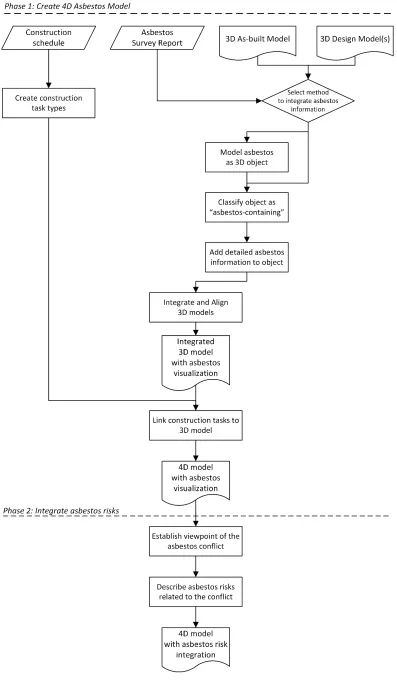
A method is developed to generate a 4D system that visualizes asbestos and integrates asbestos risk information. This method is also depicted in the schematic diagram in Figure 2. The method can be divided into two phases. The first phase involves integrating the required types of input to create a 4D model that visualizes asbestos. The second phase involves the identification and integration of asbestos risks in the 4D model.
The three types of input for the 4D model are:
Design. These data include the existing situation and the new situation according to the design. These data needs to be captured in 3D models first to create a 4D model.
Schedule data. These data should include the construction activities determined to arrive at the design of the new situation and the phasing and the time-schedule in which these activities are planned. The construction schedule is often captured in work breakdown structures. Phasing can also be incorporated in the 3D model.
Asbestos data. These data should include the locations of the asbestos containing materials in the building as well as the detailed characteristics of the asbestos in the material. This information is often obtained from asbestos survey reports.
3.1.
Creating a 4D Asbestos Model
The first step is to compare the design model or models to the asbestos documentation. It should be determined whether all asbestos-containing materials as determined in the surveys are also modelled as objects in the 3D models. All asbestos-containing materials that are not created in the models yet should be modeled as 3D objects. These objects are then, together with the objects that already have been modeled, classified as “asbestos-containing”. For example, when a wall cladding is determined asbestos-containing and the wall is modeled but the layer of cladding is not, it is recommended to model the layer of cladding as a 3D object and subsequently classify this object as asbestos-containing.
The last step is to integrate and align all 3D models into one model, creating an integral 3D model that combines the existing situation and new design and visualizes asbestos.
Following the traditional technique for integrating 3D models and the construction schedule the method proposes first to create task types. These task types describe the nature of the construction activity performed (preserve, demolish, construct and temporary). By linking these task types to the 3D objects in the model the task types specify how the objects in the model are displayed during construction process simulations. The next step is to import the construction schedule. Using the 4D tool, construction tasks from the schedule can be linked to the 3D objects involved with these activities. These steps have generated a 4D model that visualizes the design and asbestos-containing materials and allows to simulate the construction process within the existing building.
3.2.
Integrating Asbestos Risks
Now that the 4D asbestos model is created, the model can be used to identify the potential for disturbance of asbestos. This potential is high when construction activities are executed with or near to the asbestos-containing materials. The next step is to identify these potentials in the model. Indications of the potential for disturbance would be:
Asbestos-containing objects are planned to be demolished or adjusted,
Objects to be demolished are connected to – or situated near to – asbestos-containing objects, Objects to be built are planned near to – or planned to be connected to – asbestos-containing objects.
4D CAD tools allow to identify space conflicts between design features and asbestos-containing objects automatically through clash-detection functionalities. These detection tools automatically identify areas where asbestos-containing objects clash or almost clash with constructed or demolished objects. The manually or automatically identified clashes should then be documented in the model through capturing a three-dimensional viewpoint of the area.
Hartmann & Vossebeld (2013) argue that signs, such as symbols or icons, can be applied in construction process visualizations to convey risk information. To effectively communicate the asbestos risk information it is proposed to textually add a description to the conflict as the last step of the method. The probability and impact of disturbance and subsequent fiber release depends on a number of factors, as seen in literature. Understanding such risks would require an elaborate description about the asbestos characteristics. It would be difficult to visually depict this sophisticated risk information through signs. The CAD tools provide functionalities to add textual information two or three-dimensionally in the model.
4
Validation of the Modeling Method
To indicate whether the method presented yields a system that is capable of supporting asbestos risk
management the proposed method is applied on a real redevelopment construction project on
Schiphol Airport.
The presence of asbestos in the terminal buildings of the Dutch airport Schiphol has been a major obstacle to successful execution of construction projects for years. In a highly dynamic and operational environment like an airport terminal, construction projects are especially complex and risky. Asbestos risk poses additional threats on construction processes, operational processes and on the well-being of laborers and passengers.
4.1.
Introduction of the Project
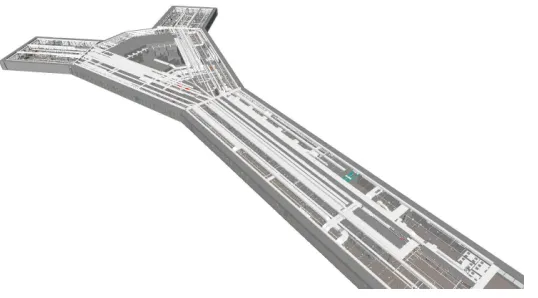
[image:18.595.185.454.366.515.2]The case project used is referred to as Gate Process Innovation Phase 2 (GPI2). The project includes the redevelopment of the first floors of the E, F, and G-pier. For the research the redevelopment of the F-Pier (4.800 m²) is chosen.
Figure 3: Snap-shot of the building information model of the existing situation of the F-Pier
The building and the new design are generated in a 3D model. The as-built model of the F-pier is depicted in Fout! Verwijzingsbron niet gevonden.. In this building, asbestos has been applied in façade panels, almost all air ducts of the ventilation system, equipment rooms, and in the stair tiling at the staircases. The scope of the redevelopment includes demolishing/removing existing barrier walls, adjusting the layout of HVAC installations, relocating interior elements, centralizing and upgrading sanitary facilities, and adjusting electronical installations. Asbestos risk is not yet extensively involved in designing and planning in this project and the probability and impact of the risks involved are not comprehensively understood. Exact asbestos locations are not well known. No tools or processes exist that helps the project team to accurately assess the risks of asbestos to the project. As a result, asbestos risk is not optimally managed.
construction schedules are not yet developed. There is no detailed construction schedule and the integration of a construction schedule is not yet relevant in this phase. To create a system that is useful for this project the integration of schedule therefore is limited. Construction task types and phasing properties can however be incorporated for this case. A 3D System created with the proposed modeling method would potentially help practitioners to assess and act on asbestos risks more effectively in this construction project.
4.2.
Research Method
For the application of the method on the real construction project, as introduced earlier, the action research methodology was followed. Baskerville & Wood-Harper (1996) argue that action research is regarded by many as the ideal research method for information systems research. Action research is aimed acquiring scientific knowledge through proposing a solution to a local situation (Baskerville & Wood-Harper, 1996). Action research thus facilitates the development of an information system such as a 3D or 4D model and the implementation of the system in a real situation.
Hartmann, Fischer & Haymaker (2008) argue that due to the knowledge-intensive nature of project routines and the temporary nature of projects, routines differ across projects and even within a single project. The authors propose to apply ethnography in action research to achieve optimal integration of the system with the local project routines. Ethnographic Action Research (EAR) complements action research by providing techniques to gain in-depth understanding of local project routines, which ensures that the developed solutions integrate well into the project context (Hartmann, Fischer, & Haymaker, 2008). The authors prove that the ethnographic action research method suits well to support developing and implementing information systems on the project level. Therefore the research is conducted following the EAR method .A disadvantage of the EAR method is that the process is relatively time-consuming. The possibilities to fully implement a system and perform iterations during a five month research are limited.
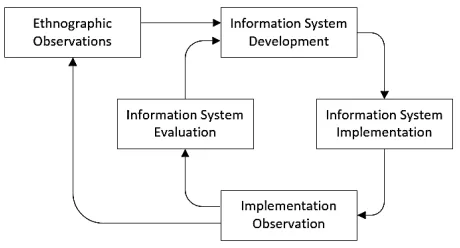
[image:19.595.196.426.624.748.2]Action research usually involves an iterative cycle of observation of practitioners, identification of problems, development of solutions, and implementation of the developed solutions (Hartmann, Fischer, & Haymaker, 2008). Through this cycle information systems are developed and iteratively improved in close collaboration with project practitioners. A schematic model of the applied research method is depicted in Figure 4. The action research steps are based on the ethnographic action research process formulated by Hartmann, Fischer & Haymaker (2008).
Following, the steps of the research process are further elaborated.
The first step in the research was to conduct an ethnographic observation of the local project routines involving asbestos and risk management. The project team was closely followed in its day-to-day work practices. The project members that played a key role in managing asbestos risk in construction projects were actively involved in the process to confirm conclusions drawn from the observations and think along with the conceptualization of the solution. Furthermore, multiple sessions, meetings and discussions related to risk and asbestos management were attended. For context, also BIM management and design coordination meetings were observed. Quantitative data was collected through analyzing the large collection project documents and management protocols. Through semi-structured interviews with key project members the quantitative data could be verified and deeper understanding was gained about how the practitioners personally perform and experience work tasks.
The semi-structured approach was applied to provide the interviewee with the opportunity to make additional remarks next to the specific topics addressed in the interview. For validity purposes possibilities to triangulate data were fully exploited (Hartmann, Fischer, & Haymaker, 2008). Triangulation was achieved through cross verification of quantitative data collections such as project documents and qualitative data collections. such as the interviews.
After the observations the development of the information system begins. From the project observations the required inputs for the 3D system could be obtained. With close involvement of the project team the 3D system was developed according to the steps described in the modeling method.
After the 3D system created able to visualize asbestos and integrate asbestos risks effectively, the implementation of the system was prepared. Due to a delay in the development of the project however it was not possible to utilize the system for real decision-making tasks regarding asbestos. It was decided to organize fictive implementations with the key project members. In a one hour session with the research student and the practitioner, the system and its functionalities were demonstrated and through semi-structured interviews the practitioners were asked to evaluate how the system supports their tasks. The interviews were semi-structured to collect specific answers but also to capture thoughts of the practitioner outside of the specific topics addressed.
Based on the findings of the implementations conclusions about the system’s capability to support decision-making tasks for the project are formulated. Furthermore, potential improvements could be determined from the implementations. One improvement was further explored and implemented in the 3D system.
5
Creating the System
Prior to applying the method for developing the system for the case project, an analysis of the project
contexts was conducted. Participant observations and analyses of the project work routines were
performed. The aim of the analysis was to gain an in depth understanding about practitioner’s work
routines. Understanding these routines helps to developing an information system that integrates
well into the project context (Hartmann, Fischer, & Haymaker, 2008).
5.1.
Ethnographic Observations
Following the ethnographic action research methodology the project team’s work routines were closely observed while project documentation was collected and unstructured interviews were conducted
Meeting observations, conversations and unstructured interviews contributed greatly to understanding how practices actually take shape and what issues emerge. Risk management protocols were analyzed and risk identification sessions were observed to discover what efforts are made in managing asbestos risk in the local project risk management practices. Asbestos control processes were uncovered through conversations and analyzing asbestos protocols. Design meetings were observed to discover what role asbestos plays in coordinating and reviewing the design. BIM meetings were observed to uncover the work routines and the established organizational structure for managing the large set of building information models in the project. External parties were consulted to gain understanding about the existing asbestos locations. Triangulating the quantitative and qualitative data collections allowed for a comprehensive overview of the observed work practices. The most important findings are summarized.
5.1.1. Asbestos Risk Management on the Project
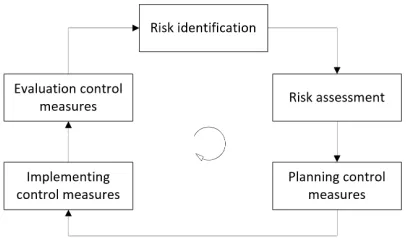
[image:21.595.210.413.624.743.2]A risk management process for construction projects is formulated by Schiphol Group. This process is also applied at the GPI2 project. The risk management cycle describes the following five steps: risk identification, risk assessment, planning control measures, implementing control measures, evaluating control measures, see also Figure 5. Various risk meetings exist within the project board, project management team, and project organization to identify and assess risks and discuss control measures. Risks are established in a project risk register, wherein cause and consequence, impact assessment and control measures are formulated.
The risk manager is responsible for facilitating and organizing the risk management process, and for
maintaining the risk register. The risk manager also monitors the status of the risks and control measures,
and advices the risk owners about acting on the risks. Risks were identified in collaborative brainstorm sessions with all members of the project team organized by the risk manager. After each identification session the risk manager processes all identified risks and documents these risks into the project risk register. Each risk is assigned to a member of the project team. This risk owner is personally responsible for assessing the risk and planning and monitoring appropriate control measures. The project’s risk management protocol prescribes a number of tools for assessing and communicating risks. After assessment control measures were planned and implemented. The actual implementation of control measures is carried out by the risk action-implementer. Five strategies are common in the project for controlling risks: by mitigating, preventing, transferring, sharing or accepting the risk. No processes exist that involve lessons learned from previous projects in decision-making. Evaluation of control measures eventually takes place to check whether the measures have been implemented well and if they were effective.
Within the organization it is common to leave asbestos in place as much as possible as abatement is not legally permitted but especially because it is very costly and greatly disturbs operational processes. To ensure safety on the airport all construction projects on the airport are supervised by a Safety and Security department of the organization. The asbestos safety expert of this department is not closely involved with
the risk management process of the project. The department advises to project organization in how to
ensure an asbestos safe environment during construction projects and closely monitors and reports on the
safety and security issues during the execution of projects. Partly due to the experiences of a previous construction project, asbestos risk management has a high priority in the project. Leaving asbestos in place in a building poses high risk on construction projects in that building. Asbestos risks were included in the traditional project risk management process. A risk owner for asbestos risks was chosen for his knowledge and experience in the field of asbestos control. The risk owner of asbestos risks plays the key role in controlling asbestos. Next to a risk owner, the risks was also assigned an action implementer. This action implementer was assigned the responsibility to act on the risk, primarily by executing the control measures
formulated by the risk owner.
5.1.2. Conclusions
Based on the ethnographic observations, some conclusions about the current asbestos risk management practices could be drawn. The risk management process is well facilitated in the project. Project risks have been identified and assessed and are actively managed. Asbestos risk specifically is managed ineffectively however. There is a lack of accurate information and proper communication of the available information. Due to this shortcoming it remains highly uncertain whether the presence of asbestos conflicts with the design and whether it may pose risks on the execution of construction activities. It shows that the survey reports do not provide the project members with the sufficient knowledge to accurately assess asbestos risk and to appropriately act on asbestos. As a result, assessment of asbestos risk is based on experience and “gut feeling” of the practitioner. Further, the project planners face difficulties deciding on the necessity of abatement and are unable to appropriately anticipate to asbestos risk in execution schedules.
5.2.
Creating the System with the Modeling Method
Based on the findings of the observations, creating the 3D system started following the proposed method.
The 3D system was developed in a commercial BIM-tool called Solibri Model Checker©. This tool was chosen because it was also applied in the project, and all key project members were familiar with the tool. The first step was to obtain all the required types of input. These were (1) the 3D model of the existing building (2) the 3D model of the new architectural design, (3) the 3D model of the existing MEP installations, (4) the phasing schedule of the redevelopment project, and (5) and information from the asbestos survey report. From the surveys the following asbestos-related information could be obtained:
The objects containing asbestos;
The location of the asbestos within the specific objects; The type and friability of the asbestos;
The determined risk class and required abatement method for each object.
The survey reports provided sufficient information to determine what objects in the model contain asbestos. It was concluded that the models had a sufficient level of detail so it was not required to perform additional modeling work to integrate asbestos-containing objects. The correct objects could be classified as asbestos-containing. Detailed asbestos information was integrated within these objects through object classification. These classifications functioned as a property of the 3D objects. For each object the correct value could be filled in (e.g. classification = “risk class”, object value = “2”).
Next, construction task types were created as classification and coupled to the 3D objects in Solibri. In the design model, objects were already assigned the property demolished or constructed. This information helped to assign the right objects to each construction task type classification. Based on the construction phasing plan created by the project planner, five phases were created, also as classifications. Based on the 2D drawings that illustrated the phasing plan, all objects could be assigned the correct phase.
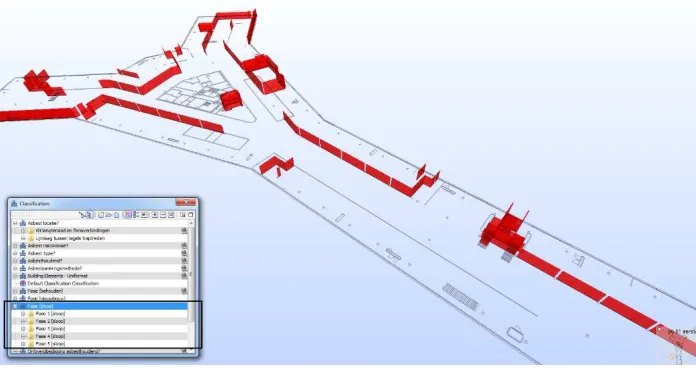
Coloring the asbestos-containing objects and the constructed and demolished objects is applied to easily distinguish between asbestos-containing and not asbestos-containing objects and construction activities. Filtering could be applied to display these objects individually. Using the classification selection box, tge construction phase breakdown structure could be viewed and used to isolate objects by both construction task and phase, see for example Figure 7.
Figure 6: The integral overview of the project
(Red: demolished, Green: new construction, Yellow: asbestos-containing)
Figure 7: Highlighting all Demolished Objects
[image:24.595.137.485.415.599.2]With the model created, the next step was to identify conflicts between asbestos and construction. The Solibri tool is capable of moving fluently through one or more highly complex models. The different colors of objects in the integrated model allows to quickly identify conflicts between asbestos and design.
[image:25.595.135.488.163.351.2]Together with an asbestos safety expert within Schiphol Group, conflicts could be identified and described.
Figure 8: Example of an asbestos-related conflict.
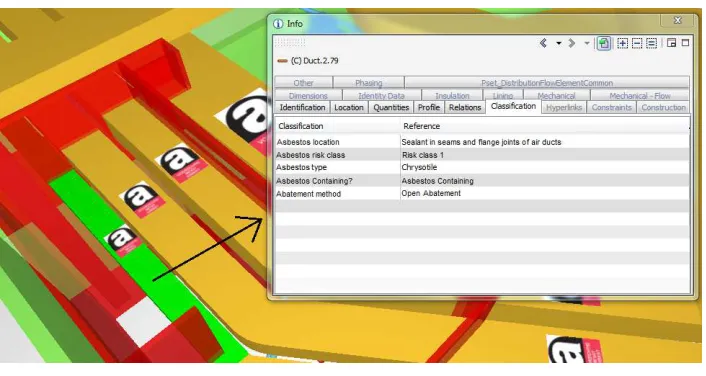
Consulting asbestos specific information of an object in the model
The conflict in Figure 8 for example, displays that demolishing activities are planned with objects (red) that are connected with asbestos-containing air ducts (yellow). To communicate that the conflict involves asbestos, the common warning sign for asbestos-containing materials was placed on the surface of the objects in the model. The sign was also used in other buildings at the airport to label asbestos-containing materials.
The conflict illustrated yields a potential for disturbance. The potential for disturbance is regarded considerable by the asbestos safety expert. Due to vibrations and potential moving of the air ducts, release of asbestos fibers may occur. This would cause asbestos exposure to laborers and potentially nearby passengers. The asbestos information stored in the object indicates that the risk of exposure is low however, as this asbestos is of the less harmful non-friable sort. Furthermore, as abatement under containment is not required, removing the asbestos-containing air ducts would have little impact on the schedule.
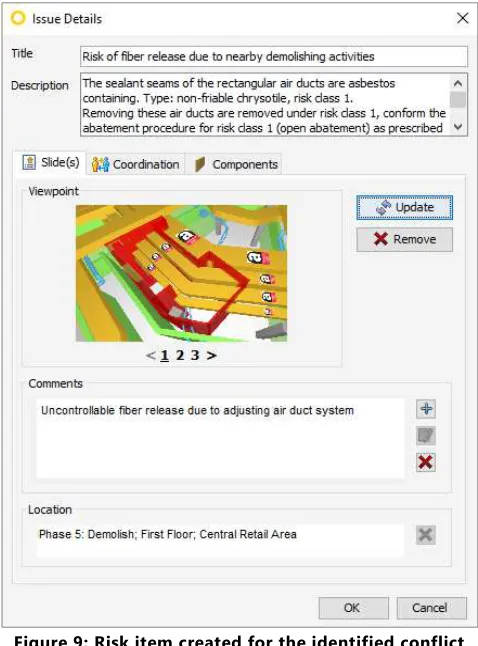
Figure 9: Risk item created for the identified conflict
The Solibri tool allows to extract the documented risk items into a PDF-file or Excel Spreadsheet. An Excel format was created with a layout similar to the traditional risk register applied in the project. The tool facilitates the extraction of the asbestos risk items to this risk register automatically, wherein the 3D view and all risk properties are stored and additional information, such as estimated impact and description of control measures, can be added.
6
Implementing the System
To assess whether the developed system is capable of supporting practitioners in real
decision-making tasks, implementation of the system is proposed by action research theory. As the design
and construction of the F-Pier building was postponed fictive implementations were organized
wherein the opinion of key project members involved in asbestos risk management was analyzed.
6.1.
System Implementations
The fictive implementation was organized as a live demonstration of the 3D system and its features and functionalities, guided by a semi-structured interview. In a semi-structured interview, the conversation can be steered toward specific topics, while the interviewee also has room to bring in what comes to mind at that moment. The interviewee is asked evaluate the system as if it was implemented to support their specific decision-making tasks for asbestos risks in the GPI2 project. In the interview the practitioner is asked how traditionally he or she performs tasks related to asbestos management, and how he or she expects that the 3D system may support these tasks, knowing the features and functionalities of the system. More specifically, it is asked what exact information would be required from the system to support these tasks, and if there is still information that the system does not provide.
6.2.
Implementation Observations
The key members from the project team for managing asbestos risk in the project had been identified from observing the project. The risk owner and risk action implementer are directly responsible for managing asbestos in the project. Further, an asbestos safety expert was consulted to identify and discuss asbestos risks in the project. Also a session with the risk manager and the modelers from the designing parties were organized. Following, the summarized findings during the implementation sessions are described.
Asbestos safety expert
A brainstorming session was organized with an asbestos expert from the Safety, Security and Environment department, who is closely involved in asbestos management during construction projects. The expert underpinned the argument from literature that the potential for disturbance may be regarded as the critical indicator for the risk of fiber release (Cherry, 1988). The integrated model was used to introduce the project to the expert and to navigate through the building. A brief summary of the scope of the project could be provided by highlighting the design and planned construction tasks. When navigating through the building the expert detected multiple areas that he considered risky in terms of the potential for disturbing asbestos containing materials. According to the expert the specific asbestos information supports assessing the probability and impact of risks.
Project risk manager
creates a more comprehensive understanding about the building and the presence of asbestos in the building. He also states that risks may be communicated more effectively as the three-dimensional representation leaves less room for personal interpretation. The risk manager expected that due to the comprehensive visualization of asbestos the project could be budgeted and planned more realistically. This expectation indicates that the 3D model also has the potential to support more accurate assessment of risks. Referring back to previous projects the risk manager argued that the probability and impact of asbestos risk was often estimated too low.
Risk Owner
As asset owner asbestos risk is often contractually assigned to Schiphol Group. As “owner” of the building the asset manager is owner of asbestos containing materials and therefore appointed risk-owner of asbestos risk in this project. The risk-owner is responsible for assessing the risks, choosing appropriate control measures and monitoring the risk throughout the project life cycle.
As the risk owner was closely involved in developing the information system, he was well-known with the functionalities of the system. The risk owner argued that the system provides a unique and novel way to communicate asbestos information. Where traditionally asbestos is documented as textual information, supported with a photograph, this system visualizes the geometry and spatial extents of the asbestos in the building and its relation to the design of the construction project. The risk owner expected that the system supports identifying risks related to asbestos and that it would greatly contribute to a more accurate assessment of these risks. He also expected that the three-dimensional representations help to devise more appropriate control measures and design changes. The risk owner also suggested that he would exchange the model with the designing parties to inform them about the present asbestos and require them to consider this information during design activities.
Risk Action Implementer
A session with the action implementer for asbestos risk was organized, who has the responsibility for implementing control measures for asbestos risk.
Looking at the model the action implementer argued that the representation of all asbestos objects supports assessing the scale of the present asbestos and its potential impact on the project. The action implementer expects that the system could also be used to support design activities. He argued that the model should be exchanged with the designing parties to communicate the conflicts between design and asbestos. Following from these issues, the practitioner expected that the designing parties can use the model to develop design changes to proactively prevent asbestos risks. He added that, due to the gained understanding the system creates, he would use the system as a mitigating measure for asbestos risks. The action implementer agreed with the risk owner’s suggestion to exchange the 3D model with the designing parties and require them to take the present asbestos into consideration during design activities.
Designing parties
architectural company was organized. Following from asbestos risks, modifying the design may contribute to mitigating asbestos risks. As a proactive measure, it can be determined that design or schedule should be optimized within the constraints of current asbestos locations to prevent risks from occurring or prevent the necessity of abatement. However, how the design or schedule should be adapted is uncertain without a good understanding about the spatial properties of the asbestos. The 3D system could provide this knowledge as it integrates asbestos, design and schedule into a single model.
After a demonstration of the system and its functionalities both practitioners argued that the system would be very helpful to understand the spatial attributes of asbestos. The practitioners argued that they would use the model at specific moments in the design phase to check the design for conflicts with asbestos containing elements. The model would then be used at collaborative sessions with the other designing parties to navigate through the building and discuss conflicts between multiple designs and asbestos. Traditionally, great uncertainty exists about how asbestos would affect the designs, and asbestos was only considered after completion of the design. The practitioners expected that using this model many issues can be detected and solved much earlier in the process. The specific asbestos information, they argued, would be of little relevance however. Mostly the visualization of the geometric properties would be helpful during design activities. For reviewing performed design changes the practitioners expected that the issue functionality for documenting risk items would be helpful. These items could be used to address the area again after performing design changes to check whether the design changes, for example, reduced the potential for disturbance.
6.3.
Improvement Iteration
From the implementation sessions the desire to allow the system to automatically detect conflicts emerged. An automatic detection of intersections with asbestos-containing objects could potentially support identifying areas with potential for disturbance. It could be an improvement to make the detection of asbestos-related conflicts more efficient and prevent that conflicts are overlooked.
Improving the identification of conflicts
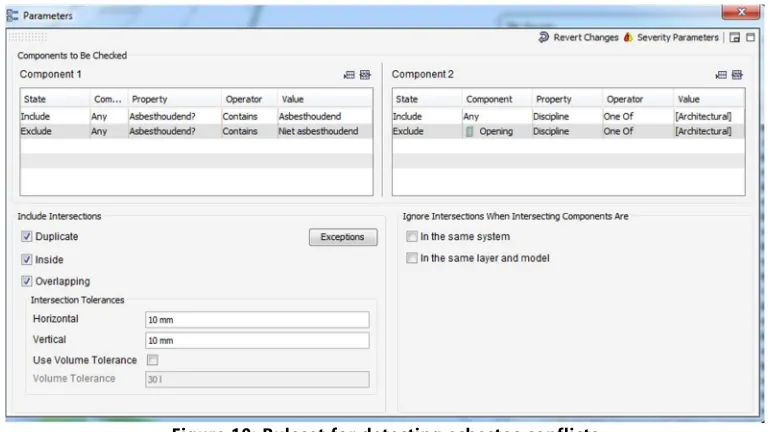
Solibri Model Checker is able to perform rule-based clash detections, a functionality that automatically identifies and reports on conflicts between objects, based on a set of rules. A ruleset was created that orders the clash detector to identify and document all conflicts with asbestos-containing objects and constructed or demolished objects, see Figure 10. A severity filter was applied in the ruleset that allowed to mark risk class 2 asbestos conflicts as more severe than risk class 1 asbestos conflicts.
Figure 10: Ruleset for detecting asbestos conflicts
[image:30.595.181.441.340.498.2]The ruleset prescribed to include all containing objects and to exclude all not asbestos-containing objects for the automated detection.
Figure 11: Adding a severity parameter
Figure 12: The list of automatically identified conflicts with asbestos
[image:30.595.104.524.536.706.2]7
Evaluating the System
This chapter describes the evaluation of the information system. First, the extent to which the system
supports risk management tasks is assessed. During the implementations it is observed how the user
evaluates the 3D system and how the user expects to utilize it during decision-making tasks.
7.1.
Contribution to asbestos risk management
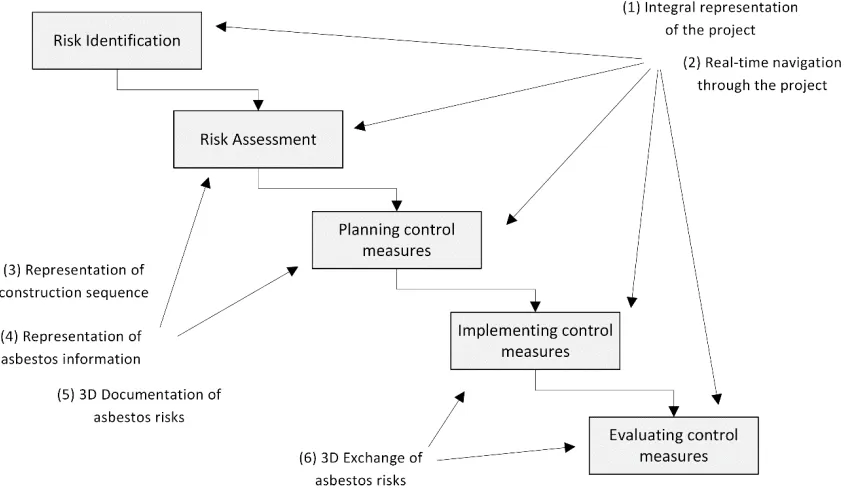
The judgement of the experts during the fictive implementations provide the first indications whether the 3D system can support risk management decision-making tasks. The implementations revealed that the 3D system potentially supports multiple tasks in the risk management process. For each phase of the risk management process the utilization of the 3D system is discussed. To assess what specific characteristics help practitioners in their decision-making task six core functionalities of the system were defined:
(1) An integral representation of the project; (2) Real-time navigation through the project; (3) Representation of the construction sequence; (4) Representation of asbestos information; (5) Documentation of asbestos risks; (6) 3D exchange of asbestos risks.
How each functionality supports risk management tasks is also depicted in Figure 13.
Risk Identification
Risk identification is traditionally performed in multiple collaborative brainstorming sessions and heavily relies on expert knowledge of the involved project members. For support, external experts and risk databases are consulted. The documented asbestos data is not involved in these risk identification efforts. Identifying asbestos risks specifically relies on even more sophisticated knowledge. The potential for disturbance which is the main factor for asbestos fiber release needs to be identified. During construction projects nearby construction activities or planned modifications are the main indicators for the potential for disturbance.
The implementation revealed that 3D system supported risk identification by providing knowledge necessary to determine the potential for disturbance. The integral display of the model laid bare the spatial relations between asbestos and construction activities. This three-dimensional insight allowed the asbestos safety expert to detect areas with a potential for disturbance, and subsequently identify risks. Real-time navigation through the model allowed to view the areas from a closer look and from different angles. This promoted understanding of the spatial extents of the problematic area.
Risk Assessment
in assessing asbestos risk. Probability and impact were determined without a comprehensive understanding about the potential for disturbance and the asbestos characteristics. Assessment is done by subjective evaluation based on the practitioner’s knowledge and experience.
During the implementations with the risk manager, project manager and risk owner it became evident that the 3D system provides multiple functionalities to support risk assessment. The visualization of the spatial extents of asbestos and its relation to design and construction activities, as well as the integration of specific asbestos information into the 3D objects allowed to quickly gain understanding about the amount of asbestos present in the building and about the potential impact on the project. This in turn would lead to a better grounded and more accurate assessment of risks.
Planning Control Measures
The project’s risk management protocol prescribes to use a number of different general strategies to controlling risk: by mitigation, prevention, transferring, sharing or accepting. For determining control measures the risk owner has the clearly understand the nature of the risk. In the project, the asbestos information available was not considered during the determination of control measures.
Due to the insights and specific asbestos information the model provides, the risk owner is supported in choosing appropriate control measures. For example, risk class 2 asbestos requires more radical control measures then relatively harmless risk class 1 asbestos. Furthermore, the spatial insights helps the risk owner to assess what the impact of measures would be on the passenger flows and operational processes. These insights will potentially support the risk owner in choosing control measures that involve asbestos information better and anticipate better to the operational environment and the construction process.
Implementing and Evaluating Design Changes as a Control Measure
A control measure mentioned multiple times was to mitigate the asbestos risk by adjusting the design. For implementing this measure the 3D system indicates to be of great support. The functionalities of documenting and exchanging the risk items are expected to support communicating the issues with design effectively to the designing parties.
The designers suggested that they would choose to apply the 3D model itself to support their design activities. Furthermore, the established viewpoints that visualize the conflict between asbestos and design are expected to support the designers in devising design changes. After reloading the revised design model into the system these conflicts can be addressed again through the saved viewpoints to check, for example, whether design changes have decreased the potential for disturbance. This indicates that the issue functionality also helps to review the performed design changes in the model.
7.2.
Conclusions
It can be concluded that the mainly the two functionalities of integral representation and navigating through the model are expected to offer the most potential to support risk management tasks. As the practitioners clearly prefer these two functionalities the functionality of automatically plotting a risk register from the 3D risk items is argued to be less important to risk management decision-making. Applying this functionality in the system was expected to be in line with the formalized nature of risk management in the project. However, most practitioners argued that the risk register would be of little added value if the 3D model could also be exchanged among project members.
[image:33.595.102.527.386.631.2]A potential challenge mentioned by the action implementer and project manager refers to the correctness of information. The building information models of the existing situation are based on a large database of CAD drawings and recent 3D scans in the terminals. Specific asbestos information is derived from the official recent survey reports. Findings in these survey reports are based on professional examinations of material samples and the judgement of asbestos experts. The practitioner mentioned that yearly hundreds of changes are made to the interiors of the airport buildings. Due to this dynamic nature of the existing situation the building information models decrease in accuracy over time, as incremental changes occur throughout the year. It would be a great challenge to keep asbestos information in the building information models of the facilities up to date.
8
Discussion
Asbestos-related risks deserve extensive attention in construction projects, as asbestos risks are particularly complicated and can have a large impact on the safety and performance of construction projects. Traditional documents do not provide the practitioner with the sufficient information to assess to what extent asbestos may have an impact on their construction projects. 4D models may be able to provide this information. Literature also indicates that 4D models are able to support risk management tasks. Yet, no studies are aimed at exploring how 4D CAD could be developed to support management of asbestos risk. This research was aimed to fill that shortcoming in literature.
8.1.
Theoretical Contributions
A method to develop a 4D CAD-based system is proposed that supports managing risks related to asbestos through integrating design data, schedule data and detailed asbestos information. The case study indicates that a 3D system developed with the method supports the identification of asbestos risks and contributes to a more accurate assessment of these risks and choosing appropriate control measures. This study contributes to 3D/4D CAD theory in multiple ways. In literature 4D models are developed to represent pre-defined risk information in order to improve the practitioner’s understanding about the identified risks. This study indicates that with asbestos risks, such models are also able to support practitioners with identification of risks. Furthermore, this study proposes a new way to integrate risk information into the model. Literature has shown that risks could either be integrated by physically linking risk information to objects, or by visually representing risk information in construction process simulations. In this research both approaches are integrated, asbestos material information is physically linked to objects, while risk information was integrated as contextual information in the model instead of object information. Also, this study contributes to the existing asbestos literature. The current body of asbestos literature predominantly focusses on waste management, occupational safety and health. The domain of construction project management has been scarcely explored. This study appears to be one of the few to address the management of asbestos risk specifically for construction project management purposes. In doing so, this study is the first to prove that CAD models can be applied to support the management of asbestos risk in construction projects.
8.2.
Practical Contributions
devising appropriate measures to control the asbestos risks. Concluding, the proposed 4D modeling method would potentially help practitioners to act more effectively to asbestos early in the project life cycle, and prevent safety issues and delays during the execution of construction projects.
8.3.
Limitations of the research
Some limitations exist with respect to the application of the 4D modeling method to the case project. The method proposes to create construction task types and to link construction activities with the objects in the 3D model as a means of integrating the construction schedule. For the construction project on Schiphol Airport the integration of the construction scheduling was limited to linking construction tasks and phase information to the objects in the model. At this phase of the project it was sufficient to visualize whether objects were constructed, temporary or demolished and it what sequence the construction is planned. The software tool applied to generate the model was limited in attaching time properties to objects and generate fluent construction process simulations. The method is therefore not fully applied and validated. The system created should be regarded a 3D system. The study does however provides a stepping-stone for further research efforts aimed at applying the method for integrating asbestos in 4D models.
Another limitation is that the 3D system is not implemented for real decision-making processes. The opinions of the practitioners about the 3D system do however provide some valuable indications about the supportive capabilities of the system for various decision-making tasks.
The method proposed proved to be suitable for developing the system with the tool Solibri Model Checker. This is just one of the many tools that exist to create and assess integrated models. Furthermore, the tool does not allow to flexibly integrate the construction schedule. The study did therefore not prove that the method is also suitable to create a 4D system using 4D tools such as Autodesk Navisworks or Vico Office.
8.4.
Further Research
This study appears to encompass the first attempt in literature to integrate asbestos in a 4D modeling method. As asbestos will continue to pose threats on construction projects in existing buildings research on this topic is relevant. In addition to this study further research in 3D and 4D modeling would be required to generate a larger body of empirical evidence on this subject.
Construction projects in existing buildings such as shopping malls or hospitals are often executed in an operational environment. During such projects continuation of operations, commercial processes and people flows are often critical issues. Especially in these environments exposure to asbestos would be extremely undesirable. This study can be a stepping-stone for future researchers that aim to improve asbestos risk management in operational contexts.
9
Conclusion
To effectively manage asbestos risk in construction projects practitioners need to know how asbestos affects their designs and planned construction activities. This requires understanding of the exact locations and detailed asbestos characteristics which is often captured in documents and schematic drawings. These data however do not provide practitioners with sufficient insight in how asbestos affects the construction projects. 4D models integrate design and construction schedule and allow to visualize risk information in a three-dimensional environment. 4D CAD would therefore potentially support practitioners in managing asbestos risk in construction projects. However, in literature no studies exist that propose a method to integrate asbestos information in 4D models. This research addressed that shortcoming in literature by developing a method to integrate asbestos information into a 4D model.
The method proposed integrates design, schedule and asbestos data and so provides practitioners with a tool to identify the potential for disturbing asbestos within the construction project’s design and schedule. Through ethnographic action research a 3D system was developed according to the proposed method and implemented in a real airport construction project. The findings indicate that the system is able to support practitioners with risk management decision-making tasks in all phases of the risk management process. The system was expected to allow for identification of asbestos risks and support practitioners in assessing asbestos risks more accurately and devising more appropriate control measures to these risks.
List of Figures
Figure 1: Creating a 4D CAD model. ... 9
Figure 2: Schematic diagram of the 4D modeling method ... 13
Figure 4: Snap-shot of the building information model of the existing situation of the F-Pier ... 14
Figure 3: Schematic Model of the Research Method ... 15
Figure 5: The followed Risk Management process in projects ... 17
Figure 6: The integral overview of the project ... 20
Figure 7: Highlighting all Demolished Objects ... 20
Figure 8: Example of an asbestos-related conflict. ... 21
Figure 9: Risk item created for the identified conflict ... 22
Figure 10: Ruleset for detecting asbestos conflicts... 26
Figure 11: Adding a severity parameter ... 26
Figure 12: The list of automatically identified conflicts with asbestos ... 26