Does Cloud Computing Matter?
Networking IT and Services Value in Organizations
Cheng-Chieh Huang
Dept. of Information ManagementNational Taiwan University, Taipei, Taiwan [email protected]
Ching-Cha Hsieh
Dept. of Information ManagementNational Taiwan University Taipei, Taiwan [email protected]
Abstract—This article argues that cloud computing matters through interactions between organizations, IT, and cloud services. It illustrates the cloud computing value generation processes of Amazon, Google, IBM, and Microsoft and examines their strategies. Furthermore, this paper proposes value networking concepts and an ANT lens for future research on cloud computing and business values.
Keywords-cloud computing; IT value, actor network theory
I. INTRODUCTION
Since Carr [1] published his article “IT Doesn’t Matter” in the Harvard Business Review, scholars have started to reconsider the business value of information technology. Carr [1] argued that IT has become a kind of commodity like water or electricity, and is thus no longer specific strategic value to enterprise. The introduction of cloud computing partly reinforces Carr’s claims, by potentially outsourcing certain IT functions to a third party service. However, cloud computing is also considered as a strategic weapon, helping enterprises lower the costs and increase their competitiveness. Does cloud computing matter or not?
Past literature on IT and business value divides IT value into two types. One, called technology determination, views IT as a strategic resource or innovative tool, and states that a specific IT can create value for organizations. Another, organization determination, claims that IT increases competitiveness when it’s aligned with organizational strategy.
With this perspective, cloud computing appears to offer technical innovation, but not all organizations can enjoy the benefit immediately. It seems that IT and organizational value generation do not share a simple causal relationship [2].
Furthermore, cloud computing is not only a technological innovation but also a service innovation. Thus, any evaluation that fails to consider the service advantages of cloud computing neglects an important characteristic.
In this article, we consider the IT business value generated through dynamic interactions of organizations, IT artifacts and services. We use the cloud computing development cases of Amazon, Google, IBM, and Microsoft to demonstrate how different business values emerged through the dynamic interactions within these companies.
We argue that while IT is more service-oriented, a
between IT, services, and business values. As a result, we employ actor network theory (ANT) as a lens to illustrate the value of cloud computing and the implications of further research.
In the following sections, we first review the literature of cloud computing and IT business value, and then propose an analytical framework. Next, we describe our methodology and use our research framework to illustrate four business case studies. Finally, we discuss our conclusions and identify contributions, limitations and suggestions for future research.
II. LITERATURE REVIEW
A. Cloud Computing
Cloud Computing generally refers to applications or IT resources delivered as services over the Internet, and the datacenter hardware and system software that provides those services. Definitions of cloud computing are diverse [3, 4]. Vaquero et al. provide one careful definition [4]:
Clouds are a large pool of easily usable and accessible virtualized resources (such as hardware, development platforms and/or services). These resources can be dynamically re-configured to adjust to a variable load (scale), allowing also for an optimum resource utilization. This pool of resources is typically exploited by a pay-per-use model in which guarantees are offered by the Infrastructure Provider by means of customized SLAs (p.51).
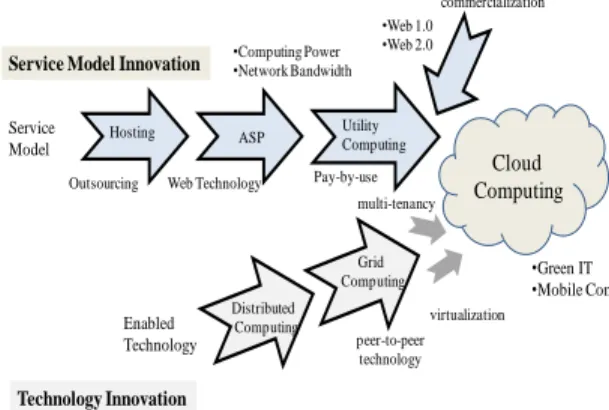
From this definition, cloud computing functions not only as an enabling technology but also as a service model. From the beginning, cloud computing has co-evolved as both a service and technology innovation (see Figure 1).
This implies that evaluations of cloud computing such as Carr [1] cannot only examine its IT characteristics, but also its service of economic model. Evaluations of cloud computing must consider both aspects.
Hosting ASP UtilityComputing Web Technology •Computing Power •Network Bandwidth Web commercialization Distributed Computing Grid Computing Cloud Computing peer-to-peer technology virtualization multi-tenancy Service Model Enabled Technology
Service Model Innovation
Technology Innovation •Web 1.0 •Web 2.0 Pay-by-use Outsourcing •Green IT •Mobile Computing
Figure 1. Co-evolution of Cloud Computing
B. IT and Business Value
Past literature on IT and business value focuses on three perspectives: assets, investments, and alignment (see Table 1). The asset perspective views IT as a strategic resource or an innovation tool that when introduced to organizations generates value. For example, Lynntien argues that Internet computing technology brings the disruptive nature of innovation to organizations [5]. Additional studies claim that IT generates business value through its combination with other complementary organizational resources, such as human resources or business relations [6, 7].
The investment perspective looks past organizational characteristics or strategy and instead focuses on financial models, such as the real option model or productivity factor counting [8, 9]. This perspective is problematic however, as existing literatures increasingly argues that organizational characteristics influence IT investment and firm performance relations [10].
The alignment perspective considers how IT may improve a firm’s performance by fitting certain organizational needs or aligning with organization strategy [11][12]. However, this viewpoint largely fails to explain why certain Internet characteristics or cloud computing increase opportunities to strengthen a company’s competitiveness.
TABLE I. LITERATURE REVIEW OF IT AND BUSINESS VALUE
Perspectives IT and Business Value Literature
assets IT as strategic resource [5] [6] [7]
IT as innovation tool
investments IT as investment [8] [9] [10]
IT as productivity factor
alignment IT organizational fit
information processing [11] [12] IT aligned to business strategy Value of Cloud Computing Organization IT Service
Figure 2. Research Framework
In summary, the potential relationship between IT and business value generation is not straightforward, but rather emerges through interactions between organization and IT [2].
C. Research Framework
Based on the literature described above, we design a framework for examining the cloud computing value generation process within different organizations. A diagram of this framework is presented in Figure 2.
III. METHODOLOGY
In this paper, we use case study methodology [13] to examine cloud computing and business value. We selected four firms: two Internet service firms (Amazon, Google), and two technology vendors (IBM, Microsoft). These four firms are famous for their use of cloud computing. Our data sources include documentation on their cloud computing development histories, news reports, company reports, successful cases, and independent analysis reports such as IDC, Gartner, and Ovum [14]. We also interviewed high-level managers to discuss their strategies and their perceptions on the values of cloud computing. All interviews were recorded. From this data, we use event analysis and our research framework to understand their value generation processes.
IV. CASE STUDIES
A. Amazon
Headquartered in Seattle, Amazon was established in 1994 as primarily an online bookstore. They soon expanded to flowers, software, electronic goods, toys, and eventually general retail items. Amazon was the first top 500 online retail business in the United States, with recorded profits in 2009 of roughly 24 billion dollars.
Amazon Supply Chain
Partner’s Supply Chain Partner’s Supply Chain Partner’s Supply Chain
Cloud Services
Figure 3. Amazon’s Cloud Comuting Strategy
The development of cloud services at Amazon began in 2003, when it first offered web services for its e-commerce partners. For example, partners who used Amazon’s online store to sell music CDs could use Amazon’s services to rank the latest music purchases and examine customer comments in order to better market and sell their products. These web services helped partners use Amazon as a promotional site for their goods.
To better facilitate their small electronic store partners, Amazon gradually transferred their internal IT infrastructure to cloud services. This included such functions as storage (S3), server computing resources (EC2) and even e-commerce business processes, such as fulfillment processes (FWS), payment processes (FPS), and personnel matching processes (Mechanical Turk).
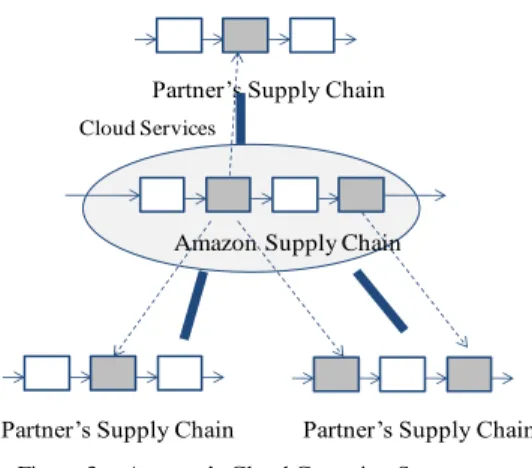
Through the development history of cloud computing at Amazon, we understand that Amazon first offered website design and development tools to help partners sell goods through Amazon’s online store. After integrating various kinds of services with partners, Amazon strengthens the competitiveness of its whole supply chain operation (see Figure 3).
B. Google
The largest online Internet search engine in the world, Google is headquartered in California and was established in 1998. Relying on advertising revenue from its search engine business, Google earned 23.6 billion dollars in 2009. For several years now, Google has moved beyond online searching, as represented by its acquisition of YouTube, the development of the Android open source operating system, the Google Chrome Internet browser, Google Earth, and various cloud services.
Google first announced its cloud services in 2005. The primary purpose of the Google API is to let consumers log into their websites frequently, increasing web traffic, and thus encouraging advertisers to place their ads on Google websites. Search Engine Google API Open Social Gmail Google Earth Google APE YouTu be Google Apps Google Chrome Android Mobile Phone OS Traffic=$
Figure 4. Google’s Cloud Comuting Strategy
Later, Google developed various types of cloud services for both consumers and website designers, such as Google Docs, Google Financial, Google Spreadsheets, Google APE, and so fourth.
For Google, search engine traffic is revenue (traffic=$). That is, services are developed and branches are merged to help improve traffic. For example, YouTube or Open Social API were acquired and merged or linked with other social community websites in order to increase their popularity and thus increase traffic. Through the new Android operating system and Google Chrome, Google hopes to connect cell phones and browsers directly to its search service, and make this service more convenient.
As Figure 4 shows, cloud services support Google’s “traffic equals money” strategy, which attracts more consumers to its search engine and thus increases advertising revenue.
C. IBM
Established in 1924, IBM started with making enterprise information hardware, such as electronic calculators, large-scale mainframes, and the first generation of personal computers. Recently, IBM has shifted its business towards services and software provided to large enterprises.
IBM started developing cloud services to help its small independent software vendor (ISVs) partners located worldwide use IBM’s servers or storage capacity. This obviated the need for ISVs to invest in hardware/software, and allowed them to develop software through IBM’s own platform. Later, IBM developed their cloud computing technology into products that support their large enterprise customers in building their own cloud data center. IBM’s online cloud services help showcase their cloud computing technology solutions.
On-Promise Market
Enterprise Market Brick-and-Mortar Company
Cloud Service Market
SME Market Online Service Company
Figure 5. IBM’s Cloud Comuting Strategy
IBM attempts to use the cloud computing technology products and leverage their consulting services and software implementation experiences in the large-scale enterprise and then explores to small and medium enterprises and on-line service companies market.
Take her cloud services implementation experiences in UPS for example, IBM combined cloud services with their software implemented in UPS. IBM supported their customers, UPS and also touched UPS’s online partners. It is so-called two-sided market strategy includes the large-scale enterprise software service market (on-promise market) that IBM has already deeply engaged and new developing medium and small-scale online service companies (cloud service market).
For IBM, cloud services and technology play a bridge role to explore on-line and small medium enterprise (SME) markets (see Figure 5).
D. Microsoft
Established in 1983, Microsoft was an early leader in computer operating systems and suite software on the personal computer with both its MS-DOS operating system and MS-Office software suite.
Microsoft earned 58 billion dollars in profit in 2009. Its personal and commercial Office series accounts for more than 90% of the market.
Despite its dominant market position, Microsoft realizes the growing trend towards online services, and that PC or on-promise software are no longer the only choices. It is thus finding ways to combine its software expertise with online services.
This is the concept of “software plus services” or “3 screens and a cloud” that Microsoft announced in 2009. For Microsoft, cloud services or cloud computing technology helps the company smoothly transition to a new "network operating system" by combining their traditional on-promise software with these services (see Figure 6).
Phone TV
PC Software
Services
3 Screens and a Cloud
Software plus Services Figure 6. Microsoft’s Cloud Computing Strategy
V. LANALYSIS AND DISCUSSION
A. Networking IT/Service Value
The four cases described above demonstrate that different companies view different opportunities with cloud computing, and align their strategies accordingly to generate value.
For these firms, cloud computing is not only a technology artifact, but also a part of their service model. In this way, it represents a techno-economic network (TEN) [15].
Callon described TEN as “a coordinated set of heterogonous actors which interact more or less successfully to develop, produce, distribute and diffuse methods for generating goods and services.” From Callon’s point of view, the economic value is generated from actors, intermediaries (nonhuman), translation and their relationships [15].
In Amazon’s case, cloud computing services stemmed from their internal IT and originally supported their business processes. Then, Amazon enrolled their e-commerce partners, adopting their web services, and then embedding their cloud services within their daily business operations. Amazon thus used IT and cloud services to form their partners’ networks and strengthen their own business value (Figure 7).
Internal business process operation performance partner’s web site cloud services partner’s business process cloud services 2 1 4 3 5 6 Internal IT Amazon
cloud
service#1 cloudservice#1
IT#1 product#1
business strategy
Figure 8. Google’s Value Networking
cloud services ISVs partners IT products , org strategy ISVs, SI partners online partners (ex: Google) cloud services online/SME customers 1 2 3 4 5 6 7 IBM
Figure 9. IBM’s Value Networking
Microsoft cloud services customers devices on-promise IT products, org strategy 1 1 2 2 2 3
Figure 10. Microsoft’s Value Networking
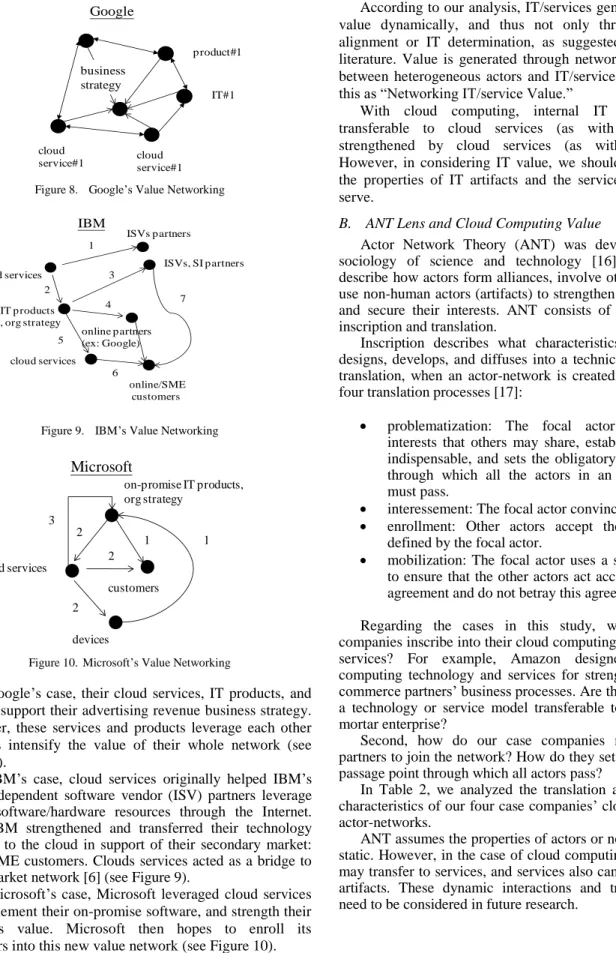
In Google’s case, their cloud services, IT products, and tools all support their advertising revenue business strategy. Moreover, these services and products leverage each other and thus intensify the value of their whole network (see Figure 8).
In IBM’s case, cloud services originally helped IBM’s small independent software vendor (ISV) partners leverage IBM’s software/hardware resources through the Internet. Then, IBM strengthened and transferred their technology products to the cloud in support of their secondary market: online/SME customers. Clouds services acted as a bridge to a new market network [6] (see Figure 9).
In Microsoft’s case, Microsoft leveraged cloud services to complement their on-promise software, and strength their product’s value. Microsoft then hopes to enroll its customers into this new value network (see Figure 10).
According to our analysis, IT/services generate business value dynamically, and thus not only through strategy alignment or IT determination, as suggested by previous literature. Value is generated through networking activities between heterogeneous actors and IT/services. We refer to this as “Networking IT/service Value.”
With cloud computing, internal IT artifacts are transferable to cloud services (as with Google) or strengthened by cloud services (as with Microsoft). However, in considering IT value, we should both discuss the properties of IT artifacts and the service models they serve.
B. ANT Lens and Cloud Computing Value
Actor Network Theory (ANT) was developed in the sociology of science and technology [16]. ANT helps describe how actors form alliances, involve other actors and use non-human actors (artifacts) to strengthen such alliances and secure their interests. ANT consists of two concepts: inscription and translation.
Inscription describes what characteristics an engineer designs, develops, and diffuses into a technical artifact. For translation, when an actor-network is created, it consists of four translation processes [17]:
problematization: The focal actor defines the interests that others may share, establishes itself as indispensable, and sets the obligatory passage point through which all the actors in an actor-network must pass.
interessement: The focal actor convinces other actors.
enrollment: Other actors accept the interests as defined by the focal actor.
mobilization: The focal actor uses a set of methods to ensure that the other actors act according to their agreement and do not betray this agreement.
Regarding the cases in this study, what do these companies inscribe into their cloud computing technology or services? For example, Amazon designed its cloud computing technology and services for strengthening its e-commerce partners’ business processes. Are the properties of a technology or service model transferable to a brick-and-mortar enterprise?
Second, how do our case companies mobilize their partners to join the network? How do they set the obligatory passage point through which all actors pass?
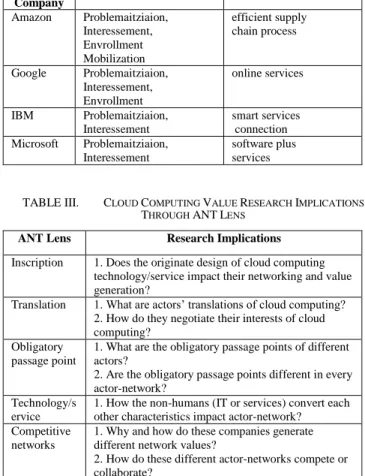
In Table 2, we analyzed the translation and inscription characteristics of our four case companies’ cloud computing actor-networks.
ANT assumes the properties of actors or non-humans are static. However, in the case of cloud computing, IT artifacts may transfer to services, and services also can strengthen IT artifacts. These dynamic interactions and transformations need to be considered in future research.
TABLE II. TRANSLATION AND INSCRIPTION OF CLOUD COMPUTING Focal Company Translation Inscription Amazon Problemaitziaion, Interessement, Envrollment Mobilization efficient supply chain process Google Problemaitziaion, Interessement, Envrollment online services IBM Problemaitziaion, Interessement smart services connection Microsoft Problemaitziaion, Interessement software plus services
TABLE III. CLOUD COMPUTING VALUE RESEARCH IMPLICATIONS
THROUGH ANTLENS
ANT Lens Research Implications
Inscription 1. Does the originate design of cloud computing technology/service impact their networking and value generation?
Translation 1. What are actors’ translations of cloud computing? 2. How do they negotiate their interests of cloud computing?
Obligatory passage point
1. What are the obligatory passage points of different actors?
2. Are the obligatory passage points different in every actor-network?
Technology/s ervice
1. How the non-humans (IT or services) convert each other characteristics impact actor-network? Competitive
networks
1. Why and how do these companies generate different network values?
2. How do these different actor-networks compete or collaborate?
Finally, in our case analysis, these companies generate different value networks. Do these networks compete? How do they compete?
In Table 3, we list additional issues and implications that are interesting for further research on the value of cloud computing, as seen through the ANT lens.
VI. CONCLUSION
In this article, we discuss cloud computing value generation through four company case studies. We argue that cloud computing value is generated through the interactions of organization, IT and services. We further analyze their value networking activities, and then propose ANT as a lens to interpret the cloud computing value generation process. ANT provides research implications for further research on cloud computing value and competitive strategy.
The analysis of this paper is limited to the four major company cases. Future research may investigate smaller
firms, and analyze firm activity, actor responses, and their translation within the actor network in more detail.
REFERENCES
[1] N. G. Carr, “IT Doesn’t Matter”, Harvard Business Review, 2003, pp. 41-49.
[2] M. L. Markus and D. Robey, “Information Technology and Organization Change: Casual Structure in Theory and Research”, Management Science, 1988, pp. 583-598.
[3] M. Armbrust and UC Berkeley RADSL, “Above the Clouds: A Berkeley View of Cloud Computing”, http://radlab.cs.berkeley/edu/, 2009, pp. 1-23.
[4] L. M. Vaguero, and L. Rodero-Merino, J. Caceres, and M. Lindner, “A Break in the Clouds: Toward a Cloud Definition”, ACM SIGCOMM Computer Communication Review, 2009, pp. 50-55. [5] K. Lyytinen and G. M. Rose, “The Disruptive Nature of Information
Technology Innovations: The Case of Internet Computing in Systems Development Organizations”, MIS Quarterly, 2003, pp. 557-595. [6] N. Melville, K. Kraemer, and V. Gurbaxani, “Review: Information
Technology and Organization Performance: an Integrative Model of IT Business Value”, MIS Quarterly, 2004, pp. 283-322.
[7] T. Ravichandran and C. Lertwongsatien, “Effect of Information Systems Resources and Capabilities on Firm Performance: A Resource-Based Perspective”, JMIS, 2005, pp. 237-276.
[8] M. Benaroch, S. Shah, and M. Jeffery, “On the Valuation of Multistage Information Technology Investments Embedding Nested Real Options”, JMIS, 2006, pp. 239-261.
[9] P. E. D. Love and Z. Irani, “An Exploratory Study of Information Technology Evaluation and Benefits Management Practices of SMEs in the Construction Industry”, 2004, pp. 227-242.
[10] L. Motiwalla, M. R. Khan, and S. Xu, “An Intra- and Inter-Industry Analysis of E-business Effectiveness”, I&M, 2005, pp. 651-667. [11] J. F. Fairbank, G. Labianica, H. K. Steensma, and R. Metters,
“Information Processing Design, Choices, Strategy, and Risk Management Performance”, JMIS, 2006, pp. 293-319.
[12] T. A. Byrd, B. R. Lewis, and R. W. Bryan, “The Leveraging Influence of Strategic Alignment on IT Investment: An Empirical Examination”, Information and Management, 2006, pp. 308-321. [13] R. K. Yin, Case Study Research, Design and Methods, 2nd Edition,
Sage Publications, CA, 1994.
[14] G. McCulloch, Documentary Research in Education, History and the Social Sciences, Routledge Falmer, London, 2004.
[15] M. Callon, “Techno-economic Networks and Irreversibility”, in: Law J. (ed.), A Sociology of Monsters: Essays on Power, Technology, and Domination, Routledge, New York, 1991, pp. 132-164.
[16] M. Callon, and B. Latour, “Unscrewing the big Leviathan”, in: Knorr-Cetina, K., Cicourel, A.V. (eds.), Advances in Social Theory and Methodology. Routledge & Kegan, London, 1981, pp. 277–303. [17] M. Callon, “Some Elements of a Sociology of Translation:
Domestication of the Scallops and the Fishermen of St. Brieuc Bay”, in: Law, J. (ed.), Power, Action and Belief, Routledge and Kegan Paul, London, 1986, pp.197–233.