Seton Hall University
eRepository @ Seton Hall
Seton Hall University Dissertations and Theses(ETDs) Seton Hall University Dissertations and Theses
Spring 3-13-2017
College Students’ Persistence and Degree
Completion In Science, Technology, Engineering,
and Mathematics (STEM): The Role Of
Non-Cognitive Attributes Of Self-Efficacy, Outcome
Expectations, And Interest
Michael Aryee
Follow this and additional works at:https://scholarship.shu.edu/dissertations
Part of theEducational Administration and Supervision Commons, and theEducational Assessment, Evaluation, and Research Commons
Recommended Citation
Aryee, Michael, "College Students’ Persistence and Degree Completion In Science, Technology, Engineering, and Mathematics (STEM): The Role Of Non-Cognitive Attributes Of Self-Efficacy, Outcome Expectations, And Interest" (2017).Seton Hall University Dissertations and Theses (ETDs). 2246.
COLLEGE STUDENTS’ PERSISTENCE AND DEGREE COMPLETION IN SCIENCE, TECHNOLOGY, ENGINEERING, AND MATHEMATICS (STEM): THE ROLE OF NON-COGNITIVE ATTRIBUTES OF SELF-EFFICACY, OUTCOME EXPECTATIONS,
AND INTEREST
By
Michael Aryee, MBA
Dissertation Committee:
Eunyoung Kim, Ph.D., Committee Chair Robert Kelchen, Ph.D., Committee member
Rong Chen, Ph.D., Committee member
A dissertation submitted in partial fulfillment of the requirements for the degree of
Doctor of Philosophy at Seton Hall University
2017
ii Abstract
The lack of students’ persistence (or student’s effort to continue their academic studies until degree completion) in Science, Technology, Engineering, and Mathematics (STEM) and the attrition of STEM students as well as the shortage of STEM workers have gathered much
attention from policy makers, governmental agencies, higher education researchers and administrators in recent years. As a result, much research efforts have been directed towards identifying factors causing the leaks in the STEM pipeline and finding effectively antidotes to patch the leakage points along the pipe. In the past, most studies in the STEM disciplines have focused on individual cognitive capacities (or academic predictors) such as precollege
performance indicators (e.g., high school GPA) and standardized achievement test scores (e.g., SAT and ACT) to explain the leading factors contributing to the high attrition rate among STEM college students. Yet these studies just address mainly one aspect of the key reasons why
students failed to persist. We still lack evidence, both empirically and theoretically, on how “non-cognitive skills”—which are essential individual characteristics vital for success in any schooling, work, and other life-time outcomes— may influence STEM major persistence. Absent from most of the scholarly discussions are the many ways in which psychosocial factors (such as grit, tenacity, optimism, self-efficacy, perseverance, motivation, self-discipline,
teamwork, reliability) influence the decision-making processes of students’ persistence. Rather than focusing on the traditional cognitive ability and academic achievement measures of academic preparation this study focused on psychosocial factors that influence the decision-making processes of students’ persistence and degree completion.
iii
The purpose of the study is to examine the extent to which non-cognitive factors (i.e., self-efficacy, outcome expectation, and interest) contribute to undergraduate students’
persistence and college degree completion in STEM with particular attention to students enrolled in 4-year colleges and universities in the United States. The analytical sample for this study was drawn from the Educational Longitudinal Study (ELS:2002-2012) dataset with the final sample used for analysis representing the 2002 cohort of 10th graders who declared STEM major in college by 2006 and participated in the final wave of ELS in 2012. As such, the result was
reflective of this group of students, and not all STEM students in college in general. Result of the study revealed three general findings about the three noncognitive factors. First, students with strong interest in pursuing a STEM major, a high sense of self-efficacy, and a mid to high level of outcome expectations are more likely to persist and complete their college degree in their declared major in STEM field. Students who reported that they had no interest in pursuing a STEM major yet declared a STEM major in their postsecondary education, and who have moderate to high self-efficacy and high outcome expectations are more likely to switch to a non-STEM major and persist to complete a degree in a non-non-STEM field. Thirdly, irrespective of whether the student was interested in pursuing STEM, a student with low self-efficacy and low outcome expectations was more likely to not attain any degree or credential.
iii
But those who wait on the Lord Shall renew their strength;
They shall mount up with wings like eagles, They shall run and not be weary,
iv Acknowledgments
First and foremost, I would like to thank God Almighty for sustaining me throughout this professional and personal journey, giving me the strength, knowledge, ability and the confidence to undertake this research study and to persevere to its satisfactory completion. Without His support, manifold blessings and opportunities, this amazing and wonderful learning journey would not have been possible.
Throughout this learning journey, I was inspired and guided by a researcher, a role model, and a pillar of support in the person of Dr. Eunyoung Kim, my advisor and mentor, and dissertation chair. Dr. Kim has been there providing me with every possible support and guidance that I needed and at all times she provided me with invaluable guidance and
suggestions to improve the quality of my work. I am deeply grateful to her encouragement and consistent help. I will also like to thank Dr. Robert Kelchen, my dissertation committee member, who supported me and provided valuable comments and feedback throughout all my dissertation seminars, and was willing to serve on my committee. I am very thankful to him. Similarly, I am very thankful to my dissertation committee member, Dr. Rong Chen, who provided valuable support to my data analysis and methodology. My heartfelt thanks also go to my African brothers and sisters at Seton Hall University, always texting and calling to ensure that I stay on course and persevere to the end. I thank them for their support. I also thank Dr. Martin Finkelstein for taking me under his wings during the initial stages of this dissertation and helping me in various
situations. Also to Musa Manneh, Teresitia Walters-Rogers, Dr. Maurice Ene and my EOP family, thank you for your support throughout this journey. I must also thank my brother, Dr.
v
Emmanuel Ankrah, for his support throughout this journey. To my proofreader, Deacon James Didger, thank you so much, it was last minute, yet you helped.
Lastly, there are no suitable words to express my sincere gratitude and appreciation to my wife – Jennifer Crayner-Aryee, whose prayers, steadfast personal support and sacrifices has made this adventure a possibility. Words are not enough to convey my profound thanks and sincere gratitude to you. This dissertation is dedicated to my beloved son—Jermic Aryee, with all my heart.
vi Table of Contents List of Tables ix List of Figures xi CHAPTER I: INTRODUCTION ... 1 General Background ... 1
Research studies on factors predicting persistence in college ... 4
Statement of the Problem ... 7
Identification of Variables and Conceptual Framework ... 11
Purpose of the Study ... 15
Research Questions ... 16
Significance of the Study ... 16
Definitions... 19
CHAPTER II: REVIEW OF THE LITERATURE ... 21
The non-cognitive Classification ... 22
Review of Major Persistence Models ... 24
Spady’s (1970) Model of the Dropout process ... 25
Tinto’s Student Integration Model ... 25
Bean’s Student Attrition Model ... 26
Critic of the major Theories ... 27
The Social Cognitive Career Theory (SCCT) ... 29
Conceptual Framework ... 32
Review of core variables in the conceptual framework ... 33
Self-Efficacy ... 33
Outcome Expectations ... 37
Interests ... 39
Chapter Summary ... 40
CHAPTER III: RESEARCH METHODOLOGY ... 42
Source of Data... 42
The selection of ELS:2002 dataset for the study ... 43
Sampling ... 44
Analytical Sample ... 46
The selection of ELS:2002 dataset for the study ... 43
Determination of the analytical sample space for the study ... 47
Measures ... 48
Outcome Variable ... 48
Non-Cognitive Independent Variables ... 49
Self-Efficacy ... 49
Outcome Expectations ... 50
Interests ... 51
Background, Contextual, and Environmental Variables ... 51
vii
Multinomial Logistic Regression ... 54
Weights ... 57
Missing Values... 57
Limitations ... 58
Summary ... 59
CHAPTER IV: RESULTS ... 60
Descriptive Statistics ... 61
Descriptive Statistics of the Outcome Variable ... 61
Descriptive Statistics of the Categorical Independent Variables ... 62
Cross-Tabulation of categorical variables ... 64
Descriptive Statistics of the Independent Continuous Variables ... 67
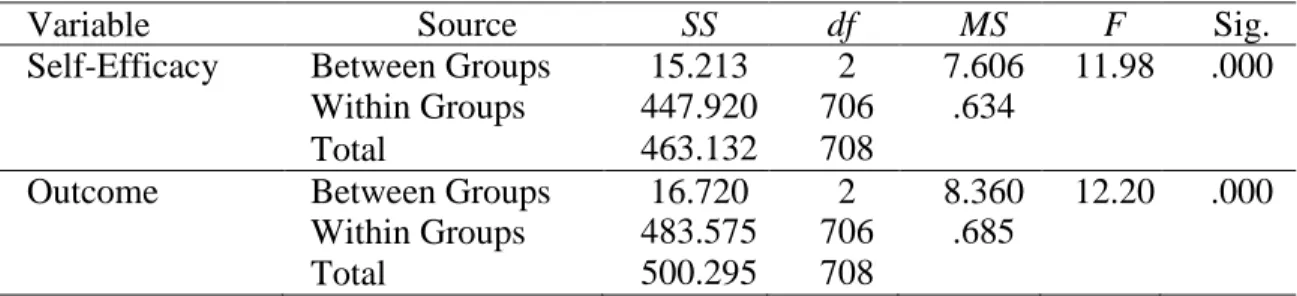
Analysis of Research Questions 1 and 2 ... 68
Multiple Pairwise Comparison of Self-Efficacy mean scores ... 70
Multiple Comparison of Outcome Expectation mean scores ... 71
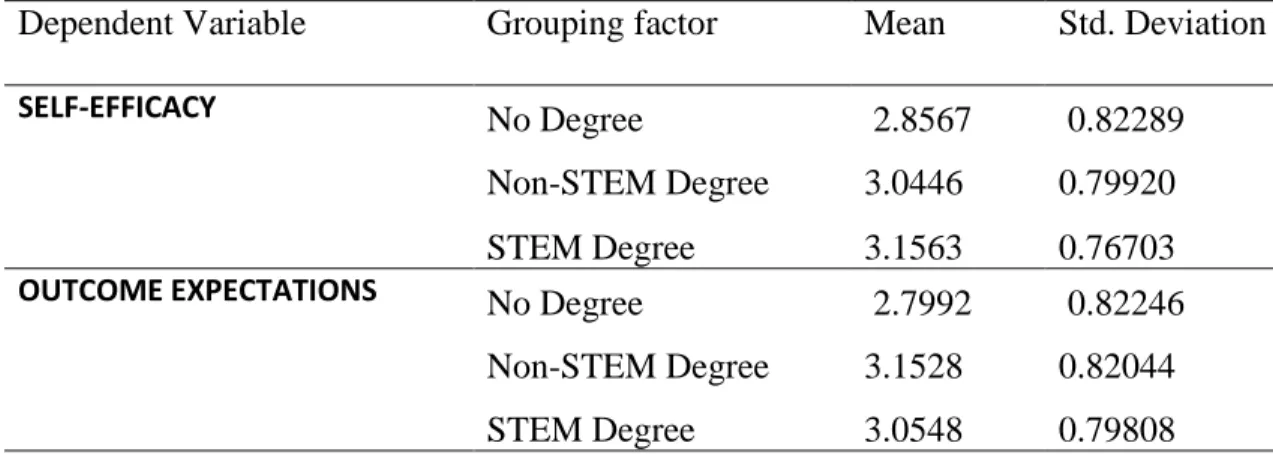
Desc. Stats. self-efficacy and outcome expectations scores ... 72
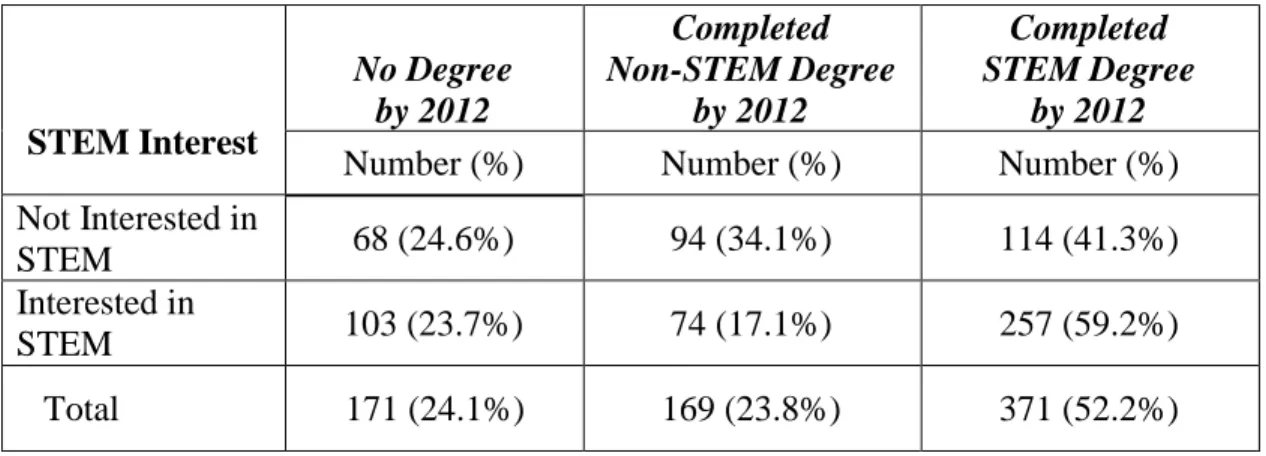
Analysis of Research Question 3 ... 73
Analysis of Research Questions 4 and 5 ... 75
Model Fitting Information ... 77
Multinomial Logistic Regression Results ... 77
MLR: No Degree status versus STEM Degree earners ... 78
MLR: Non-STEM Degree versus STEM Degree earners ... 80
Summary ... 81
CHAPTER V: CONCLUSION AND IMPLECATIONS... 83
Summary and Discussion of Findings ... 84
Importance of STEM Interest ... 85
Importance of self-efficacy ... 87
Importance of outcome expectations ... 90
Importance of the control variables ... 92
Implications for Policy and Practice ... 92
Recommendations for Future Research ... 97
Conclusion ... 99
References 101 Appendix A ELS VARIABLES USED IN THE STUDY... 125
Appendix B SUMMARY OF SIGNIFICANT RESULTS ... 128
Appendix C GRAPHICAL REPRESENTATION OF STEM DEGREE COMPLETION BY PREDICTOR VARIABLES ... 130
viii
Appendix E FIELDS OF STUDY USED AS STEM ... 136 Appendix F DETAILS OF ANALYTICAL SAMPLE AND NON-ANALYTICAL
ix
List of Tables Table Page 1 Table 1. Descriptive Statistics of STEM persistence and college degree completion status (N=710). ... 61
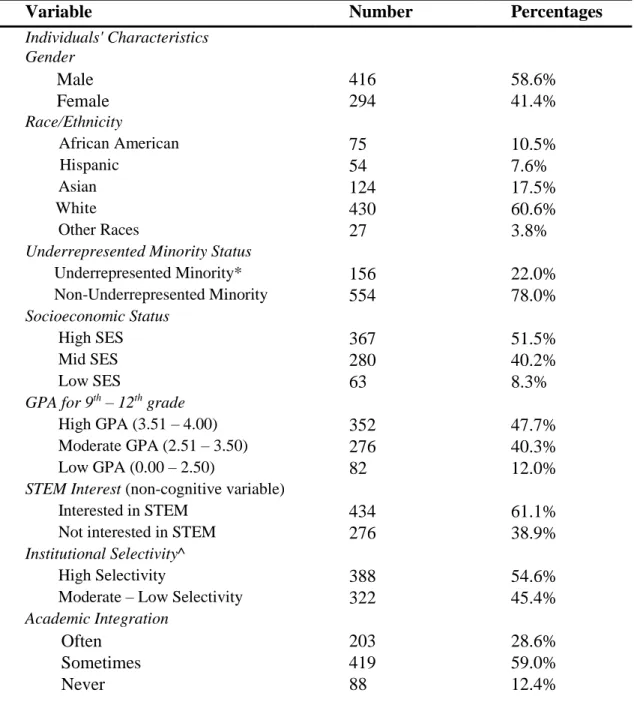
2 Table 2. Descriptive Statistics of the Independent Categorical Variables (N=710). ... 63
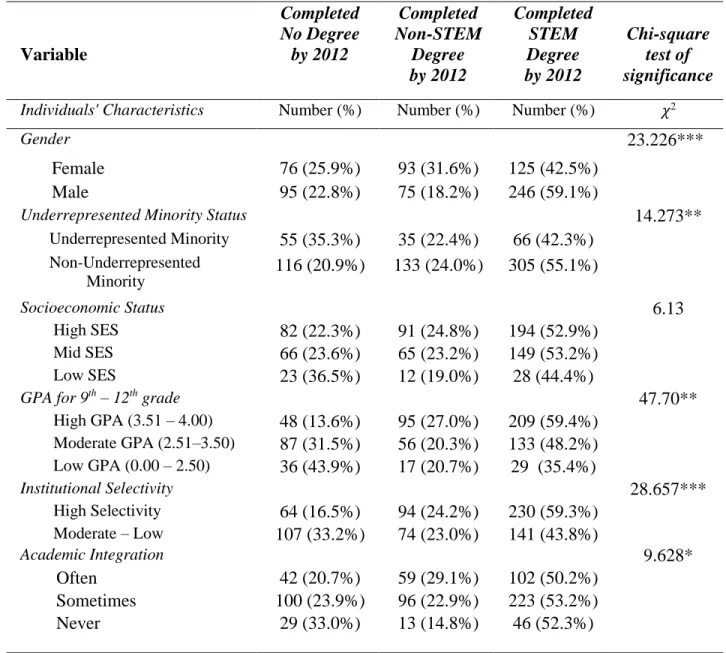
3 Table 3. Descriptive Statistics of the Independent Categorical Variables by STEM persistence and college degree completion status ... 65
4 Table 4. Descriptive Statistics of the Independent Continuous Variables ... 67
5 Table 5. ANOVA of STEM persistence and degree completion status by continuous noncognitive variables (self-efficacy and outcome expectation) ... 69
6 Table 6. Multiple Pairwise Comparison of Self-Efficacy ... 70
7 Table 7. Multiple Pairwise Comparison of Outcome Expectations ... 71
8 Table 8. Descriptive statistics for the self-efficacy and outcome expectations scores ... 72
9 Table 9. Distribution of STEM persistence and completion status by STEM Interest ... 74
10 Table 10. Model Fitting Information ... 77
11 Table 11. Multinomial Logistic Regression: Parameter Estimates and Odds Ratio for STEM persistence and college degree completion status ... 78
x
Table Page
A.1. Table A.1. Summary of ELS variables in the study ... 125 B.1. Table B.1. Summary of significant findings for research questions 1-3
(pairwise comparison) ... 128 B.2. Table B.1. Summary of significant findings for research questions 4-5
(MLR results) ... 129 F.1. Table F.1. ANALYTICAL SAMPLE: DESCRIPTIVE STATISTICS OF
STUDENTS WHO DECLARED STEM MAJORS ... 137 F.2. Table F.2. MISSING DATA: DESCRIPTIVE STATISTICS OF STUDENTS
WHO DECLARED STEM MAJORS ... 137 F.3. Table B.1. NON-STEM SAMPLE: DESCRIPTIVE STATISTICS OF
STUDENTS WHO DECLARED NON-STEM MAJORS IN 2016 ... 138
xi List of Figures
Figure Page
1 The Social Cognitive Career Theory (SCCT) framework ... 12 2 The proposed modified SCCT framework for this study... 33 A.1 Figure A.1. The graphical representation of the distribution of STEM persistence
and completion status by Gender. ... 130 A.2 Figure A.2. The graphical representation of the distribution of STEM persistence
and completion status by Underrepresented Minority Status. ... 130 A.3 Figure A.3. The graphical representation of the distribution of STEM persistence
and completion status by Self-Efficacy ... 131 A.4 Figure A.4. The graphical representation of the distribution of STEM persistence
and completion status by Outcome Expectations ... …131 A.5 Figure A.5. The graphical representation of the distribution of STEM persistence
and completion status by STEM Interest ... 132
1 CHAPTER I INTRODUCTION
Nearly a decade ago, the chairman of the National Science Board, Steven C. Beering, stated in his memorandum to members of Congress that “…the Nation is failing to meet the Science, Technology, Engineering, and Mathematics (STEM) education needs of U.S. students, with serious implications for our scientific and engineering workforce in the 21st century” (National Science Board, 2007, p. v). Beering’s remark, in part, may have arisen from the disappointing statistics concerning the large number of postsecondary students leaving the STEM field before graduation or by switching to non-STEM fields (Lowell et al. 2009; National Science Board 2012). Consequently, the U.S. may not be able to fulfill the increasing demand for domestic STEM workers nor sufficient STEM workforce to maintain its global leadership and its competitive edge in scientific innovations (U.S. Joint Economic Committee, 2012).
General background
Evidence of lack of STEM persistence and low retention rates
The recent body of STEM literature is filled with statistical evidence of the leaks in the STEM pipeline. Using the most recent data on students’ attrition from STEM fields from the 2004/09 Beginning Postsecondary Students Longitudinal Study (BPS:04/09) and its related database of 2009 Postsecondary Education Transcript Study (PETS:09), Chen (2013) showed that nearly half (48%) of STEM degree-seeking students who started college at a 4-year
institution had left without being able to complete a bachelor’s degree in a STEM discipline by 2009 (6 years after they began college). Chen (2013) also reported that nearly one-half of those
2
that left the STEM major earned a degree in a non-STEM field, while the remaining half completely exited college without earning a degree or certificate.
For community colleges, the statistics was even more alarming as 69% of the 2003-starting cohort had left these fields at some point within the 6-year period after their initial enrollment without attaining any certificate, associate degree, or bachelor’s degree with a STEM field credentials (Chen, 2013). While 59% of degree-seeking college students who began college in fall 2006 complete their degree within six years (Aud et al., 2014), only about 40% of STEM degree aspirants were able to complete their degree in the same time frame (Holden & Lander, 2012; Hurtado et al., 2012).
The attrition problem is even worse for historically underserved racial and ethnic
minorities who continue to be severely underrepresented within STEM fields (National Science Foundation, 2011; U.S. Census Bureau, 2009; Griffith, 2010; George & Malcolm, 2011). In a survey of 200,000 students—who declared their first postsecondary major in the STEM disciplines—conducted by the Higher Education Research Institute (HERI, 2010), the study revealed that only 31% of African American students, 40% of Latino students, and 37% of Native American students completed their degrees in any major within five years compared to over 60% of their white counterparts. Similarly, although combined Blacks and Hispanics represent 30% of the total US population (U.S. Census Bureau’s 2014 National Projections, 2014), only 8.4% of all the workers in STEM occupations are of Black (3.9%) or Hispanic origin (4.5%), compared to 77.3% who are Whites and 17.2% who are Asian Americans (National Science Foundation, 2011). Griffith (2010) concluded that African Americans and Hispanics are less likely to persist in STEM majors during college.
3
Data from the U.S. Department of Education (2011) estimates that only 7.5% of African Americans and 7% of Hispanics achieved a bachelor degree in STEM disciplines during the 2008-2009 academic year (U.S. Dept. of Education, 2011). Crisp and Nora, (2012) remarked that: “The demand for skilled workers in STEM fields will be difficult, if not impossible to meet, if the nation’s future mathematicians, scientists, engineers, information technologists, computer programmers, and health care workers do not reflect the diversity of the population” (p. 2). As America’s population continue to shift towards a greater share of people from racial/ethnic minority backgrounds, a growing concern about college completion rates of this population has risen to become a national issue.
Many state and federal leaders and academic researchers have paid close attention to the need for the United States to improve the college degree attainment rates of students in the STEM fields if the nation is to continue to maintain its global competence (Bettinger 2010; Callan 2008; Freeman 2006; Lowell et al. 2009; Zumeta & Raveling 2002). The President’s Council of Advisors on Science and Technology (PCAST) has estimated that the U.S. will need to produce one million new college graduates in STEM fields in order to maintain the country’s global economic advantage (PCAST, 2012). To remain globally competitive in the future, the United States will need to increasingly develop more of STEM talents and sustain the constant flow of highly skilled scientists and engineers emanating right from its own universities and colleges (Ehrenberg 2010; National Academy of Science 2005; National Governors Association 2007; National Research Council 2012; National Science Board 2007; President’s Council of Advisors on Science and Technology 2012; Sullivan 2006; Xie & Killewald 2012).
4
As concerns about the relatively low college graduation rates in the STEM disciplines continue to grow and threaten to weaken the nation’s supply of qualified STEM graduates to the STEM workforce, a number of empirical research studies have been conducted, at least, to examine the factors associated with the lack of student persistence and attrition in the STEM fields (Berkner & Choy 2008; Bettinger 2010; Espinosa 2011; Ost 2010; Radford & Horn 2012; Rask 2010; Seymour 2001; National Science Board, 2015). The central focus of these studies are represented in the following section.
Research studies on factors predicting persistence in college
Previous studies have examined the causes of student attrition—and especially in STEM, primarily focusing on individual cognitive capacities (i.e. academic predictors) such as
precollege performance indicators (e.g. high school grade point average (GPA)) and standardized achievement test scores (e.g. SAT and ACT) to explain key factors attributable to the high
attrition rate among college students (Braxton, Hirschy, & McClendon, 2004; Daley, 2010; Glogowska, Young, and Lockyer, 2007; Johnson, 2006; Tinto, 1993). Several researchers have come to conclusion that students’ pre-college academic preparation (based on the existing cognitive measures of academic preparation) was one of the key reasons as to why students failed to persist (e.g., Nicholls, Wolfe, Besterfield-Sacre, Shuman, & Larpkiattaworn, 2007; Sadler et al., 2012; Veenstra, Dey, & Herrin, 2008). As Johnson (2006) noted, students’ “grade performance… has been shown to be the most important factor in college persistence and eventual degree attainment” (p. 927).
Using existing cognitive measures of academic preparation to determine college persistence seemed to be logical at the time when the use of standardized testing as a selection
5
tool for determining college acceptance was deeply rooted in the nation’s long standing history of preferring a meritocratic caste system over a privileged class system of selection (Lehman, 1999, Robbins, Davis, Lauver, & Langley, 2004). College admissions personnel assess students’ potential to succeed academically and to graduate eventually in college based on standardized cognitive measures of academic preparation such as the SAT and ACT.
Traditionally, these cognitive measures of academic preparation (high school GPA, SAT, ACT, etc.) have assumed some degree of predictive validity in determining student’s success and persistence in college (Grissmer, 2000; Scott-Clayton, 2012). Although the predictive power of these variables varies between similar studies, Astin and his colleagues (1987) showed that high school GPA and SAT/ACT test scores account for about 12 percent of the variation in college retention. In another study, Tross and his colleagues (2000) reported that these two variables account for about 29 percent of the total variation in student’s retention.
Several studies have consistently showed association of high school GPA and test scores on standardized SAT/ACT achievement tests with academic achievement and persistence in college (ACT Research Report Series, 2012; Johnson, 2006; Noble & Sawyer, 2004; Patterson et al., 2012; Zwick & Sklar, 2005). For instance, ACT Research Report Series (2012) found that students with high high school GPA demonstrate significant long-term academic persistence compared to those with low high school GPA. Since high school GPA and test scores on
standardized achievement tests are highly correlated, it is difficult to be certain which one of the two is more powerful, although most studies point to high school GPA as the stronger predictor (Hanover Research, 2011).
6
Among African American and Hispanic students, it has been found that student’s academic performance such as high school GPA (Herrera and Hurtado, 2011) and standardized test scores such as SAT (Garcia and Hurtado, 2010) influence college persistence in STEM fields. Other studies have also identified students’ grade as the most significant determinant of student persistence (ACT Research Report Series, 2012; Pascarella and Terezini, 2005). Crisp, Nora, and Taggart (2009) found that students’ SAT math score and high school class rank percentile decisions was strongly associated with student’s decision to earn a STEM degree at a Hispanic-serving institution.
In addition to the cognitive and academic achievement variables such as high school GPA and SAT/ACT test scores, an overview of existing literature also revealed student’s entry characteristics and demographic variables such as gender, race/ethnicity as well as
socio-economic status as standard predictors of student persistence and retention behavior (Lotkowski, Robbins, & Noeth, 2004; Chen, 2013; Pascarella & Terenzini, 2005; Reason, 2009; Walpole, 2003). These studies indicate that race/ethnicity and gender are two most consistent predictors of student persistence and retention. Most of the studies show that female students persist to degree completion at higher rates than their male counterparts. Other research also identified
race/ethnicity as a significant factor in predicting student persistence (Pryor and Hurtado, 2012). Reason (2009) however, cautioned that the relationship between each of these two variables (gender and race/ethnicity) and persistence is complex. Reason (2009) found that gender tends to be statistically insignificant predictor when other important predictors such as socio-economic status is controlled in the model.
7
Institutional and environmental characteristics such as the quality of students’ interaction with faculty, advisors, and peers, students’ sense of belonging, their involvement in social life of campus, access to campus supportive networks, prevailing culture on campus environments, just to mention a few, also shape students’ persistence behavior (Berger & Heath 2005; Flowers 2003; Strayhorn 2012; Nora, 2003; Pryor & Hurtado, 2012; Veenstra, 2010; Zhao et al. 2012).
Scholarly literature on STEM persistence abounds with references to three main
categories of traditional factors that have been identified as important in this area of study. The variables include (a) student demographic background (e.g., gender, socio-economic status, and parental educational level), (b) student cognitive and academic characteristics (e.g., high school GPA, math and science standardized test scores including SAT scores, and the number of Advanced placement (AP) course taken), and (c) environmental and institutional factors (e.g., sense of belonging, involvement in social life of campus, access to campus supportive networks, prevailing culture on campus environments, degree of selectiveness of postsecondary institution, etc.) (Flowers 2003; Strayhorn 2012; Berger & Heath 2005; Zhao et al. 2012; Nora, 2003; Veenstra, 2010).
Statement of the Problem
Many researchers have investigated the predictability of cognitive variables (academic and intellectual abilities) that influence students’ retention while controlling for students’ demographic, background and contextual characteristics. Over the past several decades, most of the explanations given for the high dropout rate experienced by undergraduate institutions are usually based on Tinto’s (1987, 1993) theory of student integration model— which is one of the most widely cited theories of student persistence in the field of higher education to the extent that
8
it has been described by some researchers as reaching the level of “paradigmatic stature” (Braxton & Lee, 2005, p. 108).
However, little focus has been given to empirically investigating non-cognitive skills and attitudes, behaviors, and strategies during the high school experience that may influence
students’ success in their postsecondary education and later in their workplaces. Absent from most of the scholarly discussion are the ways in which psychosocial factors influence the decision-making processes of students’ persistence. Grit, tenacity, realistic optimism, self-efficacy, self-regulation, perseverance, interest, motivation, self-discipline, outcome expectations, reliability, such terms generally lumped under the category “non-cognitive skills”—which are essential individual characteristics vital for success in any schooling, work, and other life-time outcomes —are often excluded from the set of explanatory variables of most of the studies on STEM major persistence (Ackerman, Kanfer, & Beier, 2013).
Yet, non-cognitive behaviors and personal attributes—which are seldom used to assess students’ academic performance and persistence—have been found to be highly positively associated with academic success in college, occupational attainment and earnings (Guiffrida, 2006; Richardson, Abraham, & Bond, 2012; Jencks, 1979; Poropat, 2009; Robbins et al., 2004; Reason, 2009). Recent reported indicate that about 41% of the variation in student performance is predicted by affective variables such as student motivation, self-regulation, and assertiveness (Zientek, Ozel, Fong, & Griffin, 2013). Not only do such skills help students to identify the right courses to enroll in, but also would help higher education administrators in designing appropriate interventions for improving student retention and success (Kahn, Nauta, Gailbreath, Tipps, & Chartrand, 2002). Some recent studies have provided insight into the predictive power of
non-9
cognitive characteristics over cognitive attributes in predicting student retention and academic achievement (Burner, 2005; Rosen, Glennie, Dalton, Lennon, & Bozick, 2010).
Robbins et al. (2004) conducted a meta-analysis using 109 studies to examine the relationship between non-cognitive (non-academic) and academic factors and postsecondary retention. They identified nine psychological constructs in the non-academic category (academic goals, achievement motivation, academic self-confidence, academic-related skills, contextual influences, general self-concept, institutional commitment, social support, and social
involvement), two academic factors (high school GPA and ACT score) and student’s
socioeconomic status (SES) that influence retention. They found that, with the exception of general self-concept and achievement motivation which had a weak relationship, all the variables in the model accounted for a moderate to strong positive relationship to retention. Academic self-confidence and academic goals were the strongest predictors of retention. Their findings suggest that solely relying on traditional cognitive attributes may not be sufficient to predict college persistence and incorporating non-cognitive students’ attributes to the prediction model may increase the predictive power of college persistence.
Moreover, researchers have begun to acknowledge that the content knowledge and academic skills model of determining academic performance and persistence is no longer
sufficient to adequately address or explain student outcome differences (Baxter, 2004; Ackerman & Kanfer, 2013). A study, for example, found that a student’s competence beliefs, defined as a perception of how good a student think he or she is at a given activity, can be regarded as a key predictor of academic performance and persistence (Freiberger, Steinmayr, & Spinath, 2012). Scherer (2013) noted that, for individuals in the scientific fields, competence beliefs—which is
10
also referred to as self-concepts and self-efficacy—play an important role in achieving their learning objectives, solving problems, and improving general academic performance (Mason et al., 2013; Scherer, 2013; Tsai et al., 2011; Van Dinther, Dochy, & Segers, 2011).
Richardson et al. (2012) used a meta-analysis of 7,167 studies conducted between 1997 and 2010 to examine the relationship between academic self-efficacy, self-concept, effort
regulation, goals for course grades, locus of control, and other personality traits and college GPA and found that these attributes accounts for 14% of variance in college grades. Another meta-analysis by Schmidt and Hunter (1998) also confirmed that non-cognitive skills accounted for about 20% improvement in predicting training accomplishment and job productivity (Schmidt & Hunter, 1998), pointing to the importance role non-cognitive skills in improving the prediction of student persistence.
Thus, the role of non-cognitive skills is largely unexamined in the STEM persistence literature. Given that this area of research has been vastly overlooked in the literature, there is the need to investigate the relationship in order to better understanding its impact on higher education persistence. Clearly, a notable gap exists in the literature regarding how non-cognitive skills during high school may contribute to students’ postsecondary persistence and eventual degree completion, especially with regard to students in STEM courses. Very limited literature to date have attempted quantitatively to measure the impact of non-cognitive factors during high school years on the persistence and degree completion of students in STEM disciplines within a theoretical framework that controls for variables that previously have been identified to be related to college access and success.
11
Identification of Variables and Conceptual Framework
Recognizing that the extant literature revealed mostly the importance of pre-college preparation, high school performance, and cognitive (academic and intellectual) measures of ability to predict the success and persistence of students pursuing STEM degrees, it has become apparent that the traditional models of predicting students’ successful completion of college may no longer be adequate in explaining student persistence and degree completion. The traditional cognitive predictors do not account for the underlying motivational, affective, and psychological processes that both contribute to and influence student’s persistence behavior (Bean, 2005; Schreiner & Louis, 2011). It seems reasonable to search for alternate models that would incorporate a wide range of factors such as students’ beliefs, attitudes, personality and
motivational traits, values and expectations which are not specifically intellectual or academic in nature.
To better understand the role that student’s high school non-cognitive attributes and skills play in their later persistence and degree completion in STEM majors in college, this study draws upon a set of concrete and empirically supported social cognitive variables from the key
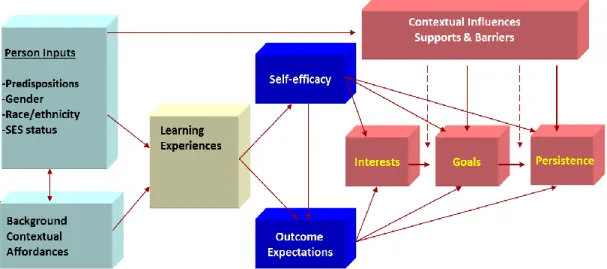
constructs of the Social Cognitive Career Theory (SCCT) framework (see Figure 1). These variables in the SCCT consider multiple and interrelated social cognitive variables (e.g., self-efficacy, outcome expectations, and interests) as well as other factors such as learning
experiences, background characteristics, and contextual influences. The full model of the SCCT framework from which key non-cognitive constructs and structural relationships were extracted for this study is presented below in figure 1.
12
Figure 1. SCCT (Lent, Brown & Hackett, 1994, 2008, 2015)
According to Lent, Brown, & Hackett (1994)—the developers of the SCCT framework, the SCCT, which evolved from Bandura’s Social Cognitive Theory (SCT) —the SCCT focuses on “(a) formation and elaboration of career-relevant interest, (b) the selection of academic and career related choice options, and (c) performance and persistence in educational and
occupational pursuits” (Lent et al., 1994, p. 79). In general, the SCCT explains the processes that occurs within educational and occupational pursuits by examining three interconnecting models of how individuals’ career interests develop, how they make career and educational choices, and how they persist and achieve academic and career success (Lent, Brown, & Hackett, 1994, 2000).
The SCCT is useful in deconstructing and understanding how individuals make career and educational choices, how they develop career and educational interests, how they deal with barriers and support that come their way in their educational and occupational pursuits, as well as how they persist and achieve academic and career success. One unique feature of the SCCT
13
framework is its focus on the psychological processes that influence individual choices and actions. Most studies using the SCCT framework emphasizes the social cognitive constructs of self-efficacy, outcome expectations, interest, goals (Lent, Brown, & Hackett, 2000).
The SCCT proposes that students who fare well and persist in college and eventually graduate do so because, in addition to their academic performance and contextual learning experiences, they have a strong robust academic self-efficacy and a context-specific personal expectation (positive outcome expectation) which help them hold high commitment (high interest and goals) to their chosen academic or career field. Such high commitment motivates students to respond to their obligations and responsibilities with vigor, resilience and
perseverance—not to succumb to obstacles, distractions, and occasional setbacks that easily overwhelm their peers. The mediating influence of self-efficacy and outcome expectations encourage students not to avoid academic challenges but to attack them head on and to put effort into their academic studies.
In terms of college persistence, the theory proposes that students are more likely to persist to graduation when they actively pursue and make progress at personally valued goals (performance goals and interest), if they feel competent and confidence in their ability to accomplish these goals (self-efficacy), if they anticipate receipt of favorable outcome (outcome expectations), and finally, if they perceive the environment as supportive and offering the resources they need to pursue their goals and interest (contextual factors) (Lent, Brown, & Hackett, 1994, 2000).
This study therefore identified five key constructs from the SCCT framework that
14
variables in the traditional model and they are: (1) Person/background inputs which are
represented by the inclusion of gender, race/ethnicity, socioeconomic status, and prior academic performance such as high school grade point average (2) Contextual and environmental supports and barriers which are factors that encourage or impede the attainment of students’ overall goal (e.g., academic integration, and institutional selectivity). The remaining three constructs which were usually not addressed by the traditional models are: (3) Self-efficacy which refers to one’s belief about his or her ability to perform and accomplish an academic task successfully (e.g., feeling confident that one has the ability to complete the tasks required for successful
performance), (4) outcome expectations which is a belief about the consequences or the results of engaging in academic task—e.g., anticipating receipt of favorable outcome, and (5) interest which refers to the extent to which one likes the academic activity—e.g., actively pursuing and making progress at personal valued goals.
As SCCT continues to be applied to persistence of students within the STEM disciplines (e.g., Byars-Winston, Estrada, Howard, Davis, & Zalapa, 2010; Lent et al., 2013; Lent et al., 2005; Lent et al., 2008; Lent, Brown, et al., 2005; Lent, Singley, Sheu, Schmidt, & Schmidt, 2007; Lent, Sheu, & Lopez, 2011; Mullikin, Bakken, & Betz, 2007), each of the
above-mentioned variables have been empirically demonstrated to relate directly or indirectly to STEM persistence. Three of the key constructs of SCCT—Self-efficacy, outcome expectations, and interest, which have survived years of rigorous research and have proven relationship with STEM persistence and degree completion—would serve as the non-cognitive variables for this study. Thus, the current study focused mostly on these three-core construct of the SCCT— Self-efficacy, outcome expectations, and interest as the key non-cognitive variables of this study.
15
Purpose of the Study
This study examined the extent to which non-cognitive factors (i.e., self-efficacy, outcome expectation, and STEM interest), students’ demographic/background characteristics (e.g., gender, ethnicity, socio-economic status, and high school GPA) and students’ contextual and environmental characteristics (e.g., academic integration, and institutional selectivity) contributed to and influenced undergraduate students’ persistence and college degree completion in Science, Technology, Engineering, and Mathematics (STEM) with particular attention to students enrolled in 4-year colleges and universities in the United States.
In this study, STEM persistence and college degree completion was conceptualized as a three-part categorical variable corresponding to students’ bachelor’s degree completion status, six years after declaring a major in a STEM field at a four-year postsecondary institution. These are: (1) STEM degree earners (i.e., students who earned at least a bachelor’s degree or higher in STEM field), (2) non-STEM degree earners (i.e., students who changed their majors and
completed at least a bachelor’s degree or higher in a non-STEM field), or (3) no degree earners (students who had not completed a degree).
The research so far suggests that a student’s high school non-cognitive attributes (self-efficacy, outcome expectation, and interests, key constructs in the SCCT),
demographic/background characteristics (e.g., gender, ethnicity, socio-economic status, and high school GPA) and students’ contextual and environmental characteristics (e.g., academic
integration, and institutional selectivity) may be strongly linked to their persistence and bachelor’s degree completion in STEM majors in college.
16
Research Questions
In this study, I explored the following research questions:
1. Are there any differences in self-efficacy by STEM persistence and degree completion status?
2. Are there any differences in outcome expectations by STEM persistence and degree completion status?
3. Is there a relationship between STEM interest and STEM persistence and degree completion status?
4. To what extent, if any, do students’ demographic/background characteristics (e.g., gender, ethnicity, socio-economic status, and high school GPA) and students’ contextual and environmental characteristics (e.g., academic integration, and institutional selectivity) affect their STEM persistence and degree completion status?
5. Controlling for demographic and background characteristics and students’ contextual and environmental characteristics, to what extent do individuals’ non-cognitive attributes (i.e., self-efficacy, outcome expectations, and STEM interest) contribute to STEM persistence and degree completion status?
Significance of the Study
Although much work has been done in the area of identifying students’ academic and cognitive profiles to help make predictions on their performance and persistence in
17
Identifying student’s noncognitive attributes might help postsecondary administrators in developing critical intervention and support systems for students who may lack certain
noncognitive characteristics which affect persistence. As most higher education continues to face severe financial challenges, the significance of identifying factors that influence persistence will play an important role in the success of the postsecondary institutions (Altbach, Gumport, & Berdahl, 2011; St. John & Chen, 2011; Johnstone, 2011).
Ackerman, Kanfer, and Beier (2013) observed that the attrition of students in the postsecondary education sector may be due to failure to identify students’ noncognitive characteristics and provide intervention for students at risk. Both cognitive and academic and non-academic factors play an important role in fostering student success and persistence (Ackerman, Kanfer, and Beier, 2013).
It is also known that America’s global competitive edge depends heavily on skills acquired through the study of STEM disciplines (U.S. Joint Economic Committee, 2012). The national economic and social benefit for increasing the number of students earning a STEM degree can be substantial if the U.S. can find solutions and interventions for the problems affecting students’ persistence in STEM major fields. At the individual level, college graduates with STEM degrees earn far more than their non-STEM counterparts. Recent data show that STEM workers earn about 26% more than their non-STEM colleagues (White House Fact Sheet, 2010). Increasing the minority pool will increase minority access to these high paying jobs as well as reduce the income inequality between the two groups. At the national level, increasing the number of STEM graduates is vital to the advancement of the U.S. in the global competitive
18
knowledge driven economy. Broadening the pool of STEM students by increasing the number of minority students in STEM will help maintain our competitiveness on global market.
There are a number of potential benefits to be gained if the predictive base of students’ persistence in STEM major fields is broadened beyond and above the traditional cognitive predictor spectrum. For example, new knowledge obtained from identifying the important non-cognitive predictors of persistence will generally help the postsecondary community in
developing more effective persistence models for the future. In addition, identifying and
analyzing non-cognitive predictors will help postsecondary educators and school administrators to create strategies which allow for targeted and personalized learning and offer opportunity for institutions to crystallize their programs and improve their student advisory services. It will also help them to make more informed policy decisions. In other words, identifying the important non-cognitive predictors of persistence will provide policy makers with understanding of the how specific non-cognitive factors influence minority student success and persistence in STEM. This study therefore will help advance the predictive knowledge in the area of STEM field persistence as well as help university administrators and policy makers in identifying areas in which they can support and improve on.
19 Definitions
The following terms are commonly used throughout the present study:
• The National Science Foundation definition of STEM includes the following disciplines: Engineering, Physical Sciences, Mathematics and Computer Sciences, Life/Biological Sciences, Social/Behavioral Sciences (Economics, Psychology and Social Sciences). • For the present study, STEM will be defined as any subject that uses and applies academic
concepts in science, technology, engineering, and mathematics to real-world situations in contexts that make connections between academic knowledge and real-world phenomena (Author). For the sake of this study, the operational definition of STEM is: Engineering, Physical Sciences, Mathematics and Computer Sciences, Life/Biological Sciences. • STEM Persistence: The ability for students who enter a postsecondary institution with
declared STEM subject to continue their STEM education until they earn at least a bachelor's degree in STEM.
• STEM persisters are a subgroup of students who entered postsecondary education in STEM fields and remain in STEM fields throughout their college career.
• STEM leavers are a subgroup of STEM entrants who leave STEM fields. These include those who switch their major to a non-STEM field and those who left postsecondary education without earning a four-year degree.
• STEM attrition refers to the enrollment choices that result in potential STEM graduates (i.e., undergraduates who declare a STEM major) moving away from STEM fields by switching majors to non-STEM fields or leaving postsecondary education before earning a degree or certificate.
20
• Persistence and Retention: It is also important to note the difference of these two terms, persistence and retention. Although they both refer to the same concept, that is, of staying at a postsecondary institution until a degree or a certificate is earned, retention does not capture the student decision making process nor does it account for factors which cannot be
controlled by the institution and its practices. On the other hand, persistence captures all institutional and external factors which influence a student’s desire to remain at an institution.
21 CHAPTER II
REVIEW OF LITERATURE Introduction
This review of literature will provide insight about the key concepts, theoretical
framework, and related literature on persistence of students in STEM major fields (Part I) and the Social Cognitive Career Theory (SCCT) (Part II). The review will begin with the concept of noncognitive classifications and will proceed by exploring three major retention and persistence theories. After reviewing these major models, it will explore the gaps in the major retention and persistence theories in order to justify the need for a model that incorporates non-cognitive variables.
Following this section, the study will provide detailed explanations about the Social Cognitive Career Theory (SCCT) (Lent, Brown, & Hackett, 1994, 2000). This is a psychosocial model, which is inclusive of behavioral, psychological, social and demographic variables. The SCCT, which is usually found in the career-development literature, will provide the conceptual clarity needed to explain college students’ persistence, especially in the STEM fields. The SCCT captures the theoretical rich constructs of cognitive and non-cognitive factors that influence the way people develop career interests, make choices, performance behaviors and how they achieve educational and occupational success as they pursue their educational or occupational goal (Lent et al., 1994).
Next, the study will use the factors in the SCCT theoretical model to propose a modified model for this study. Again, this study will focus on three of the core construct of the SCCT— Self-efficacy, outcome expectations, and interests. The study will also discuss other research
22
that confirm or refute the predictive ability of each the focused factors. Also, the study will explore the relationship between these factors and STEM persistence.
The non-cognitive Classification
The term “noncognitive” skills (or attributes) require some clarification. It usually appears in the literature either as one word (noncognitive) or hyphenated (non-cognitive). It also comes under several synonyms such as psychological, psychosocial, academic,
non-intellectual, or behavioral attributes. It is generally used to express individual skills and personality traits that are not in the cognitive domain. In this context, cognitive abilities are usually associated with intellectual capacity, reasoning, and ability to understand and solve abstract problems. Measures of cognitive skills include the use of intelligence tests and the standardized tests, especially on reading, science and math (Ackerman, 1996).
Since the early 1970s, the “noncognitive” terminology has been very common in the extant literature. Its usage mostly encompassed a broad spectrum of personality attributes. It is usually expressed in two forms, either psychological in nature (e.g., goals, interest, motivation, satisfaction, self-efficacy, etc.) or behavioral (e.g., interpersonal skills, participating in
extracurricular activities, self-discipline, honesty, integrity, etc.). Borghans et al. (2008) described noncognitive skills as the “pattern of thoughts, feelings and behavior” (p. 974).
Heckman (2008) listed noncognitive skills to include motivation, the ability to work with others, socio-emotional regulation, personality factors and time preference. Thus, noncognitive skills consist of the psychological and behavioral dispositions and tendencies that are not typically assessed through cognitive measures such as intelligence tests or the standardized tests. In most cases, the list selected for a particular study is often dictated by the availability of data.
23
One weakness of using noncognitive variables in a study is the fact that the information obtained is usually self-reported in nature. Apart from the difficulty in measurement, concern has also been raised about the confusing demarcation of the term cognitive and noncognitive category (Borghans et al., 2008, and by Almlund et al., 2011). For this reason, most studies focused mainly on cognitive characteristics using mainly content knowledge to determine persistence.
However, recent researches have shown that using content knowledge and cognitive approaches to understand student persistence without taking into consideration the richer set of personality traits and skills (often referred to as affective characteristics) that aided and
motivated the student in the acquisition of the content knowledge and cognitive skills is not sufficient. For example, in their first year of college, students may still be dealing with a variety of internal issues, such as their own changing identity, the future of their education, and
interpersonal and internal conflicts. Within the same context, they are expected to complete homework, pass their tests, and be socially responsive. Students therefore must rely on their own acquired and innate psychological resources and personality attributes such as grit, tenacity, motivation and perseverance to overcome external challenges and to persevere in their chosen majors.
Non-cognitive characteristics, therefore, in the context of this study, refer to the attitudes, dispositions, social skills, and interpersonal skills that the student draws upon to enable the accomplishment of their academic goals and to navigate successfully through the academic climate. These attributes together with other social roles and cultural determinants constitute the personality of an individual. They determine how an individual student would personally
24
behaviors and attitudes that determine whether the student has personal interest in a learning activity and whether student persist in the face of difficulties and challenges.
Review of Major Persistence Models
Identifying the factors that influence the loss of students prior to completing a degree or those factors that determine the likelihood of persisting to degree attainment have long been of interest to numerous academic scholars (Amelink & Creamer, 2010; Adelman, 1998; Bonous-Hammarth, 2000; Cole & Espinoza, 2008; Crisp, Nora, & Taggart, 2009; Griffith, 2010; Seymour & Hewitt, 1997; Tinto, 1987; Zhao et al. 2012; Nora, 2003; Veenstra, 2010). Studies focusing on investigating the loss of students prior to completing their degree and college students’ persistence— which generally refers to the student’s continuation desire and behavior to stay within the education system through their degree completion—dates back to several decades (Spady, 1970; Bean, 1980). Early studies, especially those around the first half of the twentieth century, focused mainly on factors that influence students’ cognitive intelligence and academic readiness. The early part of the twentieth century was characterized by the lack of full-blown theoretical models to explain the logic and the order behind the array of variables
proposed to influence retention and persistence of college students (Spady, 1970).
Over the course of the second half of the twenty-first century, research efforts started to shift more towards the development of theoretical models to guide research and analysis of the potential variables used in explaining retention and persistence. The models of Spady (1970), Tinto (1975, 1983), Astin (1983), Bean (1980), just to mention a few, represent some of the early full-scale models that appeared in the student retention and persistence literature during the second half of the twenty-first century.
25
Spady’s (1970) Model of the Dropout process
Spady (1970) was the first to introduced a full-scale theoretical model of student dropout in his “Explanatory Sociological Model of the Dropout Process” (Spady, 1970). Spady (1970) thought that there is the need for a “more interdisciplinary-based, theoretical synthesis of the most methodologically satisfactory findings and conceptually fruitful approaches to this problem [of dropout]” (p. 64). Spady therefore, proposed the first full-blown model to study the attrition and persistence problem. His model was based on Durkheim’s (1951) influential work on suicide. Durkheim’s (1951) idea was that an individual’s likelihood of committing suicide can be reduced when that person has shared group values and friendship support. Spady (1970), incorporated these two variables from Durkheim (1951) into his model. Spady (1970) proposed that family background characteristics, academic potential, grade performance, level of intellectual development, shared group values, friendship support and normative congruence all contribute to increase social integration. Social integration increases satisfaction, which also in turn increases institutional commitment leading to a reduced likelihood of dropping out from college.
Tinto’s Student Integration Model
Another full-scale theory that was also based upon the selected variables from
Durkheim’s (1951) theory and also built upon Spady’s (1970) model was published by Vincent Tinto (1975) in 1975. Tinto’s (1975) model by far, is the most widely empirically tested model of persistence and dropout process (Pascarella, 1980). Tinto reasoned that if people who break away from their social ties are usually the ones who lack social integration with the large society and are more susceptible to suicide, then it makes sense to believe that students would
26
Tinto (1975) proposed that a plethora of background characteristics (gender, race/ethnicity, family demographics and socio-economic status, precollege educational attainment, and personal skill sets) interact with each other to form the backbone of the individual’s initial goal commitment and institutional commitment. Tinto (1975) argued that “the process of dropout from college can be viewed as a longitudinal process of interactions between the individual and the academic and social systems…which lead to persistence and/or to varying forms of dropout” (p. 94). Tinto (1975) envisaged two systems within the institution—the academic system and the social system. In the academic system, Tinto proposed that students’ initial goal commitment may improve their grade performance and raise the level of their personal development, all together leading to academic integration and in a circular fashion reinforcing a greater goal commitment. Greater goal commitment reduces the likelihood of a student dropping out of college. Goal commitment is therefore placed twice within Tinto’s (1975) model.
Within the social system, Tinto (1975) proposed that institutional commitment would impart positively on the interaction between students and their peers (peer-group) as well as with faculty members, which in turn would lead to an increase level of social integration, reinforcing institutional commitment once again, thus, leading to a reduce likelihood of dropping out. Institutional commitment is also placed twice within Tinto’s (1975) model. Bean (1981) explained that the initial goal and institutional commitment are based on student’s educational plans rather than the actions that they take to execute the plans. The latter is based on students’ interaction with the social and academic systems of the institution.
Bean’s Student Attrition Model
Another investigator who proposed a retention theory in the early 1980s was Bean (1980), who derived his model from the theoretical concepts of employee turnover in organizations, an
27
idea borrowed from Price’s study of worker turnover. Price’s view was that income influences job satisfaction, which is a strong indicator of employee turnover. Bean (1980) found that the correspondence between income and job satisfaction can be similar to the correspondence between academic grades and achievement and dropout. Bean found that GPA was statistically linked to student’s satisfaction, which in turn leads to institutional commitment. Bean (1980) disagreed with the use of Durkheim’s suicide theory because the evidence of the theory, in Bean’s estimation, was insufficient to establish a full-scale theoretical relationship between attrition and suicide. He therefore criticized both Tinto and Spady for providing models that lacked directional causality and discreteness, and concluded that any empirical studies employing these models may be inconclusive.
Bean (1980, 1983) then postulated that various student background characteristics, organizational variables, students’ academic and social interaction directly influence satisfaction. This in turn influences institutional fit and commitment to degree completion leading to student’s intent to leave and persistence (Bean 1980, 1983). Additionally, Beans Model of Student Attrition stressed on the existence of an external factors which the institution has no control over such as time spent away from campus, students’ financial constraints, family commitments, and transfer opportunities. Bean explained that the combination of external factors, attitudinal influences, and interaction factors can collectively lead directly to a decision to drop out or to persistence.
Critique of the major Theories
Despite the prominent contribution of Tinto’s and Bean’s models in understanding students’ departure, these models do not appear to have recognized the influence of students’ psychological orientation on their persistence decisions (Guiffrida, 2006). Kahn and Nauta (2001) noted that the early traditional models explained only part of the variance of student persistence
28
and has important limitations. Several researchers (e.g., Attinasi, 1989; Stage and Hossler, 2000; Hossler, 2005; Guiffrida, 2006) noted that these models focused heavily on integration and interaction and relied less on the pre-entry psychological factors which might have shaped and influenced the student’s integration and interaction experiences. Robbins et al. (2004) reported that, although at the time of the development of these theories there were “theoretically rich constructs [available] with adequate internal and external validity,” the models did not seem to have taken advantage of such research (p. 263). The authors recognized that a full understanding of college student persistence is lacking due to the “little of integration or research synthesis of the educational and psychological literature” (p. 261).
In order to increase understanding of the college persistence, Reason (2009) recommended incorporating student motivational and behavioral variables into the set of predictors for a better understanding of the college persistence puzzle. Ackerman, Kanfer, and Beier (2013) identified another major limitation of these models by reporting that:
Although [these] models have been developed and evaluated to predict post-secondary student attrition (e.g., Tinto, 1975), they tend to focus on the entire “system” involved in undergraduate education (e.g., family background, peer and faculty interactions, institutional commitment). However, individual attributes represent a small part of these systems, and attributes other than intellectual ability have merely been suggested as potential influences. (p. 912)
Thomas, Kuncel, and Crede (2007) argued that, noncognitive variables such as maturity, motivation, self-concept, interpersonal skills, personality variables and other measures such as biographical information, personal interviews, and letters of recommendation can add validity to the traditional cognitive predictors. Recognizing that the traditional models of predicting
students’ successful college completion are no longer adequate in explaining student persistence, it seems reasonable to searched for other models that would incorporates a wide range of
29
students’ beliefs, attitudes, personality, motivational traits, values and expectations which are not specifically intellectual or academic in nature.
One such theoretical model, which has constructs that is inclusive of behavioral, psychological, social and demographic variables and that will provide the conceptual clarity needed to explain college students’ persistence, especially in the STEM fields, was found in the career-development literature. The Social Cognitive Career Theory’s (SCCT), developed by Lent, Brown, and Hackett (1994, 2000), captures the core non-cognitive attributes that influence the way people develop career interest, make choices, perform behaviors and achieve educational or occupational success as they pursue their educational or occupational goal (Lent et al., 1994). Thus, SCCT model explains how people make career choices and academic decisions. The SCCT is an appropriate model for looking at student persistence in postsecondary education since it incorporates the impact of the psychological, social, and contextual factors that influence undergraduate student retention which was largely missing from the major persistence studies (Allen & Robbins, 2008; Byars-Winston & Fouad, 2008; Lent et al., 1986; Lent, Brown, Sheu et al., 2005; Porter & Umbach, 2006). Kahn and Nauta, (2001) reported that the SCCT focuses on students’ “intrapersonal factors and self-focused perceptions” (Kahn & Nauta, 2001, p. 635).
The Social Cognitive Career Theory (SCCT)
The Social Cognitive Career Theory (SCCT) was developed by Lent, Brown, and Hackett (1994). It represents an extension of Albert Bandura’s (1986) Social Cognitive Theory which has been adapted to explain the processes and mechanisms through which “(a) career and academic interests develop, (b) career-related choices are forged and enacted, and (c)
30
Although the SCCT originally composed of the above three segmental models (interests, choice, and performance models), a fourth model (the satisfaction model) have been recently added by Lent and Brown (2006) which explores specific domains of occupational and
educational satisfaction as well as other aspects of positive adjustment to academic and career related behaviors (Lent and Brown, 2006, 2008; Lent et al., 2013). According to Lent et al. (2013), although “SCCT's segmental models each focus on a particular class of academic and career outcomes, the models were designed to overlap with one another” (p. 23). The authors explained that all the models have common cores which consist of the social cognitive theory elements: self-efficacy, outcome expectations, and goal representations.
By building on Bandura’s (1986, 1989) Social Cognitive Theory, the SCCT underscores the mutual, dynamic, and interactive influences between person inputs (internal, affective states, biological and physical attributes), their behavior (individual choices and actions), and their environment (physical and social surroundings) (Bandura, 1986, 1989). Bandura (1986, 1989) used the term “triadic reciprocity” to describe the triadic, dynamic, and reciprocal interaction of the three factors that influence individual behaviors and actions. Bandura (1986, 1989) argued that the human mind is an active force in developing individual behaviors and those individual behaviors are largely regulated antecedently through an internal process.
Bandura (1986, 1989) concluded that people’s behaviors are usually based on their values and expectations, which in turn imposes structure on their actions. Bandura (1986, 1989) then advanced two major sets of expectations that results from the active forces spawning from the cognitive process that guides human behavior. The first set of expectations deals with outcome expectations. Bandura argued that, individuals are more likely to engage in behaviors that they anticipate would result in favorable outcomes and may shy away from those that may seem to
31
have unfavorable consequences (Bandura, 1986). That is, individuals perform behaviors based on the values they place on the potential outcomes. For the second set of expectations, Bandura called it self-efficacy, which is the belief about the individual’s ability to successfully perform tasks in a specific domain. Bandura (1986, 1989) argued that self-efficacy influences the choices about which behavior the individual may want to embark on, what effort and how much
persistence they will be willing to exert on their actions in the face of obstacles.
The SCCT holds that the cognitive-persons’ variable (e.g., self-efficacy, outcome expectations, performance interests and goals), the external environmental supports and barriers (e.g., availability of requisite resources and opportunities like money, time, climate, dependence on others), and explicit behaviors (e.g., career or educational decision) interact in a dynamic and reciprocal way via feedback loops that can either enhance or impede the career and educational development processes and mechanisms, such as interests, choice, performance goals, and satisfaction (Navarro, Flores, and Worthington, 2007; Lent et al,. 2013).
The SCCT proposes that individuals will develop interests and make progress at their personally valued goals (performance goals and interest) in those activities that they feel
competent and confidence in their ability to accomplish them (self-efficacy) and for which they anticipate receipt of a favorable outcome (outcome expectations) when performing that behavior. Figure 1 shows the SCCT basic model of person, contextual/environment, and experiential (behavior) factors that influences academic and career-related choice behavior.
The SCCT model states that personal inputs and contextual background directly determine students’ learning experiences, which in turn is directly associated with their self-efficacy and outcome expectations. These factors together affect students’ interests which influence goals and ultimately lead to students’ persistence.
32
Several studies have been generated in support of the utility of the SCCT. Majority of these studies have demonstrated positive association between self-efficiency (academic/math and science), outcome expectations, interest in STEM and STEM persistence. The SCCT forms the appropriate theoretical lens to study STEM persistence and has been applied to a number of STEM related studies on academic performance and persistence (Byars-Winston, Estrada, Howard, Davis, and Zalapa, 2010; Lent, Lopez, Lopez, and Sheu, 2008). Using SCCT, Byars-Winston and colleagues (2010) examined the relationship between social cognitive variables (math/science self-efficacy, math/science outcome expectations) and how students perceived campus climate to STEM interests and commitment to attain a degree in STEM.
Conceptual Framework
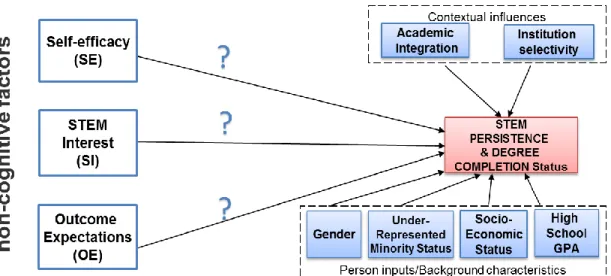
The conceptual framework for this study is depicted in Figure 2 as pathways to STEM persistence and degree completion status among seven key variable clusters. In this study, the main focus is on the extent to which STEM persistence and degree completion status is determined by (a) students’ self-efficacy beliefs, (b) outcome expectations, and (c) STEM Interest after controlling for background characteristics and contextual supports and barriers? The conceptual model for the present study using the key non-cognitive constructs extracted from the SCCT framework is presented below in Figure 2.