DOCTORAL (PhD) THESIS
UNIVERSITY OF KAPOSVÁR
FACULTY OF ECONOMIC SCIENCES Department of Marketing and Commerce
Head of Doctoral School: Dr. GYULA VARGA
Doctor of the Hungarian Academy of Sciences
Consultant:
Dr. habil. ZOLTÁN SZAKÁLY Candidate in agricultural sciences
THE COMPARATIVE MARKETING ANALYSIS OF THE
SZEKSZÁRD AND VILLÁNY WINE REGIONS
Author:
ESZTER MOLNÁR
KAPOSVÁR 2007
DOCTORAL (PhD) THESIS
UNIVERSITY OF KAPOSVÁR
FACULTY OF ECONOMIC SCIENCES Department of Marketing and Commerce
Head of Doctoral School: Dr. GYULA VARGA
Doctor of the Hungarian Academy of Sciences
Consultant:
Dr. habil. ZOLTÁN SZAKÁLY Candidate in agricultural sciences
THE COMPARATIVE MARKETING ANALYSIS OF THE
SZEKSZÁRD AND VILLÁNY WINE REGIONS
Author:
ESZTER MOLNÁR
KAPOSVÁR 2007
1. PRELIMINARIES AND OBJECTS OF THE RESEARCH
The wine has been one of the determining parts of the Hungarian history, the culture and the economy. The fame and the market position of the Hungarian wine decreased in the last decades (Gaál–Párdányi, 2006). There were and there are important changes in the world’s wine production recently. Chile, Argentina, Australia, New-Zealand and California became an important wine producer country at the ending of the 20th century. The new competitors mean challenges in the wine-growing to the European country between Hungary which have great traditions in wine production
(Priewe, 2003).
Using the approach and the means of marketing are more and more essential if taking into consideration the growing lag of Hungarian grape and wine sector and the strategic importance of grape and wine production. The wine and gastronomy have an important role in the Hungarian agriculture, in the food industry, in the tourism and in the Hungarian country-image, too.
The importance of marketing has been increasing continuously in Hungary. More and more participant in the wine market realize that the use of view and the means of marketing are indispensable if they want to reach long-lasting market success in the growing. In my opinion wine-marketing is very important because of Hungarian wine market have overproduction such as the world wine market, the wine consumer and buying habits have been changing from time to time following the style and taste. The competition on both inland and international wine market becomes ever stronger. The old and new competitors’ (European and New World countries) appearances are unfavorable for Hungarian wine-growing. There was demand for the wines of the wine region of Szekszárd and
Villány without conscious marketing on the wine market in the past. But nowadays marketing of a good quality wine product is essential, thanks to the stronger competition. Wine-growers of Szekszárd and Villány realized the importance of quality wine-production and in addition to this they try to lay bigger stress on the quality wine production in contrast to the quantity. Besides of this the numbers of wine-growers who use marketing view and means in the proper way have been increasing. There are wine marketing activities on both wine regions in different levels, forms and state of development.
The main aim of my dissertation was to get to know the marketing characteristics of the wine region of Szekszárd and Villány.
The secondary aims were:
− to get to know about the groups of the potential wine consumers drinking and buying habits among the inhabitants of South-Transdanubia.
− to determined and categorized the wine tourists of two wine regions by their features.
− to outline a practicable marketing strategy
During my researches and during the preparation of this dissertation I aimed at doing such kind of document which could be used in the practice and which is of use to the trade. According to my knowledge there were not such a complex, scholarly research in this topic which studied in the point of view of marketing separately or jointly the two wine regions.
2. MATERIAL AND METHOD
I performed research with the purpose of getting to know more of my theme. The research was based on the two internationally acknowledged method of marketing survey, the so-called secondary and primary research.
2.1. The secondary research
The secondary researches were aimed at getting to know and reviewing the main data and the main bibliography of the international and Hungarian wine-growing, take into stressed consideration to the wine production, buying, drinking habits, tendencies and wine marketing activities, too. The printed and electronic databases were the source of the data analyses.
2.2. The primary research
I used qualitative and quantitative research to get primary data, because a research could be successful only by joint usage of the two research aspects.
2.2.1. The method of the qualitative research
I used the depth interview among the methods of the qualitative research. I did 44 interviews with wine-growers and experts, too (Table 1.). Partly interviews made with the wine-growers who produce wine and/or have any kind of tourist business, thus I got to know their marketing activities, their opinion about wine tourism, wine consumptions and buying. Partly some experts were interviewed who know the wine sector and/or wine marketing. I asked them how they see the Hungarian and the
Szekszárd and Villány regional marketing activity, the tourism, how they judge the present and what they expect in the future.
Table 1. The number of the depth interview (person)
Place of depth interviews Type of depth
interviews Szekszárd wine region Villány wine region Tolna wine region Pécs wine region Other Total Growers/catering trade 9 13 2 4 - 28 Expert 2 3 - 1 4 10 Both 4 1 1 - - 6 Total 15 17 3 5 4 44
2.2.2. The method of the quantitative research
The main part of my research was two consumer inquiries. First of all I started a research among the tourists of the two examined wine regions. Later I started - parallel to the tourist’s research - an other questionnaire targeting the inhabitants of South-Transdanubia. The “tourist survey” was positively supplemented by the “regional” one, since the questionnaire forms were consciously based on each other, so they had additional and valuable answers. I wanted to know the wine-drinking, buying habits, their determining factors and how the inhabitants know and think about the wine regions and their wines in Somogy, Tolna and Baranya counties of South-Transdanubia. I got to know about tourists’ wine consuming, buying habits and some tourism characteristics about them by the research among tourists in the wine region of Szekszárd and Villány. For example: what is their traveling aim, how many days they want to spend in the region, what kind of services they require etc.
Within the frame of oral inquiry 500 people – 18 years old and above – were addressed in South-Transdanubia. Interviews took place in 24 settlements through simple random sampling with random walking and birthday key methods.
337 persons among the tourists filled in the questionnaire form. The inquiry was conducted in the towns of Villány and Szekszárd. The questionnaire forms were placed in 10-10 restaurant, winery or hotels on tables, in rooms which were chosen by judgmental sampling in both towns. Those people were in the sample who were in one of the two towns and filled in the forms.
SPSS and Excel for Windows programs were used to process the data. I used simple, two- and multi-variables statistical indices in data processing. I determined a new index number which was the annual quantity of wine consumption. In the course of this I adopted the Fishbein-model, the averages, dispersion and significance researches beside the proportion. In correlation analysis the presence and strength of relationships between qualitative factors were determined by calculating Cramer and Spearman rank correlation coefficients as well as Kendall coefficient. Factor and cluster analyses were used in data processing.
3. RESULTS
3.1. Wine-marketing in the Szekszárd and Villány wine regions
Excellent production conditions alone cannot ensure the marketability of the product. Well designed strategy is also required in order to provide a base to build marketing activities on.
Importance of marketing in viniculture is no longer ignored by interviewed experts. Wine marketing is present on different levels in the regions. As for region-level marketing, most growers and producers take it as a task of the wine route associations. Farm-level marketing means that the producer tries to follow his or her own path and carries out own, separate marketing activities. Quality of site-level marketing is constantly growing.
3.1.1. Product politics of wineries and wine-growers
In case of the examined wineries the most important element of product marketing is the nomination of the wines. As origin indicator mostly the name of the region or the settlement is use. In some cases the grower’s family name can occur. Recently more and more vineries use fantasy names or find some symbolic phrase.
Choice of straight wines and cuvees is widened in both regions through traditional, premium and international grape varieties. As for wine product development, the growers in the Villány regions seem to be more innovative. Vineries reflect ever accelerating technical and technological development. In wine production the former quantity based approach has been changed into a quality based one.
To emphasize quality wine production and protected designation of genuineness the growers of Villány region initiated the regulation of designation. According to the regulation only wines matching the set of criteria can be labeled as „DHC Villány” (Districtus Hungaricus Controllatus: Controlled Hungarian Regions Villány). In marketing actions this labeling has heavy importance since it separates distinctly the labeled wines from the others and it can provide certain guarantee of high quality for the consumers.
3.1.2. Price politics of wineries and wine-growers
A number of wines of similar quality can be found among the types of Villány and Szekszárd regions. Price of Villány wines – regardless to the category – is higher than that of the Szekszárd wines.
Wineries in both regions differentiate their prices on the basis of many aspects. One differentiating factor is the quality. Further, the growers offer their wines on different price level for consumers, wholesalers and foreign partners.
Concordant opinion of the interviewed experts is that price level of Hungarian wines is still depressed. When selling abroad it would be important to achieve higher prices because consumers associate low prices with inferior quality.
3.1.3. Sales politics of wineries and wine-growers
There are many distinct distribution channels in the wine market.
First is to sell through hyper- and supermarkets. Multinational companies have special requirements for local contractors. Despite severe requirements getting into a distribution chain is advantageous in targeting
the products to a much wider circle of consumers. These retail units provide rich choice of wines (covering the types of the whole country in some cases) for the customers.
Wines from both regions can be found in most vinotheques throughout the country.
In the wine regions of Szekszárd and Villány some wineries have their own vinotheques offering their own types or types of other wineries even from other regions. The clue is that highly trained personnel offer professional assistance for the customer in choosing the most desired types.
One of the most important distribution channels is the HORECA system. This channel means quality and value for the growers where they can display their wines and wineries, build and maintain professional connections and improve the image of their winery.
A constantly improving distributional form – sort of direct selling – in both regions is the wine tourism. Selling is strictly connected to the wine routes. According to the results of the expert interviews the wine route based selling reaches 25% and 10% of the total turnover in Villány and Szekszárd regions, respectively.
3.1.4. Marketing communication politics of wineries and wine-growers
Marketing communication has a key role in wine marketing. Marketing kit of the growers includes the presence on wine fairs and shows, being published in catalogues as well as placing PR spots or articles in the local and national media. More and more growers realized the importance of using the internet. Target groups can be reached most easily through advertisements right at the selling spot. Tourists are representing a very important target group. According to the opinion of the growers from both
regions, the best, the cheapest and the most effective advertisements the satisfied tourist.
3.2. Tourists on the wine regions
Summarizing the depth interviews it can be concluded that in both regions the growers realized the importance of the tourism. In case of Villány it provides main source for living and secure employment. Wine tourism in Szekszárd region is less emphasized, many expert say it has got insufficient marketing and even the supply and the choice fail to be optimal.
3.2.1. Tourists characteristics
Basic goals of the tourists visiting the Villány and Szekszárd regions are the followings: recreation (36.8%), wine tasting (36.8%), visiting relatives and friends (9.2%) and business trips (6.9%). 34.5% of the tourists arrive with family, 25.3 of them with boy- or girlfriend and 25.3% with friends.
Tourists who filled out the questionnaire spend one day (30%) in the regions. More than 65% of them spend one or two nights and 51.7% spend three nights there.
27.5% of the tourists were foreigners, mostly from Germany and Austria. Hungarian tourists arrived from Pest (42.5%), Baranya (12.7%), Gyır-Moson-Sopron (9.2%) counties.
From the interviews it turned out that most of the tourists are returning guests or guest groups. Almost two third of them (65.6%) had already taken part in wine tasting in the regions once or twice.
3.2.2. Wine consumption habits of tourists
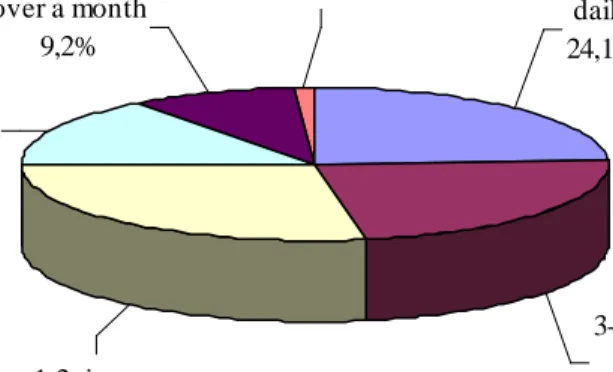
Almost 75% of the tourists drink wine once a week or more frequently.
(Fig. 1.). over a month 9,2% 1-2 times a month 14,9% 3-4 times a week 23,0% daily 24,1% 1-2 times a week 27,6% never 1,2%
Figure 1: Wine drinking frequency of tourists (n=337)
On the average the tourists drink wine three times a week and they consume 0.37 l per occasion. Significant difference can be observed when separating the set by sex. Men drink 0.46 l per occasion while women take only 0.29 l. 40% of men and 7.2% of women drink wine on a daily basis. Wine drinking frequency is growing with age but decreasing in quantities. Results show that higher education levels imply higher wine consumption.
62.2% of the answering people prefer red wines, 18.4% choose white wines and again 18.4% of them take rosé wines.
Tourist drink wine mostly with friends and if visiting a region they are keen on getting acquainted with the local wine types and usually they attend to local wine fairs and shows.
3.2.3. Wine purchasing habits of tourists
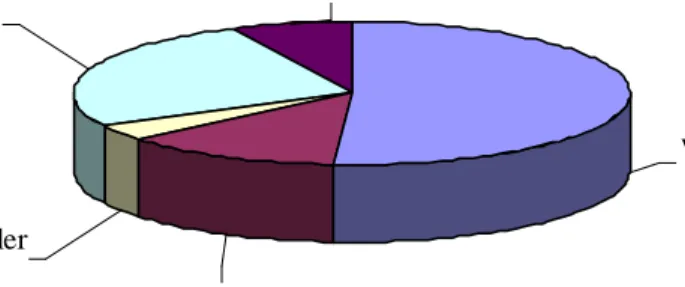
98.9% of the answering tourists purchased wines. More than a half of them (51.2%) purchased the wine directly from the grower or winery
(Fig. 2.). winery 51,2% hyper-supermarket 25,6% shop 7,0% vinotheque 12,8% wholesaler 3,4%
Figure 2: Wine purchase site of the tourists (n=337)
25.6% of the answerers buy wines in supermarkets or bigger food stores while 12.8% of them prefer to take wine from vinotheques. Buyers in wineries are mostly men (59.1%), women prefer buying in food stores since food store purchase is initiated mostly (63.6%) by women. Vinotheques are equally attended by men and women, however in this group the 18-35 yrs age segment is dominant (81.8%).
When choosing a wine people have different aspects to make their decision. Results show that most important buying factor is the quality, region, genuineness, grower or winery. Price and package, vintage year, expertise of the selling personnel are medium decision factors. Least important factors are the actual contents of etiquettes and prize award
listings. Younger buyers (18-29 years) take the suggestion of the selling person highly into consideration.
3.2.3. Possible groups of tourists
Possible groups of tourist were determined by using cluster analysis according to their travel goals, wine drinking habits and wine buying preferences.
First cluster is the „Wine drinking groups of friends”. It includes people arriving to the regions with their mates strictly for wine tasting and drinking, spending mostly a day at the site. Mostly young people (18-29 years) from the South-Transdanubian region.
Second cluster is „Wine drinking holiday makers” and consists of people arriving mainly for recreational purposes, spending generally 1-3 nights on the spot, mostly women from South-Transdanubia.
Third cluster is „Vinofil businessmen”. People of this group arrive to the regions on business, mostly with their colleagues. They spend 1-3 nights there and prefer attending to wine taste performances. They are mostly men above 49 years from Budapest.
3.3. Main results of the research in among inhabitants 3.3.1. Research of wine drinking habits
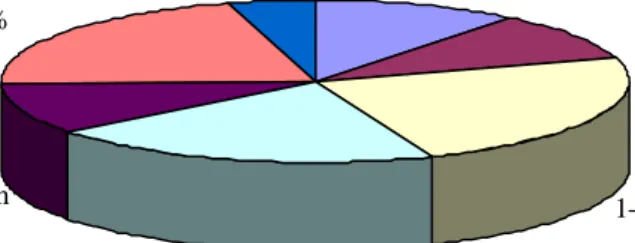
Results show that 95.6% of adult population in the South-Transdanubian region drink wine generally on a 1-2 occasions per week basis. 10.7% daily, 33.1% weekly, 30.8% monthly and 21.1% less frequently drink wine.
(Fig.3). In case of background variables a number of significant differences
daily 10,7% 3-4 times a week 9,7% 1-2 times a week 23,4% 2-3 times a month 20,8% once a month 10,0% over a month 21,1% never 4,4%
Figure 3: Frequency of wine consumption in South-Transdanubia (n=500)
Most of the non-wine drinking people (77.9%) do not consume wine because they simply do not like it, so they choose beer (or anything else).
58.4% of the people is on the side of red wine, 32.4% on the white and 9.2% votes for rosé. Men prefer red wine while women like white and rosé types. As for packaging most answerers (76.5) prefer bottled wines. Dry or half dry types are preferred by 56.5% of the sample. Men like dry types and women prefer sweeter types.
0.15-0.3 l wine is consumed per occasion in the case of 55.5% of the population and it is quite favorable if healthy nutrition and life style are taken in consideration.
More than a half of the population (57.4%) – according to their own implications – did not change wine drinking habits in the past five years. 29.5% of the population, however, indicated that recently the own consumption more or less increased. It is a positive tendency because it affects the group with a former 0.1-0.2 l consumption per occasion.
In determining the quantity of wine consumption a new index was introduced, namely the annual wine intake index. Total annual consumption of the answerers – based upon the index – is 22.896 liter and recalculated on a per capita basis it sums up to 47,9 liter per head. The index was also calculated for certain background variables. (Table 2.).
Table 2. Annual wine intake index on the basis of important background
variables (n=478)
Annual wine intake index (l)
Item total consumptions per capita consumption Total 22896 47,9 Sex male 13666 57,0 female 9230 38,5 Age 18-29 age 4833 50,5 30-39 age 5497 57,3 40-49 age 4306 45,0 50-59 age 4396 45,8 60- age 3854 40,2 Settlement town 10041 42,1 village 12855 53,9 County Somogy 7148 44,8 Tolna 7738 48,5 Baranya 8010 50,2 Education level elementary 7744 48,5 secondary 8446 52,9 higher 6706 42,0
3.3.2. Research of wine purchasing habits
84.5% of the answerers used to buy wine occasionally. Rate of daily buyers can be ignored, it is below 1% (0.06%), weekly buyers occurred up to 5.8% in the panel. It can be seen that wine is sold mostly on monthly base (38.9%) or even less frequently (39.1%).
Buying habits also display a series of significant differences. Women buy wine on more than a month basis, while men do it more frequently, more bottles a month. Secondary school and higher education levels assume more frequent wine purchase. As for living places it can be pointed out that inhabitants of Tolna county buy wine less frequently than that of the other two counties. Purchase intensity can be described by the relationship of consumption and own production. 65.6% of non-buyers covered his or her own consumption from own or family production.
Wine buying occurs mainly (49.1%) in hyper- and supermarkets followed by direct selling in wineries (24.5%). Vinotheques are visited in 16.8%, small retail units are not widely used for wine buying (8.2%).
winery 24,5% vinotheque 16,8% hyper-, supermarkets 49,1% other place 1,3% smaller retail units 8,2%
In case of wine buying two significant differences can be justified. First is that young (18-29 years) buy the wine mostly in hyper- and supermarkets and second, people in Somogy also prefer buying wine in food stores.
As for the way of buying it comes out that decision on wine buying is quite a bit (51.6%) impulse driven, so the buyer makes his or her decision right at the spot. In this case the marketing, package and brand name have the key role. If it happens in a vinotheque the selling assistance can directly drive the decision of the consumer. Quite a few people (25.8%) are looking for the wines they got used to. It is not obvious but it can be supposed that these consumers are insisting on the brand.
General opinion is that the quality of wines improved (51.0%) and 45.8% says that quality failed to change.
Wine quality is delivered to consumer by the origin (44.6%) then by the grower and winery (36.3%). Vintage year can suggest the quality only for 6.6% of the answerers.
When buying wine the actual decision of the consumer is influenced by a number of factors. According to the results first place is taken by the taste and flavor followed by the quality and then by the color. Origin, variety, price and winery are also important factors . Prize award listings and selling assistance, however, do not seem to be of vital importance.
3.3.3. Research of the knowledge about wine regions and wines
It seemed to be useful to investigate the information level of people about the wine types and wine regions. (Fig. 5.). Almost half of the people involved (43.6%) are collecting information from friends, 15.8% picks up knowledge on wine related events and 11% uses the audiovisual medium, namely the television as information source.
books 4,8% other printed materials 7,8% radio 3,8% television 11,8% Internet 6,0% friends 46,5% events 15,8% wine magazines 3,5%
Figure 5: Information sources of the population on wine and wine regions (n=456)
The study included a simple attitude analysis of Szekszárd and Villány wines through a modified Fishbein-model. In this part no individual wine was picked out but all wines of a region were taken together and it focused on constant quality, package, price, awarded prize and availability. Attitude values of the former factors were calculated, average was generated then the respective values of the regions were compared. (Table 3.).
Table 3 Attitude towards Szekszárd and Villány wines
Szekszárd wines Villány wines Item
Value Head Mean Value Head Mean Constant quality 7668 432 17,75 8153 425 19,18 Package 6128 435 14,09 6641 434 15,30 Price 6266 430 14,57 6419 428 15,00 Availability 5828 432 13,49 6199 429 14,45 Awarded prize 3229 303 10,66 3606 312 11,56 Total 29119 2032 14,33 31018 2028 15,29
The model gave a hand to determine the rank list of the five features, namely which of them is taken into consideration during decision making. Villány wines have higher attitude values either in general or individual terms as it is indicated by the mean values. Most important factor is the constant quality and least important is the information on the awarded prizes.
Inquiry contained more factors to judge in case of the two wine regions. For every single factor it turned out that the given population consider Villány wines as higher quality than Szekszárd wines.
3.3.4. Groups of wine consumers and buyers
In my study I made efforts in determining distinct groups of wine consumers on regional level. Factor and cluster analysis methods were used and four groups could be defined.
First cluster is the “Homeland wine drinkers”. A group preferring red wine having 0.5 l per occasion on a daily basis. They are mostly 50-59 years old inhabitants of Baranya county villages with secondary education level.
Second group is called “Keep habits youngsters” preferring red wine and having 0.3 l per occasion basically always of the same kind. They are mostly 30-35 years old graduated men from Tolna county.
Third cluster is the group of “Modern buyers”. Rare drinkers, preferring red wine and having 0.2 l per occasion. Older, graduated people of Baranya county towns who mostly buy the wine in big food stores.
The last group can be called “Origin seekers”. They consume wine on a weekly basis, sipping 0.1 l per occasion from high quality red wines. For the site of origin is the primary clue for quality. They are mostly over 40 years old, graduated men from Somogy county.
4. CONCLUSIONS
Marketing tasks in the examined regions equally include the extension of quality production, the widening of distribution channels, the promotion of wine consumption, the strengthening the regional image, designing complex tourist developments and the training of competent professionals.
Three main target groups were identified in the two wine regions:
− local (i.e. the wine region) population,
− non-local population,
− representatives of the media.
Best part of the local population is wine drinker, however usually the people prefer the local wine to regional types. Promotion of regional wines should be improved even within the local population.
An important target group can be the women since their share from total retail purchase is remarkably high. Young do not have well shaped wine drinking habits, not too many of them drink wine, however their interest toward wines is constantly growing. People above 45, mainly the men drink wine more and more frequently, especially as ageing brings the sense for healthiness in foreground.
Non-local population covers the circle of tourists visiting the region. Foreign tourists and inland ones – the latter mainly arriving from Budapest. (Many of them arrive to the regions on business activities.) Foreign tourists can most effectively disseminate the fame of the region’s wines if he or she leaves with positive memories.
Representatives of the media are forming a very important target group. It is an urgent need of the two regions to act in a positive way in the news either on local, regional or national level.
When positioning the products for the target groups the keynote of the message must be the quality in case of both regions. A possible slogan or philosophy of the regions can be a note just as: We produce wine down in the cellars and sell a buzz upstairs”.
Product palette should be fitted to the actual market demands but in a way that constant quality can be maintained. A “wine of the region” cuvée should be made, and that is a wine from different wineries, presented by joint action and expertise of different producers. A wine mainly for everyday consumption but supported by community marketing. Design of a regional etiquette could serve for improving the image of the regions. In Szekszárd region more attention should be paid to the packaging of premium quality wines.
Prices should be fitted to the actual distribution channel, the offered quantity and specification and of course to their own interest. Good wine must have quality-reflecting price. In case of wine low prices indicate inferior quality. After having taken part in a number of tests and interviews I think that it is the Szekszárd region where the price-value ratio of their wines must be adjusted to a proper level.
Distribution channels are looked up and chosen by the wineries. It would be a positive change if the trade sector felt an urge to seek the producers of the high quality Villány and Szekszárd wines. Maybe the “Wine producer of the year” title and foreign wine contest prizes can help with this issue.
Rate of direct selling in the Villány region is about 15-25% while in the Szekszárd area it fails to exceed 10%. The difference can be explained by the development levels of marketing and wine tourism. Regarding the buying habits of the local and regional population direct selling should be more emphasized and improved both in quantities and service qualities.
The study pointed out that once a buyer got acquainted with a certain wine of a producer and there is no chance any longer to fetch that wine directly from the cellar the same buyer is looking for it on the shelves of the big food stores – but in some cases all in vain. That’s why it would be important to strike in the bigger (i.e. over 400 sq.m) stores with the regional wines. First, of course, the negotiating positions of the producers should be strengthened but it is a kind of a “mission impossible”.
More vinotheques should be reached both inland and abroad. The level of presence must be improved.
Wine related fairs and exhibitions are great occasions to build business and/or professional connections as well as to keep an eye on the competitors. Comparing the two regions it can be concluded that the presence of Szekszárd area in such events is far weaker than that of the Villány region due mainly to the lack of marketing sense and lack of capital. Nowadays the internet provides a comfortable way to sell wines. On-line purchase shows a slow increase. Many of the regional products can be found in the virtual vinotheques – mostly connected to the sites of wine trading houses. Publishing own homepages makes it possible to order the wine directly from the producers.
Through promotional activities the name of the product, producer, winery and wine region must be burnt in the brain of the target group members and also make them associate on the quality. Influencing the people this way can help with building positive attitudes toward the region and with improving marketability.
Advertisements can disseminate the knowledge on the region, the wines, the image and the brand acceptance. Motivation campaigns can influence the behavior of the consumer. PR activities have a key role in building and
maintaining the image of the region while personal selling and direct marketing have their own roles in getting closer to the buyer.
Target groups should be reached through the channels fitting best to their needs. Women must be approached through the channels they constantly keep an eye on, while young can usually be fetched through certain wine related events.
Generally the wine drinking target group can be most effectively reached through product attached or selling spot advertisements, therefore the etiquettes have very high importance in “addressing” the buyer.
Wine tourism must be improved in both regions since it is the best way to introduce the wines. It can strengthen the reputation, fame and image because it assumes direct and personal interactions with the potential buyer.
Fame and reputation of Villány region has great value. This reputation must be maintained by producing wines over the average national quality and by communicating it in a conscious way. Szekszárd region is known by more and more people in the country due to good results on recent wine contests but it cannot be enough. Well designed marketing communication can maintain and improve the publicity of regional wines.
5. NEW SCIENTIFIC RESULTS AND FINDINGS
1. The detailed survey and analyses about the wine consumption and purchasing habits of the inhabitants in the Southern-Transdanubia was done/happened. During the researches the following main, four , groups of the inhabitants were selected: the “Homeland wine drinkers“, the “Keep habits youngsters”, the “Modern buyers” and the “Origin seekers”.
2. Three clusters were determined by the research which analyses the wine consumption and purchasing habits of the wine tourists visiting Szekszárd and Villány. The clusters of the tourists are the following: the „Wine drinking groups of friends”, the „Wine drinking holiday makers” and the „Vinofil businessmen”. The groups based on their characteristics well define the circle of wine-tourists of the wine-tourists of the two wine regions.
3. The comparison of the Szekszárd and Villány wine regions was made from marketing view. During this the differences, the similarities and the properties of them were analyzed. The comparison was mainly based on the results of the depth interviews and of the questionnaire researches with the wine tourists and the inhabitants of Southern-Transdanubia.
4. In the wine regions of Szekszárd and Villány a possible marketing strategy for the wine sector was outlined. The most important findings of the strategy were the importance of the wine quality and of the origin protection, the increase in share of wine tourism from the sales and the public relations, as well as to increase the effectiveness of the marketing
communication. The marketing means the possible target groups and to be able to reach them recommended were introduced in this strategy to serve as a practical guideline for the wine-growers, and the experts in the catering industry, tourism and marketing.
NEW SCIENTIFIC METHODOLOGICAL RESULTS
1. A new index number was introduced to determine the quantities of annual wine consumption. In the course of this the different data of the wine consumption’s frequency scale could be well expressed separately or one value.
2. The Fishbein model which was used to the attitude analysis of the two wine regions was modified. With this the definition of a more uniform and more precise measuring members became possible during the researches.
6. PROPOSALS
The draft plan of the Hungarian Winemarketing Strategy which has been drawn up recently deals with the importance of winemarketing on national level in Hungary. The strategy points to that many wine regions are in need to prepare their winemarketing strategy.
The marketing strategy which was outlined in the dissertation could serve as a practical guideline for the vineries and the communal winemarketing experts first of all in the wine regions of Szekszárd, Villány and the Pannon Wine Region, too because it contains useful information. The dissertation and other publications which were made during the years of research contain useful information about winemarketing and wine tourism for “wine profession”.
The results of the research make the wine-growers and catering industry with the tourists of the two wine-regions, as well as they give detailed and up-to-date information about the wine consumption and purchasing habits of the inhabitants in Southern-Transdanubia and of the tourists of the two wine-regions, too. The results of my research could be used or taken into account by the vineries when they make or modify their plans or strategy.
Since the research of the wine tourists pointed out that there are a lot of tourists from Budapest in the two wine-regions, so further researches are suggested to make (about the wine consumption and purchasing habits as well as their tourist claims among the inhabitants of Budapest). (I made a questionnaire research with 100 people about these topics among the inhabitants of Budapest. I will evaluate the results and write publications about it in the future.)
A detailed and complex study of the communal winemarketing activities in both wine-regions is recommended in the future, too.
I not only want to enrich the research activity of Kaposvár University with the obtained findings and my dissertation, but I also want to contribute to the more effective work of the Szekszárd, Villány and the Pannon Wine Regions, too.
7. PUBLICATIONS IN THE FIELD OF THE
DISSERTATION
SCIENTIFIC PUBLICATIONS Publication in foreign language
1. Molnár E.: Wine tourism and marketing in wine-region of Szekszárd and Villány. Acta Scientiarum Socialium. (megjelenés alatt)
Publication in Hungarian language
1. Molnár E.: A bormarketing sajátosságai a Szekszárdi borvidéken. In: Élelmiszer, táplálkozás és marketing. 1 (1-2) 117-120 (2004)
2. Molnár E.: A bormarketing jelentısége a Szekszárdi és a Villány-Siklósi borvidéken. In: Élelmiszer, táplálkozás és marketing. 2 (1-2) 55-59 (2005)
3. Molnár E.: A bor két arca. In: Élelmiszer, táplálkozás és marketing. 3 (2) 19-23 (2006)
Full texts in Proceedings
Publication in foreign language
1. Molnár E., Tarnavölgyi G.: Marketing research among wine-growers of Szekszárd. Within the European Union – Nemzetközi Konferencia. Nyugat-Magyarországi Egyetem Mezıgazdaság- és Élelmiszertudományi Kar. Mosonmagyaróvár, 2004. május 6-7. (CD)
2. Molnár E., Polereczki Zs.: Prospects of wine-marketing in Hungary. 5th International Conference of PhD students. 2005. augusztus 14-20. Miskolc. 119-202.
3. Molnár E., Polereczki Zs.: Wine-growers’ marketing activity of Szekszárd. 5th International Conference of PhD students. 2005. augusztus 14-20. Miskolc. 115-121
4. Molnár, E., Székely, B. O.: The importance and the role of wine-marketing in Hungary. Within the European Union. III. Nemzetközi
Konferencia. 2006. április 6-7. Mosonmagyaróvár. (CD)
5. Molnár, E., Székely, B. O.: Marketing research among wine-growers of Szekszárd. Within the European Union. III. Nemzetközi
Konferencia. 2006. április 6-7. Mosonmagyaróvár. (CD)
Publication in Hungarian language
1. Molnár E.: A „kadarka hazájának” marketingszempontú bemutatása. X. Ifjúsági Tudományos Fórum, Veszprémi Egyetem Georgikon Mezıgazdaságtudományi Kar. Keszthely, 2004. április 29. (CD Kiadvány)
2. Molnár E., Tarnavölgyi G.: Marketingkutatás a Szekszárdi borvidéken. VI. Nemzetközi Élelmiszertudományi Konferencia. Szegedi Tudományegyetem Szegedi Élelmiszeripari Fıiskolai Kar. Szeged. 2004. május 20-21. (CD Kiadvány)
3. Molnár E., Tarnavölgyi G.: Fogyasztási, vásárlási szokások és vélemények a szekszárdi borvidék lakosai körében. VI. Nemzetközi Élelmiszertudományi Konferencia. Szegedi Tudományegyetem Szegedi Élelmiszeripari Fıiskolai Kar. Szeged, 2004. május 20-21. (CD Kiadvány)
4. Molnár E., Székely O.: A Szekszárdi borút, mint turisztikai termék. XI. ITF. 2005. március 24. Keszthely. (CD Kiadvány)
5. Molnár E., Székely O.: A Szekszárdi borvidék a marketing tükrében. Verseny élesben. 2005. május 5-6. Mosonmagyaróvár. (CD Kiadvány)
6. Molnár E.: A bormarketing jelentısége a Szekszárdi és a Villány-Siklósi borvidéken. X. Nemzetközi Agrárökonómiai Tudományos
Napok. Károly Róbert Fıiskola. 2006. március 30-31. Gyöngyös (CD)
7. Molnár E.: Kvalitatív és kvantitatív kutatás a Villányi bortermelık és turistái körében. VII. Nemzetközi Élelmiszertudományi Konferencia. 2006. április 20. Szeged. (CD)
8. Molnár E.: Lehetséges stratégiai és taktikai marketing kialakítása a Szekszárdi borvidéken. VII. Nemzetközi Élelmiszertudományi
Konferencia. 2006. április 20. Szeged. (CD)
9. Molnár E.: Lakossági felmérés eredményei a Szekszárdi borvidéken.
XII. ITF. 2006. április 20. Keszthely. (CD)
10.Molnár E.: Borturizmus és fejlesztési lehetıségei Tolna megyében. I.
Terület- és Vidékfejlesztési Konferencia. 2007. március 2-3.
Kaposvár (CD)
EDUCATIONAL PUBLICATIONS
1. Molnár E.: Borászat a jog „tükrében”. In: Dolgozatok a Gazdasági jog témaköreibıl. Kaposvár, 18-30 (2004)
PRESENTATIONS
1. Molnár E.: Bor és egészség. Kaposvári Egyetem. Regionális