89
Socio-Economic Impact through Self Help Groups
D.Amutha Asst.Professor of Economics, St.Mary’s College (Autonomous), Tuticorin
Email: [email protected]
Received: October 14th, 2011 Accepted: October 19th, 2011 Published: October 30th, 2011 Abstract
The overall objective of the present study is to analysis the economic empowerment of women though SHGs in three villages of Tuticorin District of Tamilnadu. This study is compiled with the help of the primary data covered only in a six month period (2011). Totally 238 respondents were selected from 18 SHGs of three villages by using simple random sampling method. Empowerment signifies increased participation in decision-making and it is this process through which people feel themselves to be capable of making decisions and the right to do so. Women’s participation in decision-making in family is important indicator for measuring their empowerment. The analysis shows that 66 percent beneficiaries reported decisions are being taken by their husbands, yet, more than 34 percent respondents accepted that they do participate in decision-making process. Thus, the socio-economic conditions of women have demonstrated that their status has improved since the joining of SHG’s and availing microfinance. The result of chi-square- test revealed that there is significant difference between participation in decision-making in family and SHG women members in Tuticorin District.
Keywords: Self-Help Groups, women empowerment, percentage analysis, averages, chi-square tests 1. Introduction
Empowerment can serve as a powerful instrument for women to achieve upward social and economic mobility and power and status in society. Women’s empowerment would be able to develop self-esteem, confidence, realize their potential and enhance their collective bargaining power. A SHG is a small economically homogeneous affinity group of the rural poor voluntarily coming together to save small amount regularly, which are deposited in a common fund to meet members emergency needs and to provide collateral free loans decided by the group. (Abhaskumar Jha 2000). They have been recognized as useful tool to help the poor and as an alternative mechanism to meet the urgent credit needs of poor through thrift (V. M. Rao 2003) SHG is a media for the development of saving habit among the women (S. Rajamohan 2003). SHGs enhance the equality of status of women as participants, decision-makers and beneficiaries in the democratic, economic, social and cultural spheres of life. (Ritu Jain 2003). The basic principles of the SHGs are group approach, mutual trust, organization of small and manageable groups, group cohesiveness, sprit of thrift, demand based lending, collateral free, women friendly loan, peer group pressure in repayment, skill training capacity building and empowerment (N.Lalitha). Some estimates put these at currently 2.5 million SHGs in India. (Economic Survey of India, p.67). In Tamil Nadu the SHGs were started in 1989 at Dharmapuri District. At present 1.40 lakh groups is a function with 23.83 lakh members. Many men also eager to form SHGs, at present. Tuticorin District having 19 town panchayats formed 1230 SHGs, and their achievement is 259%. In the process, it aims to commission women with multiform forms of power; hence a study was conducted on empowerment of women by SHGs in Tuticorin District, Tamil Nadu.
1.1 Objectives
The main objectives of the study are mentioned below:
•To study the socio economic background of the members of Self Help Groups of Tuticorin District
•To know the reasons for joining SHGs.
•To examine the activities of Self Help Groups in the study area.
90 1.2 Methodology
The present study has covered three villages from Tuticorin District viz, Meelavittan, Mullakkadu and Korampallam. These three villages were selected for this because of the SHGs in these villages is functioning in a very successful manner. This study is compiled with the help of the primary data covered in only six month period (2011). The primary data collected with the help of specially prepared interview schedule. Totally 238 respondents were selected from 18 SHGs of three villages by using simple random sampling method. The sample size was 1/3 of the total members of the SHGs. This is purely a descriptive study. Percentage analysis, averages, standard deviation, variance, chi-square tests, Cramer’s V and probability analysis were used for the analysis.
2. Discussion and analysis 2.1 Age
Age is an important factor in determining the empowerment of SHG members. In the present study an effort has been made to know the age group of the respondents. In the study area, 238 respondents in three villages from Tuticorin District viz, Meelavittan, Mullakkadu and Korampallam were selected for the study and average number of the respondents in Tuticorin District study areas was about 48 members and standard deviation was about 16.
Table 1 Age wise classification of the respondents
Particulars(years) Frequency Percentage Results
31-40 39 16.4 Mean (Average):59.5
41-50 162 68.1 Standard deviation: 70.02143
51-60 33 13.9 Variance (Standard deviation): 4903
61 and Above 4 1.6 Population Standard deviation: 60.64033
14.2632460.64033
Total 238 100.0 Variance (Population Standard deviation):3677.25
Source: Primary data
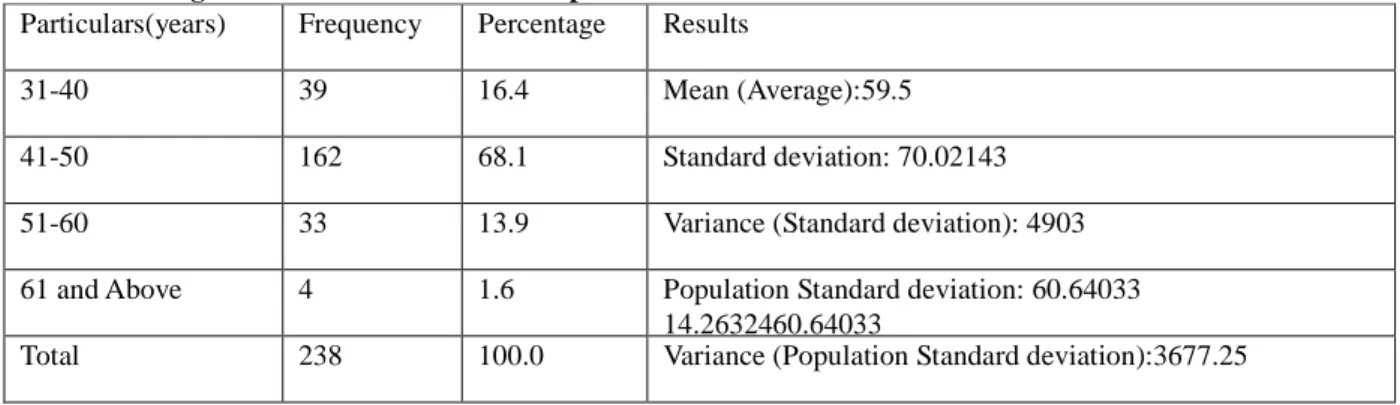
The table 1 shows the age wise classification done into four different categories. From the table we find that the respondents mainly fall under the age group of 41-50 where the highest frequency occur i.e. 162 and in total sample size it constitutes to 68.1% followed by the age group of 31-40 and its frequency is 39 which constitute 16.4% in the total sample, followed by the age group of 51-60 which the frequency is 33 and its percentage of the total sample size is 13.9%. This indication would be relevant to the study because most of the earning members in a family would be in the age group of 41-50.
2.2 Community
The caste system was introduced in ancient India on the basis of occupation. Even now to some extent people of a particular caste or community stick on to a particular trade. Even though the caste behaviour can be moulded with the help of education, exposure and multi-media development, it plays its own role relating to empowerment of SHG members.
Table 2 Community-wise Classification of the respondents
Particulars Frequency Percentage
Backward Classes 85 35.7
Most Backward Classes MBC
22 9.2
SC/ST 131 55.1
Total 238 100.0
91
From the table 2 it is understood that the respondents are mainly from the SC/ST community which is 55.1% of the total respondents. Following this next stands the backward class community with 85 members and 35.7% of the total sample size. Here most backward class is only a meager amount in the sample i.e. 22 in numbers and 9.2% in total percentage.
2.3 Religion
The religion of the family is a major influence on the empowerment of SHG members. Table 3 Religion wise Classification of the Respondents
Particulars Frequency Percentage
Hindu 205 86.1
Muslim 2 0.8
Christian 31 13.1
Total 238 100.0
Source: Primary data
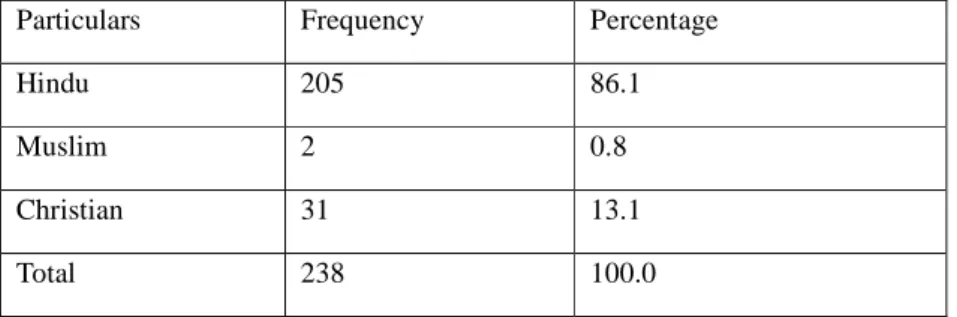
The table 3 reveals that 86.1% of the total respondents belong to the Hindu religion and the actual number is 205 of the total 238 samples selected. The remaining 13.1% are Christians. This might be about the fact that the field area chosen should be a Hindu religion dominated area.
2.4 Occupation
The SHG members were engaged in various occupations such as agriculture operations and private jobs. The occupation of the members helps them to avail themselves of credit from the banks and invest it in their irrespective occupations to earn more.
Table 4 Occupation of the Respondents
Particulars Frequency Percentage Results
Unemployed 9 3.8 Mean (Average): 59.5
Agriculture 221 92.9 Standard deviation: 107.69556
Industry 3 1.2 Variance (Standard deviation): 11598.33333
Collie 5 2.1 Population Standard deviation: 93.26709
Total 238 100.0 Variance (Population Standard deviation): 8698.75
Source: Primary data
From table 4 we conclude that more number of the respondents is engaged in agriculture for their means for livelihood i.e. 221 respondents are agriculture earning people.
2.5 Reasons for joining SHGs
The major aim of SHG is to promote savings, generate income and credit for the productive and consumptive purposes. This is true because in the study area the sample women joined the SHGs for getting loan and promoting their savings and income, in addition to attaining of social status.
Table 5 Reasons for joining SHGs
Reasons Frequency Percentage
Family Income 203 85.3
Bored at home 21 8.8
92
Total 238 100.0
Source: Primary data
(Mean: 79.33333; Standard deviation: 107.15565)
The table 5 reveals that 85.3 percent of women stated that the most important motivating factor to join the SHG was to supplement their family income. It also reveals that there is definite growing awareness in society and women in particular that if the family has to maintain a reasonable standard of living, women should supplement to family income with whatever skill they have 8.8 and 5.9 percent of them stated that they join the SHG was bored at home and to provide good life for their children, respectively.
2.6 Satisfactions with Family
The satisfaction of respondents with family members means equal status, participation and powers of decision making of women in household level. The satisfaction of respondents with family members has been reported to be quite high.
Table 6 Satisfactions with Family
Satisfaction Meelavittan Mullakkadu Korampallam Total
Very Happy 58(60.4) 65(79.3) 39(65) 162 (68.1)
Not Happy 38(39.6) 17(20.7) 21(35) 76 (31.9)
Total 96(100.0) 82(100.0) 60(100.0) 238 (100.0)
Source: Primary data
(χ2=7.58, P=0.022596, df=2, Cramer’s V=0.1785), Significant at 1% probability level.
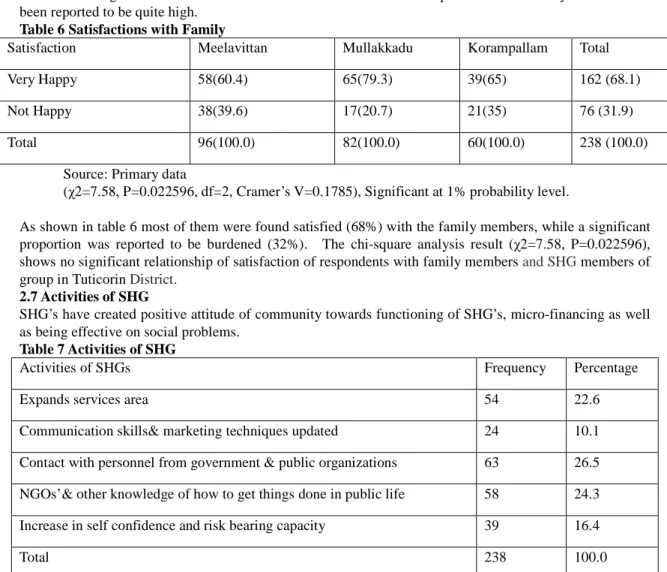
As shown in table 6 most of them were found satisfied (68%) with the family members, while a significant proportion was reported to be burdened (32%). The chi-square analysis result (χ2=7.58, P=0.022596), shows no significant relationship of satisfaction of respondents with family members and SHG members of group in Tuticorin District.
2.7 Activities of SHG
SHG’s have created positive attitude of community towards functioning of SHG’s, micro-financing as well as being effective on social problems.
Table 7 Activities of SHG
Activities of SHGs Frequency Percentage
Expands services area 54 22.6
Communication skills& marketing techniques updated 24 10.1
Contact with personnel from government & public organizations 63 26.5
NGOs’& other knowledge of how to get things done in public life 58 24.3
Increase in self confidence and risk bearing capacity 39 16.4
Total 238 100.0
Source: Primary data
(Mean: 47.6; Standard deviation: 15.94679; Variance: 254.3)
Generally SHGs include various activities. The important activities are contact with personnel from government and public organizations (26.5%) and NGOs’ and other knowledge of how to get things done in public life (24.3%) and average number of the respondents in Tuticorin District study area was about 48 members and standard deviation was about 16.
93 2.8 Decisions Making in Family
Empowerment signifies increased participation in decision-making and it is this process through which people feel themselves to be capable of making decisions and the right to do so. Women’s participation in decision-making in family is important indicator for measuring their empowerment.
Table 8 Decisions Making in Family
Decision Making Meelavittan Mullakkadu Korampallam Total
Husband 49(54.4) 72(83.7) 36(58.1) 157 (65.9)
Yourself 41(45.6) 14(16.3) 26(41.9) 81 (34.1)
Total 90(100.0) 86(100.0) 62(100.0) 238 (100.0)
Source: Primary data
(χ2=19.12, P=0.000070, df=2, Cramer’s V=0.2834), Significant at 5% probability level
It is obvious from table 8 that 66 percent beneficiaries reported that decisions are being taken by their husbands, yet, more than 34 percent respondents accepted that they do participate in decision-making process. Thus, the socio-economic conditions of women have demonstrated that their status has improved since the joining of SHG’s and availing microfinance. The result of chi-square- test (χ2=19.12, P=0.000070), revealed that there is significant difference between participation in decision-making in family and SHG women members in Tuticorin District.
2.9 Political Empowerment
Participation in Panchayatraj institution, understanding the political environment and accessing political power provide empowerment. So the opinion of the respondents were collected and shown in the following table.
Table 9 Political Empowerment
Particulars Meelavittan Mullakkadu Korampallam Total
Participation in Panchayatraj Institution
68(76.4) 80(90.9) 23(37.7) 171 (71.8)
Understand the Political Environment 21(23.6) 8(9.1) 38(62.3) 67 (28.2)
Total 89(100.0) 88(100.0) 61(100.0) 238 (100.0)
Source: Primary data
(χ2=51.88, P=<0.0001, df=2, Cramer’s V=0.4669), Significant at 1% probability level
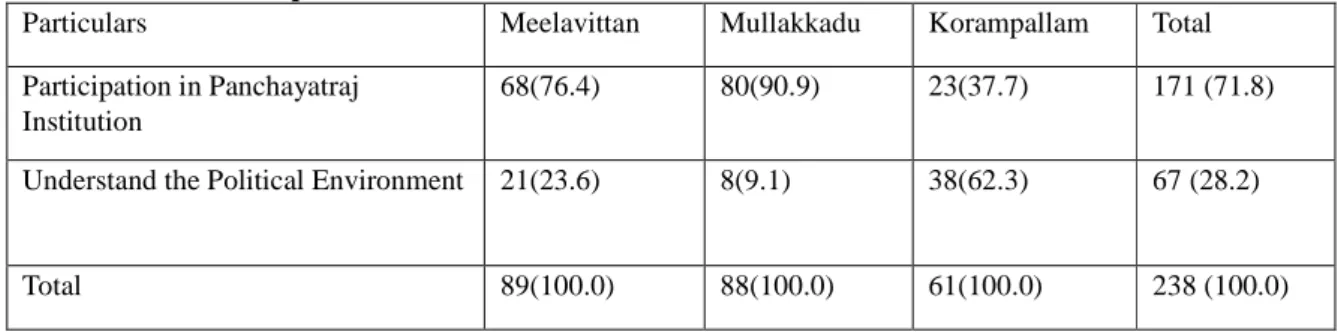
Participation in Panchayatraj institution and understanding the political environment provide empowerment. So the opinion of the respondents were collected and shown in the following table. 72% respondent were expressed that participation in Panchaytraj institution and 28% respondents were of the view that understanding the political environment showed significant difference (P < 0.001).
2.10 Entrepreneurial Empowerment
Entrepreneurs are those persons who seek to generate value, through the creation or expansion of economic activity by identifying and exploiting new products, process or markets. Entrepreneurial activity is the enterprising human action in pursuit of the generation of value, through the creation or expansion of economic activity, by identifying and exploiting new products, process or markets. Entrepreneurial activity includes the entry of new products, the creation of new products or service, and the innovation associated with different business activated. Entrepreneurial activity can therefore be associated with organic as well as acquisitive decision.
94 Table 10 Entrepreneurial Empowerment
Particulars Meelavittan Mullakkadu Korampallam Total
Increase desire to learn more professional skills
17(10.2) 4(9.1) 23(82.1) 44 (18.5)
Intensifies desire to earn and better living
149(89.8) 40(90.9) 5(17.9) 194 (81.5)
Total 166(100.0) 44(100.0) 28(100.0) 238 (100.0)
Source: Primary data
(χ2=85.36, P=<0.0001, df=2, Cramer’s V=0.5989), Significant at 1% probability level
From the table, 82% respondents were of the view that SHG intensifies desire to earn more and make better living and only 19 percent of women expressed that SHG increases desire to learn more professional skills and the difference was statistically significant (χ2=85.36, P=<0.0001).
3. Conclusion
SHGs started functioning all over Tamilnadu, in some areas they are functioning effectively whereas in other areas they face problems. Since SHGs help women to achieve economic empowerment, these policy measures can contribute a lot to the nation. To conclude, the economic activities of SHGs in Tuticorin District are quite successful.
References
Abhaskumar Jha (2004), “Lending to the Poor: Designs for Credit”, EPW, Vol. XXXV, No.8 and 9. Chiranjeevulu T. (2003), “Empowering Women through Self Help Groups – Experiences in Experiment”, Kurukshetra, March.
Chopra Kanchan (2004), “Social Capital and Development Processes – Role of Formal and Informal Institutions “, Economic and Political Weekly, July, 13.
Economic Survey of India, 2007-08.
Jeyanthi Gayari, R (2002), “SHGs in Kanyakumari District”, M.Phil., dissertation submitted to Alagappa University, Karaikudi, T.N.
Jeyaraman, R. et al., (2004), “Role of Self help Groups in Fisher Women Development,” Peninsular Economist, Vol. XII, No.2, pp. 197-200.
K. Usha (2003), “Gender, Equality and Development”, Yojana
Keishnaraj, Maithreyi (2005), ‘Growth and rural Poverty”, Economic and Political Weekly, September 21. Lalitha, N. “Women Thrift and Credit Groups- Breaking the Barriers at the Gross Roots”, Peninsular Economist, Vol. XII No. 2, pp. 188-195
Manimekalai, N. et. al., “Gross-root Women Entreprenurship through SHGs”, Peninsular Economist Vol. XII, No.2, pp. 181-187
Rajamohan, S. (2003) , “Activities of Self Help Groups in Virudhunagar District-A Study, TNJC, pp. 25-29 Rao, V.M. (2003), Women Self Help Groups, Profiles from Andhra Pradesh and Karnataka”, Kurukshetra, Vol. 50, N0.6, pp. 26-32
Ritu Jain, (2003), “Socio-Economic Impact through Self Help Groups”, Yojana, Vol. 47, No.7, pp.11-12 Sabyasachi Das, (2003), ‘Self Help Groups and Micro Credit Synbergic Integration”, Kurushetra Vol. 51, No.10, pp. 25-28
Sreeramulu, G (2006), Empowerment of Women through Self-Help Group, Eastern Book Corporation. Vandana K. Jena, (2007), Literacy for Women’s Empowerment, Indian Journal of Population Education, IAEA, New Delhi, No.38, July-Sep.
www.expressindia.com
www.flyhighonline.com
www.indianngos.com
www.knowledgeallianz.com www.microfinancegateway.org