JONA
Volume 37, Number 3, pp 135-143
CopyrightB2007 Wolters Kluwer Health | Lippincott Williams & Wilkins
T H E J O U R N A L O F N U R S I N G A D M I N I S T R A T I O N
Nursing Research Internship
Enhancing Evidence-Based Practice Among Staff Nurses
Nancy Wells, DNSc, RNMarcia Free, BSN, RN Robert Adams, MSN, RN
Many barriers inhibit nurses from using evidence to guide their practice. The authors describe the development of a Nursing Research Internship Program designed to overcome barriers to evidence-based practice and provide staff nurses with an opportunity for professional growth. Evaluation of the program indicates it has increased staff nurses’ use of the literature to identify and solve clinical problems, fostered positive attitudes about re-search, and led to increased professional develop-ment activities.
Evidence-based practice (EBP) is defined as the ‘‘integration of best evidence with clinical expertise and patient values’’1(p1)in making decisions about
patient care and care delivery. After more than 10 years of EBP, it is apparent that reducing varia-tions in practice and following evidence-based guidelines improve quality of care and patient out-comes.2 With the emphasis on quality care and patient safety, EBP has gained importance for clini-cians delivering patient care.3 Selecting interven-tions based on scientific evidence and developing protocols to reduce variations in practice are key strategies to improve patient care quality and safety. Thus, measures designed to enhance staff nurses use of EBP will contribute to better nursing care delivery systems as well as improved patient outcomes.
Background
Nursing has a long history of research utilization (RU) models and programs.4,5 The models and programs developed since the 1970s provide a framework for the use of research findings in improving clinical practice. One example, the CURN project,4 outlined explicit steps one takes to identify a clinical problem; review, evaluate, and synthesize research literature relevant to that prob-lem; plan a practice change based on the literature and methods to evaluate that change. Evidence-based practice models6,7expand the sources of evi-dence about practice to include best practice based upon clinical expertise, expert panel consensus, and benchmarking data. Thus, EBP involves use of re-sources such as guidelines and white papers pub-lished by professional organizations and cooperative groups, in addition to research evidence.
Barriers to Evidence-Based Practice
Despite a growing body of knowledge that sup-ports nursing practice and care delivery, there are barriers that inhibit EBP for nurses. These barriers have been widely explored through both qualita-tive and quantitaqualita-tive methods, within diverse nursing specialties and international settings.8Y10
Clinicians lack awareness of EBP, skills, and information resources needed to engage in EBP.11Y13 In a sample of 760 clinical registered nurses in the United States, Pravikoff et al13 found that 54% were not familiar with the term EBP, and 59% had not identified a researchable problem in their practice within the past year. Over half of the respondents reported not using research reports at
Author’s affiliations:Director, Nursing Research (Dr Wells), Staff Nurse, Clinical Research Center (Ms Free), Staff Nurse, Post Anesthesia Care Unit (Mr Adams), Vanderbilt University Medical Center, Nashville.
Corresponding author:Nancy Wells, DNSc, RN, TT-0102 Medical Center North, Vanderbilt University Medical Center, Nashville, TN 37232-2424 ([email protected]).
all to support their practice, which correlates with the fact that 76% had never searched CINAHL and 58% had never searched MEDLINE. In addition to being unfamiliar with the scientific evi-dence base, nurses felt overwhelmed by the volume of evidence and incapable of evaluating the quality of research reports.12,14,15A prime concern is dif-ficulty interpreting statistical analyses.11 McKenna et al14 noted that over two-thirds of their sample of nurses in primary care (n = 462) did not have access to relevant literature either in a library or via onsite computer facilities. Even when nurses had access to the literature, many did not feel skilled or confident in their ability to use these resources.10,13,16In addition, research reports lack clear practice implications and generalizability.17 Thus, awareness of EBP and the skills and re-sources necessary to locate evidence prevent nurses from using evidence to improve their practice.
Lack of time is the most problematic among the many factors nurses perceive as limiting their ability to use evidence in practice.11,12,18 This involves difficulty in finding time to reflect on practice; locate evidence; read, evaluate, and syn-thesize it; translate it into practical applications; implement warranted changes; and evaluate the results. Implementing new ideas is a complex process that often is lengthy and bureaucratic.15
Common complaints are that the drive for effi-ciency in busy practice settings leads to high work burden.19 Evidence-based practice is perceived as an additional burden, disconnected from tradi-tional nursing activity rather than a tool to im-prove care and efficiency.
Nurses’ perceptions that they lack the author-ity and cooperation to change patient care proce-dures constitute another significant barrier to implementing EBP.12 In the study of Glacken and Chaney20 of 169 registered nurses using the Barriers to Research Utilization Scale,21 it was found that over 68% of their sample rated lack of authority to change patient care procedures, and lack of support from physicians, coworkers, and management as moderate to high barriers to RU. Sams et al22 report a project to establish EBP in managing pain in pediatric oncology patients. Informal nurse leaders were given time, resources, and administrative support to meet the project goals. Despite these important facilitators of EBP, they met with limited success because of lack of cooperation from the 2 groups working directly with them at the bedsideVphysicians and their nursing coworkers. Managers also are perceived as a barrier to EBP indirectly, via lack of interest,23,24 commitment,16 and support.9,15 According to one
systematic review on diffusion, dissemination, and sustainability of innovations in healthcare organi-zations,25 there is strong indirect and moderate direct evidence that an innovation (driven by EBP) is more likely to be assimilated if it has a ‘‘budget line’’ and if resource allocation is both adequate and recurrent.
Lack of access to colleagues with research ex-pertise is a considerable impediment.15,24,26 Clini-cians often express a desire for access to experts, such as educators, consultants, role models, col-laborators, or supporters.9,14,19,27
Negative beliefs,14 attitudes,19 and values13
have been shown to be powerful barriers to EBP. Pepler et al28 highlight this fact at the unit level using a qualitative multiple case study approach to identify strategies used by clinical nurse specialists and clinical nurse educators to facilitate RU on nursing units. Even when similar strategies were used by clinical nurse specialists and clinical nurse educators, the observed outcomes differed across units. These differences were explained by unit culture. Units with high levels of RU were charac-terized by positive beliefs and attitudes toward EBP, and conversely, units with low levels were characterized by negative beliefs and attitudes toward EBP.
In a systematic review of studies examining individual characteristics of nurses and how they influence RU, Estabrooks et al29found support for only oneVa positive association between individ-ual beliefs and attitudes to research and RU. Wells and Baggs30 discovered that nurses who valued research were 5 times more likely to use research in their practice. Regarding antecedents to positive beliefs, attitudes, and values toward research, Olade26 found that previous participation in nurs-ing research was the most significant factor in relation to a positive research attitude. Therefore, positive attitudes and values are fostered through exposure to the research process and investigators who conduct research.
With the Institute of Medicine Quality Chasm reports calling for incorporation of EBP as crucial in healthcare reform,3 the nursing profession con-tinues to be highly motivated to explore potentially useful strategies to increase the use of evidence in practice that overcome these complex barriers. A wide range of strategies are mentioned in the literature, from simple research newsletters to synthesized evidence around a particular topic targeted to specific audiences. More comprehen-sive institution-wide initiatives based on various models for evidence-based nursing practice have been described. Concrete outcome data are less
frequently reported than program descriptions. To address the barriers to EBP, strategies are needed to improve awareness, knowledge, and skills in locating and evaluating evidence, to garner admin-istrative support, and to provide access to EBP or research mentors. One such strategy is a formal nursing research internship designed for staff nurses.
Internship Programs in Action
To overcome the complex barriers to EBP, a number of institutions have developed internship or residency programs that immerse staff nurses in the research process.31Y38Although some programs are more thoroughly outlined in the literature than others, most bear striking similarities in design, function, and outcomes. These programs are con-ceived with the goal of assisting staff nurses to identify, appraise, and use research as one form of evidence upon which to base their practice and to develop themselves professionally. All programs are led by professional nurse researchers, some also use advanced practice nurses or other mem-bers of the healthcare team as individual mentors to the interns. Exposure to the research process, peer group support, continuous quality improve-ment (CQI) concepts, and RU models are used to meet the program goals. Participants are given paid time off for varying program lengths (10-week intensive to 2 years of monthly or quarterly meet-ings). These programs are driven by the staff nurses, who identify the patient care practice, policy, or procedure they wish to question. Most programs incorporate administrative support as a key element. Staff nurses are exposed to guest speakers and local experts who expand their col-laboration potential.
Each research internship program features sequential didactic coursework on basic RU topics, research skill building exercises, and facilitated project work time. Continuing education units are offered by a number of programs. Figure 1 displays the common topics addressed in these research internship programs.
Both qualitative and quantitative outcomes have been explored to evaluate the success of these internship programs. For example, the practice and profession of nursing have been strengthened through improved patient care measures,31funded grants for nursing research,34 and submission of manuscripts for publication.38Staff nurse retention is positively affected as a result of high satisfac-tion with programs.31,32,38Dissemination of
proj-ect results has been both internal (ie, in-house publications) and external (ie, conference presen-tations, manuscripts for publication) to the organi-zations with internship programs.34,38Professional growth and development have resulted from the educational content of programs and motivated some participants to pursue advanced degrees.31,38 There have been financial savings to institutions through more cost-effective care.31,38
It is within this context that Vanderbilt Uni-versity Medical Center developed and maintains a Nursing Research Internship Program to offer staff nurses the opportunity to gain research literacy and to facilitate their professional responsibility for EBP. This program, similar to programs described in the literature, was designed to address many of the barriers to EBP. Components were selected to increase awareness of EBP, gain knowledge and skills required to locate and evaluate evidence, provide administrative support and resources (such as protected time), and allow access to experts who can role model and mentor staff nurses in the use of EBP.
Description of Internship Program
The Nursing Research Internship Program was initiated in 1999 as a means of improving patient care through the use of EBP and providing an avenue for professional development of nursing staff. The 2-year program awarded continuing education units for monthly workshops. The pro-gram exposed staff nurses to the digital libraries, increased their ability to critically analyze research literature, and used research literature to solve clinical practice problems. The CQI process lays the foundation for clinical practice change and its
Figure 1. Skill building activities provided in nursing research internship programs.
evaluation. The participants were intentionally drawn from a variety of clinical practice areas across the medical center.
Essential Resources
Involving 15 to 20 staff nurses in monthly work-shops over a 2-year period requires organizational commitment. Initial support from the Chief Nurs-ing Officer was critical in developNurs-ing an outline of the program, which was then reviewed and revised by various nurse administrative directors. This ‘‘buy in’’ was necessary because each staff nurse participant would require a staffing replace-ment for the monthly workshop in addition to professional leave pay for that day. The Director of Nursing Research at the institution developed the curriculum and was responsible for most of the course delivery. Experts were used to present specific content, such as CQI, digital library in-formation, and implementation of organizational change. Thus, the cost of the internship program was spread across clinical areas and nursing administration.
Staff nurses were selected by the nurse manag-ers in collaboration with their administrative directors. Because participation in this program was used as a reward for staff nurses who had contributed to the institution and/or clinical area, the selection criteria were broad and inclusive. Any registered nurse could be nominated by his or her manager. The manager had to agree to provide the time (replacement staffing) and professional leave pay for the intern. The staff nurses who were selected for the program also committed to engage in the monthly workshops and the learning activ-ities they completed between workshops, time for which they were not compensated.
Intern Program Curriculum
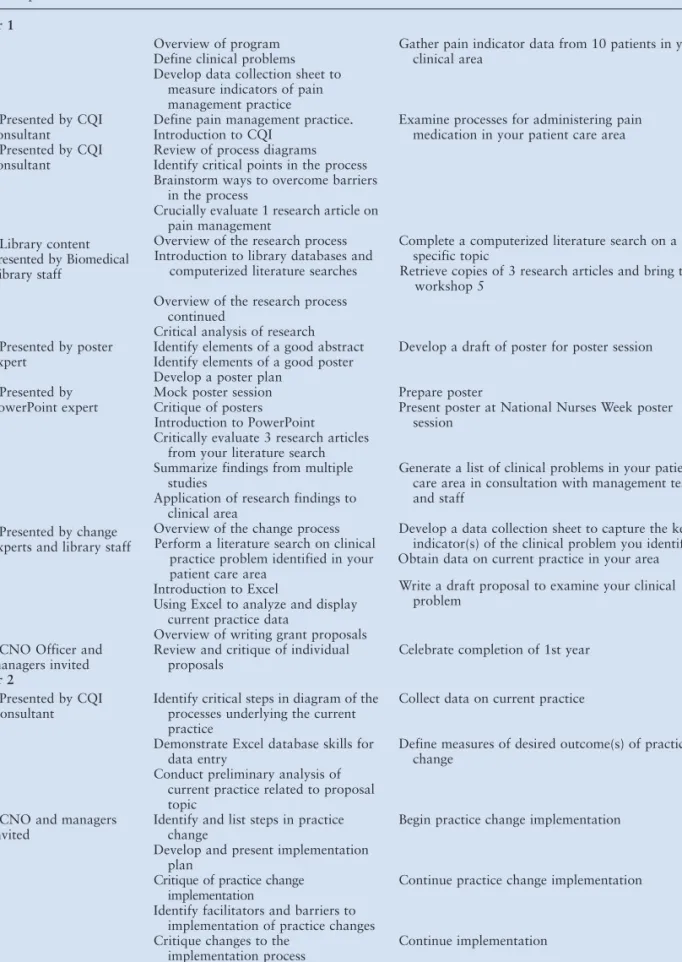
The primary focus of the program was the application of evidence to solve clinical problems. The skills necessary to locate relevant literature, critically analyze the research, determine appli-cability to the clinical practice area, and plan/ implement/evaluate practice changes were devel-oped through a mix of didactic, group discussion, and practice (Table 1). The initial 3 workshops introduce CQI concepts to lay the foundation for identifying current practice and the processes used to deliver this care. Systematic data collection methods were introduced early in the program as a means of describing current practice and later
in the program to evaluate practice change. The interns begin collecting data on a common prob-lem, such as pain management, in their clinical areas. These data were collated to present a pic-ture of current practice. In this learning activity, the processes used in each clinical area to assess and manage pain were identified. Thus, through CQI, the interns were exposed to methods of systematic collection, collation, and interpretation of data.
Ability to find relevant research has consis-tently been identified as a barrier to EBP.14,15
Despite current advances in the number of nursing research articles published and easily accessible digital libraries, many staff nurses are not familiar or comfortable with conducting literature searches. The biomedical library staff at the medical center was instrumental in improving these skills. Classes with hands-on practice were conducted by the library staff several times throughout the internship program. The interns developed skills in identifying key words to find topics in CINAHL and MED-LINE. These digital libraries can be accessed from the clinical work stations on the patient care units and clinics as well as from home computers.
A second barrier to EBP addressed in the first year of the program was the ability to critically analyze research. Didactic classes were used to present the basics of a quantitative research study. Group critique was used to allow interns with higher levels of skill in this area to coach interns with less experience in research critique. The in-tegration and synthesis of findings from multiple studies are increasing with the development of data-bases such as the Cochrane review. These existing databases, however, have not incorporated a large number of problems directed toward nursing care. Therefore, the interns learned some strategies for reviewing multiple studies and determining the consistency of findings. If consistent findings were found, then a potential practice change was planned and implemented. If findings were incon-sistent, then the interns may have needed to further explore the current practice in their clinical area and identify the processes of care delivery that may be modified to improve patient care.
The second year of the program was devoted to practice change. The workshops became shorter in length, with the expectation that the participants would work on their clinical practice project during the remainder of the workshop day (Table 1). Examples of planned change and its evaluation are provided by a variety of change ex-perts in the organization. The interns were exposed to case managers who use clinical data to support
Table 1. Nursing Research Internship Curriculum
Workshop Content Homework
Year 1
1 Overview of program Gather pain indicator data from 10 patients in your clinical area
Define clinical problems Develop data collection sheet to
measure indicators of pain management practice 2. Presented by CQI
consultant
Define pain management practice. Examine processes for administering pain medication in your patient care area Introduction to CQI
3. Presented by CQI consultant
Review of process diagrams Identify critical points in the process Brainstorm ways to overcome barriers
in the process
Crucially evaluate 1 research article on pain management
4. Library content presented by Biomedical Library staff
Overview of the research process Introduction to library databases and
computerized literature searches
Complete a computerized literature search on a specific topic
Retrieve copies of 3 research articles and bring to workshop 5
5 Overview of the research process continued
Critical analysis of research 6. Presented by poster
expert
Identify elements of a good abstract Develop a draft of poster for poster session Identify elements of a good poster
Develop a poster plan 7. Presented by
PowerPoint expert
Mock poster session Prepare poster Critique of posters
Introduction to PowerPoint
Present poster at National Nurses Week poster session
8 Critically evaluate 3 research articles from your literature search 9 Summarize findings from multiple
studies
Generate a list of clinical problems in your patient care area in consultation with management team and staff
Application of research findings to clinical area
10. Presented by change experts and library staff
Overview of the change process Perform a literature search on clinical
practice problem identified in your patient care area
Develop a data collection sheet to capture the key indicator(s) of the clinical problem you identified Obtain data on current practice in your area 11 Introduction to Excel Write a draft proposal to examine your clinical
problem Using Excel to analyze and display
current practice data
Overview of writing grant proposals 12. CNO Officer and
managers invited
Review and critique of individual proposals
Celebrate completion of 1st year
Year 2
1. Presented by CQI Consultant
Identify critical steps in diagram of the processes underlying the current practice
Collect data on current practice 2 Demonstrate Excel database skills for
data entry
Define measures of desired outcome(s) of practice change
Conduct preliminary analysis of current practice related to proposal topic
3. CNO and managers invited
Identify and list steps in practice change
Begin practice change implementation Develop and present implementation
plan
4 Critique of practice change implementation
Continue practice change implementation Identify facilitators and barriers to
implementation of practice changes 5 Critique changes to the
implementation process
Continue implementation 6 Prepare and critique abstracts
summarize practice change projects
Submit abstract for review by deadline Prepare and critique posters
changes in practice and administrators who have successfully managed large organizational change. The majority of time and effort, however, was spent in planning, implementing, and evaluating practice changes in the interns’ clinical areas.
Learning Activities
Several learning activities were built into the program to promote dissemination of the interns’ projects. The institution holds an annual poster session during National Nurses’ Week. Interns were required to write an abstract and present a poster at this annual event. In the first year, the posters present the research base for a clinical problem, and in the second year, they present the results, to date, of their practice change project. To expose the interns to grant writing, they wrote a short succinct proposal outlining their practice change project at the end of the first year. A final report of progress and outcomes of the project is written toward the end of the second year. The interns present a 10- to 15-minute summary of their project at a celebration luncheon marking completion of the internship.
Internship Program Participants
Staff nurses for the first cohort were selected for participation in the program by their manager and administrative director. Awareness of the program grew as the first cohort moved through the program, and the following cohorts included many staff nurses who expressed interest and were then recommended by their managers. Nurses from inpatient, perioperative, and ambulatory clinical areas have enrolled in the program. Attrition is high, particularly during the first 6 months of the program (Table 2). Reasons for leaving the
pro-gram are varied. In the first cohort, many of the nurses did not realize the level of commitment required to complete the 2-year internship, which included attendance at the monthly workshops as well as homework. These assignments (eg, reading research articles and library work) required between 2Y10 hours/month, time for which the nurse was not compensated. Several nurses who started the program had family crises that required their time and energy. Two nurses left the program after 1 year because they had gained the knowledge and skills they needed. Additionally, it is more difficult for managers from smaller areas with few nurses to sustain professional leave and provide alternate staffing for the monthly workshops. Therefore, the nurses who have completed the program have been primarily from the inpatient areas.
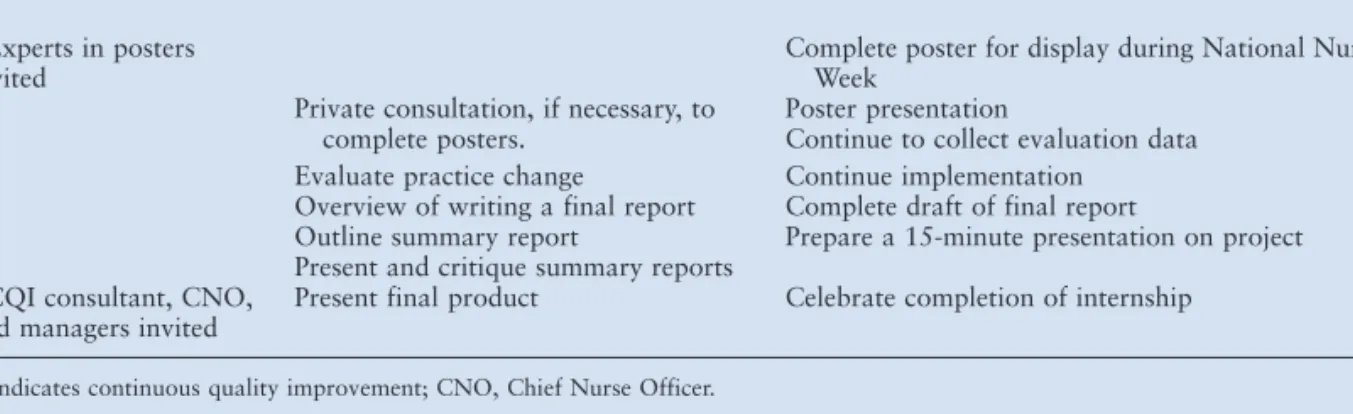
The interns investigated a wide range of clinical problems (Figure 2). Some of these issues, such as women’s presentation in the ED with acute myocardial infarction and the benefit versus cost of special endotracheal tubes to reduce ventilator-associated pneumonia, were reviewed and findings were disseminated within the patient care area. Other research findings were implemented and evaluated for effectiveness of practice change. Table 1. Continued
7. Experts in posters invited
Complete poster for display during National Nurses Week
8 Private consultation, if necessary, to complete posters.
Poster presentation
Continue to collect evaluation data 9 Evaluate practice change Continue implementation
10 Overview of writing a final report Complete draft of final report
Outline summary report Prepare a 15-minute presentation on project 11 Present and critique summary reports
12. CQI consultant, CNO, and managers invited
Present final product Celebrate completion of internship CQI indicates continuous quality improvement; CNO, Chief Nurse Officer.
Table 2. Enrollment and Attrition From Internship Program Cohort No. Enrolled No. Completed % Completed 1999-2001 17 6 35 2001-2003 16 4 25 2003-2005 17 7 41
Evaluation of the Internship Program
Evaluation of the internship program was con-ducted from October 2004 to January 2005. Inter-views were conducted with the 10 interns who had completed the program. Evidence was gathered to examine (1) continued use of EBP, (2) professional development of interns, and (3) unanticipated effects of participation in the program.
Use of Evidence-Based Practice
All participants had searched the literature from 3 to 5 times in the past 6 months to gather ideas about a problem occurring in their clinical area. The research findings were shared with colleagues. Two participants had started journal clubs in their area where research articles were regularly re-viewed and discussed. One participant displayed relevant research articles on the bulletin board in
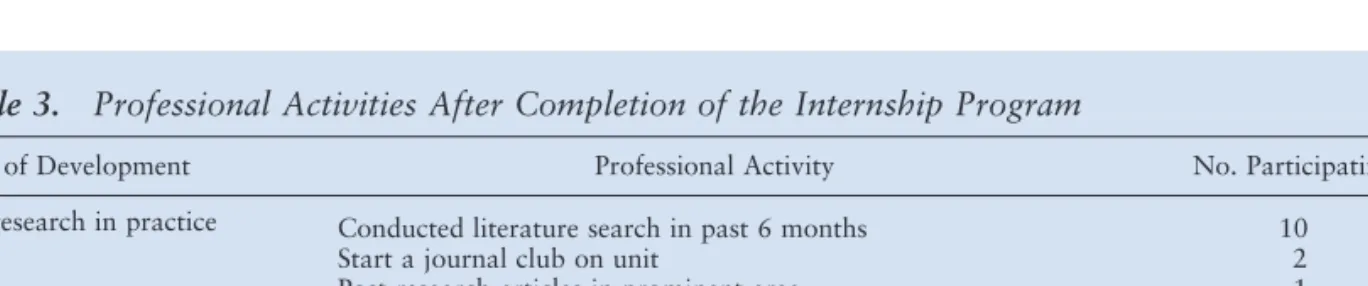
the break room so that colleagues could review the findings (Table 3). Clearly, the internship program had increased the intern’s ability to use digital libraries and find relevant research. Both formal and informal mechanisms were used to disseminate this information to their colleagues.
Participants continued to use the practice change strategies upon completion of the program. Implementing changes in practice is not always accomplished quickly. Several interns continued with implementation and completed practice changes after the completion of the program. To complete a change in family visiting hours in the ICU, one intern obtained external funding from a professional organization to support staff and family education. After completing the program, interns engaged in additional projects. Examples include (1) development of a policy on the use of external jugular lines, (2) reinforcement of the procedure used to administer vaccines, and (3) development of the role of a special procedures nurse in intensive care. The interns described a variety of strategies they used to demonstrate the links between nursing therapeutics and patient outcomes. Thus, the participants were using their new skills to plan and implement practice change following completion of the program.
In addition to using the knowledge and skills learned during the internship program, participants described changes in their attitude about research and a better understanding of EBP. The links between nursing interventions and patient out-comes were identified. Figure 3 summarizes the benefits reported during the interviews.
Professional Development
The institution has a career advancement pro-gram39 that incorporates application of research to practice as a critical component of proficient and expert nurses. Participation in the internship pro-gram helps staff nurses meet several of the critical
Figure 2. Sample of staff nurse intern projects.
Table 3. Professional Activities After Completion of the Internship Program
Area of Development Professional Activity No. Participating Use research in practice Conducted literature search in past 6 months 10
Start a journal club on unit 2
Post research articles in prominent area 1 Professional development Advanced in our career development system 6
Member of a medical center committee 8
Education Taken advanced courses for credit or continuing education units 3
behaviors required for advancement in this system. Two participants were ineligible for advancement because of their job class (eg, assistant manager); of the remaining 8 interns, 6 have advanced to proficient (n = 2) or expert (n = 4) levels since their involvement in the program (Table 3).
The institution provides tuition reimbursement for pursuing an advanced nursing degree. Thus, one desired outcome of the program was to increase the number of nurses returning to school to advance in their profession. Four interns have enrolled in and/or completed a master’s in nursing program (Table 3). In addition to degree-seeking education, 3 interns have completed continuing education to advance their knowledge base and/or complete certification in their area of practice. Par-ticipation in the internship program, then, has led to staff nurses who are continuing to improve their knowledge and advance their nursing practice.
Over the course of the program, the partici-pants are exposed to a number of resources within the medical center. For example, an intern inter-ested in bereavement worked with the hospi-tal chaplain to develop a bereavement program. These networks clearly expanded the participants’ perspective of the medical center and the opportu-nities and resources available to them. As a re-sult of this expanded view, many interns (5/10) have joined medical center or university-wide committees and continue to be active participants on these committees.
Unanticipated Effects
The participants felt valued by the institution because of the investment the organization made to allow their participation. Interns expressed increased confidence in their abilities to branch out and try different jobs after participation in the program. An unanticipated effect was that almost all interns changed positions during (n = 3) or upon completion (n = 7) of the program. Four interns have changed positions twice since completing the
program. Currently, only 1/10 is still working in the area where she worked at the beginning of the program. Despite the movement within the orga-nization, no participant has left the institution.
The second unanticipated effect was the growth of understanding and commitment to being a profes-sional nurse, with an emphasis on the expanded roles available to nurses and the obligation to be current in practice. Finally, participation in the program exposed the interns to staff from many areas and disciplines of the medical center. This has provided more networking opportunities for the participants. Summary and Implications
These findings indicate that the internship program did achieve the goals of (1) increasing use of digital libraries to search the literature, (2) increasing comfort with critical analysis of research studies, and (3) applying research findings to clinical prac-tice. Many of the barriers to EBP were minimized or eliminated through the use of didactic classes, group discussion, and hands-on experience pro-vided by the internship program. A focus on professional nursing and exposure to resources within and outside of nursing at the medical center also were evident. This exposure to a variety of professionals with a wide range of skills and ex-pertise met the needs of the interns for consultants, role models, and mentors. Although the program is small in scope, there is some evidence that the participants return to their clinical areas and dif-fuse their knowledge and enthusiasm to the staff. Each year requests from staff nurses for informa-tion about the internship program grow, indicating more widespread awareness of the program and interest in being involved. Managers and adminis-trative directors perceive this program as one method to reward staff nurses who have contrib-uted to their clinical area, even though the partic-ipants tend to move on to other clinical areas. We have learned that building accountability from the manager for support and the staff nurses for a tangible outcome is critical to our success. This can be achieved through the use of written contracts, annual performance evaluation goals, and team work. Although this program is time intensive for both interns and research program staff, the benefit to the individuals who complete the internship is great. Staff nurses learn to use library resources, critically analyze research, and plan and implement practice changes based upon research. The expo-sure to research and the research process fosters positive attitudes toward research, which have been shown to be the critical factor in the use of research to solve clinical problems.
Figure 3. Changes in attitude and understanding related to internship program.
References
1. Sackett DL, Straus SE, Richardson WS, Rosenberg W, Haynes RB.Evidence-Based Medicine: How to Practice and Teach EBM. 2nd ed. London: Churchill Livingstone; 2000. 2. Hampton DC, Griffith D, Howard A. Evidence-based
clinical improvement for mechanically ventilated patients. Rehabil Nurs. 2005;30:160-165.
3. Stevens KR, Staley JM. The Quality Chasm Reports, evidence-based practice, and nursing’s response to improve healthcare.Nurs Outl. 2006;54:94-101.
4. Horsley JA, Crane J, Crabtree MK, Wood DJ. Using Research to Promote Nursing Practice: A Guide. Orlando: Grune & Stratton; 1983.
5. Stetler CB. Refinement of the Sttetler/Marram model for ap-plication of research findings to practice.Nurs Outl. 1994; 42:15-25.
6. Newhouse R, Dearholt S, Poe S, Pugh LC, White KM. Evidence-based practice: a practical approach to implemen-tation.J Nurs Adm. 2005;31(1):35-40.
7. Titler MG, Kleiber C, Steelman VJ, et al. The Iowa Model of evidence-based practice to promote quality care. Crit Care Nurs Clin North Am. 2001;13:497-509.
8. Funk SG, Champagne MT, Wiese RA, Tornquis EM. Barriers to using research findings in practice: the clinician’s perspective.Appl Nurs Res. 1991;4:90-95.
9. Brenner M. Children’s nursing in Ireland: barriers to, and facilitators of, research utilization.Paediatr Nurs. 2005;17(4): 40-45.
10. Thompson C, McCaughan D, Cullum N, Sheldon T, Raynor P. Barriers to evidence-based practice in primary care nursingVwhy viewing decision-making as a context is helpful.J Adv Nurs. 2005;52:432-444.
11. Bryar RM, Closs SJ, Baum G, et al. The Yorkshire BARRIERS project: diagnostic analysis of barriers to research utilisation.Int J Nurs Stud. 2003;40:73-84. 12. Gerrish K, Clayton J. Promoting evidence-based practice: an
organizational approach.J Nurs Manage. 2004;12:114-123. 13. Pravikoff DS, Tanner AB, Pierce ST. Readiness of U.S. nurses for evidence-based practice.Am J Nurs. 2005;105(9):40-51. 14. McKenna H, Ashton S, Keeney S. Barriers to evidence-based
practice in primary care.J Adv Nurs. 2004;45:178-189. 15. Fink R, Thompson CJ, Bonnes D. Overcoming barriers and
promoting the use of research in practice. J Nurs Adm. 2005;35:121-129.
16. McCaughan D, Thompson C, Cullum N, Sheldon TA, Thompson DR. Acute care nurses’ perceptions of barriers to using research information in clinical decision making. J Adv Nurs. 2002;39:46-60.
17. Ferguson L. External Validity, Generalizability, and knowl-edge utilization.J Nurs Scholarsh. 2004;36:16-22. 18. Hutchinson AM, Johnston L. Bridging the divide: a survey
of nurses’ opinions regarding barriers to, and facilitators of, research utilization in the practice setting.J Clin Nurs. 2004; 13:304-315.
19. Kirshbaum M, Beaver K, Luker KA. Perspectives of breast care nurses on research dissemination and utilization. Clin Eff Nurs. 2004;8:47-58.
20. Glacken M, Chaney D. Perceived barriers and facilitators to implementing research findings in the Irish practice setting. J Clin Nurs. 2004;13:731-740.
21. Funk SG, Champagne MT, Wiese RA, Tornquist EM. BARRIERS: the barriers to research utilization scale. Appl Nurs Res. 1991;4(1):39-45.
22. Sams L, Penn BK, Facteau L. The challenge of using evidence-based practice.J Nurs Adm. 2004;34:407-414. 23. Nilsson Kajermo K, Nordstrom G, Krusebrant A, Bjorvell H.
Perceptions of research utilization: comparisons between health care professionals, nursing students and a reference group of nursing clinicians.J Adv Nurs. 2000;31:99-109. 24. Olade RA. Evidence-based practice and research utilization
activities among rural nurses. J Nurs Scholarsh. 2004;36: 220-225.
25. Greenhalgh T, Robert G, Bate SP, MacFarlane F, Peacock R. How to spread good ideas: a systematic review of the literature on diffusion, dissemination and sustainability of innovations in health service delivery and organization. Report for the National Coordinating Centre for NHS Ser-vice Delivery and Organisation Research & Development (NCCSDO). April 2004.
26. Olade RA. Attitudes and factors affecting research utiliza-tion.Nurs Forum. 2003;38(4):6-15.
27. Melnyk BM, Fineout-Overholt E, Fischbeck Feinstein N, et al. Nurses’ perceived knowledge, beliefs, skills, and needs regarding evidence-based practice: implications for acceler-ating the paradigm shift.Worldviews Evidence-based Nurs. 2004;1:185-193.
28. Pepler CJ, Edgar L, Frisch S, et al. Strategies to increase research-based practice: interplay with unit culture. Clin Nurse Spec. 2006;20:23-31.
29. Estabrooks CA, Floyd JA, Scott-Findlay S, O’Leary KA, Gushta M. Individual determinants of research utilization: a systematic review.J Adv Nurs. 2003;43:506-520.
30. Wells N, Baggs JG. A survey of practicing nurses’ re-search interests and activities. Clin Nurse Spec. 1994;8: 145-151.
31. Warren JJ, Heermann JA. The research nurse intern program: a model for research dissemination and utiliza-tion.J Nurs Adm. 1998;28(11):39-45.
32. Hinds PS, Gattuso J, Morrell A. Creating a hospital based nursing research fellowship program for staff nurses.J Nurs Adm. 2000;30:317-324.
33. Nilsson Kajermo K, Nordstrom G, Krusebrant A, Lutzen K. Nurses’ experiences of research utilization within the frame-work of an educational programme.J Clin Nurs. 2001;10: 671-681.
34. Lopez-Bushnell K. Get research-ready.Nurs Manage. 2002; 33(11):41-44.
35. Valente SM. Research dissemination and utilization: im-proving care at the bedside. J Nurs Care Qual. 2003;18: 114-121.
36. Happell B, Johnston L, Hill C. Implementing research findings into mental health nursing practice: exploring the clinical research fellowship approach.Int J Mental Health Nurs. 2003;12:251-258.
37. Happell B. The centre for psychiatric nursing research and practice: an innovative approach to enhancing clinical nursing research in the psychiatric/mental health field. Issues Mental Health Nurs. 2004;25:47-60.
38. Cullen L, Titler N. Promoting evidence-based practice: an internship for staff nurses. Worldviews Evidence-based Nurs. 2004;1:215-223.
39. Robinson K, Eck C, Keck B, Wells N. The Vanderbilt Professional Nursing Practice Program: Part 1, Growing and supporting professional nursing practice.J Nurs Adm. 2003; 33:441-450.