Hydrated chia seed effect on wheat flour and bread technological
quality
Ivan Švec
*, Marie Hrušková
(Department of Carbohydrates and Cereals, University of Chemistry and Technology Prague, Prague 6, Czech Republic)
Abstract: Commercial wheat flour was blended with hydrated white and brown chia seeds. Changes in chemical composition was described by common analytical proofs, and rheological properties of non-fermented as well as leavened dough was completely evaluated (within extensigraph and maturograph tests, respectively). Leavened bread and biscuits were prepared in a laboratory scale. Both chia type softly increased protein content and reversely their quality. Due to low amounts added, changes in dough viscoelastic properties were small. Consumer quality worsening of both tested products was also of low significance, but fibre content was increased about 50% compared to control.
Keywords: composite flour, white and brown chia, fibre, dough rheology, leavened bread
Citation: Švec, I., Hrušková, M. 2015. Hydrated chia seed effect on wheat flour and bread technological quality. Agric Eng Int: CIGR Journal, Special issue 2015: 18th World Congress of CIGR: 259-263.
1 Introduction
1
Chia seeds originate from Spanish specie of sage
(Salvia hispanica L.), annual plant bred mainly in South
American countries, and they are harvested as white or dark coloured variants. Name "chia" is derived from Aztec word "chian" meaning oily. The Mexican state Chiapas belongs to the main producers of that plant material. Seeds were and still are eaten alone or blended with cereals, in whole or milled into flour. Mixed with water, thick gel is formed in a few minutes, absorbing water up to 12-multiple of the own weight.
Chia seeds were recognised as valuable food raw-material (Reyes-Caudillo et al., 2008; Ayerza and Coates, 2011; Ciftci et al., 2012; Luna Pizzaro et al., 2013), and nowadays it is already authorised novel food ingredient (Directive 2009/827/EC). Considering bakery product, addition level was allowed up to 5% to the end
Received date: 2014-12-01 Accepted date: 2014-12-02 *Corresponding author: Ivan Švec, Department of Carbohydrates and Cereals, University of Chemistry and Technology Prague, Prague 6, Czech Republic. Email: [email protected]
of year 2012; the limit was increased to 10% recently (Regulation 2013/50/EU).
Depending on used chia level, quality parameters of wheat flour composites are changed. Parameters of chia-enriched dough are solved in papers published by e.g.
Ixtaina et al. (2008), Capitani et al. (2012) or
Iglesias-Puig and Haros (2013). Inglett et al. (2013) describe behaviour of blend composed from barley and chia flour and state that addition up to 10% had no verifiable effect on both dough viscosity and elasticity.
Chia addition into wheat flour causes gluten proteins
dilution as well as bread volume decrease.
Ortega-Ramirez et al. (2013) determined a diminishing up to 25% against non-fortified control, using 5% or 10% chia into recipe. Sweet bread structure containing 6% or 12% of chia flour was described by image analysis (Ferrera-Rebollo et al., 2012). Lower addition level did not proved in change of cell counts and sizes distribution compared to commercial sweet bread.
biscuits characteristics in blends with commercial fine wheat flour.
2
Materials and methods
Wheat flour (WF) used as composites base was of commercial origin, obtained from the Czech industrial mill. Used chia samples involved both botanical variants with white and dark seeds (Ch1 and Ch2) planted in Mexico, and bought in specialised food shop. With respect to EU legislation valid until 2012 year (258/97/ES), substitution levels were chosen as 2.5% and 5.0% on wheat flour base. Composites were signed by combination of alternative flour type and its addition level, e.g. Ch2-5.0 means ratio of 95%/5% (w/w) of wheat and Ch2 hemp flour, respectively. A dry milled
form was used for analytical tests, while the whole hydrated seeds for rheological proofs and baking tests. Before measurement, weighted amounts of 7.5 g or 15.0 g were allowed to hydrate in 150 ml of distilled water for 10 min.
Changes in chemical composition were evaluated by analytical proves as the protein content according to Kjeldahl method (ČSN ISO 1871, factor 5.7; abbreviation PRO), the Zeleny sedimentation value (baking quality of proteins, ČSN ISO 5529; ZT) and the Falling Number (estimation of amylose activity, ČSN ISO 3039; FN). Nutritional benefit of chia was evaluated in terms of dietary fibre content (AOAC 985.29) using Fibertec apparatus and Megazyme assay kit.
Viscoelastic behaviour of tested composites was evaluated by using of the extensigraph (ČSN ISO 5530-2). Maturograph proof, performed following the internal procedure (Hrušková et al., 2003), describes changing rheological properties of fermented dough within a leavening stage. From a registered curve, the optimal leavening time (time to reach a maximal dough volume) in minutes, the maturograph resistance (maximal volume) and the maturograph elasticity of fermented dough in maturograph units (MU) are read out. Internal method of baking test was published earlier (Hrušková et al., 2006); both leavened and chemically fluffed up product (bread and cookie) were prepared. By using a rapeseed displacement method and rectangular equipment, specific volume (ml/g) and product shape (height-to-diameter ratio) were evaluated (abbreviations SBrV, BrS for bread and SBiV, BiS for biscuits, respectively).
Effects of chia type and addition level were explored by the Tukey HSD test (analysis of variance, ANOVA; p < 0.05) using the Statistica 7.0 software (Statsoft, Tulsa, USA).
3 Results and discussion
3.1 Flour composites analytical quality
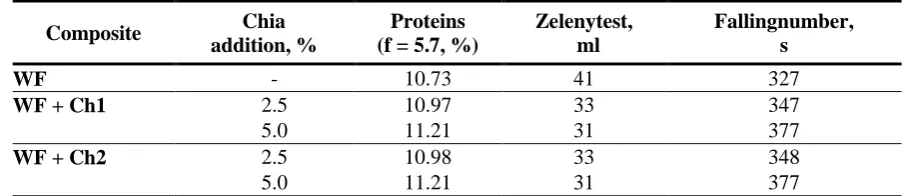
In the Table 1, amount of PRO in wheat flour standard reached a level common within the Middle Europa region with good baking quality (10.7% and 41 ml, respectively). According to small amount added (2.5% and 5.0%), chia wholemeal fortification demonstrated very slight increase of PRO up to 11.2% by 5% of both chia samples. Alternative flour affected protein quality significantly, the ZT was lowered about one-fourth independently to chia type or addition level. With respect to the FN repeatability (±25 s, ČSN ISO 3039), chia seeds did not Table 1 Analytical parameters of tested flour composites
Composite Chia
addition, %
Proteins (f = 5.7, %)
Zelenytest, ml
Fallingnumber, s
WF - 10.73 41 327
WF + Ch1 2.5 10.97 33 347
5.0 11.21 31 377
WF + Ch2 2.5 10.98 33 348
5.0 11.21 31 377
influence the parameter verifiably in spite of soft values increasing.
3.2 Rheological behaviour of non-fermented dough
As shown in the Figure 1, extensigraph test did not confirm a diminishing of protein quality evaluated by the
ZT. Dough handling properties as
elasticity-to-extensibility ratio (ERA) were not
unequivocally changed similarly to extensigraph energy (EEN). Longer resting time of dough led to soft growth of the extensigraph elasticity (Inglett et al., 2013), reflected in the ERA increase. Between the chia types tested, any significant differences were not found in composite dough rheology.
3.3 Rheological behaviour of fermented dough
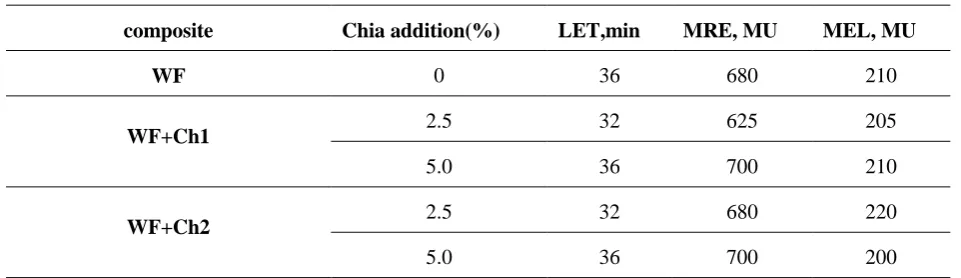
In the Table 2, behaviour of fermented dough
prepared from test flour blends demonstrated
independence on both chia type involved and addition level. A small drop in maturograph resistance (MRE) recorded for the Ch1-2.5 sample had no impact on dough elasticity, meaning similar dough machinability during hand-made bread forming.
3.4 Baking test results
As it was shown in the Figure 2, specific bread volume (SBrV) of the control sample WF (270 ml/100 g) corresponds to results of analytical and rheological tests. Owing to similar times of non-fermented dough resting and bread samples leavening (60 and 50 minutes), the Figure 1 Viscoelastic characteristics of wheat and wheat-chia flour composites. WF: white wheat flour, Ch1, Ch2:
white and brown chia seeds, respectively. EEN – extensigraph energy, ERA – extensigraph ratio (elasticity-to-extensibility); 30‘, 60‘: dough resting time.
Table 2 Rheological parameters of fermented composite dough
composite Chia addition(%) LET,min MRE, MU MEL, MU
WF 0 36 680 210
WF+Ch1 2.5 32 625 205
5.0 36 700 210
WF+Ch2 2.5 32 680 220
5.0 36 700 200
highest volume was determined for the Ch1-2.5 composite (rise about 50 units) as the highest EEN found during the extensigraph test. Volumes of further three fortified bread were similar mutually as well as in relation to control. On the other hand, Ortega-Ramirez et al. (2013) found a significant SBrV lowering (about 25%) by incorporation of 10% chia in dough recipe.
Somewhat lower variation was observed in biscuit specific volumes (SBiV) – a difference of 21 ml/100 g only was calculated between the most enhanced Ch1-5.0 and Ch2-5.0 samples. As was mentioned above, chia into mixture brings more elastic dough – it affected SBiV prepared according to those recipes due to higher contraction of biscuit pieces after their cutting out from dough sheet.
3.5 Nutritional benefit of chia addition
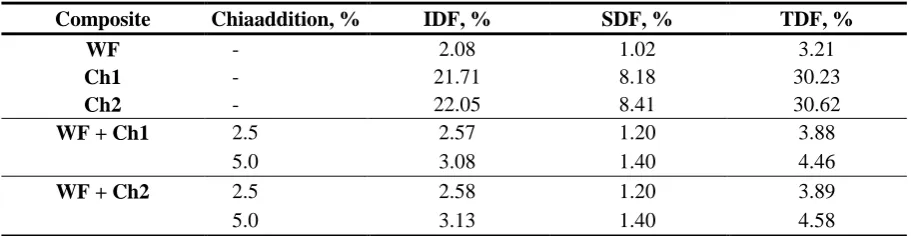
As in the Table 3, due to dietary fibre (DF) content over 20% in both chia types, 30.23% in Ch1 and 30.62% in Ch2 (in correspondence with Ayerza 2013), it’s usage in wheat flour composites significantly enhanced nutritional value of manufactured bakery product. In terms of insoluble and total dietary fibre, their proportion was increased approximately about 50%.
4 Conclusions
White and dark chia seeds combined with common fine wheat flour increased proteins content and lowered their baking potential similarly.
Further, amylose activity as the Falling number was not significantly influenced. Regardless to that, physico-mechanical properties of non-fermented and fermented dough with both chia types determined during Figure 2 Influence of chia addition on bakery products size. WF: white wheat flour, Ch1, Ch2: white and
brown chia seeds, respectively. SBrV – specific bread volume, SBiV – specific biscuit volume.
Table 3 Dietary fibre content in tested flour composites
Composite Chiaaddition, % IDF, % SDF, % TDF, %
WF - 2.08 1.02 3.21
Ch1 - 21.71 8.18 30.23
Ch2 - 22.05 8.41 30.62
WF + Ch1 2.5 2.57 1.20 3.88
5.0 3.08 1.40 4.46
WF + Ch2 2.5 2.58 1.20 3.89
5.0 3.13 1.40 4.58
the extensigraph and the maturograph tests were comparable to control wheat dough. Results of baking proof verified the findings, because specific volumes of all five tested bread samples were comparable one to each other. In case of volumes of biscuits manufactured manually, somewhat more important role was attributed to extensigraph elasticity-to-extensibility ratio; the higher ratio (a higher dough elasticity), the partially lower biscuit was determined. Regardless to that, total dietary fibre content was increased approximately about 50% by both types of chia used.
References
2009/827/ES.
http://eur-lex.europa.eu/legal-content/EN/TXT/PDF/?uri=CEL EX:32009D0827&rid=1, download March 31, 2014.
2013/50/EU,
http://eur-lex.europa.eu/legal-content/EN/TXT/PDF/?uri=CEL EX:32013D0050&rid=1, download March 31, 2014.
Ayerza, R. 2013. Seed composition of two chia (Salvia hispanica
L.) genotypes which differ in seed color. Emir.J. Food Agric.,
25: 495-500.
Ayerza, R. and W. Coates 2011. Protein content, oil content and fatty acid profiles as potential criteria to determine the origin of commercially grown chia (Salvia hispanica L.). Industrial Crops Products, 34: 1366-1371.
Capitani, M. I., V. Spotorno, S. M. Nolasco, and M. C. Tomás. 2012. Physicochemical and functional characterization of by-products from chia (Salvia hispanica L.) seeds of Argentina.
LWT – Food Sci Technol.,45: 94-102.
Ciftci, O. N., R. Przybylski, and M. Rudzinska. 2012. Lipid components of flax, perilla, and chia seeds. Eur. J. Lipid Sci. Technol., 114: 794-800.
Farrera-Rebollo, R. R., M. Salgado-Gruz, J. Chanona-Perez, G. F. Gutierréz-Lopez, L. Alamilla-Beltran, and G. Calderon-Dominguez. 2012. Evaluation of image analysis tools for characterization of sweet bread crumb structure. Food Bioprocess Technol., 5: 474-484.
Hrušková, M., I. Švec, and I. Kučerová. 2003. Effect of malt flour addition on the rheological properties of wheat fermented dough. Czech J. Food Sci., 21: 210-218.
Hrušková, M., I. Švec, and O. Jirsa. 2006. Correlation between milling and baking parameters of wheat varieties. J. Food Eng.,
77: 439-444.
Iglesias-Puig, E., and M. Haros. 2013. Evaluation of performance of dough and bread incorporating chia (Salvia hispanica L.).
Eur. Food Res. Technol., 237: 865-874.
Inglett, G. E., D. Chen, J. Xu, and S. Lee. 2013. Pasting and rheological properties of chia composites containing barley flour. Internat.J. Food Sci. Technol., 48: 2564-2570.
Ixtaina, V. Y., S. M. Nolasco, and M. C. Tomás. 2008. Physical properties of chia (Salvia hispanica L.) seeds. Industrial Crops Products, 28: 286.
Luna Pizarro, P., E. Lopes Almeida, N. C. Sammán, and Y. K. Chang. 2013. LWT – Food Sci. Technol., 54: 73.
Ortega-Ramirez, R., D. I. Leyva-García, R. M. Sanchez-Robles, and A. Morales-Ortega. Effect of addition of amaranth, chia and wheat bran on bread: Impact on antioxidant activity. C&E Spring Meeting: Unlocking the full potential of cereals: challenge for science based innovation, Leuven, Belgium, 29. - 31. May 2013, Book of Abstracts (Brijs K., Gebruers K., Courtin C. M., Delcour J. A., eds.), p. 127.