Copyright and use of this thesis
This thesis must be used in accordance with the
provisions of the Copyright Act 1968.
Reproduction of material protected by copyright
may be an infringement of copyright and
copyright owners may be entitled to take
legal action against persons who infringe their
copyright.
Section 51 (2) of the Copyright Act permits
an authorized officer of a university library or
archives to provide a copy (by communication
or otherwise) of an unpublished thesis kept in
the library or archives, to a person who satisfies
the authorized officer that he or she requires
the reproduction for the purposes of research
or study.
The Copyright Act grants the creator of a work
a number of moral rights, specifically the right of
attribution, the right against false attribution and
the right of integrity.
You may infringe the author’s moral rights if you:
- fail to acknowledge the author of this thesis if
you quote sections from the work
- attribute this thesis to another author
- subject this thesis to derogatory treatment
which may prejudice the author’s reputation
For further information contact the University’s
Director of Copyright Services
A Data Mining Toolbox for Collaborative Writing Processes
By
Vilaythong Southavilay
THESIS
Presented to the Graduate School of Engineering at
The University of Sydney
in Fulfilment
of the Requirements
for the Degree of
DOCTOR OF PHILOSOPHY
THE UNIVERSITY OF SYDNEY
2013
i ABSTRACT
Collaborative writing (CW) is an essential skill in academia and industry. The context of this research focuses particularly on collaborative forms of writing in an academic environment for the purpose of learning, in which writing activities are collaboratively performed by groups of students in a period of multiple writing sessions. CW combines the cognitive and communication requirements of writing with the social requirements of collaboration. Cognitive studies show that these requirements make CW a challenging endeavour. Providing support during the process of CW can be useful not only for achieving better quality documents, but also, more importantly, for improving the CW skills of the writers.
In order to properly support collaborative writing, it is essential to understand how ideas and concepts are developed during the writing process, which consists of a series of steps of writing activities. These steps can be considered as sequence patterns comprising both time events (as used in other process mining research) and the semantics of the changes made during those steps. Two techniques can be combined to examine those patterns: process mining, which focuses on extracting process-related knowledge from event logs recorded by an information system; and semantic analysis, which focuses on extracting knowledge about what the student wrote or edited.
This thesis contributes (i) techniques to automatically extract process models of collaborative writing processes and (ii) visualisations to describe aspects of collaborative writing. These two techniques form a data mining toolbox for collaborative writing by using process mining, probabilistic graphical models, and text mining. First, I created a framework, WriteProc, for investigating collaborative writing processes, integrated with the existing cloud computing writing tools in Google Docs. Secondly, I created new heuristic to extract the semantic nature of text edits that occur in the document revisions and automatically identify the corresponding writing activities. Thirdly, based on sequences of writing activities, I propose methods to discover the writing process models and transitional state diagrams using a process mining algorithm, Heuristics Miner, and Hidden Markov Models (HMM), respectively. My thesis compares two models of HMM: a Heuristic Markov Model and a Hidden Markov Model. The discovered process models and
ii
transitional state diagrams are used in the process analysis that quantitatively and graphically identifies patterns in the text edit sequences that were performed by the writers as they worked on their documents. Finally, I designed three types of visualisations and made contributions to their underlying techniques for analysing writing processes: (1) the revision map, which summarises the text edits made at the paragraph level over time during the course of the writing; (2) the topic evolution chart, which uses probabilistic topic models -- especially Latent Dirichlet Allocation (LDA) and its extension, DiffLDA -- to extract topics and follow their evolution during the writing process; (3) the topic-based collaboration network, which allows a deeper analysis of topics in terms of author contribution and collaboration, using a novel algorithm DiffATM in conjunction with a DiffLDA-related technique.
All components of the toolbox are validated against annotated writing activities of real documents and a synthetic dataset. I also illustrate how the automatically discovered process models and visualisations are used in the process analysis with real documents written by groups of graduate students. I discuss how the analyses can be used to gain further insight into how students work and create their collaborative documents; and ultimately to help students write more efficiently and effectively, and to assist teachers with monitoring writing groups, providing information that can facilitate early detection of problems during the writing process.
iii
ACKNOWLEDGEMENTS
During the time of doing my research and writing this thesis, I received support and help from many people. I would like to express my great appreciation to the following people and resources, which are not listed in any particular order.
With all of my heart, I am very grateful to my supervisor Dr. Kalina Yacef, and to my associate supervisor Associate Prof. Rafael A. Calvo for all the guidance, constant encouragement and support that they gave me to complete this thesis. All the advice given by them has been a great help to me in my research. I would like to thank them for assisting me in getting an Australian Research Council scholarship and Google Research Award so that I could work on this project under their supervision during the past three years. In particular, I am profoundly indebted to my supervisor, who was very generous with her time and knowledge and assisted me with each step in completing this thesis.
I would like to offer my special thanks to all administrative staff members of the school of information technologies (IT), especially the head of the school, Prof. David Dagan Feng; the post graduate research director, Anastasios Viglas; and the post graduate research officer, Evelyn Riegler, for their support so that I could finish writing this thesis. I would like to thank all technical staff members of the school of IT, headed by Greg Ryan, for their technical assistance and support during the experiments conducted for my research.
My special thanks are extended to my colleagues at the school of IT, especially all researchers and students of Computer Human Adapted Interaction (CHAI) for sharing their ideas and experience in doing research. In addition, I would like to thank my fellow friends in Learning and Affect Technologies Engineering (LATTE), especially Dr. Jorge Villalon, Stephen O’Rourke, and Dr. Liu Ming for their help with text mining library (TML), Google Document List API and for their advice on this research and the experiments.
I am grateful to thank Prof. Michael J. Jacobson for his understanding of my circumstances and his generosity in giving me an opportunity to work part-time for a project that investigates the learning of scientific knowledge about climate change through computational models at the Centre for Research on Computer Supported Learning and Cognition (CoCo). In addition, I am thankful for the experience of
iv
working closely with Dr. Lina Markauskaite, who assisted me in developing my research skills. I also would like to thank my colleagues Nick Kelly, Kate Thompson, and Poly for their technical and administrative support for the project.
I would like to acknowledge the help provided by Prof. Peter Reimann and Anindito Aditomo (Nino) in allowing me to make use of their course so that I could conduct experiments for my research. I also appreciate their assistance in preparing materials for the experiment such as mock-up visualisations and questionnaires; and for distributing visualisations of writing processes to students. In addition, they provided me with very valuable comments and suggestions with regard to the visualisations.
I would like to acknowledge the Australian Research Council DP0986873 and a Google Research Award for funding my research.
I am thankful to Maria Cristina Beato-Lanz for her wonderful assistance in proofreading all chapters in this thesis, except chapter 3 (theoretical background) in a timely manner. She also proofread two appendices (B and E). I really appreciate her assistance.
I am grateful to my mother, who was the first teacher who taught me how to read and write a word. Although she passed away about seven years ago and was not here to see me complete this PhD thesis, she is always my inspiration that leads me to work hard and to love science and technologies.
Special thanks is reserved for my wife who has been travelling and lived with me during my candidature in Sydney for three years. After the birth of our twin sons, we had to make a hard decision to separate for about six months so that I could work on this thesis, and she travelled back to my home country where she has lot of support with looking after our children. I will join her and my children after I submit this thesis.
I am grateful to all my family, especially my father and my parents-in-law, for providing financial support and assisting my wife in taking care my children while I am in Sydney writing this thesis.
Finally, I would like to dedicate this thesis to all scientists, researchers and educators from developing countries, especially from my home country, Laos. Since I was young, I always dreamed of becoming a scientist. I was awarded an AusAID scholarship to study for my bachelor's degree in Canberra, Australia. After that I was
v
awarded a Fulbright scholarship to study for my master's degree in Chicago, Illinois before returning to Australia to pursue my PhD in Sydney. Along the way, I have worked really hard to fulfil my dream to become a computer scientist. I hope my journey will inspire many young generation students in their developing work to seek an opportunity to work in the field of science and technologies.
vi TABLE OF CONTENTS ABSTRACT ... i ACKNOWLEDGEMENTS ... iii TABLE OF CONTENTS ... vi LIST OF FIGURES ... x
LIST OF TABLES ... xiv
Chapter 1 Introduction ... 1
1.1 Summary of Contribution ... 5
1.2 Outline of the Chapters ... 6
1.3 Publication Related to This Thesis ... 7
Chapter 2 Literature Review ... 9
2.1 Theoretical Framework ... 11
2.1.1 Cognitive Models of Writing Processes ... 11
2.1.2 Taxonomies of Collaborative Writing Activities... 13
2.2 Text mining for Detecting Cohesion and Topics ... 15
2.2.1 Cohesion Measure ... 17
2.2.2 Topic Extraction and Topic Evolution ... 19
2.3 Process Mining ... 24
2.3.1 Analysing Writing Processes ... 26
2.3.2 Visualising Writing Processes ... 29
2.4 Tools to Support Collaborative Writing ... 31
2.5 Summary ... 34
Chapter 3 Theoretical Background ... 37
3.1 Text Mining ... 38
3.1.1 Latent Semantic Analysis ... 38
3.1.2 Lingo: Document Clustering Algorithm ... 40
3.1.3 Latent Dirichlet Allocation ... 41
3.2 Process Mining ... 43
3.2.1 Event Logs ... 45
3.2.2 Heuristic Mining ... 46
3.2.3 Mining Additional Perspectives of Writing Processes ... 50
vii
3.3.1 Markov Models ... 52
3.3.2 Hidden Markov Model ... 53
3.4 Summary ... 55
Chapter 4 Overview of the Approach ... 57
4.1 Framework for Analysing Writing Processes ... 59
4.2 Identifying Writing Activities Automatically ... 61
4.3 Extracting Process Models of Writing Processes ... 61
4.4 Visualising Writing Processes ... 61
4.5 Summary ... 63
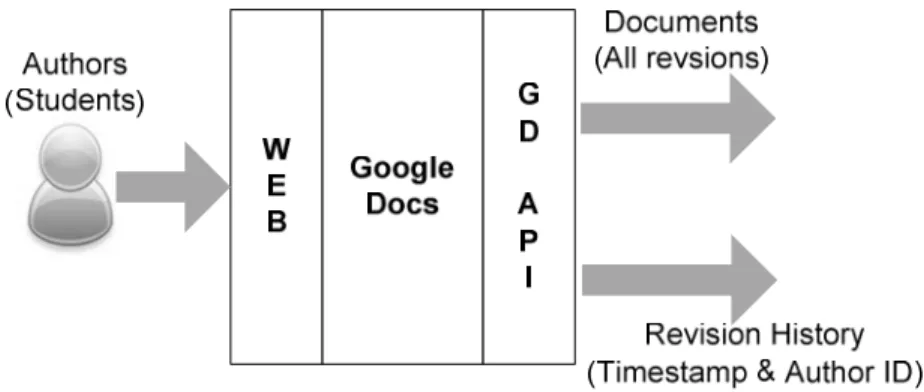
Chapter 5 WriteProc: A Framework for Data Collection ... 65
5.1 Overall Conceptual Description ... 65
5.2 Writing Environment: Google Docs ... 66
5.3 Google Document List API ... 70
5.4 Dataset for Analysing Writing Processes ... 72
5.5 Summary ... 74
Chapter 6 Identifying Writing Activities ... 75
6.1 Heuristic for Determining Collaborative Writing Activities ... 76
6.1.1 Text Structures ... 79
6.1.2 Text Edits... 80
6.1.3 Number of Words and Phrases (F1) ... 81
6.1.4 Topic Overlap (F2)... 81
6.1.5 Cohesion Comparison (F3) ... 82
6.2 Pre-processing: Computing Cohesion Changes and Topic Overlap ... 83
6.3 Heuristic Validation ... 85
6.3.1 Matrices ... 86
6.3.2 Applying Evaluation Matrices to CWA Heuristic ... 87
6.3.3 Evaluating the Heuristic with All Revisions ... 91
6.3.4 Evaluating the Heuristic per Revision ... 91
6.3.5 Evaluating the Heuristic Per Document ... 92
6.3.6 Evaluating the Heuristic for All Five Writing Activities ... 94
6.4 Summary ... 95
Chapter 7 Mining Writing Processes... 97
viii
7.1.1 Writing Process Discovery ... 98
7.1.2 Case Study ... 101
7.2 Hidden Markov Models and Heuristic Markov Models ... 110
7.2.1 Extracting Heuristic Markov Model and Hidden Markov Model ... 110
7.2.2 Pre-processing ... 112
7.2.3 Case Study ... 114
7.3 Distilling Processes to Students and Instructors: A Pilot Study ... 120
7.3.1 Mockup Visualisations ... 121
7.3.2 Feedback from Interviews ... 126
7.4 Summary ... 128
Chapter 8 Visualising Collaborative Writing Processes ... 131
8.1 A Framework for Visualising Collaborative Writing Processes ... 132
8.2 Revision Maps ... 133
8.3 Topic Evolution Chart ... 136
8.3.1 Probabilistic Topic Models ... 138
8.3.2 DiffLDA for Mining Writing Processes ... 139
8.3.3 Hyper-parameter Selection ... 141
8.3.4 Selection of Number of Topics ... 141
8.4 Topic-based Collaboration Networks ... 142
8.4.1 Diff Author-Topic Model for writing processes ... 144
8.4.2 Construction of Networks from Topics ... 145
8.5 Technical Validation ... 146
8.5.1 Data Generation ... 146
8.5.2 Pre-processing and Study Setup ... 148
8.5.3 Results ... 149 8.6 Prototype Experiment ... 150 8.6.1 Experiment Setup ... 151 8.6.2 Analysis ... 154 8.6.3 Qualitative Evaluation ... 162 8.7 Summary ... 164
Chapter 9 Discussion, Future Work, and Conclusion ... 167
9.1 Validation of this thesis work in other domains ... 168
ix
9.2.1 Google Docs API Limitations ... 170
9.2.2 Coding and Heuristic Limitations ... 171
9.2.3 Hidden Markov Model Limitations ... 172
9.2.4 Heuristic Mining Limitations ... 173
9.2.5 Visualisation Limitations ... 174
9.3 Implementation of the Toolbox ... 175
9.4 Future Work... 176
9.4.1 Improving the Heuristic with Natural Language Processing ... 177
9.4.2 Improving Topic Extraction ... 178
9.4.3 Creating Interactive Visualisations ... 179
9.5 Conclusion ... 179
Appendix A Examples of Revision Histories and Text Edits ... 181
A.1 An Example of Revision Histories ... 181
A.2 An example of Multiple Text Edits ... 182
Appendix B Text differencing procedure ... 183
B.1 Paragraph Differencing: ... 183
B.2 Word Differencing: ... 185
Appendix C Dependency diagrams of dataset a ... 189
Appendix D Four Revision maps of a prototype experiment ... 191
Appendix E A survey for revision maps ... 195
E.1 An Example of Revision Maps: ... 195
E.2 Survey questions for revision maps ... 196
x
LIST OF FIGURES
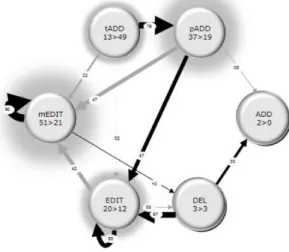
Figure 2-1. Transitional state diagram of a writing process of an individual Wiki
author (from Heeter and Jeong (2012) – Permission has been authorised). ... 29
Figure 2-2. Graph visualisation of writing process: an example of novice writer (from (Caporossi & Leblay, 2011) - permission has been authorised). ... 30
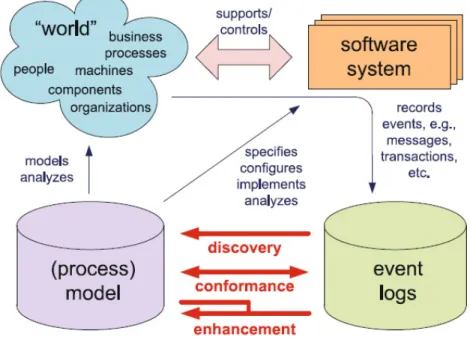
Figure 3-1. The three main types of process mining: discovery, conformance, and enhancement (from (van der Aalst, 2011) – permission has been authorised). .. 44
Figure 3-2. An example of dependency graphs. ... 46
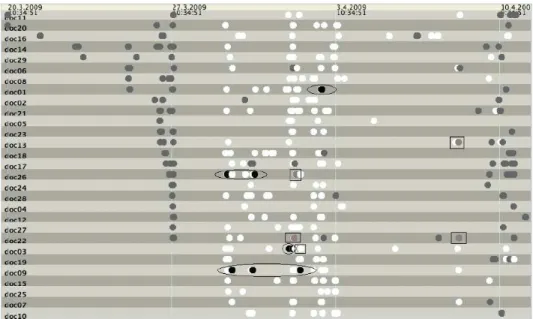
Figure 3-3. Dot chart of reviewed documents ordered by their first events’ timestamps. Grey denoted events generated by by authors; white by reviewers, black by reviewers’ group member (indicated by ovals) and brown by others (indicated by rectangles) (from (Southavilay et al., 2009)) ... 51
Figure 3-4. An example of Hidden Markov Model. ... 53
Figure 4-1. Overview of approach for extracting and analysing process models. ... 58
Figure 5-1. WriteProc: a frame work retrieving revisions and revision histories. ... 66
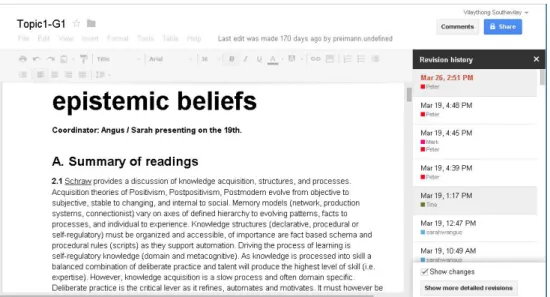
Figure 5-2. the web-based interface of revision history (on the right panel) of Google Docs, which shows a list of revisions. Each revision contains a timestamp (date and time) and an author ID (different colours for different authors). ... 68
Figure 5-3. Revision history before 2011 showing 13 revisions: R1-R13 written by 2 authors: U1 and U2. Each revision has timestamp associated with it. Σ and σ are time difference of two consecutive revisions, where Σ>30 min and σ≤30 min. 69 Figure 5-4. Revision history since 2011. Only revisions displayed in “less detailed” revision history have timestamp and user IDs. ... 70
Figure 5-5. Timeline of assignment due dates in the case study. ... 72
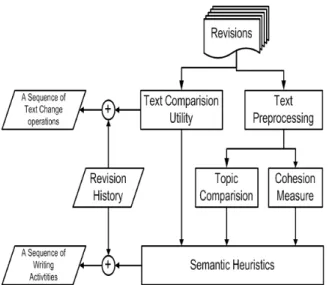
Figure 6-1. Pre-processing steps (from (Southavilay et al., 2010b)) ... 84
Figure 6-2. Precision (P), Recall (R), F1 score (F1) and Baseline (B) of detecting drafting, revising, and editing activities using the heuristic. ... 92
Figure 7-1. Final marks (in green), total number of inactivities (pause) (in blue) and writing activities (in red) of 26 groups in order of their final marks, lowest mark on the left. ... 101
xi
Figure 7-2. Numbers of drafting (blue), revising (red), and editing (green) activities performed by 26 groups (in order of their final marks, lowest mark on the left) ... 103 Figure 7-3. Dotted chart of 26 groups of students writing collaboratively (from ProM
tool) displayed in order of starting time. Circles represent drafting, triangles depict revising, and squares denote editing. Author1 is identified by the colour black and Author2 is shown in grey. ... 104 Figure 7-4. Process models of highest and lowest Achieving Groups (from ProM). 106 Figure 7-5. Sequence patterns of 4 groups (clockwise from top left 03, 19, 10, and 22)
of students writing collaboratively (from ProM). ... 108 Figure 7-6. Author collaboration based on writing activities. ... 109 Figure 7-7. HMM model created with semantic heuristic on the left (Heuristic MM)
and without the heuristic on the right (Hidden MM)... 111 Figure 7-8. Pre-processing steps. ... 112 Figure 7-9. MMs of the documents of High and Low Performing groups (Heuristic
MM and Hidden MM respectively). ... 116 Figure 7-10. Heuristic MMs of High Performing groups versus Low Performing
groups. ... 119 Figure 7-11. Mockup snapshot of writing processes, generated by Dot Chart Analysis
plugin of ProM ... 122 Figure 7-12. Mockup transition diagrams of writing activities based on hidden
Markov models. ... 123 Figure 7-13. Mockup topic evolution and topic-based collaboration ... 124 Figure 7-14. Mockup authors’ contribution based on writing activities: formatting (i.e.
editing) in green bar, revising in blue bar, and drafting in red bar. ... 125 Figure 8-1. Framework of approach producing revision maps, topic evolution charts,
and author-topic networks. ... 132 Figure 8-2. Revision map of a real document written by a group of five students: c1,
c2, c3, c4, and c5. “ad” is the administrator. ... 134 Figure 8-3. A topic evolution chart of four topics: T1, T2, T3, and T4. ... 136 Figure 8-4. Perplexity vs number of topics for a document written by graduate
students (from the case study described below). The selected number of topics is equal to 12 as explained above. ... 142
xii
Figure 8-5. A topic-based collaboration network for collaborative writing. The network is inspired by the social network proposed by Broniatowski and Christopher (2012). Nodes represents students: a1 to a4. The square is the group coordinator and circles are group members. A connection between two nodes means that the two corresponding students have written about the same topics. ... 143 Figure 8-6. Topic-based collaboration networks of four different groups of students
writing documents. Squares represent group coordinators. Circles are group members. Links between two nodes indicate that the two corresponding authors have written about the same topics. ... 146 Figure 8-7. Topic evolution for the simulated scenarios. ... 149 Figure 8-8. Experiment setup of six cycles (fortnights). Two revision maps were
provided for each cycle: the first week revision map presented by a grey diamond and the final revision map presented by a white diamond. ... 152 Figure 8-9. The first week revision map of Group c3g4. ... 156 Figure 8-10. The two-week revision map of Group c3g4. ... 157 Figure 8-11. Topic evolution map of three topics T3, T4 and T9 over 50 revisions of
Document 2. The table above shows the top 10 words of each topic. ... 159 Figure 8-12. Author-topic networks of 20 documents of four cycles. Each row shows
a cycle, which is a writing period of two weeks. Squares depict group coordinators and circles are group members. The edge connecting between two nodes represents two corresponding students writing the same topics. ... 160 Figure 8-13. The usefulness of revision maps - ranging from 1 as "strongly disagree"
to 7 as "strongly agree" ... 164 Figure 9-1. Summary of algorithms adapted and created in the toolbox, and
algorithms which can be used for improving the toolbox in the future. ... 176 Figure A-1. An example of revision histories. ... 181 Figure A-2. Two consecutive revisions showing three text edits. ... 182 Figure B-1. An example of text edits performed on 7 revisions. A revision has a diff
record associated with it. A rectangle represents a paragraph. Each circle shows a text edit. Red and blue edits are detected by paragraph differencing, whereas red ones are identified by a word differencing algorithm. ... 184 Figure B-2. An example of word edits performed on an existing paragraph. ... 185
xiii
Figure C-1. Process models, as dependency diagrams of documents written by 26 groups of two students. The final marks (out of 100) of individual groups are shown in parenthesis. The fitness of each model is the decimal number below the
group number. ... 189
Figure D-1. Revision Map of Group c3g1. ... 191
Figure D-2. Revision Map of Group c3g2. ... 192
Figure D-3. Revision Map of Group c3g3. ... 193
xiv
LIST OF TABLES
Table 2-1. Summary of topic extraction algorithms. ... 23
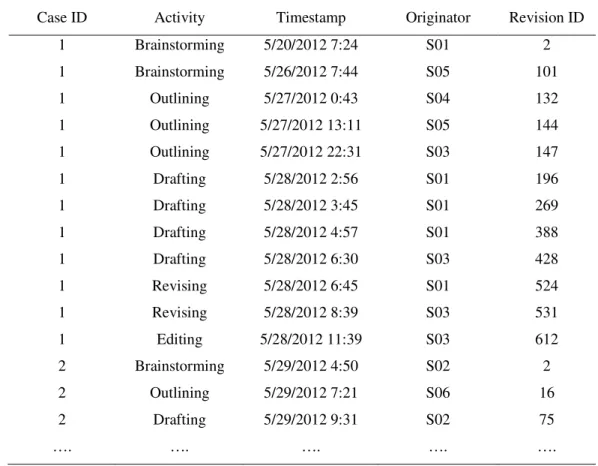
Table 3-1. Example of an event log. ... 45
Table 5-1. Number of Revisions and the final marks of 26 documents of Dataset A, in which documents are ordered by the final marks. ... 73
Table 6-1. Heuristic for identifying collaborative writing activities based on text edits (C1 – C8), text structure (S1 – S2), and functions (F1 – F3). ... 78
Table 6-2. Detecting surface change (C1) and alteration of form (C7). ... 82
Table 6-3. An example of four revisions of a hypothetical document. ... 87
Table 6-4. Evaluation using all revisions ... 91
Table 6-5. Evaluation per revision. ... 91
Table 6-6. Heuristic performance based on Zero R as baseline and F1 score for detecting three activities: Drafting (D), Revising (R), and Editing (E) for major revisions of 15 documents. The documents were ordered according to the number of writing activities they contained. ... 92
Table 6-7. Heuristic performance based on Zero R as baseline and F1 score for detecting 5 activities: Brainstorming (B), Outlining (O), Drafting (D), Revising (R), and Editing (E) for all revisions of 6 documents. The documents were ordered according to the number of writing activities contained in each. ... 94
Table 7-1. Text edits and their description ... 114
Table 7-2. Stationary Probabilities. ... 120
Table 8-1, the difference between DiffLDA for software repositories (Thomas, 2011) and DiffLDA for writing processes. ... 138
Table 8-2, the dictionary and topic distribution of a simulated data ... 147
Table 8-3, event log file presenting text edition events of revisions of a simulated document. ... 147
Table 8-4. Questionnaire for qualitative evaluation ... 153
Table 8-5. Numbers of revisions, vocabularies (unique words), delta documents, authors per revision, and final marks of all documents. ... 154
1
CHAPTER 1
INTRODUCTION
The availability of the Internet has made collaborative writing very easy to implement in schools and at work. One result of this circumstance has been the development of new forms of writing, such as blogging and wiki writing. In addition, the emerging of “cloud computing” tools and Web 2.0 applications, such as Google Docs, have led to the creation and access of near desktop-quality online writing environments.
Writing can be used not only as a method of acquiring better writing skills, but also as an important tool for learning subject matter (Bereiter & Scardamalia, 1987; Galbraith, 1999). The context of this research focuses particularly on collaborative forms of writing in an academic environment for the purpose of learning, in which writing activities are collaboratively performed by groups of students in a period of multiple writing sessions. Lowry et al. (2003) describes collaborative writing (CW) as “..an iterative and social process that involves a team focused on a common
2
objective that negotiates, coordinates, and communicates during the creation of a common document”. Cognitive studies demonstrate that CW presents a challenge with regard to all these aspects: negotiation, coordination, and communication (Flower & Hayes, 1981). Because of the complexity of the CW process, both explicit and scaffolding support need to be provided; these two types of support generally fall into one of three classes: Specialised writing and document management tools; document analysis technologies; and team process support. This thesis addresses the last two of these three classes, as the first one is provided by commercial vendors (e.g. Google) who provide the writing tools and store the documents written by students.
Even though the use of cloud computing tools, such as the collaborative writing tool Google Docs, is spreading in workplaces and classrooms, CW is not explicitly taught in school or higher education systems. Providing support on the processes of CW can be useful not only for improving the quality of the documents produced by this process, but also – and more importantly – for improving the CW skills of those involved. This research posits that in order to effectively support Higher Education students in writing together and learning from the collaborative writing process, it is necessary to develop computational support to provide visualisations of and/or feedback with regard to the students' activities during the process. The visualisations of and/or feedback on writing processes can be analysed in order to extract the patterns of text edits and writing activities that are performed during the course of writing. Analysing the discovered patterns of writing activities can assist in understanding of how certain sequence patterns of writing activities (i.e. the steps followed by a group of authors) lead to high quality outcomes and sequence patterns that may lead to low quality outcomes.
Computer-supported writing has been studied for decades in the field of Education. After ten years of collecting empirical data, Goldberg et al. (2003) found in a meta-study “that when students write on computers, writing becomes a more social process in which students sharetheir works with each other”. The study also noted that whenusing computers, students prefer to make revisionswhile producing text, rather than afterwards; they also tend to make more revisions between initial and final drafts and to produce longerpassages.
3
Review feedback, especially from peer reviews, has beenrecognized as another effective tool for learning writing (Carlson & Berry, 2008; Cho & Schunn, 2007). When students use computers to write, they engage in the revising of their work throughout the writing process; they more frequently share and receive feedback from their peers; and they benefit from teacher input earlier in the writing process than they do when writing manually. Although the studies show that computer-supported writing, including automaticfeedback tools, efficiently assists students in writing and reviewing, it is still crucial to further understand the writing process in order to develop support technologies for CW.
In order to properly support collaborative writing, it is essential to gain an understanding of how ideas and concepts are developed during the writing process, which consists of steps of writing activities. These steps can be considered as sequence patterns comprising both time events and the semantics of changes made during those steps.
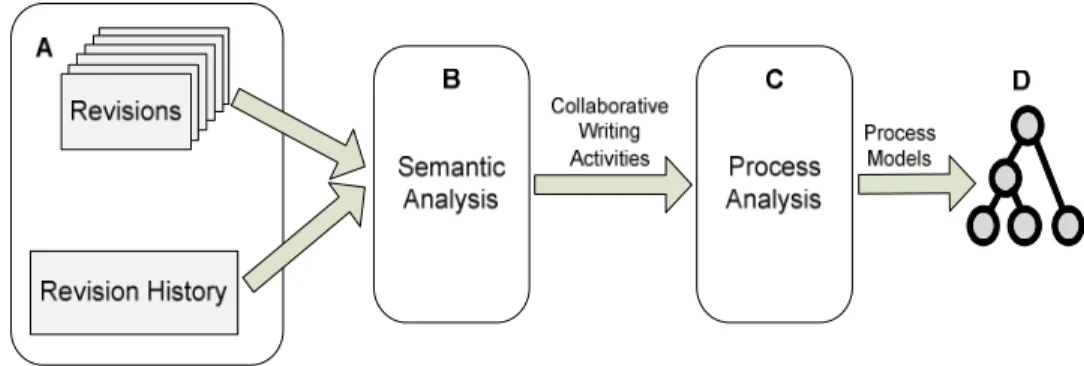
Therefore, there are two effective techniques that can be combined and used to obtain insight into students’ collaborative writing: Process mining, which focuses on extracting process-related knowledge from event logs recorded by an information system; and semantic analysis, which focuses on extracting knowledge about what the student wrote (or edited). The field of process mining covers many areas, such as process discovery (discovery of the control flow), performance characteristics (e.g. throughput times), process conformance (checking if the event log conforms to specifications), and social networks (e.g. collaboration) (Bozkaya et al., 2009; van der Aalst, 2011). Process mining analysis, in particular, is necessary to understand group awareness and writers' participation and collaboration. Text mining combines indexing, clustering, latent semantic analysis (Landauer et al., 2007) and several probabilistic topic modelling techniques (Blei & Lafferty, 2009).
For two decades, process mining techniques have been successfully applied to extract process-related knowledge from event logs recorded by business information systems; however, the techniques have only recently been applied to educational data. For example, Pecheniskiy et al (2009) used process mining tools to analyse data from online multiple choice examinations and demonstrated the use of process discovery and analysis techniques; but the area of interest in this research was the individual students' activities related to answering online multiple-choice questions
4
during assessment, not student activities related to writing and editing texts collaboratively.
There is prolific disparate research in text mining with regard to improving support for quality writing, such as tools for automatic scoring of essays (Shermis & Burstein, 2003), visualisation of documents (O'Rourke et al., 2011; Villalon & Calvo, 2011), automatic question generation (Liu & Calvo, 2011) and document clustering (Andrews & Fox, 2007); however, these existing approaches all focus on the final product, unlike the work in this research which examines the writing process itself in an effort to provide insight on how students write their documents.
In addition to the above studies, one important benefit of cloud computing tools, beyond allowing authors to edit text anywhere at any time and to collaborate seamlessly, is their capacity to store all the document revisions and revision histories (i.e. timestamps and authorship), providing unprecedented historical data of all the text edits made by authors as they write. By exploiting this data, researchers can gain insight into the processes that authors follow to write their documents, and investigate and extract information about collaborative writing that may prove useful for teachers and students.
Abundant research has recently been conducted with regard to exploiting Wikipedia’s revision history for several tasks, such as Natural Language Processing applications (Ferschke et al., 2013), including a number of studies that were particularly interested in analysing the lifecycles and evolution of Wiki articles. The article evolution extraction was based on human evaluated quality classes in Wikipedia, aiming mainly at automatically assessing the quality and trustworthiness of the articles. Although these techniques can be applied to extract collaborative writing processes not only for Wikipedia articles but also for any jointly-authored documents, the methods used in these studies do not provide adequate means for coding the writing behaviours logged in the revision histories or to sequentially analyse the collaborative writing processes observed. For this reason, these techniques can not be used directly in supporting collaborative writing.
When students engage in collaborative writing processes, they produce higher quality text (Palincsar & Brown, 1984; Scardamalia & Bereiter, 1996). However, research shows that groups tend to choose approaches that result in members working more on an individual than a collaborative basis (Ede & Lunsford, 1992). In
5
order to understand why groups tend to write individually rather than collaboratively and to discover the factors that affect group collaboration on writing tasks, it is crucial to employ techniques that identify writing activities and that model the actual sequences of these activities.
To support collaborative writing skills, feedback about the writing processes can be provided to students and teachers in the form of mirroring visualisations (Erickson et al., 1999; Kay, Maisonneuve, Yacef, & Reimann, 2006; Upton & Kay, 2009) which provide an awareness of the group’s writing activities to individual students, thus enabling them to perform their collaborative writing tasks more efficiently and effectively. In addition, teachers can use the support as tools to help them monitor groups effectively and detect problems early.
In summary, providing support on the processes of CW can be useful not only for improving the quality of the documents produced by this process, but also – and more importantly – for improving the CW skills of those involved. In order to properly support collaborative writing, it is essential to gain an understanding of how ideas and concepts are developed during the writing process. Although there is unprecedented historical data including all the document revisions and revision histories (i.e. timestamps and authorship), provided by cloud computing tools, there are problems with existing techniques for investigating into the development of ideas and concepts during the course of collaborative writing:
• The existing approaches all focus on the final product of writing, not on the process of writing.
• There is no adequate ways for coding and automatically identifying the writing behaviours logged in the revision histories; and sequentially analysing the collaborative writing processes observed.
• There is no appropriate feedback and/or visualisation for analysing the development of ideas and concepts during collaborative writing processes and mirroring the group’s writing activities to individual students and teachers.
1.1 Summary of Contribution
This thesis aims to develop techniques that automatically extract process models of writing processes and provide visualisations that describe aspects of students’ collaborative writing. The outcomes of this work are the following:
6
• To identify the text features -- e.g. text editions, topics, and cohesion -- that can be used to detect the purpose of text edits made to a document.
• To extract the corresponding collaborative writing activities or events based on these text edits; the theories of cognitive models of writing processes; and the taxonomy of collaborative writing activities and revisions.
• To create techniques for building a range of process models and representation by using those collaborative writing activities which provide different views of the collaborative writing processes.
• To design several visualisations that reflect important syntactic and semantic changes made to a document during the writing process.
1.2 Outline of the Chapters
This chapter provides an introduction to this thesis, describes the overview and motivation for the research, and outlines the contributions made by the research.
Chapter 2 reviews the current literature on the theoretical framework of cognitive models of writing processes, taxonomies of collaborative writing activities, models of analysing revisions, related process mining, and text mining works.
Chapter 3 reviews the theoretical background of the text mining and process mining algorithms and techniques used in this thesis.
Chapter 4 explains the approach of this thesis, consisting of a framework for extracting revisions and revision histories; and methods for automatically identifying writing activities, extracting process models, and visualising collaborative writing processes.
Chapter 5 introduces WriteProc, the framework for extracting revisions and revision histories, provides an overview of the framework, the writing environment, along with the approach for extracting revisions and revision histories, and describe the dataset used in the following chapters: 6 and 7.
Chapter 6 presents my techniques for automatically identifying collaborative writing activities, and the validation of these techniques, using real documents written by groups of graduate students.
Chapter 7 presents my techniques for extracting process models: causal dependency diagrams and transitional state diagrams by using process mining algorithms and hidden Markov models, respectively. It also provides the process
7
analysis of writing processes of real documents written by groups of students outlined in the studies in Chapter 5.
Chapter 8 presents my techniques for visualising collaborative writing processes; introduces three visualisations; demonstrates the validation of the techniques used for producing the visualisations based on a synthetic dataset; and provides a prototype experiment to illustrate how the visualisations are used, what information they provide, and whether they are useful.
Chapter 9 discusses the limitations of the techniques presented herein and offers suggestions for future research, as well as summarizing the approach of this thesis.
1.3 Publication Related to This Thesis
This thesis is derived from the following publication:
Southavilay, V., Yacef, K., & Calvo, R. A. (2009). WriteProc: A Framework for Exploring Collaborative Writing Processes. Paper presented at the Australasian Document Computing Symposium, Sydney, Australia. – incorporated in Chapter 5.
Southavilay, V., Yacef, K., & Calvo, R. A. (2010). Process Mining to Support Students' Collaborative Writing. Paper presented at the the third International Conference on Educational Data Mining, Pittsburgh, PA, USA. – incorporated as in Chapter 6 and 7.
Southavilay, V., Yacef, K., & Calvo, R. A. (2010b). Analysis of Collaborative Writing Processes Using Hidden Markov Models and Semantic Heuristics. Paper presented at the Proceedings of the third International Workshop on Semantic Aspect of Data Mining, Sydney, Australia. – incoporated as in Chapter 7.
Southavilay, V., Yacef, K., Reimann, P, & Calvo, R. A. (2013). Analysis of Writing Processes Using Revision Maps and Probabilistic Topic Models. Paper presented at the Proceedings of the third International Conference on Learning Analytics and Knowledge, Leuven, Belgium. – incorporated as in Chapter 8.
9
CHAPTER 2
LITERATURE REVIEW
The subject of Computer-Supported Collaborative Work (CSCW), particularly Collaborative Writing (CW), has received attention since computers were first used for word processing. The ever increasing availability of the Internet has resulted in a corresponding increase of people writing collaboratively by sharing their documents in a number of ways. Relatedly, since writing individually and collaboratively are considered essential skills in most industries, academia, and government, there has also been an increase in research on how to support the production of better documents.
Over the past two decades, an abundance of text-mining research has been conducted with the purpose of improving the support of quality writing. Shermis and Burstein (2003) described four different methods, as follows: (1) Project Essay Grade (PEG), which used a large collection of surface features such as instances of average sentence length, frequency of certain transitional words, number of
10
semicolons, and work rarity; (2) the Bayesian approach, which examined the probabilities of each token (typically a word or a stemmed word) being used in essays in each score group; (3) Intelligent Essay Assessor (IEA), which examined content, style, and mechanics, with content expressed as independent measures of semantic quality and the amount of such content; and (4) e-rater, which examined discourse structure, syntactic structure, and vocabulary usage. The PEG and Bayesian approaches are simpler to develop for real applications, although IEA and e-rater have much deeper linguistic features.
Another active section of research in improving the support of quality writing is the area of automatic question generation, exemplified by the work of Liu and Calvo (2011), which used text-mining and natural language processing techniques to provide feedback as types of questions to students based on their documents (i.e. literature reviews). In addition, the works of O'Rourke et al (2011) and Villalon and Calvo (2011) concentrated on visualising the cohesion of texts and concept maps of students’ essays, using text mining techniques respectively. Nevertheless, these studies all focus on the final product, not on the writing process itself. An investigation of how ideas and concepts are developed during the actual process of writing could be used to improve not only the quality of the documents but also -- and more importantly -- the writing skills of those involved.
Analysing the process of writing requires an understanding of how certain sequence patterns (i.e. the steps followed by a group of writers) lead to high quality outcomes. The sequence patterns of writing processes are comprised of time events (as used in other process mining research) and the semantics of the changes made during that step. Two techniques can be combined to examine the patterns: Process mining, which focuses on extracting process-related knowledge from event logs recorded by an information system; and semantic analysis, which focuses on extracting knowledge about what the student wrote or edited.
This chapter begins with a discussion of the theoretical framework of the cognitive models of writing processes and discusses the taxonomy of collaborative writing and models of analysing revisions, followed by a presentation of related works in the fields of text mining and process mining. It then reviews tools to support collaborative writing.
11
2.1 Theoretical Framework
2.1.1 Cognitive Models of Writing Processes
In order to understand the writing process, it is important to review the theoretical frame of cognitive models of writing processes and the taxonomy of collaborative writing activities and revisions.
There are three classic cognitive models of writing processes: Knowledge-telling, knowledge-transforming, and knowledge-constituting models (Galbraith, 2009). The first original model, proposed by Hayes and Flower (1980), was developed based on an experiment with writers thinking aloud as they wrote. This original model considers a writing process as an idea generation process that retrieves content from long-term memory by using resources from the writing task environment (including the writing assignment and the text produced so far) and from the writer’s long-term memory, in which a “monitor” or central executive is responsible for deciding which activities (tasks) should be carried out and when (Galbraith, 2009).
According to this model, in order to work out what to write next about a topic, the writer starts by using the specification in the writing assignment to construct a set of cues with which to probe long-term memory. If content is successfully retrieved and then positively evaluated, it is then either transformed into text immediately on paper or stored mentally in the memory for later translation. This content then acts as a new probe for memory, so that each retrieval episode consists of associated chains of content being retrieved from memory. If appropriate content cannot be retrieved, the “monitor” has to decide what to do next; it may decide to pursue a different goal -- for instance, to read more books about the topic, or to read the assignment more closely – or it may also carry on generating content by probing memory again with a different set of cues. It is important to note that the central part of this model is the “monitor”, which controls the decision process and the writer’s overall writing strategy. Because the content was retrieved periodically from memory, this original model was called the “knowledge-telling” model (Bereiter & Scardamalia, 1987).
In 1987, Bereiter and Scardamalia extended the original model of idea generation and proposed the “knowledge-transforming” model of writing. Although this model also includes the same basic mechanism of generating ideas (i.e. the retrieval of
12
content from long-term memory), it is focused on the rhetorical nature of goals towards which the writing is directed. The model claims that the writing process is not simply an evolution of a knowledge telling, but also a redefinition of writing goals, in which content is formulated as the text develops. In other words, according to this model, content is not only retrieved in response to a more elaborated representation of the assignment as a rhetorical problem, but it is also formulated in the context of, and as a contribution to, the series of rhetorical acts that emerge gradually in the text.
Although this knowledge-transforming model captures important features of the writing process, Galbraith argued that it has two problems (Galbraith, 2009). First, although one of the attractive features of the model is the claim that it accounts for the common experience of writing as a source of discovery, this is only implied in the model, and was not directly tested during its development. Second, the knowledge-telling model, which is embedded within the knowledge-transforming model as its account of how content is generated to satisfy goals, does not explain how novel content is formulated during writing. According to the knowledge-transforming model, generating an idea is a matter of accessing pre-existing content in the memory. Although this can account for the fact that the content retrieved is different when the rhetorical context drives a memory search than it is when retrieved associatively, it does not explain how new content that develops the writers’ understanding is generated. Consequently, the idea implied by the model that writing develops understanding cannot be justified without empirical testing.
Subsequent research has investigated this more directly, and examined the condition under which writers discovered new ideas through writing. In 1999, Galbraith presented writing as a knowledge constituting process. Rather than presenting knowledge as static data stored in a memory system (as assumed by Hayes and Flower), Galbraith considered that language production draws on a different semantic memory system, which is represented by a network of units analogical to neuron networks. This network is flexible in that units have different patterns of activation for different inputs, and only develop these patterns of activation in the presence of a particular input. Galbraith's model did not include a long-term memory unit or a monitor, like the two models previously discussed. According to the knowledge constituting model (Galbraith, 1999), the author's
13
semantic memory is represented by the network of units, and the author's knowledge is represented by the weights connecting the units. Galbraith did not deny that content sometimes represents individual events which can be accessed via a process of retrieval, a component which is similar to the principles of the Hayes and Flower model; and also similar to the knowledge-transforming model characteristics, the inputs in Galbraith's model consist of a specification or a goal, and a series of rhetorical acts that gradually emerge in the text. However, the weights of connections and the activation of the units in the network of the knowledge constituting model were reconfigured through a series of learning mechanisms similar to the neuron networks of humans.
2.1.2 Taxonomies of Collaborative Writing Activities
In addition to the above cognitive models, writing processes can also be described by using a taxonomy of writing activities, as proposed by Lowry et al. (2003). This taxonomy of group writing activities that occur in collaborative writing fall into six categories, as follows (Lowry et al., 2003):
1. Brainstorming: Developing new ideas for a paper draft.
2. Outlining: Creating a high-level direction in which the document will be going, including major sections and subsections.
3. Drafting: Writing the initial incomplete text of a document (this is typically synonymous with the term "writing", but the term "drafting" is used to convey incompleteness in the writing).
4. Reviewing: Having a participant or an editor read and annotate the document draft section for improvements in content, grammar, and style.
5. Revising: Responding to the above comments by making changes in the draft that reflect the feedback provided in the review.
6. Editing: Making final changes that are universally applied to a document to make it more consistent (such as copy edits, grammar, and logic).
It is important to note that generally these six activities do not occur in a linear sequence. In the process of writing a document, reviewing activities may be done not only by the authors of the document, but also by instructors or editors or peers who read and annotate the document for with regard to improvements in content, grammar, and style. To support authors during collaborative writing, it is important
14
to focus on those activities that are performed by the writers, and not by reviewers. Toward that end, it is crucial to concentrate on automatically identifying the following five collaborative writing activities that are performed by writers -- brainstorming, outlining, drafting, revising, and editing -- and leave the reviewing aside.
Faigley and Witte (1981) categorized text revisions into surface changes and meaning changes. Surface changes, as opposed to meaning changes, do not alter the meaning of the text. Surface changes are further subcategorized into formal changes, such as spelling, grammar, and punctuation; and meaning-preserving changes, which “paraphrase the concepts in the text, but do not alter them”(Faigley & Witte, 1981). Meaning, or text-based changes, are subcategorized into macrostructure or microstructure changes. Macrostructure changes include text revisions that would alter the summary of a text, while microstructure changes would not. The results of Faigley and Witte’s study showed that experienced writers made a lot of meaning changes, while novice writers made mainly surface changes (Faigley & Witte, 1981). Boiarsky (1984) argued that Although Faigley and Witte’s taxonomy provides “a means for describing the changes in the text based categories, which are for analysing how writers make text-based changes, they do not provide a description of why writers make such changes.” She further developed a model for analysing semantic changes in the writing process (Boiarsky, 1984) in which she identified the following 11 types of revision functions and operations: Alteration of form; reorganization of information; improvement in coherence; deletion of information; expansion of information; emphasis of information; subordination of information; creation of immediacy; improvement of prosody; improvement in vocabulary; and correction of grammar and mechanics. Authors used these text change operations in their writing activities for different purposes in order to produce final pieces of writing.
Boiarsky’s study examined three phases of writing -- during drafting, between drafting, and rehearsal – and involved interviews with writers and examinations of their drafts, including revisions made during the rehearsal phase. She concluded that these 11 functions and operations could provide a comprehensive and discriminating means of describing writers’ processes of revision, as well as a valid set of criteria for analysing revisions. Boiarsky also observed that writers did not engage in every
15
form of revision function and operation in every work, which she suggests might be a reflection of the writer’s previous knowledge.
The nature of the changes made by authors can be analysed by using two techniques: text mining and process mining. Work that relates to these two methods of analysis is described in the following section.
2.2 Text mining for Detecting Cohesion and Topics
During the process of writing, authors go through several revisions of text edits before the final work is completed. Particularly, authors introduce ideas (topics) by creating and editing sentences and paragraphs in the written text. In order to develop and convey topics to readers, authors refer to the same topics across several sentences and paragraphs and make connection between these topics in the content text. These overlapping and connection of the topics make the text cohesive. Therefore, detecting changes in cohesion and topics is important to understand how authors develop the content text during their writing processes. Text mining techniques can be used to extract semantic meaning from these editing processes, particularly from textual features such as cohesion improvement and topic (concept) changes. This subsection presents significant works related to the use of text mining techniques for analysing these features of the written texts.
McNamara and her colleagues at the University of Memphis used Coh-Metrix (Graesser et al., 2004; McNamara et al., 2010) to analyse writing quality (Crossley & Mcnamara, 2007; McNamara et al., 2009; Ozuru et al., 2010; Weston et al., 2011). Coh-Metrix is a computational tool that is used to assess text on more than 600 linguistic and lexical indices. These indices are related to conceptual knowledge, cohesion, lexical difficulty, syntactic complexity, and simple incidence scores (Weston et al., 2011). Coh-Metrix provides the following interesting indices:
• Syntactic complexity which computes the mean number of words before the main verb and the mean number of high level constituents (sentences and embedded sentence constituents) per word and per noun phrase.
• Connectives and logical Operators which measure the density of connectives. These connectives are associated with positive additive (also, moreover), negative additive (however, but), positive temporal (after, before), negative temporal (until), and causal (because, so) measures. The logical operators
16
measured in Coh-Metrix include variants of or, and, not and if-then combinations.
• Causality which measures causal cohesion by calculating the ratio of causal verbs to causal particles. The causal verb count is based on the number of main causal verbs identified through WordNet (Fellbaum, 2005).
• Lexical overlap which considers four forms of lexical overlap between sentences: noun overlap, argument overlap, stem overlap, and content word overlap.
• Cohesion which measures semantic coreferentiality using Latent Semantic Analysis (LSA) (Landauer & Dumais, 1997; Landauer et al., 2007), a mathematical technique for representing deeper world knowledge based on large corpora of texts. Weston et al. (2011) explained that “Unlike lexical overlap, LSA measures associations between words based on semantic similarity, which can be used to assess the amount of semantic coreferentiality in a text”.
• Spatiality which measures spatial cohesion using motion verbs and location nouns.
• Word characteristics which reports on a variety of lexical indices such as hypernymy and polysemy.
• Word frequency which indicates how often particular words occur in the English language.
In light of the above, Coh-Metrix seems to fulfil the need of discourse psychologists and other researchers to have access to one computational linguistic tool that analyses various linguistic features of texts. In particular, Coh-Metrix has been used to detect a wide variety of differences in text and discourse (Crossley & Mcnamara, 2007; McNamara et al., 2009; Ozuru et al., 2010; Weston et al., 2011) based on an investigation of the final writing product. Although the indices of Coh-Metrix described above can be used in analysing the writing process, not all of those indices are suitable for use at the writing stages during which some words and/or sentences have not been completely written yet. Nevertheless, this thesis uses a similar technique to compute the semantic similarities between sentences and paragraphs in order to measure the cohesion, which is the overlapping of words and topics, as explained in the following section.
17 2.2.1 Cohesion Measure
Cohesion refers to the presence or absence of explicit cues in the text that allow the reader to make connections between ideas in the content. For example, overlapping words and concepts between sentences indicate that the same ideas are being referred to across sentences. Likewise, connectives such as "because", "therefore", and "consequently" inform the reader that there are relationships between the ideas expressed and the nature of those relationships. Both cohesion and coherence are two similar terms used in natural language processing, particularly discourse analysis. Cohesion differs from coherence in that cohesion refers to the explicit cues found in the text, whereas coherence refers to the understanding that the reader derives from these cues in the text, which may be more or less coherent depending on a number of factors, such as the reader's prior knowledge and skill (McNamara et al., 1996; O'Reilly & McNamara, 2007). For the purposes for this research, only cohesion is taken into account in analysing the writing process, leaving coherence aside.
McNamara and her colleagues, interested in the roles played by cohesion with regard to writing quality (Crossley & Mcnamara, 2007; McNamara et al., 2010; Ozuru et al., 2010), applied the techniques as elaborated in the beginning of this subsection to examine that factor; but again, their work was focused on the final writing product. In order to acquire insight on how authors carry out their activities during the course of the writing process, one must analyse changes in cohesion over time from one revision to another, beginning by first measuring cohesion in the text; to achieve this, the following text mining techniques proposed by researchers for computing cohesion can be considered:
Latent Semantic Analysis (LSA) (Landauer & Dumais, 1997; Landauer et al., 2007) has been widely used to measure deeper quality patterns in texts, especially discourse cohesion. Traditionally, LSA semantic spaces were normally created from large corpora that reflect an assumed background knowledge. However, Villalon and Calvo (2009) proposed an elegant technique for creating a semantic space using a single document and no background knowledge. Their technique measured the semantic distance between consecutive sentences and paragraphs of a document in order to identify possible breaks in cohesion in the text. For a particular document comprised of several revisions produced during the writing process, the technique of
18
building LSA semantic space can be used for each revision of the document in order to explore the improvement of cohesion during the writing of the text.
Standard text similarity measures (based on term frequency) perform poorly on computing the distance between consecutive sentences and paragraphs for a single document because of the lack of common words between the consecutive sentences and paragraphs. Yin and Meek (2007) achieved an improved Web-relevance similarity measure for calculating similarity between short segments of text with an approach that extended the terms of text segments using information from the Web (search engine), and computed the similarity scores based on the extended representation of those text segments. This technique can be integrated into the technique proposed by Villalon and Calvo (2009) to improve the computation of cohesion measures in the text.
Although it is common for writers to repeat words to emphasize concepts in the text, good writers usually use synonymy and pronouns to avoid annoying repetition; and this issue was not taken into account in the technique proposed by Yin and Meek (2007). Varelas et al. (2005) introduced a semantic similarity measure using Wordnet as the underlying reference ontology. This method of measuring similarity as well as those previously mentioned (Villalon & Calvo, 2009; Yih & Meek, 2007) can be used to measure the distance between consecutive sentences and paragraphs in single document semantic space in order to investigate the progressive improvement of cohesion during writing processes.
The works discussed above were all focused on computing cohesion in the text of the final written product; however, not much research exists with regard to analysing cohesion changes made during the entire course of the writing process, except for one interesting work by Thomas and Sheth (2007) on automatically identifying semantic convergence in Wikipedia articles. The researchers define semantic convergence as a notion of article stability (Thomas & Sheth, 2007). For a particular Wikipedia article comprised from several revisions, they created a vector space representation of the article's revision milestones using TF-IDF as a term-weighting scheme (Salton & McGill, 1983). The vector space is computed using all the words occurring in all revisions of the article. A revision milestone is a combination of all revisions made in one week, with the word count for milestones calculated as medians. Thoms and Sheth then computed two kinds of semantic distances, one
19
being the cosine distance between every pair of consecutive revision milestones and the second being the cosine distance between every revision milestone and the final revision. Based on these two computed semantic distances, the authors examined how particular articles became mature or semantically stable despite the ongoing text edits that were performed on them.
Using the technique developed by Thomas and Sheth, one could infer that text edits that produced stable cohesion through revisions were intended to revise and/or edit content without significantly changing the flow of ideas and the concept of the text. Although the vector space model used in their work is similar to the previously mentioned works using LSA such as Villalon & Calvo (2009), Thoms and Sheth (2007) did not use singular value decomposition, which is the mathematical technique underlying LSA, to transform the vector space. Overall, their work shed light on possible methods of analysing cohesion during the writing process.
Another important feature of the writing process is topic evolution, which represents how ideas and concepts have been developed during writing. Relevant works in this area are the subject of the following subsection.
2.2.2 Topic Extraction and Topic Evolution
Blei and Lafferty (2009) define topics as the “collections of words that co-occur frequently in a text collection, and can be used to provide structure to an otherwise unstructured collection of text”. Topics can be discovered through the application of two different techniques: (1) using probabilistic graphical models such as latent Dirichlet allocation (LDA) or topic modelling (Blei et al., 2003), and (2) using a document clustering algorithm such as Lingo (Osinski & Weiss, 2005). Each of these two techniques has its own strengths and drawbacks when used for extracting topics and discovering topic evolution.
Latent Dirichlet Allocation (LDA) is a popular probabilistic topic modelling technique which, at the time of this research, has never been used to extract the evolution of topics during the writing of a document. The closest method used for this purpose is DiffLDA (Thomas et al., 2011), which has been applied for extracting topic evolution in software repositories.
There has been an increase in research related to analysing the evolution of topics in software development. Analysing topic changes over time in regard to software