504
ISSN: 1932-9466
Vol. 05, Issue 2 (December 2010), pp. 504 – 533 (Previously, Vol. 05, Issue 10, pp. 1601 – 1630)
An International Journal (AAM)
Solving Fuzzy Linear Programming Problems with Piecewise
Linear Membership Function
S. Effati
Department of Mathematics Ferdowsi University of Mashhad
Mashhad, Iran [email protected]
H. Abbasiyan
Department of MathematicsIslamic Azad University
Aliabadekatool, Iran [email protected]
Received: January 15, 2009; Accepted: August 11, 2010
Abstract
In this paper, we concentrate on linear programming problems in which both the right-hand side and the technological coefficients are fuzzy numbers. We consider here only the case of fuzzy numbers with linear membership functions. The symmetric method of Bellman and Zadeh (1970) is used for a defuzzification of these problems. The crisp problems obtained after the defuzzification are non-linear and even non-convex in general. We propose here the "modified subgradient method" and "method of feasible directions" and uses for solving these problems see Bazaraa (1993). We also compare the new proposed methods with well known "fuzzy decisive set method". Finally, we give illustrative examples and their numerical solutions.
Keywords:
Fuzzy linear programming; fuzzy number; augmented Lagrangian penalty function method; feasible directions of Topkis and Veinott; fuzzy decisive set methodMSC (2000) No.:
90C05, 90C701. Introduction
In fuzzy decision making problems, the concept of maximizing decision was proposed by Bellman and Zadeh (1970). This concept was adapted to problems of mathematical programming
by Tanaka et al. (1984). Zimmermann (1983) presented a fuzzy approach to multi-objective linear programming problems. He also studied the duality relations in fuzzy linear programming. Fuzzy linear programming problem with fuzzy coefficients was formulated by Negoita (1970) and called robust programming. Dubois and Prade (1982) investigated linear fuzzy constraints. Tanaka and Asai (1984) also proposed a formulation of fuzzy linear programming with fuzzy constraints and give a method for its solution which bases on inequality relations between fuzzy numbers. Shaocheng (1994) considered the fuzzy linear programming problem with fuzzy constraints and defuzzificated it by first determining an upper bound for the objective function. Further he solved the obtained crisp problem by the fuzzy decisive set method introduced by Sakawa and Yana (1985). Guu and Yan-K (1999) proposed a two-phase approach for solving the fuzzy linear programming problems. Also applications of fuzzy linear programming include life cycle assessment [Raymond (2005)], production planning in the textile industry [Elamvazuthi et al. (2009)], and in energy planning [Canz (1999)].
We consider linear programming problems in which both technological coefficients and right-hand-side numbers are fuzzy numbers. Each problem is first converted into an equivalent crisp problem. This is a problem of finding a point which satisfies the constraints and the goal with the maximum degree. The idea of this approach is due to Bellman and Zadeh (1970). The crisp problems, obtained by such a manner, can be linear (even convex), where the non-linearity arises in constraints. For solving these problems we use and compare two methods. One of them called the augmented lagrangian penalty method. The second method that we use is the method of feasible directions of Topkis and Veinott (1993).
The paper is outlined as follows. In section 2, we study the linear programming problem in which both technological coefficients and right-hand-side are fuzzy numbers. The general principles of the augmented Lagrangian penalty method and method of feasible directions of Topkis and Veinott are presented in section 3 and 4, respectively. The fuzzy decisive set method is studied in section 5. In section 6, we examine the application of these two methods and then compare with the fuzzy decisive set method by concrete examples.
2. Linear Programming Problems with Fuzzy Technological Coefficients and
Fuzzy Right Hand-side Numbers
We consider a linear programming problem with fuzzy technological coefficients and fuzzy right-hand-side numbers: Maximize
n j 1cjxj Subject to
n j 1aijxj bi, ~ ~ 1im (1) , 0 j x 1 jn,where at least one xj 0 and a~ and ij bi ~
are fuzzy numbers with the following linear membership functions:
1, , , , 0, , ij ij ij ij a ij ij ij ij ij ij x a a d x x a x a d d x a d where xR and dij 0 for all i1,,m, j1,,n, and
1, , , , 0, , i i i i i i i b i i i x b b p x x b x b p p x b p where ,pi 0 for i1,,m. For defuzzification of the problem (1), we first calculate the lower and upper bounds of the optimal values. The optimal values zl and zu can be defined by solving the following standard linear programming problems, for which we assume that all they the finite optimal value l z Maximize
n j 1cjxj Subject to
n
j 1 aij dij xj bi, 1im (2) xj 0, 1 jn and u z Maximize
n j 1cjxj Subject to
n j 1aijxj bi pi, 1im xj 0, 1 jn. (3)The objective function takes values between zl and zuwhile technological coefficients take values between aij and aij dij and the right-hand side numbers take values between bi and
i i p
b .
Then, the fuzzy set of optimal values, G, which is a subset of n, is defined by
1 1 1 1 0, , ( ) , , 1, . n j j l j n j j l n j G l j j j u u l n j j u j c x z c x z x z c x z z z c x z
(4)The fuzzy set of the i constraint, ci, which is a subset of n is defined by
1 1 1 1 1 1 0, , ( ) , ( ) , 1, . i n i j ij j n i j ij j n n c n j ij j i j ij ij j i ij j i j n i j ij ij j i b a x b a x x a x b a d x p d x p b a d x p
(5)By using the definition of the fuzzy decision proposed by Bellman and Zadeh (1970) [see also Lai and Hwang (1984)], we have
))). ( ( min ), ( min( ) (x x x i C i G D (6) In this case, the optimal fuzzy decision is a solution of the problem
))). ( ( min ), ( min( max )) ( ( maxx0 D x x0 G x i Ci x (7)
Consequently, the problem (1) transform to the following optimization problem Maximize Subject to G(x) (x), i C 1im x0 (8) 01.
By using (4) and (5), the problem (8) can be written as: Maximize Subject to ( ) 0 1
l n j j j u l z c x z z ( ) 0, 1
i i n j aij dij xj p b 1im x0, 01. (9) Notice that, the constraints in problem (9) containing the cross product terms xj are not convex. Therefore the solution of this problem requires the special approach adopted for solving general non convex optimization problems.3. The Augmented Lagrangian Penalty Function Method
The approach used is to convert the problem into an equivalent unconstrained problem. This method is called the penalty or the exterior penalty function method, in which a penalty term is added to the objective function for any violation of the constraints. This method generates a sequence of infeasible points, hence its name, whose limit is an optimal solution to the original problem. The constraints are placed into the objective function via a penalty parameter in a way that penalizes any violation of the constraints.
In this section, we present and prove an important result that justifies using exterior penalty functions as a means for solving constrained problems.
Consider the following primal and penalty problems:
Primal problem: Minimize Subject to
n j ij ij j i n j j j l u l p x d a z x c z z 1 1 , 0 ) ( 0 ) ( j n (10) m i ,..., 1 ,...., 1 , 0 1 , 0 , 0 j xPenalty problem:
Let be a continuous function of the form
n j j n j ij ij j i i m i n a d x p b x x x 1 1 1 1,..., , ) ( ) ( ) ( ( )
1
, 1
n j j j l u l z c x z z (11)where is continuous function satisfying the following:
y 0, if y0 and (y)0, if y0. (12) The basic penalty function approach attempts to solve the following problem:
Minimize () Subject to 0,
where
inf{(x,):xRn,R}.From this result, it is clear that we can get arbitrarily close to the optimal objective value of the primal problem by computing (µ) for a sufficiently large µ. This result is established in Theorem 3.1.
Theorem 3.1. Consider the problem (10). Suppose that for each µ, there exists a solution
(x,)Rn1to the problem to minimize +µ (x,) subject to xRnand R, and that {(x,)} is contained in a compact subset of Rn1. Then,
lim sup{ : n, , ( , ) 0} x R R g x , where )g(g0,g1,...,gm,gm1,...,gmn,gmn1,gmn2 and
1 ) , ( ) , ( ,..., 1 , ) , ( ,... 1 , ) ( ) , ( ) , ( 2 1 1 1 0
x g x g n j x x g m i p x d a x g z x c z z x g m n m n j j m n j ij ij j i i n j j j l u l (13)and
inf{ ( ,): , } [( ,)]. x xRn R x
Furthermore, the limit (x,) of any convergent subsequence of {(x,)} is an optimal solution to the original problem, and [(x,)]0 as .
Proof:
For proof, see Bazaraa (1993).
3.1. Augmented Lagrangian Penalty Functions
An augmented lagrangian penalty function for the problem (10) is as:
2 0 2 2 2 0 2 0 , 2 ) , ( max ) , , ( m n i u i i i n m i i AL i i u x g u x F , (14)where ui are lagrange multiplier. The following result provides the basis by virtue of which the AL penalty function can be classified as an exact penalty function.
Theorem 3.1.1. Consider problem P to (10), and let the KKT solution
x,,u
satisfy the second-order sufficiency conditions for a local minimum. Then, there exists a such that fori
, the AL penalty function FAL(..,u), defined with u =u , also achieves a strict local minimum at
x, .Proof:
For proof, see Bazaraa (1993).
Algorithm
The method of multipliers is an approach for solving nonlinear programming problems by using the augmented lagrangian penalty function in a manner that combines the algorithmic aspects of both Lagrangian duality methods and penalty function methods.
Initialization Step: Select some initial Lagrangian multipliers uu and positive Values i for , 2 ,..., 0 m n
i for the penalty parameters. Let (x0,0)be a null vector, and denote
) , ( 0 0 x
VIOL , where for any xRn and R,
VIOL }}(x,)max{gi(x,),iI {i:gi(x,)0
is a measure of constraint violations. Put k = 1 and proceed to the”inner loop” of the algorithm.
Inner Loop: (Penalty Function Minimization)
Solve the unconstrained problem to Minimize FAL(x,,u),
and let (xk,k) denote the optimal solution obtained. If VIOL( , k)0,
k
x
then stop with ( , k) k
x as a KKT point, (Practically, one would terminate if VIOL( , k)
k
x is lesser than some tolerance 0.) Otherwise, if
VIOL
(
,
),
4
1
)
,
(
x
k
k
VIOL
x
k1
k1proceed to the outer loop. On the other hand, for each constraint i0,...,m for which
), , ( 4 1 ) , ( k k k1 k1 i x VIOL x
g replace the corresponding penalty parameter i by 10i , repeat
this inner loop step.
Outer Loop: (Lagrange Multiplier Update)
Replace u by unew, where
,
, }, 0,..., 2. 2 max{ ) (u u g x k u i mn k i i i new 4. The Modification of Topkis and Veinott Revised Feasible Directions
Method
The first, we describe the method of revised feasible directions of Topkis and Veinott. So we propose a modification from this method. At each iteration, the method generates an improving feasible direction and then optimizes along that direction. We now consider the following problem, where the feasible region is defined by a system of inequality constraints that are not necessarily linear: Minimize Subject to
n j ij ij j i i n j j j l u l b p x d a z x c z z 1 1 , 0 ) ( 0 ) ( (15)Theorem below gives a sufficient condition for a vector d to be an improving feasible direction.
Theorem 4.1.Consider the problem in (15). Let (xˆ,ˆ) be a feasible solution, and let I be the set of binding constraints, that is I {i: gi
xˆ,ˆ 0}, where gi' are as (13). If s
ˆ, ˆ 0( . 0) ) ( 1 t n d e i d x and g i
xˆ,ˆ td 0 for iI , then dis animproving feasible direction.
Proof:
For proof see Bazaraa (1993).
Theorem 4.2. Let (xˆ,ˆ) R n1 be a feasible solution of (15). Let (z,d)be an optimal solution to the following direction finding problem:
Minimize z Subject to
ˆ, ˆ
ˆ, ˆ, 0,..., 2 0 ˆ , ˆ ) ( n m i x g z d x g d x i t i t (16) 1dj 1, j0,...,n1, 0, 0, 1 0. j x n j m i ,..., 1 ,...., 1 if z0 , then d is an improving feasible direction . Also, (xˆ,ˆ) is a Fritz John point, if and only if z0.
After simplify, we can rewrite the problem (16) as follows: Minimize z Subject to dn1z0 ( ) 1 0( , ) 1c d zu zl dn z g x n j j j
a d d p n d x dn z gi x i m j ij j i j n j1( ij ij) (
1 ) 1 ( , ), 1,...,
(17) dj zxj,j1,...,n dn1z1 1dj 1, j1,...,n1.This revised method was proposed by Topkis and Veinott (1967) and guarantees convergence to a Fritz John point.
Generating a Feasible Direction
The problem under consideration is Minimize
Subject to g xi( , ) 0,i0,...,m n 2,
where gi' are as (13). Given a feasible points (xˆ,ˆ) , a direction is found by solving the direction-finding linear programming problem DF (xˆ,ˆ) to (17). Here, both binding and non binding constraints play a role in determining the direction of movement.
4. 1. Algorithm of Topkis and Veinott Revised Feasible Directions Method
A summary of the method of feasible directions of Topkis and Veinott for solving the problem (15), is given below. As will be shown later, the method converges to a Fritz John point.
Initialization Step: Choose a point (x0,0) such that gi(x0,0)0 for i0,...,mn2, where gi are as (13). Let k = 1 and go to the main step.
Main Step:
1. Let (zk,dk) be an optimal solution to linear programming problem (17). If ,zk 0 step; ( , k)
k
x is a Fritz John point. Otherwise, zk 0and we go to 2. 2. Let lk be an optimal solution to the following line search problem:
Minimize k ldn1 Subject to 0llmax, where }, 2 ,..., 0 , 0 ) ( : sup{ max l g y ld i mn l i k k
and )yk (xk,k and gi, for all i0,...,mn2, are as (13).
Let 1
.
k k k
k
y y l d Replace k by k +1, and return to step 1.
Theorem 4.1.1. Consider the problem in (15). Suppose that the sequence {( , k)} k
x is generated
by the algorithm of Topkis and Veinott. Then, any accumulation point of {(xk,k)}is a Fritz John point.
4.2. The Modification of Algorithm
In above algorithm, we need to obtain the gradient of the objective function and also the gradient of the constraint functions.
In this modification we do not need a feasible point. Note that we can forgo from the line search problem of step 2 in the main step, since, obviously, optimal solution for this line search problem is lmax. Hence, in step 2 of the main step, we have lk lmax.
Initialization Step (The method of find a the initial feasible point)
2. Test whether a feasible set satisfying the constraints of the problem (15) exists or not, using phase one of the simplex method, i.e., solving the problem below:
Minimize 1xa
Subject to gi(x,k)sxa 0,i0,...,mn2,
where s is the vector of slack variables and x is the vector of artificial variables. Let ( , , ak) k k
x s x
be an optimal solution of this the problem. If xak 0,than (xk,k)is an initial feasible point for the problem (15) and go to 4; otherwise, go to 3.
3. Set 2 1 k k and kk1, return to 2.
4. Setx1xk, 1 k, k = 1 and go to the main step.
Main Step:
1. Let (zk,dk)be an optimal solution to linear programming problem (17). If zk 0, step ( , k)
k
x is a Fritz John point. Otherwise, zk 0and we go to 2. 2. Set lk lmax, where
}, 2 ,..., 0 , 0 ) ( : sup{ max l g y ld i mn l i k k ) , ( k k k x y , and gi is as (13). Let k k k k d l y
y 1 , replace k by k + 1, and return to 1.
The algorithm for finding lmax sup{ :l g y ldi( )0}, by employing the bisection method. This algorithm is as below:
Initialization Step:
1. Set l1 1 and k = 1.
2. If for at least one i, obtain gi(ylkd)0, then go to 3, otherwise, set lk1 lk, k = k + 1 and repeat 2.
Main Sept: 1. Set 2 k k k b a
l , if ak bk (where? is a small positive scaler); stop, lmax lk. Otherwise, go to 2.
3. If for at least one i obtain gi(ylkd)0, then set bk1 lk. Otherwise, set ak1lk, k = k + 1 and repeat 2.
5. Numerical Examples
Example 5.1. Solve the optimization problem Maximize 2x13x2
Subject to ~1x12~x24 (18) ~3x11~x26
x1,x20,
which take fuzzy parameters as 1~L(1,1),~2L(2,3),~3L(3,2) and 1~L(1,3), as used by Shaocheng (1994). That is, 3 1 ) (aij 1 2 , 2 1 ) (dij 3 3 , 5 2 ) (aij dij 4 5 .
For example, L(a11 1,d11 1) is as:
11 11 11 11 11 11 11 11 1, , ( ) , , 0, 1 1, a d x a d x a x a x a d x or 1 1 11 1 1, 1, ( ) , 1 1 1, 0, 1 1. x a x x x x
For solving this problem we must solve the following two subproblems: 1 z = maximize 2x13x2 Subject to 1x12x24 3x11x2 6 x1,x20 and 2 z = maximize 2x13x2 Subject to 2x15x24 5x14x2 6 x1,x20.
Optimal solutions of these sub problems are,
8 . 6 2 . 1 6 . 1 1 2 1 z x x and , 06 . 3 47 . 10 86 . 0 2 2 1 z x x
respectively. By using these optimal values, problem (18) can be reduced to the following equivalent non-linear programming problem:
Maximize Subject to 2x16.83x32.063.06
2 1 2 1 3 2 4 x x x x 1 2 1 2 6 3 2 3 1 2 0 1 , 0 . x x x x x x
That is, Maximize Subject to 2x13x23.743.06 (19) (1)x1(23)x24 (32)x1(13)x26 01 x1,x20.
Let us solve problem (19) by using the modification method of feasible directions of Topkis and Veinott.
Initialization Step:
The problem the phase 1 is as: Minimize xa1xa2xa3 Subject to 2xa13xa3s1xa13.063.74 (1)x1(23)x2s2xa2 4 (20) (32)x1(13)x2s3xa36 x1,x2,s1,s2,s3,xa1,xa2,xa30,
where xa1,xa2,xa3are artificial variables and s1,s2,s3 are slack variables. Set1, then, in
optimal solution of above problem we have: 741176 . 3 1 a x , xa2xa30,
and since xa10 so the feasible set is empty, the new value of 21is tried. For this 2 1
,
thenxa10.7348780 so the feasible set is empty. The new value of0.25,then the optimal solution of the problem (20) is as follows:
. 0 83658493 . 1 49008779 . 0 28807386 . 0 95198976 . 0 71355258 . 0 3 2 1 3 2 1 2 1 a a a x x x s s s x x
Hence, we are start from the point ( , 0) (0.71355258),0.95198976).
0 t
x We first formulate the
problem (19) in the form Minimize Subject to g1(x1,x2,)2x13x23.743.060 g2(x1,x2,)(1)x1(23)x240 g3(x1,x2,)(32)x1(13)x260 g4(x1,x2,)x10 (21) g5(x1,x2,)x2 0 g6(x1,x2,)0 g7(x1,x2,)10.
Iteration 1:
Search Direction: The direction finding problem is as follows: Minimize z Subject to d3z0 2d13d2 3.74d3 z 0.2880747 1.25d12.75d23.569516d3z0.490088 d1z0.7135528 d2 z0.85198976 d3 z0.25 d3z0.75 1 dj 1, j 1,2,3. The optimal solution to the above problem is
. ) 1148866 . 0 , 1148866 . 0 , 2230787 . 0 , 4628627 . 0 ( ) , ( 1 1 t z d
Line Search: The maximum value lsuch that (x0,0)ld0 is feasible is given by .
047935486 .
1
max
l Hence lmax 1.047935486 is optimal solution. We then have
. ) 37039364 . 0 , 71821759 . 0 , 19860214 . 1 ( ) , ( ) , ( 0 1 0 0 1 1 t d l x x
The process is then repeated. Then, we have:
2 2 3 3 4 4 5 5 6 6 ( , ) (1.13933356, 0.75573426, 0.39606129) ( , ) (1.14780263, 0.75037316, 0.39725715) ( , ) (1.14723602, 0.75074045, 0.39749963) ( , ) (1.14731541, 0.75068995, 0.39751106) ( , ) (1.14731003, 0.750693 t t t t x x x x x 7 7 45, 0.39751336) ( , ) (1.14731079, 0.75069296, 0.39751347) . t t x
The optimal solution for the main problem (18) is as (x1*,x2*)(1.14731079,075069296)t, which has the best membership grad *0.39751347.
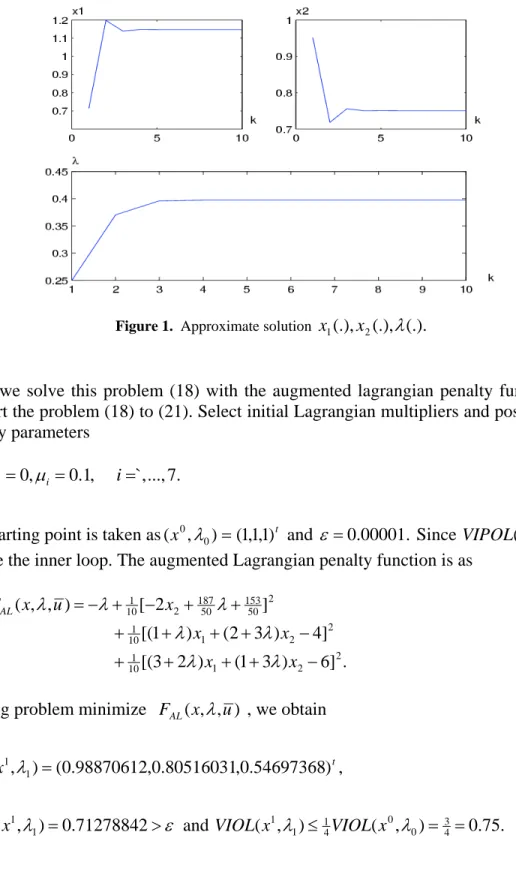
The progress of the algorithm of the method of feasible directions of Topkis and Veinott of Example 1 is depicted in Figure 1.
Figure 1. Approximate solution x1(.),x2(.),(.).
Now, we solve this problem (18) with the augmented lagrangian penalty function method. We convert the problem (18) to (21). Select initial Lagrangian multipliers and positive values for the penalty parameters
0, 0.1, `,..., 7.
i i
u i
The starting point is taken as(x , 0) (1,1,1)t
0
and 0.00001. Since ( , 0) 3 ,
0
x
VIPOL we
choose the inner loop. The augmented Lagrangian penalty function is as
2 50 153 50 187 2 10 1[ 2 ] ) , , (x u x FAL 101[(1)x1(23)x24]2 10[(3 2 ) 1 (1 3 ) 2 6]2. 1 x x
Solving problem minimize FAL(x,,u) , we obtain
t x , ) (0.98870612,0.80516031,0.54697368) ( 1 1 , )0.71278842 , (x1 1 VIOL and ( , ) ( , ) 43 0.75. 0 0 4 1 1 1 x VIOL x VIOL
Hence, we go to outer loop step. The new Lagrangian multipliers are as ). 0 , 0 , 0 , 0 , 03481512 . 0 , 09220549 . 0 , 14255768 . 0 ( new u
Set k = 1, and we go to the inner loop step. The process is then repeated. Then, we
. 0000027 . 0 ) , ( ) 39751025 . 0 , 75071332 . 0 , 14727415 . 1 ( ) , ( 00012 . 0 ) , ( ) 39753954 . 0 , 75073450 . 0 , 14724203 . 1 ( ) , ( 00042 . 0 ) , ( ) 39747561 . 0 , 75091608 . 0 , 14719466 . 1 ( ) , ( 006 . 0 ) , ( ) 39866258 . 0 , 75082359 . 0 , 14625379 . 1 ( ) , ( 05335 . 0 ) , ( ) 39605607 . 0 , 77621059 . 0 , 13080371 . 1 ( ) , ( 6 6 6 6 5 5 5 5 4 4 4 4 3 3 3 3 2 2 2 2 x VIOL x x VIOL x x VIOL x x VIOL x x VIOL x t t t t t
The optimal solution for the main problem (18) is the point , ) 75071332 . 0 , 14757415 . 1 ( ) , (x1* x*2 t
which has the best membership grad * = 0.39751025.
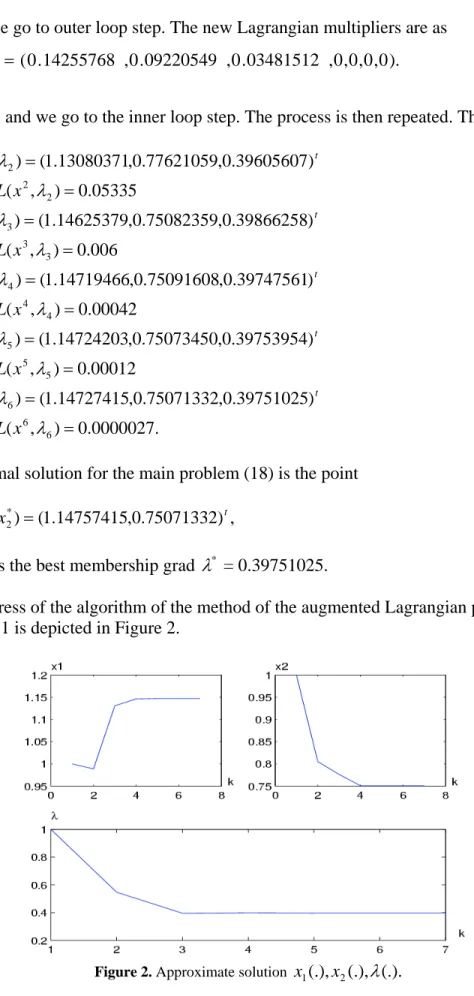
The progress of the algorithm of the method of the augmented Lagrangian penalty function of Example 1 is depicted in Figure 2.
Let us solve problem (19) by using the fuzzy decisive set method.
For = 1, the problem can be written as
, 0 6 4 5 4 5 2 8 . 6 3 2 2 1 2 1 2 1 2 1 x x x x x x x x
and since the feasible set is empty, by taking L 0 and R 1, the new value of 21 2 1 0 is tried.
For 21 0.5,the problem can be written as
, 0 6 4 4 9294 . 4 3 2 2 1 2 2 5 1 2 2 7 1 2 3 2 1 x x x x x x x x
and since the feasible set is empty, by taking L 0 and R 12,
the new value of 41
2 0 21 is tried.
For 140.25,the problem can be written as
, 0 6 4 9941 . 3 3 2 2 1 2 4 7 1 2 7 2 4 11 1 4 5 2 1 x x x x x x x x
and since the feasible set is nonempty, by taking L 41
and R 21,
the new value of
3 3 2 2 / 1 4 / 1 is tried.
, 0 6 4 4618 . 4 3 2 2 1 2 8 17 1 4 15 2 8 25 1 8 11 2 1 x x x x x x x x
and since the feasible set is nonempty, by taking L 41
and R 21,
the new value of
3 3 2 2 / 1 4 / 1 is tried.
For 83 0.375,the problem can be written as
, 0 6 4 4618 . 4 3 2 2 1 2 8 17 1 4 15 2 8 25 1 8 11 2 1 x x x x x x x x
and since the feasible set is nonempty, by taking L 83 and
,
2 1
R
the new value of
16 7 2 2 / 1 8 / 3 is tried.
For 167 0.4375,the problem can be written as
, 0 6 4 6956 . 4 3 2 2 1 2 16 37 1 8 31 2 16 53 1 16 23 2 1 x x x x x x x x
and since the feasible set is empty, by taking L 83
and R 167 ,
the new value of
32 13 2 16 / 7 8 / 3 is tried.
. 8561 3975558244 . 0 125 3975830078 . 0 25 3977050781 . 0 5 3979492187 . 0 3974609375 . 0 396484375 . 0 39453125 . 0 3984375 . 0 390625 . 0
Consequently, we obtain the optimal value of at the thirty second iteration by using the fuzzy decisive set method.
Note that, the optimal value of found at the seven iteration of the method of feasible direction of Topkis and Veinott and at the sixth iteration of the augmented Lagrangian penalty function method is approximately equal to the optimal value of calculated at the twenty first iteration of the fuzzy decisive set method.
Example 6. 2. Solve the optimization problem
Maximize x1x2
Subject to ~1x12~x2 ~3 (22) ~2x1~3x2 ~4
x1,x2 0, which take fuzzy parameters as: ), 1 , 1 ( 1 ~ L ~2L(2,1), 2~L(2,2), 3~L(3,2), b1 ~3L(3,2), 4 (4,3), ~ 21 L b
as used by Shaocheng (1994). That is,
2 1 ) (aij 3 2 , 2 1 ) (dij 2 1 , 4 2 ) (aij dij 5 3 4 3 ) (bi , 3 2 ) (pi , 7 5 ) (bi pi .
To solve this problem, we must solve the following two subproblems l z Maximize x1x2 Subject to 2x13x2 3 4x15x2 4 x1,x2 0 and u z Maximize x1x2 Subject to x12x2 5 2x13x2 7 x1,x2 0.
Optimal solutions of these subproblems are as follows:
1 0 1 2 1 l z x x and 1 2 3.5 0 3.5, u x x z
respectively. By using these optimal values, problem (22) can be reduced to the following equivalent non-linear programming problem:
Maximize Subject to x1x22.51 (1)x1(2)x2 23 (22)x1(32)x2 34 (23) 01 x1,x2 0.
Let’s solve problem (23) by using the modification method of feasible directions of Topkis and Veinott.
Initialization Step:
The problem the phase 1 is as follows: Minimize xa1xa2xa3
Subject to xa1x22.5s1xa1 1
(1)x1(2)x22s2 xa2 3 (24) (22)x1(32)x23s3 xa3 4
x1,x2,s1,s2,s3,xa2,xa3 0,
where xa1,xa2,xa3are artificial variables, s1,s2,s3 are slack variables and is fixed scaler. Set 1
. Then, xa13.25 and since xa1 0 so the feasible set is empty, the new value of 21 is
tried. Then we have
. 0 125 . 0 0 325 . 0 25 . 0 0 1411667 . 1 5 . 0 3 2 1 1 1 a a a a a x x x x x
Hence, we are start from the point ( , 0) (1.41376683,0.002421,0.125).
0
x
We first formulate the problem (19) in the form Minimize Subject to g1(x1,x2,)x1x2 2.510 g2(x1,x2,)(1)x1(2)x2 230 g3(x1,x2,)(22)x1(32)x2 340 g4(x1,x2,)x10 (25) g5(x1,x2,)x2 0 g6(x1,x2,)0 g7(x1,x2,)10.
The direction finding problem for each the arbitrary constant point (x1,x2,) is as follows:
Minimize z Subject to d3 z0 d1d22.5d3 zg1(x1,x2,) (1)d1(2)d2(x1x2)d3 zg2(x1,x2,) (22)d1(32)d2 (2x12x2)d3 zg3(x1,x2,) d1zx1 d2 zx2 d3z1 1d1,d2,d3 1.
Iteration 1
Search Direction: For the initial point (x0,0) (1.41376683 ,0.002421,0.125)t the direction finding problem is as follows:
Minimize z Subject to d3z0 d1d2 2.5d3z0.10368784 1.125d12.125d2 3.4162d3 z1.15436768 2.25d13.25d2 5.8324d3 z0.436156 d1z1.41377 d2 z0.0024 d3z0.125 d3z0.875 1dj 1, j 1,2,3. The optimal solution to the above problem is
t
z
d , ) (0.00455939 ,0.040353486 ,0.042774491 , 0.042774491 )
( 1 1 .
Line Search: The maximum value of lsuch that x0 ld0 is feasible is given by .
09670256 .
1
max
l Hence l1 1.09670256. We then have
. ) 17191087 . 0 , 04667676 . 0 , 41998447 . 1 ( ) , ( ) , (x1 1 x0 0 l1d0 t
The process is then repeated. Then, we have:
. ) 18321594 . 0 , 00000000 . 0 , 45803988 . 1 ( ) , ( ) 18321584 . 0 , 00000049 . 0 , 45803949 . 1 ( ) , ( ) 18321584 . 0 , 00000000 . 0 , 45803936 . 1 ( ) , ( ) 18321046 . 0 , 00002256 . 0 , 45802153 . 1 ( ) , ( ) 18318790 . 0 , 00000000 . 0 , 45801560 . 1 ( ) , ( ) 18296452 . 0 , 00103274 . 0 , 45719935 . 1 ( ) , ( ) 18193177 . 0 , 00000018 . 0 , 45693175 . 1 ( ) , ( 8 8 7 7 6 6 5 5 4 4 3 3 2 2 t t t t t t t x x x x x x x
The optimal solution for the main problem (18) is t
x
x , ) (1.45803988, 0.00000000)
which has the best membership grad * = 0.18321594.
The progress of the algorithm of the method of feasible directions of Topkis and Veinott of Example 2 is depicted in Figure 3.
Figure3. Approximate solution x1(.),x2(.),(.).
Now, we solve the problem (22) with the augmented Lagrangian penalty function method. We convert the problem (22) to (25). Select initial Lagrangian multipliers and positive values for the penalty parameters 0 i u , i 0.1 , i 1,..., 7.
The starting point is taken as (x0,0)(1,1,1)t and 0.00001.Since VIOL(x0,0)3 we going to inner loop. The augmented Lagrangian penalty function is as:
2 2 1 10 1 [ 2.5 1] ) , , (x u x x FAL [(1)x1(2)x2 23]2 1 2 1 2 10[(2 2 ) x (3 2 ) x 3 4] ,
with solving problem minimizeFAL(x,,u) we obtain t
x , ) (0.88778718 ,0.10414525 ,0.50264920 )
( 1 1 ,
and VIOL(x1,1)1.26469058 and also ( , ) ( , ) 48 2.
0 0 4 1 1 1 x VIOL x VIOL
Hence, we go to outer loop step. The new Lagrangian multipliers are as ). 0 , 0 , 0 , 0 , 11862916 . 0 , 0 , 25293811 . 0 ( new u
Set k = 1, and we go to the inner loop step. The process is then repeated. Then, we have:
( , ) 0. ) 18321458 . 0 , 00000034 . 0 , 45803637 . 1 ( ) . ( 0000244 . 0 ) , ( ) 18322008 . 0 , 00000024 . 0 , 45802558 . 1 ( ) , ( 0000388 . 0 ) , ( ) 18318092 . 0 , 00000151 . 0 , 45814601 . 1 ( ) , ( 00273355 . 0 ) , ( ) 18342549 . 0 , 00014049 . 0 , 4887092 . 1 ( ) , ( 00068072 . 0 ) , ( ) 18271767 . 0 , 00027062 . 0 , 45584285 . 1 ( ) , ( 06162557 . 0 ) , ( ) 19523932 . 0 , 00012926 . 0 , 42634348 . 1 ( ) , ( 00436 . 0 ) , ( ) 10791938 . 0 , 00435813 . 0 , 59043285 . 1 ( ) , ( 9 9 9 9 8 8 8 8 7 7 7 7 6 6 6 6 5 5 5 5 4 4 4 4 3 3 3 3 x VIOL x x VIOL x x VIOL x x VIOL x x VIOL x x VIOL x x VIOL x t t t t t t t
The optimal solution for the main problem (22) is t x x , ) (1.45803637,0.00000034) ( 2* * 1 ,
which has the best membership grad * = 0.18321458.
The progress of the algorithm of the method of the augmented Lagrangian penalty function of Example 2 is depicted in Figure 4.
Let us solve the problem (23) by using the fuzzy decisive set method.
For 1, the problem can be written as
, 0 1 5 4 1 3 2 5 . 3 2 1 2 1 2 1 2 1 x x x x x x x x
and since the feasible set is empty, by taking L 0 and R 1,the new value of 21 2 1 0 is tried.
For 21 0.5, the problem can be written as
, 0 4 3 2 25 . 1 2 1 2 5 2 1 2 2 5 1 2 6 2 1 x x x x x x x x
and since the feasible set is empty, by taking L 0 and R 21,
the new value of 41
2 2 / 1 0
is tried. For 41 0.25, the problem can be written as , 0 625 . 1 2 1 4 13 2 2 7 1 2 5 2 5 2 4 9 1 4 5 2 1 x x x x x x x x
and since the feasible set is empty, by taking L 0 and R 14,
the new value of 81
2 4 / 1 0
is tried. For81 0.125, the problem can be written as , 0 3125 . 1 2 1 8 29 2 4 13 1 5 9 8 22 2 8 17 1 8 9 2 1 x x x x x x x x
and since the feasible set is nonempty, by taking L 81
and R 41,
the new value of
16 3 2 4 / 1 8 / 1 is tried.
The following values of are obtained in the next twenty one iterations: . 183215915 . 0 183105468 . 0 182617187 . 0 181640625 . 0 18359375 . 0 1796875 . 0 171875 . 0 15625 . 0 1875 . 0
Consequently, we obtain the optimal value of at the twenty fifth iteration of the fuzzy decisive set method. Note that, the optimal value of found at the second iteration of the method of feasible direction of Topkis and Veinott and at the sixth iteration of the augmented Lagragian
penalty function method is approximately equal to the optimal value of calculated at the
twenty fifth iteration of the fuzzy decisive set method.
7. Conclusions
This paper presents a method for solving fuzzy linear programming problems in which both the right-hand side and the technological coefficients are fuzzy numbers. After the defuzzification using method of Bellman and Zadeh, the crisp problems are non-linear and even non-convex in general. We use here the "modified subgradient method" and "method of feasible directions” for solving these problems. We also compare the new proposed methods with well known "fuzzy decisive set method". Numerical results show the applicability and accuracy of this method. This method can be applied for solving any fuzzy linear programming problems with fuzzy coefficients in constraints and fuzzy right hand side values.
REFERENCES
Bazaraa, M. S., Sherali, H. D. and Shetty, C. M. (1993). Non-linear programming theory and algo-rithms, John Wiley and Sons, New York, 360-430.
Bellman, R. E. and Zadeh, L. A. (1970). Decision-making in a fuzzy environment, Management Science 17, B141-B164.
Canz, T. (1999). Fuzzy linear programming for DSS in energy planning, Int. J. of global energy issues 12, 138-151.
Dubois, D and Prade, H. (1982). System of linear fuzzy constraints, Fuzzy set and systems 13, 1-10.
Elamvazuthi, I., Ganesan, T. Vasant, P. and Webb, F. J. (2009). Application of a fuzzy programming technique to production planning in the textile industry, Int. J. of computer science and information security 6, 238-243.
Guu, Sy-Ming and Yan-K, Wu (1999). Two-phase approach for solving the fuzzy the fuzzy linear programming problems, Fuzzy set and systems 107, 191-195.
Negoita, C. V. (1970). Fuzziness in management, OPSA/TIMS, Miami.
Sakawa, M and Yana, H. (1985). Interactive decision making for multi-objective linear fractional programming problem with fuzzy parameters, Cybernetics Systems 16 , 377-397.
Shaocheng, T. (1994). Interval number and fuzzy number linear programming, Fuzzy sets and systems 66, 301-306.
Tanaka, H and Asai, K. (1984). Fuzzy linear programming problems with fuzzy numbers, Fuzzy sets and systems 13, 110.
Tanaka, H, Okuda, T. and Asai, K. (1984). On fuzzy mathematical programming, J. Cybernetics 3, 291-298.
Tan, Raymond R. (2005). Application of symmetric fuzzy linear programming in life cycle assessment, Environmental modeling & software 20, 1343-1346.
Zimmermann, H. J. (1983). Fuzzy mathematical programming, Comput. Ops. Res. Vol. 10 No. 4, 291-298.
APPENDIX
The Algorithm of the Fuzzy Decisive Set Method
This method is based on the idea that, for a fixed value of , the problem (9) is linear
programming problems. Obtaining the optimal solution *to the problem (9) is equivalent to determining the maximum value of so that the feasible set is nonempty. The algorithm of this method for the problem (9) is presented below.
Algorithm
Step 1. Set 1 and test whether a feasible set satisfying the constraints of the problem (9) exists or not, using phase one of the Simplex method. If a feasible set exists, set 1, otherwise, set L 0 and R 1and o to the next step.
Step 2. For the value of ,
2 R L
update the value of Land R using the bisection method as follows:
L
, if feasible set is nonempty for ,
R
Consequently, for each, test whether a feasible set of the problem (9) exists or not using phase
one of the Simplex method and determine the maximum value *
satisfying the constraints of the problem (9).