Balance of Power: Energy Management for Server Clusters
JereyS. ChaseDepartment of Computer Science
Duke University
Ronald P.Doyle
Application Integration and Middleware
IBM Research Triangle Park
Abstract
One unintended eect of the growth of the Internet is increased energy usage by servers and the infras-tructure supporting them. This paper promotes a research agenda to improve the energy eciency of Internet server sites. This goal is timely as the costs of energy usage and our vulnerability to energy sup-ply disruptions become increasingly evident. In particular, we propose energy-conscious server switching as one approach to improving eciency of server clusters at low request loads. Our pro-posal builds on the commercial acceptance of load-balancing server switches and recent industry ini-tiatives to reduce power drain of computer systems running below their peak loads. The potential sav-ings from this technique are compelling given that Internet service loads uctuate by up to an order of magnitude at all time scales.
1 Introduction
Internet data centers are often cited as a major source of increases in energy consumption, particu-larly in the US. Scientists at Lawrence Berkeley Na-tional Laboratory recently estimated that Web sites and other servers consumed over 7 terawatt-hours (TWh) of electricity in the US in 1999, more than the Internet switching infrastructure itself. Repre-sentatives of the oil, coal, and nuclear industries cite much higher estimates: George W. Bush recently stated that \the Internet accounts for 8% of US elec-tricity consumption". Although the actual gure is not yet known, it is clear that Internet services are
R. Doyle is also a student in the Computer Science
de-partment at Duke University.
signicant energy consumers in the US and globally. Moreover, the Internet service infrastructure contin-ues to grow rapidly, adding to strains on the global power grid. For example, Internet industry ana-lysts project that at least 50 million square feet of data center capacity will come on line for third-party hosting services in the US by 2005. These facili-ties have typical power densifacili-ties of 100 watts per square foot for servers, storage, switches, and cool-ing. Thus these new centers alone could add 5 GW of power demand, about 10% of the current gener-ating capacity for California. New data centers in the Seattle area are forecast to increase the city's power demands by 25% [3].
In this paper we promote a research agenda directed at improving the energy-eciency of Internet server clusters. There are several reasons why the time is right to take on this challenge. First, energy repre-sents a signicant element of the Total Cost of Own-ership for servers. The new data center capacity projected for 2005 would require approximately 40 TWh ($4B at $100 per MWh) per year to run 24x7 unless they become more ecient. Second, data centers require a signicant capital investment in equipment for cooling and backup power generation, and this cost scales with power demand. Third, ex-cessive power demand leaves Internet services un-necessarily vulnerable to energy supply disruptions. For example, wholesale electricity recently spiked to $800 per MWh on the California spot market. Finally, electricity production harms the environ-ment, and power pricing in most countries does not yet factor in environmental costs. For exam-ple, emissions of CO
2 from US coal-burning power
plants alone are equivalent to the total CO 2
out-put of Western Europe [1]. The CO
2
concentra-tion of the atmosphere has increased by 30% since the industrial revolution, an alarming gure given the current scientic consensus that higher levels of
CO
2and other gases are responsible for global
tem-perature increases over the last century, and present a signicant risk of further global warming over the next century [2]. Under the 1997 Kyoto accords, in-dustrialized nations must reduceCO
2 emissions by
5% below 1990 levels over the next decade, and yet generating electricity for the new US data centers would release about 25M tons of additional CO
2
each year by 2005.1 Thus reducing energy demand
for Internet servers is not only good business sense, it is a matter of professional and social responsibil-ity.
Our proposal adds a new dimension to power-aware resource management [7], which views power as a rst-class resource to be managed by the operating system. That work and other OS research on power management focus primarily on power-constrained systems for mobile computing. This paper applies related energy management goals to servers and clusters, in order to reduce the energy consumed for a given request load. We emphasize energy manage-ment in the network operating system, to comple-ment and leverage recent industry initiatives on ad-vanced power management for server hardware and server operating systems. Section 2 sets the context for our proposal and outlines principles for energy management in servers and clusters. Section 3 pro-poses energy-conscious server switching for server clusters, in which network switching elements direct incoming requests in a way that reduces aggregate energy consumption when the cluster is running be-low capacity. Section 4 outlines future research is-sues for energy management in server clusters. Sec-tion 5 concludes.
2 Server Energy Consumption
Our goal is to reduce the energy consumption needed to deliver a service at a given level of request throughput. In other words, we minimize an energy-per-unit-of-service metric, which we call joules per operation(JOPs). A joule is a basic unit of energy, which is power (e.g., watts) consumed over some pe-riod of time. Broadly speaking, there are four ways to improve JOPs. These are easily understood by
1The 25M ton gure assumes (1) a 40TWh annual energy
load, (2) 60% of electricity is generated from coal as in the US today, and (3) coal burning produces 1.8 lbs ofCO2 per
KWh produced.
considering a familiar analogy: reducing the energy consumed to warm the occupants of a building.
1.
Turn down the thermostat.
Previous work has explored quality-of-service tradeos for en-ergy [4], e.g., reducing the cost of displaying an image by scaling down its resolution. This approach is useful for battery-powered systems where energy is severely constrained, but it does not meet our goal of improving energy ef-ciency. Demand for Internet services | and the resource-intensity of those services | con-tinues to expand because these services oer value that improves lives and helps people to be more eective. We focus on providing these services more eciently rather than lowering their quality or using them less.2.
Generate more heat with less energy.
We can reduce the energy cost to heat a building by installing a high-eciency furnace. Simi-larly, hardware advances continue to improve the \heat" | computational power | delivered per unit of energy, although at a rate slower than Moore's Law. This suggests a cycles per joule(CPJs) metric for hardware eciency, here using \cycle" loosely and generically to cover storage and transmission resources as well as processing. Our proposal is complementary to ongoing improvements in CPJ.3.
Improve the software.
Adding insulation improves heating eciency by wasting less of the generated heat. Similarly, streamlining ser-vice software reduces the \heat" needed to de-liver the service, thereby reducing its energy consumption. This suggests a cycles per opera-tion(COPs) metric, emphasizing that software energy-eciency can be viewed as a basic per-formance measure. While software eciency is an important factor, it does not oer interest-ing new research problems.4.
Turn down the heat in empty rooms.
This paper focuses on a fourth approach: reduce the energy cost of maintaining surplus capac-ity. Like buildings, servers and clusters are sized for peak load and are \empty" much of the time. Many advances in energy-conscious systems are directed at reducing the capacity cost of idle components by transitioning them to a low-power state, e.g., disk spindown [5] and power-aware page allocation [6]. New technolo-gies such as RDRAM and Intel's QuickStart and SpeedStep processors help by oering apower
latency utilization
request traffic load
power utilization
latency
optimize latency optimize energy
request traffic load
Figure 1: Trading o latency for energy in a server cluster. wider range of low-power states and reducing
the cost of the transitions.
To formalize this as a simple model, power demand for a service is given by the formula:
(OPSCOPs)=CPJ+ P i p s( i)
where componenti consumes powerp s(
i) in power
state s. We can save energy by using the service
less (reducing OPS), making the hardware more e-cient (increasing CPJ), making the service software more ecient (reducing COPs), or by consuming less power in idle components, reducing capacity cost. We consider the base capacity cost p
s( i) for
an active component as xed independent of load, with CPJ giving a \surcharge" to use that capacity. For example, DRAM in the active state consumes a xed amount of power for continuous refresh even if it is not active, and disks consume most of their energy just to rotate the spindle. This principle applies for complete servers as well: for example, the IBM xSeries 330 consumes a peak 210 watts of power at full utilization and 150 watts at 70% load, but it consumes 90-100 watts even while it is idle. One eect of this property is that these servers de-liver better JOPS ratings in their \sweet spot" at higher utilizations.
A fundamental principle of energy management is that energy consumption should be proportional to load. This is the ultimate goal of any approach that manipulates the power states of idle components to reduce capacity cost. In the Internet server context, request trac may vary by factors of 3-6 or more through any day or week. When the cluster runs at peak throughput there is no energy cost for idle capacity, and consumption is determined purely by
the hardware (CPJs) and service software (COPs). However, when the cluster serves a lower request load, it is more ecient to concentrate request traf-c at a subset of the servers while the remaining servers enter a low-power state, as described in Sec-tion 3. This saves the energy expended to main-tain surplus capacity on the near-idle servers; in the heating analogy this corresponds to herding the occupants into a smaller number of rooms to turn o the heat in the rest of the building. When the servers are needed again, they may be awakened from the network using the recent industry Wake-On-LAN standard, in which the server's network interface listens for a wake packet while in its low-power state.
This approach to energy-conscious server manage-ment trades o latency at lower request loads to save energy. The left-hand side of Figure 1 depicts the scenario common today: servers are managed to minimize latency. In this scenario all components remain in an active state even at low load, so power never drops below the minimum to maintain full ca-pacity. At low load, this capacity is underutilitized; basic queuing theory dictates that this yields lower latency. The right-hand side of Figure 1 depicts energy-conscious server management. We propose that a cluster maintain the minimum number of ac-tive servers needed to serve the oered request load at some xed utilization. At low load, most of the servers idle in a low-power state; this reduces energy usage, but latency is higher because the remaining active servers must handle all of the requests. To return to the heating analogy: all occupants stay warm at lower energy cost, but the rooms are more crowded.
request traffic active active active standby standby sleep sleep
Figure 2: Energy-conscious request switching. Similar tradeos between energy and latency are common in energy-conscious system design, leading some researchers to consider the product energy delayas the gure of merit. [7]
3 Energy-Conscious Server
Switch-ing
We now propose a simple scheme to allow power to scale with load in Internet server clusters. We consider the simple case of a symmetric cluster in which all servers are equally powerful and any server may handle any request. Figure 2 illustrates the ar-chitecture. At the center of the cluster is a server switchsimilar to load-balancing switch products on the market from major Ethernet switch vendors and from other companies, including IBM through its WebSphere product. Large Web sites uses these switches to distribute request trac across servers. We propose to extend the switch with an energy-conscious routing policy that leverages the power management features of the back-end servers. This section outlines the simplest such policy to illustrate the basic principles; the next section explores issues for generalizing this policy.
Servers typically run an operating system module that monitors local load conditions and reports load measures to the load-balancing switch. The switch maintains a list of active, ready servers called the ac-tive set, together with load status for these servers. To simplify the discussion, we assume that load is a combined measure reecting utilization of the CPU, memory, and disks. The switch uses the load sta-tus to direct incoming requests to the least loaded servers in the active set, so as to balance incoming request trac evenly.
We propose that the switch may also add and
re-request traffic load
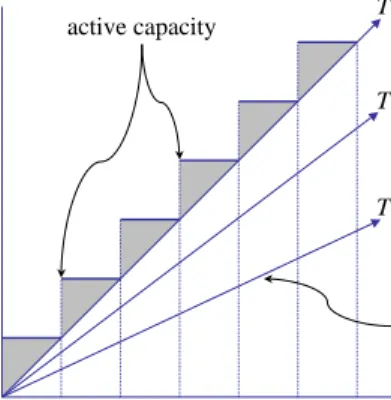
capacity active capacity utilized capacity T=1 T=.8 T=.5
Figure 3: Ramping up capacity with request trac. move nodes to or from the active set to hold the average load (utilization) of the active set close to a congured thresholdT. If the switch detects that
the average utilization has fallen belowTN=(N,1),
where N is the current size of the active set, then
it selects a victim serverV to deactivate and shifts V's request trac to the remaining members of the
active set, dropping V to a low-power state. As
described in Section 2, this reduces energy usage at lower request trac levels, but it also increases request latency because the surviving active servers run at higher utilization (bounded above byT) than
they would if all servers were active. If request traf-c intraf-creases again so that atraf-ctive set utilization ap-proachesT, then the switch selects an inactive node
to (re)activate and shifts some of the request trac to it.
In this way, the cluster automatically adjusts its ac-tive capacity | and its energy consumption | to adapt to variations in request trac. This is sim-ilar to dynamic resource recruitment for wide-area replication [8]. Figure 3 illustrates this behavior. The y-axis gives the active or utilized capacity as
a function of request trac, which increases along thex axis. The switch increases capacity as a step
function by adding servers to the active set as the incoming request rate increases through a sequence of threshold levels, represented by the vertical lines. The diagonal lines qualitatively depict the capac-ity consumed at each request level for dierent T
values: T gives the proportion of available
capac-ity that is utilized, which the switch holds constant across all threshold points. Note that it may be mis-leading to directly compare the slopes of the lines in this qualitative graph, which does not x the units on the x or y axis. In truth they are the same
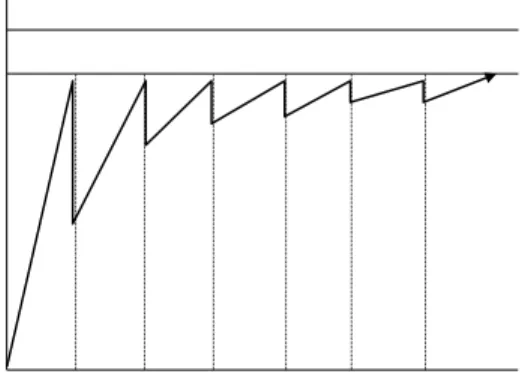
T 1.0
request traffic load
utilization
Figure 4: Utilization as request trac increases. proportionally, changing the values of the threshold points and thus the active capacity available at each request level. This is why each line has an apparent slope ofT.
Energy-conscious server switching allows only coarse-grained power management; for example, the cluster must activate entire servers even if only a fraction of its resources are needed to handle a load increase. The shaded portions of Figure 3 represent excess capacity beyond what is needed to bound utilization to T. Finer-grained power management
such as Intel SpeedStep could help to reduce ex-cess capacity. Note, however, that server-grained power management is sucient for large clusters: the shaded regions account for a shrinking portion of total capacity as the cluster grows. Large clusters are increasingly common as Web hosting companies seek economies of scale by serving large numbers of Web sites from a common hardware base.
Figure 4 shows this eect in a dierent way by de-picting the impact of power transitions on active server utilization. As utilization approaches the congured thresholdT, the cluster activates servers
to add capacity. When the active set is small, adding a server yields a signicant downward spike in utilization | and latency. For example, adding a server to an active set of one doubles the capac-ity of the cluster, cutting utilization in half. As the cluster grows, active set changes account for a pro-gressively smaller share of the cluster resources, and utilization converges to closely approximateT.
4 Research Issues
The proposed scheme for energy-conscious server switching raises several issues for future research:
Server Selection. Several policies are possible
for selecting servers to step up (activate) or step down (deactivate). For example, random spreads active time evenly across the servers, smoothing failure rates; less active servers are less likely to experience hardware failure. How-ever, a select by rank policy (\last hired rst red") may yield better performance because it deactivates the active server with the coldest cache, and reactivates the inactive server with the warmest cache.
Content Switching. Some server switches use
more sophisticated \layer 7" routing policies that consider the specic content requested (URL switching) or the source of the request (cookie switching). These constrain the choice of servers to deactivate, since each server han-dles a specic subset of the request stream. Energy-conscious switching places pressure on content-routing policies to adapt to changes in the active server set by redistributing the con-tent routing function.
Server Coordination. Inactive servers cannot
function as full-edged cluster members while in a low-power state. Energy-conscious switch-ing induces more frequent cluster membership changes, which may be problematic for clus-ter applications with strong synchronization or consistency requirements. In particular, servers must release exclusive resources (e.g., cached locks) before deactivating, and revali-date cached copies of cluster data during reac-tivation. A closely related issue is the question of stability of the active set in the presence of frequent changes in request load.
In addition, it is interesting to consider how the energy-conscious switching applies to other systems that scale by adding functionally identical compo-nents, such as decentralized storage systems.
5 Conclusion
This paper promotes a research agenda to improve energy-eciency in Internet server clusters. In par-ticular, we propose energy-conscious request switch-ing as one approach to reduce energy usage for clus-ters running below capacity, which is common given that Internet service loads uctuate by up to an or-der of magnitude at all time scales.
In our proposal, energy-conscious server switches monitor cluster load and concentrate request trac
on the minimal set of servers that can serve the in-coming trac at a specied utilization and latency. This induces the remaining idle servers to step down to a low-power state. The potential savings from this technique are compelling given the costs of en-ergy usage and the growth in Internet service capac-ity. Our approach imposes higher service latency at low loads, but allows a site administrator to control tradeos of energy and performance by conguring a bound for utilization and latency.
Other energy management techniques, such as server power management, are complementary to our approach and are important elements of an end-to-end approach to energy conservation for servers.
References
[1] US EPA global warming inventories.
http://www.epa.gov/globalwarming/emissions/.
[2] Hotting up in the Hague. Economist, November
2000.
[3] Robert Bryce. Power struggle.
In-teractive Week, December 2000.
http://www.zdnet.com/intweek/, found under
stories/news/0,4164,2666038,00.html.
[4] Surendar Chandra and Carla Schlatter Ellis. JPEG Compression Metric as a Quality Aware Image Tran
scoding. In2nd Symposium on Internet Technologies
and Systems, Boulder, CO, October 1999. USENIX. [5] Fred Douglis, P. Krishnan, and Brian Bershad. Adaptive disk spin-down policies for mobile
com-puters. In2nd USENIX Symposium on Mobile and
Location-Independent Computing, April 1995. Mon-terey CA.
[6] A. R. Lebeck, X. Fan, H. Zengh, and C. S.
El-lis. Power aware page allocation. InProceedings of
the Ninth International Conference on Architectural Support for Programming Languages and Operating Systems (ASPLOS IX), 2000.
[7] A. Vahdat, A. R. Lebeck, and C. S. Ellis. Every joule is precious: The case for revisiting operating system
design for energy eciency. In Proceedings of the
9th ACM SIGOPS European Workshop, September 2000.
[8] Amin Vahdat, Thomas Anderson, Michael Dahlin, Eshwar Belani, David Culler, Paul Eastham, and Chad Yoshikawa. WebOS: Operating System
Ser-vices for Wide-Area Applications. InProceedings of
the Seventh IEEE Symposium on High Performance Distributed Systems, Chicago, Illinois, July 1998.