ISSN Online: 1945-3124 ISSN Print: 1945-3116
DOI: 10.4236/jsea.2019.129023 Sep. 29, 2019 383 Journal of Software Engineering and Applications
Hand Gestures Recognition Based on
One-Channel Surface EMG Signal
Junyi Cao
1*, Zhongming Tian
2*, Zhengtao Wang
3*
#1Xi’an Jiao Tong University, Xi’an, China 2Chongqing University, Chongqing, China 3Sun Yat-sen University, Guangzhou, China
Abstract
This paper presents an experiment using OPENBCI to collect data of two hand gestures and decoding the signal to distinguish gestures. The signal was extracted with three electrodes on the subject’s forearm and transferred in one channel. After utilizing a Butterworth bandpass filter, we chose a novel way to detect gesture action segment. Instead of using moving average rithm, which is based on the calculation of energy, We developed an algo-rithm based on the Hilbert transform to find a dynamic threshold and identi-fied the action segment. Four features have been extracted from each activity section, generating feature vectors for classification. During the process of classification, we made a comparison between K-nearest-neighbors (KNN) and support vector machine (SVM), based on a relatively small amount of samples. Most common experiments are based on a large quantity of data to pursue a highly fitted model. But there are certain circumstances where we cannot obtain enough training data, so it makes the exploration of best me-thod to do classification under small sample data imperative. Though KNN is known for its simplicity and practicability, it is a relatively time-consuming method. On the other hand, SVM has a better performance in terms of time requirement and recognition accuracy, due to its application of different Risk Minimization Principle. Experimental results show an average recognition rate for the SVM algorithm that is 1.25% higher than for KNN while SVM is 2.031 s shorter than that KNN.
Keywords
Electromyography (EMG), Gesture Recognition, Hilbert Transform, K-Nearest-Neighbors (KNN), Support Vector Machine (SVM)
*Three authors (listed according to alphabetical order of last name) contributed to this work equally. How to cite this paper: Cao, J.Y., Tian,
Z.M. and Wang, Z.T. (2019) Hand Gestures Recognition Based on One-Channel Sur-face EMG Signal. Journal of Software En-gineering and Applications, 12, 383-392. https://doi.org/10.4236/jsea.2019.129023
Received: August 18, 2019 Accepted: September 26, 2019 Published: September 29, 2019
Copyright © 2019 by author(s) and Scientific Research Publishing Inc. This work is licensed under the Creative Commons Attribution-NonCommercial International License (CC BY-NC 4.0). http://creativecommons.org/licenses/by-nc/4.0/
DOI: 10.4236/jsea.2019.129023 384 Journal of Software Engineering and Applications
1. Introduction
Hand gestures are involved in many aspects of human life, including games, medical care, education and shopping. Hand gesture recognition refers to the process that a computer automatically detects and analyzes the measured bio-electrical signals in order to identify hand gestures of an individual. It enjoys great popularity worldwide and has been studied extensively. So far a new me-thod for hand gesture recognition with Electromyography (EMG) has been put forward considering its convenience and financial benefits.
EMG is the superposition of the action potentials of the muscle tissue occur-ring duoccur-ring a voluntary contraction, providing information on the flexion and extension of the muscles as well as the shape and position of the limbs during the completion of the movement [1]. The hand gesture recognition based on EMG has several advantages compared with optical detection. The design of the EMG sensor is relatively simple while the sensor is not sensitive to the environ-ment. In addition, the signal processing for EMG is not so complicated. Howev-er, the problem of using EMG to recognize hand gestures is the inaccuracy, so solving the problem is the motivation of the paper.
This paper focuses on the experiment where we plan to use EMG signals to recognize 2 hand gestures. And based on that, we are going to improve the ac-curacy of recognition by optimizing the algorithm. We plan to use the surface electromyography sensor (OpenBCI Ganglion) to capture muscle activity infor-mation on the skin surface of the corresponding muscle group. We are going to perform experiments to find the best placement of the electrodes and get the most reliable data. MATLAB is utilized for analyzing and processing the signals and for distinguishing the EMG generated by different gestures. The accuracy will be evaluated by performing additional tests.
Starting from the methods adopted during the whole process of the research including signal processing and classification, the rest of the paper explains the experiment in detail, analyzes and discusses the results and draws conclusions based on the findings. Several novel ideas are to be demonstrated in the follow-ing part as well.
2. Methodology
2.1. Data Acquisition
DOI: 10.4236/jsea.2019.129023 385 Journal of Software Engineering and Applications
parameter that needs to be controlled to get a high-quality raw data.
2.2. sEMG Signal Processing
The recognition of the gesture SEMG signals consists of three parts: data pre-processing, feature extraction and classification. For data pre-processing, a Butterworth filter and a segmentation algorithm are used for getting a cleaner data and for reducing the data amount. The feature extraction algorithm com-presses the sEMG signal segments into feature vectors. The features are designed so that they emphasize the gesture class specific characteristics of the sEMG sig-nal. The classifier is trained with the feature vectors to distinguish the different gestures from each other with high accuracy.
1) Data Pre-Processing a) Filtering
[image:3.595.211.538.391.483.2]We use Butterworth filter to process the original signal. Butterworth filter is a signal processing filter with flat frequency response curve in passband (shown in
Figure 2) [2]. In this experiment, the passband was chosen from 20 Hz to 90 Hz, with a 3 dB passband ripple and 40 dB stopband attenuation.
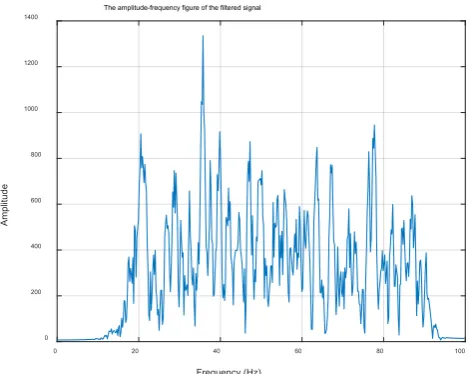
As we can see in the amplitude-frequency using FFT (see in Figure 3 and
Figure 4), the low frequency, which is of no relation to the EMG signal, has been filtered.
[image:3.595.280.470.535.707.2]Figure 1. The placement of the four channel-surface EMG electrodes is shown in the on the bottom. The gestures used for detection are shown on the top.
DOI: 10.4236/jsea.2019.129023 386 Journal of Software Engineering and Applications
Figure 3. The amplitude-frequency figure of the original signal.
Figure 4. The amplitude-frequency figure of the filtered signal.
b) Detection of Gesture Action Segment
In the beginning, we planned to use the sliding window method based on the calculation of energy in order to identify the start and the end of the segments.
We have:
( )
2di i
t t i t t
Q =
∫
−∆+∆ x t t (1) where ∆t is half of the window length, x t( )
refers to the amplitude of the EMG signal at time t, and Qi represents the energy value of signal at time ti. From themoment, if a series of Q k i ik
(
= , 1, 2,+ i+ )
is consistently larger than A (acer-tain threshold value), in that case, the ti moment is considered to be the start of
an action segment. Using the same method the end of the action can be recognized. However, we found that it was difficult to determine the value of the threshold energy for each action segmentsince the signals of different actions vary widely.
0 20 40 60 80 100
Frequency (Hz)
0 0.5
1 1.5
2 2.5
3 3.5
Amplitude
10 The amplitude-frequency figure of the original signal
0 20 40 60 80 100
Frequency (Hz)
0 200 400 600 800 1000 1200 1400
Amplitude
[image:4.595.254.490.305.492.2]DOI: 10.4236/jsea.2019.129023 387 Journal of Software Engineering and Applications
A specific threshold could not be found to recognize all pulses. Therefore, we utilize algorithms based on the toolbox function Hilbert in MATLAB to find a dynamic threshold in order to solve this problem.
The Hilbert transform is a specific linear operator that is given by the convo-lution with the function 1t
π (see in (2)). It is related to the actual data by a
90-degree phase shift.
( )( )
1 u( )
dH u t
t
τ
τ
τ
∞ −∞ =
π
∫
− (2) [3]The toolbox function hilbert in MATLAB computes the Hilbert transform for a real input sequence x and returns an analytical signal of the same length, y =
hilbert(x), where the real part of y is the original real data and the imaginary part is the actual Hilbert transform [4]. The magnitude of the analytical signal is the complex envelope of the original signal.
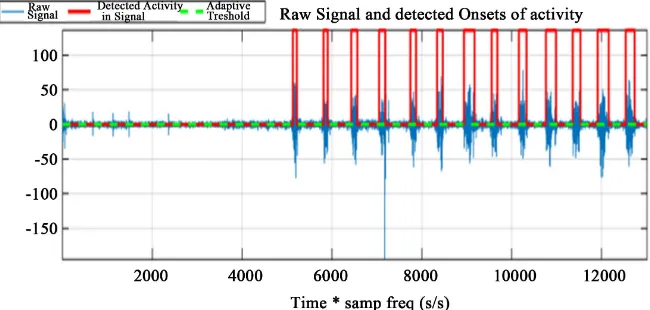
[image:5.595.213.534.360.501.2] [image:5.595.211.536.536.691.2]However, after figuring out the dynamic threshold and the beginning and end of the actions, we discovered that due to the instability of some signals, one ac-tion can be recognized as two because of some sudden attenuaac-tion of the signal (see in Figure 5). Therefore, we have made some improvements for the envelope extraction with an algorithm of “dilation” and “erosion” (see in Figure 6).
Figure 5. The mistake in recognition when detecting the action segment
DOI: 10.4236/jsea.2019.129023 388 Journal of Software Engineering and Applications
2) Feature Extraction
Feature extraction is carried out on the SEMG signals to preserve the signal patterns in order to distinguish different gestures. In our experiment, the Mean Absolute Values (MAV), the Root Mean Square (RMS), the variance and the Auto-Regressive (AR) model coefficients are used to the modeling of different SEMG signals and then input to the network for classification. A short descrip-tion of the calculadescrip-tion is given below.
Mean Absolute Value (MAV) is defined as:
1
1
MAV N n
n x
N =
=
∑
(3)where N denotes the length of the signal and xn represents the EMG signal in a
segment [5].
Variance: the general equation used to find variance by:
(
)
21 1
Var N n
n x x
N =
=
∑
− (4)where x is the mean value of the EMG signal, N denotes the length of the sig-nal and xn represents the EMG signal in a segment.
Root Mean Square (RMS) can be expressed as:
2 1 1
RMS N n
n x
N +
=
∑
(5)where N denotes the length of the signal and xn represents the EMG signal in a
segment.
Auto Regressive (AR) model coefficients: the AR model of a signal can be ex-pressed as:
( )
(
) ( )
1 p k kx n a x n k u n
=
= −
∑
− + (6)where ak refers to the coefficient of the kth order of the signal, p refers to the
order of the model, and u n
( )
is the white noise.In this experiment, we use the burg method to fit the AR model and get the coefficients of four orders as a feature of the signal.
3) Classification
DOI: 10.4236/jsea.2019.129023 389 Journal of Software Engineering and Applications
usually requires a large amount of computation, because we need to calculate the distance between every testing point and the rest to get its k nearest neighbors. For that reason a Support Vector Machine (SVM) was chosen, which provides high accuracy in calibration and classification. SVM is a discriminative classifier formally defined by a separating hyperplane. It is widely used in binary classifi-cation, since it benefits from structural risk minimization principle and avoid-ance of overfitting. When there are limited training data available, SVM usually outperforms the traditional parameter estimation methods. It effectively avoids outfitting problem, especially when there is only small amount of data samples
[7].
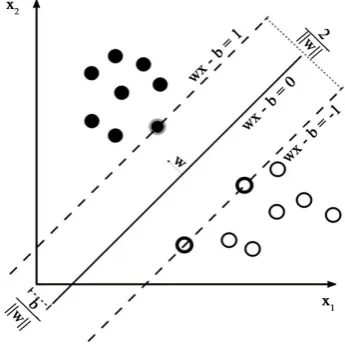
The objective of SVM algorithm is to find a decision boundary in an N-dimensional space that distinctly classifies that data points (Figure 7). Max-imizing the margin distance between two hyperplanes provides some reinforce-ment so that future data points can be classified with more confidence. So, the ultimate goal is to find a plane that has the maximum margin.
Suppose there are two gestures GTR1, GTR2 needed to be classified. We de-note the training set with samples as:
(
)
{
x gi, i}
,i=1, , n (7)where d i
x R∈ represents a feature vector of a gesture:
(
)
(
)
1, if belongs to GTR1 1 1, if belongs to GTR2 1
i i
i
i i
x wx b
g
x wx b
+ − ≥
=
− − ≤ −
(8)
A separating plane can be written as:
0
w x b⋅ − = (9)
Then the only problem is to find the maximum margin (find the minimum w), which can be solved by kernel function [8].
[image:7.595.210.538.582.637.2]The first hundred repetitions of each gesture were used as training samples to train the classifier and the rest of the gesture samples were used for testing. Rec-ognition results for the two subjects are given in Table 1 and Table 2. In the first column, the figures in parenthesis are the total numbers of test samples and fig-ures on their left are the numbers of correct recognitions. Accuracy is defined as
Table 1. Results of using SVM algorithm in classification.
SVM Test Accuracy Time
Gesture 1 40 (40) 100%
17.353 s
Gesture 2 40 (40) 100%
Table 2. Results of using KNN algorithm in classification.
KNN Test Accuracy Time
Gesture 1 39 (40) 97.5%
19.384 s
[image:7.595.209.541.671.727.2]DOI: 10.4236/jsea.2019.129023 390 Journal of Software Engineering and Applications
Figure 7. Illustration of SVM algorithm. Solid line is the hyperplane to distinguish two groups.
ACC p
p p
T
T F
= +
where was the number of correct recognitions, was the number of wrong recog-nitions. Time refers to the total time used to train the model.
Through the chart, we can see by using SVM the average recognition rate higher than using KNN algorithm. Also, the time consumed to train the model in SVM is short than KNN. Our result showed that, based on a relatively [5]
small data amount, SVM is the better choice for classification algorithm.
3. Experiment
1) Experiment Subject
One of our group members vonlunteers to be a subject in the experiment. He is 20-year-old healthy male, height of 188 cm and weight of 90 kg. He has no history of neuromuscular or joint disease and he is right-handed.
2) Experiment Device
OpenBCI is an open-source brain-computer interface platform. OpenBCI boards have 4 channels and can be used to measure and record electrical activity produced by the brain (EEG), muscles (EMG), and heart (EKG).
3) Task
The subject sat comfortably on a chair and was relaxed. Then, he executed 2 hand gestures and each gesture was repeated more than 60 times. Every gesture action lasted about 1 second with an interval of 1 to 2 seconds.
4. Conclusions
DOI: 10.4236/jsea.2019.129023 391 Journal of Software Engineering and Applications
features to generate feature vectors for classification. Then we classified the sig-nals with two different algorithms, KNN and SVM. The overall result of gesture recognition has achieved our expectations, reaching an accuracy of 97.5% for one gesture and 100% for another with a testing sample of 40 for each gesture. Meanwhile, we compare the two algorithms we have selected. From the result, it can be concluded that in such case SVN achieves a higher accuracy for recogni-tion than KNN, along with a shorter time.
However, our experiment still needs improving in some aspects. To begin with, since we did not have a deep understanding of the classification methods using KNN and SVM, we have not optimized the algorithm by adjusting the pa-rameters. It can be further improved in the future by optimizing the two algo-rithms.
In addition, we did not design the hardware. The whole device is not wearable and is inconvenient to move around, which is a limitation for people in need of help.
On all accounts, recognition of hand gesture based on SEMG signals is, though complicated and challenging, an efficient way to identify gestures and help people in need. Further study should be carried out including the optimiza-tion of the algorithm for classifying by adjusting the parameters and the devel-opment of hardware.
Acknowledgements
We would like to thank Professor Jan Van der Spiegel and our teaching assistant Susan Chen for their guidance with our sincere gratitude. Also, many thanks are expressed to Yubin Qin and his group for their kind help during the experiment.
Conflicts of Interest
The authors declare no conflicts of interest regarding the publication of this pa-per.
References
[1] Zhang, X.U. (2010) Body Gesture Recognition and Interaction Based on Surface Electromyogram. University of Science and Technology of China, Hefei.
[2] https://en.wikipedia.org/wiki/Butterworth_filter
[3] https://en.wikipedia.org/wiki/Hilbert_transform
[4] https://ww2.mathworks.cn/help/signal/ug/hilbert-transform.html?requestedDomai
n=cn
[5] Ahsan, M.R., Ibrahimy, M.I. and Khalifa, O.O. (2011) Electromygraphy (EMG) Signal Based Hand Gesture Recognition Using Artificial Neural Network (ANN). 2011 4th International Conference on Mechatronics (ICOM), Kuala Lumpur, 17-19 May 2011, 1-6. https://doi.org/10.1109/ICOM.2011.5937135
DOI: 10.4236/jsea.2019.129023 392 Journal of Software Engineering and Applications
https://doi.org/10.1016/j.bspc.2018.07.010
[7] Chen, X., Zhang, X., Zhao, Z., Yang, J. and Wang, K. (2007) Multiple Hand Gesture Recognition Based on Surface EMG Signal. 2007 1st International Conference on Bioinformatics and Biomedical Engineering, Wuhan, 6-8 July 2007, 506-509.
https://doi.org/10.1109/ICBBE.2007.133
[8] Wu, J., Pan, G., Zhang, D., Qi, G. and Li, S. (2009) Gesture Recognition with a 3-D Accelerometer. In: Zhang, D., Portmann, M., Tan, A.H. and Indulska, J., Eds., Ubi-quitous Intelligence and Computing. UIC 2009: Lecture Notes in Computer Science, Springer, Berlin, Heidelberg, 25-38.