A program for phase identification using diffractograms obtained
from TEM structure images
R. Galiciaa, R. Herreraa,∗, J. L. Riusb, C. Zorrillaa, and A. G´omeza
aDepartamento de Materia Condensada, Instituto de F´ısica, Universidad Nacional Aut´onoma de M´exico,
20-364, M´exico, 01000, D.F., M´exico.
∗e-mail:[email protected]
bDepartamento de Sistemas Complejos, Instituto de F´ısica, Universidad Nacional Aut´onoma de M´exico,
20-364, M´exico, 01000, D.F., M´exico.
Recibido el 16 de agosto de 2012; aceptado el 8 de noviembre de 2012
In this work a computer program for the indexing of diffractograms is presented. The diffractograms are obtained by means of a discrete Fourier transform from high resolution electron microscope images. The program requires the use of x-ray diffraction data files together with a fast Fourier transform program, for this purpose we used the Digital Micrograph software.
Keywords: Electron microscopy; X-ray diffraction; difractograms; indexing.
Se presenta un programa de c´omputo que ayuda a identificar los planos cristalogr´aficos (indexar difractogramas) que aparecen al aplicar la Transformada R´apida de Fourier (FFT) a una imagen digital de alta resoluci ´on obtenida con un microscopio electr ´onico de transmisi´on de alta resoluci´on. El programa requiere el uso de los archivos de Rayos X de uso com ´un y de un programa que obtenga la FFT, para este caso se utiliza el software de Digital Micrograph.
Descriptores: Microscopia electr´onica; rayos X; difractogramas; indexaci ´on.
PACS: 61.14.Dc; 61.68.+n
1.
Introduction
Diffraction is doubtless one of the most powerful techniques for the elucidation of condensed matter structure. While x-ray, neutron, and electron diffraction all provide basic in-formation on symmetry and atomic arrangements, electron diffraction is unique in its ability to identify nanometric crys-tal phases within a matrix or on a substrate. The atomic spac-ing information in a high resolution TEM image of a crystal can be extracted by taking the Fourier transform of the image. This yields a diffractogram of spots (points) in an arrange-ment similar to an electron diffraction pattern of the same specimen; however, the diffractogram can be obtained from regions of specimen on the order of a nanometer rather than the micrometer typical of conventional selected area electron diffraction.
To identify a small crystalline phase, the specimen is usu-ally tilted so that the electron beam is directed along a major zone axis in the crystal, thus yielding a symmetrical array of diffraction spots. The electron diffraction pattern provides the interplanar spacings of the (hkl) planes belonging to a given [uvw] zone. Indexing consists of assigning the specific (hkl) indices to the various spots. Measured distances from the diffractogram center (that corresponds to the transmitted beam in the diffraction pattern) to the (hkl) diffraction spots yield the dhkl-spacings for each spot in the electron diffrac-tion pattern or in the Fourier transform of the lattice image or structure image (the diffractogram). The set of d-spacings obtained in this way and the angles between pairs of spots al-low identification of the unknown phase by comparison with structures of known substances.
Once the structure of a phase is known, the major task is to index the spots in the diffraction pattern or diffractogram. A survey of related procedures for phase identification and diffraction spot indexing can be found in the Refs. 1 to 6.
This article presents a program for identifying phases using the diffractogram derived from high-resolution TEM structure images that show atomic columns. The program is based on the zone axis method of crystallography [6], and it compares the diffraction pattern data from the unknown sam-ple with that of known compounds and indexes the unknown spots when the best fit is obtained. This article describes the steps involved in the operation of the software and gives a practical example.
It is important to stress that we work with actual elec-tron micrographs and not with simulations obtained, for ex-ample, with JEMS or related programs. In the diffractogram the “spots” are identified; the rest of the spatial frequencies are not used.
2.
Program Description
A program for the analysis of a diffractogram, obtained from the high-resolution image by means of the Fast Fourier trans-form (FFT) algorithm, has been developed following a stan-dard architecture in which the Front End (Client), requests services from the Back-end (server).
The graphical user interface and the operational algo-rithm have been programmed under Delphi 6 (in the client), a platform providing a development environment integrated to the Windows environment. It is an object-oriented language that has considerable support for databases.
The services are requested from an SQL (Structured Query Language) Server 2005 Express data base, a prod-uct freely distributed, designed as a data base platform that is easy to use where one has stored procedures (SQL state-ments) that will be called by client procedures (Delphi).
For image analysis, it is necessary to know some of the parameters involved in image acquisition via DigitalMicro-graph: the electron wavelength, camera length, accelerating voltage, magnification of the image, etc. All the images were obtained with a JEOL FEG 2010 microscope equipped with image capture software.
The program can be obtained freely from the authors. Al-though at present the program uses the DigitalMicrograph software, it is possible to use other platforms such as Mat-lab for the purpose of calculating the Fourier transforms..
3.
User Screens
The program contains five screens. In the first one (Fig. 1), the user keys in the data provided by the DigitalMicrograph (DM) program in order to calculate the reference parameters such as the magnitudes of vectors defining the positions (with respect to the coordinate origin) of each of the spots in the
FIGURE1. First screen used for data identification and input.
FIGURE 2. Second screen used for the input of x-ray crystallo-graphic data for various materials.
diffractogram. The program requires at least two points and the angles between the points relative to the center spot.
The second screen (Fig. 2) introduces the lattice param-eter data taken from the X-ray crystallographic data tables relevant to the sample under consideration. These data are stored in a database for future use unless the user deletes them.
In the third screen (Fig. 3), the actual calculations are per-formed. The user selects the X-ray crystallographic database and gives a tolerance for the maximum error allowed between calculated angles and measured ones (this parameter is called
Delta in the program). This part is based upon the so-called
zone-axis method; it uses the standard formulas for interpla-nar angles and spacings as functions of Miller indices [6] for cubic, tetragonal, orthorhombic, and hexagonal crystals.
Delta is the difference between the measured angle on the
diffractogram and the angle as calculated by the program for a pair (hikili)1 and (hjkjlj)2 (taken as a possible solution).
While the program requires at least two points, a typical anal-ysis of a diffractogram will use three or more points.
The fourth (Fig. 4) and fifth screens assist the user in se-lecting the best solution, starting from the zone axis or using
FIGURE 3. Third screen where the actual calculations are per-formed.
FIGURE 4. Fourth screen where the possible solutions are dis-played.
the differences between the calculated and observed angles. The results can be stored in a (text, excel, etc.) file.
4.
Program Operation
The strategy followed to reach a plausible solution can be summarized as follows:
(a) Normally the user has an idea of what sorts of com-pounds are worth examining. In order to do this the user has to make sure that the relevant X-ray cards have been captured beforehand; otherwise he will have to capture the data using the second screen (Fig. 2). In case the user has no idea at all concerning the nature of his sample he will have to run the program over all the entries in the database, but of course this will not warrant that the “right” compound is there.
(b) From the x-ray crystallographic data table, two sets with seven Miller indices {h,k,l} are selected. Each set is selected so as to correspond to the closestdhkl spacing (in ˚A) to d1and d2, respectively.
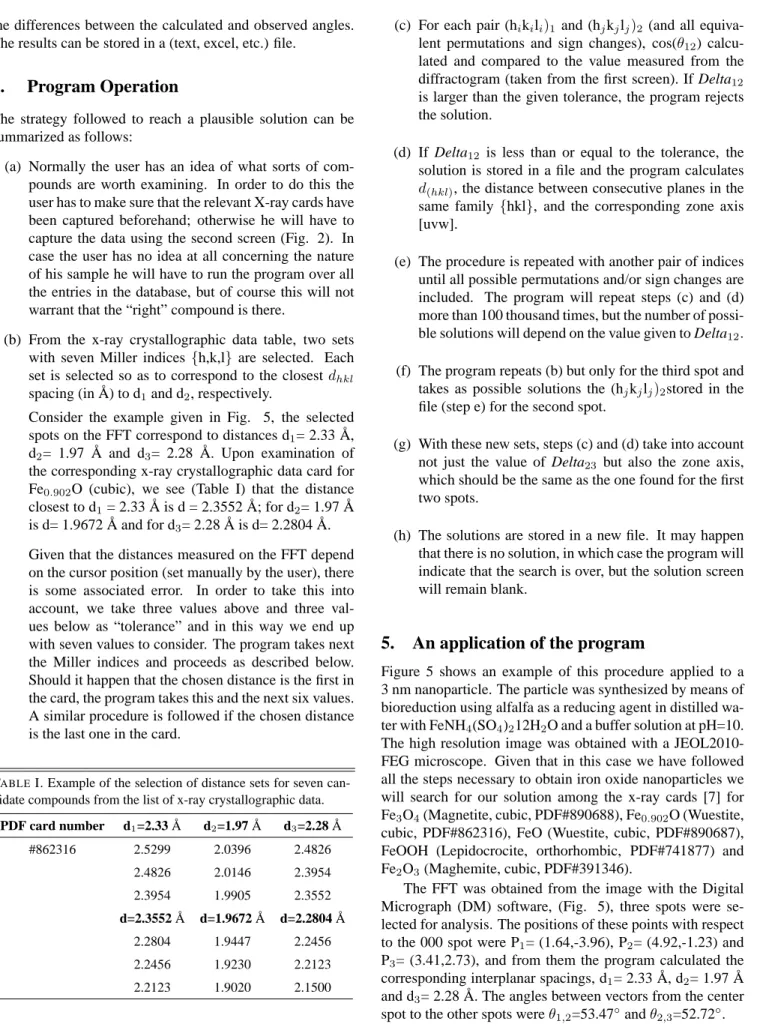
Consider the example given in Fig. 5, the selected spots on the FFT correspond to distances d1= 2.33 ˚A,
d2= 1.97 ˚A and d3= 2.28 ˚A. Upon examination of
the corresponding x-ray crystallographic data card for Fe0.902O (cubic), we see (Table I) that the distance
closest to d1= 2.33 ˚A is d = 2.3552 ˚A; for d2= 1.97 ˚A
is d= 1.9672 ˚A and for d3= 2.28 ˚A is d= 2.2804 ˚A.
Given that the distances measured on the FFT depend on the cursor position (set manually by the user), there is some associated error. In order to take this into account, we take three values above and three val-ues below as “tolerance” and in this way we end up with seven values to consider. The program takes next the Miller indices and proceeds as described below. Should it happen that the chosen distance is the first in the card, the program takes this and the next six values. A similar procedure is followed if the chosen distance is the last one in the card.
TABLEI. Example of the selection of distance sets for seven can-didate compounds from the list of x-ray crystallographic data.
PDF card number d1=2.33 ˚A d2=1.97 ˚A d3=2.28 ˚A #862316 2.5299 2.0396 2.4826 2.4826 2.0146 2.3954 2.3954 1.9905 2.3552 d=2.3552 ˚A d=1.9672 ˚A d=2.2804 ˚A 2.2804 1.9447 2.2456 2.2456 1.9230 2.2123 2.2123 1.9020 2.1500
(c) For each pair (hikili)1 and (hjkjlj)2(and all
equiva-lent permutations and sign changes), cos(θ12)
calcu-lated and compared to the value measured from the diffractogram (taken from the first screen). If Delta12
is larger than the given tolerance, the program rejects the solution.
(d) If Delta12 is less than or equal to the tolerance, the
solution is stored in a file and the program calculates d(hkl), the distance between consecutive planes in the
same family {hkl}, and the corresponding zone axis [uvw].
(e) The procedure is repeated with another pair of indices until all possible permutations and/or sign changes are included. The program will repeat steps (c) and (d) more than 100 thousand times, but the number of possi-ble solutions will depend on the value given to Delta12.
(f) The program repeats (b) but only for the third spot and takes as possible solutions the (hjkjlj)2stored in the
file (step e) for the second spot.
(g) With these new sets, steps (c) and (d) take into account not just the value of Delta23 but also the zone axis,
which should be the same as the one found for the first two spots.
(h) The solutions are stored in a new file. It may happen that there is no solution, in which case the program will indicate that the search is over, but the solution screen will remain blank.
5.
An application of the program
Figure 5 shows an example of this procedure applied to a 3 nm nanoparticle. The particle was synthesized by means of bioreduction using alfalfa as a reducing agent in distilled wa-ter with FeNH4(SO4)212H2O and a buffer solution at pH=10.
The high resolution image was obtained with a JEOL2010-FEG microscope. Given that in this case we have followed all the steps necessary to obtain iron oxide nanoparticles we will search for our solution among the x-ray cards [7] for Fe3O4(Magnetite, cubic, PDF#890688), Fe0.902O (Wuestite,
cubic, PDF#862316), FeO (Wuestite, cubic, PDF#890687), FeOOH (Lepidocrocite, orthorhombic, PDF#741877) and Fe2O3(Maghemite, cubic, PDF#391346).
The FFT was obtained from the image with the Digital Micrograph (DM) software, (Fig. 5), three spots were se-lected for analysis. The positions of these points with respect to the 000 spot were P1= (1.64,-3.96), P2= (4.92,-1.23) and
P3= (3.41,2.73), and from them the program calculated the
corresponding interplanar spacings, d1= 2.33 ˚A, d2= 1.97 ˚A
and d3= 2.28 ˚A. The angles between vectors from the center
FIGURE5. Example of a Fe2O3nanoparticle: (left) structure
im-age of 3 nm particle and (right) indexed diffractogram showing the points (spots) used for analysis.
After running the program using the x-ray crystallo-graphic data from the table for the five chosen candidate com-pounds, it was found that the best fit was with Delta1,2=1.07◦,
Angle1,2=52.4◦, Delta2,3=0.32◦, Angle2,3=52.4◦. For a Zone
Axis of [1,0,1], the indexing of the three planes was: Plane1= (-1,1,1), Plane2= (0,1,0) and Plane3= (1,1,-1), which
yielded interplanar spacings of d1=2.36 ˚A, d2=1.93 ˚A and
d3=2.36 ˚A. These values suggest that the unknown
nanopar-ticle is FeOOH with a orthorhombic structure as shown in Table II.
TABLEII. Summary of the best matches for each candidate struc-ture.
Planea−bCompound Deltaa−bSpacingaSpacingbZone Axis 1-2 Fe3O4 1.266 2.42 2.10 [1,1,0] 2-3 2.016 2.10 2.42 [1,1,0] 1-2 Fe0.902O 1.266 2.24 1.94 [1,1,0] 2-3 2.016 1.94 2.24 [1,1,0] 1-2 FeO 1.266 2.47 2.14 [1,1,0] 2-3 2.016 2.14 2.47 [1,1,0] 1-2 FeOOH 1.07 2.36 1.93 [1,0,1] 2-3 0.32 1.93 2.36 [1,0,1] 1-2 Fe2O3 1.266 2.41 2.08 [0,1,1] 2-3 2.016 2.08 2.41 [0,1,1]
Thus, in Table II we have presented the best solutions for the tested structures, and they are very similar. However, in this case for FeOOH we get the lowest Delta values and the best fitting with the measured distances.
6.
Discussion
The program requires the use of the DigitalMicrograph (DM) program and X-ray crystallographic data for various known substances. The DM package was used to analyze the images, to Fourier-transform them, and to obtain the coordinates of the various spots. Under DM it is possible to work at 64×64,
128×128 and 256×256 resolutions. This implies varying er-rors in the spot positions as a function of pixel size, so the program works within a given tolerance. The solutions are understood as best fits. Given the spot positions, the program searches for a fit to interplanar distances and angles between planes. Currently, it works for cubic, tetragonal, orthorhom-bic, and hexagonal structures.
By considering all the possibilities, for every pair of spots, the program can produce up to 100,000 solutions in general. This number is quickly reduced to a few dozen possibilities by ruling out those where the angles produce matches outside the user-given tolerance. The program pro-duces a list of possible solutions, and the final choice is left to the user.
Some of the virtues of the program are that it is friendly and easy to use, no special expertise is required, only mod-est memory resources are needed, the search takes only a few seconds, and the lattice parameter data captured can be stored in a data base for future use. Since it is based on a micro-graph, smaller regions of the sample (a few nanometers) can be studied than with selected area electron diffraction. Of course our approach is not meant to be a replacement for convergent beam electron diffraction (CBED), but it can be useful not only when CBED is unavailable but also when a set of high resolution micrographs is available and crystallo-graphic information of small areas is desired.
The main limitation of the program is that the user has to “guess” (from the chemical and physical conditions of sam-ple preparation) what are the likely structures and to include the corresponding X-ray data; it is impossible to include all the available cards.
The accuracy of the method is limited by the precision with which the magnification in the micrograph is known. In principle it would be desirable to have a “built in” standard together with the actual sample.
7.
Conclusions
Diffractograms obtained as Fourier Transforms from a dig-ital TEM image can be used to identify an unknown crys-tal in the image. This article describes a program devised to achieve this. The program has a graphical user interface that allows the user to control various windows, input boxes, and processes. Measured data can be compared with data from candidate compounds to arrive at the likely identity of the unknown crystal. Crystals of only a few nanometers in size can be analyzed by this method.
Acknowledgements
The authors acknowledge the financial support from DGAPA with grant PAPIIT IN105109-5 and Conacyt grant 82270.
1. Raymond P. Goehner and Prakash Rao, Metallography 10 (1977) 415-424.
2. C. Narayan, J. of Electron Microscopy Technique 3 (1986) 151-158.
3. P. A. Stadelmann, Ultramicroscopy 21 (1987) 131-146.
4. Harold R. Powell, Acta Cryst. D55 (1999) 1690-1695.
5. C. E. Lyman, M. J. Carr “Identification of Unknowns”, in
Elec-tron Diffraction Techniques, Vol. 2, J. M. Cowley (ed.),
Inter-national Union of Crystallography )Oxford University Press,
New York, 1993) pp. 373-417.
6. A.G. Jackson, Handbook of Crystallography for Electron
Mi-croscopists and Others (Spring-Verlag, 1991).
7. Powder Diffraction File (PDF) 2.4, (International Centre for Diffraction Data, 2003).