ANALYSIS OF SOLID WASTE MANAGEMENT PROCESS: THE CASE STUDY OF TEMEKE MUNICIPAL COUNCIL IN DAR ES SALAAM
CHINYAGA OCTAVIAN MILLINGA
A DISSERTATION SUBMITTED IN PARTIAL FULFILLMENT OF THE REQUIREMENTS FOR THE DEGREE OF MASTER OF BUSINESS
ADMINISTRATION IN TRANSPORT AND LOGISTIC OF THE OPEN UNIVERSITY OF TANZANIA
CERTIFICATION
The undersigned certifies that, he has read and hereby recommends for acceptance by the Open university of Tanzania a dissertation entitled: Analysis of Solid West Management Process: The Case study of Temeke Municipal in Dar es Salaam: in partial fulfillment of the requirements for the degree of Master of Business Administration of the Open University of Tanzania. ……….…… Dr. Salum Mohamed (Supervisor) ……….…… Date
COPYRIGHT
No part of this dissertation may be submitted or reproduced, stored in any retrieval system, or transmitted in any form by any means, electronic or mechanical photocopying, recording or otherwise without prior written permission of the author of The Open University of Tanzania in that behalf.
DECLARATION
I, Chinyaga Octavian Millinga, do hereby declare that this dissertation is my own original work, unless specifically indicated in the text. It has not been presented and will not be presented to any other University for a similar or any other degree award.
……….…… Signature
……….…… Date
DEDICATION
This dissertation is dedicated to my husband Henry Mosha for his calmness and patience plus effort which he put on me just to encourage all along the entire time of my studies at Open University of Tanzania, May God Bless him.
ACKNOWLEDGEMENTS
I am so much honored to thank Almighty God for keeping me healthy and taking me through my course successfully. My special thanks go to Dr. Salum, my supervisors, for being there always and providing many suggestions and comments at all stages of this work. I also wish to thank Temeke Municipality Department, M.P Environment and Community members for their assistance during data collection. I am also grateful to my mother Jesica Mapunda for their patience, love and prayers to me.
My hearty thanks to Mr Henry Mosha my Husband, Asnath and Jesica my children for their encouragement and moral support, my brothers Njopilay,Liginiku, Ramadhani. Ndongo and Nicholaus Njovu also my sisters Beatrice and Jacline and others for their patience, care, encouragement and support while I was going through this course.
Not forgetting my colleagues Mr Deo Seimu, Rosemary Mlagala, Elizabeth Nyari and others who I worked with tirelessly in times of trouble and joy. Finally, I thank all those who supported me directly or indirectly towards the struggle of attaining this academic level, Indeed, I claim exclusively that all the mistakes and errors in this work remain to be my responsibility.
ABSTRACT
This research was analyzing of Solid Waste Management Process in Temeke Municipal Council in Dar es salaam. A sample of 42 respondents was selected for the study. The study used accidental technique to collect the data from Community members from the streets. The study gathered data from primary and secondary sources where by primary data obtained from Community members from streets of Temeke Distric. The study used quantitative method to analyze the data collected, to carry out the research findings from the questioners were analyzed, tabulated, and then interpreted. The existing municipal solid waste management system in Dar es Salaam particularly in Temeke municipality, are not have good plan for collection and disposal of the solid waste product. There were no proper procedures for locations and vehicle routes. This leads to high consumption of municipal revenues. Data presented by the city council shows that about 30 to 54 percent of the solid waste were collected. It means there were a lot of wastes not collected. In order to improve solid waste management researcher recommends to engage more private contractors in order to manage collection and disposal of solid waste generated daily in Temeke , encouraging informal sector participation and the development of technological innovations for solid waste management. And awareness on solid waste collection and disposal should be supplemented by penalties to those who violet bylaws set by Municipal council.
TABLE OF CONTENTS CERTIFICATION ... ii COPYRIGHT ... iii DECLARATION... iv DEDICATION... v ACKNOWLEDGEMENTS ... vi ABSTRACT ... vii
TABLE OF CONTENTS ... viii
LIST OF TABLES ... xiii
LIST OF FIGURES ... xiv
ABBREVIATION ... xv
CHAPTER ONE ... 1
INTRODUCTION... 1
1.1 Background of the Problem ... 1
1.2 Statement of the Research Problem ... 3
1.3 Research Objectives ... 4
1.3.1 General Objective... 4
1.3.2 Specific Objectives... 5
1.4 Research Questions ... 5
1.4.1 General Research Question ... 5
1.4.2 Specific Research Questions ... 5
1.5 Significance of the Study ... 6
1.6 Scope of the Study ... 6
CHAPTER TWO ... 8
LITERATURE REVIEW ... 8
2.1 Introduction ... 8
2.2 Conceptual Definitions... 8
2.2.1 Solid Waste ... 8
2.2.2 Solid Waste Management ... 9
2.2.3 Combustion ... 9
2.2.4 Composting ... 10
2.3 Theoretical Literature Review... 10
2.3.1 Types of Solid Wastes ... 10
2.3.2 Strategies of Solid Waste Management ... 11
2.3.2.1 Landfills Strategy ... 12
2.3.2.2 Recycling Strategy ... 12
2.3.3 Reason for Solid Waste Management being an Issue ... 13
2.3.4 Environmental Impact of Solid Waste ... 15
2.3.5 Categories of Solid Waste ... 15
2.3.6 Policies Rules and Regulations ... 18
2.3.7 Integrated Solid Waste Management ... 18
2.4 Empirical Literature Review ... 19
2.4.1 Empirical Literature Review Worldwide ... 19
2.4.2. Empirical Literature Review in Africa ... 20
2.4.3 Empirical Literature Review in Tanzania ... 22
2.5 Research Gap Identified ... 24
2.6 Conceptual Framework ... 24
CHAPTER THREE ... 27 RESEARCH METHODOLOGY ... 27 3.1 Introduction ... 27 3.2 Research Design ... 27 3.3 Study Area ... 28 3.4 Study Population ... 28
3.5 Sample Size and Sampling Technique ... 29
3.5.1 Sample Size ... 29
3.5.2 Sampling Technique... 30
3.6 Types of Data to be Collected ... 31
3.6.1 Primary Data ... 31
3.6.2 Secondary Data ... 31
3.7 Data Collection Tools ... 32
3.7.1 Questionnaire ... 32
3.8 Validity and Reliability of the Data ... 32
3.8.1 Reliability of the Data ... 32
3.8.2 Validity of the Data ... 33
3.9 Data Analysis ... 33
CHAPTER FOUR ... 34
PRESENTATION OF RESEARCH FINDINGS ... 34
4.1 Introduction ... 34
4.2 Respondents’ Characteristics ... 34
4.2.1 Community Members Residence: ... 34
4.2.2 Comunity members Residence streets ... 35
4.2.4 Community Members Age ... 36
4.2.5 Officers from Temeke Municipal Council ... 37
4.2.6 Officer from Private Contractor ... 37
4.3 Views from Community members ... 37
4.3.1 Solid Waste Collection ... 37
4.3.2 Duration of Accessing Solid Waste Collection Service ... 38
4.3.3 Community Members’Opinion about the Quality of the Private Contractor’s Service ... 39
4.3.4 Changes in the Qality of Services Provided by Private Contractor ... 40
4.3.5 Community Members Awareness Importance of Waste Collection and Disposal ... 41
4.3.6 Community Members’ View on Privatecontractor’s Service Standard ... 42
4.3.7 Private Contractor’s Areas for Improvement ... 43
4.3.8 General Views about the Quality of Solid Waste Collection and Disposal ... 44
4.4 Private Contractors’ Views ... 45
4.4.1 Solid Waste Collection and Disposal Equipment and Tools ... 45
4.4.2 Frequency of Solid Waste Collection and Disposal ... 45
4.4.3 Contractor’s Capacity to Collect and Dispose Solid Waste ... 46
4.4.4 Support from Municipal Council to Private Contractor ... 46
4.4.5 Efficiency of Temeke Municipal Council in Solid Waste Management ... 47
4.4.6 Acceptanceof Solid Waste Collection Work... 47
4.4.7 Monitoring of Solid Waste Collection and Disposal by Municipal ... 48
4.4.8 Capacity Building for Private Contractor’s Employees ... 48
4.5 Views from Temeke Municipal Council ... 48
4.5.2 Private Contractor’s Capacity ... 49
4.5.3 Municipal’s Monitoring System ... 49
4.5.4 Regulatory Framework Governing Private Contractors ... 50
4.5.5 Law Enforcement ... 50
4.5.6 Capacity Building for Private Contractors ... 50
4.6. Discussion of the Findings ... 51
4.6.1 Process Used in Solid Waste Management ... 51
4.6.3 Capacity of Temeke Municipal Council in Solid Waste Management ... 56
4.6.4 Community Awareness on the Importance of Solid Waste Management ... 57
CHAPTER FIVE ... 58
SUMMARY,CONCLUSIONS AND RECOMMENDATIONS ... 58
5.1 Introduction ... 58
5.2 Summary of the Main Findings ... 58
5.3 Implications of the Findings ... 59
5.4 Conclusions ... 59
5.5 Recommendations ... 60
5.6 Limitations of the Study ... 61
5.7 Sugested Areas for Futher Study ... 61
REFERENCES……….………. 63
LIST OF TABLES
Table 3.1 : Sample Size and Sampling Technique ... 30
Table 4.1 : Community Members Place of residence ... 34
Table 4.2 : Community Members’ Residencial Streets ... 35
Table 4.3 : Community Members Level of Education ... 35
Table 4.4 : Community Members’Age ... 36
Table 4.5 : Community Members’ Use of Solid Waste Collection Point ... 38
Table 4.6 : Duration of Accessing Solid Waste Collection Service ... 38
Table 4.7 : Community Members’Opinion about Quality of Private Contractors’ Service ... 39
Table 4.8 : Changes in the Qality of Services Provided by Private Contractor ... 40
Table 4.9 : Community Members Awareness on Solid Waste Collection and Disposal ... 41
Table 4.10 : Community Members’ View on Private Contractor’s Service Standard ... 42
Table 4 11 : Private Contractor’s Areas for Improvement ... 43
Table 4.12 : General Views about the Quality of Solid Waste Collection and Disposal ... 44
LIST OF FIGURES
Figure 2.1 : Landfills Strategy ... 12 Figure 2.2 : Steel crushed and baled for recycling ... 13 Figure 2.3 : Baud and Schenk model (Modified by the researcher) ... 25
ABBREVIATION ISWM Intergrated Solid Waste Management. JICA Japanese International Cooperation Agency UNEP United Nations Environment Programme
CHAPTER ONE INTRODUCTION
1.1 Background of the Problem
Solid waste management is a critical concern as far as health and environmental issues are concerned. The Sources of solid waste include household activities, production in industries and commercial activities. Tanzania is among of the most country are facing an increasing burden of solid waste management. In general Tanzania does not have capacity and a reasonable working solid waste management which is efficient.
Dar es Salaam is the largest city in Tanzania and it is where most industrial production and trade activities are taking place, with estimated population of more than 4 million in 2012 and population growth rate of 4.3 percent. The total area is about 1,500 km² with population density around 2,700 people per km². ( Mbuya, 2008).
Dar es salaam composed of the four municipal councils: Dar es salaam Municipal Council, Kinondoni Municipal Council, Ilala Municipal Council and Temeke Municipal Council, together the four local government are commonly referred to as Dar es salaam local authority.
Just like other social services, local governments are responsible for solid waste management. Resources needed for solid waste management are also supposed to come under normal budget lines in the process of budgeting for all other social services. Local councils are not able to manage an existing solid waste. Dar es Salaam for example, is growing in terms of business activities, industrial production,population and city
expansion. All these factors have a significant contribution to the increasing generation of solid waste (Ishengoma, 2003).
The Pugu dump site is the an authorized site in Dae es Salaam for the receipt of solid non-hazardous wastes. It was originally intended to be designed and operated as a sanitary landfill meeting International norms. According to the Environmental Impact Assessment prepared for the site in 2004 by ERC, the site should meet the following basic requirements.
i. Formal cell development
ii. Leachate management iii. Landfill gas management
iv. Daily soil cover, final soil cover and a compaction process v. Fenced with a gate
vi. Daily records of the volume, type and source of waste vii. A plan for waste pickers
None of these most basic requirements are being met at present. The site is operated as an open dump with wastes scattered across the 65 hectares. No cover material was available on site or was being applied on a daily or even monthly basis. Compaction was limited. The bulldozer on the site was simply spreading the wastes after it had been picked over by waste pickers.
The city council of Dar es Salaam decided to privatize solid waste management in 1994 in order to improve the situation. This means waste management became a joint activity between city council and private sector. Private sector included private contractors,
community groups and Non-governmental Organizations (Kassim & Mansoor, 2003). Temeke Municipal Council is among City municipals which produce the solid waste. The Solid waste produced by Temeke municipality is amount to seven hundred forty three (743) tons per day (Temeke municipal council, 2013). Two hundred and forty three (243) tons are produced in rural areas, the remaining five hundred (500) tons are produced in the urban areas (Temeke municipal council, 2013). Out of 500 tons only 280 are collected and disposed of by the council and private contractors. The council has 10 Lories and 1 tractor and 8 trailers for solid waste product collection. Out of 10 Lories 8 are old and worn out (Temeke municipal council, 2013)
The refuse collection is done by community based organizations formed in the wards and sub wards, collected solid waste are then sent to the transfer station (secondary collection point) the council then collects solid waste from these transfer stations for disposal at damp site. There are 8 transfer station which includes Mwembeyanga, Temekemwisho, Mpogo station, Mtoni market, Kurasini, Keko collection point, Rangitatu collection point, Sterio Tandika Maguruwe and Yombo market (Temeke municipal council, 2013).
The citizens who are also taxpayers are expecting quality services in return. But it is very unfortunate that the public sector has failed to deliver to the expectation as far as solid waste management is concerned (Nondek, 2002). This study therefore, analyzes the solid waste management process in Temeke municipality and provide information for best possible interventions quantities of waste collection.
1.2 Statement of the Research Problem
Solid waste management is one of the big challenges facing most urban cities in the
(Karanja, 2005 & Mwangi, 2003) they pull together the evidence with respect to Solid waste and urban management in Africa. Besides private enterprises, nongovernmental organizations (NGOs) may also play a role in activities like solid waste collection, sanitation and public awareness programs. Despite the initiatives to privatize solid waste management, the problem of uncollected solid waste stays a threat to the population and to the environment in general.
Dar es salaam city is among cities which facing the problem of solid waste management which lead to view our city that are unorganized or uncontrolled. Management of solid waste all over the world is one of the first important priorities to the protection of community health as well as the environment pollution. Solid waste comprises all the waste arising from human and animal activities that are normally solid and are discarded as useless or un wanted disposal (Tchobanoglous, et al. 1993).
The vehicles which collecting the solid waste, instead of collecting the solid waste they just distributing the waste around the city when they are on the way to dispose. This situation is too critical to vehicles of Dar es Salaam city council which lead to distribute the outbreak diseases like cholera, tuberculosis and other related diseases which affect the human resources and environmental of the country. This study will analyse the whole process of waste manageme in the Temeke municipal.
1.3 Research Objectives 1.3.1 General Objective
The general objective of the study was to analyze solid waste management process in Temeke Municipal Council in the city of Dares Salaam.
1.3.2 Specific Objectives
Specific objectives of the study were as follows:
i. To investigate the whole process used by Temeke Municipal Council in solid waste management
ii. To analyse sustainability of the current solid waste management system implemented by Temeke Municipality
iii. To determine the capacity of Temeke Municipal Council in solid waste management
iv. To explore the level of awareness of the society about the importance of solid waste management
1.4 Research Questions
The following are the research questions that guided the process of the study:
1.4.1 General Research Question
What is the solid waste management process inTemeke municipal?
1.4.2 Specific Research Questions
i. What are the process used by Temeke Municipal Council in solid waste management?
ii. How effective are the current solid waste management system implemented by Temeke Municipal Council?
iii. Does Temeke Municipal Council have enough capacity to manage solidwaste? iv. What is the level of awareness of the society about the importance of solid waste
1.5 Significance of the Study
Findings from this study will provide information of analysis of problems facing in Temeke municipal at Dar es Salaam City Council on solid waste management process. The study will also help the government to make policies and plan programmes for municipal solid waste management proces; it will also help people to have a better insight and understanding on the optimization of municipal solid waste management process.
Further more, the study will help to develop educational training programs to educate people about the importance of minimizing the cost of the municipal solid waste management process. Moreover, the study will act as the stepping stone to the minimization of municipal budget to solid waste management system and will be useful to the private contractors on planning their operations for solid waste collection. Lastly the study will help municipal planners to quantify the costs for municipal solid waste collections so as to opt for optimal one.
1.6 Scope of the Study
Coverage for this study involves solid waste. But in fact there are other types of waste generated in Temeke. For example liquid and gaseous waste is the part of waste produced in the city. This study there fore provides only solid waste management issues. Conclusions and suggestions may not benefit any desired improvement on other types of waste other than solid waste.
1.7 Organization of the Study
Following the introduction in Chapter one, the literature review is provided in Chapter two, a brief historical review of the problem of Municipal solid waste management
process and in Chapter three Methodology used to this study and detailed description of the mathematical. It further reviews the methods used to solve those problem. Chapter four presents presentation and discussion of research findindngs, and chapter five summary, conclusions and recommendations.
CHAPTER TWO LITERATURE REVIEW 2.1 Introduction
This chapter presents a review of ideas various authors and discusses theories relevant to this study, conceptual framework and key issues which contribute to the understanding of the subject of this research study.
2.2 Conceptual Definitions
This part entails the definition of key concepts used in the study concerning solid waste
management process and its strategies of solid waste management, and all empirical
literature review in world, Africa and in Tanzania,
2.2.1 Solid Waste
Solid waste means any materials which have no value to the original generator in a form of non liquid. Solid waste can be discarded from household, industry, market, construction sites or other institutions (Hoornweg at all,1999). According to the environment management Act (2004), Solid waste is as nonliquid materials arising from domestic, street, commercials, industrials and agricultural activities and include refuse or garbage, construction and demolition activities, garden trimming and mining operation, dead animals and abandoned car scraps.
Solid waste means any garbage, refuse, sludge from a waste water treatment plant, water supply treatment plant, or air pollution control facility and other discarded materials including solid, liquid, semi-solid, or contained gaseous material, resulting from industrial, commercial, mining and agricultural operations, and from community
activities, but does not include solid or dissolved materials in domestic sewage, or solid or dissolved materials in irrigation return flows or industrial discharges that are point sources subject to permit.
2.2.2 Solid Waste Management
Solid waste management is the process of collection of solid waste, storage, treatment, transportation up to a point of disposal (Blight and Mbande,1996). The environmental management Act (2004) defines solid waste management as an essential services that is provided to protect the environment and public health, promote hygiene, recover materials, avoid waste , reduce waste quantities, decrease emission and residuals and prevent spread of diseases and environmental pollution.
2.2.3 Combustion
According to the Environmental Management Act (2004), combustion is a process of burning waste in a controlled situation. It is done in a well designed facility for this purpose. Sometimes combustion is set to generate electricity. The combustion is carried out for materials that cannot be re used and where no landfills available. To reduce waste volume, local governments or private operators can implement a controlled burning process called combustion or incineration. In addition to reducing volume, combustors, when properly equipped, can convert water into steam to fuel heating systems or generate electricity. Incineration facilities can also remove materials for recycling.
Burning waste at extremely high temperatures also destroys chemical compounds and increase environment pollution, regular testing ensures that residual ash is non-hazardous before being land filled. About ten percent of the total ash formed in the combustion
process is used for beneficial use such as daily cover in landfills and road construction (The environmental management Act, 2004).
2.2.4 Composting
Composting which involves the controlled decomposition of plant remains and other organic materials to make an earthy dark, crumbly substance that is excellent for enriching soil and preventing soil erosion is a great way to recycle yard and kitchen wastes and reduce the volume of garbage waste sent to landfills or incinerators for disposal. Natural composting or biological decomposition, began with the first plants on earth and has been going on ever since. As vegetation falls to the ground, it slowly decays, providing minerals and nutrients needed for plants, animals and microorganisms. The production of “mature” (or usable) compost from organic wastes also requires high temperatures to destroy pathogens and seeds that natural decomposition does not destroy construction (The environmental management Act, 2004).
2.3 Theoretical Literature Review
In this section will show the types of the solid waste management and strategies of waste management.
2.3.1 Types of Solid Wastes
There are several types of solid waste product which includes the followings, i. Residential solid wastes
ii. Food waste, paper, cardboard, plastic, textiles, leather, garden waste, wood, glass, metal, ash, special waste (e.g. bulky items, consumer electronics, appliances, batteries, oil, tires) and household hazardous waste.
iii. Industrial/Manufacturing solid wastes
House keeping waste, packaging, food waste, construction and fabrication waste, hazardous waste, sludge, liquid, ash, special waste and scrap material.
iv. Commercial solid wastes
Paper, cardboard, plastic, wood, food waste, glass, metal, special waste and hazardous waste.
v. Medical solid wastes
House keeping waste, packaging, food waste, hazardous waste, infectious waste and radiological waste.
vi. Agricultural solid wastes
Spoiled food waste, crop waste, hazardous waste (e.g. pesticides) and food processing by-products.
vii. Construction/Demolition solid wastes
Wood, steel, concrete, bricks, brush, rocks, dirt and hazardous waste. viii. Municipal Services solid wastes
Street sweeping; landscape and tree trimming; general waste from parks, beaches and other recreational areas; water and waste water treatment plant sludge waste. ix. Hazardous solid wastes
Household hazardous waste such as batteries, tube lights, spent drugs, oils, paints and chemicals and industrial hazardous waste.
2.3.2 Strategies of Solid Waste Management
2.3.2.1 Landfills Strategy
Oduro Kwartengs. (2007) Defines that Landfill is the process of disposal of solid waste which involves burying the waste, this remains a common practice in most African countries. A properly designed and well-managed landfill can be a hygienic and relatively inexpensive method of disposing of waste materials. Common product of landfills is gas (mostly composed of methane and carbon dioxide), which is produced as organic waste breaks down anaerobically. This gas can create odor problems, kill surface vegetation, and is a greenhouse gas.
Figure 2.1 : Landfills Strategy
Source: www.metrotaifun.comMariMaticOy: Automatic Waste Collection Systems (2013)
2.3.2.2 Recycling Strategy
Oduro-Kwartengs.(2007) Also define Recycling is refers to the collection and reuse of waste materials such as empty beverage containers. The materials from which the items are made can be reprocessed into new products. Material for recycling may be collected separately from general waste using dedicated bins and collection vehicles are sorted directly from mixed waste streams and are known as kerb-side recycling, it requires the owner of the waste to separate it into various different bins prior to its collection.
The most common consumer products recycled include Aluminum such as beverage cans, copper wire, steel and old steel furnishings or equipment, polyethylene bottles, glass bottles and jars, paperboard cartons, newspapers, magazines and light paper, and corrugated fiberboard boxes. The type of material accepted for recycling varies by city and country. Each city and country has different recycling programs in place that can handle the various types of recyclable materials. However, certain variation in acceptance is reflected in the resale value of material once it is reprocessed.Oduro-Kwartengs.(2007)
Figure 2.2 : Steel crushed and baled for recycling
Source: (Metrotaifun.com Mari MaticOy: Automatic Waste Collection Systems.)
2.3.3 Reason for Solid Waste Management being an Issue
Generation of solid waste has been on the increase with raising population and economic change. It is obvious that poorly managed solid waste create a danger to the health of human and high risk to the surrounding environment. Many problem occur, such as water, air pollution and human healthiness. Climatic changes are potential a result of improper handling of waste. A planned comprehensive waste control program can reduce these potential problems (Onibokun & Kamuyi, 1999).
Cointreau (1991) argue that in any form of cities or towns, the Municipal Council or local government in a given area has the responsibility of solid waste management. The author estimates that solid waste management may consume between 20 and 50 per cent of local government annual budget. The task of solid waste management is complex. It requires appropriate organisational capacity and cooperation between various stakeholders both in the private and public sectors. Solid waste management is critical because it has an implication on public health and environment issues in general.
Waste management is also an essential task which has important consequences on the quality and sustainability of the urban environmentand the efficiency and productivity of the urban economy. In most cities of developing countries, waste management has proved to be inadequate. Some streets have no enough access to a waste collection service. Only a fraction of the generated waste is actually collected. In many developing countries for example, the systems for collection, transportation and disposal or recycling of solid waste are not satisfactory from the environmental, economic and financial points of view (Benavides, 1992).
Giroult (2005) explain that an optimum solid waste management requires improvements to technical systems in all levels that are involved in waste management. This includes improving ways of collection, containers or vehicle specifications, dumping sites or innovative recycling. Specific guidelines and methods are needed to support implementation of solid waste management plans. Such improvements will contribute towards building capacity of local government to manage solid waste management operations.
2.3.4 Environmental Impact of Solid Waste
Where solid waste is not well managed, there are several impact felt on the environment. The decomposition of waste turns into constituent chemical and cause environmental air pollution. This is the common problem in developing nation. Most of landfills in developing nations do not meet the required standards. It may need huge budget to keep landfills in a required standard. Constituent chemicals are known for their potential to contaminate surrounding air and water.
Another major environmental concern is gas from decomposing garbage. UNEP (1996) for example explain that methane gas comes out as a by product of the anaerobic respiration of bacteria. These bacteria survive within landfills containing high amounts of moisture. These types of gases are contributing to the problem of greenhouse gases (GHGs) which are responsible for global warming.
2.3.5 Categories of Solid Waste
Pongracy and Pohjola (1997) contributed to theories of understanding the concept of solid waste management. They provide the following categories of waste:
Category 1 Materials which were produced for specific purpose are useless after fulfilling the intended purpose. This is true because for example the producer of drinking water uses bottle to store water. When a person purchase and drink the water, the bottle has finished its intended purpose. But on the other hand the bottle may be used for other purpose through it has finished its original purpose. Example of other uses of bottle is storing other forms of liquid like honey or home salt.
Category 2 Things which has a clear purpose but their performance become low because of change of structure or state. This theory is also presenting a true and Fairview when defining waste material. For example a vehicle may losses its normal function ability as a result of broken part or parts. But the researcher has the opinion that such vehicle should not be treated as a waste material tight away. It is possible to repair or replace the broken component and restore the vehicle function again.
Category 3 Materials which clear purpose and good performance but users have failed to use. The statement is clearly correct. This is because the owner of a new vehicle may fail to use it because of failure to buy fuel to run the car. In this case to the first owner of the carmightbe a waste. But it is possible to find a new owner who can afford fuel and there for the car become non waste.
From the theory discussed above, the researcher has the observation that it can be so tricky to determine when a certain material becomes waste and when it is not a waste material. UNEP (1996) stipulates some criteria to be considered when evaluating selected technologies as far as solid waste management is concerned. It should be cost-effective. Cost effectiveness is determined through a cost analysis. The cost analysis helps city council to understand cost involved in doing business for services offered. Specifically, cost analysis provides an approach to identify full cost of solid waste management system over a certain period of time. It is associated with identification and inclusion of both direct and indirect costs involved in solid waste management. It should also take into consideration current and future costs and overheads.
The choice considers environmental issues: Solid waste processing and disposal sites passes for environmental problems. These problems are associated with the emissions from the solid waste. Solid waste management systems need to consider pollution control measures to assure a high possible level of safety.It is appropriate in the current social and cultural environment. According to Bartone (1995), most of solid waste management activities do not give priority to research. Lack of research leads to selection of inappropriate methods of solid waste management. Methods and technology selected do not consider local social and cultural environment. Bartone also see that social status of solid waste management workers is low. This brings negative perception on the work of managing waste materials. As a result, these workers disrespect their job and in turn perform below standard and produces low quality work.
Suitability in bringing intended results: Most governments in developing countries have limited funds for solid waste management. Therefore they need to develop measures to reduce and recover the expenditure and increase revenues where possible. They need to turn their solid waste management systems to more self-financing programs. They should develop different alternative cost-cutting, cost-recovering, and revenue-raising schemes (e.g. waste minimization, deposit-refund system for recyclable materials, import or sales tax on certain packaged products, collection of user service charges, etc.) and implement pilot studies on these economic incentive measures. Sustainability on the other hand considers type of technology used and its effectiveness in managing amount of waste produced.
2.3.6 Policies Rules and Regulations
Haight (1991) argue that countries need to have policies, rules and regulations to govern solid waste management. The policies, rules and regulations facilitate to achieve the objective of making cities and streets clean. The rules for example, lay down the powers and functions of various stakeholders and the general public in relation to solid waste management. Proper solid waste management policies support resource allocation for the collection, transporation and disposal of solid waste and assures sustainability.
In Tanzania for example, solid waste management is regulated by the Tanzanian solid waste management regulations Act (2009). The regulation stipulates procedures to obtain permit to operate solid waste disposal sites, transport solid waste, dispose solid waste and it regulates licence to own or operate solid waste disposal site. It also define duties of local government authorities and other stakeholders to manage and minimize solid waste atsource.
2.3.7 Integrated Solid Waste Management
Agha (2006) defines Integrated solid waste management (ISWM) as a comprehensive waste prevention, recycling, composting, and disposal program. An effective ISWM system considers how to prevent, recycle, and manage solid waste in ways that most effectively protect human health and the environment. The process of ISWM is effective when various actors are working together. But the government through Municipal Councils should take up the leading role to make ISWM effective. A working solid waste management system requires to have proper rules, regulation and policies. Such rules, regulation and policies should be able to control and reduce solid waste
generation,provide for guidelines on disposal and recycling. Finally it will contribute towards an integrated solid waste management.
2.4 Empirical Literature Review
This section reviews some contribution from other authors who conducted studies on solid waste management in different parts of the world.
2.4.1 Empirical Literature Review Worldwide
Ndimo (1998) report that most of the developed countries have well organized collection systems. Collection bins are provided in curb to collect solid waste. Different colored collection bins are placed in curbs for different types of waste materials.These collection bins are also provided for recyclables such as glass, cans, plastic bottles etc. Communities carry waste and put in these containers. These recyclables are later removed and used for recycling industries, Curbside collection. System is efficient in many developed countries. Wastes are carried out from house and are placed in curb with different colored bins. These wastes are later picked by collection vehicles. These vehicles are single compartmented and multi-compartmented to collect recyclables separately.
Beall (2009) report that the main disposal methods applied by most municipal solid waste systems in Asiaincludes opendumping sites and sanitary landfill. General speaking the conditions of such waste dumping sites are vulnerable causing serious environmental pollution,bad smell for example is affecting areas around the dump sites. The rodents and other insects are spreading waste products around exposing danger for various diseses.
JICA (2004) presents a situation of solid waste managemnt in Nepal. In Nepal, at least each individual person generates about 0.34 kilogram of waste a day. This means the total waste generation in Nepal in 2003 with an urban population of 3.5 million became 1,369 tons/day or approximately 0.5 million tons/year. But the municipal was able to collect about about 600 tons/day.
In Malaysia, solid waste is normally collected from offices, homes and from industries. Then it is transported to some dumpsites. After it has been collected, people takes no interest in where the waste is taken to. Generally few homes or offices have dumping sites of their own. In 1980s, waste collection was privatized. Before thie year, all waste collection was done by the government authorities. After privatization, the governmnet is supervising and set up regulations (Huszain,2004).
In developed countries of Europe, the main priority of waste management took a new turn. Authorities in these countries are laying strategies to prevent too much waste as a priority to manage waste in cities. Conservation of resources is highly promoted in order to minimize waste generation. For this reason, industrial firms looks for space and opportunities outside their firms where they can utilize their waste(Vancini, 2000).
2.4.2. Empirical Literature Review in Africa
Developing countries have different solid waste collection systems.The collection system is divided into primary and secondarycollection system. Primary collection systems consists ofCollection of waste from household and put into communitycollection container. And the secondary systems consist of collection of waste from community collection container to the dump site. Primary collection equipmentare easy to operate
and maintain. These primary collection equipments are tricycles which are driven by human power. In order to prevent fall of waste from these equipment, it is enclosed from all four sides.The primary and secondary collection system is carried out by small mechanical vehicles, trucks. These collection vehicles collect solid waste from community collection centers, wastes from street corners (Oduro. Kwarteng, 2007).
Obirih Opareh (2003) reports that in Lagos Nigeria, the Waste Disposal Board divided the city into zones. It awarded contracts to selected contractors to collect the industrial and commercial waste from large generator in these zones. The Lagos State Waste Disposal Board collected user charges from the industrial and commercial establishment serviced paid 60 percent of the monies collected to the private well as for providing across subs dial for residential collection.
Dijk (2006) argue that in developing African Countries, solid waste management is the function given to local government authorities. The local government authorities are given mandate to budget for solid waste management. They are also mandated to formulate bylaws that govern solid waste management in their respective towns and cities. This is in line with Tanzania where the role of waste management is given to local government authorities.
Another scholar Mwangi (2003), said that in Africa solid waste management is challenged by weak regulatory environment. This creates loopholes for people who generate solid waste in cities to avoid actual involvement in managing the waste that they produce. Other challenges includes lack of proper involvement of private sector and other community groups such as non governmental organizations and low level of technology
applied in solid waste management. In Ghana for example in the city of Kumasi, solid waste is collected from house to house by a private waste collector. The collector is giving those service as a private business. Residents pay user fees in an arranged system agreed between the waste collector and the households. This means that the collector is not paid by the municipal council. In streets where there are many households, user fees goes down because of sharing the costs amongst the households (Oduro-Kwarteng, 2007).
2.4.3 Empirical Literature Review in Tanzania
While Tanzania has made efforts to further develop its urban centers by allowing private hospitals, there has been a lack of infrastructure generated to accommodate the growing amounts of waste. The rapid industrialization of the country is outgrowing any current infrastructure in place to ensure the health and safety of its citizens.
Kassenga, (1999).Combining a lack of appropriate waste storage, protective equipment, and removal services can lead to the health threats. Currently, the more dangerous medical wastes are simply mixed with municipal solid waste and dumped at the disposal sites discussed above. However, Tanzania is undergoing changes in making a comprehensive, functioning waste disposal system a pre-requisite for the development of new hospitals.
Bigger proportion of Dar essalaam city resident live in unplanned areas. Halla and Majani (1999) report that 60 to 70 percent of the Dar essalaam population lives in unplanned settlement. Study conducted by Majani (2002) reveled that although majority of Dar es salaam population lives in unplanned settlement but solid waste management
infrastructure is not adequate in these areas and this shortage of infrastructure create a huge capacity gap for the city authority in solid waste management.
A study conducted by Coffey (1994) revealed that inadequate infrastructure means that only small proportion of Dar essalaam population is reached by the city solid waste collection services. The sections of the city population which get solid waste management service include people who live or work in the city center or mostly commercial areas and planned settlement. City authority has failed to provide solid waste management services efficiently in other areas of the city. The impact of low capacity to manage solid waste by the city council includes an obvious problem of piles of solid waste in streets. Living in such dirty environment, residents are becoming prone to health problem such as cholera and environment air pollution.
Masamu (2007) argue that among the main factors contributing to the problem of solid waste management is the fact that the city for example, are not equipped with waste bins to dump solid waste. As a result, city residents have taken traditional option where individuals pass through houses to collect solid waste by using push carts.
Another observer Solomon(2011)see that solid waste is a serious problem in the City of Dar es Salaam. The city authorities in each of the districts of Dar es Salaam have the entire role to manage all forms of waste. But the city authorities tends to neglect the role of households in waste management. The households are not considered to be an important actor in dealing with waste although they are involved generating the waste.
According to Nondek (2002) local government authorities in the city of Dar es Salaam have been given the role of waste management. Each district authorities under the local government system is responsible for waste management. But this policy is not fully followed because of some factors that include low capacity to implement policies and an increasing size of the city.
2.5 Research Gap Identified
Going through the above readings, the researcher see that the city has tried many ways to deal with waste management problem. The city for example has allowed private sector to remove waste in streets. Individual are also trying to support the efforts to remove solid waste but the problem has not been successfully resolved.
The researcher has the opinion that there is still a chance to deal with solid waste management. This study will focus on some gaps not dealt with by other literatures. The gap that researcher has seen include exploring on other potential option available within the city to incorporate them in the system to support and improve solid waste management and capacity of the city authority. The informal sector for example is potential to supplement the city effort to improve solid waste collection capacity. The researchers also have not shown critically capacity gaps of the solid waste management system. This research will explore more on the existing solid waste management system of the city council and come up with a more informed suggestions for improvement.
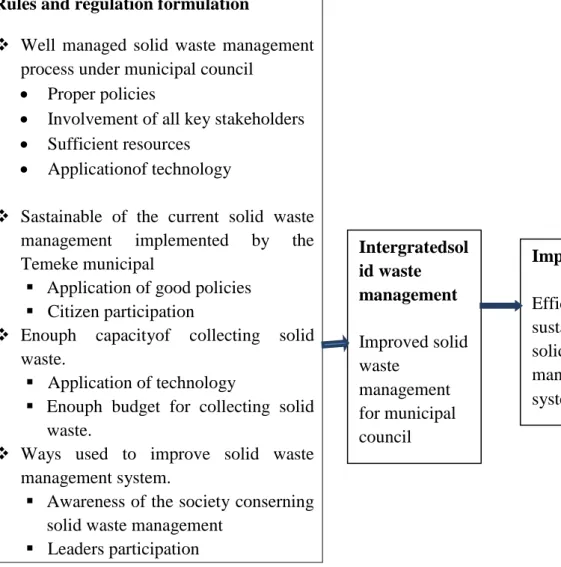
2.6 Conceptual Framework
Solid waste systems for collection and transport cannot manage to clear out the problem of waste generated in large towns with increasing population. Normally in large cities
where the population is high, solid waste are uncontrolled. Baud and Schenk (1994) suggest that when this happens, authorities need to take critical measures. The measures should include formulation of laws and policies regulation. City authorities should also plan for utilization of available resources and a careful selection of waste collection points and ensure community participation.
Figure 2.3 : Baud and Schenk Model (Modified by the researcher)
2.7 Theoretical Framework
Solid waste system for collection and transport cannot manage to clear out the problem of waste generated in large towns with increasing population. Normally in large cities where the population is high, solid waste are uncontrolled. (Baud and schenk (1994) suggest
Rules and regulation formulation
Well managed solid waste management process under municipal council
Proper policies
Involvement of all key stakeholders Sufficient resources
Applicationof technology
Sastainable of the current solid waste management implemented by the Temeke municipal
Application of good policies Citizen participation
Enouph capacityof collecting solid waste.
Application of technology
Enouph budget for collecting solid waste.
Ways used to improve solid waste management system.
Awareness of the society conserning solid waste management
Leaders participation Impact Efficient and sustainable solid waste management system Intergratedsol id waste management Improved solid waste management for municipal council
that when this happens authorities need to take critical measures. The measures should include formulation of laws, regulations,good policies and appropriate technologies. City authorities should also plan for utilization of available resources and a careful selection of waste collection points and ensure community participation. If all be organized the city will reduce harm to human hearth, environmental conservation and effective utilization of resources
CHAPTER THREE
RESEARCH METHODOLOGY
3.1 Introduction
This chapter presents research methodology employed in the study. It covers the overall research design, outlines the research area, study population, sample selection and size, as well as methods adopted in data collection and analysis.
3.2 Research Design
Research design is the arrangement of condition for collection and analysis of data in a manner that aim to combine relevance to the research purpose with economy in procedure. In fact the research design is the conceptual structure within which research is conducted. It constituents the blue print of the collection, measurement and analysis of data. Cothary (2004)
The term "research design" refers to how a researcher puts a research study together to answer a question or a set of questions. Research design works as a systematic plan outlining the study, the researchers' methods of compilation, details on how the study will arrive at its conclusions and the limitations of the research.
Research design is not limited to a particular type of research and may incorporate both quantitative and qualitative analysis. When defining research design to an audience, there are a few things you will need to make clear, while avoiding the use of scientific terms that may lose your audience. (http://www.ehow.com/how_7402461_define-research-design.html#ixzz2PxJij9iy)
The case study research design is also useful for testing whether scientific theories and models actually work in the real world. You may come out with a great computer model for describing how the ecosystem of a rock pool works but it is only by trying it out on a real life pool that you can see if it is a realistic simulation.
The researcher decided to use case study design strategy in conducting this study because it will assist to measure the performance and the capacity of the city council as well as the private sectors responsible with waste collection. The Wieviorka (1992) commends the use of case studies in similar situation where by in his book he noted that, “the use of a case design gives an opportunity to relate fact and concept, reality and hypothesis. Both structured and unstructured interview on the subjectwill be used with the aim of understanding facts as people’s view.
3.3 Study Area
Data for this study were collected fromTemeke municipal Council in Dar es Salaam region. Dar es Salaam region was chosen because it is the largest city in the country with highest population and produces the largest quantities of solid waste. Temeke district is among three districts of Dar es Salaam region, it was chosen for the study because the researcher lives in the district hence data collection will be convenient.
3.4 Study Population
Preece (1994) defines study population as a group of individuals or items that share one or more characteristics from which data can be gathered.Study population is divided into three categories namely senior officer at Temeke municipal, private waste collectors and citizens. Temeke Municipal Council is involved because it is responsible for waste
management and it is the one forming policies and bylaws on waste management within Temeke district. Private waste collectors are invoved because they are directly involved in waste collection and transportation. The ordinary Temeke residents are involved in the study because they live in the study area and they experience waste management challenges in their daily life.
3.5 Sample Size and Sampling Technique
The following are the sample size and the sampling technique which were used.
3.5.1 Sample Size
Sample size refers to the number of items to be selected from the universe to constitute a sample. The size of the sample should neither extremely large nor too small, it should be optimum (Preece, 1994). In this study a total of 42 people participated in the study. One senior officer from Temeke Municipal council, one official from private waste collection company and 40 ordinary citizens from Temeke residential areas
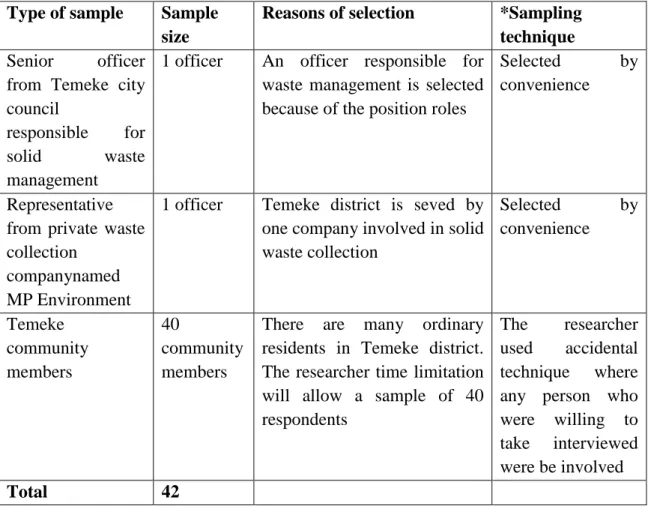
Sample size determination is the act of choosing the number of respondents to represent a selected population being studied (Emmel, 2013). As indicated on table 3.1 above, the reseacrher for this study involved a total of 42 respondents. Based on the argument by Webster (1985) a reseeacher may select sample size because of the convinience to carry out the study. In this case, the 42 size is chosen because of time and resource limitation.
The table below gives a summary of sample, sample size and sampling technique
Table 3.1 : Sample Size and Sampling Technique Type of sample Sample
size
Reasons of selection *Sampling technique Senior officer
from Temeke city council
responsible for solid waste management
1 officer An officer responsible for waste management is selected because of the position roles
Selected by convenience
Representative from private waste collection
companynamed MP Environment
1 officer Temeke district is seved by one company involved in solid waste collection Selected by convenience Temeke community members 40 community members
There are many ordinary residents in Temeke district. The researcher time limitation will allow a sample of 40 respondents
The researcher used accidental technique where any person who were willing to take interviewed were be involved
Total 42
Source: Researcher’s Own Construct
3.5.2 Sampling Technique
White (2002) sampling technique refers to the technique or procedures the researcher would adopt in selecting some sampling units from which inferences about the population is drawn.
One senior officer from Temeke municipal council was selected because the position is the one responsible for solid waste management. In this case it was selected because of its convenience reason. Grimshaw (2010) explain that one representative of a population can be selected because of its convinient position in a situation.
One senior officer from private contractor was involved because there are only one private collector in Temeke district. The senior officer selected because the position is the one responsible for solid waste management in the Temeke municipal. In this case it was selected because of its convenience reason. Grimshaw(2010) explain that one representative of a population can be selected because of its convinient position in a situation.
In the case of ordinary citizens, there are many people in Temeke distric, the resecher used accidental technique to collect the data from community members from the street. In this case, the researcher applied an accidental technique. Accordning to Grimshaw (2010) accidental technique is where the researcher involves any person that come across in a given location such as on a street.
3.6 Types of Data to be Collected 3.6.1 Primary Data
Data that has been collected from first-hand-experience is known as primary data. Primary data has not been published yet and is more reliable, authentic and objective. Primary data has not been changed or altered by human beings; therefore its validity is greater than secondary data.
3.6.2 Secondary Data
Data collected from a source that has already been published in any form is called as secondary data. The review of literature in this research is based on secondary data. Mostly from books, journals and periodicals
Both methods of collecting data were applied for the study.
3.7 Data Collection Tools
Questionnaires were used by the researcher to the various sample group established for the study.
3.7.1 Questionnaire
A questionnaire is a means of eliciting the feelings, beliefs, experiences, perceptions, or attitudes of some sample of individuals. Questionnaires contained questions that were formulated from specific objectives of the study. The one municipal official and the one officer from private waste management company were given questionnaires to fill in by themselves. This is because they were in their respective offices and some questions had data or reference requirement. This required time and space. The researcher left the questionnaires for some time and collected them back after they have done. But the questionnaires for the 40 ordinary citizens were filled in by the researcher. This is because of the accidental technique used in involving the ordinary citizens which does not offer reasonable contact with the respondent.
3.8 Validity and Reliability of the Data
3.8.1 Reliability of the Data
Neuman (2003) defines reliability of the data is the extent to which data are consistent over time and an accurate representation of the total population. Cozby, (2001). Reliability is the degree to which an assessment tool produces stable and consistent results. In order to collect reliable data questionnaire were used to collect data. Statement
from questionnaires was used as reference to ensure reliability where necessary table and narrative modelwere used to present the results processed.
3.8.2 Validity of the Data
Neuman (2003) defines validity of the data is the ability of data collected in measuring what it is intended to measure. Cronbach(1971). Validity refers to how well a test measures what it is purported to measure. In order to assure reliability and validity of data, the researcher triangulated some information to check accuracy. Before data analysis, the researcher checked all information on questionnaires. Information related to quantities were cross checked with other sources such as existing reports.
3.9 Data Analysis
According to Grimshaw (2010) data analysis refers to the computation of certain measure along with searching for patens of relationship that exist among data group.The study used quantitative techniques to analyze the data collected. To carry out the research successfully the findings from the questioners were analyzed, tabulated, and then interpreted. Tables and charts are more useful when it comes to quantitative information. Further explanations are provided to analyze information on these tables and charts. Some of the data were summarized by using description and analyzed by using percentage. A descriptive analysis was done by transforming the raw data into understandable form to facilitate the interpretation of the data.
CHAPTER FOUR
PRESENTATION OF RESEARCH FINDINGS 4.1 Introduction
This study attempted to analyse solid waste management prosess the case study Temeke municipal council. In chapter four presentantion cover all questionnaire filled by respondents which were officers and community members and the discussion of the findings.
4.2 Respondents’ Characteristics
4.2.1 Community Members Residence:
The community members who participated in the study were asked to indicate the area they lived. They were asked to indicate whether they live in residential or commercial areas. The results were indicated on the table 4.1below:
Table 4.1 : Community Members Place of Residence
Place Frequency (N) Precentage ( %)
Resdential 23 57.5%
Commercial 17 42.5%
Total 40 100%
Source: research data
Data presented on the Table 4.1 above indicates that a total of 23 community members out of 40 who participated in this study (equal to 57.5 per cent) are living in residential areas. Those who are living in commercial areas were 17 (equal to 42.5 per cent). It indicates that the community members who live in residential area were 23 members which is more than the community members who live in commercial area chich is 17 members as indicated on table 4.1 above.
4.2.2 Comunity members Residence streets
The community members who partricipated in the study were asked to indicate where they live by mentioning their respective streets. The results as indicated on the table 4.2 below:
Table 4.2 : Community Members’ Residencial Streets
Street Frequency (N) Percentage (%)
Mbagala 13 32.5%
Temeke 15 37.5%
Tandika 12 30%
Total 40 100%
Source: Research data
Data presented on table 4.2 above shows that 13 community members out of 40 who participated in the study live in Mbagala street. This is (equal to 32.5 per cent). Those who live in Temeke street were 15 (equal to 37.5 per cent). Residents from Tandika who participated in the study were 12 (equal to 30 per cent). It indicates that the community members who live at Temeke were 15 members more than two streets Mbagala and Tandika which shows 13 community members who live Mbagala and 12 members who live Tandika.
4.2.3 Community Members Level of Education
Responents who participated in the study were asked to indicate their level of education. The result wereas shown on thetable 4.3 below.
Table 4.3 : Community Members Level of Education
Level of Education Frequency (N) Percentage (%)
Primary education 20 50%
Secondary education 9 22.5%
Collage 7 17.5%
Non of the above 4 10%%
Total 40 100%
The data presented on the table 4.3 above shows that a total of 20 community members who participated in the study (equal to 50 per cent) completed primary education. Those who completed secondary education were 9 (equal to 22.5 per cent) and those who completed college education were 7 (equal to 17.5 per cent) and total of 4 members (equal to 10 per cent) not completed any of primary, secondary or college education. It indicates that 90% of community members who participated in this study were educated and only 10% were not educated. But primary education were 50%, were so many compared with the colleges were 17.5 and secondary education were 22.5%.
4.2.4 Community Members Age
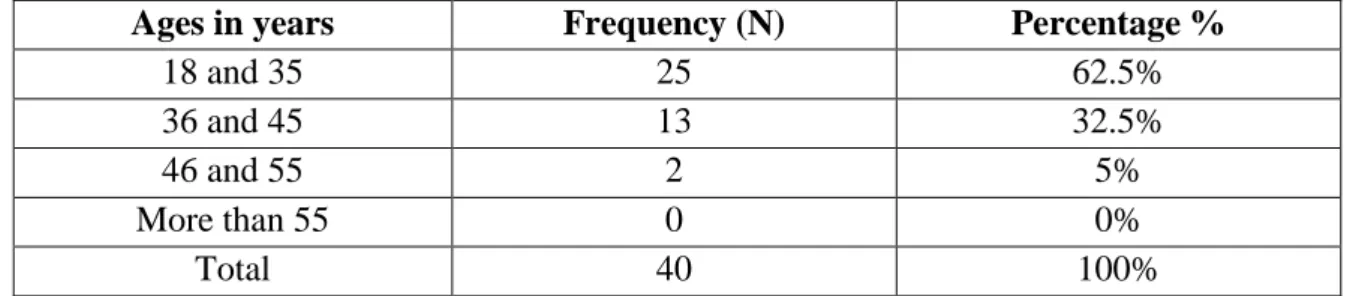
Community members who pertcipated this study were asked to indicate their age. They were given three options from which to select a group that represent their age. The result were as presented on the table 4.4 below.
Table 4.4 : Community Members’Age
Ages in years Frequency (N) Percentage %
18 and 35 25 62.5%
36 and 45 13 32.5%
46 and 55 2 5%
More than 55 0 0%
Total 40 100%
Source: Research data
The data presented on the table 4.4 above shows that 25 community members who participated in this study (equal to 62.5 per cent) were age between 18 and 35 years. Those who age between 36 and 45 years were 13 (equal to 32.5 per cent). A total of 2 community members (equal to 5 per cent) indicated that they are age between 46 and 55 years. There was no community member who participated in the study aged obove 55
years. It indicates that the community members who participated in this study were under 55 years. And community members who have the age between 18 and 35 were 62.5% there most frequency than age between 36 and 45 chich shows 32.5% and age between 46 and 55 were 5%.
4.2.5 Officers from Temeke Municipal Council
There was one official from Temeke Minicipal Council who participated in the study. He was a male aged between 46 and 55 years of age. He is working in the Municipal Council as a Dumpsite Officer with nine years of service in the same position and the level of education was collage..
4.2.6 Officer from Private Contractor
Currently there is one private contractor working on solid waste management in Temeke Municipal Council. The company is called M.P Environment. The study involved one representative from M.P Environment. The representative was a male person aged between 18 and 35 years. He is a Manager living in Temeke street and the level of education was college
4.3 Views from Community members
4.3.1 Solid Waste Collection
The community members who participated in this study were asked about solid waste collection in their residential areas. were asked frequency in which they through solid waste at the collection point. The table 4.5 below shows the results.
Table 4.5 : Community Members’ Use of Solid Waste Collection Point
Period Frequency (N) Percentage (%)
Regular (more than once per week) 20 50%
Avarage ( at least once within one week)
9 22.5%
Rerely (at least once in the month) 11 27.5%
40 100%
Source: Research data
The data presented on the table 4.5 above indicated that 20 out of 40 community members (equal to 50 per cent) who participated in this study indicated that they use solid waste collection point more than once a week. A total of 9 community members who participated in the study (equal to 22.5 per cent) reported that they use solid waste collection points to throw solid waste once a week. Those respondents who reported they rarely use the collection points were 11 (equal to 27.5 per cent) of all respondents. The data indicates that the contractor was good because the members who says more than once a week were 50% , but the system used need more support or follow up because there were 27.5% members who says at least in one month.
4.3.2 Duration of Accessing Solid Waste Collection Service
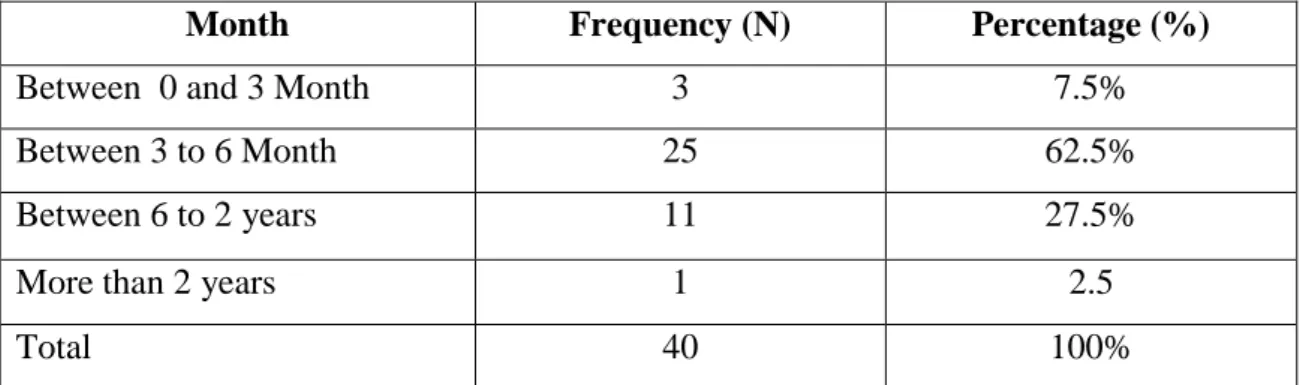
The community members who participated in this study were asked to indicate the length of time they have been accessing solid waste collection service provided by the private contractor. The table 4.6 below shows the results.
Table 4.6 : Duration of Accessing Solid Waste Collection Service
Month Frequency (N) Percentage (%)
Between 0 and 3 Month 3 7.5%
Between 3 to 6 Month 25 62.5%
Between 6 to 2 years 11 27.5%
More than 2 years 1 2.5
Total 40 100%