ISSN (e): 2250-3021, ISSN (p): 2278-8719
Vol. 08, Issue 6 (June. 2018), ||V (IV) || PP 62-73
A Case Study on Municipal Solid Waste Management System of
Rohtak City, Haryana, India.
Meena Deswal and J.S. Laura
Department of Environmental Sciences Corresponding Author: Meena Deswal and J.S. Laura
Abstract:
Municipal solid waste management is a major problem faced by city planner all over the world. The main objective of this study to examine the current and environmental compliance status of the solid waste management system of Rohtak city. Total waste generation of the city is 189 MT/day and per capita, waste generation is 0.4 Kg/person. For proper management whole city is divided into six zones. Among which zone five and six covers surrounding nine villages. The present service area covered by the bins are less than 50 percent. The chemical characteristics of solid waste at dumpsite are as follows: moisture (33.72%), Bulk density (0.32 gm/cc), Dry density (0.24 gm/cc), C/N Ratio (36.6), and CV (816 Cal/Kg). The C/N ratio and moisture content of the municipal waste of Rohtak is a suitable raw material for composting through biological treatment. On the other hand, the calorific value of the waste is low (816 kcal/kg) which makes it unsuitable for thermal treatment. Results drawn from this study will be useful for Urban local body and planners, for proper management of solid waste and environmental sound city management.
Keywords-
Solid waste management, population, legislation, composition.--- --- Date of Submission: 05-06-2018 Date of acceptance: 20-06-2018 --- ---
I.
INTRODUCTION
Municipal solid waste management is one of the major problems that city planners face all over the world1,2,3,4. The problem is especially severe in most developing country cities where increased urbanization, poor planning and lack of adequate resources contribute to the poor state of municipal solid waste management system 5,6,7,8,9,10. There is a considerable amount of disposal of waste without proper segregation, leading to both economic and environmental loss. It is estimated that about 145626 metric tons of solid waste generated every day in India11. Per capita waste generation ranges from 0.2 kg to 0.6 kg 12. The collection efficiency ranged from 50 to 90% only, leaving the balance unattended among which 2% of the uncollected wastes are burned openly in the streets and 10 % of the collected Municipal solid waste (MSW) is openly burnt13. It is estimated that the urban local bodies spend about Rs. 500 to Rs. 1500 per ton on solid waste for collection, transportation, treatment, and disposal. 60 to 70 % of this amount is spent on collection, 20 to 30% on transportation and less than 5% on final disposal of the waste as per Ministry of Urban Development, 2001. Generally, the state and municipal governments consider solid waste a low priority and consequently give less budgetary support to this field. Slow decision-making processes in the municipalities create an additional hindrance. In a broader sense, municipal solid-waste management is a very complex task, as the social, economic and cultural cooperation among households, communities, enterprises, and the municipal authorities is minimal and lack of awareness of the rules and regulations, as well as environmental concerns with poor resources, have created a chaotic situation14,15,16. Although India has formulated legislation relating to municipal solid waste, hazardous waste and biomedical waste, the compliance, and awareness of rules among communities and municipalities are lagging behind.
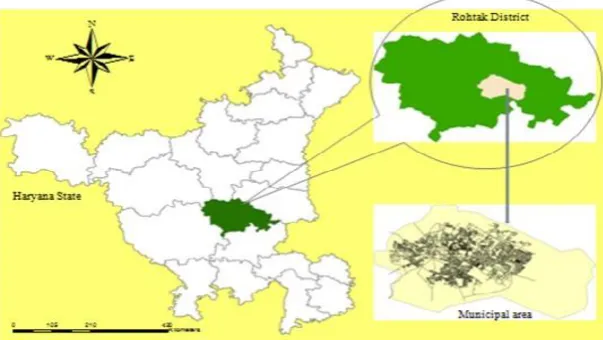
Study Area
Figure. 2 Population growth of Rohtak City.
Due to increase in population and urbanization the municipal limits also extended which was 30.96 Km2 in 2007, this limit was extended to 104.10 Km2 in 2010. In 2012 the municipal corporation included surrounding nine villages due to which limits became 139.4 Km2 with a population of 4.8 lac (MCR, 2013).
II.
MATERIALS AND METHODS
For the generation of database survey with the questionnaire was conducted. For spatial representation of database Toposheet (H43W9) was purchased through SOI Chandigarh. Secondary data regarding waste generation, collection system, disposal method and working zone distribution for waste management and medical waste was collected through Municipal Corporation of Rohtak (MCR). The dumpsite characteristics of waste are considered most useful as it is only the source for the establishment of the treatment project for the municipal waste. Bulk density, moisture content, dry density, calorific value and C/N ratio of dumpsite waste, was determined by standard methods for which ten samples of 10 kg each were collected separately, mixed and brought to analytical size by quartering method. Data regarding a number of bins and their location was collected through survey and its service area was estimated through ArcGIS 9.3 by creating a buffer of 250 meters.
Prevailing solid waste management scenario of Rohtak city
Figure.3 Solid waste management Zones of Rohtak city.
Table.1 Zones for waste management in Rohtak City.
Zones Housing units (approx.)
Population (approx.)
Waste generatio n
(MT/day)
Per month approx. Expenditure (Rupees)
1 27,245 1,04,444 41.8 14,47,708.00 2 14,756 66,634 26.7 11,86,765.84 3 11,217 53,863 21.5 12,07,681.01 4 37,762 169,433 67.8 3,64,800.00 5 12,020 35,514 14.2 2,89,898.00 6 10,073 40,440 16.2 3,60,281.00 TOTAL 1,13,073 4,70,328 188.2 48,57,133.00
Source- Municipal Corporation Rohtak
Waste collection system-
Figure.4 Flowchart of the municipal waste collection system of Rohtak
The recyclable wastes are segregated manually by Kabariwala and rag pickers which are estimated at about 2500 in number. The Kabariwala also purchase recyclable waste from residential and commercial establishments while rag pickers collect recyclables from marketplaces, dustbins, and dump sites and sort them before selling (Figure. 5). As per “Action Plan for management of Municipal Solid Waste” suggestive 2015 for the acceptability and role of rag pickers, identity cards will be provided by Non-Governmental Organizations. But in the city, it is not applicable yet. However, these recyclables are not segregated to the maximum extent, thereby allowing them to be a part of landfill waste.
Figure.5 Segregation of waste by informal sector
Primary collection system
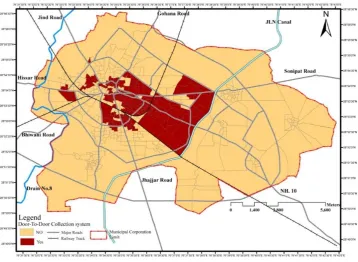
schools, colleges, universities or other places of education, organization, academy, hotels and restaurants; have their own waste management system as per Municipal solid waste (Management and Handling) Rules 2000. However, waste finally dumped at the common dumpsite. In 18.4 km2 (13.2%) area door-to-door collection system is available whereas in 121 km2 area not served by this facility (Figure. 6). It covers 226429 population (47%) and 128 MT (54%) of municipal waste is collected by this system. The high-density housing areas of old city portion and organized colonies are served by this system.
Figure. 6 Map of the location of the door-to-door collection system.
III.
RESOURCES AVAILABLE WITH MUNICIPAL CORPORATION ROHTAK FOR
SOLID WASTE MANAGEMENT
1. Secondary storage bins
2. Solid waste collection and transport equipment. 3. Dumpsite.
4. Management plant.
Secondary storage bins
Figure.7 Location map of Community Bins and open dumps.
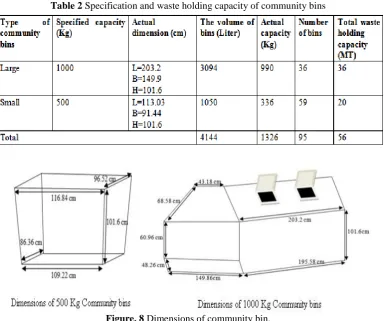
Table 2 Specification and waste holding capacity of community bins
Figure. 8 Dimensions of community bin.
places waste was to be directly burned in community bins, at some places cow dung dumped into community bins, at some places large bins are placed although there was no population residing there. At many places waste is openly dumped in pits or vacant plots. This unscientific dumping is due to less number of community bins as compared to the demand. As per the survey, there were 72 community bins were found, whose percentage of service area covered is less than 50% as shown in Table 3.
Table 3 Service area covered by existing bins
Zone Number of bins existing
% of service area covered
Built up area (km2)
Service area covered by present bins (km2)
1 14 22.18 % 4.3 0.96
2 6 7 % 2.1 0.16
3 29 29.5 % 5.3 1.6 4 20 32.8 % 4.5 1.5
5 - - 1.2 -
6 3 15 % 2.9 0.45
Solid waste collection and transport equipment
MCR has 29 waste transportation vehicles among them 24 are tractor trolley, 4 are dumper placer and 1 is self-loading truck. Among these vehicles tractor trolley make 3 trips per day, dumper placer makes 7-8 and self-loading truck make only one trip as shown in Table 4. These vehicles transport about 128.84 MT/day. The waste collected from secondary collection points is directly transported to the existing dump sites within the city. In order to avoid contact with waste and the spillage of waste during transportation, it was decided to cover transport vehicles and avoid multiple handling, but with limited success.
Table 4 Details of waste collection vehicle fleet system
Vehicle Number Collection Cycle Total waste collected per day
Tractor trolley 24 3 71.28 MT Dumper placer 4 7 to 8 49.50 MT Self Loading truck 1 3 8.06T
Dump Site
Figure. 9 Location map of dumpsites.
Treatment plant
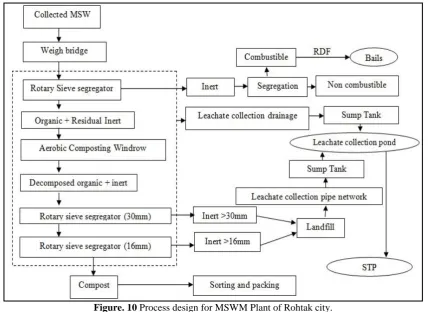
The project which is under construction is an Integrated Solid Waste Disposal Facility (ISWDF) consisting of sanitary landfill and composting plant along with other auxiliary systems. ISWDF have a section for processing MSW which will involve mechanical segregation, shredding, screening to separate both fine inert and some percentage of biodegradable matter, fines screening, ballistic separation etc which will finally result in the segregation of the waste into recyclable, biodegradable and non-biodegradable waste. The process design for MSW compost plant involves various steps as describes Figure 10. The total cost of the project is Rs 19.88 Crore, whose processing capacity is 100 TPD. The plant was approved in February 2008. As per Detail project report (DPR) and in being executed by NBCC the completion date was be March 2015 and its first run was done in March 2017 which was not satisfactory.
Biomedical wastes
There are 300 hospitals, dispensaries and nursing homes in Rohtak city, which generating approx. 350 Kg/day of biomedical waste. According to the biomedical waste (Management and Handling) Rules, 1998, the generator has the responsibility to take care of biomedical waste generated on their premises by either providing facilities like incinerators (major hospitals) or by sending waste to waste- disposal facilities on a par and use basis. The total biomedical waste generated can be classified in 3 categories- 1) Healthcare facilities (86%), 2) Infectious waste (9%), and 3) Hazardous waste (5%). The hospitals and healthcare facilities use four color-coded plastic bags- Red, Yellow, Blue and Black, depending on the categorization of waste (Figure 11). The S.D Biomedical Waste Management Company (Pvt.) has been designated as the authority for the safe treatment and disposal of biomedical waste. The company has 6 vehicles (Figure 12) and 12 workers for the collection of medical waste. The company has the following equipment on its facility for the management of the medical waste- incinerator, autoclaves, shredders and an Effluent Treatment Plant.
1
Solid waste characteristics and quantification
The solid waste generated in Rohtak city is approximately 188.2 MT/day with collection efficiency 80%. The per capita generation is 0.49 Kg/Person/Day. The composition of solid waste is shown in Figure.13. The chemical characteristics of solid waste are as follows: moisture (33.72%), Bulk density (0.32 gm/cc), Dry density (0.24 gm/cc), C/N Ratio (36.6), and CV (816 Cal/Kg). Municipal solid waste is a complex waste stream, where many different types of waste aggregate from domestic, commercial and industrial sources within a single waste stream. Waste quantities, volume, and composition in different geographical areas vary as it depends upon socio-economic, population, cultural traditions, consumption behavior, the degree of industrialization and climate. Two major waste treatment technologies are available thermal and biological. Out of these characteristics, the C/N ratio and calorific value of the waste are the main deciding factors for the technology to be adopted for the management of the waste. According to CPCB (2000), the moisture and C/N ratio of MSW for biological treatment should be 40-45 % and 30:1. For thermal treatment, the calorific value of waste should be >1500 kcal/kg (CPCB, 2000). As per these recommendations, the C/N ratio and moisture content of the municipal waste of Rohtak is a suitable raw material for composting through biological treatment. On the other hand, the calorific value of the waste is low (816 kcal/kg) which makes it unsuitable for thermal treatment.
I. The status of Environmental Compliance
In compliance with the MSW rules, the following actions have been taken in the collection of Municipal Solid Waste-
Construction/demolition wastes are to be kept separately. There is partial compliance. It disposed along the sides of roads and vacant plots.
As per the executive order, waste burning is banned but some places burning in action.
No restriction on animals.
Street sweeping is done by municipal workers using brooms and tricycle rickshaws. The collection is quite low due to non-uniformity in the collection system. Due to the financial constraints, the infrastructure required such as litter bins, twin bins for segregated garbage, handcarts with two chambers, safety equipment, and other equipment needed for efficient garbage collection are not made available in adequate number.
Segregation of waste is not being done by citizens in the city. People throw their waste along the roadside, vacant plots and into the community bins without segregation. Transportation is carried out in open vehicles and cause air pollution and aesthetic problems. The loading capacity of vehicles is also low due to which less quantity of waste transported, which enhances the fuel consumption and cost of management practice.
There is total ignorance of “Haryana Non-Biodegradable Garbage (Control) Act 1998” in Rohtak city as the segregation of non-degradable waste is not done at source whereas informal segregation was done by the rag pickers but the percentage is very low. The MCR also not place the separate receptacles for non-degradable as provision given in section 4 of the act.
Biomedical/industrial waste is not to be mixed with MSW. Biomedical waste is separately treated. Disposal of highly infectious bio-medical waste remains a grave concern in the city, posing a risk to residents as well as the environment. In an attempt to dispose of bio-medical waste in a proper manner, the Rohtak city tied up with a private firm. Some of the provisions of Bio-Medical Waste (Management and handling) Rules, 1998, say color-coded containers have to be used for different types of wastes. Only authorized agencies can collect and dispose of such wastes at their faculties through various methods such as incineration, shredding and deep burial but that is not happening in proper extent. About 1.6 % of biomedical waste found in the composition of Municipal waste which includes intravenous fluid bottles, blood-stained cotton, vacutainer blood collection tube. It is the matter of great concern regarding the health of rag pickers and the environment.
The capacity of the sanitary landfill is less than the waste generation in the city as the waste generation of the city is 188.2 tons/day whereas the working capacity of the plant is 100 tons/day.
IV. CONCLUSION
The solid waste management in Rohtak city appears to be inadequate and needs up gradation. Segregation of recyclable material would be the crucial factor to a reduction in the quantity of solid waste for final disposal. Higher priority needs to be assigned to the municipal waste management by the local body and a system approach needs to be adopted for optimizing the entire operation of waste management encompassing segregation at source, systematic collection, transportation routes, types of vehicle and development and proper operation of the sanitary landfill site.
REFERENCES
[1]. Obirih-Opareh N, Post J, Quality assessment of public and private modes of solid waste collection in Accra, Ghana. Habitat International. 2002; 26:95-112.
[2]. Maity SK, Bhattacharyay BK, Bhattacharyay B, A case study on Municipal solid waste management in Chandan Nagar city. International Journal of Application or Innovation in Engineering and Management. 2012; 1(2):1-4.
[3]. Muchangos LD, Tokai A, Hanashima A, Application of the Delphi Method to the Indetification of Barriers to a waste management policy in Maputo city, Mozambique. Journal of Susutainable Development. 2015; 8(6):146-157.
[4]. Chaturvedi A, Gaurav JK, Managing Waste in India with Foresight. Bulletin. 2018;47(4):1-10.
International organization of Scientific
Research
73 | P a g e
faculty of Engineering Hunedoara. 2008; 3:266-272.
[16]. Chavan BL, Zambare NS, A case study on Municipal solid waste management in Solanpur City, Maharashtra, India. International Journal of Research in Civil Engineering, Architechture & Design. 2013;1(2):2347-8284.
[17]. Rana R, Ganguly R, Gupta AK, Solid waste management in chandighar- A case study. Journal of Civil Engineering and Environmental Technology, 2014; 1(4):67-70.
[18]. Central Ground Water Board, Ministry of Water Resources, Government of India, North-west Region, Chandigarh.2007.