Assistance
G. Ferrer, A. Garrell, M. Villamizar, I. Huerta, A. Sanfeliu
Abstract This chapter presents some real-life examples using the interactive mul-timodal framework; in this work, the robot is capable of learning through human assistance. The basic idea is to use the human feedback to improve the learning behavior of the robot when it deals with human beings. We show two different pro-totypes that have been developed for the following topics: interactive motion learn-ing for robot companion; and on-line face learnlearn-ing uslearn-ing robot vision. On the one hand, the objective of the first prototype is to learn how a robot has to approach to a pedestrian who is going to a destination, minimizing the disturbances to the ex-pected person’s path. On the other hand, the objectives of the second prototype are twofold, first, the robot invites a person to approach the robot to initiate a dialogue, and second, the robot learns the face of the person that is invited for a dialogue. The two prototypes have been tested in real-life conditions and the results are very promising.
1 Introduction
Humans live interacting with other people and perform tasks in individual and col-lective ways everyday. Robotic researchers are interested in designing robots that can interact with people in the same way that humans do. In order to reach this goal, robots must learn from the interaction with humans and learn humans skills used in everyday life to acquire robot social behaviors that can then be used in a wide range of real-world scenarios: domestic tasks, shopping, assistance, guidance, entertainment, surveillance, rescue or industrial shop-floor.
There are many examples where these interactions occur, but some of them are very basic and people do not realize the extreme difficulty that entails executing such tasks for a robot. For example, the navigation in crowded environments, such Institut de Rob`otica i Inform`atica Industrial CSIC-UPC, e-mail: [email protected], [email protected], [email protected], [email protected], [email protected]
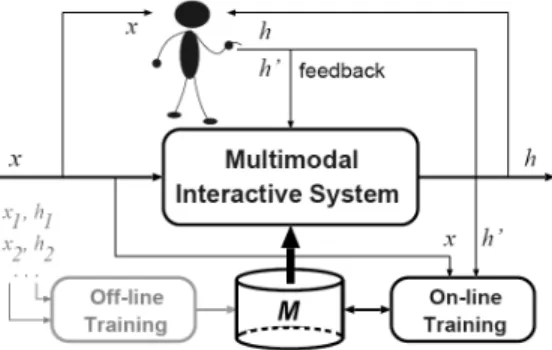
Fig. 1 General multimodal interactive framework.
as crossing streets or shopping malls, or the social engagement to initiate a conver-sation, are simple examples where this interaction occurs. In the last years important academic and private research efforts have been carried out in this field. Examples can be seen in automatic exploration sites [32], evacuation of people in emergency situations [4], crafting robots that operate as team members [29], therapists [7], robotic services [24] or robot guiding [16, 14].
In this chapter, we will present some examples where the robots learn from the interaction with humans using the general multimodal interaction framework. We will show how the general multimodal system is used in two specific tasks namely: interactive motion learning for robot companion; and on-line face learning using robot vision.
The general idea of the multimodal interactive framework used in the present work is depicted in Fig. 1. As it can be seen, the model can be learned off-line or on-line, and the human -the oracle- uses the information coming from inputs and the outputs to train again the system in order to improve the model. We will see in the two examples how this framework is used.
We have developed two prototypes where the interaction occurs and it is used to improve the systems. The first prototype is “interactive motion learning for robot companion”. The objective is to learn how a robot has to approach to a pedestrian who is going to a destination, minimizing the disturbances to the expected person’s path. In this prototype, the robot has to detect the person’s path, forecast where the person is going to move and approach to the target while taking into account the person intentionality.
The second prototype, “online face learning using robot vision”, has two main objectives. On the one hand, the robot seeks the interaction proactively, the objective is to invite a person to approach the robot to initiate a dialogue. The robot has to take into account the person behavior (reactions) to convince the person to approach the robot. The robot uses a perception system to know the person position and orienta-tion and uses a dialogue and robot moorienta-tions to invite the person to approach. On the other hand, the robot learns people’s faces. The system learns the face of the person by means of a sequence of images that the robot vision system captures while the
person is in front of the robot. The robot only asks the person when the captured face image is very different with respect to the learned face model. If the person agrees with the new face image, the robot uses this image as a positive image to improve the face classifier. In case that the person rejects that face image, the robot uses the image as a negative image to also improve the face classifier. The on-line face learning is done in real-time and is robust to varying environment conditions such as lighting changes. Moreover, it is robust to different people independently of the aspect and gender.
Throughout the two prototypes, the multimodal interactive system improves the accuracy and robustness of the prototypes thanks to the use of a human in the loop. The human plays the role of a teacher with the robots, that is, it evaluates and corrects the results of the robots’ tasks in changing environment conditions and human behaviors. The system has been tested in real-life situations and the tests show the improvements of using this framework with respect to using classical non-interactive approaches in several robot tasks.
The remainder of the chapter is organized as follows. In section 2, the interac-tive motion learning for robot companion approach towards humans is explained. Section 3 describes how the robot performs his active behavior and the online face learning using robot vision to detect and identify the people. Finally, the last sec-tion briefly reviews the topics discussed in the different secsec-tions of this chapter and establishes the final concluding remarks of this work.
2 Interactive Motion Learning for Robot Companion
Navigation in crowded urban environments, such as crossing streets or shopping malls, is an easy task for humans. However, it is extremely difficult for a robot due to the high environment uncertainties and the variability of the human behavior. The uncertainties associated to the problem can be partially overcome using the multimodal interaction (MI) framework, shown in Fig. 1, where the human can teach specific issues of the robot companion approach.
The aim of the this prototype is to show how a robot can learn to accompany a person and navigate safely and naturally in urban settings, minimizing the distur-bances to the expected person’s paths in two different situations: when crossing the path of a person and when approaching a person to guide him/her to a destination. We are considering for this prototype that we know the urban map, the obstacles and that the robot guides one person. The person can move in any direction, but the goal of the person is to arrive to a given destination, and the robot must accompany the person minimizing the disturbances to his(her) trajectory. Due that the person can change anytime his(her) trajectory, the robot must track the person and anticipate to his(her) path using a human motion predictor. In summary the system has to take into account the following requirements:
• The human motion predictor must infer the person motion intentionality (goal), forecasting the path required to get there.
• The robot has to use its navigation model and a human motion predictor to take into account the person’s motion intentionality.
Robot Interaction Control
Human Motion Predictor People perception and tracking
feedback Real world interaction
Laser People Detector Tracker Vision People Detector Laser Camera
Interactive Robot Motion learning
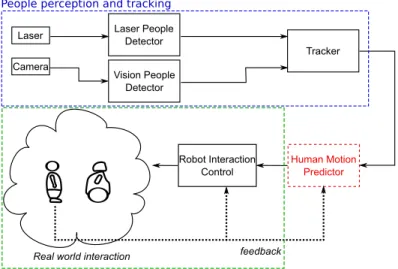
Fig. 2 Interactive Motion Learning: Schematic prototype of the interactive motion learning for
robot companion.
The prototype scheme is depicted in Fig. 2. We can realize that it shares some issues of the general multimodal interaction framework shown in Fig. 1. The input to the system is the robot motion and the person path, which are obtained through the robot odometry and the robot laser/vision person tracker. The output of the system is the robot motion approaching or guiding the person. The human in the loop provides the multimodal interaction and he(she) can modify the robot motion behavior in different ways. We have used in this prototype the on-line feedback of the person by using a subjective measure of comfortableness of the target being approached or guided. This measure allows to learn some parameters of the robot motion.
2.1 People Detection and Tracking
People detection is needed to track person motion and to extract the learning pa-rameters for comfortable robot navigation in urban sites. Our tracker combines the information of a laser detector, based on [2] and a vision detector based on the His-togram of Oriented Gradient [6]. The people tracker uses the ideas of the work of [1, 25] with some variations, for example instead of using a Kalman filter, we use a particle filter.
The information of both detectors, the laser and the camera, is fused to obtain a robust detection of the people. The output of this fusion is used as the tracker input.
2.2 Human motion prediction and the social-force model applied
to robot companion
As we have commented, we need a human motion predictor to know where the person will be after some period of time and a navigation model that allows to navi-gate safety in the urban area, and that can learn the best parameters to accompany a person.
There are several human motion predictors in the literature. The work of Ben-newitz [3] learn the different human motion paths using clustering techniques. The work of Foka [11] uses a geometric model to find the best trajectory from the person position and the destination. The work of Ferrer [10] uses a geometric model but us-ing the present and the previous person path to infer the destination. We have used in this prototype a new model, a Bayesian human motion predictor that calculates the person posteriori probabilities to reach all destinations in the scene. The path to the destination that obtains the highest probability is used as the trajectory that will follow the person, that is the human motion prediction model.
With respect to the robot navigation model, there exists in the literature a high number of models, but they are oriented to the navigation of a robot in a static en-vironment or when the moving objects are not humans. When there are humans in the robot trajectory or when the robot must accompany persons, then there are few works that deal with this issue. The best well known model is based on “so-cial forces” and it has became important for human robot interaction studies. The social-force model was proposed by Helbing [20] to explain the human to human “virtual” forces that appear when two or more humans have motion interactions, that means one person guides another one, both persons follow the same trajectory to collide, one person wants to transverse a group of people, etc. The Helbing’s approach treats each person as a particle abiding the laws of Newtonian mechanics, more specifically, there are several forces in the motion interaction between humans, for example the dragging force that appears when a person follows another one, or the push force that happens when a person is approaching another person without stopping. An extension of Helbing’s work that takes into account the time of colli-sion has been proposed by Zanlungo [37]. We have extended this social-force model to the relations between robots and humans [15] and applying it for guiding people in urban areas with two or more robots.
In this prototype we use the social-force model including additional forces for accompany a person to a destination. The aim is to obtain the force that the robot must apply at each instant i, Fi. This force Fi governs the trajectory to the desti-nation goal piand it is computed as the summation of the attractive force to go to the goal figoaland the robot interaction force Fiint to the static an dynamic objects or persons.
Fi= figoal+Fiint (1) Let us go to describe each one of the these forces. Assuming that pedestrian tries to adapt his or her velocity within a relaxation time k−1i , the attractive force to go to the goal, figoal, is given by:
figoal=ki(v0i −vi) (2)
The relaxation time is the interval of time needed to reach a desired velocity and a desired direction.
The interaction force Fiint is the summation of all the repulsive forces, finti,q, that interact with the robot coming from static (obstacles) and dynamic objects (people, cars, ...). This force prevents humans from crashing with static obstacles o, humans (or dynamic objects) pi or the robot r. These person-robot interaction forces are modeled as:
finti,q=Aqe(dq−di,q)/Bq
di,q di,q
(3) where q∈P∪O∪ {r}is either a person (o any moving object), an static object of the environment or the robot. Aqand Bqdenote respectively the strength and range of interaction force, dq is the sum of the radii of a pedestrian and an entity and
di,q≡ ri− rq.
The parameters of the previous equation are obtained in a two step optimization: first we optimize the parameters of the model forces describing the expected human trajectories under no external constrains and consequently we obtain the k param-eter and second, we optimize the paramparam-eters of the force interaction model under the presence of a moving robot, taken into account that these are the only exter-nal force altering the outcome of the described trajectory, obtaining{A,B,d}. All optimizations are carried out using genetic optimization algorithms [17].
The robot force Fi is the result of applying all the forces that are needed for the robot navigation. By computing this force at each instant i, we obtain a robot trajectory that can be seen as a reactive navigation system. When we incorporate the human motion prediction to the computation of this force, then the behavior of the system is more than reactive, then we can improve the robot motion because is an-ticipating the human motion. This is specially important for guiding or approaching people, because the robot anticipates his(her) motion trajectory.
In this prototype, we have gone a step further, we have incorporated a multimodal interaction approach to modify the robot forces (and indirectly its velocity and tra-jectory) to improve the comfortableness of the person when is moving to a desti-nation and a robot perturbs his(her) trajectory. For our experiments, the person that is approached and guided by the robot, has a video-game controller (a wii device) to modify the parameters that control de robot forces (we will explain these param-eters in the next section). We will call this person, controller. The person-controller through a video-game person-controller dynamically modifies the robot forces meanwhile tries to perform a determined trajectory aiming to a given destination. In
our experiments, first the robot have to approach the person-controller and then the robot accompanies it to the destination. In the first part of the experiment, the robot is far away the personal space of the person-controller and he(she) can modify its trajectory (or the robot velocity or trajectory using the wii device) if he(she) feels that the robot can collide with him(her). In the second part of the experiment, when the robot is near the personal space of the person-controller, he(she) can control the robot velocity or trajectory if he(she) feels that the robot is moving too fast or too slow.
2.3 Interactive Robot Motion Learning
We will explain in this section how the human can modify the robot forces using the subjective measure of comfortableness, and how we learn these parameters. As we have commented previously the person-controller uses a wii device to send the on-line feedback to the robot.
The robot motion is based on the social forces commented in the previous sec-tions, and the robot autonomously moves to the destination goal, first looks for the person and then accompanies him/her to the destination goal. While the robot ac-companies a person, interaction takes place continuously, through the social forces and also using the human feedback of comfortableness, to learn different robot ap-proaching behaviors. There are few articles regarding this topic. The work of Fox [12] or more recently the work of Fraichard [13] analyzes dynamical obstacle avoid-ance strategies for robot navigation; the work of Kanda [23] uses prediction strate-gies in social robots in a train station; and the works of Chung [5] or Henry [21] deal robot robot control design.
In our system, the on-line feedback is a subjective measure, which varies some parameters of the system by weighting the contribution of all the active forces. The forces that we have considered are:
• Force to the target destination: we infer the target destination by using the inten-tionality prediction described at section 2.2 and thus the robot aims to the most expectable target destination.
• Force aiming to the person: either the current person position as well the expected motion prediction are known.
• Force of interaction: that is a repulsive force due to the relative position and velocity between the robot and the target.
The combination of these three forces determines the behavior of the robot while the robot is approaching the person. In contrast to the social-force model, two dif-ferent goals are taken into account. First, a force makes the robot to approach to the predicted destination fr,destgoal. Furthermore, the robot must approach the person who must accompany, hence, a second goal pushes the robot to move closer to the person
Fr=α fr,destgoal+β frigoal+γFr,iint (4) The most interesting part of the system so far, resides in the fact that the approach proposed does not require static targets, the robot is able to navigate near to moving persons.
Although we want to obtain a general approaching rule, it highly varies from per-son to perper-son in addition to the highly noisy environment in which we are working. Accordingly, we propose the use of an erc f(x)function to measure the contribution of the human feedback provided{α,β,γ}. By using this function we guarantee a slow change in the contribution of these parameters near its constraints. While it-eratively repeating the robot physical approach, the provided feedback refines the weights of the force parameters and we can infer a basic interactive behavior where the person feels comfortable under the presence of the robot.
#1
#3
#2
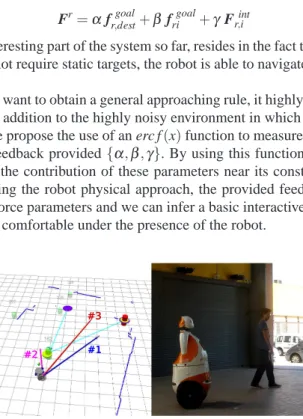
Fig. 3 Illustration of the experiment. On the left is depicted the robot interface, in which the
social forces can be appreciated, centered on the robotic platform. On the right hand side of the picture appears the real scene.
As can be seen in Fig. 3, we have reproduced the experiment under controlled conditions. The left figure shows the robot motion and after a few approaches to the target, the robot captures the behavior of the person, by heading towards the most expectable destination of the target. The attractive force to the target destination is plotted as the #1 arrow, and the force approaching the person is plotted as the #2 ar-row. The interaction force represents the repulsion generated by the target towards the robot. This force is important to reach the state where the robot does not ap-proach too close to the target, as this behavior will most likely produce repulsion. The result of all the weighted forces is represented as the #3 arrow.
2.4 Experimental results
In order to validate the usefulness of our contributions to the robot companion sub-ject, that is, making use of human motion prediction and a human feedback as a measure of comfortableness, we have made a set of experiments combining these characteristics and evaluating the overall performance of each combination:
Ro bo t' s Intel lige nce Le vel o f in te ractio n Le vel o f Co nfid en ce
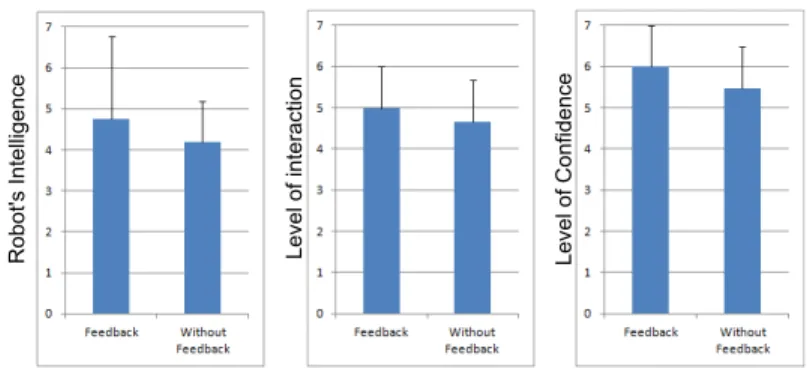
Fig. 4 People’s perception of the use of the interaction (remote control). Left: Robot’s
Intelli-gence. Center: Level of interaction. Right: Level of confidence.
• With feedback • Without feedback
The measurement of the performance of the overall system is a simple rating on a Likert scale between 1 to 7. For the evaluation score, ANOVA measurements are conducted. It is necessary to study if the use of the remote control enhances the interaction between the robot and a person.
In order to analyze if the use of the remote control enhances the interaction be-tween the robot and a person, three different scores are examined: “Robot’s Intel-ligence”, “Level of interaction” and “Level of confidence”, plotted in Fig. 4. To summarize, the multimodal feedback under the shape of a wii remote controller improves the subjective performance, according to the poll, nevertheless, the im-provement is marginal.
3 Autonomous Mobile Robot Seeking Interaction for
Human-Assisted Learning
In the last years, great efforts have been carried out by researchers around the world with the aim of creating robots capable of initiate and keep dynamic and coherent conversations with humans [27]. If robots are able to start a conversation, they cre-ate an active engagement with people which can be used to seek assistance from them. This engagement is particular convenient to improve some robot skills. For example, a human can act as a teacher to guide and correct the robot’s behavior or its response. This active interaction leads to improve the robot capabilities using the human knowledge.
In this section, we present a multi-modal framework where robot and human interact actively to compute an on-line and discriminative face detector. To achieve this objective, the proposed framework consists of two main components or steps. The first one corresponds to create the engagement between the robot and a human,
whereas the second step refers to the computation of the on-line face detector once the engagement and the dialogue are established.
More specifically, during the first step, the robot seeks and approaches to a human in order to initiate the conversation or interaction. This is done using its sensors and approaching algorithms. Once the conversation is initialized, a coherent dialogue is conducted during the second step to compute and refine the face detector using the human assistance. This results in a robust and discriminative face detector that is computed on the fly and is assisted in difficult circumstances.
The proposed framework is described in the following. Sec. 3.1 shows the proac-tively seeking interaction between the robot and humans (first step), and Sec. 3.2 describes the on-line face detector and the procedure used to assist the classifier using human-robot interactions (second step).
3.1 Robot’s Proactively Seeking Interaction
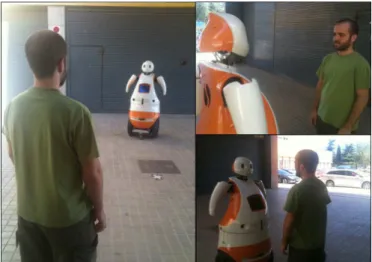
Recently, social robots have begun to move from laboratories to real environments to perform daily life activities [30, 31, 35]. To this end, the robots must be able to interact with people in a natural way. Recent studies have shown robots which are able to encourage people to begin interaction [8, 19], but using a strategy based on people approaching to the robot in order to establish the interaction and dialogue. Contrary, we present, in this section, a method where the robot is proactive and approaches to people to initiate the interaction and establish the engagement. This is exemplified in Fig. 5.
This proactive way of creating engagements between people and robots enables numerous applications such as guiding robots, tourism robots, or robots focused in approaching people for providing information about a specific urban area. On the other hand, this engagement can be also useful to assist the robot and improve its skills. For example, using the human help, the robot can improve its vision skills. Therefore, it can detect objects and faces in a more robust and discriminative man-ner. The human can assist the robot to validate or correct the robot responses when it has uncertainty about its predictions. In this way, the robot capabilities are im-proved along with the number of human interventions. This is particular application is addressed in Sec. 3.2.
To seek the interaction with humans, the robot has a people detector that allows to localize and identify humans in its neighbourhood. Once the person is localized, the robot approaches and invites the human to initiate and participate in the interac-tion. The robot is also able to respond according to human reactions. For instance, if the robot invites a person to approach, and he ignores it, the robot will return to insist. However, if human does not approach, the robot will search for another volun-teer. Furthermore, if a person shows interest in the robot, it will start the interaction process with this person.
The active robot’s behavior is performed developing a finite state machine. This state machine allows robot to react depending on people’s behavior. The robot is
Fig. 5 Robot approaching. The TIBI robot approaches to a human to start the interaction.
able to decide if humans are interested in starting the interaction by tracking people positions only.
The robot’s behavior is based on the conceptual framework known as “prox-emics” presented by Hall [18], which studied human perception and the use of the space. This work proposed a basic classification of distances between individuals: • Intimate distance: the presence of other person is unmistakable, close friends or
lovers (0-45cm).
• Personal distance: comfortable spacing, friends (45cm-1.22m).
• Social distance: limited involvement, non-friends interaction (1.22m-3m). • Public distance: outside circle of involvement, public speaking (>3m).
Based on these proxemics, Michalowski et al. [26] classified the space around a robot to distinguish human’s levels of engagement while interacting or moving around a robot. In the present work, our robot tries to maintain a social distance through voice messages and movements.
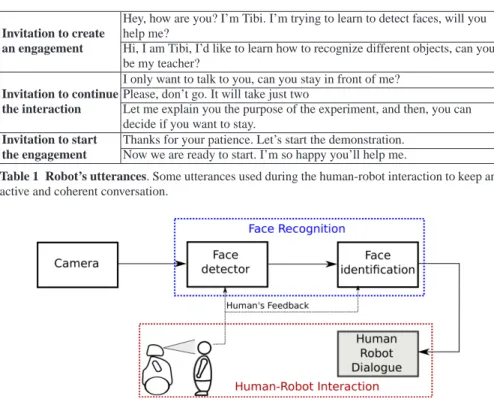
In Table 1 some sample phrases uttered by the robot are presented. Allowing the robot to acquire the proactive behavior, the number of interactions between the robot and people increases, so, as it will be explained in section 3.2, humans are able to assist the robot in the the computation of an on-line method for face recognition.
3.2 On-line Face Learning Approach
In order to detect and identify faces in images, we use an on-line and discrimina-tive classifier. Particularly, this classifier is based on on-line random ferns [22, 33],
Hey, how are you? I’m Tibi. I’m trying to learn to detect faces, will you
Invitation to create help me?
an engagement Hi, I am Tibi, I’d like to learn how to recognize different objects, can you be my teacher?
I only want to talk to you, can you stay in front of me?
Invitation to continue Please, don’t go. It will take just two
the interaction Let me explain you the purpose of the experiment, and then, you can decide if you want to stay.
Invitation to start Thanks for your patience. Let’s start the demonstration.
the engagement Now we are ready to start. I’m so happy you’ll help me.
Table 1 Robot’s utterances. Some utterances used during the human-robot interaction to keep an
active and coherent conversation.
Fig. 6 On-line face learning. The proposed approach consists, mainly, of a face recognition
mod-ule and a human-robot interaction modmod-ule. The first modmod-ule is in charge of detecting and identify-ing faces, whereas the second one establishes a dialog with a human. The synergically combination of both modules allows to compute a robust and efficient classifier for recognizing faces using a mobile robot.
which can be progressively learned using its own hypotheses as new training sam-ples. To avoid feeding the classifier with false positive samples, the robot will ask for the human assistance when dealing with uncertain hypotheses. This particular combination of human and robot skills allows to compute a discriminative and ro-bust face classifier that outperforms a completely off-line random ferns [28], both in terms of recognition rate and number of false positives.
Following, the main components of the proposed approach are described in de-tail. Fig. 6 sketches these constituents and the overview scheme. The synergically combination of a face recognition system with a human-robot interaction module gives the proposed approach: on-line face learning.
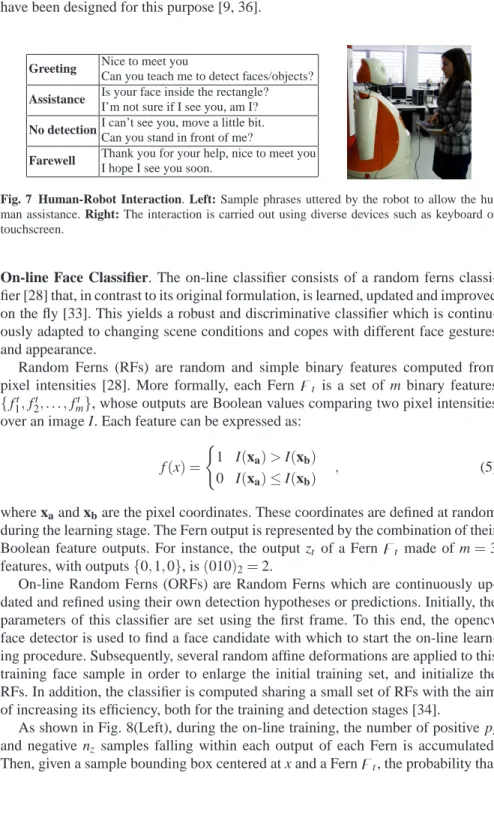
Human-Robot Interaction. The on-line classifier is learned and assisted using the mobile robot and its interaction with a human. To this end, the robot is equipped with devices such as a keyboard and a screen that enable a dynamic and efficient interaction with the human. The interaction is carried out by formulating a set of concise questions (Fig. 7(Left)), that expect for a ‘yes’ or ‘not’ answer. In addition, the robot has been programmed with behaviors that avoid having large latency times,
specially when the human does not know exactly how to proceed. Strategies for approaching the person in a safe and social manner, or attracting people’s attention have been designed for this purpose [9, 36].
Greeting Nice to meet you
Can you teach me to detect faces/objects?
Assistance Is your face inside the rectangle?
I’m not sure if I see you, am I?
No detectionI can’t see you, move a little bit.
Can you stand in front of me?
Farewell Thank you for your help, nice to meet you
I hope I see you soon.
Fig. 7 Human-Robot Interaction. Left: Sample phrases uttered by the robot to allow the
hu-man assistance. Right: The interaction is carried out using diverse devices such as keyboard or touchscreen.
On-line Face Classifier. The on-line classifier consists of a random ferns classi-fier [28] that, in contrast to its original formulation, is learned, updated and improved on the fly [33]. This yields a robust and discriminative classifier which is continu-ously adapted to changing scene conditions and copes with different face gestures and appearance.
Random Ferns (RFs) are random and simple binary features computed from pixel intensities [28]. More formally, each Fern ̥t is a set of m binary features {ft
1,f2t, . . . ,fmt}, whose outputs are Boolean values comparing two pixel intensities over an image I. Each feature can be expressed as:
f(x) =
(
1 I(xa)>I(xb)
0 I(xa)≤I(xb) , (5)
where xaand xbare the pixel coordinates. These coordinates are defined at random during the learning stage. The Fern output is represented by the combination of their Boolean feature outputs. For instance, the output zt of a Fern̥t made of m=3 features, with outputs{0,1,0}, is(010)2=2.
On-line Random Ferns (ORFs) are Random Ferns which are continuously up-dated and refined using their own detection hypotheses or predictions. Initially, the parameters of this classifier are set using the first frame. To this end, the opencv face detector is used to find a face candidate with which to start the on-line learn-ing procedure. Subsequently, several random affine deformations are applied to this training face sample in order to enlarge the initial training set, and initialize the RFs. In addition, the classifier is computed sharing a small set of RFs with the aim of increasing its efficiency, both for the training and detection stages [34].
As shown in Fig. 8(Left), during the on-line training, the number of positive pz and negative nz samples falling within each output of each Fern is accumulated. Then, given a sample bounding box centered at x and a Fern̥t, the probability that
Fig. 8 On-line Random Ferns. Left: Ferns probabilities. Right: Human-assistance criterion.
x belongs to the positive class is approximated by P(Ft=z|x) =pz/(pz+nz), where z is the Fern output [22, 33]. The average of all Fern probabilities gives the response
of the on-line classifier:
H(x) =1 k k
∑
t=1 P(̥t|x), (6)where 1k is a normalization factor. If the classifier confidence H(x)is above 0.5, the sample x will be assigned to the positive (face) class. Otherwise, it will be assigned to the negative (background) class.
The classifier is updated every frame using its own hypotheses or predictions. In particular, the classifier selects the hypothesis (bounding box) with the highest confidence as the new face location. Using this hypothesis as reference, nearby hy-potheses are considered as new positive samples, while hyhy-potheses which are far away are considered as new false positive samples. These positive and false positive samples are then evaluated for all the Ferns to update the aforementioned pzand nz parameters, see Fig. 8(Left).
Human Assistance. ORFs are continuously updated using their own detection pre-dictions. However, in difficult situations in which the classifier is not confident about its response, the human assistance will be required. The degree of confidence is de-termined by the response H(x). Ideally, if H(x)>0.5 the sample should be classi-fied as a positive. Yet, as shown in Fig. 8(Right), a range of valuesθ (centered on
H(x) =0.5) is defined for which the system is not truly confident about the classi-fier response. Note that the width ofθ represents a trade off between the frequency of required human interventions, and the recognition rates. A concise evaluation of this parameter is performed in the experimental section.
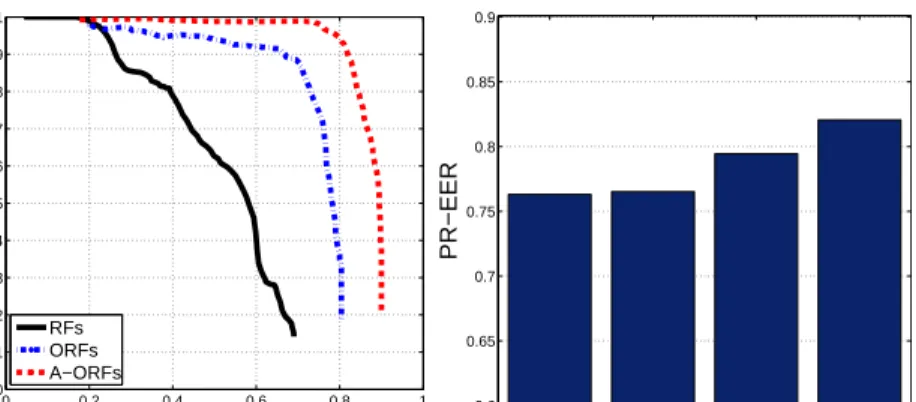
0 0.2 0.4 0.6 0.8 1 0 0.1 0.2 0.3 0.4 0.5 0.6 0.7 0.8 0.9 1 Recall Precision RFs ORFs A−ORFs 0.6 0.65 0.7 0.75 0.8 0.85 0.9 PR−EER θ = 0.05 θ = 0.1 θ = 0.2 θ = 0.3
Fig. 9 Face Recognition Rates. Left: Precision-Recall curves for different detection approaches. Right: Recognition rates in terms of human assistance.
3.3 Experiments
The on-line face learning method is evaluated on a face dataset acquired using a mobile robot. This face dataset has 12 sequences of 6 different persons (2 sequences per person). Each face classifier is learned using an image sequence and tested in the second one. The dataset is quite challenging as faces appear under partial occlusions, 3D rotations and at different scales. Also, fast motions and face gestures disturb the learning method [33].
More precisely, the learning/recognition method is evaluated using three differ-ent strategies for building the classifier. First, an offline Random Ferns approach (RFs) is considered. This classifier is learned using just the first frame of the train-ing sequence and is not updated anymore. The second approach considers an ORFs methodology without human intervention. Finally, the proposed human-assisted ap-proach which is denoted by A-ORFs. Remind that the human assistance is only required during the learning stage. During the test, all classifiers remain constant, with no further updating or assistance.
Fig. 9(Left) shows the Precision-Recall curves of the three methodologies, and Fig. 3.3(Left) depicts the Equal Error Rates (EER). Both graphs show that the A-ORFs consistently outperform the other two approaches. This was in fact expected, as the A-ORFs significantly reduce the risk of drifting, for which both the RFs and ORFs are very sensitive, especially when dealing with large variations of the learn-ing sequence.
What is remarkable about the proposed approach is that its higher performance can be achieved with very little human effort. This is shown both in the last 4 rows of the table in Fig. 3.3(Left) and in Fig. 9(Right), where it is seen how the amount of human assistance influences the detection rates. Observe that with just assisting in a 4% of the training frames, the detection rate with respect to ORFs increases a 2%. This improvement grows to an 8% when the human assists on a 25% of the frames.
Method θ PR-EER Human Assistance RFs − 55.81 − ORFs − 74.79 − A-ORFs 0.05 76.31 4.66%±0.46 A-ORFs 0.1 76.51 9.54%±0.87 A-ORFs 0.2 79.44 16.25%±1.09 A-ORFs 0.3 82.06 25.72%±1.65
Fig. 10 Recognition Results. Left: Face recognition rates for different learning approaches:
off-line Random Ferns (RFs), On-off-line Random Ferns (ORFs) and On-off-line Human-Assisted Random Ferns (A-ORFs). Right: Face detection examples given by the proposed human-assisted method.
Finally, Fig. 3.3(Right) shows a few sample frames of the detection results, once the classifier learning is saturated (i.e., when no further human intervention is re-quired). The on-line face classifier is able to handle large occlusions, scalings and rotations, at about 5 fps.
4 Conclusions
In this chapter we have presented two different ways of robot learning using the interaction with humans. Furthermore, we have described two different prototypes: interactive motion learning for robot companion; and mobile robot proactively seek-ing interaction plus human-assisted learnseek-ing.
We have presented a complete interactive motion learning for robot companion, the “interactive motion learning for robot companion” prototype, in three stages. The first initial design, the perception module, has been implemented and tested ex-tensively in indoor environments. The implementation of the second design, where an external agent moves the robot, was a key step in order to obtain a human in-tentionality predictor and a motion predictor. A database has been collected of the robot approach to a walking human and the data was used to calculate the model parameters of the intrinsic forces and the interaction forces. For the final stage, we have implemented a multimodal feedback system, where a behavior inference of the weighting parameters of the contributing forces is implemented on-line. All this stages went through intensive real experimentation in outdoor scenarios, by far more challenging scenarios. The results are measured using a poll and its results give in-formation regarding the success of the system.
In the “online face learning using robot vision” prototype the human-robot in-teraction is performed in a very dynamic and efficient manner. Robot’s proactive behavior has advantages in comparison with passive conducts. Firstly, invitation service, a robot offers information and invites people to interact with it. And, sec-ondly, this behavior increases the number of interactions, and therefore, people can assist the robot to improve its skills continuously. Furthermore, we have realized
that using the interactive multimodal framework, we are able to handle large oc-clusions, scaling and rotations in different environment and with diverse number of people.
Acknowledgements This research was conducted at the Institut de Rob`otica i Inform`atica
In-dustrial (CSIC- UPC). It was partially supported by the CICYT project RobTaskCoop (DPI2010-17112) and the MIPRCV Ingenio Consolider 2010 (CSD2007-018).
References
1. K.O. Arras, S. Grzonka, M. Luber, and W. Burgard. Efficient people tracking in laser range data using a multi-hypothesis leg-tracker with adaptive occlusion probabilities. IEEE
Interna-tional Conference on Robotics and Automation, pages 1710–1715, May 2008.
2. K.O. Arras, O.M. Mozos, and W. Burgard. Using boosted features for the detection of people in 2d range data. In IEEE International Conference on Robotics and Automation, number April, pages 3402–3407. IEEE, 2007.
3. M. Bennewitz, W. Burgard, G. Cielniak, and S. Thrun. Learning motion patterns of people for compliant robot motion. The International Journal of Robotics Research, 24(1):31, 2005. 4. J. Casper and R.R. Murphy. Human-robot interactions during the robot-assisted urban search
and rescue response at the world trade center. IEEE transactions on systems, man, and
cyber-netics, Part B., 33(3):367–385, 2003.
5. S.Y. Chung and H. Huang. A Mobile Robot That Understands Pedestrian Spatial Behaviors.
Learning, pages 5861–5866, 2010.
6. N. Dalal and B. Triggs. Histograms of oriented gradients for human detection. In IEEE
CVPR’05, June 2005.
7. K. Dautenhahn. Robots as social actors: Aurora and the case of autism. In The Third
Interna-tional Cognitive Technology Conference, pages 359–374, 1999.
8. K. Dautenhahn, M. Walters, S. Woods, K.L. Koay, CL Nehaniv, A. Sisbot, R. Alami, and T. Sim´eon. How may i serve you?: a robot companion approaching a seated person in a helping context. In Proceedings of the 1st ACM SIGCHI/SIGART conference on Human-robot
interaction, pages 172–179. ACM, 2006.
9. D. Feil-Seifer and M.J. Mataric. Defining socially assistive robotics. In Proc. of the
Interna-tional Conference on Robotics and Automation, pages 465–468, 2005.
10. G. Ferrer and A. Sanfeliu. Comparative analysis of human motion trajectory prediction using minimum variance curvature. In Proceedings of the 6th international conference on
Human-robot interaction, pages 135–136, Lausanne, Switzerland, 2011.
11. A.F. Foka and P.E. Trahanias. Probabilistic Autonomous Robot Navigation in Dynamic Envi-ronments with Human Motion Prediction. International Journal of Social Robotics, 2(1):79– 94, 2010.
12. D. Fox, W. Burgard, and S. Thrun. The dynamic window approach to collision avoidance.
IEEE Robotics; Automation Magazine, 4(1):23–33, March 1997.
13. T. Fraichard and J.J. Kuffner. Guaranteeing motion safety for robots. Autonomous Robots, (January), February 2012.
14. A. Garrell and A. Sanfeliu. Local optimization of cooperative robot movements for guid-ing and regroupguid-ing people in a guidguid-ing mission. In IEEE/RSJ International Conference on
Intelligent Robots and Systems. IEEE, 2010.
15. A. Garrell and A. Sanfeliu. Cooperative social robots to accompany groups of people. The
International Journal on Robotics Research, published online 4 September 2012, 2012.
16. A. Garrell, A. Sanfeliu, and F. Moreno-Noguer. Discrete time motion model for guiding people in urban areas using multiple robots. In IEEE/RSJ International Conference on Intelligent
17. D.E. Goldberg. Genetic Algorithms in Search, Optimization & Machine Learning. Addison-Wesley, 1988.
18. E. T. Hall. The hidden dimension, man’s use of space in public and private. Great Britain,
London: The Bodley Head Ltd, 1966.
19. K. Hayashi, D. Sakamoto, T. Kanda, M. Shiomi, S. Koizumi, H. Ishiguro, T. Ogasawara, and N. Hagita. Humanoid robots as a passive-social medium: a field experiment at a train station. In Proceedings of the ACM/IEEE international conference on Human-robot interaction, pages 137–144, 2007.
20. D. Helbing and P. Moln´ar. Social force model for pedestrian dynamics. In Physical review.
E, Statistical physics, plasmas, fluids, and related interdisciplinary topics, volume 51, pages
4282–4286. May 1995.
21. P. Henry, C. Vollmer, and B. Ferris. Learning to navigate through crowded environments.
Robotics and Automation, 2010.
22. Z. Kalal, J. Matas, and K. Mikolajczyk. P–n learning: Bootstrapping binary classifiers by structural constraints. In Computer Vision and Pattern Recognition, 2010.
23. T. Kanda, D.F. Glas, M. Shiomi, H. Ishiguro, and N. Hagita. Who will be the customer?: a social robot that anticipates people’s behavior from their trajectories. In Proceedings of the
10th international conference on Ubiquitous computing, pages 380–389. ACM, 2008.
24. K. Kawamura, R.T. Pack, M. Bishay, and M. Iskarous. Design philosophy for service robots.
Robotics and Autonomous Systems, 18(1–2):109–116, 1996.
25. M. Luber, G. Diego Tipaldi, and K.O. Arras. Place-dependent people tracking. The
Interna-tional Journal of Robotics Research, 30(3):280, January 2011.
26. M.P. Michalowski, S. Sabanovic, and R. Simmons. A spatial model of engagement for a social robot. pages 762–767, 2006.
27. Y. Morales, S. Satake, R. Huq, D. Glas, T. Kanda, and N. Hagita. How do people walk side-by-side?using a computational model of human behavior for a social robot. In ACM/IEEE
International Conference on Human-Robot Interaction, pages 301–308, 2012.
28. M. Ozuysal, M. Calonder, V. Lepetit, and P. Fua. Fast keypoint recognition using random ferns. In IEEE Transactions Pattern Analysis and Machine Intelligence, pages 448–461, 2010. 29. J.C. Scholtz. Human-robot interactions: Creating synergistic cyber froces. In Multi-robot
systems: from swarms to intelligent automata: proceedings from the NRL workshop on multi-robot systems, page 177, 2002.
30. R. Siegwart, K.O. Arras, S. Bouabdallah, D. Burnier, G. Froidevaux, X. Greppin, B. Jensen, A. Lorotte, L. Mayor, and M. Meisser. Robox at expo. 02: A large-scale installation of personal robots. Robotics and Autonomous Systems, 42(3):203–222, 2003.
31. T. Tasaki, S. Matsumoto, H. Ohba, M. Toda, K. Komatani, T. Ogata, and H.G Okuno. Dynamic communication of humanoid robot with multiple people based on interaction distance. In
RO-MAN, 13th IEEE International Workshop on Robot and Human Interactive Communication,
pages 71–76. IEEE, 2004.
32. C. Trevai, Y. Fukazawa, J. Ota, H. Yuasa, T. Arai, and H. Asama. Cooperative exploration of mobile robots using reaction-diffusion equation on a graph. ICRA, 2003.
33. M. Villamizar, A. Garrell, A. Sanfeliu, and F. Moreno-Noguer. Online human-assisted learn-ing uslearn-ing random ferns. In International Conference on Pattern Recognition, Tsukuba, Japan, 2012.
34. M. Villamizar, F. Moreno-Noguer, J. Andrade-Cetto, and A. Sanfeliu. Shared random ferns for efficient detection of multiple categories. In International Conference on Pattern Recognition, 2010.
35. K. Wada, T. Shibata, T. Saito, and K. Tanie. Analysis of factors that bring mental effects to elderly people in robot assisted activity. volume 2, pages 1710–1715, 2002.
36. D.M. Wilkes, R.T. Pack, A. Alford, and K. Kawamura. Hudl, a design philosophy for socially intelligent service robots. In American Association for Artificial Intelligence Conference, 1997.
37. F. Zanlungo, T. Ikeda, and T. Kanda. Social force model with explicit collision prediction.