Representation on the Semantic Web
Edited byPiero Andrea Bonatti
1, Stefan Decker
2, Axel Polleres
3, and
Valentina Presutti
41 University of Naples, IT, [email protected]
2 RWTH Aachen, DE, [email protected]
3 Wirtschaftsuniversität Wien, AT, [email protected]
4 STLab, ISTC-CNR – Rome, IT, [email protected]
Abstract
The increasingly pervasive nature of the Web, expanding to devices and things in everyday life, along with new trends in Artificial Intelligence call for new paradigms and a new look on Knowledge Representation and Processing at scale for the Semantic Web. The emerging, but still to be concretely shaped concept of “Knowledge Graphs” provides an excellent unifying metaphor for this current status of Semantic Web research. More than two decades of Semantic Web research provides a solid basis and a promising technology and standards stack to interlink data, ontologies and knowledge on the Web. However, neither are applications for Knowledge Graphs as such limited to Linked Open Data, nor are instantiations of Knowledge Graphs in enterprises – while often inspired by – limited to the core Semantic Web stack. This report documents the program and the outcomes of Dagstuhl Seminar 18371 “Knowledge Graphs: New Directions for Knowledge Representation on the Semantic Web”, where a group of experts from academia and industry discussed fundamental questions around these topics for a week in early September 2018, including the following: what are knowledge graphs? Which applications do we see to emerge? Which open research questions still need be addressed and which technology gaps still need to be closed?
Seminar September 9–14, 2018 – http://www.dagstuhl.de/18371
2012 ACM Subject Classification Information systems→Semantic web description languages,
Computing methodologies→Artificial intelligence, Computing methodologies→Knowledge
representation and reasoning, Computing methodologies → Natural language processing,
Computing methodologies→Machine learning, Human-centered computing→Collaborative
and social computing
Keywords and phrases knowledge graphs, knowledge representation, linked data, ontologies, semantic web
Digital Object Identifier 10.4230/DagRep.8.9.29 Edited in cooperation with Michael Cochez
Acknowledgements The editors are grateful to Michael Cochez for his valuable contributions to the planning and organization of this workshop. He was in all respects the fifth organizer.
1
Executive Summary
Piero Andrea Bonatti (University of Naples, IT) Michael Cochez (Fraunhofer FIT, DE)
Stefan Decker (RWTH Aachen, DE)
Axel Polleres (Wirtschaftsuniversität Wien, AT) Valentina Presutti (STLab, ISTC-CNR – Rome, IT)
License Creative Commons BY 3.0 Unported license
© Piero Andrea Bonatti, Michael Cochez, Stefan Decker, Axel Polleres, and Valentina Presutti
In 2001 Berners-Lee et al. stated that “The Semantic Web is an extension of the current web in which information is given well-defined meaning, better enabling computers and people to work in cooperation.”
The time since the publication of the paper and creation of the foundations for the Semantic Web can be roughly divided in three phases: The first phase focused on bringing Knowledge Representation to Web Standards, e.g., with the development of OWL. The second phase focused on data management, linked data and potential applications. In the third, more recent phase, with the emergence of real world applications and the Web emerging into devices and things, emphasis is put again on the notion of Knowledge, while maintaining the large graph aspect: Knowledge Graphs have numerous applications like semantic search based on entities and relations, disambiguation of natural language, deep reasoning (e.g. IBM Watson), machine reading (e.g. text summarisation), entity consolidation for Big Data, and text analytics. Others are exploring the application of Knowledge Graphs in industrial and scientific applications.
The shared characteristic by all these applications can be expressed as a challenge: the capability of combining diverse (e.g. symbolic and statistical) reasoning methods and knowledge representations while guaranteeing the required scalability, according to the reasoning task at hand. Methods include: Temporal knowledge and reasoning, Integrity constraints, Reasoning about contextual information and provenance, Probabilistic and fuzzy reasoning, Analogical reasoning, Reasoning with Prototypes and Defeasible Reasoning, Cognitive Frames, Ontology Design Patterns (ODP), and Neural Networks and other machine learning models.
With this Dagstuhl Seminar, we intend to bring together researchers that have faced and addressed the challenge of combining diverse reasoning methods and knowledge representa-tions in different domains and for different tasks with Knowledge Graphs and Linked Data experts with the purpose of drawing a sound research roadmap towards defining scalable Knowledge Representation and Reasoning principles within a unifying Knowledge Graph framework. Driving questions include:
What are fundamental Knowledge Representation and Reasoning methods for Knowledge Graphs?
How should the various Knowledge Representation, logical symbolic reasoning, as well as statistical inference methods be combined and how should they interact?
What are the roles of ontologies for Knowledge Graphs? How can existing data be ingested into a Knowledge Graph?
In order to answer these questions, the present seminar was aiming at cross-fertilisation between research on different Knowledge Representation mechanisms, and also to help to identify the requirements for Knowledge Representation research originating from the deployment of Knowledge graphs and the discovery of new research problems motivated by
applications. We foresee, from the results summarised in the present report, the establishment of a new research direction, which focuses on how to combine the results from knowledge representation research in several subfields for joint use for Knowledge Graphs and Data on the Web.
The Seminar
The idea of this seminar emerged when the organisers got together discussing about writing a grant proposal. They all shared, although from different perspectives, the conviction that research on Semantic Web (and its scientific community) reached a critical point: it urged a paradigm shift. After almost two decades of research, the Semantic Web community established a strong identity and achieved important results. Nevertheless, the technologies resulting from its effort on the one hand have proven the potential of the Semantic web vision, but on the other hand became an impediment; a limiting constraint towards the next major breakthrough. In particular, Semantic Web knowledge representation models are insufficient to face many important challenges such as supporting artificial intelligence systems in showing advanced reasoning capabilities and socially-sound behaviour at scale. The organisers soon realised that a project proposal was not the ideal tool for addressing this problem, which instead needed a confrontation of the Semantic Web scientific community with other relevant actors, in the field. From this discussion, the ”knowledge graph” concept emerged as a key unifying ingredient for this new form of knowledge representation – embracing both the Semantic Web, but also other adjacent communities – and it was agreed that a Dagstuhl seminar on ”Knowledge Graphs: New Directions for Knowledge Representation on the Semantic Web” was a perfect means for the purpose.
The list of invitees to the seminar included scientists from both academia and industry working on knowledge graphs, linked data, knowledge representation, machine learning, automated reasoning, natural language processing, data management, and other relevant areas. Forty people have participated in the seminar, which was very productive. The active discussions during plenary and break out sessions confirmed the complex nature of the proposed challenge. This report is a fair representative of the variety and complexity of the addressed topics.
The method used for organising the seminar deserves further elaboration. The seminar had a five-day agenda. Half of the morning on the first day was devoted to ten short talks (5 minutes each) given by a selection of attendees. The speakers were identified by the organisers as representatives of complimentary topics based on the result of a Survey conducted before the seminar: more than half of the invitees filled a questionnaire that gave them the opportunity to briefly express their perspectives on the topic and to point out relevant challenges that they would put in their future research agenda with the highest priority.
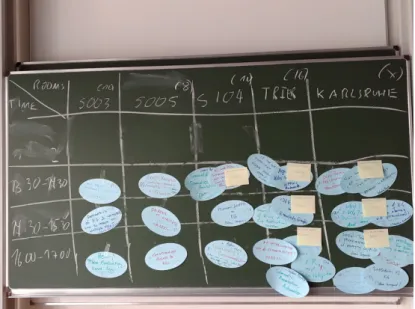
The aim of these short speeches was to ignite the confrontation by sharing the emerging views on the main challenges from this survey. After the speeches we organised the further discussion in an “Open Space” session that served to collaboratively build the agenda for the rest of the day (and that influenced the agenda of the next days). The open space method consists of giving everyone the opportunity to propose one or more break out topics. To propose a topic, a proposer had to explain in few words what it was about, then write it down on a post-it that was attached on a blackboard (see Figure 1). At the end of the session, attendees were invited to sign up for the topics of their interest (by marking the corresponding post-it).
Figure 1Blackboard with post-its from the open session.
The more popular ones (up to fifteen and having at least three sign ups) were selected to compose the agenda. Each break out session used a one-hour slot during the afternoon. The second day continued with most of the break out sessions with the aim of continuing the discussion started the first day and work towards consolidating a report (finalised on the fourth day). Reports would reflect view and vision emerging from the break out group. On the same day attendees had the opportunity to self-propose to give additional short speeches, addressing missing relevant topics. We used part of the second day’s morning for these speeches. We explicitly asked attendees to avoid speeches on “my research” and to only address relevant challenges that were overlooked so far.
On the third day we started with a plenary discussion and the seminar group agreed on splitting into four groups to discuss “Grand challenges” separately, then share the results before going back to the break out sessions. The aim was to share a common high level vision reference before consolidating the more specific discussions that were ongoing in the break out sessions. On the fourth day, the seminar group split again in break out sessions including a “Grand challenges” one. Each session was assigned to at least two coordinators, who committed to consolidate in a draft report the results from the previous meetings. It was decided to merge a few topics, when appropriate.
Break out sessions had varied level of technical abstraction depending on the nature of the topic, and its level of maturity within the state of the art. To give some examples: the break out session about “Grand challenges” mainly discussed a vision for a future research agenda and maintained a high level of abstraction, while the session on “Human and Social Factors in Knowledge Graphs” provided more concrete insights as it could build on both academic and industrial research results, projects and practical experiences. The session on “Applications of Knowledge Graphs” focused on technical details and issues on two relevant
Overview of the Report
This report is organised in two main parts: Section 3 includes a list of abstracts providing an overview of the short speeches that we had the first two days. All the other sections are consolidated reports of the emerging vision, research challenges, possible research agenda, and proposed approaches, from break out sessions. When applicable, the reports give an overview of specific relevant research work.
2
Table of Contents
Executive Summary
Piero Andrea Bonatti, Michael Cochez, Stefan Decker, Axel Polleres, and
Valentina Presutti. . . 30 Overview of Short Talks
Evolution and dynamics
Eva Blomqvist. . . 36 Enabling Accessible Scholarly Knowledge Graphs
Sarven Capadisli . . . 36 Logic and learning – Can we provide Explanations in the current Knowledge Lake? Claudia d’Amato . . . 37
Knowledge graph creation and management
Michel Dumontier . . . 39 New Symbol Groundings for Knowledge Graphs
Paul Groth . . . 39 Cultural issues in multilingual knowledge graph
Roberto Navigli . . . 40 Quality and Evaluation of Knowledge Graphs (beyond DBpedia)
Heiko Paulheim . . . 40 Humans in the Loop, Human readable KG
Marta Sabou . . . 41 ML with KGs – research and use cases around KGs at Siemens
Volker Tresp . . . 41 Privacy and constrained access
Sabrina Kirrane. . . 42 Value Proposition of Knowledge Graphs
Sonja Zillner . . . 42 Social-Technical Phenomena of (Enterprise) Knowledge Graph Management
Juan F. Sequeda . . . 43 Concise account of the notion of Knowledge Graph
Claudio Gutierrez . . . 43 Grand Challenges
Paul Groth, Frank van Harmelen, Axel-Cyrille Ngonga Ngomo, Valentina Presutti, Juan Sequeda, and Michel Dumontier. . . 45 On the Creation of Knowledge Graphs: A Report on Best Practices and their Future
Sabbir M. Rashid, Eva Blomqvist, Cogan Shimizu, and Michel Dumontier . . . 49 Knowledge Integration at Scale
Andreas Harth, Roberto Navigli, Andrea Giovanni Nuzzolese, Maria-Esther Vidal . 54 Knowledge Dynamics and Evolution
Evaluation of Knowledge Graphs
Heiko Paulheim, Marta Sabou, Michael Cochez, and Wouter Beek. . . 63 Combining Graph Queries with Graph Analytics
Dan Brickley, Aidan Hogan, Sebastian Neumaier, and Axel Polleres . . . 69 (Re)Defining Knowledge Graphs
Aidan Hogan, Dan Brickley, Claudio Gutierrez, Axel Polleres, and Antoine Zim-mermann . . . 74 Foundations
Claudia d’Amato, Sabrina Kirrane, Piero Bonatti, Sebastian Rudolph, Markus Krötzsch, Marieke van Erp, and Antoine Zimmermann . . . 79 Natural Language Processing and Knowledge Graphs
Paul Groth, Roberto Navigli, Andrea Giovanni Nuzzolese, Marieke van Erp, and Gerard de Melo . . . 89 Machine Learning and Knowledge Graphs
Steffen Staab, Gerard de Melo, Michael Witbrock, Volker Tresp, Claudio Gutierrez, Dezhao Song, and Axel-Cyrille Ngonga Ngomo . . . 93 Human and Social Factors in Knowledge Graphs
Marta Sabou, Elena Simperl, Eva Blomqvist, Paul Groth, Sabrina Kirrane, Gerarrd de Melo, Barend Mons, Heiko Paulheim, Lydia Pintscher, Valentina Presutti, Juan F. Sequeda, and Cogan Matthew Shimizu. . . 100 Applications of Knowledge Graphs
Sarven Capadisli and Lydia Pintscher . . . 104 Knowledge Graphs and the Web
Sarven Capadisli, Michael Cochez, Claudio Gutierrez, Andreas Harth, and Antoine Zimmermann . . . 106 Participants . . . 111
3
Overview of Short Talks
3.1 Evolution and dynamics
Eva Blomqvist (Linköping University, SE) License Creative Commons BY 3.0 Unported license
© Eva Blomqvist
Nobody would today consider the Web as a static thing. Similarly, knowledge in a company is never static, it is constantly changing. So why is it that so many approaches developed in the past decades make the assumption that knowledge on the web, or elsewhere, is not going to change? At an early stage this can be a way to manage the complexity of a problem, simply to get started, but we cannot afford to use that excuse any more – if we want to be taken seriously by developers and users out in industry. New methods, technologies and standards that we produce, or propose, need to start from this assumption, i.e., that everything is dynamic, and build on that, rather than ignoring it and then potentially trying to cover it by add-ons at the end. Knowledge graphs in a highly dynamic environment necessarily needs to themselves be highly dynamic and constantly evolving, and we are the ones that have to provide the technology to support that evolution!
3.2 Enabling Accessible Scholarly Knowledge Graphs
Sarven Capadisli (TIB – Hannover, DE)
License Creative Commons BY 3.0 Unported license
© Sarven Capadisli
Scholarly knowledge includes a range of research artefacts that needs to be described. These include research articles, peer reviews, research data, social interactions like review requests and notifications in general, as well as different kinds of annotations on research objects. The current state of access and use of scholarly knowledge is insufficient for society at large. By enabling accessible scholarly knowledge graphs as well as applications which make use of it, we hope to enable universal access to previous research. By improving the availability through linked research, we can facilitate discovery and building on existing research. A fundamental first step is to investigate and develop effective ways to represent fine-grained information that is accessible, human and machine-interpretable, and interconnected. Other challenges look into ways in which academic journals can decouple the registration and certification functions of scholarly communication. Also we can investigate the feasibility of universal access to knowledge through decentralisation, freedom of expression, privacy respecting, and social.
3.3 Logic and learning – Can we provide Explanations in the current
Knowledge Lake?
Claudia d’Amato (University of Bari, IT)
License Creative Commons BY 3.0 Unported license
© Claudia d’Amato
The goal of the talk is to raise the attention on the following research questions: a) is it important to provide explanations when providing information by exploiting a Knowledge Graph (KG)? b) Would it be possible to design integrated numeric and symbol-based machine learning methods, to be used for tackling the link prediction problem, that are scalable and able to provide interpretable models? c) Are interpretable models a sufficient form of explanation or do we need to provide an actual line of reasoning, illustrating the decision making process? d) Is it possible to develop a unified framework integrating different reasoning paradigms?
A KG is often defined as an object for describing entities and their interrelations, by means of a graph. Knowledge graphs are usually assumed to be large and arbitrary entities may be interrelated, thus covering various topical domains [1]. The importance of assessing relations among entities has driven research on developing effective methods for solving the link prediction problem. This is often regarded as a classification problem that can be solved by the use of machine learning classification methods. In the last few years, vector space embedding solutions have been largely adopted [2, 3]. They allow to create propositional feature vector representations starting from more complex representations, such as graphs, thus allowing to apply numeric approaches resulting scalable besides of effective. The main problem of numeric approaches is that they do not allow to provide somehow an explanation of the predicted results, that is, similarly to the goal of “Explainable AI” research field (which aims to produce “glass box” models that are explainable to a human, without greatly sacrificing performances), an explanation of the reason why a certain entity is predicted as being related (with respect to a given relation) to another one. The exploitation of symbol-based learning methods would be useful at this regards since they are known to generate interpretable models that allow to explain how conclusions are drawn [4, 5]. Nevertheless, symbol-based learning methods are also known to be less scalable than numeric methods. As such integrated numeric and symbol-based approaches need to be developed in order to come up with interpretable models whilst still staying scalable. Such an integrated solution would be an initial step ahead towards providing explanation. Indeed interpretable models actually describe how solutions are obtained but not why they are obtained. Providing an actual explanation means to formulate and supply a line of reasoning, illustrating the decision making process of a model whilst using human understandable features of the input data. The ability of performing reasoning is important not only for providing explanations. KGs are often considered as the output of an information acquisition and integration process, where information may come from several and different sources. As such, problems such as noise and conflicting information may arise. Additionally, some acquired information could be valid only in some contexts or with respect to a certain period of time. As such the ability to apply different reasoning paradigms such deductive reasoning, paraconsistent reasoning, inductive reasoning, normative reasoning, analogical reasoning could be necessary. Large research efforts have been devoted to study each reasoning paradigm, however, when considering large KGs coming from the integration of multiple sources of information, multiple reasoning paradigms could be needed at the same time. As such a unified framework integrating different reasoning paradigms needs to be formalized.
References
1 H. Paulheim. Knowledge graph refinement: a survey of approaches and evaluation methods. Semantic Web Journal, 8(3):489–508, IOS Press, 2017.
2 P. Minervini and C. d’Amato and N. Fanizzi. Efficient energy-based embedding models for link prediction in knowledge graphs. Journal of Intelligent Information Systestems, 47(1):91–109, 2016.
3 M. Cochez and P. Ristoski and S. P. Ponzetto and H. Paulheim. Global RDF Vector Space Embeddings. In C. d’Amato et. al (eds.).The Semantic Web – ISWC 2017 – 16th International Semantic Web Conference (2017), Proceedings, Part I volume 10587 ofLNCS, pages 190–207. Springer, 2017.
4 G. F. Luger. Arti1cial Intelligence: Structures and Strategies for Complex Problem Solving. Addison Wesley, 5 edition, 2005.
5 L. De Raedt. Logical and Relational Learning: From ILP to MRDM (Cognitive Technolo-gies) Springer-Verlag, 2008.
6 L. Galárraga, C. Teflioudi, F. Suchanek, and K. Hose. AMIE: Association rule mining under incomplete evidence in ontological knowledge bases. InProceedings of the 20th International World Wide Web Conference (WWW 2013). ACM, 2013.
7 F. A. Lisi. AL-QuIn: An onto-relational learning system for semantic web mining. Inter-national Journal of Semantic Web and Information Systems, 2011.
8 J. Józefowska, A. Lawrynowicz, and T. Lukaszewski. The role of semantics in mining frequent patterns from knowledge bases in description logics with rules.Theory and Practice of Logic Programming, 10(3):251–289, 2010.
9 J. Völker and M. Niepert. Statistical schema induction. In G. Antoniou et al., editors, The Semantic Web: Research and Applications – 8th Extended Semantic Web Conference, (ESWC 2011), Proc., Part I, volume 6643 ofLNCS, pages 124–138. Springer, 2011. 10 A. K. Joshi and P. Hitzler and G. Dong Logical Linked Data Compression InThe Semantic
Web: Research and Applications – 10th Extended Semantic Web Conference, (ESWC 2013), Proceedings, volume 7882 ofLNCS, pages 170–184. Springer, 2013.
11 L. Dehaspeand and H. Toironen. Discovery of frequent datalog patterns. Data Mining and Knowledge Discovery, 3(1):7–36, 1999.
12 B. Goethals and J. Van den Bussche. Relational association rules: Getting warmer. In Proceedings of the International Workshop on Pattern Detection and Discovery, volume 2447 ofLNCS, pages 125–139. Springer, 2002.
13 C. d’Amato and V. Bryl and L. Serafini. Semantic Knowledge Discovery and Data-Driven Logical Reasoning from Heterogeneous Data Sources. In F. Bobillo et al.(Eds.), ISWC International Workshops, URSW 2011-2013, Revised Selected Papers, vol. 8816 Springer, LNCS/LNAI (2014).
14 R. Agrawal, T. Imielinski, and A. N. Swami. Mining association rules between sets of items in large databases. In P. Buneman and S. Jajodia, editors,Proc. of the 1993 ACM SIGMOD Int. Conf. on Management of Data, pages 207–216. ACM Press, 1993.
15 C. d’Amato and V. Bryl and L. Serafini. Data-Driven Logical Reasoning. In Proc. of the 8th Int. Workshop on Uncertainty Reasoning for the Semantic Web (URSW’12), vol. 900, CEUR (2012).
3.4 Knowledge graph creation and management
Michel Dumontier (Maastricht University, NL) License Creative Commons BY 3.0 Unported license
© Michel Dumontier
While there are many manifestations of knowledge graphs (KGs), there are few guidelines as to how to create them or make them widely available in a reliable manner owing to ambiguity in their definition. In the most basic sense, KGs represent some form of knowledge that is amenable to processing by graph or reasoning algorithms, in which entities are related to their attributes and to other entities, along with provenance of where that knowledge was obtained. KGs are created through a myriad of approaches – be it manual, automatic, or semi-automatic – using a variety of data sources such as textual documents, microdata embedded in web pages, large and small databases, and crowdsourced statements. They are subject to a wide variety of data processing activities such as mapping entities to concepts, extracting relations from text, transforming facts to specific formats for indexing, integrating vastly different data sources, and finding errors through quality assessment. All KG creation methods have their advantages and disadvantages, and can often create vastly different KGs that can have important implications in downstream applications such as answering questions, offering recommendations, and making new predictions. Clearly, there remain great challenges towards organizing the emerging KG community in making their KGs FAIR – Findable, Accessible, Interoperable, and Reusable – to the benefit of both humans and
machines.
3.5 New Symbol Groundings for Knowledge Graphs
Paul Groth (University of Amsterdam, NL & Elsevier Labs, NL) License Creative Commons BY 3.0 Unported license
© Paul Groth
Today’s knowledge graphs primarily use social systems in combination with logics to define the meaning of their symbols. For example, a knowledge graph might use rdfs:subClassOf to define a subclass hierarchy – the meaning of which is found by dereferencing to a document on the web and then interpreting the natural language and mathematical definitions found at the location. I suggest that we should instead think about grounding the symbols of a knowledge graph (the entities and relations) in other mediums. For example, one can think about grounding these symbols in a sub-symbolic space (e.g. vector embeddings). Likewise, it is possible to ground symbols in physical reality through sensors or in shared simulations. Adopting these other forms of groundings would allow for more expressive knowledge graphs. There are a number of sets of related work that provide good routes into these alternative mechanisms. The work of Douwe Kiela is highly relevant as discussed in his thesis “Deep embodiment: grounding semantics in perceptual modalities”. The work of Cynthia Matuszek on grounded language acquisition using robotics is also highly relevant. Additionally, resources such as visualgenome.org enable the connection of symbols and images. Overall, combining these lines of work with Knowledge Graphs can provide a rich set of new research avenues around integration, reasoning, use and exchange.
3.6 Cultural issues in multilingual knowledge graph
Roberto Navigli (Sapienza University of Rome, IT) License Creative Commons BY 3.0 Unported license
© Roberto Navigli
When dealing with multilingual lexicalized knowledge graphs, such as Wikidata or BabelNet, a number of issues arise, including the impossibility to lexicalize a certain concept in a given language (e.g. ikigai from Japanese; gezellig from Dutch), the different perception of the same concept in different cultures (e.g. copyright in the UK vs. Germany) or the granularity of sense distinctions. All these issues need to be addressed in upcoming research of multlingual KGs.
3.7 Quality and Evaluation of Knowledge Graphs (beyond DBpedia)
Heiko Paulheim (Universität Mannheim, DE) License Creative Commons BY 3.0 Unported license
© Heiko Paulheim
Various metrics for the quality evaluation of knowledge graphs have been proposed. Zaveri et al. [1] propose a set of 17 metrics, focusing mostly on technical and legal dimensions of the data and Linked Data recommendations. They cluster the metrics into availability, licensing, interlinking, security, and performance. Färber et al. [2] come up with a broader collection, encompassing accuracy, trustworthiness, consistency, relevancy, completeness, timeliness, ease of understanding, interoperability, accessibility, licensing, and interlinking. Looking not only at those papers, but also at the open reviews reveals that defining objective metrics for KG quality is a challenging endeavour. Despite the mere analysis of the quality of existing knowledge graphs, various methods for improving the quality of those knowledge graphs have been proposed as well, which we have reviewed in [3]. In that article, we do not only review more than 40 approaches of KG completion and error detection, but also shed more light on the evaluation.
Some of the key findings of the survey include:
1. Although KG completion and error detection seem related, there are rarely any approaches
that tackle both tasks simultaneously.
2. Likewise, although quite a few approaches deal with error detection, error correction is
hardly addressed.
3. DBpedia is the most used KG for evaluation. Many papers only report on DBpedia,
hence making it difficult to derive general applicability of the proposed approaches.
4. There is a large variety of evaluation setups, ranging from split validation to cross
validation with various splits and foldings, and a large number of different metrics used aside precision, recall, and F1-score. Due to those differences in the setup, it is hard to compare results between different papers directly.
5. Scalability evaluations are still rare; almost half of the papers do not mention scalability
at all.
Following up on those observations, there are some research question that we identfy worthwhile diving into:
1. Which quality improvements does the community deem the most necessary (e.g.,
2. How can we come up with standardized evaluation setups for KGs and KG
completion/-correction methods?
3. How can we best preserve the efforts made towards KG improvements? References
1 A. Zaveri, A. Rula, A. Maurino, R. Pietrobon, J. Lehmann, and S. Auer: Quality Assess-ment for Linked Open Data: A Survey. SWJ 7(1), 2016
2 Michael Färber, Frederic Bartscherer, Carsten Menne, and Achim Rettinger: Linked data quality of DBpedia, Freebase, OpenCyc, Wikidata, and YAGO SWJ 9(1), 2018
3 H. Paulheim: Knowledge Graph Refinement – A Survey of Approaches and Evaluation Methods. SWJ 8(3), 2017
3.8 Humans in the Loop, Human readable KG
Marta Sabou (TU Wien, AT)
License Creative Commons BY 3.0 Unported license
© Marta Sabou
We consider two interaction interfaces between humans and knowledge graphs. On the one hand, during the process of knowledge acquisition and verification, humans act as sources for different types of knowledge, including, factual, expert, or social knowledge. Mechanisms for acquiring such knowledge are diverse and range from manual approaches, to semi-automatic and human-in-the loop systems where algorithmic and human computation are intertwined (e.g., through active learning). On the other hand, knowledge graphs enable various information seeking tasks, such as question answering, search (semantic, exploratory, serendipitous) and conversational systems (e.g., chatbots). Technical challenges in these interaction settings arise from dealing with large KGs and from the need to adapt generic methods to domain/enterprise specific scenarios. Opportunities arise in terms of being able to collect viewpoints, opinions etc from humans that enable the creation of more realistic applications. Additionally, knowledge graphs enable a range of new applications (such as sense making) which should be built by relying on cognitive science theories to maximize the effectiveness of the information transfer to humans. Besides technical challenges, ethical issues should be considered when involving humans in KG creation processes (e.g., through crowdsourcing) as well as for ensuring correct, unbiased and diversity aware output of applications built on top of KGs.
3.9 ML with KGs – research and use cases around KGs at Siemens
Volker Tresp (Siemens AG – München, DE) License Creative Commons BY 3.0 Unported license
© Volker Tresp
Labeled graphs can describe states and events at a cognitive abstraction level, representing facts as subject-predicate-object triples. A prominent and very successful example is the Google Knowledge Graph, representing on the order of 100B facts. Labeled graphs can be represented as adjacency tensors which can serve as inputs for prediction and decision making, and from which tensor models can be derived to generalize to unseen facts. These
ideas can be used, together with deep recurrent networks, for clinical decision support by predicting orders and outcomes. Following Goethe’s proverb, “you only see what you know”, we presented how background knowledge can dramatically improve information extraction from images by deep convolutional networks and how tensor train models can be used for the efficient classification of videos. We discussed potential links to the memory and perceptual systems of the human brain. We concluded that tensor models, in connection with deep learning, can be the basis for many technical solutions requiring memory and perception, and might be a basis for modern AI.
3.10 Privacy and constrained access
Sabrina Kirrane (WU Wien, AT)
License Creative Commons BY 3.0 Unported license
© Sabrina Kirrane
Irrespective of whether the goal is to provide open access to a knowledge graph or to constrain access to the graph or a subset of the knowledge held therein, policies have an important role to play. For instance, if a data publisher does not specify a license the default is all rights reserved. a company may wish to restrict access to their Enterprise knowledge graph and likewise individuals may exercise there rights to specify how there data should be used and by whom. There are already several existing ontologies and policy languages that could be leveraged ranging from general policy languages, to specific policy languages, including some standardisation efforts, however the expressivity, correctness and completeness with respect to specific use case requirements is still and open research challenge. Although it may be possible to employ existing encryption and anonymisation techniques to knowledge graphs, the utility of the knowledge will most certainly be compromised. Constraints are a fact of life. Therefore we need to figure out how to deal with them!
3.11 Value Proposition of Knowledge Graphs
Sonja Zillner, (Siemens AG, DE)
License Creative Commons BY 3.0 Unported license
© Sonja Zillner
We often talk about the value of knowledge graphs. But what is their main value proposition and what is their USP? In industrial settings, knowledge graphs are an important asset for realizing industrial Artificial Intelligence (AI) applications. Through the combination of both, knowledge graphs that capture relevant domain knowhow and AI algorithms that reason and learn to solve problems or answer questions, augmented intelligence applications supporting users to focus on ambitious and creative instead of repetitive tasks can be developed. Examples range from the improved visualization of radiological findings to advanced diagnostics systems for power plants to flexible manufacturing for Industry 4.0 applications. But is there also a clear correlation between the type of a knowledge graph’s value proposition and its addressed technical requirements?
3.12 Social-Technical Phenomena of (Enterprise) Knowledge Graph
Management
Juan F. Sequeda, (Capsenta, USA)
License Creative Commons BY 3.0 Unported license
© Juan F. Sequeda
An early vision in Computer Science has been to create intelligent systems combining Knowledge and Data capable of reasoning on large amounts of data. Today, this vision is starting to be fulfilled through Knowledge Graphs.
Even though we are starting to see adoption of Knowledge Graphs by the large enterprises, we are also observing barriers for adoption by small and medium enterprises. It is important to understand why and see if there are new scientific problems and opportunities.
We argue that these barriers are not just technical/engineering but also social. For example, we lack tools for non-experts, methodologies to design conceptual models together with mappings, understanding who are the different stakeholders and the roles they can/should play. Therefore it is important to study and understand the socio-technical phenomena of managing (creation, maintenance, evolution, etc) Knowledge Graphs.
3.13 Concise account of the notion of Knowledge Graph
Claudio Gutierrez (University of Chile – Santiago de Chile, CL) License Creative Commons BY 3.0 Unported license
© Claudio Gutierrez
Brief origins of the notion.
If one would try to find a footprint of the prehistory of the notion of knowledge graph (KG), it would be the idea of representing knowledge in a diagrammatic form, in people like Aristotle (∼350 BC), Sylvester (1878 [11]) , Peirce (1878 [6]), Frege (1879 [2]), etc.
The origins of the modern idea can be traced back to Ritchens (1956 [8]), Qullian (1963 [7]) and Milgram (1967 [12]). From a formal point of view, it was very influential the introduction of the notion of frames (M. Minsky (1974 [4]) A Framework for representing knowledge); the formalization of semantic networks (W. A. Woods (1978 [13]),What’s in a Link: Foundations for Semantic Networks); and the notion of conceptual graphs (J. Sowa (1979 [9]), Semantics of Conceptual Graphs).
A systematic study involving KG is the Ph.D. Thesis of R. R. Bakker,Knowledge Graphs: representation and structuring of scientific knowledge in 1987 [1]. Many of these ideas were published in 1992 in a paper authored by P. James (a name representing many researchers) and titledKnowledge Graphs [3].
Twenty years later, in 2012, Google popularized the notion worldwide with the patent Knowledge graph based search system, a system described as follows:
“[...]a novel, useful system that develops and maintains one or more individual and/or group contexts in a systematic fashion and uses the one or more contexts to develop a Personalized Medicine Service [...] The innovative system of the present invention supports the development and integration of any combination of data, information and knowledge from systems that analyze, monitor, support and/or are associated with entities in three distinct areas:[...]”
What is really a Knowledge Graph?
John Sowa wrote in the entrySemantic networksin the Encyclopedia of Cognitive Science (1987 [10]):
“Woods (1975) and McDermott (1976) observed, the semantic networks themselves have no well-defined semantics. Standard predicate calculus does have a precisely defined, model theoretic semantics; it is adequate for describing mathematical theories with a closed set of axioms. But the real world is messy, incompletely explored, and full of unexpected surprises.”
P. James, mentioned before, defined a Knowledge Graph as follows:
“A knowledge graph is a kind of semantic network. [...] One of the essential differences between knowledge graphs and semantic networks is the explicit choice of only a few types of relations.”
Later Lei Zhang in a Ph.D. thesis titledKnowledge Graph Theory and Structural Parsing (2002 [14]) defined:
“Knowledge graph theory is a kind of new viewpoint, which is used to describe human language [...] knowledge graphs have advantages, which are stronger ability to express, to depict deeper semantic layers, to use a minimum relation set and to imitate the cognition course of mankind etc. Its appearance gave a new way to the research of computer understanding of human language.”
The Google Patent (2012) referred above conceptualized KG as systems:
“The system of the present invention systematically develops the one or more complete contexts for distribution in a Personalized Medicine Service. These contexts are in turn used to support the comprehensive analysis of subject performance, develop one or more shared contexts to support collaboration, simulate subject performance and/or turn data into knowledge.”
More recently, M. Nickel, K. Murphy, V. Tresp and E. Gabrilovich in their article A Review of Relational Machine Learning for Knowledge Graph (2016 [5]) defined KG as follows:
“[...] a graph structured knowledge bases (KBs) that store factual information in form of relationship between entities.”
In summary, we learned that a knowledge graph is a kind of semantic network, an artifact whose scope, characteristic, features, even uses, remain open and are in the process of being defined. The brief history presented above suggests that, to design the future of the field, it would be valuable to climb on the shoulders of three giant notions: Frames, Semantic NetworksandConceptual Graphs.
References
1 R. R. Bakker. Knowledge Graphs: Representation and Structuring of Scientific Knowledge. Ph.D. Thesis, University of Twente, 1987.
2 G. Frege. Begriffsschrift. Halle, 1879.
3 P. James. Knowledge graphs. Linguistic Instruments in Knowledge Engineering. Elsevier Publ., 1992.
4 M. Minsky. A framework for representing knowledge. MIT-AI Memo 306, Santa Monica, 1974.
5 M. Nickel, K. Murphy, V. Tresp, and E. Gabrilovich. A review of relational machine learning for knowledge graphs. Proc. of the IEEE, 2016.
6 C. S. Peirce. How to make our ideas clear. Popular Science Monthly 12, 1878.
7 R. Quillian. A notation for representing conceptual information: An application to se-mantics and mechanical English paraphrasing. Systems Development Corp. Santa Monica, 1963.
8 R. H. Ritchens. General program for mechanical translation between any two languages via an algebraic interlingua. Report on Research: Cambridge Language Research Unit. Mechanical Translation 3 (2), 1956.
9 J. Sowa. Semantics of conceptual graphs. Proc. 17th. ACL, 1979.
10 J. Sowa. Semantic networks. In: Encyclopedia of Cognitive Science, 1987. 11 J. J. Sylvester. Chemistry and algebra. Nature 17: 284, 1878.
12 Jeffrey Travers and Stanley Milgram. An experimental study of the small world problem. Sociometry, Vol. 32, No. 4, 1967.
13 W. A. Woods. What’s in a link: Foundations for semantic networks. Representation and Understanding. Studies in Cognitive Science, 35-82., 1978.
14 L. Zhang. Knowledge Graph Theory and Structural Parsing. Ph.D. Thesis, University of Twente, 2002.
3.14 Grand Challenges
Paul Groth (University of Amsterdam, NL & Elsevier Labs, NL), Frank van Harmelen (Free University Amsterdam, NL), Axel-Cyrille Ngonga-Ngomo (Universität Paderborn, DE), Valentina Presutti (CNR – Rome, IT), Juan F. Sequeda (Capsenta Inc. – Austin, US), and
Michel Dumontier (Maastricht University, NL) License Creative Commons BY 3.0 Unported license
© Paul Groth, Frank van Harmelen, Axel-Cyrille Ngonga Ngomo, Valentina Presutti, Juan Sequeda, and Michel Dumontier
The emergence of large scale knowledge graphs (KGs) has opened up the possibility for a wide-range of exciting research directions. This chapter attempts to capture some of these large scale challenges. The participants tried to formulate challenges that pushed the boundaries of current thinking. We clustered 14 specific challenges into four groups:
1. Representing Knowledge i.e. “How do you say that?”
2. Access and interoperability at scale i.e “How do you get that?” 3. Applications i.e. “How do you do that?”
4. Machine⇔Humanity Knowledge Sharing i.e .”Computamus ergo sumus”
These clusters range from deep technical challenges that are being tackled today (e.g. the connection between subsymbolic and symbolic representations) to future visions where knowledge graphs act as the communication mechanism between humanity and AI. We see these challenges not as the definitive list but as inspiration for the broader community to think about where the foundations of knowledge graphs can take us.
During the discussion, one frame that helped us was to think about the notion of knowledge and data at scale. We begin by introducing that context. We then list the challenges themselves.
Context: the structure of knowledge & data at scale
There are credible models of data at scale (from Data Management). There are credible models of knowledge (from Knowledge Representation and Knowledge Engineering), but there are very few credible models ofknowledge and data at scale. (where “scale” is with respect to each of the V’s: volume, variety, veracity, velocity, etc).
Our object of study is therefore the structure ofknowledge and data at scale. As in any scientific field, we distinguish the following three layers:
Models: a model of the structure of knowledge and data at scale (e.g. knowledge graphs) Manifestations: instances of such a model (e.g. Wikidata, DBpedia)
Applications: methods and tools that rely on such instances (e.g. “search engine”, “re-commender system’, “data interoperability”,”knowledge integration system”, “knowledge discovery”)
In the light of the above, what the community has done is to develop a model for the structure of knowledge & data at scale, namely: Knowledge Graphs.
Multiple models for the structure of knowledge and data at scale have been proposed:
1. Relation algebra (“it’s a table!”) 2. Knowledge graphs (“it’s a graph!”) 3. Latent semantics (“it’s a vector space!”)
4. World Wide Web (“it’s a network of documents!”)
Thus, current knowledge graphs are just one model for the “structure of knowledge & data at scale”, and alternative and complementary models have been studied and will no doubt be proposed in the future. Each of these will explain/describe/implement other aspects of the structure of knowledge & data at scale. Essential to our understanding of the structure of knowledge & data at scale is knowing when to use which of these complementary and sometimes competing models.
Any model has to be testable, in order to distinguish it from other models and to decide when which model is most appropriate. A model for knowledge and data at scalecan be tested against:
Theoretical properties (Kuhn’s properties of scientific theories: accuracy, internal consist-ency, scope, simplicity; as well as properties specific for models of knowledge and data at scale such as robustness, graceful degradation and others)
Performance in a task at scale (the V’s): how well does this model support performance of a particular task, measured in various ways: ease of design, ease of implementation, ease of maintenance, does it combine with other models, and others).
Performance for users: supporting useful abstractions for presentation, explainability, etc. Cognitive “convenience”
Occam’s razor (as always)
These and other criteria will allow models to be compared against other models, telling us when to use which model. When a model falls short on some of these criteria, that is a prompt to improve or extend the model. For example, current knowledge graphs fall short on representing time, versioning, probability, fuzziness, context, reification, and handling inconsistency among others. New generations of knowledge graph models should explain/describe/implement these and other aspects of the structure of “knowledge & data at scale”.
The challenges clustered below can be thought of as directions in the exploration of knowledge & data at scale.
Representing Knowledge
How do you say that?
Diversity and flexibility in methods for knowledge representation. To have at our disposal a plurality of knowledge representations (from logics to embeddings, and others) to effectively capture all forms of knowledge including ambiguous, inconsistent, incomplete, erroneous, biased, diverging, approximate, contested, and context-specific knowledge.
How do we capture and represent change within Knowledge Graphs? Knowledge Graphs today are primarily entity centric. The goal here is develop new formalisms, algorithms, techniques to handle the evolution and change of events, languages, and entities.
Symbolic meets subsymbolic (KG + ML): Knowledge graphs represent knowledge by means which generalize well but lack the flexibility of more fuzzy models to knowledge representation such as those used by connectionist paradigms. Connectionist approaches on the other hand fail to generalize and lack explainability. The is a need to enable connectionist ML to consume and generate knowledge graphs while allowing for knowledge to represent and infer upon knowledge stored in connectionist models.
Access and interoperability at scale
How do you get that?
Interoperable knowledge graphs: A large number of KGs are already available and they capture a large portion of the knowledge of domains such as products, persons, locations, etc. However, these knowledge graphs are available in heterogeneous formats with partly incompatible semantics. The multitude of formats and semantics is likely to persist. How can we create a universe of knowledge graphs with different semantics that can interoperate and represent all knowledge necessary for both humans and AIs. Related questions include scalable partial/incomplete reasoning under these constraints as well the need to abide by practical restrictions while using KGs.
A Public FAIR Knowledge Graph of Everything. We increasingly see the creation of knowledge graphs that capture information about the entirety of a class of entities. For example, Amazon is creating a knowledge graph of all products in the world and Google and Apple have both created knowledge graphs of all locations in the world. This grand challenge extends this further by asking if we can create a knowledge graph of “everything” ranging from common sense concepts to location based entities. This knowledge graph should be “open to the public” in a FAIR manner democratizing this mass amount of knowledge.
Uniform computational access to knowledge-based services. Can we access all forms of knowledge, whether previously stated or inferred by computational service) through a common interface, thereby reducing the barrier to finding and using knowledge at the time it is needed?
Rapid task-performant reindexing of knowledge. Successful execution of particular tasks (finding relevant datasets, predicting new drug uses, etc) may require transformation of knowledge to other representations that are better suited for the task. Can we create an infrastructure to facilitate this repurposing of global knowledge?
Applications
How do you do that?
Answering sophisticated questions over heterogeneous knowledge graphs. Can we an-swer sophisticated, context-sensitive questions over different knowledge graphs with different formalisms, languages, schemas, content, availability, restrictions, access methods?
Make the translation of knowledge to praxis instantaneous. Currently, knowledge is transferred to practice through complex chains where humans translate knowledge into software and physical systems. With the advent of cyber-physical systems (e.g. augmented reality, IoT), there is the potential to directly translate knowledge into action. Thus, the vision is that gap between knowing and practicing will approach zero.
Knowledge graphs as socio-technical systems. Graphs and their applications are largely created by people. We need to leverage theory, methods and empirical evidence from other disciplines (behavioural economics, CSCW, UX, cognitive psychology etc) to: Understand the cognitive and social processes by which knowledge (and knowledge shaped as a graph) emerges; Identify patterns and best practices to support these processes; Improve developer experience to allow them to create, curate and reuse KGs effectively; Provide guidelines and best practices to help developers use and appreciate large-scale KGs that are inherently messy, diverse and evolving; Understand what social features (expertise of KG contributors, their motivations, group composition) influence the outcomes (completeness of the knowledge, how it is represented, what is missing, viewpoints and opinions etc.)
Machine
⇔
Humanity Knowledge Sharing
Computamus ergo sumus (We compute, therefore we are).
Knowledge graphs as an interface between humanity and machines as well as machines and machines. As machines become generators of knowledge how do we enable communic-ation between those machines and humanity as whole. Likewise, just as humans share their knowledge through institutions such as libraries how do we enable machines and humans to share their knowledge at scale.
Generating, grounding, translating, and using machine generated languages. Recent work suggests how machines may create their own languages that are distinct from those that we know and understand. How can we explain or translate statements made in those languages to other (human / non-human) languages?
Natural Data Understanding: The plethora of data formats and implicit semantics required universal machinery which can consume arbitrary data (incl. KGs) and generate KGs. All existing efforts in natural language understanding, processing of web tables, etc. can be regarded as a foundation for this effort.
Self-aware KGs: What should KGs be? They are currently regarded as the result of some (partly continuous) knowledge extraction processes. One possible path towards knowledge graphs being universal enablers for agent-agent interchange (where agent = humans + machines) would be to regard them as biological entities, which live in a digital space. These universal independent social agents would be able to interface with other agents (humans, machines) to fulfill goals set externally or internally.
3.15 On the Creation of Knowledge Graphs: A Report on Best
Practices and their Future
Sabbir Rashid (Rensselaer Polytechnic Institute – Troy, US) Eva Blomqvist (Linköping University, SE), Cogan Matthew Shimizu (Wright State University – Dayton, US), and Michel Dumontier (Maastricht University, NL)
License Creative Commons BY 3.0 Unported license
© Sabbir M. Rashid, Eva Blomqvist, Cogan Shimizu, and Michel Dumontier
Knowledge Graphs have an important role in organizing and making information more broadly available to people and machines. While many knowledge graphs have been developed, the approaches used to build them can differ substantially. The elusiveness of standards or best practices in this area poses a substantial challenge to the knowledge engineer that wants to maximize their discovery and reuse, as dictated by the FAIR (Findable, Accessible, Interoperable, Reusable) principles. In this chapter, we define a set of best practices to constructing FAIR knowledge graphs.
Introduction
A knowledge graph (KG) is a conceptual entity that, as the name implies, is a graph structure that represents knowledge [13]. Knowledge graphs have been used for a variety of tasks, including question answering, relationship prediction, and searching for similar items. A knowledge graph has several components, including resources that convey attributes and entities, relationships between such resources, and additionally annotations to express metadata about the resources. Several requirements for KGs [13] are that they express meaning as structure and use a limited set of relations. All statements and entities in a knowledge graph should be unambiguous, which can be accomplished by “using global identifiers with unambiguous denotation.” Furthermore, knowledge graphs must provide justification for statements by including explicit provenance information.
The Findability, Accessibility, Interoperability, and Reusability (FAIR) [17] principles provide guidelines for publishing data and metadata on the web. In order for a knowledge graph to adhere to the FAIR principles, resources in the graph should use unique and persistent identifiers. The knowledge graph should be accessible, freely and openly, even after the data has been retired. The resources should be described using descriptive metadata that is written using vocabularies that adhere to the FAIR principles. Furthermore, provenance about the resource, such as how they was derived, should be rich and detailed.
Interoperability is the ability of data or tools from different sources to be integrated [17]. It is one important aspect of knowledge graphs, as it advocates understanding and reuse amongst various users. In order to achieve this across the multitude of engineers, developers, and researchers, it is important to define a coherent set of best practices for the engineering and creation of knowledge graphs. However, today there exist many best practices and methodologies for creating different kinds of knowledge graphs (e.g. ontologies, linked data, etc.), resulting in knowledge graphs of various quality. Worse yet, when drawing the best practices from these different development communities, we see that they are sometimes incompatible. For example, there is conflict over the best practices between those communities that adhere to strong or weak weight semantics for their knowledge graphs. In addition, we must consider how these best practices may apply to knowledge graphs in general outside of semantic web communities, such as those used by the Natural Language
Processing (NLP) or Machine Learning (ML) communities. Often, at the application or project level, methodologies used for the creation of knowledge graphs may not necessarily follow any particular set of best practices. For example, several methods employed when constructing knowledge graphs may include using models inherent in specific ontologies that suggest a particular knowledge representation pattern. Additionally, for annotation using concepts from ontologies, such as the annotation of dataset variables, the use of public search engines on vocabulary repositories (Bioportal [14], Ontobee [18], linked open vocabularies [16]) are often employed. The result may be the use of a concept that best matches the task at hand. The use of multiple ontologies may have undesirable consequences, such as resulting in inconsistencies between terms. If such concepts do not exist, one may continue to define their own terms and build their own ontology without using commonly agreed upon definitions. As a validation approach, some form of consistency checking is required in order to keep the knowledge graph suitable for inference activities.
Knowledge graph developers must choose between methodologies and best practices for specific domains, or for engineering different kinds of knowledge graphs. Therefore, one challenge is to examine and consolidate existing best practices, and possibly extend them, to encompass all kinds of knowledge graphs, as well as currently unaddressed aspects of knowledge graphs. Thus, we may ultimately provide a clear workflow for an arbitrary development team to create FAIR [17] (Findable, Accessible, Interoperable, and Re-usable) knowledge graphs.
Existing Best Practices
We distinguish between two different categories of best practices for the creation of knowledge graphs: its provision (driving “findable” and “accessible”) and its design (driving “interoper-able” and “re-us“interoper-able”). In addition, we must promote these standards, because, even within the Semantic Web community, an exhaustive set of best practices or standards is nonexistent. It is hard to know which best practices to develop if we do not know which others may exist. It then seems unreasonable to expect a similar set of best practices from the NLP and ML communities with whom we try to bridge the gap. While an exhaustive set is difficult to come by, we have identified a non-exhaustive list of existing best practices related to the design of knowledge graphs, inclusion of high quality metadata and provenance, and methods for converting structured data into knowledge graphs.
Knowledge Graph Design
When starting to design an ontology or knowledge graph, all the necessary concepts or possible uses may not be initially known. Agile [9] & eXtreme [15, 1] Design (XD) methodologies allows for modular updates when needed, which is pertinent for the design and sharing of ontologies among collaborative groups. This approach is often referred to as modular ontology modelling or design [8].
Agile design encourage simplicity, in which only essential features are implemented at first, and additional features can be included in the future. When following this methodology, one should explain complex ideas fully and keep straightforward ideas simple. The eXtreme Design methodology was inspired by this Agile approach, as ontologies used should only contain concepts and properties that are essential for the particular task at hand. XD
requires end-user or customer involvement, is driven based on a set of design requirements, and is iterative in that it produces an early deliverable and subsequently builds on the end result.
Ontology Design Patterns (ODPs) [5] can provide guidance into specific ways to represent different forms of knowledge1. Use of ODPs promote interoperability across disciplines. Ontology Design Patterns include a set of ontology pattern types, a list of existing patterns, and a table of domains and their descriptions for which the patterns can be applied. Ontology pattern types cover structural ODPs, such as logical and architectural ODPs, correspondence ODPs, such as re-engineering and alignment ODPs, and presentation ODPs, such as naming and annotation ODPs. Additionally, content, reasoning, and lexico-syntactic ODPs are included. The list of patterns contain community submitted patterns for content, re-engineering, alignment, logical, architectural and lexico-syntactic ODPs. The specified domains are available on the organization wiki2 and include various sciences, linguistics, music and media, and various industry related topics, such as management, industrial processes, and manufacturing. Creating ODPs allows for re-usability of artifacts across different use cases. Re-usability and interoperability is further promoted by following best practices for documenting Ontology Design Patterns [10].
High Quality Metadata
High quality metadata is crucial to help users find relevant knowledge graphs. Two useful specification are the HCLS dataset specification [6] and the Data on the Web Best Practices [12]. The HCLS dataset specification provides detailed requirements on how to describe datasets in terms of Semantic Web vocabularies in order to promote the search and reuse of datasets. Many of the properties recommended in this specification can be applied to the publication of knowledge graphs, such as the inclusion of publication and version information, descriptions and keywords, and provenance.
The Data on the Web Best Practices W3C recommendation also provides guidelines related to the publication of data that can also be extended to publishing knowledge graphs. This document includes the specifications of providing detailed metadata, data quality information, provenance, persistent identifiers, and documentation. Furthermore, the reuse of existing vocabularies and making the data accessible through an application program interface (API) are also recommended.
As mentioned above, an important aspect of high quality metadata is the inclusion of detailed provenance, where the content comes from and how it was generated or derived. PROV-O [11] and Nanopublications [7] offer guidance in this respect. The PROV-O ontology is a W3C recommendation that provides a set of OWL classes, properties, and restrictions that can be used to include provenance annotations. PROV-O includes high level classes for prov:Entity, prov:Agent, and prov:Activity. Entities are defined as anything physical, digital, conceptual, real or imaginary that has fixed features. Example prov:Entity classes include prov:Collection, prov:Plan and prov:Bundle. Agents are defined as the bearers of responsibility for an activity. Included in the set of prov:Agent classes are prov:Organization, prov:Person and prov:SoftwareAgent. Finally, prov:Activities represent events that occur over a period of time that involve entites.
1 http://ontologydesignpatterns.org/wiki/
Nanopublications allow for context to reinforce the value of an assertion, which can be included in the form of provenance statements about assertions or facts. The nanopublication model can be implemented using a collection of RDF Named Graphs. Facts are included in an assertion graph. Provenance information about the assertion is included in a provenance graph. Provenance about the nanopublication itself is included in a publication information graph.
Linked Data offers another way of providing semantically rich knowledge graphs. The Best Practices for Publishing Linked Data [2] specifies a set of guidelines as a sequence of steps. These steps include selecting and then modeling a dataset, choosing appropriate URIs, referencing standard vocabularies when possible, converting the data to a Linked Data representation, and providing machine access such that the data is reachable by search engines and similar web processes.
Structured Data Transformation
Standardized methods to transform data into knowledge graphs make it easier to maintain and reproduce. Two such methods for data tranformation that we recommend include using R2RML [3] or RML [4]. R2RML is language that allows the user to define custom mappings from a relational database schema to an RDF model. The R2RML document itself is written in RDF, in which mappings for each table can include a template for the desired output URI structure, specified ontology classes to be instantiated to, and relationships between columns. Such relationships can be used to link to other relational databases through, for example, primary keys. Since the input data are stored in relational databases, SQL queries can be used in the R2RML mapping files when constructing the desired RDF. An extension to R2RML is RML, which aims to be more generic by keeping the core model of the R2RML vocabulary, but excluding database specific concepts.
Challenges
We have identified four challenges that must be overcome to promote the use of best practices when constructing knowledge graphs. It is important to promote the best practices identified in this chapter in order to encourage wide spread use. We must also find additional best practices that were missed in this initial search. Overcoming the challenges of consolidating and integrating best practices from different communities will allow for interdisciplinary collaboration. Finally, the set of best practices that are required for different methodologies of knowledge graph creation should be specified. For example, the best practices used for manual creation of knowledge graphs may differ from automated approaches. Corresponding sets have to be discovered and organized accordingly.
Conclusion
In this chapter we considered how to apply best practices to knowledge graphs by identifying a non-exhaustive list of existing best practices. We discussed best practices pertaining to knowledge graph design, including Agile and eXtreme Design methodologies, as well as Ontology Design Patterns. We considered W3C specifications pertaining to including
high quality metadata when publishing knowledge graphs, including the HCLS dataset specification, the Data on the Web best practices, and the Best Practices for Publishing Linked Data. Furthermore, we considered existing mapping languages for transforming structured data into knowledge graphs, including R2RML and RML. Finally, we discussed some challenges that need to be overcome. A coherent set of best practices for the engineering and creation of knowledge graphs advocates understanding and reuse amongst engineers, developers, and researchers working with knowledge graphs.
References
1 E. Blomqvist, K. Hammar, and V. Presutti. Engineering ontologies with patterns-the extreme design methodology., 2016.
2 B. Hyland, G. Atemezing, and B. Villazón-Terrazas. Best practices for publishing linked data. W3C recommendation, 2014.
3 S. Das, S. Sundara, and R. Cyganiak. R2RML : RDB to RDF mapping language. W3C Recommendation http://www.w3.org/TR/r2rml/, 2011.
4 A. Dimou, M. Vander Sande, P. Colpaert, R. Verborgh, E. Mannens, and R. Van de Walle. RML: A generic language for integrated rdf mappings of heterogeneous data. In LDOW, 2014.
5 A. Gangemi. Ontology design patterns for semantic web content. InInternational semantic web conference, pages 262–276. Springer, 2005.
6 A. J. Gray, J. Baran, M. S. Marshall, and M. Dumontier. Dataset descriptions: HCLS community profile. Interest group note, W3C (May 2015) http://www. w3. org/TR/hcls-dataset, 2015.
7 P. Groth, A. Gibson, and J. Velterop. The anatomy of a nanopublication. Information Services & Use, 30(1-2):51–56, 2010.
8 K. Hammar, P. Hitzler, and A. Krisnadhi. Advances in Ontology Design and Patterns, volume 32. IOS Press, 2017.
9 A. Hunt and D. Thomas. The trip-packing dilemma [agile software development]. IEEE Software, 20(3):106–107, 2003.
10 N. Karima, K. Hammar, and P. Hitzler. How to document ontology design patterns. Ad-vances in Ontology Design and Patterns, Studies on the Semantic Web, 32:15–28, 2017. 11 T. Lebo, S. Sahoo, and D. McGuinness. PROV-O: The PROV ontology.W3C
recommend-ation, 2013.
12 B. F. Lóscio, C. Burle, and N. Calegaro. Data on the web best practices. W3C recommend-ation, 2017.
13 J. McCusker, J. Erickson, K. Chastain, S. Rashid, R. Weerawarana, and D. McGuinness. What is a Knowledge Graph? Semantic Web Journal, Under Review, 2018.
14 N. F. Noy, N. H. Shah, P. L. Whetzel, B. Dai, M. Dorf, N. Griffith, C. Jonquet, D. L. Rubin, M.-A. Storey, C. G. Chute, and M. A. Musen. BioPortal: ontologies and integrated data resources at the click of a mouse. Nucleic acids research, 37(suppl_2):W170–W173, 2009. 15 V. Presutti, E. Daga, A. Gangemi, and E. Blomqvist. eXtreme design with content ontology
design patterns. InProc. Workshop on Ontology Patterns, 2009.
16 P.-Y. Vandenbussche, G. A. Atemezing, M. Poveda-Villalón, and B. Vatant. Linked open vocabularies (LOV): a gateway to reusable semantic vocabularies on the web. Semantic Web, 8(3):437–452, 2017.
17 M. D. Wilkinson, M. Dumontier, I. J. Aalbersberg, G. Appleton, M. Axton, A. Baak, N. Blomberg, J.-W. Boiten, L. B. da Silva Santos, P. E. Bourne, et al. The FAIR guid-ing principles for scientific data management and stewardship. Scientific data, 3, 2016. 18 Z. Xiang, C. Mungall, A. Ruttenberg, and Y. He. Ontobee: A linked data server and
3.16 Knowledge Integration at Scale
Andreas Harth (Fraunhofer IIS – Nürnberg, DE), Roberto Navigli (Sapienza University of Rome, IT), Andrea Giovanni Nuzzolese (CNR – Rome, IT), Maria-Esther Vidal (TIB – Hannover, DE)
License Creative Commons BY 3.0 Unported license
© Andreas Harth, Roberto Navigli, Andrea Giovanni Nuzzolese, Maria-Esther Vidal
Introduction
The number and variety of data sets have grown exponentially during the last decades and a similar growth rate is expected in the next years. In order to transform the enormous amount of disparate data into actionable knowledge, fundamental problems, such as knowledge integration, must be solved. Integrating data sets requires the effective identification of entities that, albeit described differently, correspond to the same real-world entity. This integration problem has received considerable attention from various computer science domains such as databases, artificial intelligence, and semantic web. However, there are still key challenges that need to be faced in order to integrate knowledge at scale. Open issues arise because entities can be made available by autonomous sources either at rest or in motion, and represented in various models or (un)structured formats. Moreover, entity meaning may change over time and become inconsistent and incomplete with periodic peaks. During the Dagstuhl seminar “Knowledge Graphs: New Directions for Kno