Dieter Fensel
Holger Kett
Marko Grobelnik (Eds.)
Common Value Management
1
st
International Workshop on Common
Value Management CVM2012
at the Extended Semantic Web Conference 2012 (ESWC2012) |
May 27-31, 2012 | Heraklion, Greece
Imprint
Editors
Dieter Fensel (STI Innsbruck, Innsbruck, Austria)
Holger Kett (Fraunhofer IAO, Stuttgart, Germany)
Marko Grobelnik (Jozef Stefan Institute, Ljubljana, Slovenia)
Authors
Dieter Fensel, Andreea-‐Elena Gagiu, Harriet Kasper, Holger Kett, Iva Koleva,
Birgit Leiter, Inna Novalija, Ioannis Stavrakantonakis, Tadej Štajner, Stefan
Thaler, Andreas Thalhammer, Ioan Toma
Cover Design
Carmen Brenner, Ioan Toma
Publishing
Fraunhofer Verlag, Stuttgart
Sales and Distribution
Fraunhofer-‐Institut für Arbeitswirtschaft und Organisation IAO
Nobelstrasse 12, 70569 Stuttgart
Tel.: +49 (0)711 970 5120
Fax +49 (0)711 970 5111
[email protected]
http://www.ebusiness.iao.fraunhofer.de
Printing and Bindery:
Mediendienstleistungen des
Fraunhofer-‐Informationszentrum Raum und Bau IRB, Stuttgart
Printed on acid-‐free and chlorine-‐free bleached paper.
All rights reserved; no part of this publication may be translated, reproduced,
stored in a retrieval system, or transmitted in any form or by any means,
electronic, mechanical, photocopying, recording or otherwise, without the
written permission of the publisher.
Many of the designations used by manufacturers and sellers to distinguish their
products are claimed as trademarks. The quotation of those designations in
whatever way does not imply the conclusion that the use of those designations is
legal without the consent of the owner of the trademark.
Forword
In current times, next to high quality products or service, being competitive also means to be active on various channels of Social Media such as Blogs, Twitter, Facebook, Google+. This results in a huge workload which can be exemplified by considering small hoteliers. How can they ensure that they are found by their potential customer, i.e., how can they find them? They should have web sites with a high visibility on various search engines, they must be present in a large number of on-line booking channels, they should be found through the web site of the town, and obviously a Facebook site is a must. Also, bookings through mobile platforms are significantly increasing and many of them want to be found also in this domain. Why not add a video about the hotel on YouTube, a chat channel for instant communication, fast email and fax response capabilities, the old-fashioned telephone, and occasional tweets and emails that are clearly distinguishable from spam?
The 1st International Workshop on Common Value Management (CVM2012) focuses on
one of today’s major trends, not only in relation to semantic technology research, but also in relation to the industries’ huge demand for tools and consulting in the domain of social media.
The term Common Value Management (CVM) serves as an umbrella for three major aspects
of today’s organization on-line communication:
• Yield Management
also known as Revenue Management "is an economic discipline appropriate to many service industries in which market segment pricing is combined with statistical analysis to expand the market for the service and increase the revenue per unit of available capacity"1. Yield management is mostly about maximizing the short term gain of an enterprise. One has to monitor price offers of competitors and has to reflect various constraints over offering products and prices in various booking channels.
• Brand Management
"is the application of marketing techniques to a specific product, product line, or brand"2. Here, the long term value of a company is the focus of interest. A brand has been carefully monitored, has an active dissemination strategy and can furthermore be used to maintain and increase the value of the brand. Finally crisis management, i.e., rapid cycles of monitoring and disseminating, has to be performed to protect against significant value loss of a brand.
• Reputation Management
"also known as directory management, is the process of tracking an entity's actions and other entities' opinions about those actions; reporting on those actions and opinions; and reacting to that report creating a feedback loop"3. It can be the general reputation of an enterprise, as well as a public body, political parties etc. Here it is not directly about an economic value, however, about maximizing the impact of a campaign in relation to a certain budget.
CVM addresses these challenges especially in regard to the increasing number of on-line communication channels such as:
• Broadcasting, e.g.: web sites, news, email, RSS feeds, Twitter, chats, blogs
• Sharing of information items such as: bookmarks, images, slides, and videos
• Collaboration through wikis
1
The Basics of Revenue Management, Integrated Decisions and Systems, Inc., 2005. http://www.adhp.org/pdf/1-theBasicsofRM.pdf
2
http://en.wikipedia.org/wiki/Brand_management 3
• Group communication and interaction through sites such as Facebook, Google+, LinkedIn, XING, and a multitude of specific recommendation and feedback places for certain vertical domains.
• Semantic-based Dissemination through formats such as microdata, RDF, RDFa, and
SPARQL; and vocabularies such as Dublin Core, FOAF, and GoodRelations, schema.org, etc.
We want to emphasize the aspect of bi-directionality in these interactions. This means multichannel dissemination, market and feedback analysis of various communication events, and communication in general as integrated loops of both activities.
The 1st International Workshop on Common Value Management focuses on the scientific and
technical aspects of semantics in relation to this topic. In this context, the aims of the workshop are to get an insight in the current state of the art in this field and also to mark current academic and industrial trends in this field. Semantics can hereby be used to describe and establish content, channels, and their alignments.
Five invited talks, given by Rainer Babiel, Florian Engel and Roman Zimmerman, Martin Hepp, Yannis Charalabidis and Julius van de Laar provide the context for much of the work presented in the workshop papers. The very enlightening and engaging invited talks cover aspects ranging from use of semantics in eCampaigning, exposing business information using semantic technologies, new ways to generate value from and for society with ICT as well as how to shape public perception, frame the debate and effectively engage the audience in the digital age.
Four high quality papers were accepted at the workshop. The paper “Social Media Matrix Matching Corporate Goals with External Social Media Activities” proposes a matrix based instrument that supports companies to decide based on their corporate or communication goals which social media activities to execute. The matrix is evaluated on reference case social media consultancy projects. The paper “A vision of effective, efficient multi channel online value management” proposes an approach for scalable, effective and efficient online communication using semantic technologies for common value management. The paper “Diversity through Social Media” describes an approach for interactive diversity analysis based on social media that can be used for tasks such as reputation management, market analysis or sentiment analysis. The proposal approach is evaluated on a dataset of social media microposts from telecommunication domain. Finally, the paper “An approach for evaluation of social media monitoring tools.” proposes a structured evaluation framework comprising a set of evaluation criteria that can be used to analyze social monitoring tools from three perspectives: the concepts they implement, the technologies used and the user interface they provide.
May 2012 Dieter Fensel
Holger Kett Marko Grobelnik
Table of Contents
1 INVITED TALKS... 6
1.1 SOCIAL MEDIA MONITORING -‐ TODAY'S LEAK OF SEMANTICS ... 6
1.2 ON NEW WAYS TO GENERATE VALUE "FROM AND FOR" SOCIETY WITH ICT... 6
1.3 SEMANTIC TECHNOLOGIES AND ECAMPAINING... 7
1.4 TALKING TO THE MARKET WITH DATA: FROM SEMANTICS SEO TO LINKED OPEN COMMERCE... 8
1.5 CUTTING THROUGH THE NOISE: HOW TO SHAPE PUBLIC PERCEPTION, FRAME THE DEBATE AND EFFECTIVELY ENGAGE YOUR AUDIENCE IN THE DIGITAL AGE... 8
2. RESEARCH PAPERS... 9
2.1 SOCIAL MEDIA MATRIX MATCHING CORPORATE GOALS WITH EXTERNAL SOCIAL MEDIA ACTIVITIES. HARRIET KASPER, IVA KOLEVA, AND HOLGER KETT... 9
2.2
C
OMMONV
ALUEM
ANAGEMENT-‐
BASED ONE
FFECTIVE ANDE
FFICIENTO
N-‐
LINEDC
OMMUNICATION.
DIETER FENSEL, BIRGIT LEITER, STEFAN THALER, AND ADNREAS THALHAMMER... 192.3
DIVERSITY THROUGH SOCIAL MEDIA. TAEDJ ŠTAJNER, AND INNA NOVALIJIA... 41
2.4
AN APPROACH FOR EVALUATION OF SOCIAL MEDIA MONITORING TOOLS. IOANNIS STAVRAKANTONAKIS, ANDREEA-ELENA GAGIU, HARRIET KASPER, IOAN TOMA, AND ANDREAS THALHAMMER... 52
Social Media Monitoring – today’s leak of semantics
Rainer Babiel1
1
Babiel GmbH, Germany www.babiel.com
Abstract: Social Media activities are based on the results of monitoring hundreds or thousands of websites, blogs and social networks. Regarding to the themes which are monitored, daily millions of documents have to be checked and the relevance for the monitoring has to be weight. Reducing the workload to a few thousand articles, photos and so on, the Monitoring has to decide which of them are worth to be read, answered or rectified. All is done on statistical methods without semantic interpretation. And this leads to misinterpretation and fail decisions.
On new ways to generate value “from and for” society with ICT
Yannis Charalabidis1
1
University of Aegean
Abstract: Information and Communication Technologies have an unprecedented potential to improve the responsiveness of governments to the needs of citizens and have long been recognized as a key strategic tool to enable reforms in the public sector. During the last years, this potential of ICT has started to be dealt with in a multi-disciplinary way, giving birth to new research communities dealing with governance and policy modeling, modeling and simulation of complex systems, public administration information systems, open governance and social media.
During the last 30 years, ICT-related modernization efforts in the Public Sector can be categorized under two main areas: the development and deployment of electronic service portals and systems that targeted the one-stop service provision towards citizens and businesses (wave 1) and the introduction of collaborative tools and social media platforms external to the administration (wave 2), aiming at enhancing the democratic debate without through a clear path from deliberation to implementation of public policies.
A third wave in now rising, that will target the heart of governance – that is citizen and small business participation in all aspects of governance, including knowledge management, policy agenda setting, decision making and control. This effort is crucial if large societal problems are to be attached, within an environment of resource scarcity and need for public sector streamlining. Key technologies and scientific domains that will give rise to this new wave of innovative, multidisciplinary and, eventually, breakthrough applications are the following:
• Crowd-sourcing methods and tools for getting ideas, development effort, as well as
• Social innovation and revolutionary forms of policy making and governance
• Internet activism, acting as a fore-front and ice-breaker in breakthrough ideas
• Model-based governance, policy modeling, simulation and visualization
• Opinion mining, sentiment analysis and visualization of public deliberation
• Trend and behavior forecasting
• Open data gathering, curation, publishing and automated access
• Open services, offered as basic ingredients for citizen-centric development
• Web of Things applications in public administration
• Cross-country, cross-language, cross-culture applications for governance
This new wave of ICT-enabled governance applications will eventually assist in tackling large societal problems, such as hunger, poverty, unemployment, immigration, financial crisis, ageing. This large-scale attempts are envisaged to require innovative multi-disciplinary approaches, gathering patterns and solution elements from social and political sciences, mathematics, management, engineering, complex systems theory as well as information and communication technologies.
Finally, this third wave for governance applications will also signal the shifting of focus from the “well known stakeholders” that is political parties, administration, members of parliaments, government officials and the sort, towards the “real owners” of the problems and beneficiaries of the final solutions, that is non-governmental organizations, associations of dynamic very small enterprises, student and youth communities, collective citizen bodies of any sort and individuals.
Semantic technology and eCampaining
Florian Engel1 and Roman Zimmerman1
1
more onion, Austria www.more-onion.com
Abstract:Semantic technology can be used for digital campaigns in a number of different ways. One of the areas ecampaigners spend a log of time with is profiling their audience. To reach optimal participation and engagement it's a good practice to test your campaigns, iterate and keep testing. In some ways RDFa and sentiment detection can be used to support this process. Data is key to understanding what's really going on. In most cases there are more questions than answers. Why does one campaign work while the other one doesn't really attract people's attention? Which supporters respond to what kind of content? How can we improve overall engagement of specific supporter groups?
Talking to the Market with Data: From Semantic SEO to Linked
Open Commerce
Martin Hepp1
1
Hepp Research GmbH, Germany www.heppnetz.de
Abstract:In this talk, we will analyze why exposing business information using semantic technology is a key component of any marketing strategy for specific products, and illustrate the roles of schema.org, GoodRelations, RDFa, and Microdata for future Web architectures that reach out to the digital devices of potential customers.
Cutting through the noise: How to shape public perception, frame
the debate and effectively engage your audience in the digital age
Julius van de Laar1
1
Strategic Campaigns & Communication, Germany www.juliusvandelaar.com
Abstract:Successful political campaigns have mastered the tactics and strategies used to effectively present an argument, manage and respond with authority during crisis, influence the debate and shape public perception.
Yet, in today’s 24/7 media environment it has become more difficult than ever to set an agenda, frame an issue or engage an audience.
Four years ago, Barack Obama set a new standard for campaigning by changing the way new media was used to build an aspirational brand, engage and empower supporters, raise money and turn out voters. As the 2012 presidential race unfolds, the campaigns are stepping up their game. And in this cycle, they are embracing digital media more than ever.
However, it’s not only the President’s campaign and his opponents who are faced with the challenge to create a narrative and frame the public debate. Organizations in the private sector often deal with the similar complex issues as they struggle to deliver tailored messages to target their audience, regardless of whether its costumers, investors, media, the general public or even potential employees.
From storytelling to big data lifestyle targeting: Julius van de Laar will provide a first hand account on how today’s most effective campaigns leverage battle tested strategies combined with new media tools to create a persuasive narrative and how they translate into actionable strategies for the corporate context.
Social Media Matrix
Matching Corporate Goals with External Social Media Activities
Harriet Kasper1, Iva Koleva and Holger Kett1
1
Fraunhofer Institute for Industrial Engineering IAO, 70569 Stuttgart, Germany {harriet.kasper, holger.kett}@iao.fraunhofer.de
Abstract. In this paper we introduce the Social Media Matrix, a practitioner-oriented instrument that supports companies to decide based on their corporate or communication goals which social media activities to execute. The matrix consists of three parts: 1. Social media goals and task areas have been identified and matched. 2. Five types of social media activities have been defined. 3. The matrix provides a structure to assess the suitability of each activity type on each social media platform for each goal. Whereas the first two parts can be generally used, the assessment must be conducted explicitly for an industry sector. A ready to use assessment for the German B2B sector has been exemplarily compiled from expert-interviews with practitioners and by reviewing concrete social media activities. The matrix is used as a basis for social media consultancy projects and evaluated thereby.
Keywords: web 2.0, social media, corporate social media, marketing, communication, planning, instrument, tool, decision tool, practitioner-oriented, goal-oriented, business-to-business, B2B.
1
Introduction
Facebook, founded in 2004, according to its own website4 had 845 million monthly users at
the end of December 2011. Together with platforms like Twitter5, LinkedIn6 or YouTube7 and other web 2.0 sites like blogs and forums, social media’s impact on society and its relevance for business cannot be denied. The Social Media Governance Study 2011 [1], an empirical survey of communication managers and PR professionals in companies, governmental institutions and non-profit organizations in the German-speaking part of Europe: Germany, Austria and Switzerland, reveals that 71.4 percent of all organizations currently actively apply social media in their communications, which is a growth of 17 percent compared to the survey result of 2010 [2]. Only 7 percent of the respondents have neither applied nor planned to use social media. In the current project CLOUDwerker8, which is partially funded by the German Ministry of Economy and Technology, we experienced in several interviews that even small crafts enterprises are aware of the importance of social media and want to enter this field. Furthermore a survey of the University of Darmstadt [3] examined social media use by business-to-business (B2B) oriented companies, which seems to be different from consumer oriented businesses (B2C) and therefore is also a topic we are addressing with this paper. Structured approaches, methods and tools that support the process of choosing the `right` social media activities for a company have for a wide range of industries and businesses not been introduced yet. Our work aims to close this gap and suggests an instrument that can provide the necessary backing for corporate social media decisions. In this paper we concentrate on external social media activities, in contrast to such activities that are dealing with the internal use of social media also referred to as enterprise 2.0 [4].
4 www.facebook.com 5 www.twitter.com 6 www.linkedin.com 7 www.youtube.com 8 www.cloudwerker.de
Current literature concentrates on different aspects of social media and is examined in section 3 of our paper, after introducing our methodology for developing the Social Media Matrix in section 2. In section 4 we will present the overall structure of the Social Media Matrix. Section 5 discusses the exemplary assessment of social media activities. We show how the Social Media Matrix can be used in section 6 and conclude with describing future extensions in section 7.
2
Methodology
The basic idea of matching corporate and communication goals with concrete social media activities on social media platforms arouse from talking to practitioners in companies across different industry sectors. Although it was our intention to create an instrument which is widely applicable, in the initial phase of our work we have chosen to narrow down our target group on business-to-business (B2B) oriented companies in Germany.
Besides considering relevant literature we have carried out six structured expert interviews [5] with practitioners who are in charge of social media activities in such B2B companies to identify their:
• overall approach, perceived potentials and challenges
• goals that should be met by social media activities
• best practices from experience and observation
The evaluation of the documented interviews confirmed the necessity of a structured approach, served as a review and completion of our goal list and formed the base for the assessment presented in section 5. Furthermore by including the intended end user of the Social Media Matrix its relevance to practice could be ensured.
Our assumption that it is essential to assess social media activities and accumulate best practices and examples for an industry sector rather than only for goals has confirmed and today during the evaluation in consultancy projects our matrix can easily be adapted to other sectors e.g. business-to-consumer oriented industries.
3
Literature Review
Concerning social media, companies must answer the questions what to do (strategy), how to do this (organization: roles and processes) and which tools offer support to do so (information systems). This approach can be derived from Oesterle [6] who suggested this classification for business engineering tasks in general. Furthermore our practitioner-oriented view asks to distinguish between three solution types:
• structured approach for choosing and optimizing concrete social media activities
• models, methods and checklists for designing and implementing social media activities
• instruments supporting structured approach, including models, methods and checklists
Figure 1 gives an overview of social media publications and classifies them according to the above mentioned criteria.
Table 1. Classification of social media literature
Additional aspects of our literature review are summarized in the following paragraphs:
• Scientific level: A general distinction of literature about social media can be drawn between scientific studies e.g. Kaplan and Haenlein [7], Mangold and Faulds [8], Hettler [9], Peters [10], Zerfaß [11] and a tremendous number of key expert views on the use of social media in business e.g. Weinberg [12], Brogan [13-14], Evans [15], Li and Bernoff [16] and Solis [17]. Due to being a fast moving new field of study, many of the experts and key authors in social media are current practitioners in this field, who have been widely-accepted as thought leaders e.g. key bloggers like Jeff Jarvis9.
• Definition of social media: There is a discussion about the concept of social media and how it differs from related concepts such as web 2.0 and user generated content [7][12][18-20]. The authors provide general advices for companies on how to engage in social media and how to communicate with their stakeholders on different platforms. In this regard Joel [19] contends that marketing of trust and transparency is important and focuses on the idea of ‘building of a community based on trust’. Evans [15] shares this point of view and emphasizes the importance of involving customers in social media conversations with regard to social customer relationship management.
• Impact of web-based activities: Many early approaches consider not only technological
development but also the changes in the ways organizations and end-users use the web. As one of the first books on web 2.0 ‘The Cluetrain Manifesto’ [21] provides a set of 95 theses, which aim to examine the impact of the internet on both consumers and organizations. The manifesto contends that internet technologies enable people to have "human to human" conversations, which have the potential to transform traditional business practices. O’Reilly [18] describes the revolution of Web 2.0 as the era of participation and collective intelligence, and with his book “The wisdom of crowds” [22] James Surowiecki provided a standard work on the chances of this new development beyond using it for PR and marketing purposes.
• Structured approach: Few studies [9-11], [16] provide structured approaches, suggesting
strategies and models for social media engagement and for implementation of social media
9
activities. Forrester Research executives Li and Bernoff [16] develop a framework for engaging in the ‘groundswell’ based on following activities: listening, talking, energizing, and supporting. The framework attempts to help companies to understand and engage with their customers within the social media space. Although Li and Bernoff suggest a clear community engagement model and segment web 2.0 participators, it does not satisfactorily provide an understanding of the contribution of these activities to corporate objectives. Zerfaß [11] suggests the concept of ‘Social Media Governance’ as a regulatory framework for incorporating social media, based on a quantitative survey in Germany [1-2].
• Overall social media concept: Although ‘Social Media Governance’ by Zerfaß is an
overall concept concentrating on organizational issues, it focuses on the PR-perspective and omits that social media can be used to achieve goals in fields such as product management or recruiting. Other studies analyze the use of social media from specific viewpoints, for example PR [23], social media marketing [12][15], reputation management [10].
• Social media marketing: Some authors [12], [24] concentrate on social media marketing
and understand social media as a chance to promote websites, products or services and ‘to communicate with and tap into a much larger community that may not have been available via traditional advertising channels’ [12]. Others are adamant that social media and marketing are distinctive disciplines and independent from each other. Brogan [14] for example suggests that “Marketing is NOT Social Media - Social Media is NOT Marketing”. Focusing on the PR-perspective, Scott [23] believes that traditional public relations practices ‘do not work anymore’. He contends that web 2.0 allows companies to take ownership of information and independently publish it instead of pushing it in the form of press releases to traditional media outlets. Although a lot of works analyze social media from a specific perspective, only a few studies focus on the integration of social media in the business practice. Mangold and Faulds [8] see social media as an element of the promotional mix within the marketing mix of a company and stress the need for integration of social media activities into communication strategies. They provide a set of examples for companies, which have successfully integrated social media. However, the study does not contain a well-structured approach, explaining how social media can be incorporated.
• Social media management tools: For monitoring and analysis of social media activities a
new tool class has established which plays an important role in social media management. The provided opportunities for companies using these tools and their specific functions have been examined in several market studies [25-27]. The publications see a trend of these tools developing towards engagement platforms, which allow companies to directly react on found contributions in social media and a necessity to make the functions available for workgroups. In a whitepaper Owyang and Lovett suggest a social media measurement framework [28] and projects like Next Corporate Communications10 research value and return on invest (ROI) of social media, but general, in depth and ready to use instruments and key performance indicators have not yet been revealed.
• Model for social media planning: Despite the high interest in the field of social media, well-structured approaches and models for realizing social media activities in the business practices are to our knowledge limited available. Although some scientific studies as well as some key experts suggest that planning social media activities has to be a part of a corporate communications strategy [8-9], [11], still they do not satisfactorily provide solutions that help companies to plan and coordinate activities.
As shown in figure 1 current literature focuses on ‘strategy’ but when it comes to the more practice-oriented views on ‘processes’, ‘information systems’ and concrete ‘models, methods and checklists’ most generalizations do not work anymore. With the Social Media Matrix we suggest an ‘instrument supporting structured approach, including models, methods and checklists’.
10
4
Social Media Matrix and its overall structure
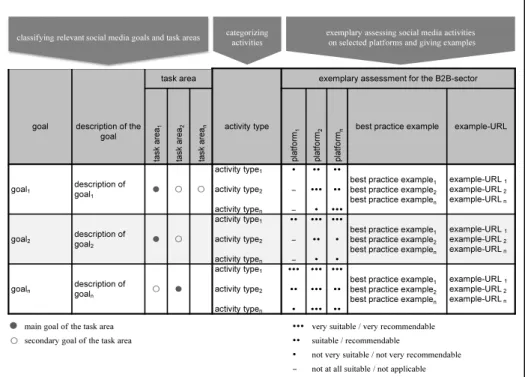
Our work supports the methodical selection of appropriate social media activities. The suggested instrument ‘Social Media Matrix’ aims at providing a match of suitable social media activities to relevant social media goals of companies. Thus, the matrix provides (1) a classification of social media goals and dedicated business tasks, (2) a categorization of social media activity types, and (3) the concrete assessment of each activity type on each platform for each goal, including a collection of examples. Figure 2 illustrates the overall structure of the Social Media Matrix.
Table 2. Structure of the social media matrix (1) Classification of relevant social media goals by task areas
Social media can be used for achieving various goals of different departments. The matrix provides a classification of social media goals by task areas, in order to allow the user to focus on analysis, planning, execution and controlling of social media - away from the company’s functional perspective and toward the integrated communication management concept [8], [11]. To facilitate orientation and coordination with regard to the practical application of the instrument, we have identified different social media task areas and matched these with the goals. The following eleven task areas have been assigned to a total of 29 social media goals:
• media relations
• reputation management
• agenda setting
• issues management
• crises management
• branding & brand management
• customer relationship management & influencer relationship management
• trend, market & competition analysis
• social media marketing & social commerce
• product & innovation management
A task area may pursue more than one goal. Furthermore the single goals may impact each other. For this reason, we have distinguished between main and secondary goals within a task area. For example, ‘increasing brand awareness’ is defined as a main goal within the task area ‘branding & brand management’. Whereas ‘building relationships to influencers in social media’ is a secondary goal of ‘branding and brand management’ which will contribute to the achievement of the main goal.
(2) Categorizing activities
A major outcome of our work was to realize that before assessing the suitability of a platform for a goal the type of activity must be distinguished. We have therefore defined five types of social media activities, which cover all possibilities:
• content: Content refers to the publishing of information in the form of text, image, graphic,
audio and video. This category includes only activities, which are based on one way communication, e.g. a company’s info on the Facebook fan page or the channel on YouTube.
• interaction and dialog: This type comprises activities aimed at interacting and discussing
with stakeholders. Such activities can be for example posts on the company’s wall on Facebook or a group on LinkedIn.
• listening and analyzing: This activity type is about finding conversations about the
company, its brands and products and analyzing these in order to turn them into valuable insights. This monitoring can be manual or automated and can furthermore include keyword search about competitors, current issues, important stakeholders etc.
• application: Expanding the possibilities of a social media platform by own applications to
enable further interaction is summarized under this activity type. For example Facebook allows programming of own applications.
• networking: Taking active steps to find contacts and to build relationships is referred to as
networking. This includes e.g. @-referencing other users on Twitter or inviting users to a group on LinkedIn.
(3) Assessing platforms and finding examples
Whereas goals, task areas and activity types are generally applicable this third part of the Social Media Matrix must be adapted both to the industry sector and the country/regional context. It comprises a list of the most relevant social media platforms in one country and the assessment of the suitability of each activity type on each platform for each goal. Additionally best practices are collected and added as examples to the assessment.
The assessment can either rely on expert rating or derive from examples and best practices. For our exemplary assessment for B2B companies in Germany we used a combination of both approaches. A third possibility which we shortly discuss in the ‘future research’ section is crowdsourcing the assessment.
5
Assessing suitability of social media activities for German B2B companies
To make the Social Media Matrix a ready to use instrument for planning corporate social media activities it must include specific assessment and examples to answer the question “How useful is a certain activity type on a certain platform to reach a certain goal?”. In contrast to social media goals and to a certain extend also platforms which can both be generalized, the assessment in the matrix must be explicit, e.g. for an industry sector. In our work social media activities of German companies that predominantly follow business to business (B2B) transactions have been reviewed and evaluated according to goal, activity type and used platform to sample such a specific assessment. Together with the results of theexpert interviews a directly applicable Social Media Matrix for the German B2B sector has been created which is at the same time through the examples a snap-shot of current social media use in B2B companies in Germany.
The social media platforms we considered in this use case were Facebook, Twitter, YouTube, Xing11, Blogs and ‘community platforms or forums’. For transferring the results to other than German markets the platform Xing should be substituted by LinkedIn which is its international pendant. For most goals content, interaction / dialog and networking are the predominant activity types. Our assessment shows that social media activities can be used in German B2B companies best to achieve these goals:
• building and improving product and brand image
• identifying, contacting and bonding influencers
• improving ranking on search engines
• generating leads
• employer branding and recruiting
Social Media activities that aim towards vending products or providing service and support over social media platforms are less suitable, due to the complexity of B2B products. Nevertheless it could be a strategy to explicitly address such goals that seem less suitable and are therefore less represented to create unexpected social media activities that by their newness gain more attention which in social media means success.
6
Application Modes
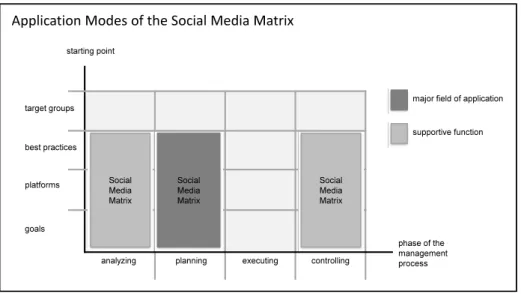
Integrated communication distinguishes four management phases: analysis, planning, execution and controlling [29]. The Social Media Matrix is primarily designed to support planning activities, but can also be used for analyzing industry sectors beforehand or controlling own activities. A second dimension in applying the Social Media Matrix is the starting point of decision making. Besides goals - platforms and best practices can be used. The proposed structure allows all three starting points. Furthermore target groups / stakeholders are often used as a starting point for activity analysis, planning and controlling. This perspective has not (yet) been considered in the matrix, but since target groups are an implicit part of goals and best practices further detailing the matrix in this respect is possible.
11
Figure 3 illustrates the application modes of the Social Media Matrix.
Fig. 1. Application modes of the Social Media Matrix
We have initially implemented the social media matrix in Excel. The user can flexibly use the matrix for decision making by for example:
• prioritizing goals or filtering goals by task area
• using the assessment of the platforms to decide upon which platform to enter or to understand which optimization opportunities already used platforms offer
• using the assessment to identify which goals can best be achieved by social media activities
• using the given examples to better understand possibilities
7
Conclusion and future research
We have introduced an instrument for companies to choose social media activities based on corporate goals and an assessment of the suitability of certain activities on selected platforms. The suitability assessment has been conducted exemplary for the German B2B-sector. Moreover our Social Media Matrix contains an example set of realized social media activities in the B2B-sector in Germany, which can be regarded as best practices and provide orientation for the user. Therefore this is a ready to use tool for German B2B-companies which is currently evaluated during consulting projects. It has been shown, that our practical integrated approach has not been presented in literature so far.
This work builds the foundation of a more sophisticated tool for planning and controlling corporate social media activities. To close this paper, three selected aspects of future work are presented in brief in the following paragraphs.
• Crowdsourcing example collection and assessment of social media activities:
Especially in the field of social media the web community is a great source for information which can be used for optimizing the Social Media Matrix. A web interface could be used to collect examples for corporate social media activities. Each example should be assigned at least one goal, the industry-sector, the platform and the activity type it refers to. In an international context, country information should also be provided. Incentive to enter this data could be the possibility to compare the entered activity with other activities in the same industry sector. Assessing activities for different sectors could be either by experts, or everybody. Exceeding critical masses is essential here.
• Detailing social media platform representation: Since marketing and corporate
communications is often driven by target group segmentation, this information must be modeled within the social media matrix. One approach is to add target group information to
the description of platforms. Ideally the defined parameters can be easily used to describe any platform and new platforms thereby could derive their assessment from existing data.
• Estimating costs: To make the Social Media Matrix an effective tool in terms of Common
Value Management the assessment of social media activities must be expanded by adding cost factors for execution of an activity. Cost factors could be distinguished into initial cost and operating cost, they contain time elements (e.g. singular vs. regular) and are interconnected with the available resources. It is a matter of research to what extend cost estimate and ROI of social media activities can be generalized.
8
Acknowledgements
The work published in this article is partially based on the diploma thesis of Iva Koleva filed in January 2012 with the University of Hohenheim in Stuttgart, Germany. The thesis has been initiated and supervised by Harriet Kasper, Fraunhofer IAO and examined by Prof. Dr. Frank Brettschneider-Vetter (1st examiner, University of Hohenheim) and Prof. Dr.-Ing. Dr.-Ing. E.h. Dieter Spath (2nd examiner, University of Stuttgart).
References
[1] Fink, S., Zerfaß, A., Linke, A.: Social Media Governance 2011 – Expertise Levels, Structures and Strategies of Companies, Governmental Institutions and Non-Profit Organizations communicating on the Social Web. University of Leizpig / Fink & Fuchs Public Relations AG, Leipzig / Wiesbaden (2011). Retrieved from www.socialmediagovernance.eu
[2] Fink, S., Zerfaß, A.: Social Media Governance 2010 – How companies, the public sector and NGOs handle the challenges of transparent communication on the Internet. University of Leipzig / Fink & Fuchs Public Relations AG, Leipzig / Wiesbaden (2010). Retrieved from www.socialmediagovernance.eu [3] Pleil, T.: Mehr Wert schaffen: Social Media in der B2B-Kommunikation. Books on Demand, Darmstadt
(2010)
[4] Spath, D. (ed.), Guenther, J.: Trendstudie Wissensmanagement 2.0 – Erfolgsfaktoren für das Wissensmanagement mit Social Software. Fraunhofer Verlag, Stuttgart (2010)
[5] Bogner, A., Littig, B., Menz, W.: Das Experteninterview – Theorie Methode, Anwendung. 2nd ed., Wiesbaden: VS Verlag für Sozialwissenschaften (2005)
[6] Oesterle, H.: Business Engineering – Prozess- und Systementwicklung. Band 1: Entwurfstechniken. 2nd ed., Springer-Verlag, Berlin (1995)
[7] Kaplan, A. M., Haenlein, M.: Users of the world, unite! The challenges and opportunities of social media. In: Business Horizons, vol. 53 (1), pp. 59 - 68 (2010)
[8] Mangold, W. G., Faulds, D. J.: Social media - The new hybrid element of the promotion mix. In: Business Horizons, vol. 52 (4), pp. 357-365 (2009)
[9] Hettler, U.: Social Media Marketing. Marketing mit Blogs, sozialen Netzwerken und weiteren Anwendungen des Web 2.0. Oldenbourg, München (2010)
[10] Peters, P.: Reputationsmanagement im Social Web. Risiken und Chancen von Social Media für Unternehmen, Reputation und Kommunikation. Social Media Verlag, Köln (2011)
[11] Zerfaß, A., Fink, S., Linke, A.: Social Media Governance: Regulatory frameworks as drivers of success in online communications. IPRRC International Public Relations Research Conference, Miami (2011) [12] Weinberg, T.: Social media marketing. Strategien für Twitter, Facebook & Co. O'Reilly, Beijing (2010) [13] Brogan, C., Smith, J.: Trust economies: investigations into the new ROI on the web. (2008) Retrieved
from http://changethis.com/44.04.TrustEconomy
[14] Brogan, C.: Marketing is NOT Social Media-Social Media is NOT marketing. (2007) Retrieved from http://www.chrisbrogan.com/marketing-is-not-social-media-social-media-is-not-marketing/
[15] Evans, D.: Social media marketing. An hour a day. Wiley, Indianapolis, Indiana (2008)
[16] Li, C., Bernoff, J.: Groundswell: winning in a world transformed by social technologies. Harvard Business School Press, Boston, MA (2008)
[17] Solis, B.: Engage! The complete Guide for Brands and Business to Build, Cultivate and Measure Success in the New Web. Wiley, Hoboken, N. J. (2010)
[18] O'Reilly, T.: What Is Web 2.0. O'Reilly Media (2005). Retrieved from http://oreilly.com/web2/archive/what-is-web-20.html
[19] Joel, M.: Trust economies: the new marketing ROI. Six Pixels of Separation (2007). Retrieved from http://www.twistimage.com/blog/archives/trust-economies---the-new-marketing-roi/
[20] Joel, M.: Six pixels of separation. Everyone is connected - connect your business to everyone. Business Plus, New York (2010)
[21] Levine, R., Locke, C., Searls, D., Weinberger, D.: The cluetrain manifesto. Perseus Publishing. http://www.cluetrain.com/ (2000)
[22] Surowiecki, J.: The Wisdom of Crowds - Why the Many Are Smarter Than the Few and How Collective Wisdom Shapes Business, Economies, Societies and Nations. Doubleday, Anchor (2004)
[23] Scott, D. M.: The new rules of marketing & PR - How to use news releases, blogs, podcasting, viral marketing and online media to reach buyers directly. Wiley, Hoboken, N. J. (2008)
[24] Barefoot, D., Szabo, J.: Friends with benefits. A social media marketing handbook. No Starch Press, San Francisco (2010)
[25] Kasper, H., Dausinger, M., Kett, H., Renner, T.: Marktstudie Social Media Monitoring Tools – IT-Lösungen zur Beobachtung und Analyse unternehmensstrategisch relevanter Informationen im Internet. Fraunhofer Verlag, Stuttgart (2010)
[26] Plum, A.: Ansätze, Methoden und Technologien des Web-Monitorings – ein systematischer Vergleich. In: Brauckmann, P. (ed.): Web-Monitoring – Gewinnung und Analyse von Daten über das Kommunikationsverhalten im Internet. Pp. 21-46, UVK, Konstanz (2010)
[27] Gilliatt, N.: Social Media Analysis Platforms for Workgroups. Social Target LCC (2010)
[28] Owyang, J., Lovett, B.: Social Marketing Analysis – A New Framework for Measuring Results in Social Media. Altimeter Group / Wen Analytics Demystified (2010). Retrieved from http://www.slideshare.net/jeremiah_owyang/altimeter-report-social-marketing-analytics
[29] Zerfaß, A.: Unternehmenskommunikation und Kommunikationsmanagement - Grundlagen, Wertschöpfung, Integration. In: Pilwinger, M., Zerfaß, A. (eds.): Handbuch Unternehmenskommunikation. Pp: 21-70, Gabler, Wiesbaden (2007).
Common Value Management -
based on Effective and Efficient On-line Communication
Dieter Fensel1, Birgit Leiter1, Stefan Thaler1, and Andreas Thalhammer1
1
University of Innsbruck, STI-Innsbruck, 6020 Innsbruck, Austria [email protected]
Abstract. We discuss the challenge of scalable dissemination and communication approaches in a world where the number of channels is growing exponentially. The web, Web 2.0, and semantic channels have provided a multitude of interaction possibilities providing significant potential for yield, brand, and general reputation management. Our goal is to enable smaller organizations to fully exploit this potential. To achieve this, we have developed a new methodology based on distinguishing and explicitly interweaving content and communication as a central means for achieving content reusability, and thereby scalability over various heterogeneous channels.
Keywords: brand-, reputation-, yield- and value management
1 Introduction and Motivation
The last two hundred years have revolutionized international transport and communication. Fax, phone, and later the Internet, have radically changed our communication possibilities. More and more communication has been freed from the geographic barriers that formerly limited their speed and expansion. Now, it is (in principle) possible to instantly communicate with a large portion of the entire human population. Nevertheless, new means also generate new challenges.
Take the world of the TV consumer as an example. Twenty-five years ago, there were around three channels. Therefore, selecting your program was a rather trivial task which required no more than a few seconds. Whilst hundreds of channels have been added, thousands of channels have been connected via the Internet, where extremely large libraries of videos (which go beyond the metaphor of a ‘channel’), currently define the content. The consumer could now spend a lifetime in search of a program he or she wishes to watch. Obviously, consumers require new skills and more efficient access means to scale and filter the exponentially increased offer.
Precisely the same is needed for our overall approach to on-line (or Internet-based) communication. Assume the task of a small hotelier. How can it be ensured that the hotel is found by potential customers, i.e., how can he/she find them? The hotelier should have a website with high visibility on various search engines and must be present in a large number of on-line booking channels. We should find the hotel on the town's website, and the hotel should have a Facebook page, perhaps with a booking engine included. Bookings made through mobile platforms are increasingly popular, and the hotelier would want to be found there too. Why not add a video about the hotel on YouTube, a chat channel for instant
communication, fast email and fax response capabilities, the old-fashioned telephone, and occasional tweets and emails that are clearly distinguishable from spam? Preferably the communication should be multi-directional, i.e., the hotelier should realize when one of his posts gets commented on (up to a full-fledged impact analysis), or even more importantly, the hotelier should know when someone talks about the hotel, and how much the costumer liked it. As much as this is needed, this obviously does not scale and [2] calls it “the growth of the multichannel monster”. In principle, the hotelier is presented with three equally problematic alternatives:
• He does it on an ad-hoc basis by himself, as a side activity. This would work, however,
the number of potential customers (and therefore business opportunities) that he is missing may be tremendous and could, in the long run, take him out of the market completely.
• He builds up a professional communication team by hiring a large number of social media experts and assigns them to manage his various communication channels. Actually, a large hotel chain may be able to do this. In the case of our hotelier, he would find himself even more quickly out of the market due to the high costs attached to this “solution”.
• Finally, he could start to cooperate with an external marketing agency. This marketing agency must understand the domain (tourism, accommodations) and the various communications means available to disseminate the contents about our hotel in an effective and efficient fashion. These agencies have some IT support that supports multi-channel dissemination, however, they have to manually adopt, align, and define the content for these channels. In summation, these services are costly and only partial solutions (to limit the high costs of manual labor by dissemination experts).
Organizations of all sizes, commercial and not-for-profit, regularly face the challenge of communicating with their stakeholders using a multiplicity of channels, e.g. websites, videos, PR activities, events, email, forums, online presentations, social media, mobile applications, and recently structured data. The social media revolution has made this job much more complicated, because:
• the number of channels has grown exponentially,
• the communication has changed from a mostly unilateral "push" mode (one speaker, many listeners) to an increasingly fully bilateral communication, where individual stakeholders (e.g. customers) expect one-to-one communication with the organization, and the expected speed of reaction is shrunk to almost real-time, and
• the contents of communication becomes more and more granular and increasingly dependent on the identity of the receiver and the context of the communication.
Organizations need an integrated solution that provides management and execution of communication goals in a mostly automated fashion, with costs equivalent to mass-media communication, along with the granularity of individual experts, and at the pace of real-time social media. We are aiming to mechanize important aspects of these tasks, allowing scalable, cost-sensitive, and effective communication for small-or-medium sized business units and comparable organizations for which information dissemination is essential but resources are significantly limited. Additionally, it may also help intermediaries such as marketing agencies to extend their business scope by increasing the cost-effective ratio.
Communication is a means to an end. Section 2 analyses the major goals that may underlie communicative interaction of an organization with a larger audience. We identify yield, brand, and reputation management as three major aspects around which communication may be centered. They can be identified as variations of general value management differing in their short-versus-long-term orientation towards commercial goals, as well as in their overall connection to financial value orientation. Section 3 sketches the major technical elements that we developed to implement a common value management framework. Section 4 discusses some of the related work and directions for future research activities. Finally, conclusions are provided in Section 5.
2 The Aspects of Value Management
Scalable, multi-channel communication is a difficult challenge. In order to better understand it, we want to clarify the various underlying goals that it should achieve. Agents often connect (directly or indirectly) economic interests with their communication activities. In the following, we discuss different economic contexts for the communication approaches of organizations.
2.1 Yield Management
Yield or revenue management “is an economic discipline appropriate to many service industries in which market segment pricingis combined with statistical analysis to expand the market for the service and increase the revenue per unit of available capacity” [3].12 Short-term increase of income is a valid target for a business entity; however, it is quite tricky to realize in a multichannel world. For example, hotels are confronted with a multitude of on-line booking channels. Hotels should provide their available rooms and rates to most, if not all of these channels to prevent missing their potential customers. For many channels, visibility is achieved through low prices. However, channels also often require price constraints on the price offers of other channels. Some channels generate costs without guaranteeing actual income. Let us discuss some important issues: A hotel currently provides active booking facilities on its hotel website, through booking.com, expedia.com, Facebook, and Google Maps. It wants to increase the overall conversion rate for bookings in all of these channels, and therefore needs answers to the following questions:
• How is my price positioned towards the price of my competitors?
• What is my reputation in all of these channels? More than 90% of all Internet users are
already reading product reviews and more than 50% have indicated that their purchasing decisions are based primarily upon them.
• Am I adequately represented in all these channels (comments, reviews, etc.)?
• The hotel could reduce its price in channel X to maintain visibility and to increase bookings through this channel. Due to legal constraints, it has to reduce its price in many other channels which leads to reduced revenues from those bookings.
• A hotel needs recommendations for what needs to be done and the support to do it, e.g.
possible actions would be to reduce their price by 10% or to include more amenities and supplements, to be more active on Facebook in order to increase social media links and conversations, or if guests complain about the coffee it could therefore be alerted to improve this service.
• A hotel wants to announce rooms through Google Maps. It therefore starts to pay for each click through this search interface. If many clicks fail to lead to a booking, the hotel may begin to lose a significant amount of money.
• The same scenario could occur with static on-line coupons13 that offer a 50% discount through a coupon platform that requests an additional 25% for each coupon. This can easily end in negative revenue and lacks dynamicity. Imagine a “magic” dissemination button for a bar owner that can announce dynamically a happy hour, special offers, interesting news etc. on-the-fly to the right circle of interested public, establishing the bar as a trendy place where a hip crowd is getting together.
Many solutions to yield management are based on complex statistical methods and complex domain assumptions on how variation of the price can influence the number of bookings of a service. However, a multi-directional multi-channel approach must also rely on Swarm intelligence14. Observing in real time the reaction of customers and competitors will be key to achieving on-line marketing. Adopting your offer and your price dynamically in response to the behavior of your (on-line visible) environment will become critical to economic success.
12
http://en.wikipedia.org/wiki/Yield_management, and Revenue_management 13
http://en.wikipedia.org/wiki/Coupon 14
2.2 Brand Management
Yield management tries to maximize the immediate revenue of an organization. However, communication is also very important in relation to the long-term value of a company. Actually, the reputation of a company can be viewed as one of its most important assets.
Proper management, such as managing the value of brands,15 may be essential for its
long-term economic success. This may conflict with revenue management. In many cases, it may be useful for short-term income management to reduce the price of the offering, which on the other hand can diminish and undermine the long-term income that is generated through a general price profile indicating quality and exclusivity.
2.3 Reputation Management
The economic impact of proper reputation management is evident when we talk about the reputation of economic entities. However, non-profit organizations also have a need for general reputation management and public campaigns. 16 “Reputation is the opinion (more technically, a social evaluation) of a group of entities toward a person, a group of people, or an organization on a certain criterion. It is an important factor in many fields, such as education, business, online communities or social status.”17 Here, it is not the direct and intermediate economic income that matters. It is rather about maintaining or increasing the appreciation an organization, topic, or certain approach gains in the public eye. However, even a campaign on a public issue has an immediate economic dimension to it: trying to use the available budget for it in the most effective way. Therefore, providing means to increase the effectiveness and efficiency of public campaigns is of high value.18
2.4 Value Management
All of the issues above could be viewed as facets of Value Management, where value is defined as the regard that something is held to deserve, i.e., its importance. Online,
multi-channel and bi-directional Value Management is about disseminating19, communicating, and
interacting with large, on-line communities to increase the value of a certain entity or issue. The value managed could cover issues such as importance, economic short-term income, or long-term value. [4] identifies the following activities as part of an on-line based value management: Reputation management; Competitive Intelligence, i.e., Competitor Observation; Market Analysis; Influencer Detection; Trend Analysis; Market Analysis; Crisis Management; Issue Management; Campaign Monitoring; Product and Innovation Management; Customer Relationship Management; Risk Management; and Event Detection. Obviously, these activities overlap and share many common elements. It would be interesting to reduce these activities to the set of atomic tasks from which they are composed.
3 The Aspects of Value Management
We start this section by introducing the underlying idea and major structure of our approach. We then discuss our role model, tool support, and finally, we sketch some applications of our approach.
15
“The American Marketing Association defines a brand as a "name, term, design, symbol, or any other feature that identifies one seller's good or service as distinct from those of other sellers.” http://en.wikipedia.org/wiki/Brand 16 E.g. http://www.readwriteweb.com/archives/how_to_manage_your_online_reputation.php. 17 http://en.wikipedia.org/wiki/Reputation 18
Also, in the case of political parties, the number of votes they collect can be seen as their “economic” value. 19
“To disseminate (from lat. disseminare „scattering seeds“), in terms of the field of communication, means to broadcast a message to the public without direct feedback from the audience.” http://en.wikipedia.org/wiki/Dissemination
3.1 Separating Content and Channel to enable various dimensions of reuse in transactional communication
“I am about to propose the existence of something called the knowledge level, within which knowledge is to be defined.”20
The core idea of our approach is to introduce a layer on top of the various Internet based communication channels that is domain specific and not channel specific.21 So one has:
• information models, that define the type of information items in a domain;
• a channel model (or communication model), that describes the various channels, the
interaction pattern, and their target groups;
• mappings of information items to channels through weavers; and finally,
• a library of implemented wrappers for actual channel instances.
What is essential is to distinguish the communication or channel model from the conceptual
descriptions of the information.22 Our approach requires the creation of a communication model (i.e., an increasingly complete model of channels), and knowledge models for each vertical (such as research projects, research institutes, associations, hotels, restaurants, tourist events, medical doctors, etc.), and finally linking the knowledge model with the
communication model through a weaver that weaves concepts with channels. This will not be
cheap! However, you pay one price for an entire vertical, i.e. for thousands or up to millions of business units. Even if it would cost the same amount as doing it manually directly on a channel basis for ten of them, it is obviously cheaper if the number of business units is higher than ten. And on the contrary, we think that even if done directly for one business unit, it quickly turns into profit by saving on manual dissemination work through a mechanized communication model. After all, data and information can be expressed at the conceptual level, which the domain expert understands. Mapping of the different communication means (where he is not at all an expert) is done automatically after the first implementation. The difficult dissemination through channels is done automatically through proper channels that are attached to these concepts.
Currently, all commercially available solutions are only channel centric and do not provide any built-in support for what needs to be disseminated or where to disseminate what piece. In our approach, a knowledge-model is built and explicitly linked with the channel model. This must be done once for a hotel, and can then be reused for millions of them. That is, we aim for the major elements of reusability:
1. The same information element can be reused for various channels through its channel independent formulation using the information model.
2. The information model is developed as domain ontology for a certain vertical area such as tourist accommodations, gastronomy, medical doctors etc. Therefore, it can be reused
for various agents active in the same vertical domain.
These elements of reusability deliver the major contribution to the scalability of our approach.
3.1.1 Information Model
An information model is an ontology that describes the information items that are used in typical communication acts in a certain domain. Many methodologies for building such ontologies have been developed, compare [5]. Building ontologies can be a time-consuming and expensive process. Fortunately, we have a strong modeling bias that helps us to
20
This notion of knowledge level was first introduced by Allen Newell in the 1980s, to have a way to rationalize an agent’s behavior. ... Beneath the knowledge level resides the symbol level. Whereas the knowledge level is world oriented, namely that it concerns the environment in which the agent operates, the symbol level is system oriented, in that it includes the mechanisms the agent has available to operate. The knowledge level rationalizes the agent’s behavior, while the symbol level mechanizes the agent’s behavior. http://en.wikipedia.org/wiki/Knowledge_level
21
See also as an excellent presentation on this idea: http://www.slideshare.net/reduxd/beyond-the-polar-bear 22