Durham E-Theses
Devising New Models for School Improvement in
Developing Nations: Sierra Leone, a case study
MASON, MIRIAM,THERESA
How to cite:
MASON, MIRIAM,THERESA (2019) Devising New Models for School Improvement in Developing Nations: Sierra Leone, a case study, Durham theses, Durham University. Available at Durham E-Theses Online: http://etheses.dur.ac.uk/13354/
Use policy
The full-text may be used and/or reproduced, and given to third parties in any format or medium, without prior permission or charge, for personal research or study, educational, or not-for-prot purposes provided that:
• a full bibliographic reference is made to the original source • alinkis made to the metadata record in Durham E-Theses • the full-text is not changed in any way
The full-text must not be sold in any format or medium without the formal permission of the copyright holders. Please consult thefull Durham E-Theses policyfor further details.
Academic Support Oce, Durham University, University Oce, Old Elvet, Durham DH1 3HP e-mail: [email protected] Tel: +44 0191 334 6107
http://etheses.dur.ac.uk
Devising New Models for
School Improvement
in
Developing Nations:
Sierra Leone, a case study
Miriam Theresa Mason
A Thesis Presented for the
Doctor of Philosophy Degree
At the School of Education, Durham University
19th July 2019
Abstract
Background and Introduction: This research describes the planning, design, implementation and evaluation of a Continuous Professional Development & Learning (CPDL) programme for schools in Sierra Leone, a low-income country with low educational standards.
Aims: The research aimed to: (i) assess evidence of EducAid schools’ effectiveness; (ii) identify features of EducAid practice that government schools might adopt; (iii) design a CPDL programme for Sierra Leonean teachers; (iv) report the programme’s impact on students’ progress; (v) explore the possibility of programme delivery by local and largely untrained teachers; (vi) throw light on aspects of the programme that participants saw as strengths and weaknesses.
Design and Methods: Within an innovative quasi-experimental design, an impact evaluation drew on data from five intervention and ten comparison schools, and a process evaluation drew on data on information from programme participants and the trainers. The impact evaluation was based on public exam results, literacy test scores and attendance data collected pre- and post-CPDL. Process data included information from lesson observations, semi-structured interviews, focus groups and a post-intervention evaluation workshop.
Results: The impact evaluation showed larger improvements in student attendance and literacy test results in the intervention schools than in the comparison schools. The process evaluation identified challenges in embedding changes in pedagogic practice, and in data collection. However, it also identified consistent evidence of improvements in student behaviour. These were supported by head teachers and community groups and were seen as a necessary but not sufficient condition for the literacy score improvements.
Discussion and Conclusions: Discussion focuses on how far the six aims were met and on how the research adds to understanding of CPDL and school improvement in a low-income country. The impossibility of randomisation in sample selection prevents any strong causal claims for the CPDL’s impact. The possibility of a larger scale roll-out is considered, subject to changes in the programme suggested by the process evaluation.
Contents
Abstract 1
Contents 3
Copyright, Acknowledgements, Dedication 6
Section 1 - Introduction 7
1 Introduction 8
Section 2 – Literature Review 14
2 1 – School Effectiveness & Improvement – Social & Cognitive Aims of Education 15 3 2 – School Improvement – Professional versus Business Capital Approaches &
CPDL
33
4 3 – Education in Sub-Saharan Africa with particular reference to Sierra Leone 50
5 4 – Emerging research aims 69
Section 3 – Justification of and Construction of a CPDL based school improvement programme
73
6 1 – Is there robust evidence that EducAid schools were unusually successful in their students’ academic achievements and / or in catering for their social needs?
74
7 2 – The transferable and non-transferable features of EducAid’s practice 87 8 3 – Intervention design (rationale & development); description of intervention;
delivery planning
103
Section 4 – Design & Methods 124
9 1 – Design of the Evaluation of the School Improvement Programme 125
10 2 – Pilot study and the implications for the main study 152
Section 5 – Results 170 12 1 – Outcome data – Exam results, Student attendance & Literacy scores 171 13 2 – Process data – Understanding the Training Team – Possibilities & Challenges 186 14 4 – Process data – Participants’ & Trainers’ Perspectives on the Programme 193
Section 6 – Discussion & Conclusions 231
15 1 – Discussion – To what extent have the research questions been addressed and what further research is recommended?
232
16 2 – Discussion – Using the results in planning a roll out 252
17 Conclusions & Recommendations for Further Research 263
Section 7 – References 270
Section 8 – Appendices 298
Appendix 3 – Conference papers for teacher-led randomised control test projects A. Comparing the impact on student literacy levels of reading to a doll, reading to
a partner and reading alone.
B. Comparing the impact of materials with only content-based learning activities with the impact of materials with higher-level thinking and values-based learning activities on student learning and retention.
Appendix 4
A. The SDG4 Quality Education Outcome Targets & Means of Implementation (UNDP, 2017)
Appendix 8
A. Description of CPDL initial two-week programme
B. Ubuntu Schools
C. QEP Checklist – Action list Appendix 9
A. Description of the literacy test
B. Literacy Test
C. Literacy Test Marking Scheme
D. Head teacher – Semi-structured interview schedule E. Teacher – Semi-structured interview schedule
F. EducAid Training Team – Semi-structured interview schedule G. Head-teachers – Focus group discussion schedule
H. Teachers – Focus group discussion schedule I. Children focus group discussion schedule J. Evaluation Workshop Activities
K. Lesson Observation Form
Appendix 11 – Ethics Approval Process and Documents A. Letter of Confirmation of Ethics Approval B. Ethics Application Form & Declaration
299
301
303
312
C. Participations Information Sheet & Declaration of Informed Consent & Declaration of Informed Consent for Child participants
D. Research Proposal Summary for Ethics Approval Application Appendix 12
A. Summary of t-tests using change scores comparing all the intervention schools B. Two-tailed T-tests comparing Time 1 literacy test scores in Project Y and M1 &
Project Y & M2
C. T-test comparing mean Time 1 and Time 2 literacy test scores & change scores for girls’ and boys’ literacy tests in Project Y schools
D. T-test comparing mean change scores in classes 1 – 3 and classes 4 – 6 literacy tests in Project Y schools
E. SPSS read out for ANOVA regression test comparing post-test (Time 2) scores in Project Y schools with post-test scores in M1 schools while holding pre-test Y score constant.
F. SPSS read out for ANOVA regression test comparing post-test (Time 2) scores in Project Y schools with post-test scores in M2 schools while holding pre-test Y score constant.
Appendix 13
A. Project Y Schools – lesson observation elements measured at Times 1 and 2 and % change between two times
B. M1 Schools – lesson observation elements measured at Times 1 and 2 and % change between two times
C. M2 Schools – lesson observation elements measured at Times 1 and 2 and % change between two times
D. Schools – % change in lesson observation elements measured between Times 1 and 2
Appendix 14
A. Table showing % change between Times 1 and 2 in lesson observation elements in Y Project schools
B. Table showing % change between Times 1 and 2 in lesson observation elements in M1 schools
C. Table showing % change between Times 1 and 2 in lesson observation elements inM2 schools
D. Table showing % change between lesson observations at Time 1 and at Time 2 in Y Project, M1 & M2 schools
E. Detail of elements of lessons observed in Project Y, M1 and M2 schools that may have been affected by the national lesson plan manual initiative
F. Detail of elements of lessons observed where Project Y schools seem to have improved
G. Detail of elements of lessons observed where Project Y schools did not improve 344
348
352
Abbreviations 360
Glossary of EducAid terms 361
Statement on co-authored publications arising from this thesis 362
Copyright
The copyright of this thesis rests with the author. No quotation from it should be published without the author's prior written consent and information derived from it should be acknowledged.
Acknowledgements
The purpose of undertaking this research was to enable me to better serve education in Sierra Leone, my second home. This undertaking would not have been possible without many helping hands along the way: the kind encouragement and generous payment of my fees by Michael Colin of Make it Happen, Sierra Leone, the patience of my friends and family; Tense’s loving support and confidence in a positive ending; the encouragement of my EducAid family and especially the EducAid training team with whom I worked on the CPDL programme; the slowly growing commitment of the Project Y communities - schools and children where we worked; the generosity of those who provided quiet places for me to hide in to study; those who have patiently proof-read early drafts and most particularly my supervisors. Andrew Joyce-Gibbons patiently encouraged me in the early days to believe that one day it might happen. Professor Per Kind who is sadly no longer with us inspired me through his own work in Ethiopia. Professor Carole Torgerson helped me through some tortuous moments of methodology design and results write-up and patiently gave up days to get me over the last hurdle. My greatest appreciation goes to Professor David Galloway whose rigour, perseverance and kindness, even if occasionally explosive, has been the greatest guarantor that this journey might one day have a successful outcome. He has gone the extra-mile in so many ways: coming to Sierra Leone and living and working in Maronka village, returning half-baked ideas with suggestions and corrections, encouraging me to publish before submitting. I thank my lucky stars he agreed to supervise my PhD. My thanks to all of you for your patience, kindnesses and support from near and far.
Dedication
I dedicate this work to EducAid and to Sierra Leone, to those youngsters with whom we work. With all the blood, sweat and tears that went into this thesis, I commit to fighting on for a better future through education for all of them and in particular, with all my love, for Kofi and Nancy.
n.b. Permission has been obtained with signed parental/guardian consent forms for the use of the photos – for which, my thanks.
Section 1
Introduction
1
Chapter 1 Introduction
This research seeks to provide answers to questions about how to improve the quality of education provision in Sierra Leone. Millions of pounds, dollars, euros and more have been spent on education improvement. Enrolment and access have improved. Quality has not. This study describes the design of an innovative CPDL based school improvement
programme that addresses support to cognitive and non-cognitive student outcomes. The programme is evaluated using an innovative quasi-experiment.
a. An overview
This research analyses and evaluates a recent stage in the development of a small non-governmental education organisation in Sierra Leone in West Africa. Following a student exchange visit by University College London students to Njala University, EducAid was established in 1994 as a sponsorship programme for eight students that James Boardman and Swithun Mason had met while in Sierra Leone. In 1997 I visited the sponsorship
programme which had by then grown to provide school costs for over fifty students, only to discover that the schooling that was being paid for was not achieving any of the aims of education. Classrooms were overfull (70, 80, 90 or more students in one class) and were often without a teacher because teachers had not been paid for months. Sponsored students regularly failed every one of their public exams and the charity came to the conclusion that it needed either to stop its activities or do something with much greater control over the quality of provision. From this point, it was clear that the aim would be to provide the quality of education that would enable young people to take their first steps out of poverty and would also train them in citizenship values of integrity, community spirit and more.
I moved to Sierra Leone to establish our first junior secondary school. Although this school opened with only 20 students on 18th September 2000, the programme grew fairly quickly
and within three years had over 1000 students. The need for good quality, free education was enormous after an eleven-year war which deprived thousands of children of their education (Bu-Buakei Jabbi, 2007). All schools at the time were fee paying but EducAid’s
“fees” were (and remain) excellent behaviour, excellent attendance and excellent effort (EducAid, 2017) making it possible for even the poorest to attend. EducAid had six well established schools, one primary, three junior secondary and two senior secondary when it first received requests to support other schools in improving the quality of their teaching and learning. At the time the research began, this number had grown to 12 schools across eight sites, comprising of 5 primary schools, five junior secondary schools and two senior secondary schools. All EducAid schools have an admissions policy giving priority to the most disadvantaged children and young people in one of the poorest countries in the world (UNDP, 2018). The research originated in a request from other schools in Sierra Leone that EducAid staff help them improve. This subsequently evolved into a request for the provision of a whole school improvement programme comprising a continuing professional
development and learning (CPDL) programme for teachers, school leaders and relevant Ministry officials as well as associated interventions with other key stakeholders. However, the request raised two fundamental questions. The first concern was, did EducAid actually have evidence that its schools were unusually successful in their students’ academic achievements and/or in catering for their psychosocial needs? If not, it could arguably be unethical to offer support of this kind to other schools. Secondly, was it possible to identify features of EducAid schools that could be applied in government schools? EducAid being an independent and privately funded organisation was not constrained by the same regulations as some of the government schools that were asking for help. Some features of EducAid are simply not transferable to other schools. Section 3 explains the methods used to evaluate EducAid’s competence and justification in responding positively to the request, reviews the transferable and non-transferable features of EducAid’s practice and describes the
construction of an appropriate school improvement programme.
In consultation with my Sierra Leonean colleagues, I was responsible for this design, just as I had been responsible for designing the EducAid ways of working from which the programme learned. An important part of the design of the CPDL programme, however, was that
EducAid’s Sierra Leonean staff could deliver it. As explained in more detail in the methods Chapter 8, delivery by Sierra Leonean staff would make the programme more credible to Sierra Leonean teachers and therefore more sustainable and cost-effective. Because they would deliver the programme, EducAid staff would also be responsible for collecting data on responses to it. However, of the ten staff involved, only one had a degree and a higher teacher’s certificate, two held teaching qualifications and the others were secondary school
graduates still under-going their post-secondary studies with only informal teacher-training. None had any research experience except the degree holder who had conducted a small empirical research project for his final dissertation. All the staff were former EducAid pupils. Accordingly, the aims of the research are:
1. To assess critically the evidence that EducAid schools were unusually effective in their students’ academic achievements and/or in catering for their psychosocial needs.
2. To identify which, if any, features of EducAid schools might be adopted in government schools.
3. To design a school improvement programme based on CPDL suitable for use in the Sierra Leonean resource constrained context.
4. To obtain and assess evidence showing whether students’ performance had improved by the end of the school improvement CPDL programme and at follow-up.
5. To identify problems and possibilities associated with well-motivated but largely
untrained teachers delivering school improvement programmes, and collecting data for an evaluation, with only arms-length supervision from the Country Director.
6. To throw light on aspects of the programme that the teachers, pupils and other stakeholders experienced as strengths and weaknesses of the programme.
b. Significance of the study
Background to education in Sierra Leone since the war.
Sierra Leone was devastated by an eleven-year war (1991-2002) that destroyed most of the country’s education infrastructure and undermined whatever credibility the teaching profession had retained to that point (Sawyer, 2010). In line with global trends, the
Education For All (EFA) and Universal Primary Education (UPE) (UNESCO, 2000) drives were impactful and school attendance did gradually improve. UNESCO - UIS data indicate that Sierra Leone and Senegal actually outpaced other countries in Sub-Saharan Africa in
improving equity in enrolment, attendance and completion in secondary education in the 18 years after the war (UNESCO-UIS, 2019). However, post-war education rehabilitation
tended to focus on rebuilding schools rather than improving the quality of teaching. While enrolment has increased, little has been done until quite recently to address the significant quality challenges. In line with Sub-Saharan African regional experiences more generally, Sierra Leone continues to produce students who have completed all the primary school
years (and often secondary school too) yet can still neither read nor write fluently. This is evidenced by the 2017 Secondary Grade Learning Assessment which found that ‘large proportions of …secondary …pupils do not demonstrate more than basic English and maths skills’ (Government of Sierra Leone: Ministry of Basic and Secondary Education, 2017 p38). Sierra Leone, consequently, has an adult literacy rate of 32.4% (UNDP, 2018). Low literacy levels have an impact on economic development and on democratic engagement.
Additionally, those who are semi-literate or illiterate feel substantially marginalised by government with a resultant mistrust between the governed and the governing class. In turn, this results in instability and a vulnerability to crises (Sisay, Hitchen, & Paice, 2018). This is a reality in Sierra Leone but much of Sub-Saharan Africa is in the same situation, for similar reasons to those that have created tensions in Sierra Leone. If this research indicates that a holistic, whole school community, values-led approach is associated with meaningful improvement, it could potentially be of use in other parts of anglophone and even
francophone Sub-Saharan Africa.
EducAid Sierra Leone.
EducAid is a small, education-focused, not for profit organisation that started as a
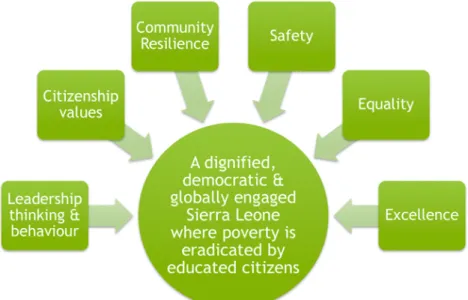
sponsorship programme during the war and opened its first school in 2000. Based on the conviction that education is the solution to all of the challenges outlined above, EducAid set out to deliver on a vision of ‘a dignified, democratic and globally-engaged Sierra Leone where poverty is eradicated by educated citizens‘ as illustrated in the figure 1.1 (EducAid, 2017). Initially through a growing number of its own schools, EducAid sought to provide the quality of education that would enable young people to take control of their own lives and to take the first steps out of poverty. The initial sponsorship programme had, in line with national statistics, failed to deliver the necessary quality for a change in their life chances. The children that EducAid sponsored had their fees paid but this did not guarantee them an education.
With time, EducAid grew and was contracted to run a number of schools for other
organisations. At one stage EducAid was serving over 3000 children. At the same time as the sustainability of funding for this growing network of schools was becoming a serious challenge, the request to support other schools created a new way to have a broader impact. Returning to its original vision and asking some difficult questions about how most efficiently to achieve it, EducAid started to work towards a new strategy of outreach school improvement programming. This meant transferring responsibility for six of eleven schools to the government. By focusing on the remaining five schools as role-model establishments, EducAid sought to position itself alongside the school leadership and management of a growing number of government schools as a provider of structured training and support to improve the quality of teaching and learning. This programme is called the Quality
Enhancement Programme (QEP). EducAid hoped to therefore have an impact on many thousands more children than the six schools given to the government. Testing the efficacy and sustainability of the programmes would, however, become increasingly important. The research described in this dissertation formalises the investigation into the school
improvement programme’s core elements. It identifies plans for the next stage of research-led planning to implement and strengthen the programme.
c. Structure of the thesis.
The structure of the dissertation is as follows:
Section 2 reviews relevant literature in Chapters 2-4, concluding with a more detailed statement of aims and objectives arising from the literature in Chapter 5. Section 3
(Chapters 6-8) explains the justification for EducAid providing a structured school
improvement programme based on CPDL to other schools, and describes construction of the programme. While this forms part of the research for this dissertation, it should be seen as background information to the main study, which reports the delivery and evaluation of the programme. Section 4 (Chapters 9-11) describes the design and methods, including lessons learned from a pilot study. Section 5 (Chapters 12-14) reports the results and Section 6 (Chapters 15-17) discusses the results, ending with a chapter of conclusions. In the next chapter I begin the literature review with an analysis of the cognitive and non-cognitive purposes of education.
Section 2
Literature Review
2
Chapter 2 - Literature Review (1)
School Effectiveness & School Improvement: Social & Cognitive Aims of Education d. Introduction.
Because of the breadth of the issues addressed in this study, the literature review is
organised into three chapters. Chapter 2 reviews literature focusing on school effectiveness and improvement with a particular acknowledgement of the need to address both the social and cognitive aims of education and the challenges this presents due to the lack of
measures for social development. Chapter 3 reviews literature focusing on school
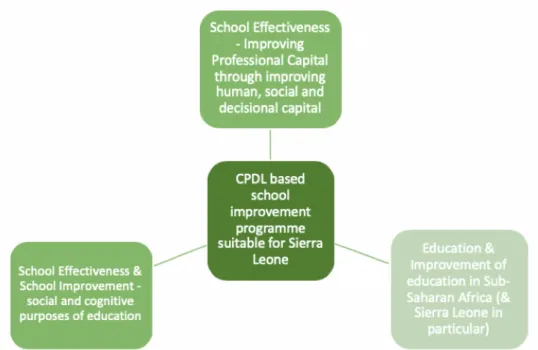
improvement with a discussion of different approaches to improving professional capital, reviewing the implications for the design of a CPDL programme in Sierra Leone of the need to build social, human and decisional capital (Hargreaves & Fullan, 2012). Chapter 4 reviews literature on education in Sub-Saharan Africa and Sierra Leone in particular. It reviews the particular challenges faced in Sub-Saharan Africa with regards improving education quality. Together they facilitate an understanding of what a strong CPDL based school improvement programme suitable for Sierra Leone might look like. Figure 2.1 illustrates the point.
Figure 2. 1 - The contributions of the three literature review chapters to the design of a CPDL programme suitable to address school improvement in Sierra Leone
Each chapter makes its own contribution to understanding the probable necessary considerations to be included when designing a CPDL based school improvement suitable for a resource-constrained context of Sierra Leone. Chapter 2 establishes the importance of giving attention to both social and cognitive aspects of education. Chapter 3 deduces a need for the inclusion of inter- and intra-school collaboration as well as support of reflective practice in order to develop professional capital at the level of the teacher, the school and the school system. Chapter 4 examines the particular context of education systems in Sub-Saharan Africa and the likely adaptations required for a CPDL programme to work in Sierra Leone.
This chapter reviews literature relating to school effectiveness and school improvement. The literature makes clear the need for both the social and cognitive aims of education to be addressed in order for both schools and school improvement programmes to be effective. The chapter concludes with a discussion of the relevance of the mainstream western school effectiveness and school improvement literature for teacher development and school improvement in Sierra Leone.
e. The Purpose of Education
Cognitive and non-cognitive aims of education
There is a longstanding consensus that the purpose of education is more than passing on knowledge. Dewey, (1916)believed that individuals can grow within the education system and at the same time learn to serve the purposes of democracy. (S. M. Barrett, 1932) argued further that education is preparation for life and that teachers are responsible for their pupils’ physical, mental and moral development. Postman & Weingartner (1969) found that the purpose of education was essentially to improve society and help it escape crises they felt threatened the survival of humanity. Barrett saw schools as needing to facilitate personal development, whereas Dewey, Postman & Weingartner saw education as having a broader purpose for society. Postman and Weingartner saw education as a tool for society’s salvation and not simply the growth of personal abilities. They essentially provided a rationale for education to develop personal strengths: there is a need for one’s critical thinking and analytical skills to be developed in order to save society from itself. They argued that it is the purpose of education to prepare young people to challenge the status quo and interrogate the institutions they meet. Challenging the status quo, though, requires moral judgement. This raises a question about the obstacles to the kind of critical thinking
that Postman and Weingarten call for in contexts that do not encourage genuine informed democratic engagement.
Challenges despite the consensus
Outlined below are a number of challenges to the actualisation of this reality:
• Education of the oppressed and the oppressor
Despite the consensus, there are powerful obstacles to realising this sort of education. For Freire (1970), in the Brazilian context of significant wealth disparity, the humanising purpose of education was particularly acute. He saw the underlying purpose of education of the oppressed as a way for them to reject and overcome their oppression while not emulating the oppressor. The need is not for a systematic education that must by definition be provided by the dominant class (the oppressors) and thus will never serve the purpose of freeing the oppressed. Rather, the need is for education programmes through which the oppressed devise their own models and targets. Education for Freire is almost synonymous with revolution, although for the oppressors, to be educated is realising that participating in oppression de-humanises them.
Edelsky (1994) argued, rather as Freire did, that styles of education will either subvert or uphold the systems that entrench the dominance of the wealthy over the poor, the powerful over the powerless. Freire wrote about Latin America whereas Edelsky’s writing addressed the American education system, but they reflect a common understanding of how good pedagogy can empower learners. In societies such as Sierra Leone’s, the social justice aspects of education tend to relate to alleviating the economic burden and disempowerment of illiteracy. There is little consciousness of skills such as the critical engagement and awakening discussed by Edelsky. Even within the large international donor-driven programmes, improvement focuses on literacy and numeracy with little or nothing on how relationships occur within the classroom or the school, or any challenge to social norms (Ministry of Education, 2017). In Freire’s and Edelsky’s analyses, one cannot separate pedagogy from content, for pedagogy will either subvert or uphold unjust
societies. In a context of significant inequality, they both argue for a pedagogy that awakens learners’ abilities to subvert, challenge and change the status quo.
• Conformity and democracy
There is a tension between conformity and democracy. Democracy requires an ability to think critically and maintain one’s individuality; conformity is required for social cohesion. It is hard to find the balance between enabling the young to conform to their society versus developing their individual ability to perceive and judge for themselves (Rockler, 1932). Dewey (1916) strongly believed in democracy in education and that individuals can
simultaneous grow within the education system and serve the purposes of democracy. Even Gray, (2008) who actively celebrated what he termed the ‘wilfulness’ of children which allowed them to succeed in earlier societies, acknowledged that there is some need to moderate this with a level of conformity. Gray (2008), among others, saw modern schooling as curtailing a child’s ‘wilfulness’ which was in earlier times the source of their success. Balancing needs and strengths in developing the individual versus serving the needs of society, creates a false dichotomy. Many, who are not schooled to conformity as in much modern-day schooling, still grow up to be well-balanced, successful adults who fully contribute to society.
• What is measurable?
It is easier to measure success against a conformist agenda. A set agenda means an end to the question of what to measure. If everybody takes a different route, then who defines success? The need to measure seems to focus the activities we engage in (Borgonovi, Hitt, Livingston, Sadoff, & Zamarro, 2018). Nagaoka et al, (2015) among others ,warn about the lack of development in the science of measuring education’s social aims (Nagaoka,
Farrington, Ehrlich, & Heath, 2015). Clear pathways of progress in non-cognitive aims of education as well as scientifically tested measures are still lacking. The potential misuse, they argue, is almost as large a danger as the complete lack of these measures. Misuse can result in faulty data and attribution of inappropriate significance to statistics leading to misdirection of resources and efforts.
Throughout the literature, there is discussion of education needing to provide for more than cognitive development. There must be opportunity for holistic development and for young people to become life-long learners, engaged citizens and positive contributors to society. However, there is no definitive list of non-cognitive aims or guidance on how to prioritise them. Maybe this is because of the breadth and variety of contexts and cultures across
which education is provided. Stringfield & Teddlie (2012 p 381) observed that the debate over the aims of education and what in a school is to be measured to demonstrate that it is achieving its aims has ‘often produced more heat than light.’
There is broad consensus that the aim of schooling is to provide an environment and opportunities in which young people can learn to develop cognitively and socially in and after leaving school. It is important therefore to understand how effective schools are at delivering this.
• Relevance for teacher development and school improvement in Sierra Leone
Programming in Sierra Leone must address schools’ and teachers’ ability to provide for children’s cognitive and non-cognitive needs. Neglect of one will reduce the impact on both. How to measure success in providing opportunities for children’s non-cognitive development will be as much an issue in Sierra Leone as anywhere else. Poor measures result in misunderstanding data which risks a focus on fruitless endeavours and a waste of scarce resources.
f. School Effectiveness
School effectiveness, argued Reezigt & Creemers (2005), is focused on what works and why. Hopkins, (1990 p182) found that ‘for a school to be called 'effective' within a certain cultural context, [it must be] (i) accomplishing the best possible pupil outcomes (defined in both individual and societal terms); with (ii) as little wastage of pupil talent as possible; and with (iii) efficient use of means. Hopkins’ concern recognised different needs within different cultural contexts. Appropriate ‘pupil outcomes’ are culturally determined, and children’s needs are dependent on their cultural context. How cultural contexts dictate what the ‘best pupil outcomes’ are to be, is a matter of much political and policy debate.
School Effectiveness Studies
The Eight-Year Study (Aikin, 1942) described the methods, findings and conclusions of an eight-year longitudinal study involving 30 schools. The study aimed to demonstrate that a more arts focused, trans-disciplinary curriculum in which teachers and school leaders would work together with more respectful relations, would better prepare students for life. Some saw this study as disastrous and concluded that it failed publicly and dramatically as the difference between the grades of the comparison students versus the ‘special’ students
involved in the project was negligible (Stringfield & Teddlie, 2012). At the time, the report itself concluded that those that had experienced the progressive curriculum achieved equally, or only a little higher, on standardised tests as those who had not. However, they had also acquired a range of other skills and competences relevant to a full and rounded experience of education (University of North Carolina Press, 1942).
The Eight-Year Study (Aikin, 1942) focused on America’s contemporary concerns: the failure of most high schools to simultaneously educate students well for life and for college
entrance. The call for schools to prepare children for more than exams is fundamental but not yet achieved in even the most developed country contexts. While the school
improvement movement can be said to have started in America, this work was of global interest and significance.
In 1966, Coleman et al (1966) found that socio-economic factors determined students’ outcomes and that schools could have little impact. This prompted a renewal of interest into what constituted an effective school, and a number of studies were undertaken.
While not the only reason school effectiveness research resumed, the much-cited Coleman Report was one spur to action because of its controversial findings that neither teacher nor school could really change student outcomes. Large numbers of educators refused to be satisfied with the report’s conclusions and set about proving it wrong with considerable energy (Stringfield & Teddlie, 2012).
In 1970, Weber, (1970)conducted research into four inner city schools which were successful in teaching early grade reading. He concluded that there was a list of common factors across the successful schools.
A further, more sophisticated study (Madden, Lawson, & Sweet, 1976) compared 21 pairs of schools and confirmed Weber’s findings. Both studies emphasise the importance of:
a. strong leadership
b. high expectations
c. a positive atmosphere
d. regular monitoring &
A further study by Brookover & Lezotte, (1979) investigated eight elementary schools, six of which had improving children’s standards and two of which had declining standards. This research drew similar conclusions to those of Weber (1970) and Madden et al., (1976), and added to the existing list of factors that characterise improving schools:
f. good home-school relationships &
g. a clear whole-school mission and strong teacher accountability for achieving it These lists were produced through comparative case studies and observation over a period of time of the common characteristics of effective schools. The studies challenged the findings of the Coleman Report on Equality of Educational Opportunity (Coleman et al., 1966). With its conclusions that socio-economic factors, not schools, largely determine student outcomes, the Coleman report implied a limited role for schools. In contrast, the conclusion of these subsequent studies that ‘schools can and often do make a difference’ (Stringfield & Teddlie 2012 p381) was more appealing to educators. These studies also provided the impetus for attempts to improve schools so they could improve their impact on the course of children’s lives.
The characteristics established in the 1970s by Brookover & Lezotte, (1979); Madden et al., (1976); Weber, (1970) continue to be identified as the key aspects of school effectiveness, with some later additional concerns relating to data storage, analysis and management (Bryk et al, 2010; Stringfield & Teddlie, 2012). However, of the seven factors identified, few are easily measured. Tools and proxies need devising to support a full understanding of success in each field. The debate continues about what is to be measured and how.
The focus on what is measurable
When things can be measured they can be compared. Stringfield and Teddlie (2012) cite the example of the British league tables which ranked schools by their General Certificate of Secondary Education (GCSE) grades. Students, schools and parents opted for easier
subjects, avoiding the harder to attain English and Maths so more children could obtain more good GCSE grades. The league tables had to be readjusted to take this into account so only results including English and Maths were reported. Schools had to adjust their practice again. In recent years the emphasis has been placed on English and Maths, often to the detriment of other subjects (Stringfield & Teddlie, 2012). What is measured and reported on drives policy and practice.
Comparisons of school effectiveness often focus on easier to define and measure cognitive outcomes such as test scores or exam results, which then become the focus of parental and governmental enquiry as well as international data collection. What is easy to measure becomes the only thing to be measured and thus prioritised (Zhao, 2016). For a more accurate picture one must evaluate across a broad range of educational aims. An effective school must be achieving on many fronts.
From the criteria outlined by Ofsted1 for school inspection, to the research by Zhao that
outlines the importance of balancing cognitive and non-cognitive functions and the
corresponding losses when these are not balanced, it is clear in literature and practice that both academic and social functions must be prioritised.
Zhao (2016) identified four key areas of damage when cognitive achievement is over-emphasised:
1. The Rise of the Undervalued: The Importance of Diversity
2. Job Creators, Not Job Seekers: The Importance of Creativity and Entrepreneurship
3. Globalized World, Globalized Economy: The Need for Global Competency
4. When the Floor Becomes the Ceiling: Mediocrity vs. Greatness (Zhao, 2016 p1)
In recognising the dangers to be avoided, he identifies by implication other important aims of education. I extrapolate from Zhao’s list of dangers that instead, schools need to:
1. provide opportunities across a broad range of disciplines and competences. Schools need to encourage and provide for diversity and not homogeneity. The subjects and areas of skill that are often neglected need to be made available. A diet of maths, English and science neglects the creative disciplines and the development of important opportunities for
diversity. Society needs a variety of talent and ability.
1In the UK, a school is assessed by the Office for Standards in Education (Ofsted) against four main categories:
• effectiveness of leadership and management
• quality of teaching, learning and assessment
• personal development, behaviour and welfare
2. provide opportunities for the development of creativity and entrepreneurial ‘21st century skills.’ A healthy society requires its citizens to have a range of transferable skills and attitudes.
3. engage and interact with realities and people across cultural and linguistic
boundaries. Particularly in a period of intolerance and division, exposure to people that are different enables children to see that what unites us is far greater than what separates us. 4. provide opportunities for children to demonstrate their greatness and ability to excel and not their ability to conform to mediocre expectations. Focusing on standardised tests encourages children to conform to the expectations of those devising the tests. They cannot go beyond 100% or even go in a different direction. Without disengaging from the general flow of their colleagues, conformity and compliance are the only options. There is no scope for excellence.
Zhao (2016) effectively proposed an alternative lens through which to examine effectiveness. Nixon & Comber, (2012) cited a teacher who eloquently expressed how current measures failed to value what any clear minded educator wants to celebrate: tests for running assemblies, mediating playground conflict and so on do not exist.
The challenge is in standardising non-cognitive achievements. In another context the creativity that this teacher celebrates in her students would be impossible but might be replaced by running a programme to teach out of school girls to read or by designing a mural for a community building or by organising a team to clean the beach or by innumerable other things. A school that can encourage such actions and attitudes, and create an environment for creativity, independence and citizenship to be fostered is certainly likely to be a good and effective school. But how do we standardise the relevant indicators and measures?
Despite the consistent acknowledgement that both the cognitive and non-cognitive aims of education must be developed, few studies have focused on both academic progress and behavioural issues. Noteworthy exceptions were two seminal projects in London, in which data on behaviour and educational progress were collected:
• Rutter, Maughan, et al., (1979) found that the behavioural and social outcomes for children were influenced by the social ethos of the schools they attended.
• Mortimore et al., (1988) recorded students’ self-esteem, behaviour and attendance as well as progress in literacy and numeracy.
Mortimore et al found that the school that children were attending was a better predictor of their educational progress than their social background. They also found that the outcomes were linked: where there were good non-cognitive outcomes there tended also to be good cognitive outcomes and vice versa. In contrast to the Coleman Report (Coleman et al., 1966), Rutter et al., (1979) found that, even though the family background has a substantial influence on attainment, the school could make a significant difference to children’s
progress, and an even more striking difference to their behaviour.
School effectiveness is complex and although there is no conclusive definition, broad themes focus on preparing young people for tomorrow’s world and providing opportunities for holistic development. To ensure a school is achieving this, Hargreaves and Fullan, (2012) identified the importance of collective responsibility, where teachers work together in a spirit of friendly rivalry or ‘collaborative competition’. Unity of purpose across a whole school and, as they argue, across a district (or at least a network of schools) creates an environment in which schools can become truly effective.
Relevance for teacher development and school improvement in Sierra Leone
The challenge of measurability leads to a focus on cognitive outcomes, even though the literature clearly suggests a correlation between cognitive and social outcomes (Rutter, et al 1979). It also seems likely that excellent behaviour and relationships are probably a
necessary condition for good cognitive outcomes, but on their own they are insufficient (Galloway, 1995). Within the Sierra Leonean education system there is so little data that any improvement in record keeping represents progress; however, it will be important to ensure that the global drive for cognitive-focused outcomes does not overwhelm any school
improvement programming to the detriment of non-cognitive concerns.
g. School Improvement
If school effectiveness is about describing the ability of an institution to serve the needs of its students, school improvement is about the processes required to ensure that the school (and increasingly the system) achieve and maintain school effectiveness (National College for Teaching and Leadership, 2011). There is a difference however between knowing the characteristics of an effective school and helping schools become effective. Telling a
head-teacher they must focus on improved literacy, for example, does not enable them to achieve this goal. The debate therefore centres upon how to apply school effectiveness research for real school improvement.
Problems in applying school effectiveness research include the need to separate causes from effects of effective schools, and is one key to translating the research into meaningful support interventions. Rutter et al., (1979) found that pot plants were more often found in successful schools. Galloway and Edwards (1991) noted reports of heads, in emulation of these successful schools, buying pot-plants. The fact that pot plants do well in successful schools is may be an indicator and consequence, not the cause, of an ordered environment, conducive to good learning.
School Improvement Studies
The review by Feldhoff, Radisch, & Bischof (2016) noted numerous strategies for assessing the need for school improvement, for undertaking school improvement and for researching the efficacy of school improvement programmes. They found no standardisation of any of the processes or indeed the theoretical frameworks underpinning school improvement. This was due to the extraordinary complexity of the endeavour, with contributing factors
including:
• longitudinal nature of school improvement
• the indirect nature of school improvement
• school improvement as a multi-level phenomenon
• the reciprocal nature of school improvement
• differential paths of development and nonlinear effects
• variety of meaningful factors (Feldhoff et al., 2016 p 9,10)
Longitudinal nature: Because research on school improvement is the examination of change over time, studies must be longitudinal. Frequency and timing of measurement points, as well as the constancy of measurement types, must be considered.
Indirect: All changes must be internalised and personalised by teachers before the impact can be seen on student outcomes.
Multi-level: Change must happen on many levels: with teams and departments, individual teachers and with students.
Reciprocity: One change may require other changes as different components within the organisation are interdependent.
Non-linear and differential paths: Different schools improve and progress in different, and often non-linear ways.
Variety of factors: Schools are complicated institutions with many contributing stakeholders. Their improvement can vary widely even within one school; therefore, all factors must be considered for an accurate picture.
In summary, they argued that these ingredients need adequate consideration for full understanding of the complexity of school improvement research and designing school improvement research methods and tools.
Of 428 journal articles that matched the original search criteria Feldhoff et al., (2016) only selected 13 for analysis because they demonstrated awareness of the six domains outlined above. This demonstrates how few studies and programmes adequately recognise the complexity of school improvement.
Glatter (2012) argued strongly that the international focus on competition and choice has not had the impact on improvement that was promised by the proponents of neo-liberalism with their “ belief that the market is the only legitimate allocator of goods and services in society at large [and] not just in the economy” (Battin, 1991 p296).
Glatter, (2012), and Hargreaves & Fullan, (2012) argued that business and free market thinking have driven the marketisation of education and resulted in short-lived
improvement in only a few schools. Demirjian, (2013) further concluded that marketisation has failed to improve schools or the education system. Marketisation has reinforced socio-economic inequalities and made tackling social and educational inequity even more difficult. Hargreaves & Fullan, (2012) find that marketisation has encouraged a focus on piecemeal improvement of certain institutions, rather than on large scale, systematic improvement to ensure the provision of a good quality education for all.
Much school and system improvement policy change is prompted by responses to PISA scores. As these scores focus on student science, maths and literacy, the policy changes also tend to focus on fixing issues in these fields, ignoring the equally important social aims of education (Borgonovi et al., 2018). Focusing on improved student cognitive outcomes too often leads to neglecting other core aspects. The political drive to raise standards led to a
focus on cognitive outcomes through the emphasis on market forces, thus ignoring one of the key lessons from the school effectiveness literature that indicates that improved social and cognitive outcomes are strongly linked (Rutter et al., 1979).
h. Are the debates and learning around school effectiveness and school improvement relevant to low-income countries?
All the studies that Feldhoff et al. (2016) refer to were in western contexts. A considerable knowledge gap exists in terms of appropriate research around effective school improvement in low-income countries and even more so in Sub-Saharan Africa and in Sierra Leone.
Feldhoff et al (2016) provide a framework for the examination of school improvement and conclude that, to understand real change, longitudinal studies need to be designed that take full cognisance of the extraordinary complexity of school improvement.
The emergence of international studies and indices provides the possibility of much larger scale comparisons and facilitates the move towards a focus on systemic change (Hargreaves & Fullan, 2012; Hopkins, etal 2014). However, whereas these trends are evident across many high-income countries, they are less present in lower-income country contexts. In some countries, the teaching profession and thus the professionalism of teachers have been so systematically undermined that the school level engagement with improvement has been a concern for only a tiny minority. Sierra Leone exemplifies this reality (Nishimuko, 2007). For example, action research in most low-income country contexts is nearly impossible. Where the teachers are paid spasmodically, if at all, and corruption in school leadership and school inspection is rife, it is difficult for teachers to acknowledge the need to improve even if the route to improvement were clear. Sierra Leone is a clear case in point (Nishimuko, 2007). As discussed in later chapters, any expectation of engagement with demotivated teachers in projects involving action research is unrealistic and doomed to failure. Building relationships of trust and support is a necessary prerequisite. On the other hand, where there is less governmental control and thus ability to insist on universal implementation of governmental initiatives, there can be a greater freedom to achieve some improvement in standards by working on more grass roots endeavours (D. H. Hargreaves, 2001). If this is the case, then the relationships are worth investing in so teachers can be encouraged to engage actively in such projects.
Some studies exist but tend to lack the complexity Feldhoff et al (2016) prescribe for full appreciation of the complexity of school improvement. Research undertaken by Bold et al
(2017) across Sub-Saharan Africa provides interesting insights but is not longitudinal. As Feldhoff et al (2016) point out this may inform an understanding of a school’s effectiveness but cannot be equated with an evaluation of school improvement.
Inequalities between countries and regions make the evolution of one united school of thought with regards to school improvement or measures of success both difficult and possibly even inappropriate. A few of the starkest differences are described below.
Basic resources.
Townsend (2012) notes the futility of comparing countries that have had a public universal education system for over 140 years with some with such a system only 20 years old or less, as well as some countries where even basics are absent. Townsend cites former minister of education for South Africa, Smangaliso Mkhatshwa: ‘…many of our schools have no
electricity, no water, no toilets, no libraries, no laboratories, no furniture, no classrooms, no teachers, no buildings, no windows, no pride and no dignity’ (Townsend, 2012 p376). It is difficult if not impossible to improve pedagogy and governance in a context with such enormous infrastructure challenges.
Data management.
Stringfield & Teddlie (2012) acknowledge the importance of evolving more efficient data storage systems and also greater transparency and higher quality data. Poor data management hinders progress in most low-income country contexts. Standards of data quality, integrity in data handling, data storage and retrieval are problematic even at governmental level. This compounds any other difficulties that arise with undertaking research in low-income countries such as Sierra Leone. Without basic data, evaluation of programmes is impossible as is the identification of where to focus resources or support. At every level the lack of data undermines further progress and development.
Leadership.
Townsend (2012, p 374) writes with confidence that, ‘We have moved from a time where school leaders were identified by their seniority and were moved into leadership positions without any form of training, to a time where leadership training for head teachers and principals has become a new industry in education.’
Of course, in his context, this is true. It is not however true in Sierra Leone or in many Sub-Saharan African and low-income countries, where even concepts of less hierarchal
leadership sit uncomfortably with many school leaders. Taking responsibility for all that happens in one’s own school is a nearly unknown concept, due to lack of training, different cultural expectations and lack of motivation resulting from poor work conditions (Bisschoff & Rhodes, 2012; Nishimuko, 2007). Headteachers are largely selected for their seniority or, worse, their connections and have never had any training for their positions (MEST, 2013). For discussion of school Improvement in the Sub-Saharan African context, Bisschoff & Rhodes (2012) provided a slightly modified list of factors to be considered.
1 The physical environment of the school
2 The curriculum and its assessment
3 Teacher supply, training, professional development and support
4 School leadership
5 Links and partnerships with parents and the community
The physical environment of the school.
There are insufficient classrooms, furniture and teaching and learning materials. Many schools do not provide a physically or emotionally safe environment either. 73 countries have not yet banned corporal punishment in schools (Global Initiative to End All Corporal Punishment of Children (GIEACPC), 2015). Nearly all of these countries are low-income countries and most Sub-Saharan African countries are among them. In addition, in many Sub-Saharan African countries a worrying component of the gender inequality is sexual abuse and violence in schools, perpetrated largely against girls (Bisschoff & Rhodes, 2012; Ombati & Ombati, 2012). That schools must be safe may seem obvious but cannot be assumed in all contexts.
The curriculum and its assessment.
Bisschoff & Rhodes (2012) find that in South Africa the curriculum and its assessment have been modernised somewhat but it is less clear elsewhere in Sub-Saharan Africa. When the West African Examination Council was established, for example, the ‘adaptation’ of
education for Africa was feared as an attempt at ‘dumbing down’ education for Africans (Dillard, 2012). That fear goes deep and a strong resistance to change in the syllabi and exam structure continues. As the teaching and exam syllabi are the same, the assessment dictates learning priorities because what is not measured is not valued (Pritchett, 2013a). Where assessments focus on content, teaching does too.
Teacher supply, training, professional development and support.
Bold et al (2017) highlighted the difference between the requirements for school
improvement versus the realities of teacher knowledge and competence. Teacher numbers are insufficient, and existing teachers lack the knowledge and skills to do the job. Many are neither trained or qualified (for example, in Sierra Leone 52% are qualified (MEST, 2013) and even those are trained inadequately, through programmes focusing on theory rather than practice and experience, and with no post-college support component (Bold et al., 2017; Akyeampong et al, 2011). Bold et al’s study identified core problems including the tiny proportion of the curriculum that teachers sufficiently understand, the small percentage of the prescribed time they teach for and the low levels of pedagogical skill. The clarity of this tripartite problem indicates a clear direction for the focus of school and teacher
improvement programming.
A recent report investigating behaviours and attitudes of 1,428 teachers from across Sierra Leone indicated that teachers, ‘on average taught for 13 of the 25-30 prescribed school hours in a standard week, which amounts to approximately two and a half hours of teaching per day (or less than half of the standard school day). One in three teachers also reported significant disruptions to their instructional time in the past two weeks. The average disruption was as high as four days in the last two weeks.’ (Ministry of Education, 2017) Basic teacher professionalism is so seriously undermined that without addressing teacher attendance and punctuality, impact from any other input or intervention is unlikely.
School leadership
Oduro et al (2007) noted that while school leaders ostensibly have greater autonomy as more decisions and funding are decentralised to individual schools, the leaders are still largely at the beck and call of the Ministry rather than treated as professional educators able to lead their colleagues in improving their service provision. Bisschoff & Rhodes (2012) found few leaders consciously taking responsibility for trying to improve their schools. These are mainstream concerns in higher income countries. In the developing world, the concerns are largely still absent. There is a dearth of research on effective support for leadership development and on gauging school leaders’ understanding of both leadership and educational quality, and even less on how to improve leadership (Oduro et al., 2007).
Links and partnerships with parents and the community
While Pritchett, (2013b) clarifies that, for any rebirth of education, parents and local
governance are key, most Sub-Saharan African schools struggle with this. Parents often feel disenfranchised by schools and although some governments attempt to involve them, attempts have not generally succeeded in overcoming the barriers (Bisschoff & Rhodes, 2012). This may be where strategies have been guided by well-meaning donor supported programmes lacking sufficient cultural contextual understanding. For example, in Sierra Leone: a school management committee (SMC) handbook detailing SMC roles,
responsibilities, governance and composition, exists in a format inaccessible to the illiterate majority of rural community members. The Ministry of education no longer has a copy, few if any schools have it and even fewer have SMCs that could read or use it. Success is unlikely with this document as the key community engagement tool.
i. Relevance for teacher development and school improvement in Sierra Leone
Meaningful school improvement in Sierra Leone will address teacher-student contact time, teacher subject knowledge and teacher pedagogical knowledge. It must also tackle school leadership and governance with a holistic approach incorporating community and parental bodies. Outside of national programming, tackling curriculum and assessment is difficult. The focus must be on how one teaches more than what one teaches. The abolition of corporal and humiliating punishments and the establishment of safety as a norm are foundational to all other improvements.
j. Conclusion
A recurring theme in this chapter has been the importance of integrating the social and cognitive aims of education. There has been little progress in quantifying these social aims, as well as standardising meaningful measures that are respected by educators and policy makers. This has too often resulted in their neglect.
There has been greater progress in understanding school improvement and how schools can improve by engaging across whole districts and systems. However, this is not a universal achievement, and in Sierra Leone many schools remain unaware of the need, means or even a clear target for their own improvement. The literature indicates the need for research evaluating programmes to improve school leadership, to improve relationships between
schools and communities, to create physically and emotionally safe environments and very pragmatically, the handling of data.
Consistently too, the dictatorship of measures and indicators is noted: whatever can be measured and counted focuses policy and endeavours for change. This makes it ever more urgent that appropriate measures are found for both cognitive and non-cognitive aims of education.
The question emerges: Is it possible to improve schools through enhancing leadership and governance, building relationships within the school and between the school and the community, fostering socially safe environments and improving data management?
3
Chapter 3 - Literature Review (2)
School Improvement – Professional vs Business Capital Approaches & CPDL a. Introduction
The previous chapter focused on the cognitive and social aims in education and the links to school effectiveness and school improvement literature. This chapter reviews school improvement literature with reference to its implications for the design of high-quality teacher Continuous Professional Development and Learning (CPDL).
In their book ‘Professional Capital: Transforming Teaching in Every School’ Hargreaves & Fullan (2012) establish a roadmap for education system renewal. Further discussion will show that this important work has insights extending beyond the original contexts they review. In the discussion chapters of this thesis, their conclusions will be discussed in detail in relation to the focus of the current study.
Using Hargreaves & Fullan's (2012) text as a framework, this chapter examines evidence from the literature about the most successful school improvement approaches. Drawing upon their terminology, this review discusses the development of professional capital, characterised as human plus social plus decisional capital. First, however, attention focuses on literature on alternative business capital driven models for school improvement. They argue that this business capital approach brings only short-term gains and does not serve the teaching profession or society.
b. Business capital driven approaches to school improvement
Hargreaves and Fullan (2012) argue that business capital models of school improvement focus on economic short-term savings that result in a shallow, low-skilled profession
incapable of preparing the next generation for the challenges of tomorrow. As Luger, (2011) notes in his review of their book, their categorisation of all innovators as pursuing a business capital model is a generalisation lacking detailed evidence. The distinction between
business and professional capital is nevertheless conceptually important.
Hargreaves and Fullan (2012) conclude that much education investment has business-driven motives, prioritising economic opportunities for the investor over a concern for improved standards of teaching and learning. The United States and the United Kingdom need to
refocus on revaluing the teaching profession, investing in it and supporting sustainable school improvement (Hargreaves and Fullan 2012).
Their aversion to business-driven models of education aligns with much of the opposition to the UK academy movement. There are now nearly 6,000 academies (Committee of Public Accounts, 2018). Some British newspapers allege that multi academy trust (MAT)
acquisition of local authority schools is privatisation of education by stealth. The Guardian gives an example where a trust sacked school caterers and cleaners before contracting catering and cleaning services for an academy from a company owned by the venture
capitalist that had established the MAT (Boffey & Mansell, 2016). The MAT aimed to acquire a string of approximately 200 schools. The authors argued that their motivation was
lucrative business not improved school quality.
The House of Commons Committee of Public Accounts argue that MATs are not good value for money for the tax payer. The Committee asserted that the Department for Education is slow to respond to governance failures in many MATs (The Committee of Public Accounts, 2018). There may have been early gains in student performance in the initial wave of academies, most of which were previously under-achieving schools but, subsequently, far less improvement has been seen because the later schools were already performing at a much higher level (Machin & Vernoit, 2010).
Academisation in the UK is viewed by these writers as being business-driven. Similar education reform attempts like the Swedish ’free-schools’ programme and America’s charter schools’ are also characterised as driven by business motives not concern for school improvement (Kitchener, 2013). Bifulco & Ladd (2006) interrogated student outcome data for charter schools in North Carolina and Bohlmark & Lindahl, (2008) investigated data from 16 years’ worth of students graduating from the free school system in Sweden. The
research indicates that neither system has delivered on promises of improved student outcomes through increased choice and competition.
Criticism of business-driven models in education has been widespread. Espinosa, (2017) argued strongly against educational institutions in Colombia being turned into businesses, declaring that the language of business: indicators, supply and demand, standards and performance evaluation are indicative of a transformation of education into a business to such an extent that the social value of education is lost. Espinosa further cited Ospina, (2008) calling for the focus of education to be ‘on coexistence and solidarity rather than
rivalry and competition2.’ The dangers of the business-driven model are identified as the
loss of focus on the broader social and non-cognitive aims of education, and the increase in segregation and inequality while at the same time providing no sustained benefit either to student performance or to the education system as a whole (Kitchener, 2013; Machin & Vernoit, 2010).
c. An Alternative Professional Capital approach.
Hargreaves & Fullan (2012) deduced a formula: “professional capital = human capital + social capital + decisional capital” which will be explored in the following section. Each component will be reviewed with regards its contribution to the aim of school improvement.
School improvement through improving human capital
Research internationally indicates that the greatest institutional determinant of pupil success is the quality of the teacher (Furlong, 2015; Hattie, 2003). As a result, the
recruitment of teachers as well as the quality of ITE and indeed CPDL is also under scrutiny. Yet the implications of this evidence for policy and for the design of CPDL remain a matter for debate.
What is meant by human capital?
Odden & Kelly, (2008)describe human capital as talent but for Hargreaves & Fullan, (2012), human capital, in the education context, is the ability to teach. High levels of human capital are the result of investment in the individual teacher, their initial training and subsequent professional development, combined with challenging reflective practice.
In this section, the literature provides an overview of recruitment criteria and practices, initial teacher education and continuing professional development. While literature on teacher recruitment and ITE it is of general interest, this research will not review it in detail, as tackling, much less affecting practice in Sierra Leone is beyond the scope of this current project.
A. Hargreaves & Fullan, (2012) reflected on how the four top performing countries for education in the OECD, Finland, Singapore, South Korea and Canada recruit teachers from the top 30% of university graduates, whereas countries like the United States of America and the United Kingdom more typically recruit teachers from the bottom 25%.
2El énfasis de la educación debería ser la convivencia y la solidaridad antes que la rivalidad y la competencia,