Automatic Refactoring for Renamed
Clones in Test Code
by
Jun Zhao
A thesis
presented to the University of Waterloo in fulfillment of the
thesis requirement for the degree of Master of Applied Science
in
Electrical and Computer Engineering
Waterloo, Ontario, Canada, 2018
c
I hereby declare that I am the sole author of this thesis. This is a true copy of the thesis, including any required final revisions, as accepted by my examiners.
Abstract
Unit testing plays an essential role in software development and maintenance, especially in Test-Driven Development. Conventional unit tests, which have no input parameters, of-ten exercise similar scenarios with small variations to achieve acceptable coverage, which often results in duplicated code in test suites. Test code duplication hinders comprehen-sion of test cases and maintenance of test suites. Test refactoring is a potential tool for developers to use to control technical debt arising due to test cloning.
In this thesis, we present a novel tool,JTestParametrizer, for automatically refactoring method-scope renamed clones in test suites. We propose three levels of refactoring to parameterize type, data, and behaviour differences in clone pairs. Our technique works at the Abstract Syntax Tree level by extracting a parameterized template utility method and instantiating it with appropriate parameter values.
We applied our technique to 5 open-source Java benchmark projects and conducted an empirical study on our results. Our technique examined 14,431 test methods in our benchmark projects and identified 415 renamed clone pairs as effective candidates for refactoring. On average, 65% of the effective candidates (268 clone pairs) in our test suites are refactorable using our technique. All of the refactored test methods are compilable, and 94% of them pass when executed as tests. We believe that our proposed refactorings generally improve code conciseness, reduce the amount of duplication, and make test suites easier to maintain and extend.
Acknowledgements
First, I would like to thank my supervisor, Professor Patrick Lam, for his invaluable advice and guidance. I sincerely appreciate the opportunity to learn from him and his patience throughout my master program. Without his knowledge and expertise which were always available to me, I would not have completed this thesis.
I would like to thank Professor Michael Godfrey and Professor Derek Rayside for reading my thesis and providing valuable feedback during their busy schedules.
In addition, I would like to thank my parents and my girlfriend Yuwei Jiao for their endless love and support during my studies in Waterloo. Thanks to my former colleague Yi Zhuang for his encouragement and help during my application to University of Waterloo. I would also like to thank all my friends at University of Waterloo for their willingness to help out whenever needed.
Finally, I would like to thank my colleagues Jonathan Eyolfson, Stephen Li, and Zeming Liu, for helping me improve my work.
Dedication
Table of Contents
List of Tables viii
List of Figures ix
1 Introduction 1
2 Related Work 4
2.1 Clone Type Classification . . . 4
2.2 Test Code Refactoring . . . 7
2.3 Clone Removal Refactoring. . . 8
3 Motivating Examples 10 3.1 Typical Clones . . . 10
3.2 Parameterizable Difference Categorization . . . 20
4 Approach 23 4.1 Tools and Concepts . . . 23
4.2 Parameterization Techniques . . . 26
4.2.1 Type Parameterization . . . 26
4.2.2 Data Parameterization . . . 27
4.2.3 Behaviour Parameterization . . . 29
4.3.1 Input and Output . . . 31 4.3.2 Workflow . . . 32 4.3.3 Implementation . . . 35 4.4 Limitations . . . 37 5 Evaluation 41 5.1 Applicability. . . 42 5.2 Correctness . . . 43 5.3 Refactoring Quality . . . 44 5.4 Case Study . . . 45 5.4.1 JFreeChart . . . 46 5.4.2 Gson . . . 47
5.4.3 Apache Commons Lang and Commons IO . . . 49
5.4.4 Joda-Time . . . 53
5.4.5 Summary . . . 55
5.5 Threats to Validity . . . 55
6 Conclusions and Future Work 57 6.1 Conclusions . . . 57
6.2 Future Work . . . 57
List of Tables
5.1 Selected benchmark projects . . . 41
5.2 65% of the effective candidates (268 clone pairs) in our benchmark projects
are refactorable using our technique . . . 43
5.3 94% of the 268 refactored test method pairs execute without failures across
List of Figures
2.1 Exact clones differ only by whitespace . . . 4
2.2 Renamed clones differ by variations in variable names, literals, and comments 5
2.3 Gapped clones differ by one gapped statement . . . 6
2.4 Semantic clones differ by specific implementations (iteration vs recursion) . 6
2.5 Renamed clones lie within method boundaries . . . 7
3.1 MutableDateTime and Instanttests differ by types of the variable test . 11
3.2 Using generic types to abstract the types MutableDateTime and Instant . 13
3.3 Two DateAxis tests differ by argument values in the DateTickUnit
con-structor call . . . 14
3.4 Different integer literal values are parameterized as method arguments . . 16
3.5 MethodstestCapListener,testFrameListenerhave similar structure but
instantiate different methods (DialCap vs ArcDialFrame), call different
methods (setCap vs setDialFrame), and use different method parameters
(Color.red vs Color.gray) . . . 18
3.6 Test utility method dialPlotTestsTestListenerTemplate parameterizes
behavioural differences in method calls between methods testCapListener
and testFrameListener from Figure 3.5 . . . 19
4.1 Deckard detectstestGetLastMillisecondandtestGetFirstMillisecond
as a potential refactorable clone pair . . . 24
4.2 JDeodorant maps statements between test methods testGetLastMillisecond
4.3 Refactoring example with primitive value casting from intto long . . . . 28
4.4 Common behavioural interfaceDialPlotTestsTestListenerAdapter<TDial> and its implementations in Figure 3.6 . . . 30
4.5 JTestParametrizer’s overall workflow . . . 33
4.6 Combining clone pair instance AST nodes . . . 36
4.7 Clone pair with nested behavioural differences . . . 39
4.8 Parameterization of nested behavioural differences . . . 40
5.1 JFreeChart contains similar testFindRangeBounds() methods which test related types. . . 46
5.2 Gson test suite contains similar test methods with differences in generic classes 47 5.3 Refactorable test methods testLeft String and testRight String both access private fields of test class StringUtilsSubstringTest and contain data and behavioural differences . . . 49
5.4 Refactorable test methodstestBelowThresholdandtestAtThresholdboth access private fields of test class DeferredFileOutputStreamTestand con-tain data differences. . . 51
5.5 Differing values in testRemoveBadIndex1 and testRemoveBadIndex2 can be parameterized locally . . . 54
Chapter 1
Introduction
Unit testing is a widely used technique for software developers to ensure proper code behaviour. Ideally, each unit test verifies a specific function of a code unit, and the entire suite of tests works collectively to maintain the system functionality, in a regression testing application of unit tests; or can even guide development, in a Test-Driven Development application [10].
Traditionally, unit tests are designed to run independently with no input parameters. Thus, many unit tests in a suite exercise similar scenarios with small variations to achieve acceptable coverage in unit testing frameworks. Such self-contained test cases often re-sult in test code duplication, which increases maintenance effort in test suites and error-proneness due to inconsistent updates while maintaining the suites.
Technical debt is a concept that describes the long-term effects of short-term expedients in software development [11]. Technical debt can accrue in test suites as in any other software artifact. Test refactoring can be a powerful tool to address the technical debt in test suites and improve the quality of test code. A number of techniques are available to implement refactoring in test code. Tillman and Schulte have proposed parameterized unit tests (PUTs) to improve the expressiveness of unit tests and to enable reusing the common logic behind similar tests [37]. In addition, Saff proposed Theories to generalize example-based tests as a lightweight form of specification [35]. Other techniques to refactor test clones involve using different language features such as inheritance or generics.
We believe it is valuable to retrofit existing test cases to reduce code duplication. Thummalapenta et al conducted an empirical study to generalize conventional unit tests to parameterized unit tests manually, and they concluded that retrofitting existing unit tests with parameterization is beneficial to detecting new defects and increasing branch
coverage [36]. Appropriate refactoring on existing test clones can also help make the tests easier to understand and reduce the brittleness of test suites.
Existing clone detection techniques have traditionally been applied to production code. However, our work contributes a novel application of clone detection techniques to test code. Clone detection tools usually report a large number of refactorable candidates that appear to be similar. Manually inspecting and refactoring detected candidates is both time-consuming and error-prone [12]. Automatic refactoring techniques can be a useful tool for developers to control test cloning and maintain their test suites.
Our goal is to help developers more easily refactor test clones. In this thesis, we present a technique to automatically refactor similar test clones by parameterizing clone differences and provide these refactoring suggestions to the developers. Our technique focuses on parameterizing three types of differences (section 3.2) in clone pairs: (1) Type differences; (2) Data differences; and (3) Behavioural differences. Our refactoring strategy involves extracting a parameterized template utility method and instantiating it with appropriate parameter values.
We have therefore implemented a tool, JTestParametrizer, which enables developers to automate the test refactoring process, control duplicated test code, and improve the quality of their test suites. We implemented our technique as an Eclipse Plugin application using the Java Development Tooling (JDT) framework. For each clone pair, our tool uses JDeodorant developed by Tsantalis et al [38] to perform AST node mapping and difference detection. It then combines the mapped nodes to construct a combined clone tree, and extracts a parameterized template to unify the type, data, and behavioural differences. Finally, our tool then writes code that passes appropriate parameter values to the extracted template method, thus instantiating specific test cases.
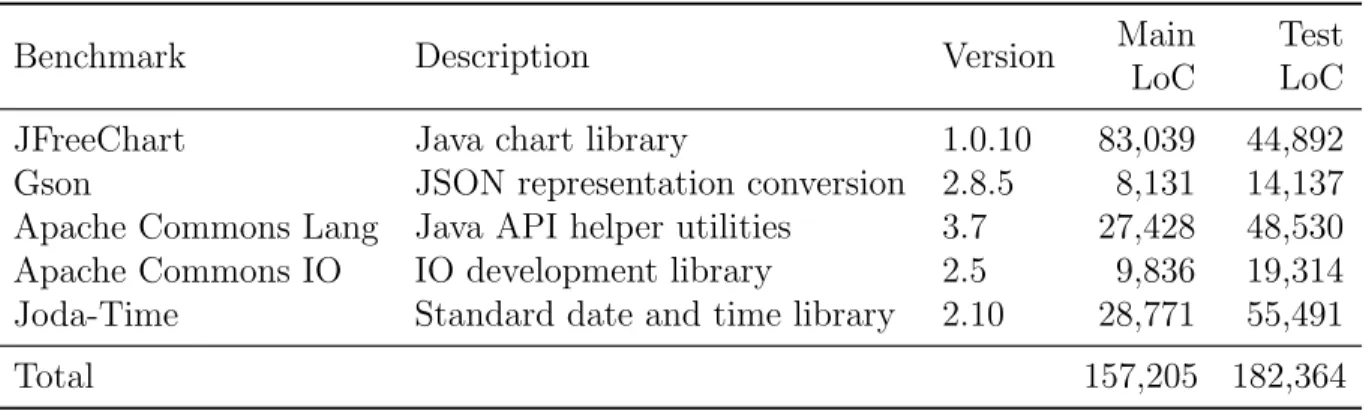
We conducted an empirical study on a collection of 5 Java-based open source benchmark projects. The benchmark test suites contain test code ranging from 14,000 to 55,000 lines, and 14,431 test methods in all. Our technique identified 415 renamed clone pairs in our benchmark test suites as effective candidates for refactoring. On average, our technique refactors 65% of the effective candidates (268 clone pairs). All of the refactored test methods compile, and 94% of them pass when executed as tests. We manually inspected the correctly refactored clone pairs for each benchmark project and found that, although individual tests could be more complicated to understand and specific tests could become more difficult to debug, our refactoring suggestions can make test suites more concise. Appropriate refactoring reduces the amount of duplication and makes the suites easier to maintain and extend.
Our main contributions are:
• a technique to provide refactoring suggestions for test-level clone pairs in existing test suites;
• an implementation of that technique; and
• an empirical study of five benchmark projects using our technique. Our tool is available under the MIT License at:
Chapter 2
Related Work
In this section, we first present the definitions of clone types that we use in our context. We then discuss refactoring activities in test code. Finally, we discuss recent research work in clone removal refactoring.
2.1
Clone Type Classification
Our technique aims to refactor method-scope renamed clones (Type II clones) in a test suite. Such clones may beType II clones (Definition 2) as well as structural clones (Defini-tion 5) where the syntactic bound is a method boundary. In this thesis, we use the terms method-scope renamed clones and renamed clones interchangeably.
In our context, we adopt the following definitions from Roy and Cordy’s work on clone detection [34].
Definition 1 Type I clones are identical code fragments except for variations in whites-pace (may be also variations in layout) and comments. We also refer to these as exact clones. Figure 2.1 presents an example of exact clones. These two code fragments differ by whitespace and comments.
// exact clone instance1
if (a >= b) {
c = d + b; // Comment1
} else
c = d - a; // Comment2 // exact clone instance2
if (a>=b) { //Comment1’ c=d+b; d=d+1; } else // Comment2’ c=d-a;
Figure 2.1: Exact clones differ only by whitespace
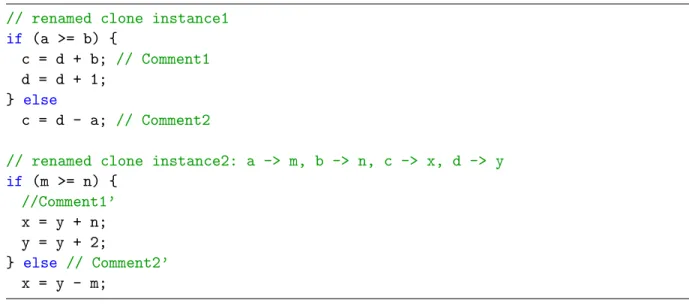
Definition 2 Type II clones are structurally/syntactically identical fragments except for variations in identifiers, literals, types, layout and comments. We also refer to these asrenamed clones. Figure2.2 presents an example of renamed clones. The two fragments vary in variable names, literals, and comments, but have the same syntactic structure.
// renamed clone instance1
if (a >= b) {
c = d + b; // Comment1
d = d + 1; } else
c = d - a; // Comment2
// renamed clone instance2: a -> m, b -> n, c -> x, d -> y
if (m >= n) { //Comment1’ x = y + n; y = y + 2; } else // Comment2’ x = y - m;
Figure 2.2: Renamed clones differ by variations in variable names, literals, and comments
Definition 3 Type III clones are copied fragments with further modifications. Such clones may not only contain variations in identifiers, literals, types, layout and comments, but also differ by changed, inserted or removed statements. We also refer to these asgapped
clones. Figure2.3 presents an example of gapped clones. The second clone instance differs from the first clone instance with a gap of one inserted statement.
// gapped clone instance1
if (a >= b) {
c = d + b; // Comment1
} else
c = d - a; // Comment2 // gapped clone instance2
if (a >= b) {
c = d + b; // Comment1
e = 5; // This statement is added
} else
c = d - a; // Comment2
Figure 2.3: Gapped clones differ by one gapped statement
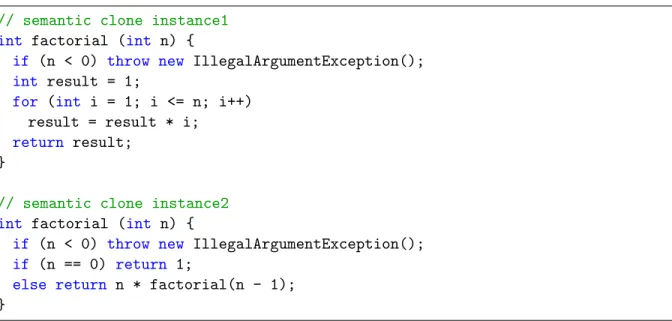
Definition 4 Type IV clones are two or more code fragments that perform the same computation but are implemented through different syntactic variants. We also refer to these assemantic clones. Figure2.4presents an example of semantic clones. Both functions calculate the factorial of their argumentn, but they are implemented in two different ways. The first clone instance uses iteration, while the second one uses a recursive call.
// semantic clone instance1
int factorial (int n) {
if (n < 0) throw new IllegalArgumentException(); int result = 1;
for (int i = 1; i <= n; i++) result = result * i;
return result; }
// semantic clone instance2
int factorial (int n) {
if (n < 0) throw new IllegalArgumentException(); if (n == 0) return 1;
else return n * factorial(n - 1); }
Definition 5 Structural clones are simple clones (Type I, II, III, or IV) that lie within a syntactic boundary following the syntactic structure of a particular language. These boundaries can be a function boundary, statement boundary, class boundary, etc. Figure 2.5 presents an example of method-scope structural clones. These clones have method boundaries; they are also renamed clones with variations in variable names, literals, types, and method names.
// method-scope structural clone instance1
public void test1() { TypeA t1 = new TypeA();
assertEquals(5, t1.getSomeValue()); }
// method-scope structural clone instance2
public void test2() { TypeB t2 = new TypeB();
assertEquals(10, t2.getOtherValue()); }
Figure 2.5: Renamed clones lie within method boundaries
2.2
Test Code Refactoring
Refactoring test code was first proposed by van Deursen et al [40]. They indicated that specific bad smells such as code duplication arose more often in test code than in produc-tion code. They also described a set of test refactorings to eliminate these bad smells. Meszaros [32] presented a detailed and systematic explanation of test patterns, including roadmaps for manually refactoring test code. However, neither of the past works proposed techniques to automate test refactoring.
Guerra and Fernandes [16] presented a framework for reasoning about test structure and proposed a tool to perform simple refactorings. They also indicated that test code refactoring should be different from application code refactoring and refactoring in test code needed to keep the same verifications of the application code behaviour. While their technique mainly focused on validating and refactoring the test structure inside a test class, our tool can provide refactoring suggestions for developers to remove duplicated code in test suites.
restructure unit tests. Their approach profiles the execution information of unit tests and defines a metric based on execution information to measure the similarity between test methods. However, TestSurgeon does not refactor test code. Our technique automatically refactors similar test clones and directly applies refactoring changes to source code.
2.3
Clone Removal Refactoring
Clone management plays an important role in software maintenance and evolution. While some studies identified positive aspects of code clones in the software development life cycle [23,26,15,27], code duplication is often overall harmful for software system, resulting in additional maintenance efforts [20,28, 13, 9,25, 30, 7,19].
Extensive refactoring might not always be beneficial or practical [24]. Researchers have proposed techniques to recommend clones for refactoring. Wang and Godfrey [41] proposed a decision tree-based classifier to provide recommendations for refactoring. They collected training data from three open source projects (646 clone instances) to reflect the benefit, cost, and risk of clone refactoring and trained their model based on this refactoring history data. Mondal et al [29, 33] defined a clone change pattern, Similarity Preserving Change Pattern (SPCP), to mine software evolution history. They proposed a technique to identify clones that follow this pattern as important candidates for refactoring. While these techniques recommend opportunities for clone refactoring, they do not refactor the duplicated code. These techniques also focus on non-test code.
Recent research has also investigated automatic clone refactoring. Tsantalis et al [39] proposed a technique to investigate the applicability of lambda expressions for clone refac-toring with behavioural differences. They conducted an empirical study to refactor a large dataset of Type II and Type III clones, and found that lambda expressions are a useful tool to increase the applicability of behavioural parameterization. Lambda expressions are not the only language feature that developers can use to parameterize behavioural differences between clones. Our tool introduces three parameterization techniques to pa-rameterize type, data, and behavioural differences. Because we focus on method-scope renamed clones in test suites, our technique provides more specific refactoring suggestions than their results.
Tsantalis et al [38] propose a tool, JDeodorant, to analyze clone pairs and investigate whether the differences between clones can be safely parameterized. Their technique aims for general code; our focus on test code is novel. Their analysis involves nesting structure matching, statement mapping, and precondition examination between input pairs of code
fragments. In our implementation, we use JDeodorant as the clone analysis tool to perform statement mapping and code difference detection on test code.
Meng et al [31] designed and implemented an automated refactoring tool for clone removal based on systematic editing (i.e., making similar changes to multiple locations). Their technique uses six refactoring operations to extract common code and parameterize differences in types, methods, variables, and expressions. Although systematic editing indicates opportunities to remove code redundancy, relying on systematic edits could limit the refactoring scope for clone removal. Our approach takes the results of clone detection as input, which could be more flexible for developers to use. In addition, their tool has limited support for parameterizing type variations, and cannot handle refactor when any parameterized type (e.g.,T) instantiates new objects (e.g.,new T()) or retrieves the type literal (e.g.,T.class). Our technique can handle these cases and produce readable code.
Juillerat and Hirsbrunner [21] proposed an algorithm to refactor method-scope clones using theForm Template Method pattern. Their transformation was only semi-automated. Hotta et al [17] followed up with a technique to assist applying theForm Template Method refactoring. Their approach handles gapped clones with the program dependence graph and provides refactoring suggestions with a GUI. However, their refactoring technique relies on applying theForm Template Method design pattern, which requires a common abstract superclass to store the extracted template method. Our technique can provide a broader scope to refactor clones without extra levels of inheritance.
Balazinska et al [8] propose a refactoring approach to redesign clone methods using the strategy design pattern. Their transformation factorizes the commonalities of clones and parameterizes their differences. However, applying the strategy design pattern to the redesign process introduces multiple levels of indirection to mask clone differences, which significantly increases the size of the system. Moreover, their refactoring process becomes more complicated for parameterizing the differences in local variable types. In our approach, we use fewer levels of indirection to parameterize clone differences. Also, our technique can easily handle type differences by introducing generic methods.
Chapter 3
Motivating Examples
Our work proposes and implements refactoring suggestions for test pairs that are method-scope renamed clones. Such clones are exact method clones except for variations in iden-tifiers, literals, and types [34].
In this section, we use three clone pairs from our benchmarks as examples to illustrate the typical patterns that we found in the test suites and how our technique refactors these clone pairs. Using these examples, we categorize the parameterizable differences observed in our work.
3.1
Typical Clones
Example 1
Figure 3.1 presents a pair of renamed clones found in the test suite of the Joda-Time project (version 2.10). This clone pair contains variables with different types (highlighted in pink), declaring variables of types MutableDateTime and Instant respectively. After instantiating variables with specific types, both of the methods then test the date and time fields of the variables. Therefore, both test cases follow the same logic. The main difference between the methods of this clone pair is the type difference in the variable declaration and instantiation, which can be parameterized using generic methods.
// test method in org.joda.time.TestMutableDateTime_Basics
public void testGet_DateTimeField() {
MutableDateTime test = new MutableDateTime ();
assertEquals(1, test.get(ISOChronology.getInstance().era())); assertEquals(20, test.get(ISOChronology.getInstance().centuryOfEra())); assertEquals(2, test.get(ISOChronology.getInstance().yearOfCentury())); assertEquals(2002, test.get(ISOChronology.getInstance().yearOfEra())); assertEquals(2002, test.get(ISOChronology.getInstance().year())); assertEquals(6, test.get(ISOChronology.getInstance().monthOfYear())); assertEquals(9, test.get(ISOChronology.getInstance().dayOfMonth())); assertEquals(2002, test.get(ISOChronology.getInstance().weekyear())); assertEquals(23, test.get(ISOChronology.getInstance().weekOfWeekyear())); assertEquals(7, test.get(ISOChronology.getInstance().dayOfWeek())); assertEquals(160, test.get(ISOChronology.getInstance().dayOfYear())); assertEquals(0, test.get(ISOChronology.getInstance().halfdayOfDay())); assertEquals(1, test.get(ISOChronology.getInstance().hourOfHalfday())); assertEquals(1, test.get(ISOChronology.getInstance().clockhourOfDay())); assertEquals(1, test.get(ISOChronology.getInstance().clockhourOfHalfday())); assertEquals(1, test.get(ISOChronology.getInstance().hourOfDay())); assertEquals(0, test.get(ISOChronology.getInstance().minuteOfHour())); assertEquals(60, test.get(ISOChronology.getInstance().minuteOfDay())); assertEquals(0, test.get(ISOChronology.getInstance().secondOfMinute())); assertEquals(60 * 60, test.get(ISOChronology.getInstance().secondOfDay())); assertEquals(0, test.get(ISOChronology.getInstance().millisOfSecond())); assertEquals(60 * 60 * 1000, test.get(ISOChronology.getInstance().millisOfDay())); try { test.get((DateTimeField) null); fail();
} catch (IllegalArgumentException ex) {} }
// test method in org.joda.time.TestInstant_Basics
public void testGet_DateTimeField() { Instant test = new Instant ();
assertEquals(1, test.get(ISOChronology.getInstance().era()));
assertEquals(20, test.get(ISOChronology.getInstance().centuryOfEra())); assertEquals(2, test.get(ISOChronology.getInstance().yearOfCentury())); assertEquals(2002, test.get(ISOChronology.getInstance().yearOfEra()));
assertEquals(2002, test.get(ISOChronology.getInstance().year())); assertEquals(6, test.get(ISOChronology.getInstance().monthOfYear())); assertEquals(9, test.get(ISOChronology.getInstance().dayOfMonth())); assertEquals(2002, test.get(ISOChronology.getInstance().weekyear())); assertEquals(23, test.get(ISOChronology.getInstance().weekOfWeekyear())); assertEquals(7, test.get(ISOChronology.getInstance().dayOfWeek())); assertEquals(160, test.get(ISOChronology.getInstance().dayOfYear())); assertEquals(0, test.get(ISOChronology.getInstance().halfdayOfDay())); assertEquals(1, test.get(ISOChronology.getInstance().hourOfHalfday())); assertEquals(1, test.get(ISOChronology.getInstance().clockhourOfDay())); assertEquals(1, test.get(ISOChronology.getInstance().clockhourOfHalfday())); assertEquals(1, test.get(ISOChronology.getInstance().hourOfDay())); assertEquals(0, test.get(ISOChronology.getInstance().minuteOfHour())); assertEquals(60, test.get(ISOChronology.getInstance().minuteOfDay())); assertEquals(0, test.get(ISOChronology.getInstance().secondOfMinute())); assertEquals(60 * 60, test.get(ISOChronology.getInstance().secondOfDay())); assertEquals(0, test.get(ISOChronology.getInstance().millisOfSecond())); assertEquals(60 * 60 * 1000, test.get(ISOChronology.getInstance().millisOfDay())); try { test.get((DateTimeField) null); fail();
} catch (IllegalArgumentException ex) {} }
Figure 3.1: MutableDateTime and Instanttests differ by types of the variable test Figure 3.2 shows our refactoring suggestion. To reuse the common logic behind the clone pair in Figure3.1, we propose abstracting the types MutableDateTime andInstant as type parameters in the generic method testBasicsTestGet DateTimeFieldTemplate. More specifically, the type MutableDateTime and Instant are subclasses of the type AbstractInstant, and we can declare generic type TInstant constrained to extend the type AbstractInstant to represent types MutableDateTime and Instant. The generic method serves as a test utility method, which can be reused in the body of test cases by passing in different concrete type parameters.
// parameterized template in
org.joda.time.TestBasicsTestGet_DateTimeFieldTemplate
public static <TInstant extends AbstractInstant>
void testBasicsTestGet_DateTimeFieldTemplate(Class<TInstant> clazzTInstant) throws Exception {
TInstant test = clazzTInstant.newInstance();
assertEquals(1, test.get(ISOChronology.getInstance().era())); assertEquals(20, test.get(ISOChronology.getInstance().centuryOfEra())); assertEquals(2, test.get(ISOChronology.getInstance().yearOfCentury())); assertEquals(2002, test.get(ISOChronology.getInstance().yearOfEra())); assertEquals(2002, test.get(ISOChronology.getInstance().year())); assertEquals(6, test.get(ISOChronology.getInstance().monthOfYear())); assertEquals(9, test.get(ISOChronology.getInstance().dayOfMonth())); assertEquals(2002, test.get(ISOChronology.getInstance().weekyear())); assertEquals(23, test.get(ISOChronology.getInstance().weekOfWeekyear())); assertEquals(7, test.get(ISOChronology.getInstance().dayOfWeek())); assertEquals(160, test.get(ISOChronology.getInstance().dayOfYear())); assertEquals(0, test.get(ISOChronology.getInstance().halfdayOfDay())); assertEquals(1, test.get(ISOChronology.getInstance().hourOfHalfday())); assertEquals(1, test.get(ISOChronology.getInstance().clockhourOfDay())); assertEquals(1, test.get(ISOChronology.getInstance().clockhourOfHalfday())); assertEquals(1, test.get(ISOChronology.getInstance().hourOfDay())); assertEquals(0, test.get(ISOChronology.getInstance().minuteOfHour())); assertEquals(60, test.get(ISOChronology.getInstance().minuteOfDay())); assertEquals(0, test.get(ISOChronology.getInstance().secondOfMinute())); assertEquals(60 * 60, test.get(ISOChronology.getInstance().secondOfDay())); assertEquals(0, test.get(ISOChronology.getInstance().millisOfSecond())); assertEquals(60 * 60 * 1000, test.get(ISOChronology.getInstance().millisOfDay())); try { test.get((DateTimeField) null); fail();
} catch (IllegalArgumentException ex) {} }
// refactored test method in org.joda.time.TestMutableDateTime_Basics
public void testGet_DateTimeField() throws Exception { TestBasicsTestGet_DateTimeFieldTemplate
.testBasicsTestGet_DateTimeFieldTemplate( MutableDateTime .class); }
// refactored test method in org.joda.time.TestInstant_Basics
public void testGet_DateTimeField() throws Exception { TestBasicsTestGet_DateTimeFieldTemplate
.testBasicsTestGet_DateTimeFieldTemplate( Instant .class); }
Figure 3.2: Using generic types to abstract the types MutableDateTime and Instant
Example 2
Figure 3.3 shows another duplication pattern. The only difference in this clone pair lies in the argument values passed to the DateTickUnit constructor (highlighted in purple), which is 1 and 10 respectively. The parameterized template method can be extracted by abstracting the different integers as a method argument.
// test method in org.jfree.chart.axis.junit.DateAxisTests
public void testPreviousStandardDateMillisecondA() { MyDateAxis axis = new MyDateAxis("Millisecond");
Millisecond m0 = new Millisecond(458, 58, 31, 12, 1, 4, 2007); Millisecond m1 = new Millisecond(459, 58, 31, 12, 1, 4, 2007); Date d0 = new Date(m0.getFirstMillisecond());
Date end = new Date(m1.getLastMillisecond());
DateTickUnit unit = new DateTickUnit(DateTickUnit.MILLISECOND, 1 ); axis.setTickUnit(unit);
// START: check d0
axis.setTickMarkPosition(DateTickMarkPosition.START); axis.setRange(d0, end);
Date psd = axis.previousStandardDate(d0, unit); Date nsd = unit.addToDate(psd);
assertTrue(psd.getTime() < d0.getTime()); assertTrue(nsd.getTime() >= d0.getTime());
// MIDDLE: check d0
axis.setRange(d0, end); psd = axis.previousStandardDate(d0, unit); nsd = unit.addToDate(psd); assertTrue(psd.getTime() < d0.getTime()); assertTrue(nsd.getTime() >= d0.getTime()); // END: check d0 axis.setTickMarkPosition(DateTickMarkPosition.END); axis.setRange(d0, end); psd = axis.previousStandardDate(d0, unit); nsd = unit.addToDate(psd); assertTrue(psd.getTime() < d0.getTime()); assertTrue(nsd.getTime() >= d0.getTime()); }
// test method in org.jfree.chart.axis.junit.DateAxisTests
public void testPreviousStandardDateMillisecondB() { MyDateAxis axis = new MyDateAxis("Millisecond");
Millisecond m0 = new Millisecond(458, 58, 31, 12, 1, 4, 2007); Millisecond m1 = new Millisecond(459, 58, 31, 12, 1, 4, 2007); Date d0 = new Date(m0.getFirstMillisecond());
Date end = new Date(m1.getLastMillisecond());
DateTickUnit unit = new DateTickUnit(DateTickUnit.MILLISECOND, 10 ); axis.setTickUnit(unit);
// START: check d0
axis.setTickMarkPosition(DateTickMarkPosition.START); axis.setRange(d0, end);
Date psd = axis.previousStandardDate(d0, unit); Date nsd = unit.addToDate(psd);
assertTrue(psd.getTime() < d0.getTime()); assertTrue(nsd.getTime() >= d0.getTime());
// MIDDLE: check d0
axis.setRange(d0, end); psd = axis.previousStandardDate(d0, unit); nsd = unit.addToDate(psd); assertTrue(psd.getTime() < d0.getTime()); assertTrue(nsd.getTime() >= d0.getTime()); // END: check d0 axis.setTickMarkPosition(DateTickMarkPosition.END); axis.setRange(d0, end); psd = axis.previousStandardDate(d0, unit); nsd = unit.addToDate(psd); assertTrue(psd.getTime() < d0.getTime()); assertTrue(nsd.getTime() >= d0.getTime()); }
Figure 3.3: Two DateAxis tests differ by argument values in theDateTickUnit constructor call
Figure 3.4 presents the results of our technique for the clone pair from Figure 3.3, showing a case of parameterized unit tests [37]. Parameterizing the data difference makes the refactored test cases more concise, effectively saving 21 lines of code from the original clone pair with 54 lines. Refactoring also helps facilitate data-driven testing and reduces the technical debt of the test suite maintenance when more tests with different data are needed.
// parameterized template in org.jfree.chart.axis.junit.DateAxisTests
public void dateAxisTestsTestPreviousStandardDateMillisecondTemplate(int i1) { MyDateAxis axis = new MyDateAxis("Millisecond");
Millisecond m0 = new Millisecond(458, 58, 31, 12, 1, 4, 2007); Millisecond m1 = new Millisecond(459, 58, 31, 12, 1, 4, 2007); Date d0 = new Date(m0.getFirstMillisecond());
Date end = new Date(m1.getLastMillisecond());
DateTickUnit unit = new DateTickUnit(DateTickUnit.MILLISECOND, i1); axis.setTickUnit(unit);
axis.setTickMarkPosition(DateTickMarkPosition.START); axis.setRange(d0, end);
Date psd = axis.previousStandardDate(d0, unit); Date nsd = unit.addToDate(psd);
assertTrue(nsd.getTime() >= d0.getTime()); axis.setTickMarkPosition(DateTickMarkPosition.MIDDLE); axis.setRange(d0, end); psd = axis.previousStandardDate(d0, unit); nsd = unit.addToDate(psd); assertTrue(psd.getTime() < d0.getTime()); assertTrue(nsd.getTime() >= d0.getTime()); axis.setTickMarkPosition(DateTickMarkPosition.END); axis.setRange(d0, end); psd = axis.previousStandardDate(d0, unit); nsd = unit.addToDate(psd); assertTrue(psd.getTime() < d0.getTime()); assertTrue(nsd.getTime() >= d0.getTime()); }
// refactored test method in org.jfree.chart.axis.junit.DateAxisTests
public void testPreviousStandardDateMillisecondA() {
this.dateAxisTestsTestPreviousStandardDateMillisecondTemplate( 1 ); }
// refactored test method in org.jfree.chart.axis.junit.DateAxisTests
public void testPreviousStandardDateMillisecondB() {
this.dateAxisTestsTestPreviousStandardDateMillisecondTemplate( 10 ); }
Figure 3.4: Different integer literal values are parameterized as method arguments
Example 3
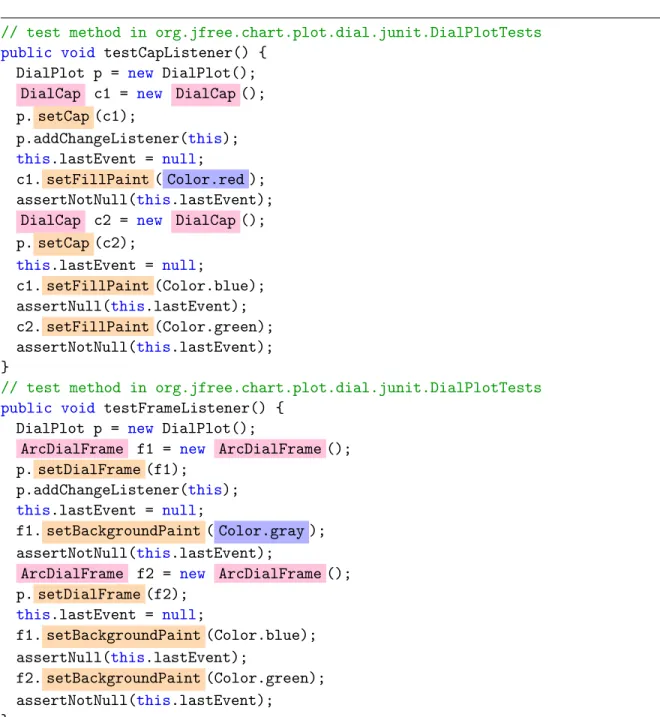
Finally, Figure 3.5 not only contains type and data differences which are similar to the previous examples (highlighted in pink and purple respectively) but also introduces a new type of difference in object method invocations (highlighted in orange). This time, the clone tests still have the same structure, but they call methods with different names (i.e., setCap and setDialFrame). These different method calls can possibly be invoked on receiver objects of different types (i.e., DialCap and ArcDialFrame). We would expect methods with different names to have different behaviours. However, we can still refactor these tests as they have the same structure.
// test method in org.jfree.chart.plot.dial.junit.DialPlotTests
public void testCapListener() { DialPlot p = new DialPlot();
DialCap c1 = new DialCap (); p. setCap (c1);
p.addChangeListener(this); this.lastEvent = null;
c1. setFillPaint ( Color.red ); assertNotNull(this.lastEvent);
DialCap c2 = new DialCap (); p. setCap (c2);
this.lastEvent = null;
c1. setFillPaint (Color.blue); assertNull(this.lastEvent); c2. setFillPaint (Color.green); assertNotNull(this.lastEvent); }
// test method in org.jfree.chart.plot.dial.junit.DialPlotTests
public void testFrameListener() { DialPlot p = new DialPlot();
ArcDialFrame f1 = new ArcDialFrame (); p. setDialFrame (f1);
p.addChangeListener(this); this.lastEvent = null;
f1. setBackgroundPaint ( Color.gray ); assertNotNull(this.lastEvent);
ArcDialFrame f2 = new ArcDialFrame (); p. setDialFrame (f2);
this.lastEvent = null;
f1. setBackgroundPaint (Color.blue); assertNull(this.lastEvent);
f2. setBackgroundPaint (Color.green); assertNotNull(this.lastEvent);
}
Figure 3.5: MethodstestCapListener,testFrameListener have similar structure but instantiate different methods (DialCap vs ArcDialFrame), call different methods (setCap
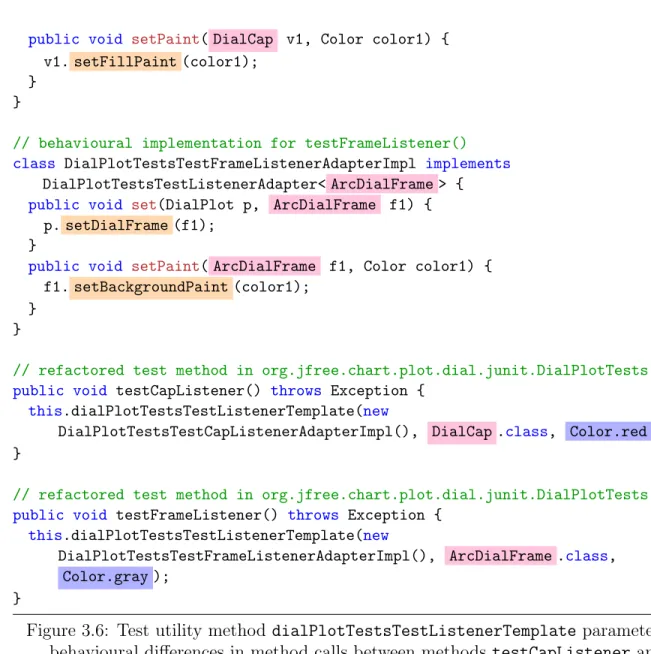
Figure 3.6 shows our suggested refactoring for the code pair in Figure 3.5. The basic idea is to extract the common interface, DialPlotTestsTestListenerAdapter, based on the behavioural differences, then apply different implementations of the common interface to individual test cases. Similar to the parameterization of data differences, we apply the behavioural differences through the template method argument by passing specific interface implementation objects.
// parameterized template in org.jfree.chart.plot.dial.junit.DialPlotTests
public <TDial extends AbstractDialLayer> void dialPlotTestsTestListenerTemplate( DialPlotTestsTestListenerAdapter<TDial> adapter, Class<TDial> clazzTDial,
Color color1) throws Exception { DialPlot p = new DialPlot();
TDial v1 = clazzTDial.newInstance(); adapter.set(p, v1);
p.addChangeListener(this); this.lastEvent = null;
adapter.setPaint(v1, color1); assertNotNull(this.lastEvent);
TDial v2 = clazzTDial.newInstance(); adapter.set(p, v2);
this.lastEvent = null;
adapter.setPaint(v1, Color.blue); assertNull(this.lastEvent);
adapter.setPaint(v2, Color.green); assertNotNull(this.lastEvent); }
// common behavioural interface
interface DialPlotTestsTestListenerAdapter<TDial> { void set(DialPlot dialPlot1, TDial tDial1);
void setPaint(TDial tDial1, Color color1); }
// behavioural implementation for testCapListener()
class DialPlotTestsTestCapListenerAdapterImpl implements DialPlotTestsTestListenerAdapter< DialCap > {
public void set(DialPlot p, DialCap c1) { p. setCap (c1);
public void setPaint( DialCap v1, Color color1) { v1. setFillPaint (color1);
} }
// behavioural implementation for testFrameListener()
class DialPlotTestsTestFrameListenerAdapterImpl implements DialPlotTestsTestListenerAdapter< ArcDialFrame > { public void set(DialPlot p, ArcDialFrame f1) {
p. setDialFrame (f1); }
public void setPaint( ArcDialFrame f1, Color color1) { f1. setBackgroundPaint (color1);
} }
// refactored test method in org.jfree.chart.plot.dial.junit.DialPlotTests
public void testCapListener() throws Exception { this.dialPlotTestsTestListenerTemplate(new
DialPlotTestsTestCapListenerAdapterImpl(), DialCap .class, Color.red ); }
// refactored test method in org.jfree.chart.plot.dial.junit.DialPlotTests
public void testFrameListener() throws Exception { this.dialPlotTestsTestListenerTemplate(new
DialPlotTestsTestFrameListenerAdapterImpl(), ArcDialFrame .class, Color.gray );
}
Figure 3.6: Test utility method dialPlotTestsTestListenerTemplateparameterizes behavioural differences in method calls between methods testCapListener and
testFrameListenerfrom Figure 3.5
3.2
Parameterizable Difference Categorization
Based on the above motivating examples and our observations during refactoring, we iden-tify three basic types of parameterizable differences:
1. Type difference
Type differences include tests that differ in the classes that they declare or instantiate. Note that the classes of different types are not necessarily subclasses of a common su-perclass except for the classObject. We will describe our parameterization technique for type differences in section 4.2.1.
As shown in Figure 3.1, the matching variables test are declared and instantiated with different types, MutableDateTime and Instant, respectively. Also, classes of different types in Figure 3.5, DialCap and ArcDialFrame, are instantiated and as-signed to variables of corresponding type.
2. Data difference
This group mainly refers to differences in literal values or variables of different data types. We explain more details about how we parameterize data difference in section
4.2.2. Figure 3.3 presents an example of data difference in integer literal values. In
our refactoring work, we observed many instances of this difference type in test cases, especially in some data-intensive test suites such as the Joda-Time benchmark. 3. Behavioural difference
Method calls are key actions in Object-Oriented Programming. Behavioural differ-ences include tests that differ in the identity of the methods that they invoke. Java method invocations include a receiver expression, method name, and actual param-eter values:
<receiver expr>.<method name>(<actual parameter values>)
For this type of difference, we consider receiver expressions and method names. Dif-ferences in actual parameters can be detected as data difDif-ferences. Section 4.2.3 will present more details about how we parameterize behavioural differences.
As discussed in Figure 3.5, the method pair of p.setCap and p.setDialFrame only has a behavioural difference in its method name identifier, while the method pair of c1.setFillPaintandf1.setBackGroundPaintcontains differences in both receiver expression and method name.
Our observations show that many differences in parameterized clones fit one of the three above types. Our refactoring technique focuses on automatically parameterizing these three types of differences in clone pairs. Other difference types are out of scope for this work. Additionally, these basic parameterizable differences can appear individually or
together in a nested way. We apply the parameterization techniques in our approach in a depth-first search (DFS) way to refactor the abstract syntax tree structure of the clone pair, which we will describe in the next section.
Chapter 4
Approach
Our tool, JTestParametrizer, refactors renamed clones in test cases and provides these refactorings as suggestions to the developers.
In this section, we first introduce the tools and concepts that we use in our approach. Then, we present three parameterization techniques that we developed for refactoring test cases and describe more implementation details about our approach. Finally, we discuss the limitations of our refactoring technique.
4.1
Tools and Concepts
Abstract Syntax Trees (AST) are tree-based data structures widely used in compilers to represent the structure of source code in a programming language [6]. These trees represent text-based source code in a tree form. Each node of the tree denotes a syntactic element in the source code. AST nodes can represent literal values, variable declarations, expressions, statements, etc. ASTs are a convenient and powerful tool for programmatically analyzing and modifying source code [1].
In our implementation, we use the Java Development Tooling (JDT) API [4] on the Eclipse platform for parsing source code to ASTs. The JDT allows users to write, compile, test, debug, and edit programs written in the Java programming language. The Eclipse JDT API provides a large hierarchical organization of AST node types including different types of nodes such as Expression, Statement, Type, Name, BodyDeclaration, etc. Each type may contain dozens of concrete AST nodes. For instance, theStatement group has 22 kinds of statement nodes, and the Expression group contains up to 32 kinds of expression
nodes. To perform appropriate operations over such a complex object structure, our im-plementation applies the visitor pattern, which allows flexibly defining specific behaviour based on the AST node type.
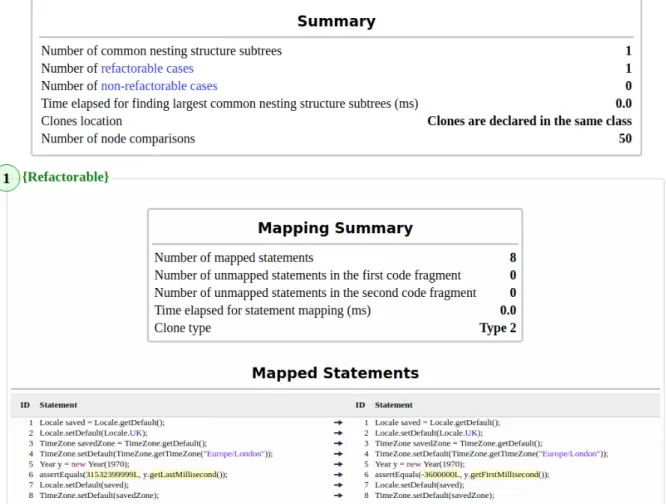
Additionally, we use Deckard [18] to detect potential candidates for refactoring. Deckard is a tree-based clone detection tool which is applicable to any language with a formally specified grammar [18]. It reports clone candidates, which serve as raw inputs to our refactoring system. We then use JDeodorant [38] as a library in our implementation to perform clone analysis, which involves mapping corresponding AST nodes and identifying the differences in clone pairs. JDeodorant is an Eclipse plugin that supports identifying and resolving duplicated code smells in Java software [3]. Unlike Deckard, it does not detect clone candidates, but focuses on clone analysis and refactoring with given clone candidates. In our implementation, we use the analysis results from JDeodorant for further refactoring. Figure4.1 shows a pair of renamed clones detected by Deckard in the test suite of the JFreeChart project (version 1.0.10). Manual inspection confirms that a data difference (highlighted in purple) and a behaviour difference (highlighted in orange) exist in the argument lists of theassertEquals method calls. Figure 4.2 presents the analysis results from JDeodorant. JDeodorant can map statements between clone instances and identify the differences in the arguments of the assertEquals method call. Our technique uses this analysis information to provide refactoring suggestions.
// test method in org.jfree.data.time.junit.YearTests
public void testGetLastMillisecond() { Locale saved = Locale.getDefault(); Locale.setDefault(Locale.UK);
TimeZone savedZone = TimeZone.getDefault();
TimeZone.setDefault(TimeZone.getTimeZone("Europe/London")); Year y = new Year(1970);
assertEquals( 31532399999L , y. getLastMillisecond ()); Locale.setDefault(saved);
TimeZone.setDefault(savedZone); }
// test method in org.jfree.data.time.junit.YearTests
public void testGetFirstMillisecond() { Locale saved = Locale.getDefault(); Locale.setDefault(Locale.UK);
TimeZone savedZone = TimeZone.getDefault();
Year y = new Year(1970);
assertEquals( -3600000L , y. getFirstMillisecond ()); Locale.setDefault(saved);
TimeZone.setDefault(savedZone); }
Figure 4.1: Deckard detects testGetLastMillisecond and testGetFirstMillisecond as a potential refactorable clone pair
Figure 4.2: JDeodorant maps statements between test methods testGetLastMillisecond and testGetFirstMillisecond and identifies the clone differences
4.2
Parameterization Techniques
Our examples in the previous section motivate three levels of refactoring: • Type parameterization
• Data parameterization • Behaviour parameterization
All of our refactoring techniques work at a per-method granularity. Our refactoring strategy first extracts a parameterized template method from the clones, and then instan-tiates it with the proper parameter values. We apply this strategy at all three levels.
4.2.1
Type Parameterization
A type-parameterizable clone includes entries with different type identifiers. Java includes generics to abstract over types. The basic idea of generics is to allow types, including basic data types such as Integer, String, and user-defined types, to be a parameter to methods, classes, and interfaces. When the classes of different types are subclasses of a common superclass except for the classObject, we add the common superclass as the bound of the extracted generic type.
In the abstract syntax tree (AST), differences in type identifiers mainly exist in the following two types of AST nodes:
• Variable declarations
A variable declaration in Java contains a type identifier and a variable name. For in-stance, the following statement declares a variabletestof the typeMutableDateTime.
MutableDateTime test;
In renamed clones, paired variables declared with different types result in a type difference. Type differences in this type of AST node can be easily parameterized with generic methods.
As shown in Figure 3.2, MutableDateTime and Instant are different paired type identifiers. They are abstracted as the type parameterTInstantin the parameterized template, which can be later instantiated with MutableDateTimeandInstantin the test cases.
• Object instantiation
Java instantiates objects using the new operator. The following expression creates an object of the type MutableDateTime.
new MutableDateTime()
When classes of different types are instantiated with constructor calls, there exist type differences in the class instance creation node. To parameterize this type of AST node, we use the generic class, Class<T> in the java.lang package, to unify the type differences. This generic class provides a newInstance() method to create a new instance of its generic type. Furthermore, in Java, writing .classafter a class name retrieves the Class object which represents the given class.
As shown in Figure 3.6, the argument clazzTDial of type Class<TDial> in the parameterized template method is used to unify the type difference innew DialCap() and new ArcDialFrame(). We invoke the newInstance() method of clazzTDial to create a new class instance of TDial type, which parameterizes the DialCap and ArcDialFrame classes.
4.2.2
Data Parameterization
A data-parameterizable clone has differences in literal values and variables of different types. As shown in Figure 3.4, the main refactoring idea is to replace the differing values with a parameter to unify the clone pair and pass the particular values as arguments to the extracted template method in different test cases. The key to parameterizing data differences is to determine the common compatible type for the pair of differing values. Based on the data types of the value pair to parameterize, we take into account two groups in our refactoring approach:
• Primitive values
Primitive values include numbers, characters, boolean literals, and variables of prim-itive types. We use the following implicit casting order for Java number literals in our data parameterization:
byte -> short -> int -> long float -> double
The left-side value can be implicitly assigned to any right-side value. When the paired values are of different primitive types, we use a best-effort approach to find the closest assignment compatible common type with implicit casting. Figure 4.3 presents a refactoring example with primitive value casting from the Joda-Time project (version 2.10). When we parameterize the primitive value pair of int and long, we use the type longas the argument type. This widening conversion may not be desirable for test coverage reasons. Developers need to review the test cases to further confirm the refactoring suggestions. In our benchmarks, we observed 22 clone pairs with this type of casting, accounting for 5% of our total effective refactoring candidates. As a conversion of intor long to float, or of long to double, may lose precision, it would not be desirable to parameterize value pairs of integer and floating-point numbers. In our approach, we consider that integer values (byte, short, int, and long) are incompatible with floating-point values (float anddouble). If there is no compatible common type, the clone pair will be marked as non-refactorable.
• Non-primitive values
Non-primitive values can be any variables of Java library types or user-defined types. If the data pair binds with different non-primitive types, our technique tries to find the nearest common superclass or interface of the data types as the parameter type. When the differing non-primitive types share no common superclass or interface except for the class Object, the clone pair will be marked as non-refactorable.
// test method1 in org.joda.time.field.TestMillisDurationField
public void test_getMillis_int() {
assertEquals(0, MillisDurationField.INSTANCE.getMillis(0));
assertEquals(1234, MillisDurationField.INSTANCE.getMillis(1234)); assertEquals(-1234, MillisDurationField.INSTANCE.getMillis(-1234)); }
// test method2 in org.joda.time.field.TestMillisDurationField
public void test_getMillis_long() {
assertEquals(0L, MillisDurationField.INSTANCE.getMillis(0L));
assertEquals(1234L, MillisDurationField.INSTANCE.getMillis(1234L)); assertEquals(-1234L, MillisDurationField.INSTANCE.getMillis(-1234L)); }
// parameterized template in org.joda.time.field.TestMillisDurationField
public void testMillisDurationFieldTest_getTemplate(long l1, long l2, long l3, long l4, long l5, long l6) {
assertEquals(l1, MillisDurationField.INSTANCE.getMillis(l2)); assertEquals(l3, MillisDurationField.INSTANCE.getMillis(l4)); assertEquals(l5, MillisDurationField.INSTANCE.getMillis(l6)); }
// refactored test method1 in org.joda.time.field.TestMillisDurationField
public void test_getMillis_int() {
this.testMillisDurationFieldTest_getTemplate(0, 0, 1234, 1234, -1234, -1234); }
// refactored test method2 in org.joda.time.field.TestMillisDurationField
public void test_getMillis_long() {
this.testMillisDurationFieldTest_getTemplate(0L, 0L, 1234L, 1234L, -1234L, -1234L);
}
Figure 4.3: Refactoring example with primitive value casting from int tolong
4.2.3
Behaviour Parameterization
We parameterize methods with behavioural differences, that is, method invocation calls having different signatures. These method calls must still have the same length argument lists, but may have different method names, or perhaps different receiver objects. In our approach, differences in method argument lists are unified before parameterization of method invocation pairs. After parameterizing the argument lists, the argument lists may then have comparable types. Therefore, the behaviour parameterization focuses on the differences in receiver object and method name of the method invocation node.
To unify different method invocations, our parameterization carries out the following steps:
1. We create a common interface to collect all unified behavioural methods with com-patible signatures.
2. We add an argument, adapter, to the parameterized template method with the common interface type. This argument serves as the receiver object for the refactored operations.
3. For each pair of different method invocations in the clone pair, we extract an interface method declaration into the common interface. More specifically, we abstract the receiver object as the first parameter in the interface method declaration, then add all the parameterized arguments to the interface method argument list. Note that we can skip extracting the receiver object if the method invocations do not contain a receiver object (static or implicit this).
Figure 4.4 revisits the example from Figure 3.6 and shows how we extract a com-mon behavioural interface and its instantiations. We extract a comcom-mon generic inter-face,DialPlotTestsTestListenerAdapter<TDial>, to parameterize the behavioural dif-ferences in the clone pair. This common interface contains two method declarations. The method declaration set(...) unifies setCap(...) and setDialFrame(...), while the method declaration setPaint(...) unifies setFillPaint(...) and setBackground-Paint(...). For naming the unified method declarations, we use a best-effort approach to extract the longest common parts of the pair of original method names. If the original method names have no common parts, we assign unique names of the formactionN where N is a counter that increments with each generated name.
// common behavioural interface
interface DialPlotTestsTestListenerAdapter<TDial> { void set(DialPlot dialPlot1, TDial tDial1);
void setPaint(TDial tDial1, Color color1); }
// behavioural implementation for testCapListener()
class DialPlotTestsTestCapListenerAdapterImpl implements DialPlotTestsTestListenerAdapter< DialCap > {
public void set(DialPlot p, DialCap c1) { p. setCap (c1);
}
public void setPaint( DialCap v1, Color color1) { v1. setFillPaint (color1);
} }
// behavioural implementation for testFrameListener()
class DialPlotTestsTestFrameListenerAdapterImpl implements DialPlotTestsTestListenerAdapter< ArcDialFrame > { public void set(DialPlot p, ArcDialFrame f1) {
p. setDialFrame (f1); }
public void setPaint( ArcDialFrame f1, Color color1) { f1. setBackgroundPaint (color1);
} }
Figure 4.4: Common behavioural interface
DialPlotTestsTestListenerAdapter<TDial> and its implementations in Figure 3.6 After unification of different behaviour, we define specific behavioural operations by implementing each declared method in the common interface. Finally, we pass different behavioural implementation variables of the common interface as arguments in the pa-rameterized template method to perform appropriate behavioural operations. As shown in Figure4.4, bothDialPlotTestsTestCapListenerAdapterImpland DialPlotTestsTest-FrameListenerAdapterImplimplement the same interface, DialPlotTestsTestListener-Adapter<TDial>, with a set of different behavioural definitions. For instance, in the imple-mentation of the interface method,void set(DialPlot, TDial), the class DialPlotTests-TestCapListenerAdapterImplinvokes the methodsetCap, while the class DialPlotTests-TestFrameListenerAdapterImpl calls the method setDialFrame.
4.3
Refactoring Roadmap
Our refactoring tool,JTestParametrizer, is implemented as an Eclipse Plugin application, which batch processes all clone pairs in the input file and directly applies refactoring changes to the source files.
4.3.1
Input and Output
Our refactoring tool is designed to process a pair of test methods which are considered to be duplicates. We expect these method-scope clones to be reported by a clone detection tool like Deckard. The input of our refactoring technique is therefore the output of clone
detection along with a program to refactor. The user can also specify custom clone pairs in the input file.
Each clone pair has two records about the clone instances. Each clone instance record includes the following information:
• Clone group ID, an integer indicating the ID of the clone group to which the current clone instance belongs;
• Source folder, indicating the root path of the source code; • Package name (e.g. com.google.gson);
• Class name; • Method signature;
• Start and end line location.
Currently, we only refactor clone pairs in the same package. Clone pairs located in different packages are not in scope for our refactoring work. Conceptually, it is not difficult to apply our technique to clone pairs across different packages. However, we believe clone pairs in different packages are less related to each other than those in the same package. We thus choose to focus on refactoring clone pairs in the same package.
Our tool directly applies the refactoring changes to the targeted source files. If the clone pair is located in the same test class, our tool adds a parameterized template method, the common behavioural interface, and its implementation classes to the same class. When the pair of test methods are in different test classes, we create a utility class to store the parameterized template method and the common behavioural interface, while we put the implementation classes of the common interface as inner classes in their corresponding test classes. Additionally, all targeted test methods are modified in their source file.
4.3.2
Workflow
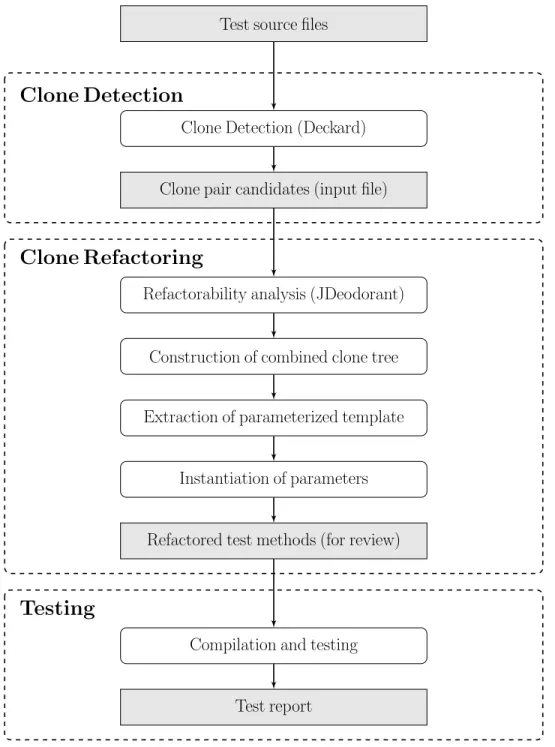
Figure4.5 presents the basic workflow of our technique. From a high-level perspective, the workflow consists of three major processes, and our refactoring technique fits in the Clone Refactoring step.
Clone Detection
Clone Refactoring
Testing
Test source files
Clone Detection (Deckard)
Clone pair candidates (input file)
Refactorability analysis (JDeodorant)
Construction of combined clone tree
Extraction of parameterized template
Instantiation of parameters
Refactored test methods (for review)
Compilation and testing
Test report
1. Clone Detection (Preprocessing)
First, we use popular clone detection tools to select refactoring candidates. In our pre-processing work, we have tried some popular tools such as CloneDR [9], Deckard [18], and CCFinder [22]. Finally we decided to use Deckard as our clone detection tool because it is free software that easily works under Linux. It is also a tree-based, accurate, and scalable code clone detection tool, which is easy to install and use. After detecting the clone candidates with the clone detection tool, we use a simple script to extract the clone pairs in the appropriate format from the clone detection report. We save these results in the input file for the following processing. Also, the user is free to modify the input file with a custom selection of clone pairs. Note that our technique can work with other clone detection tools. Any clone detection tool can be used as long as it generates output in the appropriate format.
2. Clone Refactoring
At this stage, our refactoring tool reads all the clone pairs from the input file and starts to analyze and refactor the method-scope clones. Using the analysis results from JDeodorant, our tool manipulates the abstract syntax tree (AST) structure of the clone pair and directly applies changes to the source files.
After our tool finishes refactoring all the clone pairs, developers need to review the modified test cases. They can continue to modify the refactored code, such as refac-toring variable names or adding comments, to further improve the refacrefac-toring quality. Also, local changes to a specific file or multiple files can be removed if the refactoring changes are not desirable. It is easy to undo changes with the use of version control tools like Git.
3. Testing
After applying appropriate refactoring, we build the modified test code under the project build system, and look for compilation errors. If the project cannot be built due to compilation errors, developers must make additional manual modifications to erroneous refactored test code to eliminate the errors. Once the project can be successfully compiled, we execute the test cases within the project test framework. By inspecting the refactored code as well as the test results after refactoring and those before refactoring, developers can determine the final refactoring quality and decide whether to make further modifications or merge changes to the project master branch.
4.3.3
Implementation
Following the workflow in Figure 4.5, our technique for refactoring renamed clone pairs comes in the Clone Refactoring process. Our refactoring analysis is based on the AST structure, which can represent a source code construct, such as a name, type, expression, statement, or declaration.
More specifically, the roadmap of our refactoring technique consists of the following major steps:
1. Refactorability analysis
First, our tool needs to ensure that a clone pair is actually refactorable. That is, the pair should have isomorphic AST structure. We perform our analysis at AST node level, which includes statement mapping, difference marking, and parameterization analysis.
With the recent research in clone refactoring, we choose to use JDeodorant [38] as the clone analysis tool to map the AST nodes and detect the differences in clone pairs. Based on the analysis results from JDeodorant, we select the renamed clone pairs (i.e, structurally/syntactically identical fragments except for variations in iden-tifiers, literals, types, layout and comments [34]) as effective candidates for further refactoring.
2. Construction of combined clone tree
With the results from the previous step, we have all the information about AST node mapping and the differences in a clone pair. At this stage, we combine the mapped nodes to construct a combined clone tree, which serves as the primary data structure to unify the clone pair and extract the parameterized template.
Figure 4.6 illustrates how we construct a combined clone tree. The clone pair in-stances have the same AST structure. That is, each node in one clone instance can be mapped to its corresponding node in the other clone instance. From the previous step, we collect all the mapped nodes with differences (highlighted in colors other than green). Using this difference mapping information, we combine the nodes con-taining differences in a bottom-up approach. For each pair of differing nodes, we calculate the paths from the differing nodes to their root node (highlighted in red) in the clone instances. We combine each pair of mapped nodes in these paths. Thus, the combined node pairs are either differing nodes or nodes containing differences in their child elements, while the nodes without combining in the combined clone tree do not contain any differences.
Figure 4.6: Clone pair instances have the same AST structure and we combine each pair of mapped nodes in the paths from the differing nodes to their root node
3. Extraction of parameterized template
After constructing the combined clone tree, we continue to extract the template to unify the type, data, and behavioural differences with parameters. The parameteri-zation technique described in section4.2is implemented by manipulating AST nodes in the combined clone tree. We apply the visitor pattern in our implementation to define appropriate operations based on the specific AST node type that we are refactoring.
Overall, we follow a top-down approach to extract the parameterized template. Our implementation starts from the root node in the combined clone tree and examines every node in a depth-first search (DFS) manner. Using the characteristics of the combined clone tree, we can immediately figure out whether or not the current com-bined node contains a difference itself or in its descendent nodes. If the current
node does not contain any difference, we can stop diving deeper to improve refac-toring efficiency. When there exists a difference inside the current node, we apply our parameterization techniques based on the difference categorization to unify the combined nodes along the whole paired path. Finally, the template we extract is represented in the form of the AST structure, which can be easily transformed to the source code. In addition, we create the common interface at this stage if the combined clone tree contains behavioural differences.
4. Instantiation of parameters
Finally, we pass the clone differences as parameters to the extracted template method to implement different behaviour with specific data and types in the test cases. Based on the type of clone difference, the generic template method extracted from the previous step accepts parameters in two different ways:
• Type parameters
The generic types can be replaced with specific concrete types when the template method is invoked in the body of test methods.
• Argument values
By making use of the common behavioural interface, different implementations of the interface can be passed as arguments to the template, which enables different behavioural operations with the compatible interface in the template method execution. Similarly, the template method arguments are also able to accept different data values to apply the data differences.
4.4
Limitations
As described in section4.3.3, our technique uses JDeodorant [38] as the clone analysis tool to map nodes at the AST structure level and detect the difference in the clone pair. The approach we propose inherits JDeodorant’s limitations. JDeodorant does not support the analysis of more than two clone fragments. Additionally, our technique is based on the parameterization of clone differences. This parameterization refactoring approach works less well when clone pairs cannot be fully parameterized. We discuss our limitations in detail below.
Clone Multiplicity
Our refactoring tool only supports the analysis and refactoring of clone pairs, that is, clone groups containing two method-scope clones. When it comes to clone groups with more than two clone instances, our technique cannot be applied directly. The main difficulty lies in determining and refactoring the differences across multiple clone instances.
The current technique could be extended to support multi-clone refactoring. We could first select a clone member among the clone group as the master instance, which serves as the reference to identify the differences in the clone group. By applying our mapping approach to every combination of clone pairs between the master instance and the other members in the clone group, the difference information across clone instances could be collected with the same reference (master instance). This difference information could be further summarized to determine the global differences across all clone instances. With the same parameterization techniques described in section4.2, the parameterized template could be extracted and multiple test methods refactored in a similar way to the proposed approach.
In principle, there is no problem with applying our technique to more than two clone instances. It is a straightforward extension that we have not explored yet. Our technique can conveniently refactor any two members of a N-member clone set.
Access Issue
Another limitation of our approach is the access issue to private fields or methods when the clone pair instances located in different classes need access to their private class members. For clone pairs across different classes, our refactoring technique extracts a parameterized template method in a new utility class located in the same package. Thus, the template method has no access to the private members of the original class of the clone pair, which leads to an access issue if the template method needs to access private class members (fields or methods). In our benchmarks, we observed 48 clone pairs with this access issue, accounting for 12% of the effective refactoring candidates.
Currently, we simply mark the clone pairs with this issue as non-refactorable clone groups. Access modifiers of the related clone classes can be refined according to developers’ needs. There are other ways to access private members, through reflection, but that would be detrimental to code quality. Developers should manually inspect this type of clone candidates to determine whether refactoring is appropriate.