Limited Supervision
Abiola Victor Obamuyide
Department of Computer Science
University of Sheffield
This dissertation is submitted for the degree of
Doctor of Philosophy
I hereby declare that except where specific reference is made to the work of others, the contents of this dissertation are original and have not been submitted in whole or in part for consideration for any other degree or quali-fication in this, or any other university. This dissertation is my own work and contains nothing which is the outcome of work done in collaboration with others, except as specified in the text and Acknowledgements. This disser-tation contains fewer than 65,000 words including appendices, bibliography, footnotes, tables and equations and has fewer than 150 figures.
Abiola Victor Obamuyide June 2020
I give all glory to God for the blessings of life, provision, and amazing grace, without which nothing would have been possible in the first place.
I would like to express my profound gratitude and appreciation to my supervisor, Dr Andreas Vlachos, for giving me the opportunity to study for a PhD, and for his guidance, support and motivation throughout the PhD journey. He gave me many opportunities, and provided invaluable insights and ideas which helped shape my development as researcher. I could not have wished for a better supervisor and mentor. I am also very grateful to other members of my supervisory team, Dr Mark Stevenson and Professor Georg Struth, for their constructive feedback and suggestions which helped form my research direction. I am extremely grateful to my examiners, Dr Nikolaos Aletras and Prof Danushka Bollegala, for providing very valuable and detailed feedback that helped improve the quality of this thesis.
I would like to thank the SUMMA Project 1 and all the partners involved.
Special thanks to Sebastian Riedel and Jeff Mitchel for hosting me at various times, Thomas Demeester, Tim Rockt¨aschel, Lucas Sterckx and everyone I met at the UCL NLP group for enlightening research discussions; and Afonso, Sebastião, David, Pedro, Mariana, Rui and everyone I met at Priberam for a memorable stay in Lisbon. Thank you all for a great project.
I would like to express my sincere appreciation to all colleagues in Sheffield’s Natural Language Processing Group. I thank Mark, Makis, James, Hardy, Ignatius, Zeerak and Tope for their friendship, support and for being awesome lab mates. I am also grateful to other PhDs, Post-docs, Staff and Visitors for various discussions, ideas and assistance.
Special thanks to all Christian friends in the City Life Church family, and especially brothers Ayo, Femi and their families, for being a blessing, and a continual source of spiritual support and encouragement. Thank you for all you do, and may God continue to bless you abundantly in all your endeavours.
1This work was supported by the European Union’s Horizon 2020 research and innovation
I will also like to appreciate many of my pre-Sheffield colleagues and friends for sending greetings and for continued relationships.
Last but not least, my deepest gratitude to my parents, brothers, sisters and my extended family for providing emotional and moral support.
Large reams of unstructured data, for instance in form textual document collections containing entities and relations, exist in many domains. The process of deriving valuable domain insights and intelligence from such docu-ments collections usually involves the extraction of information such as the relations between the entities in such collections. Relation classification is the task of detecting relations between entities. Supervised machine learning models, which have become the tool of choice for relation classification, require substantial quantities of annotated data for each relation in order to perform optimally. For many domains, such quantities of annotated data for relations may not be readily available, and manually curating such annotations may not be practical due to time and cost constraints.
In this work, we develop both model-specific and model-agnostic ap-proaches for relation classification with limited supervision. We start by proposing an approach for learning embeddings for contextual surface pat-terns, which are the set of surface patterns associated with entity pairs across a text corpus, to provide additional supervision signals for relation classification with limited supervision. We find that this approach improves classification performance on relations with limited supervision instances. However, this initial approach assumes the availability of at least one annotated instance per relation during training. In order to address this limitation, we propose an approach which formulates the task of relation classification as that of textual entailment. This reformulation allows us to use the textual descriptions of relations to classify their instances. It also allows us to utilize existing textual entailment datasets and models to classify relations with zero supervision instances.
The two methods proposed previously rely on the use of specific model architectures for relation classification. Since a wide variety of models have been proposed for relation classification in the literature, a more general approach is thus desirable. We subsequently propose our first model-agnostic meta-learning algorithm for relation classification with limited supervision.
This algorithm is applicable to any gradient-optimized relation classification model. We show that the proposed approach improves the predictive per-formance of two existing relation classification models when supervision for relations is limited. Next, because all the approaches we have proposed so far assume the availability of all supervision needed for classifying relations prior to model training, they are unable to handle the case when new supervision for relations becomes available after training. Such new supervision may need to be incorporated into the model to enable it classify new relations or to improve its performance on existing relations. Our last approach addresses this short-coming. We propose a model-agnostic algorithm which enables relation classification models to learn continually from new supervision as it becomes available, while doing so in a data-efficient manner and without forgetting knowledge of previous relations.
List of Figures xiii List of Tables xv 1 Introduction 1 1.1 Motivation . . . 1 1.2 Aims . . . 3 1.3 Contributions . . . 4 1.4 Thesis Structure . . . 6 1.5 Publications . . . 7 2 Related Work 9 2.1 Introduction . . . 9
2.2 Approaches to Relation Classification . . . 10
2.2.1 Fully Supervised Relation Classification . . . 10
2.2.2 Unsupervised Methods . . . 14
2.2.3 Semi-Supervised Approaches . . . 15
2.2.4 Distant Supervision . . . 19
2.2.5 Neural Networks Methods . . . 26
2.2.6 Relation Classification with Matrix Factorization . . . 29
2.3 Evaluation Metrics for Relation Classification . . . 30
2.3.1 Ranked Evaluation Measures . . . 31
2.4 Summary . . . 32
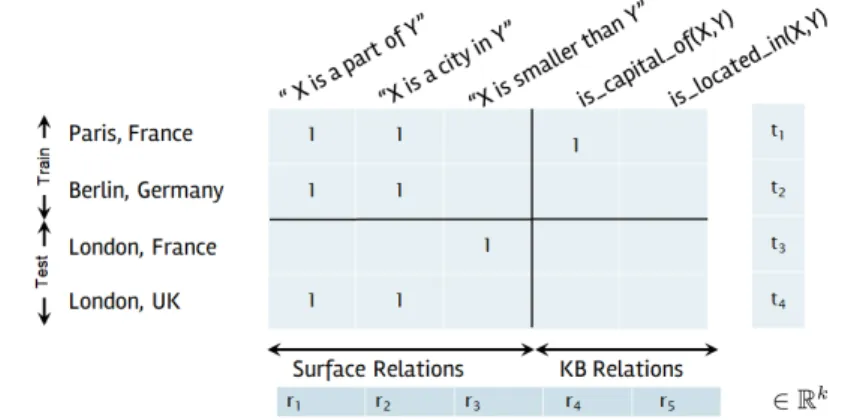
3 Contextual Pattern Embeddings for Relation Classification 33 3.1 Relation Classification with Universal Schema . . . 34
3.1.1 Learning . . . 36
3.2 Predicting Relations with Limited Supervision . . . 37
3.3 Factorization Machines for Relation Classification with Limited Supervision . . . 38
3.3.1 Objective Formulation . . . 41
3.3.2 Dataset . . . 42
3.3.3 Setup and Evaluation . . . 42
3.3.4 Results and Discussion . . . 43
3.4 Related Work . . . 46
3.5 Summary . . . 46
4 Zero-shot Relation Classification via Textual Entailment 47 4.1 Background on Textual Entailment . . . 48
4.2 Relation Classification via Textual Entailment . . . 50
4.2.1 Model . . . 52
4.2.2 Dataset . . . 55
4.2.3 Experiments and Results . . . 56
4.3 Related Work . . . 61
4.4 Summary . . . 62
5 Model-Agnostic Meta-Learning for Relation Classification 63 5.1 Background . . . 64
5.2 Model-Agnostic Meta-Learning for Relation Classification . . . 66
5.3 Experiments . . . 67
5.3.1 Relation Classification Models . . . 67
5.3.2 Setup . . . 68
5.3.3 Datasets . . . 68
5.3.4 Experimental Details and Hyperparameters . . . 68
5.3.5 Evaluation Metrics . . . 72
5.3.6 Results and Discussion . . . 72
5.4 Related Work . . . 73
5.5 Summary . . . 73
6 Lifelong Relation Classification with Meta-Learning 75 6.1 Background . . . 77
6.2 Meta-Learning for Lifelong Relation Classification . . . 78
6.3 Relation Classification Model . . . 79
6.4 Experiments . . . 83
6.4.1 Setup . . . 83
6.4.2 Datasets . . . 83
6.4.3 Evaluation Metrics . . . 83
6.5 Summary . . . 84
7 Conclusions and Future Directions 85
7.1 Research Contributions and Findings . . . 86 7.1.1 Contextual Pattern Embeddings for Relation
Classifi-cation . . . 86 7.1.2 Relation Classification as Textual Entailment . . . 87 7.1.3 Model-Agnostic Meta-Learning for Relation Classification 88 7.1.4 Lifelong Relation Classification with Meta-Learning . . 88 7.2 Future Directions . . . 88 7.2.1 Active Learning for Sample Selection . . . 89 7.2.2 Multitask Learning Across the KBP Pipeline . . . 89 7.2.3 Multilingual and Multidomain Relation Extraction . . 89
1.1 Summary of our Contributions . . . 5 2.1 Illustration of a fully-connected neural network with one input
layer, one hidden layer and one output layer. . . 25 2.2 An illustration of the computations performed by an RNN
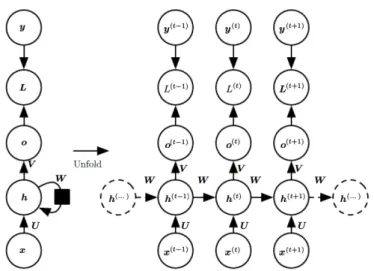
model, drawn with recurrent connections (left), and unfolded in time (right). L is a loss function which measures the
dis-crepancy between model outputso and true target values y at
each timestep t (Goodfellow et al., 2016). . . 27
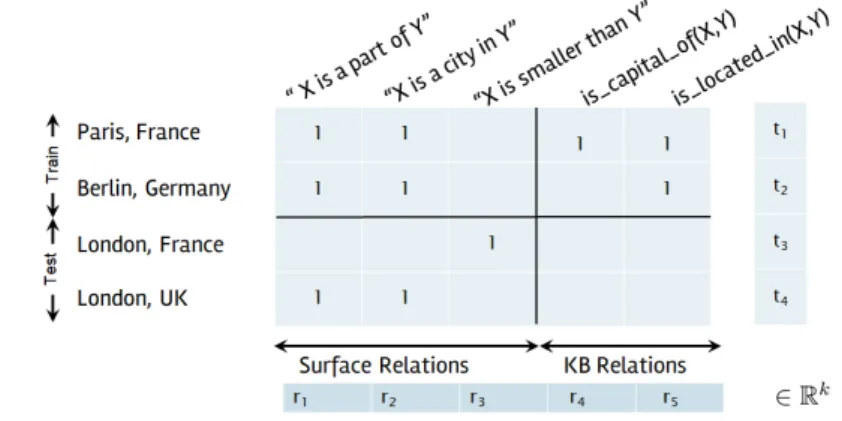
3.1 The Universal Schema matrix . . . 34 3.2 The Universal Schema matrix without training instances of
the relation is_located_in(X,Y) . . . 37
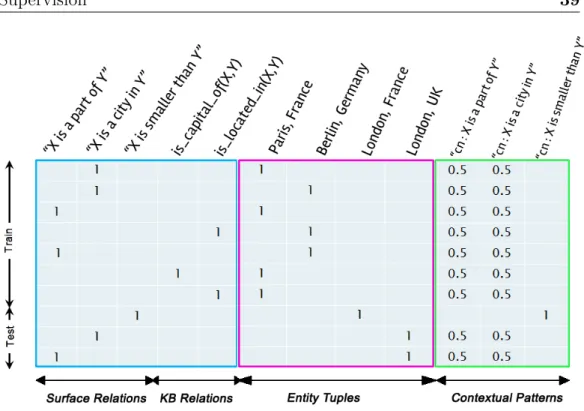
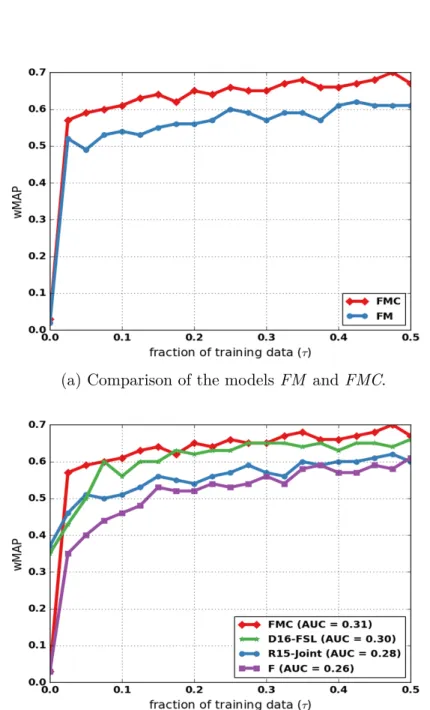
3.3 Input observations as a matrix with contextual pattern infor-mation. Each row in the matrix represents a fact (an instance), and the three variables with names starting with “cn:” are contextual patterns. . . 39 3.4 Comparison of model FM with FMC (a), and FMC with
previous work (b). . . 44 4.1 Limited supervision results: F1 scores on UW-RE as fraction
of training data (τ) is varied. When τ=0, we get the zero-shot
results in Table 4.2 . . . 58 4.2 F1 scores on LMU-RC as fraction of training data (τ) is varied. 58
4.3 Attention visualization . . . 60 5.1 Results obtained using TACRED-PA as the learner model on
(a)SemEval, and (b) TACRED datasets . . . 69 5.2 Results obtained usingC-GCN as the learner model on (a)SemEval,
6.1 Results obtained using 100 training instances for each task on (a) Lifelong FewRel and (b) Lifelong SimpleQuestions datasets. 81 6.2 Results obtained using 200 training instances for each task on
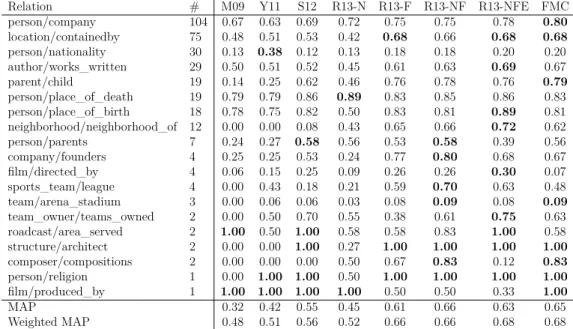
3.1 Results using the full training dataset. The # column is the number of true facts in the test pool. . . 43 3.2 Number of associated surface pattern fact mentions of each
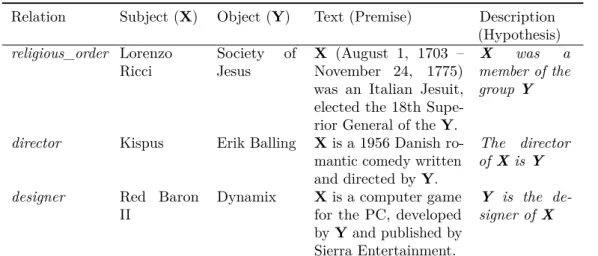
relation in the training set. . . 45 4.1 Examples of relations, entities, sample text instances, and
relation descriptions. . . 51 4.2 Zero-shot relation learning results for ESIM and CIM using
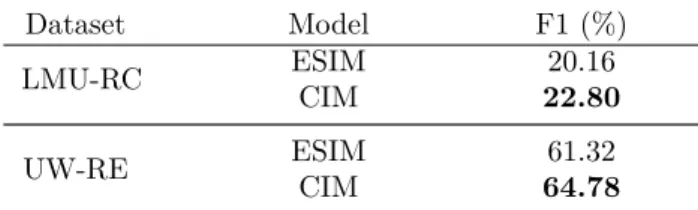
Distant Supervision (DS) data. . . 56 4.3 Zero-shot relation learning results for model CIM pre-trained
on two sources of data: Textual Entailment (TE), or both Distant Supervision and Textual Entailment (TE+DS). . . 56 5.1 Results with 1% training data on SemEval using
TACRED-PA as the learner model. The # column is the number of instances of each relation during training, and TC-PA denotes theTACRED-PAmodel (trained without meta-learning), while
MLRC denotes the same model trained with our approach. . . 71 5.2 Results with 1% training data on SemEval usingC-GCN as
the learner model. The # column is the number of instances of each relation during training, and C-GCN is the C-GCN
model trained without meta-learning, while MLRC denotes the same model trained with our approach. . . 71 6.1 Accuracy on the test set of all tasksACCwhole(denotedACCw.)
and average accuracy on the test set of only observed tasks
ACCavg (denoted ACCa.) on the Lifelong FewRel andLifelong SimpleQuestions datasets. Best results are in bold. Except forMLLRE, results for other models are obtained from Wang et al. (2019). . . 80
Introduction
1.1
Motivation
The arrival of the information age has made available a deluge of information in various forms, including audio, video and text. In particular, the World Wide Web (WWW) has further accelerated the rate of growth of this information, as well as providing a scalable and cost-effective way of accessing and utilizing this information. For instance, it has been estimated that the amount of digital data available to us will grow by about 50 folds from the year 2010 to 2020 (Gantz et al., 2012), resulting in an exponential increase in the volume of information within this period. It is desirable to be able to store this information in a form that is maximally useful, available and easy for both man and machine to reason with in the process of solving problems.
This is one of the main motivations for constructing repositories of knowl-edge such as Knowlknowl-edge Bases (KB). A KB provides a structured format for organizing, accessing and utilizing information on a large scale. Knowledge bases contain factual information about various entities, their attributes and the relationships between them. The knowledge contained in a KB is stored in such a way as to make machines able to efficiently and effectively read, write, update and reason over such knowledge. KBs typically store information in the form of Resource Description Framework(RDF)1 triples, which consist of
a subject entity, a predicate , and an object entity or attribute value. In recent years, several efforts have been made in the construction of large knowledge bases, through various community-driven and academic efforts. Examples of such knowledge bases include Freebase (Bollacker et al., 2008a) , NELL (Carlson et al., 2010), YAGO (Suchanek et al., 2007), DBPedia
(Auer et al., 2007) and Wikidata (Vrandečić, 2012). In industry, knowledge bases serve as useful repositories of knowledge that can be easily queried and power various modern day applications, for instance web search and smart personal assistants such as Google Now, Apple’s Siri, Microsoft’s Cortana, and Amazon’s Alexa. Examples of industrial knowledge bases include Google’s Knowledge Graph, Microsoft’s Satori and Facebook’s Entity Graph.
Although knowledge bases can be quite large and contain many facts, en-tities and relations, they are frequently incomplete. Thus, the facts contained in knowledge bases needs to be updated from time to time. Moreover, because entities are constantly evolving in their roles, associations and attributes, real-life KBs frequently need to be augmented with new relations to extend their coverage.
However, a major challenge that arises when extending knowledge bases to new relations is the lack of sufficient quantities of annotated training data with which to train classification models for the new relations. State-of-the-art approaches for detecting relations between entities are supervised models which require sufficient quantities of supervision to achieve good performance. While sufficient quantities of labelled training data is needed to learn good models for relation classification, such quantities of labelled training data may not be readily available, and even when available, may be expensive and time-consuming to create. Thus, there is the need for the development of approaches for relation classification both when there is zero annotated data, and when there is only limited annotated data for relations. This is the major problem we address in this thesis.
Relation classification aims to detect relations between various entities from text. It is an essential part of many knowledge base population approaches (Ji and Grishman, 2011), and can be useful for a variety of other language processing systems, such as question answering, information retrieval and conversational artificial intelligence systems. A variety of approaches and models have been proposed for the task in the literature, ranging from unsupervised methods which primarily employ clustering-based techniques to semi-supervised methods which provide some guidance in the form of seed instances, to various fully supervised methods, including those that employ manual feature engineering, kernel methods, and deep representation learning methods.
1.2
Aims
Our overall aim in this work is to develop novel approaches for relation classification from text that do not rely on extensive amounts of labelled data, and instead are able to utilize zero or little supervision data for classifying relations. In order to achieve this, we address the following challenges faced in relation classification with zero and limited supervision:
• Existing approaches for relation classification with limited supervision (Rocktäschel et al., 2015; Demeester et al., 2016) propose combining matrix factorization with propositional logic rules. Rocktäschel et al. (2015) assumed that there is sufficient initial supervision for relations
that can be used to extract such rules, which may not always be the case especially for new relations with few supervision instances. Demeester et al. (2016) assumed the existence of a relevant external resource that can be used to generate such rules as a source of additional supervision to improve performance for new relations. However, relevant external resources are not always available for all domains, can be incomplete and sometimes contain outdated information, thus rendering any supervision obtained from them unreliable. In Chapter 3 we propose an alternative approach to the use of logic rules when supervision is limited, by investigating how information which is already present within text corpora can be utilized effectively to provide additional supervision for relation classification with limited supervision.
• Many knowledge bases have text descriptions of the relations included in their relation ontology. These descriptions can be regarded as giving a definition to the relations. However, previously proposed approaches to relation classification with limited supervision have mostly ignored this information. The challenge with utilizing such descriptions lies chiefly in how to incorporate them into relation classification systems in such a way as to allow for generalization to the wide range of lexical variations used in expressing relations in text. The work reported in Chapter 4 investigates how relation descriptions can be used to classify relations when no annotated training data is available.
• While a great variety of supervised models have been proposed for the task of relation classification, the majority of current state-of-the-art models are based on the use of neural networks, which requires
substantial quantities of supervision data for each relation. In addition, these approaches to relation classification do not have any explicit objective that encourages the models to share and exploit knowledge among all relations. In a limited supervision setting, it should be useful if models are encouraged to exploit knowledge of how to classify one relation to improve performance on other relations. In Chapter 5 we investigate how to reduce the quantity of annotated data required to train supervised neural relation classification models.
• Current approaches for training relation classification models assume the availability of all supervision data for relations in advance before training the model. In order to incorporate newly available supervision into such models after training, either to improve performance on existing relations or to enable classification of new relations, they usually need to undergo substantial retraining. This can be expensive and may lead to the model forgetting how to classify old relations. There is thus the need for models that are able to utilize new supervision as it becomes available, without the need for substantial retraining. Such new supervision can either be used to improve performance on old relations, or to acquire the ability to classify new relations, or both. In Chapter 6 we investigate how to develop relation classification models that are able to learn continually from new supervision as it becomes available, while being data efficient and not forgetting knowledge from previously seen relations in the process.
1.3
Contributions
The contributions of this thesis include the following:
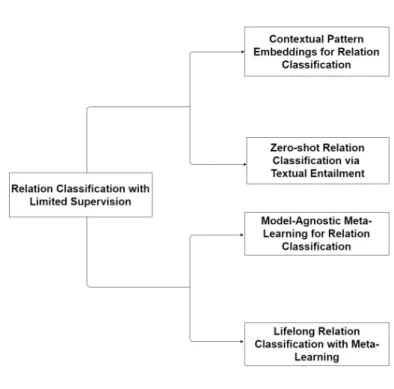
Contextual Pattern Embeddings for Relation
Classifica-tion with Limited Supervision
While previous work proposed the use of rules mined from external sources, we propose the modelling of contextual surface patterns and their interactions within a Factorization Machines (Rendle, 2010) model for relation classification in limited supervision settings. Contextual patterns, which are the set of surface patterns that are associated with entity tuples in text, are readily
Figure 1.1 Summary of our Contributions
available within any text corpus, and have the advantage that they do not require consulting external sources to obtain. We investigate learning embeddings for these contextual patterns within a Factorization Machines model for relation classification. We demonstrate that by explicitly modelling the correlations between knowledge base relations and contextual surface patterns we achieve performance equivalent to matrix factorization combined with propositional rules, despite not using such additional supervision in our approach.
Zero-shot Relation Classification as Textual Entailment
We propose an approach and a model for utilizing textual entailment (Fyodorov et al., 2000; Condoravdi et al., 2003; Bos and Markert, 2005; Dagan et al., 2005; MacCartney and Manning, 2009) for relation classification without labelled data. In this formulation, sentences containing at least two entities of interest can be thought of as the premise, and the textual description of the relation of interest as the hypothesis. We show that this formulation leads to several advantages, including the ability to perform zero-shot relation classification by exploiting relation descriptions, use existing textual entailment models for
relation classification, and utilize readily available textual entailment datasets to enhance the performance of relation classification systems.
Model-Agnostic Meta-Learning for Relation
Classifica-tion
We propose to consider the task of relation classification as an instance of meta-learning (Schmidhuber, 1987; Naik and Mammone, 1992; Thrun and Pratt, 1998), and develop a model-agnostic meta-learning protocol for training relation classifiers to achieve enhanced predictive performance in limited supervision settings. This enables us to explicitly optimize the parameters of relation classification models during training for enhanced performance on all relations with limited supervision. We demonstrate that the proposed meta-learning approach improves the predictive performance of two state-of-the-art supervised relation classification models.
Lifelong Relation Classification with Meta-Learning
While most existing relation classification models assume that all supervision data needed for learning is available at training time and are unable to adapt to exploit newly available supervision data to classify new relations without substantial retraining, we propose an approach to make relation classification models able to learn continually by incorporating supervision for new relations as it becomes available, without the requirement for substantial retraining and without forgetting knowledge from past relations, based on a combination of ideas from lifelong learning (Ring, 1994; Thrun, 1996; Zhao and Schmidhuber, 1996) and optimization-based meta-learning.
1.4
Thesis Structure
This rest of the thesis is organized as follows:
Chapter 2 begins by reviewing the task of relation classification and
approaches that have been proposed for it in the literature. It also discusses various metrics used for evaluating relation classification systems.
Chapter 3 presents an approach for learning contextual patterns
em-beddings within a factorization machine framework for relation classification with limited supervision. It shows that effectively modelling the interactions among contextual surface patterns and relations can perform better than
combining matrix factorization with propositional logic rules for relation classification with limited supervision.
Chapter 4 describes a principled way to incorporate relation
descrip-tions to enable the classification of reladescrip-tions with zero supervision labels, by formulating the task as one of textual entailment. It demonstrates that this approach performs well on two relation classification benchmarks.
Chapter 5 proposes a model-agnostic algorithm with a training objective
that explicitly encourages relation classification models to learn to perform well on all relations, especially when there is only limited supervision. It shows that when evaluated on two datasets, the approach improves predictive performance of two state-of-the-art relation classification models in the limited supervision setting.
Chapter 6 proposes an approach to enable relation classification
mod-els exploit newly available supervision to classify new relations continually and efficiently, without forgetting previously learned relations. It reports the results of experiments conducted on two lifelong relation classification benchmarks which demonstrate the effectiveness of the proposed approach in both limited supervision and full supervision settings.
Finally, Chapter 7 concludes with a discussion of our reseacrh
contribu-tions and possible direccontribu-tions of future work.
1.5
Publications
This thesis is based on work reported in the following publications:
1. Model-Agnostic Meta-Learning for Relation Classification with Limited Supervision
Abiola Obamuyide and Andreas Vlachos
Proceedings of the 57th Annual Meeting of the Association for Compu-tational Linguistics (ACL 2019), Florence, Italy.
Association for Computational Linguistics.
2. Meta-Learning Improves Lifelong Relation Extraction
Abiola Obamuyide and Andreas Vlachos
Proceedings of the ACL 2019 Workshop on Representation Learning for NLP (RepL4NLP), Florence, Italy.
3. Zero-shot Relation Classification as Textual Entailment
Abiola Obamuyide and Andreas Vlachos
Proceedings of the EMNLP 2018 Workshop on Fact Extraction and VERification (FEVER),Brussels, Belgium.
Association for Computational Linguistics.
4. Contextual Pattern Embeddings for One-shot Relation Ex-traction
Abiola Obamuyide and Andreas Vlachos
Proceedings of the 31st Conference on Neural Information Process-ing Systems (NIPS 2017) Workshop on Automated Knowledge Base Construction (AKBC), Long Beach, CA, USA.
Related Work
In this chapter we present an overview of related work in relation classification. We define the task of relation classification, and discuss various approaches that have been proposed for it and the representative methods of each approach. We also elucidate the drawbacks associated with each approach and solutions that have been proposed in the literature, and then conclude with a definition of the evaluation metrics used to measure the performance of relation classification systems.
2.1
Introduction
Relation classification is the task of identifying the semantic relationships between two or more arguments, which are usually entities (Culotta et al., 2006; Bach and Badaskar, 2007). It is an important task for information extraction. In this thesis, we assume that there are two candidate entities involved in each relation, and further that the entities have been identified in a preprocessing stage. This is a common setup for extracting relationships, and is sometimes referred to as just relation extraction in the literature. Examples of semantic relations which can exist between two entities include “spouse of” relation between Barack and Michelle Obama, “founder of” relation
between Steve Jobs and Apple, and “capital of” relation between Paris
and France.
The output of relation classification can be used to populate an empty
knowledge base (KB) of relations, or to augment existing knowledge bases such as DBPedia (Auer et al., 2007), Freebase (Bollacker et al., 2008a), YAGO (Suchanek et al., 2007) or Wikidata (Vrandečić, 2012). A relation schema specifies how the information in a KB is structured, including the
set of allowable entities and relation types. For instance, the schema might specify that the spouse of relation can only hold exclusively between two entities of a certain type (e.g. persons); that the capital of relation can only hold between two geopolitical entities which have a geographical location attribute, etc. Thus, a knowledge base contains structured information about entities and their relationships, arranged according to a predefined schema. The task of identifying and labelling the spans of text which are entities is known as named entity recognition (Grishman, Ralph Sundheim, 1996), and is usually required before relation classification. The entire pipeline, from entity identification, coreference resolution and entity linking to relation classification, and afterwards updating a knowledge base with the extracted information is usually carried out as part of the process of knowledge base population (Ji and Grishman, 2011).
2.2
Approaches to Relation Classification
A variety of approaches and setups have been proposed and explored in the literature for extracting relations from text (Bach and Badaskar, 2007; Sarawagi, 2008; Konstantinova, 2014; Pawar et al., 2017), and they can be broadly categorized according to the degree of supervision required in each approach. These are (i) Fully Supervised methods (ii) Unsupervised meth-ods (iii) Semi-Supervised Methmeth-ods, and (iv) Distantly Supervised methmeth-ods. In addition to these, we also discuss specific methods for identifying rela-tions relevant to this thesis, such as Neural Networks methods and Matrix Factorization methods.
2.2.1
Fully Supervised Relation Classification
Supervised methods for relation classification require the true labels of all supervision instances. Each instance in the training set is annotated with one of a predefined set of relations. The task is often formulated as a multi-class classification task, with each relation corresponding to a class. Usually an additional dummy or negative relation class is also included to represent instances that do not express any of the target relations. Traditionally, these methods are based on the use of features or kernels.
Feature-based Methods
This approach utilizes a set of features derived from each relation instance to make a classification decision on the instance. The performance of these methods is dependent on the feature set used, and a lot of effort is usually spent on feature engineering - finding a set of features with good discriminative performance on the relation instances. These features can be any combination of lexical, syntactic or semantic features of the instances.
Kambhatla (2004) explored the impact of a number of lexical, syntactic and semantic features for extracting relations, and presented results of uti-lizing such features within a maximum entropy classifier on the Automatic Content Extraction (ACE) (Doddington et al., 2004) dataset. They found that a combination of the features gives the best performance on the dataset. Similarly, a systematic study of the effectiveness of a variety of feature combi-nations for relation classification was carried out by Jiang and Zhai (2007). They report that while they found each of the lexical, syntactic and semantic features to be effective on their own, syntactic features were generally the most effective of the three, and that simple lexical, syntactic and semantic features generally performs well. They also report some gains in performance when using all the three types of features.
Kernel-based Methods
The performance of feature-based relation classification methods rely largely on the set of features used, thus requiring a lot of manual effort in the design and selection of discriminative features. Instead of explicit feature engineer-ing, kernel-based methods offer the alternative of designing kernel functions which compute similarities between instances efficiently in an implicit, high-dimensional feature space. One of the earliest application of kernel methods for natural language tasks was by Collins and Duffy (2002) who proposed kernels whose computations are performed over parse trees, and Lodhi et al. (2002) who present kernels whose computations are defined over strings of
characters (sequences). The kernels proposed by Collins and Duffy (2002) compute similarity of two instances as the number of shared subtrees in their syntactic trees. The kernel utilizes a high-dimensional, implicit feature space where each dimension represents one possible subtree, such that the value computed by the kernel for any two instances represents their inner product in the high-dimensional space. Similarly, the kernel proposed by
Lodhi et al. (2002) compute the similarity of two instances as the number of shared subsequences in their string (sequence) representations.
Kernel-based methods for relation classification represent relation instances as a vector of lexical, syntactic and semantic features. The similarity between two relation instances is then computed in terms of the degree of overlap in their representations. There are different types of kernels that have been proposed for the task of relation classification, including sequence kernels, syntactic tree kernels and composite kernels.
Sequence kernels represent each relation instance as a sequence of items and the kernel function measures the similarity of two instances by computing the extent of overlap of their subsequences. Bunescu and Mooney (2005b) present an extension of the sequence kernels proposed by Lodhi et al. (2002) which is able to work with sequences composed of combinations of words and part of speech tags. Bunescu and Mooney (2005b) represent each component of sequences (i.e each word or PoS tag) with a feature vector representation, thus turning each relation instance into a sequence of vector representations. A Support Vector Machines (Cortes and Vapnik, 1995) classifier is then trained to distinguish positive from negative relation instances.
Syntactic tree kernels define their computations over parse tree representa-tion of relarepresenta-tion instances, and measure the similarity of two relarepresenta-tion instances by computing the extent of overlap of their subtrees. The parse tree of a relation instance represents the instance in terms of its syntactic constituents, such as verb phrases, noun phrases and the words in the instance. It is also possible to augment the parse tree of instances with additional information such as part of speech tags. Syntactic tree kernels for relation classification are explored in Zelenko et al. (2003), who proposed kernels which compute similarities over the shallow parse tree representations of relation instances, together with algorithms for computing such kernels.
Some tree kernel approaches are based on the use of features derived from the dependency parse tree of an instance, which describes the grammatical relations between the words that make up the sentence. In a dependency tree, the words that make up a sentence form the nodes, with a directed edge from a word (dependent) to its parent. The tree kernels proposed by Zelenko et al. (2003) for parse tree representations was extended by Culotta and Sorensen (2004) to compute the similarity between two given dependency trees. In order to represent each relation instance, Culotta and Sorensen (2004) consider the smallest subtree of each sentence which contains both the
subject and object of the relation. In addition, they also augment each node in the dependency tree with additional features such as its PoS tag, entity type, WordNet hypernyms and position.
Bunescu and Mooney (2005a) proposed a shortest path dependency kernel for relation classification, which is based on the idea that the relation between two entities can be determined based on the information along the shortest dependency path between the two entities. Each relation instance is repre-sented as the lexicalized shortest path between the two entity mentions in its dependency tree, and the kernel is designed to compute the similarity between two relation instances from this representation. To prevent data sparsity resulting from the use of just words in the lexicalization of a dependency path, words are replaced by their corresponding word classes, such as part of speech tags and entity types.
It is also possible to combine the information from multiple individual kernels into a single composite kernel. As stated by Pawar et al. (2017), information captured by a sequence kernel can be combined with information captured by a syntactic tree kernel into a single composite kernel, through a sum, linear combination or a product of the two kernels. It is however important to ensure the individual kernels are normalized prior to their combination, in order to have balanced contribution from all kernels in the final result.
Zhao and Grishman (2005) proposed to combine information obtained from sentence tokenisation together with that obtained from parsing for relation classification. They designed different kernels to take advantage of each type of information. They observe that performance progressively increases as they add each of their kernels, since each successive kernel helps to address mistakes made by previously added kernels. They report that a composite kernel made up of a combination of all the kernels results in the best overall performance. Nguyen et al. (2009b) also explored the use of composite kernels to capture various syntactic and semantic information for relation classification. They designed a kernel to capture syntactic information obtained from the constituency and dependency tree of relation instances, and a separate kernel to capture information obtained from entity types and lexical sequences. They combine the kernels into a composite kernel, and report that it outperforms previous systems.
2.2.2
Unsupervised Methods
Unsupervised methods for relation identification aim to be able to discover relations without any labelled data or predefined relation inventory. There are a number of approaches under this paradigm, including clustering-based methods and topic-based methods.
Hasegawa et al. (2004) proposed an early clustering-based approach to unsupervised discovery of relations. Their approach requires only that named-entity mentions must be identified beforehand, for instance by preprocessing the corpus with a named entity tagger. The approach starts by grouping co-occuring entity pairs together and then aggregating their contexts across the corpus together. Based on the aggregated entity pair contexts, similarities between the entity pairs are computed and those with the highest similarity are grouped together in a cluster as belonging to a relation. For a given entity pair, Hasegawa et al. (2004) consider it to be co-occuring if they are not more that N words apart, where N is a parameter which is set empirically. The words in between entities in the pair, aggregated across all its occurrences in a corpus, is taken as the context for the mention pair. Then, a vector of tf-idf counts is computed for each mention pair with its context. To determine the similarity of two pairs of mentions, the cosine product of their context vectors is taken. Mention pairs are then clustered according to their similarity scores using hierarchical clustering.
The Discovery of Inference Rules in Text (DIRT) algorithm was proposed by Lin and Pantel (2001) as a way of inducing relation types by generalizing dependency paths of relation instances. Their proposed algorithm is inspired by the distributional similarity hypothesis (Harris, 1954; Firth, 1957), but instead of identifying similar words, identifies dependency paths which tend to link the same set of words. They compute similarities between depen-dency paths, and generate inference relationships between the most similar dependency paths. Lewis and Steedman (2013) presented an approach for discovering clusters of relation types in a bilingual setting, using English and French as a case study. Their approach is based on exploiting the alignments between named entities in the two languages to discover text patterns express-ing the same relations. Inspired by Latent Dirichlet Allocation (LDA)-based topic models (Blei et al., 2003), Yao et al. (2011) propose a series of methods for discovering clusters of relation triples from a corpus that utilizes generative probabilistic models for modelling entity pairs and the syntactic dependency paths between them. Unlike standard topic models where the observations
are words and each word is assumed to be drawn from a topic distribution indicated by a latent topic indicator variable, Yao et al. (2011) assume that a document is made up of an exchangeable collection of relation facts, where each relation fact is drawn from a relation type distribution selected by a latent relation type variable. Their approach further imposes entity type constraints on the induced relations, and exploits features on the dependency path between entity mentions. Building on the work of Yao et al. (2011), De Lacalle and Lapata (2013) propose to automatically integrate general domain knowledge in the form of first order logic rules into topic models. This has the advantage that induced relation clusters respect the contraints imposed by both the data distribution and human-specified domain rules.
An approach based on paraphrase acquisition was proposed for unsuper-vised relation discovery by Romano et al. (2006). For their approach, they assume a list of lexico-syntactic templates which entail the relations of interest and a syntactic matcher to identify the occurences of the given templates from text. The syntactic matcher is based on a sequence of three transformations, which include syntactic dependency parsing text, then matching the entailing templates in the dependency parse, and finally extracting candidate relation arguments which match the template argument variables. The authors give an example for the template “X interact with Y”, for which their approach produces the paraphrases “X bind to Y”, “X activate Y”, etc.
2.2.3
Semi-Supervised Approaches
While unsupervised relation discovery methods can detect relations without supervision data, the extracted clusters of relations are sometimes incoherent, and mapping the relation clusters into a semantic relation schema afterwards is not always straightforward. However, generating labelled data for fully supervised relation classification can be time consuming and expensive in terms of both cost and the effort required. It is desirable to have relation clas-sification methods that are not dependent on completely annotated training data, thus reducing both the cost and manual effort required for extracting relations. Semi-supervised approaches have been proposed to improve on unsupervised methods by utilizing limited supervision together with a large amount of unlabelled data for extracting relations. We next give an overview of representative methods under this approach.
Bootstrapping Methods
Bootstrapping-based approaches for extracting relations typically require just a few seed instances of each relation, in addition to a large unlabelled corpus of text, such as the Web. The seed instances given to these approaches usually include example subject and objects of each relation. Based on the given initial supervision, these approaches return as output relation instances from the unlabelled corpus. Examples of early boostrapping approaches include the Dual Iterative Pattern Relation Expansion (DIPRE) algorithm (Brin, 1998) and Snowball (Agichtein and Gravano, 2000).
The DIPRE algorithm is based on the pattern relation duality principle, which states that given a good set of relational patterns, a good set of entity tuples can be obtained, and conversely, given a good set of entity tuples, a good set of patterns can be obtained. Algorithm 1 below gives a sketch of the DIPRE algorithm.
Algorithm 1 Dual Iterative Pattern Relation Expansion (DIPRE)
Require: Set ofS tuples known to be in relation R
Output: SetS grown over multiple iterations
1: whilethere are no new tuples to be addeddo
2: Find all occurrences of the tuples fromS on the Web 3: Learn patternsP from these occurrences
4: Search the web usingP to find new tuplesT
5: Add T to S
6: end while
DIPRE accepts as input seed instances the entities pairs and the patterns between them specified in form of tuples. It then proceeds iteratively, first finding occurrences of the entity pairs on the Web, extracting relation patterns from the found entity pairs, searching the web with the acquired patterns to find new entity pairs, and augmenting the initial set of seed instances with the newly-found instances. The process is repeated until a predefined number of entity pairs have been found by the system. Brin (1998) report that with just three seed examples of the “author” relation, their system was able to generate 15257 unique author and book instances from a corpus of 24 million web pages.
Agichtein and Gravano (2000) propose a system called Snowball that improves the DIPRE boostraping algorithm by generalizing how its relation patterns and tuples are generated, represented and evaluated. Instead of using regular expressions to match entity mentions in the relation patterns as
was done in DIPRE, Snowball made use of entity tags instead. This improves the precision of the patterns, since this ensures that selected entities are valid relation arguments. Snowball represents the words surrounding entities with vectors, which enables similarities of entity context to be computed with the inner product between vectors. In addition, Snowball evaluates the precision of discovered patterns in each iteration and discards those which have low precision, as determined by a confidence score which can be computed as the fraction of correct tuples the pattern is able to correctly extract to the total number of tuples retrieved. Tuples can in turn be evaluated based on the confidence values of the patterns that extract them. Thus unlike DIPRE, Snowball is able to filter out low quality patterns and tuples in each of its runs in order to improve the quality of extracted relation facts.
Active Learning based Approaches
A shortcoming common to all bootstrapping-based approaches is that they suffer from semantic drift (Riloff and Jones, 1999; Curran et al., 2007), a phenomenon whereby the precision of their extractions gradually deteriorates over time. However, labelling a sufficient number of supervision instances for training supervised systems can be expensive and time consuming. This is one of the main motivations behind the introduction of active learning techniques (Settles, 2010) to select the most useful training instances for annotation, thereby reducing the time and cost of data labelling, under the assumption that the model is allowed to request for the labels of a limited number of unlabelled instances. In order to determine which instances would be selected for annotation from a large pool of unlabelled instances, various criteria have been proposed. The overall objective of all active learning approaches is to be able to achieve performance comparable to that of a fully supervised system with a fraction of the training data.
One of the earliest applications of active learning for extracting relations was by Sun and Grishman (2012), who propose a system called LGCo-Testing
that uses active learning based on the co-testing (Muslea et al., 2000) selective sampling framework for relation classification. It uses two classifiers based on two different views of the data, a maximum entropy classifier which uses features local to each relation instance (local view), and a k-nearest neighbour classifier which utilizes global features based on the distributional similarities between words occurring in the relation contexts computed from a 2 billion token corpus (global view). The instances selected for annotation are then
those with labels on which the global and local classifiers disagreed the most. When compared to a completely supervised system, the authors report that their approach leads to reduction in annotations by up to 97% while maintaining the same level of performance.
Open Information Extraction (OpenIE)
Banko et al. (2007) proposed the concept of open information extraction, which is able to discover potentially interesting relations between entities automatically from a text corpus. They introduced TextRunner, an early OpenIE system. TextRunner is made up of three core modules, namely the self-supervised learner, the single-pass extractor, and the redundancy-based assessor.
The self-supervised learner heuristically labels extracted entity tuples as either positive or negative candidate relation instances, based on a set of predefined rules. It then represents each candidate relation instance with a vector of features, and trains a Naive Bayes classifier to distinguish the positive from the negative relation instances.
The single-pass extractor is run once over the corpus to annotate it with PoS tags and noun phrase chunks. It considers each pair of noun phrase chunks found within a sentence as a candidate relation instance, and obtains the relation name by heuristically eliminating unimportant phrases from the words occurring between such pairs. It uses the Naive Bayes classifier built in the previous step to classify each relation instance into positive and negative relation instances, and then accepts and stores only the positive relation instances into the system.
The redundancy-based assessor assigns a probability of correctness to each extracted fact tuple, by first automatically merging extracted relation tuples which have the same entities and relation names, while keeping track of the number of sentences from which each extraction was made. It then uses the sentence counts to compute the probability of correctness of each extracted tuple.
Fader et al. (2011) observed that the output of TextRunner suffers from a number of shortcomings, which severely affect its quality. These include incoherent extractions and uninformative extractions. Incoherent extractions occur when the extracted relation phrases does not have any meaningful interpretation. This is usually as a result of the word by word sequential decisions made by TextRunner on whether or not to include words in the
relation phrase. The authors give an example of a sentence that leads to such extractions in TextRunner as “Extendicare agreed to buy Arbor Health Care for about US $432 million in cash and assumed debt.”, for which TextRunner returns an extraction such as (Arbor Health Care, for assumed, debt). The relation phrase “for assumed” is not valid since it starts with a preposition.
Uninformative extractions are those which omit important information from the relation phrase. For instance, from the sentence “Bill Gates made a donation to the UN”, TextRunner may extract (Bill Gates, made, a donation) instead of (Bill Gates, made a donation to, the UN). The authors note that though this problem can be partially addressed with syntactic constraints, this can result in the extraction of overly long relation phrases such as “is offering only modest greenhouse gas reduction targets at” from the sentence “The Obama administration is offering only modest greenhouse gas reduction
targets at the conference”.
To address the above short-comings of TextRunner, Fader et al. (2011) propose ReVerb, an OpenIE system with better quality of extractions.
In order to correct the problem of incoherent extractions, ReVerb intro-duced the use of syntactic constraints on possible relation phrases that can be extracted. One of such constraints is that a relation phrase has to be either a verb, a verb followed by a preposition, or a verb followed by nouns, adjectives or adverbs together with a preposition. If there are adjacent matches within a sentence, they are merged into a single relation phrase. Also, the system requires that the relation phrase must be located between its two arguments within a sentence.
To address the problem of uninformative extractions, ReVerb uses lexical constraints, such as requiring that for a relation phrase to be valid, it must have been observed with at least k relation arguments in the corpus, where k is a hyperparameter set to 20 in ReVerb.
Overall ReVerb adopts a different approach toTextRunner for extracting relations. In contrast with TextRunner, it makes globally informed decisions about relation phrases rather than word-by-word decisions.
2.2.4
Distant Supervision
Distant Supervision is an approach to obtaining noisy labels for training data (relation instances for training relation classification models) from existing semantic knowledge bases, such as Freebase, Wikidata or DBPedia. It is regarded as a method for obtaining weak labels for training data since the
annotations obtained from it are not always the ground truth labelling of the data. However, it is a popular method as it provides an inexpensive way to provide labels for unlabelled data. One of the earliest proposals to create “weakly labelled” training data from a knowledge base was carried out for the biomedical domain by Craven and Kumlien (1999). Later, similar ideas were proposed by Mintz et al. (2009), Bunescu and Mooney (2007) and Nguyen et al. (2007). Mintz et al. (2009) utilized Freebase as the knowledge base for generating weak labels for various relations and referred to the idea as
“distant supervision”, a term which is now commonly used to refer to the approach. In order to annotate sentences with relations from the knowledge base, distant supervision utilizes a labelling heuristic known as the distant supervision assumption, which can be summarized thus:
Distant Supervision Assumption : If two entities participate in
a relation, then any sentence that contains the two entities might express that relation.
As an illustration, given that the entity pairBarack Obama, United States
is present in the knowledge base for the relation country of birth, the
following sentences which contain both entities are considered by distant supervision to be instances of the country of birth relation:
1. Barack Obama was born in Honolulu, Hawaii, United States 2. Barack Obama is the 44th President of the United States
3. Barack Obama was seen with his wife Michele in Chicago, United States To train a relation classifier for the country of birth relation, all of
the above sentences are taken as positive relation instances. Since negative relation instances are also required to train a relation classifier, other sentences which do not contain the entity pairs known to be participating in this relation are taken to be negative instances. After the extraction of features from the training instances, any supervised classifier, such as Logistic Regression may then be trained to classify test relation instances.
As a result of the noisy data annotation, which leads to both false positives in the training data (for instance the second and third sentences above) and false negatives (when a sentence that expresses a relation is omitted from the training data because the entities in the sentence are not present in the knowledge base), distantly supervised relation classification systems suffer
from reduced performance compared to relation classification systems trained on manually annotated data. As a result of this, a variety of approaches have been proposed to address the problem of false positives and false negatives. We give a brief overview of these approaches.
Reducing False Positives in Distant Supervision
A number of approaches have been proposed to address the issue of false positives in distant supervison data, and Roth et al. (2013) present a survey of these approaches. The fundamental premise of distant supervision is that all sentences containing entities known to be in a relation in a knowledge base are likely to express that relation. As the example sentences above illustrates, this is not always the case. Hence Riedel et al. (2010) argue that the distant supervision assumption is too strong. They proposed instead the expressed-at-least-once assumption, which relax the fundamental distant supervision assumption, requiring only that at-least one of the selected sentences should express the relation of interest.Riedel et al. (2010) then proposed a noise reduction model based on the new assumption. The noise reduction approach of Riedel et al. (2010) utilizes a factor graph which models the relation existing between two entities and the sentences which might express the relation. The model is not given information about which sentences express each relation, but rather the model is penalized whenever it does not satisfy the expressed-at-least-once constraint. They consider the task as an instance of constraint driven semi-supervised learning (Chang et al., 2008), and utilized Gibbs sampling (Geman and Geman, 1984; Jensen et al., 1995) with SampleRank (Wick et al., 2009) for inference.
Following their proposal, a number of other noise reduction approaches have also been proposed (Hoffmann et al., 2011; Surdeanu et al., 2012a). These approaches are typically based on a probabilistic graphical modelling framework with the expressed-at-least-once assumption included as a con-straint, though they differ with respect to the dependencies assumed to be present in the data, the modelling stage at which the constraint is enforced and the specific graphical model inference method employed.
Hoffmann et al. (2011) introduce MultiR, which extends the model of Riedel et al. (2010) to the multi-label setting. MultiR is able to model entity pairs which participate in overlapping relations, for instance the pair
(Satya Nadella, Microsoft) which participates in the relations employee_of
per entity pair, MultiR has a variable for each entity pair and relation that indicates if the relation holds for the entity pair, thus allowing for the prediction of more than one relation for that pair. Values are assigned to the variables via distant supervision during training. The model also contains factors that represent the per-sentence relation predictions and ensure that for each entity pair, only one relation is predicted per sentential context. In other words, while it allows each entity pair to take part in multiple relations, only one such relation can hold for the entity pair in a particular sentence. To estimate model parameters, the authors employ a perceptron-style (Collins, 2002) training algorithm.
Building on the work of Hoffmann et al. (2011), Surdeanu et al. (2012a) proposed the Multi-Instance Multi-Label Relation Extraction (MIMLRE) model, a probabilsitic graphical model which makes predictions in two stages. In the first stage, a multi-class relation classifier makes predictions for each sentential context. The predictions from the first stage is then aggregated by a collection of per-relation binary classifiers in the second stage to make predictions for each entity pair. In this model, the expressed-at-least-once constraint is implemented by means of a feature in the per-relation classifiers which fires when the relation has been predicted at least once for the entity pair in the set of its sentential contexts. The authors report results which show that their approach outperforms the previous approaches of Riedel et al. (2010) and Hoffmann et al. (2011).
A number of other noise-reduction approaches are based on the use of surface patterns. A generative, hierarchical topic model for reducing false positives by scoring and filtering relational patterns was proposed by Alfonseca et al. (2012). The model was inspired by that proposed for multi-document summarization in Haghighi and Vanderwende (2009), except that Alfonseca et al. (2012) consider relation patterns as words and entity pairs as documents. In addition, Alfonseca et al. (2012) further divide entity pairs into groups according to which relations they participate in. The generative model assumes three topic distributions : a background topic distribution over patterns common to all relations, an entity pair-specific topic distribution over patterns, and a relation-specific topic distribution which is used to estimate the probability that a surface pattern expresses a relation. The authors employ Gibb’s sampling as the inference algorithm. As noted in Roth et al. (2013), the advantage of approaches that use topic models for noise
reduction, in contrast to those that use theexpressed-at-least-once-assumption, is that they do not require separate negative instances for training.
Takamatsu et al. (2012) proposed a different generative model for noise reduction. In contrast to the model of Alfonseca et al. (2012), which utilizes the indirect approach of first modelling the generative process of patterns and then utilizing that to model their probability of expressing a relation, Takamatsu et al. (2012) aim to directly model the probability of a pattern expressing a relation or not. The underlying assumption of their model is that if a pattern matches a relation’s entity pair, then either the pattern expresses the relation, or it has a high overlap in entity pairs with other patterns that express the relation, although it does not explicitly rule out the possibility that the entity pairs of a pattern which expresses a relation may still be observed with other patterns that do not express the relation. In addition, unlike the approach of Riedel et al. (2010), the model of Takamatsu et al. (2012) groups relation patterns together for each entity pair, and has the advantage that it is able to handle cases where there is only one mention of an entity pair in the corpus. They evaluate their approach on a dataset derived from Wikipedia and report better performance compared to previous noise reduction approaches.
Reducing False Negatives in Distant Supervision
False negatives are instances which are assumed to not have any relations because they are not present in the knowledge base used for distant supervision. This is often a result of the incompleteness of the knowledge bases used for distant supervision, as most of them are incomplete. Even the largest knowledge bases, such as Freebase and Wikidata are still missing instances of many relations (for instance, Min et al. (2013) report that 93.8% of persons
in Freebase have no place of birth attribute). Consequently, if such false negatives are used as part of distant supervision training data, they would lead to suboptimal performance for relation classification models trained with such data. In order to reduce the impact of false negatives on performance, Min et al. (2013) extend the MIML model of Surdeanu et al. (2012a) to use fewer negative training examples and instead utilize more positive and unlabelled examples. They propose a 4-layer hierarchical graphical model with latent variables that represent the true label assignment of training examples.
To train their model, they utilized hard Expectation Maximization (EM) 1
together with a log-likelihood objective. The authors evaluate their model on the KBP dataset of Ji et al. (2010) and report performance improvements over the approaches proposed in Surdeanu et al. (2012a) and Hoffmann et al. (2011) for reducing noise.
Xu et al. (2013) propose to increase the quantity and quality of supervision data through the use of a pseudo-relevance feedback mechanism. The approach assumes entity pairs which appear more frequently in relevant sentences are likely to express the relation of interest, and augments a knowledge base with missing relation instances extracted by exploiting information from the passage retrieval model of Xu et al. (2011). To increase recall of such entity pairs, the passage retrieval model utilizes coarse features, which they combine with fine features obtained from the system of Hoffmann et al. (2011) to encourage high precision. After relation mentions are annotated with distant supervision, the passage retrieval model, which is a ranker based on Support Vector Machines (Cortes and Vapnik, 1995), is trained on the same dataset to provide relevance feedback on the distantly annotated mentions. The distantly annotated mentions are then filtered with the passage retrieval model, and thereafter used to train the MultiR model of Hoffmann et al. (2011). When compared with the same model trained on the unfiltered distantly annotated mentions, they report that their approach leads to improvements in performance.
Some approaches propose to mitigate the impact of false negatives by augmenting distantly annotated data with manually annotated data. Nguyen and Moschitti (2011) explored combining manually labelled data from the ACE (Doddington et al., 2004) dataset with distantly annotated text from Wikipedia. For their experiments, they linearly interpolated the outputs of kernel-based supervised relation models from Zhang et al. (2006) and Nguyen et al. (2009a). They report that the models trained on both distantly-annotated data and manually distantly-annotated ACE data outperform that trained on manually annotated ACE data alone.
Pershina et al. (2014) extended theMIML model of Surdeanu et al. (2012a) with a new layer containing a set of latent variables to model the human ground truth labels for each instance in distantly annotated relation instances. The human ground truth labels were extracted from the KBP dataset of (Ji
1In hard EM, the expectation step computes the most probable value (or assignment) of
the latent variable, while in soft EM the expectation step retains a probability distribution over the possible values of the latent variable. See, for instance, MacKay (2003) for more information.
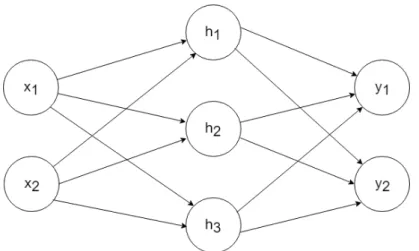
Figure 2.1 Illustration of a fully-connected neural network with one input layer, one hidden layer and one output layer.
and Grishman, 2011) and incorporated into the training process of MIML in the form of “relation guidelines” which encode the entity type preferences and indicative dependency paths of each relation. During training, the labels obtained from such relation guidelines are able to override the labels assigned to relation mentions by the original MIML model. When evaluated on the KBP dataset, the authors report their approach improves performance compared to various previous models such as those proposed in Surdeanu et al. (2012a), Mintz et al. (2009), Hoffmann et al. (2011) and Min et al. (2013).
Angeli et al. (2014) explored the use of various active learning criteria for selecting a limited number of distantly annotated mentions for manual annotation. They combine such manually annotated mentions together with a much larger distantly annotated corpus for relation classification. The authors compared three active learning criteria for selecting instances to annotate: sampling uniformly at random, sampling by high Jensen-Shannon divergence, and a new criterion proposed by the authors, which samples instances which are both uncertain and representative of the other instances . They perform experiments on the 2010 and 2013 versions of the KBP dataset, and report that the use of active learning generally improves over the MIML model of Surdeanu et al. (2012a) trained without active learning, and that their proposed active learning criterion outperforms the other alternatives.
2.2.5
Neural Networks Methods
In this section we first present an overview of neural networks and their various variants. We then present specific neural network architectures and approaches that have been proposed for relation classification.
Artificial Neural Networks, usually referred to as Neural Networks (NNs), are learning models inspired by, and which are a simplification of, how neurons work in biological brains. They are usually made of a set of interconnected nodes, with each node being the artificial analogue of the biological neuron. A node receives input, processes it and then passes on the result of its processing to other nodes connected to it. The edge connecting two nodes is typically associated with a parameter value, which is learnt during training. They can be nested arbitrarily deeply in layers, with each layer computing an arbitrary transformation of its input. Neural networks have the ability to use non-linear activation functions to map layer inputs to outputs, and as a result they are able to learn highly non-linear compositional functions to map inputs to outputs. They are trained by minimizing the empirical loss on data using a gradient-based optimization algorithm such as Stochastic Gradient Descent (Nemirovski and Yudin, 1978). The process of passing inputs through the successive layers of a neural network to produce outputs is known as forward propagation, while the gradient of the loss with respect to the parameters of the network is computed with a procedure termed backpropagation (Rumelhart et al., 1988; Werbos, 1990), which utilizes the chain rule of calculus together with dynamic programming for efficient gradient computations. Figure 2.1 gives an illustration of a feed-forward neural network with a single hidden layer. In order to utilize neural networks for natural language tasks, each word in the input is usually represented by an embedding vector, also known as aword embedding vector. Common neural network-based architectures that have been proposed include Recurrent Neural Networks (RNNs) (Jordan, 1986; Elman, 1990), Long-short term memory (LSTM) (Hochreiter and Schmidhuber, 1997) networks and Convolutional Neural Networks (CNNs)(LeCun et al., 1998).
RNNs can be thought as a flexible variant of feed-forward neural networks. In contrast to feed-forward neural networks which have a predefined number of hidden layers, RNNs are able to change the number of their hidden layers such that each layer of the network corresponds to a new time step of the input and share parameters between the layers. RNNs are made mainly of recursively defined functions which accept as input the current input and previous state, and produce a current state vector, which can optionally be