A COMPILER TOOLCHAIN FOR DISTRIBUTED DATA INTENSIVE SCIENTIFIC WORKFLOWS
A Dissertation
Submitted to the Graduate School of the University of Notre Dame in Partial Fulfillment of the Requirements
for the Degree of
Doctor of Philosophy
by
Peter Bui
Dr. Douglas Thain, Director
Graduate Program in Computer Science and Engineering Notre Dame, Indiana
© Copyright by Peter Bui
2012
A COMPILER TOOLCHAIN FOR DISTRIBUTED DATA INTENSIVE SCIENTIFIC WORKFLOWS
Abstract by Peter Bui
With the growing amount of computational resources available to researchers today and the explosion of scientific data in modern research, it is imperative that scientists be able to construct data processing applications that harness these vast computing systems. To address this need, I propose applying concepts from tradi-tional compilers, linkers, and profilers to the construction of distributed workflows and evaluate this approach by implementing a compiler toolchain that allows users to compose scientific workflows in a high-level programming language.
In this dissertation, I describe the execution and programming model of this compiler toolchain. Next, I examine four compiler optimizations and evaluate their effectiveness at improving the performance of various distributed workflows. Afterwards, I present a set of linking utilities for packaging workflows and a group of profiling tools for analyzing and debugging workflows. Finally, I discuss modifi-cations made to the run-time system to support features such as enhanced prove-nance information and garbage collection. Altogether, these components form a compiler toolchain that demonstrates the effectiveness of applying traditional compiler techniques to the challenges of constructing distributed data intensive scientific workflows.
CONTENTS
FIGURES . . . iv
TABLES . . . vi
ACKNOWLEDGMENTS . . . vii
CHAPTER 1: INTRODUCTION . . . 1
CHAPTER 2: RELATED WORK . . . 13
2.1 Workflow Systems . . . 13
2.2 Distributed Computing Abstractions . . . 15
2.3 Programming Languages . . . 16
2.4 Compiler Toolchain . . . 18
CHAPTER 3: COMPILING WORKFLOWS . . . 23
3.1 Programming Interface . . . 24
3.2 Workflow Compiler . . . 32
3.3 Workflow Manager . . . 36
CHAPTER 4: OPTIMIZING WORKFLOWS . . . 41
4.1 Structured Allocation . . . 43
4.2 Instruction Selection . . . 49
4.3 Hierarchical Workflows . . . 55
4.4 Inlining Tasks . . . 62
CHAPTER 5: LINKING WORKFLOWS . . . 67
5.1 Application Linker . . . 68
CHAPTER 6: PROFILING WORKFLOWS . . . 82
6.1 Workflow Analyzer . . . 83
6.2 Workflow Monitor . . . 89
6.3 Workflow Reporter . . . 93
CHAPTER 7: MANAGING WORKFLOWS . . . 100
7.1 Local Variables . . . 101
7.2 Nested Makeflows . . . 109
7.3 Provenance and Annotations . . . 114
7.4 Garbage Collection . . . 119
CHAPTER 8: CONCLUSION . . . 128
8.1 Automatic Optimizations . . . 128
8.2 Dynamic Workflows . . . 129
8.3 Compiling to DAGs . . . 132
8.4 Beyond Distributed Computing . . . 133
8.5 Impact . . . 135
APPENDIX A: WEAVER API . . . 137
A.1 Datasets . . . 137
A.2 Functions . . . 142
A.3 Abstractions . . . 149
A.4 Nests . . . 153
APPENDIX B: WEAVER INTERNALS . . . 156
FIGURES
1.1 Typical Biometrics Workflow . . . 2
1.2 Workflow Toolchain versus Conventional Compiler. . . 6
3.1 Weaver Abstractions . . . 29
3.2 Weaver Nests . . . 30
3.3 Weaver Compiler . . . 33
3.4 Weaver Software Stack . . . 39
4.1 Stash Structure . . . 44
4.2 Stash Benchmark Workflows . . . 45
4.3 Stash Benchmark Execution Times . . . 46
4.4 Stash Benchmark on AFS Sample Timelines . . . 48
4.5 Instruction Selection . . . 51
4.6 Instruction Selection Benchmark Workflows . . . 52
4.7 Instruction Selection Benchmark Results . . . 53
4.8 Hierarchical Workflows . . . 56
4.9 Transcode Benchmark Workflows . . . 58
4.10 Transcode Benchmark Execution Times . . . 59
4.11 Transcode Benchmark Task Rates Over Time . . . 61
4.12 Inlined Tasks . . . 63
4.13 Inlined Tasks Benchmark Workflow . . . 64
4.14 Inlined Tasks Benchmark Results . . . 65
5.1 Starch (STandalone application ARCHiver) . . . 70
5.2 Starch Benchmark Workflows . . . 72
5.3 Starch Benchmark Workflow Execution Times . . . 74
5.5 Result of Linking with makeflow link (1) . . . 79
5.6 Result of Linking with makeflow link (2) . . . 81
6.1 Sample Workflow Provenance Information bymakeflow analyze . 85 6.2 Sample Node Provenance Information bymakeflow analyze . . . 87
6.3 Workflow Progress with LuLuLua Android Application. . . 88
6.4 makeflow monitorConsole Output . . . 90
6.5 makeflow monitorWeb Output . . . 91
6.6 makeflow reportSample (Overview) . . . 94
6.7 makeflow reportSample (Tasks Profiling) . . . 96
6.8 makeflow reportSample (Tasks Histogram) . . . 97
6.9 makeflow reportSample (Symbols Profiling) . . . 98
7.1 Weaver Variable Example . . . 106
7.2 Weaver Batch Options Example . . . 108
7.3 dag width Algorithm . . . 111
7.4 dag width Illustration . . . 112
7.5 Modified Makeflow Transaction Journal Example . . . 115
7.6 Weaver Generated Debugging Symbols Example . . . 118
7.7 Garbage Collection Benchmark Workflow . . . 122
7.8 Garbage Collection Benchmark Execution Times . . . 124
7.9 Garbage Collection Benchmark Running Time Percentages . . . . 125
7.10 Garbage Collection Benchmark Collection Histograms . . . 127
8.1 Iteration Workflow Example . . . 131
A.1 Weaver Dataset Examples . . . 139
A.2 BXGrid SQL Dataset Examples . . . 140
A.3 Weaver Function Examples . . . 143
A.4 Weaver Abstraction Examples . . . 152
A.5 Weaver Nests Examples . . . 154
B.1 Weaver Function call Method . . . 157
B.2 Weaver Dataset iter Method . . . 159
TABLES
1.1 COMPILER TOOLCHAIN CONTRIBUTIONS . . . 7
3.1 WEAVER PROGRAMMING INTERFACE COMPONENTS . . . 24
3.2 WEAVER DATASETS . . . 25
3.3 WEAVER FUNCTIONS . . . 26
3.4 WEAVER ABSTRACTIONS . . . 28
3.5 WEAVER AND MAKEFLOW DAG EXAMPLE . . . 37
4.1 COMPILER OPTIMIZATIONS OVERVIEW . . . 42
5.1 STARCH CREATION AND EXTRACTION BENCHMARK . . . 71
A.1 WEAVER COMMAND FORMAT TEMPLATE . . . 144
ACKNOWLEDGMENTS
First, I would like to thank my family for their encouragement throughout my time in graduate school. I especially owe a debt of gratitude to my wife, Jennifer Rising, for her infinite patience and unwavering support.
I would also like to thank my friends, colleagues, and collaborators who not only provided encouragement, technical help, and moral support, but also intel-lectual stimulation and inspiration. In particular, I thank my colleagues Michael Albrecht, Hoang Bui, Patrick Donnelly, Dinesh Rajan, and Li Yu, my collabo-rators Badi Abdul-Wahid, Rory Carmichael, Irena Lanc, and Andrew Thrasher, and my undergraduate advisees, Kevin Partington and Samuel Lopes.
I am also grateful for the guidance and mentoring of my advisor, Dr. Douglas Thain, whose insight and intellect routinely challenged me to improve and expand my research and myself.
Finally, I would like to thank my committee members, Dr. Scott Emrich, Dr. Patrick Flynn, and Dr. Jesus Izaguirre, who were supportive of my research and allowed me to collaborate with their students to produce the work in this dissertation.
CHAPTER 1 INTRODUCTION
Today, research scientists face the challenge of generating, processing, and analyzing a deluge of scientific data in a timely and organized manner [53]. Fortu-nately, they have access to an abundant amount of computing resources available to them in the form of distributed campus clusters, parallel computing grids, and commercial cloud environments. One of the key challenges that these researchers face is how to effectively and efficiently harness the computing power of these dis-tributed systems to accelerate and scale their data intensive scientific workflows.
Fulfilling the role of the toolsmith [16], computer scientists have begun to ad-dress this problem by developing new distributed programming software tools that simplify and ease the use of such computing resources in processing this scientific data. Some of these new programming tools come in the form of distributed computing abstractions such as MapReduce [35] and All-Pairs [78] that optimize specific patterns or models of computation. These new systems generally come from the nascent cloud computing field and have been proven useful in enabling the development of high performance and high throughput distributed scientific applications [41, 110].
Unfortunately, while these distributed computing abstractions have been suc-cessful in facilitating specific patterns of computation, they often fail to encompass
large and sophisticated scientific workflows. This is because while many compu-tational data processing workflows consist of a series of separate compucompu-tational stages, these tools normally focus on a single particular stage. Such multi-stage workflows are often too complicated to be performed in a single abstraction and may in fact require the use of multiple computational abstractions. Therefore, while computing abstractions are powerful and easy-to-use, they are not general or flexible enough to support all scientific workflow patterns.
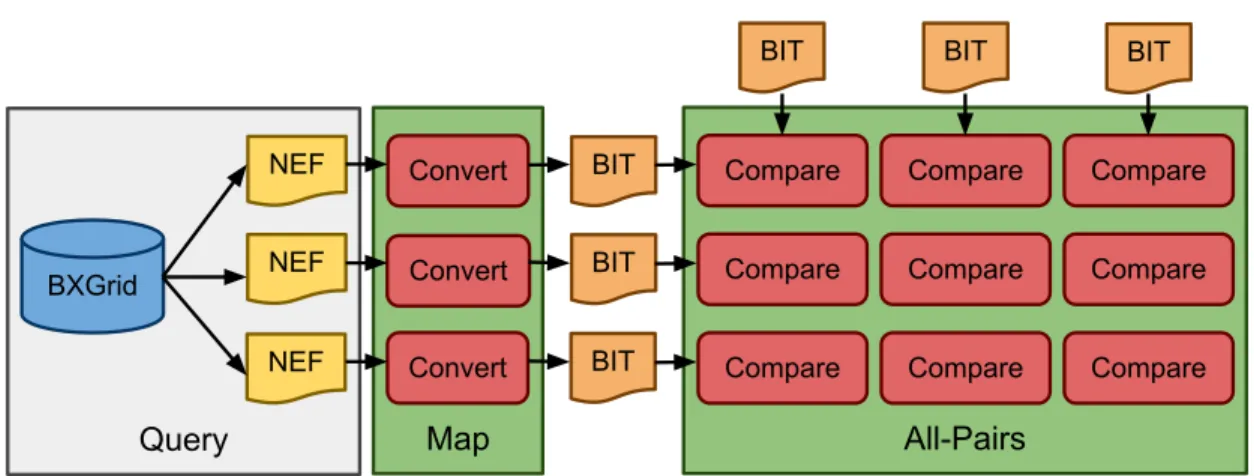
Map Query BXGrid NEF NEF NEF Convert Convert Convert All-Pairs BIT BIT BIT
Compare Compare Compare
Compare Compare Compare
Compare Compare Compare
BIT BIT
BIT
Figure 1.1. Typical Biometrics Workflow
A typical biometrics experiment involves extracting data from a repository, trans-forming it into an intermediate format, and then analyzing it using domain-specific tools.
For instance, researchers in the Computer Vision Research Laboratory (CVRL) at Notre Dame typically perform a experimental workflow that consists of(1) se-lecting and extracting a subset of data from a repository,(2)transforming the raw
data into an intermediate form suitable for processing,(3)and finally performing the experiment as shown in Figure 1.1. The first step involves defining a collection of input data and filtering it into the subset required for the experiement. The second step requires converting all of the elements of this selected dataset from the original raw format into a distilled version suitable for comparison and analysis by domain-specific applications. The final step takes all of the transformed data and computes a scoring matrix by comparing every pair-wise combination of the input dataset. Because each of these three steps is a unique pattern of computation, it is necessary for a workflow that encompasses all of these steps to support multiple abstractions that are capable of implementing these patterns.
In the more traditional cluster and grid computing world, the problem of multi-stage workflows has been address by distributed systems such as DAGMan [1], Pegasus [36], Kepler [75], and Taverna [86], which allow users to specify a pipeline of computational tasks. These specifications usually consist of relationships be-tween tasks and the data inputs and outputs and are used by the software tools to construct a directed acyclic graph (DAG) representing the flow of data through the pipeline. Distributed computing abstractions can be incorporated into these systems by implementing the abstraction directly as nodes in the DAG or by using a specialized implementation as a single node in the graph [25, 60, 89, 117, 125]. Once a DAG has been formed, it is processed by a workflow manager which dis-patches tasks to a distributed computing engine such as Condor [113], SGE [48], or Hadoop [51].
The main disadvantage of these DAG-based systems is that they require end users to explicitly construct workflow graphs, which is often cumbersome and te-dious for larger sophisticated workflows [21, 23, 29, 59]. For example, it is not
uncommon for scientific workflows to consist of thousands to millions of tasks, where each job must be specified as a DAG node. Recent research projects such as Swift [120, 126] tackle the problem of efficiently specifying scientific workflows by proposing new programming languages. In these systems, the directed acyclic graph is implicitly constructed by a compiler or interpreter that parses and pro-cesses a workflow specification written in a high-level scripting language. The advantage of this approach is that it allows for rapid construction of sophisticated distributed applications in conciseand maintainable workflow applications [119].
The introduction of a new programming language, however, has significant challenges in terms of adoption and ease of use. For instance, it is not always possible to deploy the new system onto unprivileged distributed resources, and it may be difficult to convince non-expert users to adopt the new language due to the unfamiliar syntax or programming model. Rather than developing a new language, my dissertation addresses the problem of enabling both novices and experts to develop distributed data intensive scientific workflows by proposing a workflow compiler named Weaver [21, 23] that is built on top of an existing general purpose programming language, Python [96]. By building the compiler as a domain-specific language (DSL) in Python, Weaver enables researchers to effectively and efficiently script scientific distributed workflows using a familiar and ubiquitous programming language with a rich ecosystem of existing software, documentation, and community.
As noted previously, the problem of enabling both expert and novice users to effectively utilize the abundant computing resources available to them is an active and ongoing topic in distributed systems. While robust and scalable systems exist for managing resources and scheduling tasks, it is still difficult, particularly for
non-specialists, to effectively harness distributed systems such as campus grids or cloud data centers. Although software tools such as abstractions and workflow systems exist, they are either not flexible enough for large scale distributed ap-plications or too cumbersome to utilize effectively. What is needed is a way to integrate both of these types of systems.
This dissertation asserts that we need a compiler toolchain that enables scientific researchers to take advantage of the power of distributed computing abstractions along with the flexibility of DAG-based workflow systems. To ac-complish this goal, my dissertation combines ideas from cluster, grid, and cloud computing with conventional compiler and programming language techniques into a workflow compiler toolchain facilitates the construction of distributed data in-tensive scientific workflows.
By applying concepts from traditional compilers, linkers, and de-buggers to the challenges of distributed workflows, we will be able to improve the expression, performance, portability, and management of the resulting workflows.
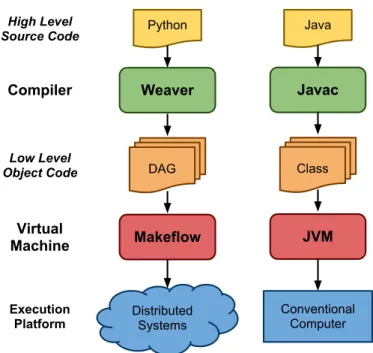
With this in mind, I approach the problem of composing distributed workflows by drawing parallels between the programming and execution model of traditional programming languages with the proposed workflow toolchain. As illustrated in Figure 1.2, there are striking similarities between conventional compiler and the workflow toolchain. Conceptually, the programming and execution model found in both systems involve: (1)a compiler that translates a high-level representation of the application into a low-level object format and (2) a virtual machine that executes the generated objects by dispatching work to a target execution platform.
For instance, in a traditional programming language such as Java [49], we start with a program specified in high-level source code and pass it to the Java compiler to translate the program specification into low-level object code (i.e. class files). These generated objects can then be passed to the virtual machine, in this case the JVM [73], which executes the program by issuing instructions to a conventional computer hardware system.
Python Java Weaver Javac DAG Class Makeflow JVM Distributed Systems Conventional Computer High Level Source Code Compiler Low Level Object Code Virtual Machine Execution Platform
Figure 1.2. Workflow Toolchain versus Conventional Compiler.
The key insight this dissertation contributes is that one can approach the challenge of constructing distributed workflows by utilizing the programming and execution model used in conventional programming languages: translate a high-level specifi-cation of the workflow using a compiler to produce a low-level object that is then passed to a virtual machine for execution on available computing resources.
As with the traditional compiler, the toolchain proposed in this dissertation begins with a high-level specification of the application. In this case, a Python script that represents the workflow is passed to the Weaver compiler, which in turn generates a low-level DAG representation of the workflow. This DAG is then sent to a workflow manager, Makeflow [3] in this case, that executes the applica-tion by dispatching tasks to available distributed systems. In this programming model, DAGs are viewed as the assembly language of distributed workflows and abstractions are high-level functions to be combined to form these workflows.
TABLE 1.1
COMPILER TOOLCHAIN CONTRIBUTIONS
Component Description of Research Contribution
Compiler Apply optimization techniques to DAG-based workflow
con-struction.
Utilities Provide tools to package, analyze, monitor, and profile work-flow.
Run-time Modify run-time system to support local variables, nested
workflows, enhanced provenance information, and garbage collection.
This dissertation applies the novel conceptual approach of compiling distributed workflows to the problem of constructing distributed data intensive scientific ap-plications. It begins by exploring how effective various compiler techniques are
when constructing distributed workflow applications. Specifically, I investigate the application of the concepts of register allocation, instruction selection, data partitioning, software pipelining, and loop unrolling in compiling distributed work-flows. Beyond these compiler optimizations, my dissertation also investigates the utility of various toolchain components such as linkers and profilers in modify-ing and monitormodify-ing the generated workflow objects. Additionally, I also perform some modifications to the run-time system to address some shortcomings in the virtual machine. A summary of the components of the compiler toolchain and my research contributions is provided in Table 1.1.
While my concrete contribution is the development of a compiler toolchain for distributed workflows, the dissertation also includes the construction of a few distributed applications. Some of these workflows will be synthetic benchmarks designed to demonstrate and evaluate the characteristics and features of both the toolchain and the distributed systems utilized in this dissertation. Other results, however, are from productive-level applications used by researchers from various disciplines and backgrounds. These are real world applications from fields such as biometrics and bioinformatics that benefit directly from the advances made by the research presented in this thesis.
The key impact of this work is enabling both expert and novices to effectively construct scalable data intensive scientific workflows that execute on various dis-tributed systems. Such an ability not only increases the number of experiments researchers can perform, but also facilitates the completion of otherwise infeasi-ble applications. Even though the dissertation focuses primarily on the design and implementation of the compiler toolchain, it is important to note that the software is already being utilized by various third parties to develop distributed
data intensive scientific workflows in the fields of biometrics, bioinformatics, and molecular dynamics, and thus is having an immediate impact on research and science beyond distributed systems.
The remainder of this dissertation describes, examines, and evaluates the var-ious components of the proposed distributed workflow compiler toolchain and proceeds as follows:
Chapter 2 provides a review of previous research related to programming dis-tributed data intensive scientific workflows. In particular, it first examines the use of abstractions, workflow systems, and programming languages in construct-ing distributed scientific applications. While abstractions are powerful in that they facilitate distributed computing without requiring the user to know the in-timate details of the distributed system, they come at the cost of execution gen-erality and flexibility. On the other hand, workflow systems enable a variety of workflow patterns but are cumbersome or difficult for novice users to utilize effectively. High-level programming language approaches provide an alternative approach that combines the ease-of-use of abstractions with the power of the more general workflow systems. In addition to discussing previous distributed comput-ing work, Chapter 2 also describes relevant compilers and programmcomput-ing languages research that are incorporated into the programming toolchain proposed in this dissertation.
Next, chapter 3 discusses the Weaver compiler’s programming interface and execution model. Unlike programming languages such as Swift, Weaver is im-plemented as a domain-specific language (DSL) on top of Python, which allows users to utilize a familiar scripting language to compose scientific workflows. Ad-ditionally, rather than introducing another workflow system, Weaver targets and
augments the Makeflow [3] workflow manager as its run-time system. Because of this, I concentrate on the programming language and compiler aspects of the toolchain, while leaving the details of distributed execution and management to Makeflow. A more in-depth examination of the programming API and implemen-tation of the compiler is presented in Appendix A and Appendix B.
To evaluate the workflows generated by the compiler toolchain, I executed the various benchmarks and tests presented in this dissertation on the different grids, computing clusters, and cloud platforms available at the University of Notre Dame. These distributed systems are representative of the type of computing resources available to researchers at most medium to large research institutions [111].
Chapter 4 presents the application of various compiler techniques to the gen-eration of distributed workflow applications. In particular, register allocation, instruction selection, data partitioning, software pipelining and loop unrolling are utilized by Weaver to transform directed acyclic graphs (DAG) into optimized workflows. The design and implementation of each method is discussed and eval-uated using synthetic benchmarks consisting of appropriate applications and tests. The goal here is to identify how effective such traditional compiler and program-ming language techniques are in increasing the performance of distributed work-flows and to determine when an end user should employ such optimizations to their scientific applications.
In Chapters 5 and 6, I discuss two sets of utilities that operate on the gener-ated workflow objects. The first set is a pair of linkers: an application linker that packages individual commands for reliable deployment and a workflow linker that modifies the workflow DAG for portability. These linkers help users manage their software components, which is non-trivial when operating in a distributed
envi-ronment. The second set of applications consist of an analyzer that will examine the Makeflow log and return information regarding the execution of the workflow in a variety of formats, amonitor that tracks the progress of a running workflow in real-time, and a reporter that provides a statistical summary of a workflow’s execution. These three profiling utilities facilitate debugging and tracking of the users workflows which are often challenging tasks for distributed applications.
In addition to developing new software tools such as a compiler and utilities, I also modify and augment Makeflow, the target run-time system used in this dissertation. Chapter 7 details the type of modifications made in my research work. For instance, the Makeflow parser is modified to support local task variables, which is vital for enabling the setting of task-specific batch options. Makeflow is also augmented to be made aware of nested Makeflow instances so that it can accurately perform resource allocations on hierarchical workflows. Likewise, the workflow manager is enhanced to emit additional provenance information and to support symbolic annotations. Lastly, methods for collecting garbage (i.e. temporary intermediate files) are implemented, benchmarked, and analyzed are implemented in Makeflow to prevent filesystem resource exhaustion.
Finally, in Chapter 8, I reflect on the results of my dissertation and consider possible future enhancements. For instance, I briefly explore the idea of data-mining provenance information in order automatically optimize a workflow and consider how to support dynamic workflows that allow for conditionals and run-time decision making. Additionally, I reflect on the advantages and disadvantages between having a workflow interpreter and a workflow compiler. Moreover, I discuss how the core ideas in my dissertation can be applied beyond the field of distributed computing and to programming in general.
The last decade has seen a surge in the amount of data involved in scientific research. Due to the increasing demand and requirement generating, processing, and analyzing massive quantities of experimental data, the role of distributed computing in scientific research has grown in importance across all disciplines. As such, the problem of effectively constructing distributed data intensive scientific workflows is an important, though difficult problem. This dissertation proposes a bold novel approach to constructing these data intensive workflows: a distributed workflow compiler toolchain that enables both novice and expert users to specify their workflow in a concise and maintainable high-level language which is trans-lated to a DAG to be executed on a variety of distributed systems such as campus grids, parallel computing clusters, and cloud platforms.
CHAPTER 2 RELATED WORK
The challenge of enabling both expert and novice users to effectively harness abundant computational resources in data intensive scientific research is an active and ongoing research problem in the field of distributed computing. In particular, there has been a plethora of research into various workflow systems, distributed computing abstractions, and programming languages aimed at providing intuitive and powerful systems for constructing distributed applications. This chapter dis-cusses the relevant work related to the proposed compiler toolchain.
2.1 Workflow Systems
Traditionally, the main approach to programming distributed applications is to provide researchers workflow systems based on the concept of directed acyclic graphs (DAGs) [123]. In these systems, the nodes of the graph are the set of tasks to be executed and the links between the nodes determine the order in each tasks are executed. Condor DAGMan [2] and Pegasus [36] are two examples of modern workflow systems that allow the user to specify a set of tasks to compute and the relationship between each task. Makeflow [3, 124] is another example a workflow manager that utilizes a DAG to schedule and manage tasks. Each of these systems provide a custom workflow language and an interpreter that takes
the job specification and produces an execution plan that is utilized by the system to process the workflow.
Another modern workflow system is Kepler [75], which is sophisticated scien-tific workflow application that allows users to construct workflows using a graph-ical interface. This system comes with many built-in components and has been used for large scale experiments. Taverna [86] is a similar graphical workflow sys-tem which builds on top of various web services and grid syssys-tems. Internally, it operates on a high-level XML language called Scufl [85], which while lacking in explicity looping constructs allows for nesting to create sophisticated data flows.
BPEL [74] is an Oasis standard for composing a set of interacting Web services into larger composite Web-based workflows [42]. Since most scientific workflows do not currently utilize Web services, BPEL’s adoption in scientific data processing has been limited. Moreover, the specification itself is control-flow oriented and involves explicitly defined XML and WSDL variables and does not support dataset iteration. As such BPEL is cumbersome for computational scientists to write and often results in large and repetitive documents [118].
Though proven to be powerful and robust, these workflow systems remain underutilized due to their complexity and unfriendly user interfaces [9, 101]. That is although these workflow tools are effective and scale well to large distributed workflows, the manual construction of DAGs can be tedious and error-prone for the end user. This ineffective programming interface serves as an unfortunate barrier for many users, both expert and novices, and thus prevents such systems from reaching wider adoption and limiting their possible impact on scientific research.
2.2 Distributed Computing Abstractions
In recent years, distributed computing abstractions have been introduced to simplify the use of distributed computing systems. The most well-known such abstraction is Google’s Map-Reduce [35]. Although the orignal Map-reduce system is proprietary, there a few open source implementations such as DisCo [91] and [51], with the latter being used extensively in both industrial and academic settings. In this programming model, users only need to provide two functions, a mapper
for selecting or filtering data, and a reducer for combining or reducing the data. The complexity of dispatching and scheduling jobs is abstracted or hidden from the user by a run-time execution manager.
Beyond Map-Reduce, other abstractions have been introduced. For instance, the Cooperative Computing Lab (CCL) at the University of Notre Dame has introduced All-Pairs and Wavefront [79, 124]. The former is a pattern of com-putation normally found in biometrics experiments where two datasets must be compared pairwise, while the latter is a distributed dynamic programming pat-tern often used in economics of genomics. These abstractions not only simplify the construction and execution of certain types of distributed applications, but also tend to be more efficient than naive implementations of the desired workflow. Overall, all of these distributed computing abstractions have been relatively successful at enabling non-expert users to create certain distributed applications while shielding them from the complexity of distributed systems. Due to their limited and simplified programming models, however, abstractions by themselves are not sufficient for the many types of workflows [60, 122]. For instance, it can be difficult to develop an application that requires multiple instances of an abstraction or even to combine different ones in the same workflow.
A few systems approach the problem of constructing distributed workflow ap-plications by combining both DAG-based systems and computing abstractions. For instance, Oozie [89] is a XML-based workflow system that runs on top of the Hadoop Map-Reduce framework and is used extensively for data processing tasks at web service providers such as Yahoo!. Additionally, Kepler has modules for designating particular nodes or tasks for running on Hadoop [117]. Despite this hybrid approach, these systems still lack expressive programming interfaces and ease-of-use.
2.3 Programming Languages
In response to these deficiencies, there has been a surge in research aimed at developing new programming languages and frameworks to bridge the gap between workflows and abstractions, while still providing the user friendly programming interfaces. Some of these languages build on top of abstractions, while others operate directly on workflow systems. The compiler toolchain proposed in this dissertation is a part of this current research trend and attempts to tackle the challenge of programming distributed workflows.
Pig [88] and Sawzall [93] are two languages that provide a high-level interface to Map-Reduce [35]. The former targets the open source Hadoop platform, while the latter runs on the Google’s proprietary system. Both of these languages pro-vide a simplified programming model composed of datasets and functions that is presented as new declarative programming languages with SQL-like syntax [28]. Cascading [25] is a Java library built on top Hadoop that allows users to explicitly construct dataflow graphs in order to program data-parallel pipelines that run on Hadoop’s Map-Reduce. FlumeJava [29] is another Java library that runs on top
of Hadoop and also supports constructing data processing pipelines by performing operations on a set of parallel collections provided by the library. Unfortunately, due to the nature of the Hadoop platform, it can be difficult to integrate legacy or external software. Moreover, since these frameworks are tightly tied to the Map-Reduce abstraction, the user is constrained in the types of workflows they can effectively specify.
Dryad [60] is another workflow system where users develop applications through the construction of DAGs. Because the work of building a workflow graph is rather low-level and complex, the authors of Dryad suggest the use of various higher-level tools such as DryadLINQ [59]. This programming construct takes advantage of the LINQ programming idiom in Microsoft’s .NET system to allow the specifica-tion of Map-Reduce type workflows using a single LINQ [76] expression. Another language built on top of Dryad is SCOPE [26], which is a declarative scripting language where programs are written in a variant of SQL. Like Pig and Sawzall, these Dryad-based languages are tied to their distributed computing platform and thus are limited to the Map-Reduce programming model.
Swift [120, 126] also tackles the problem of specifying diverse scientific work-flows, but does so by providing a general purpose programming language complete with a data type system. In Swift, users construct data structures representing their input and output data and specify functions that operate on these structures in a new custom programming language. This specification is then compiled into a set of abstract computation plans which is processed by the CoG Karajan [116] execution engine which works in conjunction with the Swift run-time system and Falkon [97] to execute the plans on loosely-coupled distributed systems such as Condor.
GEL (grid execution language) [71] is another programming language similar to Swift. It requires users to define programs to run and what order to execute the tasks, while handling data transfer and job execution for the users. Unfortunately, it also requires users to explicitly state which jobs are parallel and which ones are not, rather than determining these from data dependencies as in Swift and the proposed compiler toolchain.
GRID superscalar [104] demonstrates the use of an imperative programming language to implicitly construct workflows. In the GRID superscalar programming environment, users utilize either C/C++ or Perl in conjunction with CORBA IDL specifications of the tasks to automatically generating a task data-dependent workflow graph. This workflow generation an execution is accomplished using a run-time library which dispatches tasks in a master-worker paradigm.
Skywriting [82] is an interpreter-based approach to programming cloud applica-tions that utilizes a purely-functional programming language based on Javascript. It relies on futures [5] and lazy evaluation to implicitly extract parallelism from the workflow script. Because its CIEL execution engine [83], it supports dynamic applications that involve iteration and recursion.
2.4 Compiler Toolchain
In addition to adopting ideas from distributed workflows, abstractions, and programming languages, this dissertation incorporates a variety of techniques and methods from research involving compilers and traditional programming languages to produce a compiler toolchain for data intensive scientific workflows. The pro-posed compiler toolchain in this thesis is meant to be analogous to common de-velopment toolchains such as GCC [106] and LLVM [69].
The first set of contributions involves implementing a few compiler optimiza-tion techniques in order to increase the performance of the generated distributed workflows. For instance, like a conventional compiler where we need to manage stack allocation [4, 31] and perform name mangling [98, 99], distributed workflows need to manage and store both a prioridata and intermediate data. Another im-portant optimization method is instruction selection, which is used to translate an intermediate program presentation to a lower-level form closer to the target platform [45]. When performing instruction selection, the goal is to choose the optimal set of instructions that will yield the best performance in the context of the targeted architecture (e.g. SIMD [102] instructions), rather than lowest common denominator code that is portable. A third compiler technique is data partitioning [57], which is used to minimize communication overhead by group instructions (normally in a parallel loop).
In addition to these capabilities, I also investigate and evaluate graph trans-formation techniques based on conventional compiler optimization methods. One such optimization method is software pipelining [65], where code segments are scheduling in such a way that they can interleave based on data dependencies. An-other optimization is unrolling instructions to overcome dispatch overhead [12, 38]. Related to this is function or method inlining, which is also used to mitigate run-time lookup or dispatching [52]. All of these common optimizations are regularly performed on most modern compilers and help increase execution performance in traditional applications.
Distributed computing researchers have only recently begun to utilize similar techniques to optimize the performance of DAG-based workflows. For instance, clustering or transforming a directed graph to reduce dependencies [63] was
ex-plored by the Pegasus project on the Montage and Tomography applications [103]. Some researchers have utilized flowcharts as models to optimize workflows [37], while others have focused on run-time transformations of workflows to improve scheduling and resource allocation [94]. In this dissertation, I concentrate only on compiler optimization techniques that operate on a static DAG representation of a scientific workflow.
In addition to incorporating compiler optimizations, my dissertation also im-plements a few common toolchain utilities. The first set of tools is a pair of linkers [10] which can be used to package individual applications that are a part of the workflow or to organize the generated workflow DAG as a whole. In other words, these software tools enable static linking [33] of executables and workflows in a manner similar to crunchgen [61] andstatifier [115]. Unlike these tools, how-ever, the linkers presented in this dissertation do not require access to the original source code, and they can package data and environmental settings in addition to executables and libraries into one self-contained application unit. The goal of these linker tools is to encapsulate individual executables (or the entire workflow) with their dependencies (i.e. libraries, configuration files, environment variables) and in order to minimize the complication of distributing dynamically linked [55] applications in a heterogeneous execution environment.
Likewise, I also present a pair of profiling utilities to analyze and monitor the execution of the workflow. These programs are distributed workflow analogs of the traditional gprof [50] application found in GCC and the condor status -better-analyzecommand provided by Condor. Because profiling and monitor-ing workflows is a complex and ongomonitor-ing research field [40], I primarily focus on demonstrating the utility of these tools and how they improve the experience of
developing and debugging distributed workflows. The objective here is to provide a set of tools that can parse, display, and export the provenance [8] information generated by the workflow both during and after its execution in an user-friendly manner such that the researchers can monitor and debug their distributed appli-cations.
Finally, this dissertation also modifies and augments the Makeflow workflow manager to support additional run-time capabilities. For instance, garbage col-lection [15, 121], which typically involves a variety of algorithms for allocating and managing resources such as memory is implemented to tackle the problem of intermediate files exhausting filesystem resources. Additionally, a method of annotation similar to that found in OpenMP [34] and Cilk [13] is used to allow users to specify resource constraints to be propagated. This information is utilized by Makeflow to allow users to take advantage of platform specific options such as Condor ClassAds. Furthermore, Makeflow is modified to make it aware of nested invocations and to manage environmental variables in a manner more consistent with the traditional Make utility [43]. Note, that I avoid addressing any compli-cations with recursive make [77] and only focus on nested configurations in my dissertation.
Overall, the proposed compiler toolchain shares a few of the important features present in these many projects. As noted previously, the compiler toolchain uti-lizes the DAG-based workflow engine as its run-time system. Because the Weaver compiler does not force users to define workflows in terms of graph nodes and links, it is most similar to DryadLINQ, Swift, and FlumeJava in providing a high-level programming interface. Like FlumeJava, but unlike Swift, Weaver builds on top of an existing programming language, Python, rather than introduce a new
one. This takes advantage of Python’s user-friendliness and allows programmers to utilize the plethora of existing Python software. Likewise, Weaver is not re-stricted to a single programming construct as in DryadLINQ, Pig, and Sawzall, but encompasses a whole library of components that form a domain-specific lan-guage for distributed computing. Furthermore, the compiler toolchain also applies techniques found in traditional compilers and programming languages such as op-timizations and garbage collection. All of these features combine into a compiler toolchain that enables users to rapidly and effectively construct data intensive scientific workflows.
CHAPTER 3
COMPILING WORKFLOWS
The central component of a programming toolchain is the compiler. In or-der to evaluate the application of compiler techniques to distributed workflows, I implemented the Weaver [23] workflow compiler that enables computational re-searchers to construct distributed data intensive scientific workflows in the Python programming language.
To construct a distributed workflow using Weaver, the user programs a spec-ification in Python that utilizes various Dataset, Function, Abstraction, and
Nestcomponents provided by the Weaver programming interface. Once the speci-fication is complete, the user processes the script using the Weaver compiler which generates a workspace (sandbox directory) that contains a directed acyclic graph (DAG) enumerating each task in the workflow and their relationship with each other and any other files materialized by the compiler during compilation. The generated DAG is passed to a workflow manager whose job is to schedule the tasks specified in the generated DAG by dispatching the jobs to a distributed execution engine. This chapter briefly summarizes the programming interface provided by the compiler, examines the execution model of the compiler, and discusses the components of the entire software stack.
3.1 Programming Interface
Weaver provides a simple, though restricted, programming model that consists ofDatasets,Functions,Abstractions, andNestsas shown in Table 3.1. These concepts are the fundamental building blocks of the Weaver application program-ming interface (API) and are implemented as a custom Python package consisting of modules, classes, and functions that end users combine and extend to define their distributed scientific workflows.
TABLE 3.1
WEAVER PROGRAMMING INTERFACE COMPONENTS
Component Summary
Datasets Collections of data objects that represent physical files.
Functions Specifications of executables used to process data.
Abstractions Patterns of execution that define how functions are applied to datasets.
Nests Execution context consisting of a DAG and namespace.
The first component of the Weaver programming interface is the idea of a
Dataset. Data intensive scientific workflows typically involve processing and an-alyzing a repository of experimental data that is stored as files on the filesystem. In the Weaver, collections of such data are represented by Datasetobjects where
each element’s string (i.e. str ) method returns the filesystem location of a particular item’s data. This convention means that a Dataset in Weaver can be a Python list, set, generator, and any other object that implements Python’s iteration protocol.
TABLE 3.2 WEAVER DATASETS
Dataset Description
Glob Collection of files based on path expression.
FileList Collection of files stored in a text file.
SQLDataset Collection of data from a SQL database.
Query ORM selection and filtering function for Weaver Datasets.
Table 3.2 provides a list of theDatasetobjects provided by Weaver. The first
Datasetconstructor provided by Weaver,Glob, allows users to select a collection of files based on a path expression such as *.dat, while the second Dataset,
FileList, specifies that the data files are enumerated in a text file. The third
Dataset, SQLDataset, provides users a straightforward mechanism for extracting data from a SQL [28] database such as MySQL [84] and transparently materializing the data as physical files. All of these Datasets can be filtered into smaller subsets using Weaver’s Query function, which allows users to perform selection
and filtering operations on Datasets using an ORM [62] expression language similar to SQLAlchemy [105].
The second component of Weaver’s programming interface is theFunction. In most scientific workflows, anensemble of executables are used to process and ana-lyze a set of data. Weaver accounts for these applications by providing the notion of a Functionspecification object that defines the location of the executable and its command line interface. This means that eachFunctionspecifies information such as the path to the executable and how arguments to the Function are to be formatted to generated a shell command that can be executed to perform the desired operation. Like objects in a Dataset, eachFunction also corresponds to an object on the filesystem.
TABLE 3.3
WEAVER FUNCTIONS
Function Description
Function Base Functionobject constructor.
ParseFunction Convenience wrapper that constructs Function and sets command format.
ShellFunction Constructs Function out of shell script specified as string.
PythonFunction Constructs Function from inline Python code.
As shown in Table 3.3, Weaver provides a set of custom Python components designed to expedite and simplify the specification of workflow Functions. The first item in the table is the base object constructor from which all other construc-tors are derived and requires the user to specify the location of the executable and the command format specifying how the shell command should be arranged.
ParseFunction is a utility wrapper that will construct a Function based on a string template and will automatically set the location and command format for the user. It is used internally by Abstractions when parsing the Function ar-gument and is provided to the user for convenience. The next two Functions,
ShellFunction and PythonFunction allow the user to embed or inline shell and Python code respectively. This means that rather than having to create external scripts, the user can simply place the scripts inside the main workflow specifica-tion and the compiler will automatically materialize a script file for the user. The final Function is Pipeline, which enables users to combine multiple Functions
into a single meta-Functionthat behaves as a normal Function.
The third component in the programming interface is Abstractions. These are high-order functions that specify a specific pattern of computation with a precise set of semantics. In Weaver, Abstractions are basically lazily evalu-ated [5] Datasets that take Function and Dataset arguments and specify how the Functions are to be applied to the input Datasets to produce the output
Dataset. As such, the result of one Abstractioncan be passed as an argument to anotherAbstractionor to aFunctionto coordinate a sequence of operations. This means that rather than explicitly forming a graph of tasks, users implicitly construct their workflow DAGs by passing Datasets as inputs to Abstractions
TABLE 3.4
WEAVER ABSTRACTIONS
Abstraction Description
AllPairs(function, inputs a, inputs b)
Apply function to all pair-wise com-binations of inputs a and inputs b.
Map(function, inputs) For each input in inputs, apply
function.
MapReduce(mapper, reducer, inputs)
For each input in inputs apply
mapper, sort intermediate outputs, and then applyreducer.
Merge(function, inputs) Use function combine inputs by
us-ing a parallel reduction.
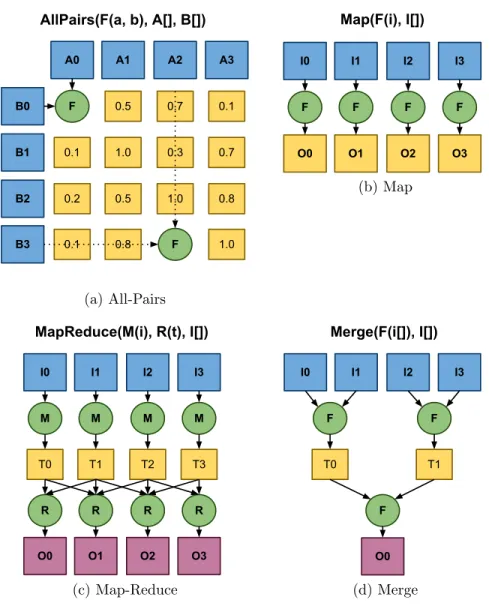
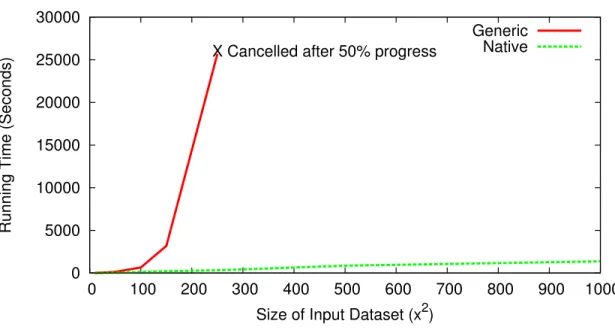
Table 3.4 summarizes the four Abstractions provided by the Weaver com-piler. The first AbstractionisAllPairs [78], which is a pattern of computation where each member of one dataset is compared to each member of a second dataset to produce a matrix that contains the resulting scores for each comparison. The second Abstractionis Map, which involves applying a Function to each item in aDataset to produce a new outputDataset. MapReduce[35] is a computational pattern that first applies amapperFunctionto the input Datasetto generate an intermediate collection of key-value pairs that are shuffled, sorted, and then pro-cessed by thereducer Function. The finalAbstractionisMergewhich performs a parallel reduction [64] on the inputDataset using a specified merge Function. As illustrated in Figure 3.1, all of the tasks generated by these Abstractions
exhibit data independence and thus can be scheduled concurrently and executed in parallel.
A0 A1 A2 A3 B0 B1 B2 B3 0.5 0.7 0.1 F 0.1 1.0 0.3 0.7 1.0 0.8 0.5 0.2 0.1 0.8 F 1.0 AllPairs(F(a, b), A[], B[]) (a) All-Pairs I0 I1 I2 I3 O0 F F Map(F(i), I[]) F F O1 O2 O3 (b) Map I0 I1 I2 I3 M T0 T1 T2 T3 MapReduce(M(i), R(t), I[]) M M M R R R R O0 O1 O2 O3 (c) Map-Reduce I0 I1 I2 I3 F T0 T1 Merge(F(i[]), I[]) F F O0 (d) Merge
Figure 3.1. Weaver Abstractions
The structure of the fourAbstractions provided by Weaver are illustrated in this Figure. In each pattern of computation, the processing of the data can be performed independently and thus can be scheduled to execute in parallel or concurrently.
The final component in the Weaver programming interface is the notion of a
Nest. In Weaver, all workflows consist of a workspace and a directed acyclic graph. The workspace serves as a storage area for any intermediate and output workflow artifacts, while the DAG encodes the relationships between tasks in the workflow.
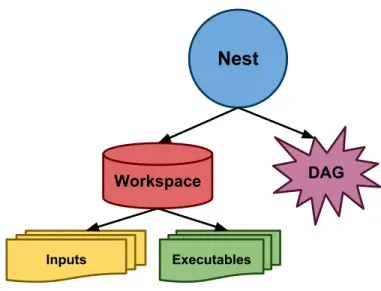
Nests are Weaver objects that represent both a workspace and DAG. Whenever an Abstraction is processed, it is done so in the context of a particular Nest, which captures any tasks produced by the Abstraction being executed. Figure 3.2 illustrates the structure of WeaverNestobject. As can be seen, aNestconsists of both a workspace and a DAG.
Nest
Workspace DAG
Inputs Executables
Figure 3.2. Weaver Nests
In Weaver, a Nest is a conceptual object that consists of a namespace (e.g. workspace on the filesystem) and a directed acyclic graph that contains the tasks in the workflow.
One way to understand the Nest concept is to consider that a workflow typi-cally has two key features that distinguish it from other workflows: (1)a names-pace and(2)a DAG. The namespace of the workflow determines the environment in which the workflow is to be executed. Typically this namespace corresponds to workspace on the filesystem and thus can be mapped to a specific sandbox. In addition to this namespace, a workflow also consists of a directed acyclic graph that specifies the tasks to be performed and how they are related to one another. Taken together, both the namespace and the graph combine to uniquely iden-tify a single workflow. It is possible, for instance, that a single namespace would contain multiple DAGs or for a single DAG to exist in multiple namespaces. To properly identify a specific workflow, then, we must use the combination of both the namespace and the DAG. In Weaver, each Nest object is associated with a particular namespace and a single DAG. Therefore, each Nest maps to a specific workflow. That is, a workflow in Weaver is a represented by a Nest. Whenever we compile a workflow using Weaver, we are constructing aNest.
To utilize the Weaver compiler, users employ theDataset,Function,Abstraction
and Nest components described here to specify their distributed workflow. The programming interface is restrictive in that it requires that all data and functions to be represented on the filesystem, but is flexible enough to support a variety of computational patterns. The compiler comes with a collection of components for the user to utilize, but also allows developers to extend these modules and even add their own. A more in-depth discussion of the Weaver API, along with example source code, is provided in Appendix A.
3.2 Workflow Compiler
As mentioned earlier, the workflow language is implemented as a domain-specific language on top of Python. This means that rather than having its own lexer and parser, Weaver depends on the language facilities of the Python in-terpreter. When writing Weaver scripts, the user is basically programming in a restricted subset of Python that primarily consists of invoking and utilizing the various Datasets, Functions, and Abstractions components discussed previ-ously. The advantage of this is that users get to leverage their familiarity with Python instead of having to learn a new programming language.
To construct a workflow, users simply utilize the Weaver components in a Python script to specify their distributed workflow. In addition to the Weaver library and the standard Python library, users may employ any available third party Python module such as NumPy or SciPy [87] to construct their workflow. Once the workflow application is completely specified, the script is passed to the Weaver compiler for processing.
As shown in Figure 3.3, the output of the Weaver compiler is a sandbox direc-tory that contains the DAG file detailing the tasks scheduled by the compiler. If necessary, any scripts or files materialized by the compiler (e.g. ScriptFunctions
orPythonFunctions) are placed in this sandbox. As such, this sandbox directory represents theNest’s workspace component, while the DAG file generated by the compiler corresponds to the Nest’s workflow graph component. Together, the sandbox and DAG file represent a single unique workflow.
When a script is passed to Weaver, the compiler begins processing the spec-ification by initializing the output sandbox which serves as the default location for the compiler’s output. This includes creating the directory if it does not exist
Python
Script Weaver Sandbox
Input Compiler Output
Scripts Executables Input Data DAG
Figure 3.3. Weaver Compiler
In Weaver, a workflow is specified using the Python library components provided by the compiler. This specification is passed to the compiler that evaluates the Python script and generates a sandbox directory that contains a DAG file enumerating the tasks necessary to execute the desired workflow and any files materialized during compilation.
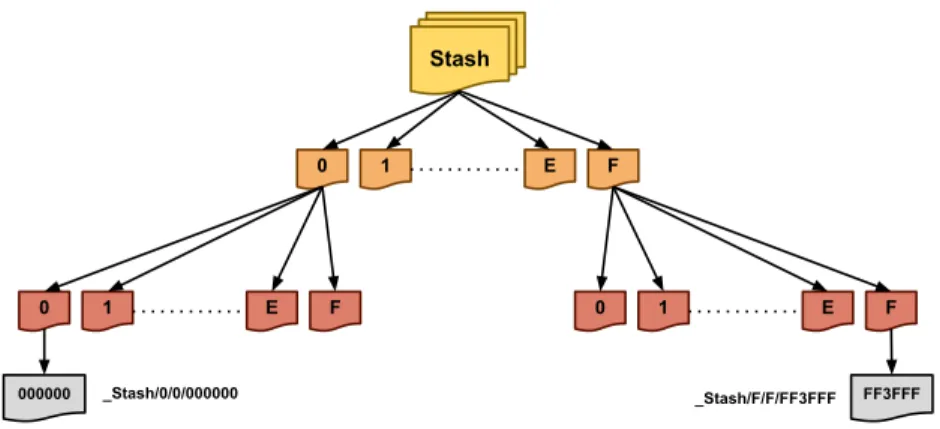
and setting up the Stash structure which is described in Section 4.1. After this, the compiler configures an initial Python environment by importing the various components of the framework into the global interpreter namespace and setting required paths. After this the compiler evaluates the specified Python script using Python’s execfile function, which reads in the Python script and evaluates it using the environment setup by the compiler.
The side-effect of this evaluation is the generation of the workflow DAG and any necessary materialized files. That is, in order to generate a Weaver workflow, it is necessary to evaluate the Weaver script in a specially constructed Python environment. The toolchain includes a Python script, weaver, that sets up the sandbox, configures the environment, and evaluates the Weaver specification as described in the previous paragraph and is considered the compiler.
It should be noted, however, that it is possible to utilize the Weaver library components without this compiler (i.e. execute the script using Python directly
rather than with weaver) and still have it generate proper workflows. In fact, evaluating or executing the Dataset, Function, and Abstraction components directly in Python will work as long as an initialNestobject is setup as the current context manager. For the most part, however, it is recommended that users generate workflows with theweavercompiler script which ensures the environment is properly configured.
During the evaluation of the workflow script, the compiler tracks the tasks generated by theAbstractionsandFunctions. Whenever users invoke one of the Weaver Abstractions in the Python script, Functions are applied to Datasets
in the pattern proscribed by theAbstractionand a sequence of tasks in the form of(abstraction, function, command, inputs, outputs, options)tuples is scheduled with the current Nest.
As noted previously, in Weaver, Abstractions are Datasets. In fact, the current implementation has Abstractions as a child class of the Dataset class. This is because in Weaver,Abstractionsgenerally behave asDatasets(i.e. users pass them as inputs to Functionsor other Abstractions), except that they also schedule some computation (Datasets, on the other hand, do not schedule any computation). Because of this, Abstractions are memoized futures [5] that (1)
are lazily evaluated and (2) cache their results. This is important to consider because if an Abstraction is not iterated over (i.e. used as an argument to another Abstraction or Function), then it will never be computed and thus never scheduled in the workflow.
To prevent the situation of using anAbstraction, but not generating any tasks during compilation, Weaver registers each Abstraction with the CurrentNest
the workflow, it will iterate over every Abstraction associated with it to ensure that everyAbstractionis computed and scheduled. Since the results of iterating over a Datasetare cached, we will never schedule tasks more than once because the Datasetwill only be generated once.
If the user utilizes the Nest constructor in the workflow specification, then a new sub-workflow is initialized and subsequent tasks are associated with this new
Nest. This continues until the Nest is out of scope, and then the previous Nest
is restored. Just as Abstractions are registered with the CurrentNest, child
Nests are registered with their parents. This is done to ensure that all of the
Abstractionsdefined in the child Nests are appropriately compiled.
When theweavercompiler is finished evaluating the Weaver script, it will then call thecompile method of the CurrentNest. This will in turn perform the cas-cading series of compilations described above. Besides iterating overAbstractions
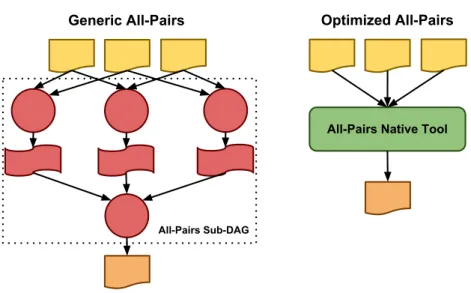
and compiling sub-Nests, the compiler will also perform some optimizations. For instance, rather than having a single DAG node responsible for a single task, the user may wish to aggregate a group of tasks into one single super DAG node. This is an example of clustering which was shown by the Pegasus project to have significant performance benefits on the Montage and Tomography applications [103]. Another possible optimization technique is the use of instruction selection to take advantage of native optimization tools. These optimizations and others implemented by the compiler are discussed in further detail in Chapter 4. Once everything is compiled, the compiler will then emit the computed DAG in a format suitable for the target workflow manager.
In summary, a directed acyclic graph of tasks is generated as a side-effect of the evaluation of the Weaver script that utilizes the Dataset, Function, and
Abstraction components of the Weaver programming interface. All of these tasks are tracked by a Nest object, which will perform various optimizations on the graph and finally emit a DAG representing the specified workflow. A more detailed examination of the Weaver’s implementation is provided in Appendix B.
3.3 Workflow Manager
As mentioned previously, the Weaver compiler generates a sandbox directory containing a DAG and various files required for proper execution of the workflow. To actually execute the workflow, the user must pass this workspace and DAG to a workflow manager which will use the sandbox as the storage area for the outputs of the workflow and any intermediate workflow artifacts generated during execu-tion and will parse the DAG to generate tasks to execute on various distributed execution platforms.
Currently, the compiler only supports the Makeflow [3] workflow manager al-though the initial version [21] did support Condor’s DAGMan system [1]. The decision to only support Makeflow was done because some critical aspects of the dissertation required modifying the run-time system to support some of the de-sired features of the toolchain. Because of my familiarity with Makeflow, I decided to only target it and add the features the toolchain required to it. These modifi-cations are discussed in detail in Chapter 7.
When a workflow script is compiled with Weaver, a Makeflow DAG is generated in the sandbox directory. This DAG contains rules similar to those found in a regular UNIX Makefile [43] that describe tasks in terms of the inputs and output dependencies and the command used to accomplish the desired task. These rules are used by Makeflow to form an internal directed acyclic graph of the entire
workflow. In this graph, the nodes are the data to be processed and the tasks to be executed with this data, and the links are the relationships between the tasks and the necessary input and output files. By forming this directed graph, Makeflow can accurately determine which tasks depend on others and schedule the work appropriately to optimize concurrency and parallelism.
TABLE 3.5
WEAVER AND MAKEFLOW DAG EXAMPLE
Weaver Source Makeflow DAG
jpgs = [str(i) + ‘.jpg’ for i in range(1000)] 0.png: 0.jpg /usr/bin/convert
conv = ParseFunction(‘convert {IN} > {OUT}’) /usr/bin/convert 0.jpg 0.png
pngs = Map(conv, jpgs, ‘{BASE WOEXT}.png’) 1.png: 1.jpg /usr/bin/convert
/usr/bin/convert 1.jpg 1.png 2.png: 2.jpg /usr/bin/convert /usr/bin/convert 2.jpg 2.png ... 999.png: 999.jpg /usr/bin/convert /usr/bin/convert 999.jpg 999.png
An example of the relationship between the user-defined Weaver workflow script and the generated Makeflow DAG is shown in Table 3.5. In this simple
example, we wish to convert a thousand JPG images to PNG format. We can specify this workflow in three lines of Weaver as shown on the left side of the table. If we process this workflow specification with the Weaver compiler, we get the Makeflow DAG displayed on the right side of the table below. For each JPG file, we created a rule consisting of the output PNG file, the input JPG file, the
convert executable, and the shell command required to perform the task. Note the listing on the right is only an abbreviation of the Makeflow DAG, as the whole DAG would be two thousand lines, which is much longer than the three line Weaver specification. As can be seen, Weaver enables concise specifications of large data intensive workflows and thus improves the expression of such workflow applications.
This is the one of the key reasons for compiling workflows rather than con-structing them directly. With a high-level language such as the Weaver DSL, it is possible succinctly specify a complex workflow consisting of thousands to mil-lions of tasks in a very few lines of code. Constructing the DAG manually would be tedious and error-prone, while using ad-hoc scripts would become difficult to manage in the long-term. Having a formalized method of generating workflows, as provided by the Weaver compiler, enables rapid and reliable development of these data intensive applications. Additionally, as we will see in Chapter 4, compiling workflows also provides an opportunity to perform optimizations that can boost the performance of the workflows.
The complete Weaver software stack is composed of three layers as shown in Figure 3.4. The first layer is the Weaver compiler framework which is used to translate a workflow specification in Python into a Makeflow DAG. The second layer is the Makeflow workflow manager which processes the DAG and dispatches
Weaver Makeflow
Local, Condor, SGE, WorkQueue
Python
DAG
Jobs
Figure 3.4. Weaver Software Stack
To create and execute workflows using this toolchain, users write workflow spec-ifications in Python and then compile them using Weaver. This will generate a workspace and a DAG containing the tasks necessary for accomplishing the work-flow. In order to execute the workflow, the workspace and DAG is passed to the Makeflow workflow manager which will create batch jobs on a variety of execution platforms.
jobs to the third layer, the various distributed execution engines. As a portable DAG-based workflow manager, Makeflow provides the ability to utilize different execution engine such as Condor [113], Sun Grid Engine (SGE), WorkQueue [22], and local Unix processes. To perform workflow execution, Makeflow internally employs the master-worker paradigm [72] to perform task scheduling and resource allocation.
Because Weaver generates Makeflow DAGs rather than directly scheduling for a specific execution engine, users of the framework can easily take advantage of multiple execution environments by simply selecting the appropriate platform at run-time. This flexibility allows users to adapt to the resources available to them without having to modify their workflow specification. Additionally, Makeflow utilizes a transaction journal to record the progress of a workflow. This journal is normally stored as a plain text file in the workflow’s workspace and can be used
to collect provenance information such as the number of tasks failures, attempts, execution times, and more. The log also enables Makeflow to resume or restart a failed workflow without rescheduling already completed tasks. Batch system specific logs such as a Condor log file are also stored in the workspace and can also be used to collect provenance information.
Overall, this system architecture is similar to other workflow systems such as Swift and Pegasus. For instance, Swift relies on CoG Karajan execution engine [116, 126] to dispatch tasks and perform resource allocation, while Pegasus relies on Condor DAGMan [1, 36] for distributed execution. In this case, the toolchain presented in this dissertation depends on the Makeflow workflow manager to per-form the actual execution of the workflow. Because Makeflow supports a variety of distributed execution platforms, this means that Weaver workflows can be easily ported to and executed on different distributed systems.
Finally, the power and utility of the Weaver’s execution model is that the compiler allows for users to rapidly construct and configure workflows in a high-level language (Python). This is important because it is not always clear what the best decomposition of a workflow should be or what elements are required. Using the Weaver compiler, users can rapidly prototype and generate their distributed workflows in a concise and reliable manner. With Makeflow’s support for local and distributed systems, these workflows can be tested locally on a multi-core system and then later executed on different distributed platforms when the workflows have been debugged.
CHAPTER 4
OPTIMIZING WORKFLOWS
As with traditional compilers, Weaver supports a few optimization techniques that can be used to increase the performance or run-time characteristics of the generated workflows. This chapter discusses four optimization methods that were implemented by the Weaver workflow compiler and examines their effect on the performance of a few sample benchmarks. These methods were inspired by tech-niques from traditional programming language compilers and are summarized in Table 4.1. As noted in the table, each optimization corresponds to a traditional compiler technique and has its advantages and disadvantages. In addition to dis-cussion and testing these optimizations, this chapter also includes analysis for when these methods are appropriate for achieving improved performance. Over-all, these optimization techniques can yield significant performance increases un-der the right circumstances and provide evidence of the effectiveness of applying certain traditional compiler methods to DAG-based workflows.
TABLE 4.1
COMPILER OPTIMIZATIONS OVERVIEW
Optimization Analogy Advantages Disadvantages
Structured Allocation Name mangling Prevents inode exhaustion,
keeps sandbox clean
Slower compilation, negligi-ble performance increase
Instruction Selection Instruction selection Take advantage of optmized
implementation
Lack of availability, limited interface
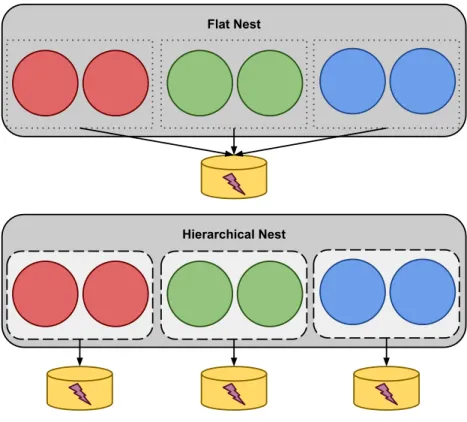
Hierarchical Workflows Data partitioning Increase concurrency,
inter-leave execution
Explicit management, barri-ers
Inline Tasks Loop unrolling Minimize dispatch time Namespace complications,
break constraints