Iran University of Medical Sciences
____________________________________________________________________________________________________________________
1. PhD candidate, Department of Medical Education, Iran University of Medical Sciences, Tehran, Iran. [email protected] 2. Assistant Professor, Department of e-learning in Medical Education, Virtual School, Center for Excellence in E-learning in Medical
Educa-tion, Tehran University of Medical Sciences, Tehran, Iran. [email protected]
3. (Corresponding author) Associate Professor, Department of Internal Medicine, Medical School, Educational Development Center, Tehran
University of Medical Sciences, Tehran, Iran. [email protected]
4. Department of Medical Education, Medical School, Tehran University of Medical Sciences, Tehran, Iran. [email protected]
Pamphlet as a tool for continuing medical education:
performance assessment in a randomized controlled
interventional study
Aeen Mohammadi1, Rita Mojtahedzadeh2, AmirHossein Emami*3
Marjaneh Dehpour4
Received:7 June 2014 Accepted:17 March 2015 Published:23 August 2015
Abstract
Background: Pamphlet is a tool used for distance continuous professional development programs. In this study, we assessed the impact of an educational pamphlet on improving prescription writing errors in general physicians’ performance.
Methods: In this randomized controlled interventional study, we prepared a training pamphlet ac-cording to the most prevalent prescription writing problems. We randomized 200 participants among general physicians affiliated with Tehran Social Security Insurance Organization, and randomly di-vided them into intervention and control groups. Participants’ prescriptions (N= 34888) were inves-tigated over a month, and then the prepared pamphlet was sent out to the participants in the interven-tion group. After three months we examined their one-month prescripinterven-tions again (N= 30296) and investigated the changes in prescription errors.
Results: There was no significant difference in the mean number of prescriptions in two groups before and after intervention (p= 0.076). Mean number of medicinal items reduced significantly in intervention group. Also mean number of prescriptions including injection drugs (p= 0.024), Corti-costeroids (p= 0.036), Cephalosporin (p= 0.017) and non-steroidal anti-inflammatory drugs (p=0.005) reduced significantly. No significant differences were found for other errors.
Conclusion: This study showed that use of an appropriate pamphlet has a considerable impact on improving general physicians’ performance and could be applied for continuous professional devel-opment.
Keywords: Educational media, Pamphlet, Continuous medical education, General practitioners.
Cite this article as:Mohammadi A, Mojtahedzadeh R, Emami AH, Dehpour M. Pamphlet as a tool for continuing medical education: performance assessment in a randomized controlled interventional study.Med J Islam Repub Iran2015 (23 August). Vol. 29:252.
Introduction
Physicians are supposed to be up to date and this is met through Continuous Medical Education (CME) and Continuous Profes-sional Development (CPD) activities (1). Continuous development is an ethical and professional responsibility of every healthcare member all through their profes-sional career (2). CME concept and CPD development strategies have recently
changed greatly with more focus on patient safety, improved care, and evidence based practice (3,4). For instance CPD activities are more learner-centered and self-directed compared to CME programs with more teacher-centered approaches (5). However, it is recommended to integrate core compe-tencies of practice based learning in CME and CPD activities and use new instruc-tional strategies (6). In fact CME and CPD
are lifelong collaborative and continuous learning approaches (7).
In different countries, numerous CME programs are offered and the certificate of attendance is required for extending the medical license (8,9). Face-to-face continu-ing education may include seminars, con-ferences, congresses, short-term profes-sional training courses, and formal educa-tion programs, and distance educaeduca-tion in-cludes on-line education or sending period-icals, books, educational CD/DVDs, bro-chures, and pamphlets (10).
A pamphlet is a compact educational me-dium used as a tool to reinforce learning process. It takes a short time to read a pam-phlet and it acts as a reminder of important points. It aims to change knowledge and attitude, or to teach a behavioral skill. Pamphlets are used in different studies for educating communities and patients (11-13).
Rational prescription of medicine by phy-sicians, monitoring drug usage and distribu-tion, and promotion of public culture to achieve more effective medical treatment, shape principles of healthcare in developed countries (14).
In 1985, the World Health Organization (WHO) held a conference in Nairobi, Ken-ya on rational use of drugs. Since then, ef-forts to improve the use of drugs in devel-oping countries have increased with the aim of changing the public attitude and the cul-ture of drug prescription by physicians (15). This study assessed the impact of ad-ministering a scientifically prepared pam-phlet on improving General Practitioners’ (GPs) performance, and to evaluate its pos-sible role in CPD programs.
Methods
Preparing the educational pamphlet
For designing the educational pamphlet, we firstly had to identify GPs’ prescription writing errors. Thus, from the GPs’ pre-scriptions returned to the Social Security Organization (SSO) between January 20th
and February 18th, 2010. We randomly se-lected 600 ones. Two separate SSO’s
pre-scription evaluator personnel identified the frequency of each error in selected pre-scriptions based on common prescription errors (16), including content and writing errors. Writing errors included: illegibility of prescription, insertion of “as per order”, not mentioning diagnosis, and excessive medicinal items. Content errors consisted of drugs misprescriptions and interactions. A pharmacologist and a clinical pharma-cologist identified most frequent or critical errors. Then the educational pamphlet was prepared according to identified errors un-der the supervision of above mentioned ex-perts.
Also, we designed a checklist on the basis of identified errors to assess prescriptions. To check interpersonal reliability of the checklist (between raters), 50 assessed pre-scriptions were reviewed simultaneously by two experts, and for individual reliability (within rater), 50 prescriptions were as-sessed in two rounds with one-week inter-val.
Intervention
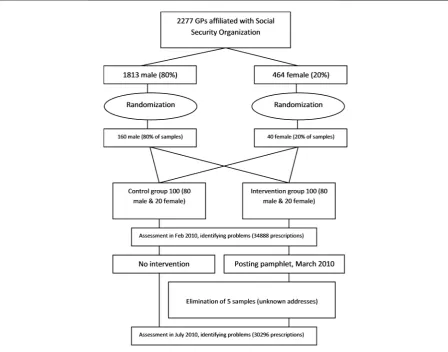
In this study, 2277 GPs affiliated with Tehran SSO were chosen as the study pop-ulation. The duration of the study was six months between February and August 2010. Of 2277 GPs, 1813 were male (80%) and 464 were female (20%). Using a simple random sampling, 200 GPs including 160 males (80 in intervention and 80 in control groups), and 40 females (20 in the interven-tion and 20 in control groups) were ran-domly selected (Fig. 1).
Initially, we identified prescription errors of all participants during one month period (February 2010) according to the above-mentioned checklist. Then, the prepared educational pamphlet was sent to the GPs’ in the intervention group. Five physicians (5%) were excluded due to unknown ad-dress. Then we examined the prescriptions of both groups with the same checklist, in July 2010. Before the intervention 34888 prescriptions were reviewed (19405 and 15483 from the intervention and the control groups, respectively). After the
tion, 30296 prescriptions were studied (15661 and 14635 from the intervention and the control group, respectively).
Statistical Analysis
We determined the mean number of pre-scriptions with errors in the intervention and control groups before and after inter-vention and used t-test to compare the dif-ferences. Also, we performed repeated measures analysis of variances (ANOVA) to assess the effect of the pamphlet. Normal distribution and homogeneity of variances were confirmed prior to analysis. P value less than 0.05 was considered as signifi-cant. In August 2010, we posted the pam-phlet to the control group for ethical issues.
Results
Table 1 presents the errors and their fre-quency. The between and within rater's er-rors of the devised assessment checklist were 2% and 1%, respectively, which were
acceptable.
In total, prescriptions written by 195 GPs were examined; 95 (49%) of them were in the intervention group and 100 (51%) in the control group. There was no significant dif-ference for the years of experience between intervention (8.1% ± 3.52) and control (8.2 ± 3.00) groups (p= 0.874). Also, there was no significant difference between two groups in gender (p= 0.463).
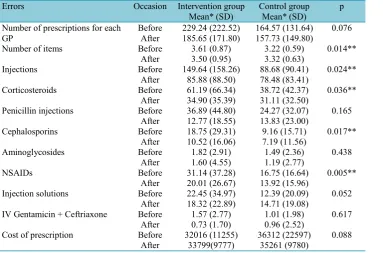
There was no significant difference in the mean number of prescriptions in the inter-vention and the control groups before and after intervention (p= 0.076). Mean number of medicinal items reduced significantly in intervention group. Also mean number of prescriptions including injection drugs, Corticosteroids, or 3rd generation injection cephalosporin and non-steroidal anti-inflammatory drugs (NSAIDs) reduced sig-nificantly. However, no significant differ-ences were found for the mean number of prescriptions including Penicillin injection,
Fig. 1. Schematic study design and randomized groups
Aminoglycosides, injection solutionsimul-taneous prescription of Gentamicin and Ceftriaxone or mean medicinal cost. Table 2 compares the mean (SD) errors in two groups before and after the intervention.
Discussion
The effect of education on reducing pre-scription writing errors has been examined in various studies (17-19). Also, studies in different countries have shown the need for distance training of GPs and identified self-training as a suitable method for CME; physicians showed a positive attitude to-ward it (20). In a study active learning strategies enhanced physicians’ knowledge of drug interaction and reduced related er-rors frequency from 1.6% to 0.24% (21).
Also instructional interventions relatively improved proper drug prescription (22). One study in Iran reported a decrease in mean number of medicinal items from 3.9% in 1999 to 3.49% in 2001, following a CME intervention (23).
In this study, we examined the effective-ness of a pamphlet in a real environment. We assessed the prescriptions before inter-vention in winter and after interinter-vention in summer. So there may be the effect of dis-eases prevalence in different seasons on prescriptions. We considered this point in analysis and the effect was adjusted using repeated measures of variances.
We found that the mean number of items in prescriptions reduced significantly. Also mean number of injection drugs reduced
Table 1. Types and percentages of errors among total errors in participants’ prescriptions
Type of error Errors
N*(%)
Injection drugs 36 (25)
Corticosteroid prescriptions 9 (6)
Injection solutions 4 (2.5)
3rdgeneration injection cephalosporin 2 (1.5)
Penicillin injection 17 (12)
Simultaneous prescription of gentamicin and ceftriaxone 3 (2)
Aminoglycosides 17 (12)
NSAIDs 25 (17)
Cost of prescription 32 (22)
*Total number of prescriptions: 600, Total number of prescription with errors: 84, Total number of errors: 145
Table 2. Results and comparison of participants’ prescription errors before and after intervention.
Errors Occasion Intervention group
Mean* (SD) Control groupMean* (SD) p Number of prescriptions for each
GP BeforeAfter 229.24 (222.52)185.65 (171.80) 164.57 (131.64)157.73 (149.80) 0.076
Number of items Before 3.61 (0.87) 3.22 (0.59) 0.014**
After 3.50 (0.95) 3.32 (0.63)
Injections Before 149.64 (158.26) 88.68 (90.41) 0.024**
After 85.88 (88.50) 78.48 (83.41)
Corticosteroids Before 61.19 (66.34) 38.72 (42.37) 0.036**
After 34.90 (35.39) 31.11 (32.50)
Penicillin injections Before 36.89 (44.80) 24.27 (32.07) 0.165 After 12.77 (18.55) 13.83 (23.00)
Cephalosporins Before 18.75 (29.31) 9.16 (15.71) 0.017**
After 10.52 (16.06) 7.19 (11.56)
Aminoglycosides Before 1.82 (2.91) 1.49 (2.36) 0.438
After 1.60 (4.55) 1.19 (2.77)
NSAIDs Before 31.14 (37.28) 16.75 (16.64) 0.005**
After 20.01 (26.67) 13.92 (15.96)
Injection solutions Before 22.45 (34.97) 12.39 (20.09) 0.052 After 18.32 (22.89) 14.71 (19.08)
IV Gentamicin + Ceftriaxone Before 1.57 (2.77) 1.01 (1.98) 0.617 After 0.73 (1.70) 0.96 (2.52)
Cost of prescription Before 32016 (11255) 36312 (22597) 0.088 After 33799(9777) 35261 (9780)
* Mean number of errors for each participant, ** Significant (p< 0.05)
significantly, too. This finding is in accord-ance to the study performed in Shiraz (22); but unlikely, we found no significant de-crease in mean Penicillin injections. In our study, participants in intervention group significantly prescribed less Cephalosporin and NSAIDs; the same is found in another study (22). In our study, except for some injection drugs and Corticosteroids, the mean number of prescribing Penicillin in-jection, Aminoglycosides, injection solu-tions simultaneous prescription of Gen-tamicin and Ceftriaxone or mean medicinal cost were not reduced significantly. Other studies had reached the same findings about simultaneous prescription of Gentamicin and Ceftriaxone after education (21,24). It seems that correction of some of the pre-scription errors require more educational, or maybe non-educational, interventions which needs further studies.
The results could be affected if the postal package was failed to be delivered or if it was not read due to huge load of commer-cial packages mailed to doctors. On the other hand, it should be noted that the sig-nature of Tehran University of Medical Sciences, as a famous university in Iran, may have motivated GPs to study the pam-phlet. Nonetheless, pamphlet impact on GPs’ prescription writing was positive.
Conclusion
The results of this study showed that a well-designed pamphlet is an appropriate tool for CME and could change GPs per-formance regarding proper prescription writing. Using pamphlets as an educational medium could reinforce learning in contin-uing education.
Acknowledgements
This study was carried out as part of a re-search project at Tehran University of Med-ical Sciences; in June 2010, contract num-ber 10190/76/01/89. The ethical principles of this study were approved by the Ethics Committee of Tehran University of Medi-cal Sciences (license number 10190).
Conflict of interests
The authors declare no competing in-terests.
References
1. Khan AW. Continuing Professional Develop-ment (CPD); what should we do? Bangladesh Jour-nal of Medical Education 2012; 1(1):37-44.
2. Filipe HP, Silva ED, Stulting AA, Golnik KC. Continuing professional development: Best practic-es. Middle East Afr J Ophthalmol 2014; 21(2):134.
3. Russell B, Maher G, Prochaska JO, Johnson SS. Strategic Approaches to Continuing Medical Educa-tion: Applying the Transtheoretical Model & Diffu-sion of Innovation Theory. CE Measure 2012; 6(3):27-31.
4. Chakhava G, Kandelaki N. Overview of legal aspects of Continuing Medical Educa-tion/Continuing Professional Development in Geor-gia. Journal of European CME 2013; 2(1):19-23.
5. Alkhazim M, Althubaiti A. Continuing medical education in Saudi Arabia: Experiences and percep-tion of participants. J Health Spec 2014; 2(1):13.
6. Ahmed K, Wang TT, Ashrafian H, Layer GT, Darzi A, Athanasiou T. The effectiveness of contin-uing medical education for specialist recertification. Can Urol Assoc J 2013; 7(7-8):266.
7. Talati JJ. Lifelong learning: Established con-cepts and evolving values. Arab J Urol 2014; 12(1), 86-95.
8. Weisshardt I, Stapff I, Schaffer M. Increased understanding of medical education pathways in Europe as a potential quality factor in CME-a com-prehensive assessment of the current landscape. Journal of European CME 2012; 1:9-17.
9. Schaffer M, Weisshardt I. Beyond accreditation systems–the identification of different implementa-tion models for CME across Europe. Journal of Eu-ropean CME 2013; 2: 5–9.
10. Marinopoulos S, Baumann M. American Col-lege of Chest Physicians Health and Science Policy Committee: Methods and definition of terms: effec-tiveness of continuing medical education: American College of Chest Physicians Evidence-Based Educa-tional Guidelines. Chest 2009; 135(3 Suppl):17S-28S.
11. Robinson KS, Moss BW, Archer LO, Sole DP, Fitzpatrick MH. An Educational Pamphlet May Im-prove Patient Satisfaction in a Busy Tertiary Care Emergency Department. Ann Emerg Med 2008; 51(4): 543.
12. Nicola P. Kleina b, Kissnerc J, Aguirreb A, Sparksc R, Campbelld S, et al. Differential maternal responses to a newly developed vaccine information pamphlet. Vaccine 2010; 28: 323–328.
13. Hamajima N, Takeuchi T, Iwase T, Murai H, Miura SH. Survey on Pamphlet Use Explaining
Breast Cancer Operations in Japan. Breast Cancer 1998; 5: 235-241.
14. Ginzburg R, Cohrssen A. Demonstrating scribing Competence: A Successful Pilot of a Pre-scription Competency Curriculum for Family Medi-cine Residents. Fam Med 2007; 39(10): 703-5.
15. World Health Organization. How to Investi-gate Drug Use in Health Facilities: Selected Drug Use Indicators. Geneva. 1993, [cited 2010, Dec 15].
Available from:
http://apps.who.int/medicinedocs/en/d/Js2289e/#Js2 289e
16. General Medical Council. Investigating the prevalence and causes of prescribing errors in general practice: Prevalence and causes of prescribing errors in general practice. May 2012. [cited 2010, March]. Available from http://www.gmc-uk.org/Investigating_the_ preva-lence_and_causes_of_prescribing_errors_in_general _practice___The_PRACtICe_study_Reoprt_May_2 012_48605085.pdf
17. Odusanya OO, Oyediran MA. The effect of educational intervention on improving rational drug use. Niger Postgrad Med J 2004; 11(2): 126-131.
18. Madridejos-Mora R, Amado-Guirado E. Pe-rez-Rodriguez MT. Effectiveness of the combina-tion of feedback and educacombina-tional recommendacombina-tion for improving drug prescription in general practice. Medical Care 2004; 42(7): 643-648.
19. Figueiras A, Sastre I, Gestal-Otero JJ. Effec-tiveness of educational interventions on the im-provement of drug prescription in primary care: a critical literature review. J Eval Clin Pract 2001; 7(2): 223–241.
20. Gayle A. Brazeau, Susan M. Meyer, Michele Belsey. Preparing Pharmacy Graduates for Tradi-tional and Emerging Career Opportunities. Am J Pharm Educ 2009; 73(8): 157.
21. Ghorbani M, Hosseini SM, Khori V. Investi-gating the effectiveness of face to face education on decreasing drug interaction in 2005/2006 autumn and winter prescriptions of insurance institutes. Journal of Azad Islamic University 2007; 17 (3): 171-175. (In Persian)
22. Zare N, Razmjoo MM, Gaeminia M, Zey-ghami B, Agha Maleki Z. Effectiveness of the Feedback and Recalling Education on Quality of Prescription by General Practitioners in Shiraz. Ta-bibe Shargh 2007; 4 (9): 255-261. (In Persian)
23. Ghahremani H. How to prevent overuse of drugs. Journal of Guilan University of Medical Sci-ences 2004; 50: 4-9. (In Persian)
24. Figueiras A, Sastre I, Gestal-Otero JJ. Effec-tiveness of educational interventions on the im-provement of drug prescription in primary care: a critical literature review. J Eval Clin Pract 2001; 7 (2): 223– 241.