The dark side of personality and
its relationship to aggression
Stephanie Regina Elisa van Lier
Maastricht UniversityAbstart
Keywords
Agression, machiavellisme, narcissism, proactive agression, psychopathy, reactive agression.
Introduction
Aggression is a big problem in society. Especially aggression in youth is regularly in the news. In fact, for no less than 5% of students in the Netherlands there is reason for concern because of their physical aggressive behavior1. Aggressive behavior in children
has not only negative consequences for the environment of the aggressive child, but also for the aggressive child. For example, aggressive children are at greater risk of getting a depression2.
Aggressive behavior takes different forms and can manifest itself physically, verbally and socially. In addition to the various forms of aggression, aggression can be divided into two functions: proactive and reactive aggression. Proactive aggression is defined as an unprovoked, aversive behavior intended to harm, dominate, or coerce another person. Reactive aggression is a defensive response to a perceived threat, fear, or provocation3.
Previous research has shown that personality plays an important role in the development of aggressive behavior4. This study focused on three undesirable personality traits. The
Dark Triad is a term used to describe these constellation of three socially undesirable personality traits: narcissism, psychopathy, and Machiavellianism.
The main question of this study is whether there is a specific relation between Dark Triad personality traits and proactive and reactive aggression in adolescents between 14 and 19 years old. It is expected that a relationship does exist between general aggression, proactive aggression and reactive aggression and the Dark Triad personality traits and that, as in previous studies, two out of three dark triad personality traits, namely narcissism and psychopathy, correlate with aggression6,7.
Methods
ParticipantsSixty-two participants were included in this study, these participants were aged between 14 and 19 years (M = 15.8, SD = 1.35) and were all students of a high school in Maastricht. Both boys (n = 22) and girls (n = 40) participated in the study and the students were spread over four levels of education.
Design and measures
The present study is a cross-sectional correlational study. To answer the main question of the present study, the participants of the study completed two questionnaires. First, they completed the Dirty Dozen for Youths (DD-Y), this is a questionnaire to measure the Dark Triad personality traits. The Dirty Dozen that was used in this study has proven to be reliable and valid in previous research8. The DD-Y is derived from the adult version which
has been developed by Jonason and Webster 9.The questionnaire consists of 12 5-point
Likert items and three subscales (narcissism, Machiavellianism and psychopathy). All three subscales include four 5-point Likert items.
Second, the participants completed the child rating scale for aggression (CRA), this is a questionnaire to measure proactive and reactive aggression. The CRA is a self-report version of the Teacher Rating Scale for Aggression (TRA) by Brown et al.3, and has proven to
be reliable and valid in previous research10. The questionnaire consists of 21 5-point Likert
items and two subscales (proactive aggression and reactive aggression). The proactive aggression subscale consists of 10 5-point Likert items and the reactive aggression subscale consists of six 5-point Likert items. The other five 5-point Likert items are not classified.
t-test was performed. An independent samples t-test was also performed to see if there was a significant difference between the several levels of education. Pearson correlations were calculated to examine whether there was a link between age and the scores on the different subscales of the questionnaires. Pearson correlations were then calculated to find out if there might be a relationship between the Dark Triad personality traits and aggression and proactive and reactive aggression. Relevant variables were then added to a regression model. To examine which personality traits of the Dark Triad were unique predictors of aggression, a multiple regression analysis was performed. The personality traits of the Dark Triad (narcissism, Machiavellianism and psychopathy) were the independent variables in the model and general aggression, proactive aggression and reactive aggression were the dependent variables in the model.
Results
General resultsAs shown in table 1, boys and girls scored significantly different on the DD-Y, boys scored significantly higher on the questionnaire than girls. Also on the subscales psychopathy and Machiavellianism there was a significant difference between boys and girls, the boys scored higher than the girls again.
Table 1: General findings (means, standard deviations, gender differences) of the questionnaires used in the present study
Total population (N = 62)
Girls (n = 40)
Boys (n = 22)
M SD M SD M SD t
DD-Y 26.08 6.98 24.21 6.88 29.57 5.85 3.03*
Psychopathy 8.20 2.90 7.40 2.60 9.71 2.90 3.17*
Machiavellianism 8.03 2.81 7.35 2.62 9.33 2.76 2.76*
Narcissism 9.84 3.14 9.54 3.39 10.36 2.63 .99
CRA 37.07 9.10 35.97 8.60 39.10 9.86 1.27
Proactive 16.22 4.12 15.54 3.60 17.55 4.82 1.81
Reactive 12.55 3.48 12.50 3.35 12.54 3.79 .15
No significant correlation was found between age and the subscales proactive aggression (r = -.01, p = ns), reactive aggression (r = .00, p = ns), narcissism (r = .05, p = ns), Machiavellianism (r = .14, p = ns) and psychopathy (r = -.05, p = ns). Because only one participant of the VMBO and one participant of the practical education participated in the study, they were excluded here. No significant difference between HAVO and VWO was found, neither with regard to CRA nor DD-Y (CRA [t(56) = .02, p = ns] and DD-Y [t(56) = 1.09, p = ns]) and the subscales of the CRA (proactive aggression [t(55) = .42, p = ns] and reactive aggression [t(58) = .08, p = ns]) and the DD-Y (narcissism [t(57) = 1.39, p = ns], Machiavellianism [t(57) = .74, p = ns] and psychopathy [t(57) = .38, p = ns]).
Relationship between Dark Triad personality traits and aggression
The Dark Triad personality traits correlated positively with aggression (rsbetween .51 and .73, ps < .01). A positive correlation was also found between the subscales of the DD-Y and
the subscales of the CRA (rs between .41 and .70, ps < .01). Of the Dark Triad personality traits. Machiavellianism shows the strongest positive correlation with total aggression (r = .73, p <.01), proactive aggression (r = .69, p <.01), and reactive aggression (r = .70, p <.01).
Unique predictors of aggression
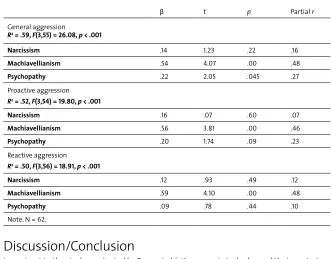
Narcissism, Machiavellianism and psychopathy were added to the regression model because all Dark Triad personality traits significantly correlated with overall aggression, proactive aggression and reactive aggression. The regression model with overall aggression as the dependent variable and narcissism, Machiavellianism and psychopathy as independent variables was significant, F(3, 55) = 26.08, p <.001. In table 3 is shown that Machiavellianism is the strongest predictor of general aggression. In table 3 can also be seen that narcissism is not a unique predictor of general aggression.
The regression model with proactive aggression as the dependent variable and narcissism, Machiavellianism and psychopathy as independent variables is significant, F(3, 54) = 19.80, p <.001. In Table 3 is shown that Machiavellianism is the only unique predictor of proactive aggression.
By calculating partial correlations it was examined whether the previously demonstrated associations between the dark triad personality traits and aggression, proactive aggression and reactive aggression existed after adjustment for other variables in the dataset. The strength of the correlation drops significantly after adjustment for other variables. After controlling for the influence of other variables, Machiavellism proved to be the only significant correlation with aggression, proactive aggression and reactive aggression (partial rs between .48 and .46, ps <.001).
Table 2: Summary of regression analysis (enter method) for the aspects of the Dark Triad personality traits that predict the degree of general aggression, proactive aggression and reactive aggression
β t p Partial r
General aggression
R2 = .59, F(3,55) = 26.08, p < .001
Narcissism .14 1.23 .22 .16
Machiavellianism .54 4.07 .00 .48
Psychopathy .22 2.05 .045 .27
Proactive aggression
R2= .52, F(3,54) = 19.80, p < .001
Narcissism .16 .07 .60 .07
Machiavellianism .56 3.81 .00 .46
Psychopathy .20 1.74 .09 .23
Reactive aggression
R2= .50, F(3,56) = 18.91, p < .001
Narcissism .12 .93 .49 .12
Machiavellianism .59 4.10 .00 .48
Psychopathy .09 .78 .44 .10
Note. N = 62.
Discussion/Conclusion
In contrast to the study conducted by Barry et al. 6, the current study showed that narcissism
predictor of aggression in general. This would mean that there are concerns needed about the development of aggressive behavior in children who exhibit psychopathic traits. However, this is not in line with the research that was previously done by Cima and Raine
7 where psychopathy was correlated with proactive aggression.
The only unique predictor of general aggression, proactive aggression and reactive aggression found in the present study is Machiavellianism. This would mean that there are concerns needed about the development of aggressive behavior in children who exhibit traits of Machiavellianism. This is not in line with the fairly recent study of Lau and Marsee 5 nor with the study of Loftus and Glenwick 11. In these studies, no correlation
between Machiavellianism and aggression was found.
From the results of the present study we can indeed conclude that there is a relationship between some of the Dark Triad personality traits and general aggression, proactive aggression and reactive aggression. However, the relations that are found in this study are not in line with the existing literature. These different results may be related to a number of shortcomings in the current study. The main limitation is probably the small size of the study population, the study population is too small to generalize to the real population. That the participants were all non-clinical adolescents may also be seen as a limitation. A final limitation of the present study is that only self-report has been used to measure aggression and the Dark Triad personality traits, in this way there is a greater chance of socially desirable answers. If using multiple informants (e.g., teachers and parents) the likelihood of socially desirable answers is smaller.
If Machiavellianism and narcissism turn out to be unique predictors of aggression, and if Machiavellianism really turns out to be a specific predictor of proactive and reactive aggression, there may possibly be designed an intervention to prevent/reduce the development of aggression. In this way, it can be prevented that the development of the child is disturbed by aggressive behavior. However, further research into the role of Machiavellianism in the development of aggression is recommended.
Role of the student
References
1. Scholte, E.M. & van der Ploeg, J.D. (2006). Prevalentie van sociaal emotionele problemen bij schoolgaande kinderen. Tijdschrift voor Orthopedagogiek, 45, 15–23.
2. Crick, N.R., & Grotpeter, J.K. (1995). Relational aggression, gender, and social‐psychological adjustment. Child Development, 66, 710-722.
3. Brown, K., Atkins, M.S., Osborne, M.L., & Milnamow, M. (1996). A revised teacher rating scale for reactive and proactive aggression. Journal of Abnormal Child Psychology, 24, 473-480.
4. Valois, R.F., MacDonald, J.M., Bretous, L., Fischer, M.A., & Drane, J.W. (2002). Risk factors and behaviors associated with adolescent violence and aggression. American Journal of Health Behavior, 26, 454-464. 5. Lau, K.S., & Marsee, M.A. (2013). Exploring narcissism, psychopathy, and Machiavellianism in youth:
Examination of associations with antisocial behavior and aggression. Journal of Child and Family Studies, 22, 355-367.
6. Barry, T.D., Thompson, A., Barry, C.T., Lochman, J.E., Adler, K., & Hill, K. (2007). The importance of narcissism in predicting proactive and reactive aggression in moderately to highly aggressive children. Aggressive Behavior, 33, 185-197.
7. Cima, M., & Raine, A. (2009). Distinct characteristics of psychopathy relate to different subtypes of aggression. Personality and Individual Differences, 47, 835-840.
8. Muris, P., Meesters, C., & Timmermans, A. (2013). Some youths have a gloomy side: Correlates of the dark triad personality traits in non-clinical adolescents. Child Psychiatry & Human Development, 44, 658-665. 9. Jonason, P.K., & Webster, G.D. (2010). The dirty dozen: a concise measure of the dark triad. Psychological
Assessment, 22, 420.
10. Roelofs, J., Meesters, C., ter Huurne, M., Bamelis, L., & Muris, P. (2006). On the links between attachment style, parental rearing behaviors, and internalizing and externalizing problems in non-clinical children. Journal of Child and Family Studies, 15, 319-332.