WHAT DO WE KNOW AND WHAT ARE THE IMPLICATIONS?
Susan Sunila Sharma1, Lutzardo Tobing2, Prayudhi Azwar3
1 Department of Finance & Centre for Financial Econometrics, Deakin Business School, Australia. Email: [email protected]
2 Bank Indonesia Institute, Bank Indonesia, Jakarta, Indonesia. Email: [email protected] 3 Bank Indonesia Institute, Bank Indonesia, Jakarta, Indonesia. Email: [email protected]
Unit root properties of macroeconomic data are important for both econometric modeling and policymaking. The form of variables (whether they are a unit root process) helps determine the correct econometric model. Equally, the form of variables helps explain how they react to shocks (both internal and external). Macroeconomic time-series data are often at the forefront of shock analysis and econometric modeling. There is a growing research emphasis on Indonesia using time-series data; yet, there is limited understanding of the data characteristics and shock response of these data. Using an extensive dataset comprising 33 macroeconomic time-series variables, we provide an informative empirical analysis of unit root properties of this data. We find that, regardless of data frequency, empirical evidence of unit roots is mixed. Some data series respond quickly to shocks while others take more time. Almost all macroeconomic data suffer from structural breaks. We draw implications from these findings.
Keywords: Unit root; Macroeconomic data; Structural breaks; Shocks; Econometric modeling.
JEL Classification: C5; E1.
ABSTRACT
Article history:
Received : July 1, 2018
Revised : October 20, 2018
Accepted : October 20, 2018
policymakers interpret and use data. URP assists in understanding the form of data. There are two forms data can take, either stationary or non-stationary. In simple terms, stationary time-series data have mean, variance, and co-variance that do not change over time. By comparison, a non-stationary series is best characterized as one whose mean, variance, and co-variance change over time. Precise knowledge of the form of the time-series data is important, because when its form is stationary, this implies that shocks will have short-term (or temporary) effects. On the other hand, a non-stationary series implies that shocks have long-term or permanent effects on the variable. This knowledge has policy implications because policymakers need to understand the form of variables to deduce how they will react to policy changes and/or shocks.
The second advantage from understanding the form of variables has roots in econometric modeling. Applied researchers are constrained by theory in modeling data. Theory also tends to dictate the form in which variables need to be modeled. There are many examples of this. Two are offered here for demonstration. First, consider the Purchasing Power Parity (PPP) hypothesis, which holds that prices equalize across countries, meaning that any price differences on a good/service in any two like countries should be stationary for PPP to hold; see Narayan (2006a). Second, the popular efficient market hypothesis argues that asset prices (such as stock prices) should be stationary (see Narayan and Smyth, 2007).
So great has been the influence of unit roots pioneered by Nelson and Plosser (1982)—considering the need to understand the shock reaction of variables and the form in which they enter econometric modeling, as discussed above—that there is a separate literature on new tests for unit roots; see also Perron (1989), which marks the starting point for research based on structural break(s). In other words, researchers have focused attention on developing more robust unit root tests that can offer greater precision when testing for the precise form of the data. Two avenues for improvement noted recently are important to highlight. Endogenous structural break treatment has a notable history in unit root testing. However, while the tests became available following Lee and Strazicich (2003), subsequent work (see, for instance, Narayan and Popp, 2010) took issue with the precision in estimating the break dates themselves, because accurate identification of breaks has implications for precise understanding of the form of the data (Narayan and Popp, 2010). More recent work (Narayan and Liu, 2015; Narayan, Liu and Westerlund, 2016) takes issue with the fact that when modeling for unit roots, it is not only structural breaks that are important, but also the role of a time trend and data heteroskedasticity can be equally important in delivering an unbiased understanding of the data.
on the market and firm-level liquidity of eight emerging stock markets in Asia. Tanuwidjaja and Choy (2006) examine the role of Indonesian central bank credibility in achieving an inflation target. Hadiwibowo and Komatsu (2011) examine the macroeconomic trilemma and international capital flows under several financial structures in Indonesia. Djuranovik (2014) develops a model of the term structure of interest rates in Indonesia to create a link between the yield curve and macroeconomic fundamentals, namely real activity, inflation, and interest rate. Sowmya and Prasanna (2018) examine interaction between the yield curve and macroeconomic factors of Asian economies. Such studies and future research would benefit from greater understanding of the importance of unit root tests.
Returning to the idea of understanding the form of the variable, what started off as instrumental knowledge in using macroeconomic data spread quickly to other fields of research where shocks were relevant in understanding how variables respond to them. The unit root idea, for instance, was popularized in Narayan and Smyth (2007) in a time-series setting and extended to a panel data setting in Narayan, Narayan, and Smyth (2008). In tourism economics, the idea was introduced by Narayan (2005a,b) and in health economics by Narayan (2006b). The main message of these studies is that unit root evidence is important to understanding the nature and impact of shocks not only with macroeconomic data (see Section II), but also with other time-series data where shocks are relevant, such as in energy, tourism, and health.
This paper proceeds as follows. Section II reviews the literature on the presence of unit root in macroeconomic data. Section III discusses our data and results. Finally, Section IV sets forth concluding remarks.
II. THE LITERATURE
This section provides a feel for the importance of understanding the unit root behavior of macroeconomic data. We choose selected studies from this literature that we believe best offers a snapshot of the work done on unit roots devoted to macroeconomic data.
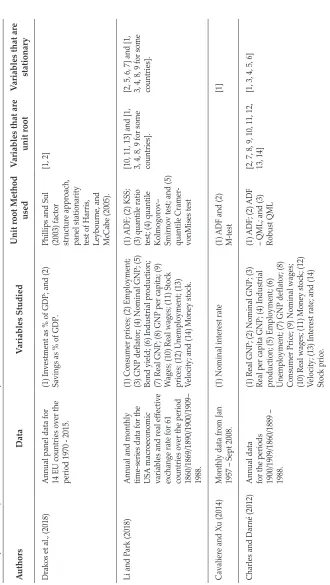
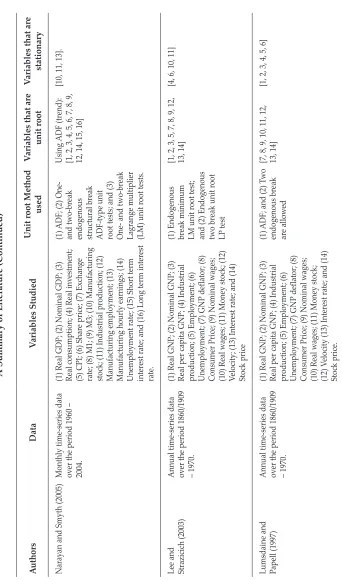
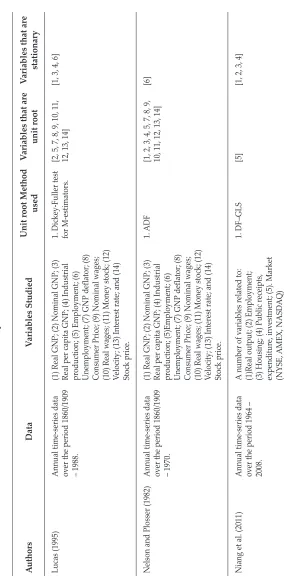
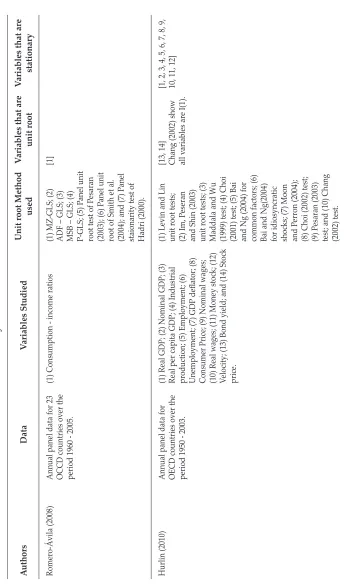
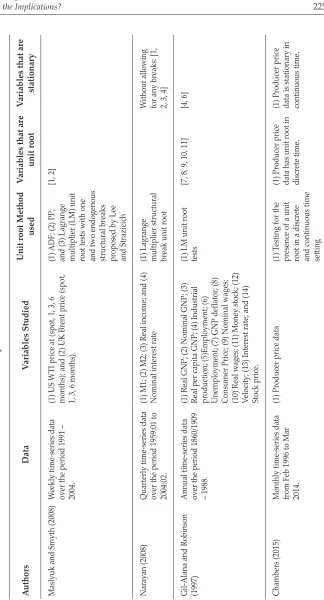
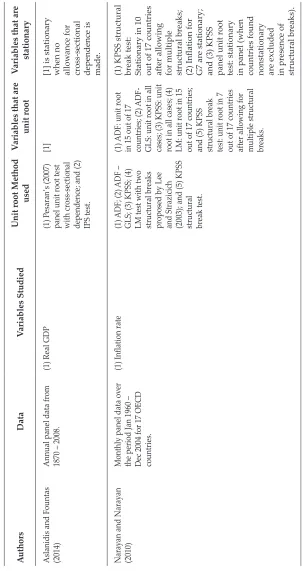
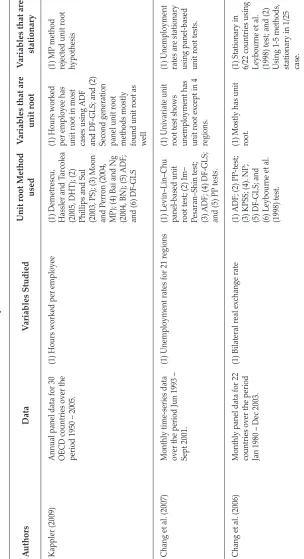
we have some results that we can consider, depending on policy objectives. The second feature of the literature, which can be read from Column 3, is that a wide range of macroeconomic data are utilized in unit root tests. The most popular data series seem to be GDP, inflation, and exchange rate; the highest number of variables used is around 14. Our study presents an extensive unit root analysis focusing on Indonesia—our sample includes 33 annual time-series data and 31 monthly time-series data. This represents a first comprehensive analysis of unit root testing of macroeconomic data.
The third feature concerns the econometric approach taken to test the unit root hypothesis. There are several points to note here. First, early studies seem to use tests without structural breaks. These studies are complemented by papers that address the unit root issue with structural breaks. Second, recent studies employ panel data models. Thus, the literature has progressed from time-series– based methods to panel data–based methods for testing the unit root hypothesis. We position our study within the popular structural break unit root testing methodology.
The final feature concerns the evidence on unit root. At best, the evidence appears mixed. Two trends are notable, however. First, panel data models offer greater evidence of stationarity. One reason for this is the gain in power to reject the unit root null that results from an increase in sample size when data is pooled across cross-sections and over time. Second, time-series models that accommodate structural break(s) offer greater evidence of stationarity (evidence against the unit root null hypothesis). These factors have implications for how one should approach unit root testing in macroeconomic data. We employ structural break unit roots tests within a time-series setting.
III. DATA AND RESULTS
This table provides summary of literature on studies that exami
ne the presence of unit root in macroeconomic v
ariables.
Authors
Data
Variables Studied
Unit root Method
used
Variables that are
unit root
Variables that are
stationary
Drakos et al., (2018)
Annual panel data for 14 EU countries ov
er the
period 1970 - 2015.
(1) Inv
estment as % of GDP; and (2)
Savings as % of GDP.
Phillips and Sul (2003) factor structure approach, panel stationarity test of Harris, Leybourne, and McCabe (2005).
[1, 2]
Li and P
ark (2018)
Annual and monthly time-series data for the USA macroeconomic variables and real effectiv
e
exchange rate for 61 countries ov
er the period
1860/1869/1890/1900/1909– 1988. (1) Consumer prices; (2) Employment; (3) GNP deflator; (4) Nominal GNP; (5) Bond yield; (6) Industrial production; (7) Real GNP; (8) GNP per capita; (9) Wages; (10) Real w
ages; (11) Stock
prices; (12) Unemployment; (13) Velocity; and (14) Money stock.
(1)
ADF; (2) KSS;
(3) quantile ratio test; (4) quantile Kolmogorov– Smirnov test; and (5) quantile Cramer- vonMises test [10, 11, 13] and [1, 3, 4, 8, 9 for some countries].
[2, 5, 6, 7] and [1, 3, 4, 8, 9 for some countries].
Cav
aliere and Xu (2014)
Monthly data from Jan 1957 – Sept 2008.
(1) Nominal interest rate
(1)
ADF and (2)
M-test
[1]
Charles and Darné (2012)
Annual data for the periods 1900/1909/1860/1889 – 1988. (1) Real GNP; (2) Nominal GNP; (3) Real per capita GNP; (4) Industrial production; (5) Employment; (6) Unemployment; (7) GNP deflator; (8) Consumer Price; (9) Nominal w
ages;
(10) Real w
ages; (11) Money stock; (12)
Velocity; (13) Interest rate; and (14) Stock price.
(1)
ADF; (2)
ADF
– QML; and (3) Robust QML [2, 7, 8, 9, 10, 11, 12, 13, 14]
[1, 3, 4, 5, 6]
Table 1.
Authors
Data
Variables Studied
Unit root Method
used
Variables that are
unit root
Variables that are
stationary
Naray
an and Smyth (2005)
Monthly time-series data over the period 1960 – 2004. (1) Real GDP; (2) Nominal GDP; (3) Real consumption; (4) Real inv
estment;
(5) CPI; (6) Share price; (7) Exchange rate; (8) M1; (9) M3; (10) Manufacturing stock; (11) Industrial production; (12) Manufacturing employment; (13) Manufacturing hourly earnings; (14) Unemployment rate; (15) Short term interest
rate;
and
(16)
Long
term
interest
rate.
(1)
ADF; (2) One-
and two-break endogenous structural break ADF-type unit root tests; and (3) One- and two-break Lagrange multiplier (LM) unit root tests.
Using
ADF (trend):
[1, 2, 3, 4, 5, 6, 7, 8, 9, 12, 14, 15, 16]
[10, 11, 13].
Lee and Strazicich (2003) Annual time-series data over the period 1860/1909 – 1970. (1) Real GNP; (2) Nominal GNP; (3) Real per capita GNP; (4) Industrial production; (5) Employment; (6) Unemployment; (7) GNP deflator; (8) Consumer Price; (9) Nominal w
ages;
(10) Real w
ages; (11) Money stock; (12)
Velocity; (13) Interest rate; and (14) Stock price (1) Endogenous break minimum LM unit root test; and (2) Endogenous two break unit root LP test
[1, 2, 3, 5, 7, 8, 9, 12, 13, 14]
[4, 6, 10, 11]
Lumsdaine and Papell (1997) Annual time-series data over the period 1860/1909 – 1970. (1) Real GNP; (2) Nominal GNP; (3) Real per capita GNP; (4) Industrial production; (5) Employment; (6) Unemployment; (7) GNP deflator; (8) Consumer Price; (9) Nominal w
ages;
(10) Real w
ages; (11) Money stock;
(12) V
elocity (13) Interest rate; and (14)
Stock price.
(1)
ADF;
and
(2)
Two
endogenous break are allow
ed
[7, 8, 9, 10, 11, 12, 13, 14]
[1, 2, 3, 4, 5, 6]
Table 1.
Table 1.
A Summary of Literature (Continued)
Authors
Data
Variables Studied
Unit root Method
used
Variables that are
unit root
Variables that are
stationary
Lucas (1995)
Annual time-series data over the period 1860/1909 – 1988. (1) Real GNP; (2) Nominal GNP; (3) Real per capita GNP; (4) Industrial production; (5) Employment; (6) Unemployment; (7) GNP deflator; (8) Consumer Price; (9) Nominal w
ages;
(10) Real w
ages; (11) Money stock; (12)
Velocity; (13) Interest rate; and (14) Stock price. 1. Dickey-Fuller test for M-estimators.
[2, 5, 7, 8, 9, 10, 11, 12, 13, 14]
[1, 3, 4, 6]
Nelson and P
losser (1982)
Annual time-series data over the period 1860/1909 – 1970. (1) Real GNP; (2) Nominal GNP; (3) Real per capita GNP; (4) Industrial production; (5)Employment; (6) Unemployment; (7) GNP deflator; (8) Consumer Price; (9) Nominal w
ages;
(10) Real w
ages; (11) Money stock; (12)
Velocity; (13) Interest rate; and (14) Stock price.
1.
ADF
[1, 2, 3, 4, 5, 7, 8, 9, 10, 11, 12, 13, 14]
[6]
Niang et al. (2011)
Annual time-series data over the period 1964 – 2008.
A number of v
ariables related to:
(1)Real output; (2) Employment; (3) Housing; (4) Public receipts, expenditure, inv
estment; (5). Market
(NYSE,
AMEX, NASDAQ)
1. DF–GLS
[5]
Authors
Data
Variables Studied
Unit root Method
used
Variables that are
unit root
Variables that are
stationary
Romero-Ávila (2008)
Annual panel data for 23 OCCD countries ov
er the
period 1960 - 2005.
(1) Consumption - income ratios
(1) MZ-GLS; (2) ADF – GLS; (3) MSB – GLS; (4) P-GLS; (5) P
anel unit
root test of P
esaran
(2003); (6) P
anel unit
root of Smith et al. (2004); and (7) P
anel
staionarity test of Hadri (2000).
[1]
Hurlin (2010)
Annual panel data for OECD countries ov
er the
period 1950 - 2003.
(1) Real GDP; (2) Nominal GDP; (3) Real per capita GDP; (4) Industrial production; (5) Employment; (6) Unemployment; (7) GDP deflator; (8) Consumer Price; (9) Nominal w
ages;
(10) Real w
ages; (11) Money stock; (12)
Velocity; (13) Bond yield; and (14) Stock price. (1) Levin and Lin unit root tests; (2) Im, P
eseran
and Shin (2003) unit root tests; (3) Maddala and Wu (1999) test; (4) Choi (2001) test; (5) Bai and Ng (2004) for common factors; (6) Bai and Ng(2004) for idiosyncratic shocks; (7) Moon and P
erron (2004);
(8) Choi (2002) test; (9) P
esaran (2003)
test; and (10) Chang (2002) test. [13, 14] Chang (2002) show all v
ariables are I(1).
[1, 2, 3, 4, 5, 6, 7, 8, 9, 10, 11, 12]
Table 1.
Authors
Data
Variables Studied
Unit root Method
used
Variables that are
unit root
Variables that are
stationary
Maslyuk and Smyth (2008)
W
eekly time-series data
ov
er the period 1991 –
2004.
(1) US WTI price at (spot, 1, 3, 6 months); and (2) UK Brent price (spot, 1, 3, 6 months).
(1)
ADF; (2) PP;
and (3) Lagrange multiplier (LM) unit root tests with one and
two
endogenous
structural breaks proposed by Lee and Strazicich
[1, 2]
Naray
an (2008)
Quarterly time-series data over the period 1959:01 to 2004:02. (1) M1; (2) M2; (3) Real income; and (4) Nominal interest rate (1) Lagrange multiplier structural break unit root
W
ithout allowing
for any breaks: [1, 2, 3, 4]
Gil-Alana and Robinson (1997) Annual time-series data over the period 1860/1909 – 1988. (1) Real GNP; (2) Nominal GNP; (3) Real per capita GNP; (4) Industrial production; (5)Employment; (6) Unemployment; (7) GNP deflator; (8) Consumer Price; (9) Nominal w
ages;
(10) Real w
ages; (11) Money stock; (12)
Velocity; (13) Interest rate; and (14) Stock price. (1) LM unit root tests
[7, 8, 9, 10, 11]
[4, 6]
Chambers (2015)
Monthly time-series data from Feb 1996 to Mar 2014.
(1) Producer price data
(1) T
esting for the
presence of a unit root in a discrete and continuous time setting (1) Producer price data has unit root in discrete time. (1) Producer price data is stationary in continuous time.
Table 1.
Authors
Data
Variables Studied
Unit root Method
used
Variables that are
unit root
Variables that are
stationary
Aslanidis and Fountas (2014) Annual panel data from 1870 – 2008.
(1) Real GDP
(1) P
esaran’s (2007)
panel unit root test with cross-sectional dependence; and (2) IPS test.
[1]
[1] is stationary when no allow
ance for
cross-sectional dependence is made.
Naray
an and Naray
an
(2010)
Monthly panel data ov
er
the period Jan 1960 – Dec 2004 for 17 OECD countries.
(1) Inflation rate
(1)
ADF; (2)
ADF –
GLS; (3) KPSS; (4) LM test with two structural breaks proposed by Lee and Strazicich (2003); and (5) KPSS structural break test.
(1)
ADF: unit root
in 15 out of 17 countries; (2)
ADF-GLS: unit root in all cases; (3) KPSS: unit root in all cases; (4) LM: unit root in 15 out of 17 countries; and (5) KPSS structural break test: unit root in 7 out of 17 countries after allowing for multiple structural breaks.
(1)
KPSS
structural
break test: Stationary in 10 out of 17 countries after allowing for multiple structural breaks; (2) Inflation for G7 are stationary; and (3) KPSS panel unit root test: stationary in panel (when countries found nonstationary are excluded in presence of structural breaks).
Table 1.
Authors
Data
Variables Studied
Unit root Method
used
Variables that are
unit root
Variables that are
stationary
Kappler (2009)
Annual panel data for 30 OECD countries ov
er the
period 1950 – 2005.
(1) Hours worked per employ
ee
(1) Demetrescu, Hassler and T
arcolea
(2005, DHT); (2) Phillips and Sul (2003, PS); (3) Moon and P
erron (2004,
MP); (4) Bai and Ng (2004, BN); (5)
ADF;
and (6) DF-GLS
(1) Hours worked per employ
ee has
unit root in most cases using
ADF
and DF-GLS; and (2) Second generation panel unit root methods mostly found unit root as well (1) MP method rejected unit root hypothesis
Chang et al. (2007)
Monthly time-series data over the period Jun 1993 – Sept 2001.
(1) Unemployment rates for 21 regions
(1) Levin–Lin–Chu panel-based unit root test; (2) Im– Pesaran–Shin test; (3) ADF; (4) DF-GLS; and (5) PP tests.
(1) Univ
ariate unit
root test shows unemployment has unit root except in 4 regions. (1) Unemployment rates are stationary using panel-based unit root tests.
Chang et al. (2006)
Monthly panel data for 22 countries ov
er the period
Jan 1980 – Dec 2003.
(1) Bilateral real exchange rate
(1)
ADF; (2) PP-test;
(3) KPSS; (4). NP; (5) DF-GLS; and (6) Leybourne et al. (1998) test. (1) Mostly has unit root.
(1) Stationary in 6/22 countries using Leybourne et al. (1998) test; and (2) Using 1-5 methods, stationary in 1/25 case.
Table 1.
Authors
Data
Variables Studied
Unit root Method
used
Variables that are
unit root
Variables that are
stationary
Hüseyin (2005)
Monthly time-series data for the USA, UK, Germany, and Italy ov
er
the period Jan 1982 – Dec 2003.
(1) Bilateral real exchange rate
(1)
ADF; (2)
PP-test; (3) KPSS; (4) Modified Ng and Perron test. (1) Maximum presence of unit root in the case of Germany and Italy. (1) Maximum cases of stationarity for the USA and UK.
Smyth (2003)
Quarterly panel data for 6 Australian state and 2 territories ov
er the period
Feb 1982 – Jan 2002.
(1) Unemployment rates
(1)
ADF; (2)
Levin-Lin and FGLS T
ests;
and (3) IPS T
est.
Both
ADF and IPS
finds [1] to be a stationary v
ariable.
Levin and Lin (1992) and FGLS test show presence of unit root in [1].
Choi (2001)
Monthly panel data ov
er
the period Mar 1973 – Mar 1996. (1) Real exchange rates (US real exchange rates vs. the Canadian dollar; German Mark; Japanese Y
en; French
Franc; British Pound; and the Swiss Franc). (1) DF-GLS; and (2) combination unit root tests and IPS’ t-bar test. (1) DF-GLS shows unit root in Exchange rates (1) Combination unit root tests and IPS’ t-bar test shows some evidence of stationarity.
Table 1.
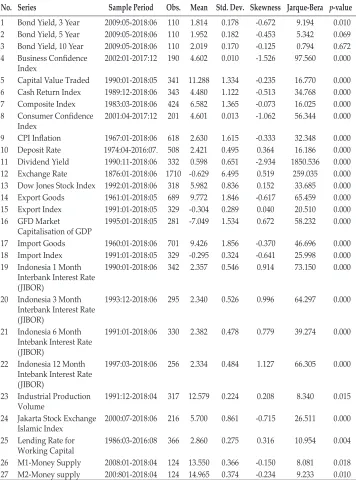
null hypothesis of a normal distribution.
No. Series Sample Period Obs. Mean Std. Dev. Skewness Jarque-Bera p-value
1 Bond Yield, 3 Year 2009:05-2018:06 110 1.814 0.178 -0.672 9.194 0.010 2 Bond Yield, 5 Year 2009:05-2018:06 110 1.952 0.182 -0.453 5.342 0.069 3 Bond Yield, 10 Year 2009:05-2018:06 110 2.019 0.170 -0.125 0.794 0.672 4 Business Confidence
Index 2002:01-2017:12 190 4.602 0.010 -1.526 97.560 0.000 5 Capital Value Traded 1990:01-2018:05 341 11.288 1.334 -0.235 16.770 0.000 6 Cash Return Index 1989:12-2018:06 343 4.480 1.122 -0.513 34.768 0.000 7 Composite Index 1983:03-2018:06 424 6.582 1.365 -0.073 16.025 0.000 8 Consumer Confidence
Index 2001:04-2017:12 201 4.601 0.013 -1.062 56.344 0.000 9 CPI Inflation 1967:01-2018:06 618 2.630 1.615 -0.333 32.348 0.000 10 Deposit Rate 1974:04-2016:07. 508 2.421 0.495 0.364 16.186 0.000 11 Dividend Yield 1990:11-2018:06 332 0.598 0.651 -2.934 1850.536 0.000 12 Exchange Rate 1876:01-2018:06 1710 -0.629 6.495 0.519 259.035 0.000 13 Dow Jones Stock Index 1992:01-2018:06 318 5.982 0.836 0.152 33.685 0.000 14 Export Goods 1961:01-2018:05 689 9.772 1.846 -0.617 65.459 0.000 15 Export Index 1991:01-2018:05 329 -0.304 0.289 0.040 20.510 0.000 16 GFD Market
Capitalisation of GDP 1995:01-2018:05 281 -7.049 1.534 0.672 58.232 0.000 17 Import Goods 1960:01-2018:06 701 9.426 1.856 -0.370 46.696 0.000 18 Import Index 1991:01-2018:05 329 -0.295 0.324 -0.641 25.998 0.000 19 Indonesia 1 Month
Interbank Interest Rate (JIBOR)
1990:01-2018:06 342 2.357 0.546 0.914 73.150 0.000
20 Indonesia 3 Month Interbank Interest Rate (JIBOR)
1993:12-2018:06 295 2.340 0.526 0.996 64.297 0.000
21 Indonesia 6 Month Intebank Interest Rate (JIBOR)
1991:01-2018:06 330 2.382 0.478 0.779 39.274 0.000
22 Indonesia 12 Month Intebank Interest Rate (JIBOR)
1997:03-2018:06 256 2.334 0.484 1.127 66.305 0.000
23 Industrial Production
Volume 1991:12-2018:04 317 12.579 0.224 0.208 8.340 0.015 24 Jakarta Stock Exchange
Islamic Index 2000:07-2018:06 216 5.700 0.861 -0.715 26.511 0.000 25 Lending Rate for
Table 3.
Descriptive Statistics of Yearly Data
No. Series Sample Period Obs. Mean Std. Dev. Skewness Jarque-Bera p-value
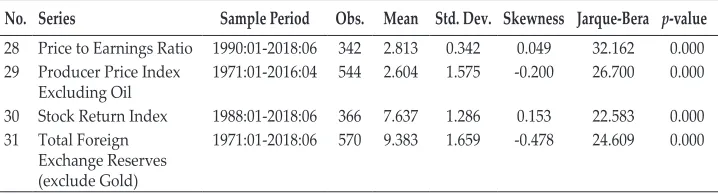
28 Price to Earnings Ratio 1990:01-2018:06 342 2.813 0.342 0.049 32.162 0.000 29 Producer Price Index
Excluding Oil 1971:01-2016:04 544 2.604 1.575 -0.200 26.700 0.000 30 Stock Return Index 1988:01-2018:06 366 7.637 1.286 0.153 22.583 0.000 31 Total Foreign
Exchange Reserves (exclude Gold)
1971:01-2018:06 570 9.383 1.659 -0.478 24.609 0.000
This table presents descriptive statistics for yearly data. Thirty-three data series are considered, and Column 3 contains the sample period for each series followed by the number of observations (Obs.) in the sample. The mean, Standard Deviation (SD), skewness, Jarque–Bera (JB) test coefficient and its respective p-values are presented in Columns 5 to 9, respectively. The JB test examines the null hypothesis of a normal distribution.
No Series Sample Period Obs. Mean Std. Dev. Skewness Jarque-Bera p-value
1 Capital Value Traded 1977-2017 41 9.119 3.556 -0.665 4.758 0.093 2 Cash Return Index 1989-2017 29 4.443 1.164 -0.494 2.929 0.231 3 Composite Index 1977-2017 41 6.305 1.448 0.174 2.463 0.292
4 CPI 1960-2016 57 1.626 3.295 -1.647 36.827 0.000
5 CPI Inflation 1948-2017 70 -0.351 5.297 -0.955 12.002 0.002 6 Deposit Rate 1974-2017 44 2.406 0.502 0.514 1.974 0.373 7 Dividend Yield 1990-2017 28 0.585 0.696 -2.858 132.257 0.000 8 Dow Jones Stock Index 1992-2017 26 5.991 0.849 0.113 2.676 0.262 9 Exchange Rate 1818-2017 200 -2.170 6.002 1.058 41.992 0.000 10 Export Goods 1946-2017 72 9.102 2.191 -0.251 5.507 0.064 11 Export Goods and Services 1990-2017 28 13.221 1.256 -0.393 2.339 0.311 12 Export Index 1991-2017 27 -0.299 0.284 0.071 1.951 0.377 13 GDP-Deflator Inflation 1961-2015 55 2.758 1.100 0.970 8.970 0.011 14 GDP-Deflator 1960-2015 56 1.671 2.166 -0.278 2.359 0.307 15 GFD Market Capitalisation
of GDP 1993-2017 25 -6.875 1.591 0.612 4.731 0.094 16 Nominal GDP 1951-2017 67 9.383 6.128 -0.850 9.208 0.010 17 Real GDP 1870-2017 148 13.421 1.263 0.634 14.674 0.001 18 Import Goods 1946-2017 72 8.847 2.111 -0.048 5.574 0.062 19 Import Goods and Services 1990-2017 28 13.221 1.256 -0.393 2.339 0.311 20 Import Index 1991-2017 27 -0.280 0.307 -0.458 2.140 0.343 21 Indonesia 1 Month
Interbank Interest Rate (JIBOR)
1990-2017 28 2.366 0.503 0.523 1.281 0.527
22 Indonesia 3 Month Interbank Interest Rate (JIBOR)
1993-2017 25 2.361 0.506 0.708 2.202 0.332
23 Indonesia 6 Month Interbank Interest Rate (JIBOR)
A plot of the annual time-series data is available in Figure 1. Tables 2 and 3 show descriptive statistics based on monthly and annual time-series data, respectively. Given the time-series nature of the data, we note from both these tables the start data. Not all series have lengthy data. For example, some series, like exchange rate, have data going as far back as 1876. Inflation and deposit rate data are available from the 1960s and 1970s, respectively, while for other series much smaller data samples are available. Details are found in Columns 2 and 3 of these tables. Thus, data series have different start dates. This is dictated entirely by data availability.
24 Indonesia 12 Month Interbank Interest Rate (JIBOR)
1997-2017 21 2.341 0.474 0.889 2.814 0.245
25 Industrial Production
Volume 1991-2017 27 12.575 0.232 0.203 0.753 0.686 26 Lending Rate for Working
Capital 1986-2017 32 2.832 0.286 0.296 0.881 0.644 27 Price to Earnings Ratio 1990-2017 28 2.805 0.307 -0.429 1.332 0.514 28 Producer Price Index
Excluding Oil 1971-2017 47 2.740 1.607 -0.209 2.468 0.291 29 Stock Return Index 1987-2017 31 7.573 1.356 0.072 1.378 0.502 30 Total Foreign Exchange
Reserves (exclude Gold) 1971-2017 47 9.410 1.651 -0.473 1.947 0.378 31 Total Reserve 1960-2015 56 8.334 2.585 -0.768 5.835 0.054 32 Unemployment 1973-2017 35 1.711 0.858 2.621 201.509 0.000 33 Wholesale Price Index 1971-2016 46 2.662 1.604 -0.207 2.265 0.322
Figure 1. A Plot of Annual Time-Series Data
Cash Return Index
0 10
1989 1994 1999 2004 2009 2014
Composite Index
0 5 10
1977 1983 1989 1995 2001 2007 2013
Capital Value
0 10 20
1977 1983 1985 1995 2004 2013
CPI Inflation
-20 -10 0 10
-10 0 10
1818 1852 1886 1920 1954 1988
Deposit Rate
0 2 4 6
1974 1981 1988 1995 2002 2009 2016
Dow Jones Indonesia
0 5 10
Dividend Yield
-4 -2 0 2
1990 1996 2002 2008 2014
6-month JIBOR
0 2 4
1991 1996 2001 2006 2011 2016
Market Capitalization
-10 -5 0
11 12 13
1991 1997 2003 2009 2015
0 2 4
1990 1994 1998 2002 2006 2010 2014
1-month JIBOR
3-month JIBOR
0 2 4
Price to Earning Ratio
0 2 4
1990 1994 1998 2002 2006 2010 2014
0 2 4
1986 1991 1996 2001 2006 2011 2016
Lending Rate
12-month JIBOR
0 2 4
0
1971 1979 1987 1995 2003 2011
0 20
1870 1895 1920 1945 1970 1995
Real GDP
Wholesale Price Index
-5 0 5 10
0 20
1987 1993 1999 2005 2011 2017
Stock Index
Producer Price Index
-5 0 5 10
1971 1979 1987 1995 2003 2011
0 10 20
1946 1958 1970 1982 1994 2006
0 10
1990 1995 2000 2005 2010 2015
-1 0 1
1991 1996 2001 2006 2011 2016
Export Index
0 5 10
1983 1989 1995 2001 2007 2013
0 10 20
1946 1958 1970 1982 1994 2006
Import Goods
-1 0 1
1991 1996 2001 2006 2011 2016
Import Index
0 20
1990 1995 2000 2005 2010 2015
-10 -5 0 5
1960 1972 1984 1996 2008
-10 0 10 20
1951 1965 1979 1993 2007
Nominal GDP
-5 0 5
10 GDP-Deflator
0 5 10
1961 1966 1971 1976 1981 1986 1991 1996 2001 2006 2011 GDP Deflator Inflation
0 10 20
1960 1966 1972 1978 1984 1990 1996 2002 2008 2014
Total Reserve
2 allows for two breaks in level as well as slope (see Column 6). The true break dates are denoted by TB1 and TB2; k represents the optimal lag length; and ***, **, and * indicate that the unit root null hypothesis is rejected at the 1%, 5%, and 10% levels of significance, respectively.
No. Series Sample T
M1 M2
T-stat TB1 TB2 k T-stat TB1 TB2 k
1 Bond Yield, 3 Year 2009:05-2018:06 110 -3.796 2011:08 2013:05 4 -4.306 2011:08 2013:05 4 2 Bond Yield, 5 Year 2009:05-2018:06 110 -3.480 2013:05 2013:09 0 -3.062 2013:05 2013:10 0 3 Bond Yield, 10 Year 2009:05-2018:06 110 -3.711 2011:12 2013:05 0 -4.123 2013:05 2013:10 3 4 Business Confidence Index 2002:01-2017:12 190 -5.235*** 2006:08 2006:11 3 -5.170** 2006:08 2006:12 3 5 Capital Value Traded 1990:01-2018:05 341 -2.639 1997:07 1998:07 2 -5.520*** 1997:07 2008:09 5 6 Cash Return Index 1989:12-2018:06 343 -6.238*** 1997:07 1997:10 4 -3.535 1997:07 1998:09 4 7 Composite Index 1983:03-2018:06 424 -3.026 1997:07 2008:09 1 -3.613 1997:07 2008:09 1 8 Consumer Confidence
Index 2001:04-2017:12 201 -4.099* 2004:09 2006:12 1 -4.585 2004:09 2006:12 1 9 CPI Inflation 1967:01-2018:06 618 -5.400*** 1998:01 2005:09 4 -6.085*** 1998:01 2005:09 4 10 Deposit Rate 1974:04-2016:07. 508 -2.882 1984:02 1997:07 3 -3.451 1984:02 1997:07 3 11 Dividend Yield 1990:11-2018:06 332 -3.339 1999:06 2000:03 0 -3.648 1999:06 2000:03 0 12 Exchange Rate 1876:01-2018:06 1710 -6.105*** 1960:07 1963:12 4 -4.498* 1960:07 1963:12 4 13 Dow Jones Stock Index 1992:01-2018:06 318 -2.690 1998:07 2008:09 0 -3.675 1998:07 2008:09 0 14 Export Goods 1961:01-2018:05 689 -2.014 1974:01 1977:02 4 -1.951 1974:01 1977:02 4 15 Export Index 1991:01-2018:05 329 -2.072 1997:12 2008:10 5 -3.703 1997:12 2008:10 5 16 GFD Market Capitalisation
of GDP 1995:01-2018:05 281 -1.241 2004:04 2005:11 0 -1.825 2004:04 2005:11 0 17 Import Goods 1960:01-2018:06 701 -2.363 1978:03 1986:11 3 -3.067 1978:03 1986:11 3 18 Import Index 1991:01-2018:05 329 -2.457 1997:12 1998:04 5 -1.792 1997:12 1998:06 5 19 Indonesia 1 Month
Interbank Interest Rate (JIBOR)
1990:01-2018:06 342 -3.791 1997:07 1997:10 5 -4.559* 1997:07 1998:01 4
20 Indonesia 3 Month Interbank Interest Rate (JIBOR)
1993:12-2018:06 295 -2.566 1999:04 1999:06 0 -4.449* 1999:05 2005:07 5
21 Indonesia 6 Month Interbank Interest Rate (JIBOR)
1991:01-2018:06 330 -3.102 1997:08 1999:05 5 -3.032 1997:08 1998:04 5
22 Indonesia 12 Month Interbank Interest Rate (JIBOR)
1997:03-2018:06 256 -3.423 2005:07 2008:09 5 -4.373 2005:07 2008:09 5
23 Industrial Production
Volume 1991:12-2018:04 317 -4.408* 1999:01 2003:11 4 -6.984*** 1997:12 2003:11 4 24 Jakarta Stock Exchange
Islamic Index 2000:07-2018:06 216 -2.981 2004:10 2008:09 3 -4.026 2008:02 2008:09 0 25 Lending Rate for Working
Table 5.
Unit Root Results for Yearly Data
As a robustness check, we examine annual time-series data. The results from the unit root test are reported in Table 5. With the Model 1, the unit root null is rejected for 12/33 series while with the Model 2, the null is rejected for 9/33 series. Taking both models together, with annual data, a total of 16 series are unit root stationary, meaning the unit root null hypothesis is comfortably rejected. This represents 48% of the variables.
No. Series Sample T
M1 M2
T-stat TB1 TB2 k T-stat TB1 TB2 k
27 M2-Money Supply 2008:01-2018:04 124 -1.627 2010:11 2011:11 4 -1.848 2010:11 2011:11 4 28 Price to Earnings Ratio 1990:01-2018:06 342 -4.719** 1998:09 2008:12 1 -5.118** 1998:09 2008:12 1 29 Producer Price Index
Excluding Oil 1971:01-2016:04 544 -3.374 1986:08 1997:12 5 -2.136 1986:08 1997:12 5 30 Stock Return Index 1988:01-2018:06 366 -3.277 1997:07 1998:07 1 -3.530 1998:07 1998:11 0 31 Total Foreign Exchange
Reserves (exclude Gold) 1971:01-2018:06 570 -6.325*** 1983:02 1990:11 5 -4.018 1983:02 1987:06 5
This table shows Narayan and Popp (2010) unit root results for yearly data. Column 3 and 4 show the sample period and the corresponding number of observations. We refer to the Table 3 of Narayan and Popp (2010) for the critical values for unknown break dates. M1 and M2 are two models for testing unit root. The model M1 (see Column 5) allows for two breaks in level and the model M2 allows for two breaks in level as well as slope (see Column 6). The true break dates are denoted by TB1 and TB2. The k represents the optimal lag length. ***, **, and * indicate the unit root null is rejected, at levels of statistical significance 1%, 5%, and 10%, respectively.
No. Series Sample T
M1 M2
T-stat TB1 TB2 k T-stat TB1 TB2 k
1 Capital Value Traded 1977-2017 41 -4.396 1988 1996 2 -4.504 1996 1999 1 2 Cash Return Index 1989-2017 29 -0.461 1997 2000 1 -2.383 1997 2000 0 3 Composite Index 1977-2017 41 -3.642 1987 1996 0 -3.322 1987 1992 0 4 CPI 1960-2016 57 -15.732 1971 1997 5 -9.516 1972 1997 5 5 CPI Inflation 1948-2017 70 -0.274 1961 1965 2 -5.215 1961 1965 0 6 Deposit Rate 1974-2017 44 -4.881 1983 1997 2 -2.857 1983 1998 4 7 Dividend Yield 1990-2017 28 -4.647 2001 2003 5 -7.136 1998 2009 5 8 Dow Jones Stock Index 1992-2017 26 -4.878 1999 2007 5 -7.423 1999 2007 0 9 Exchange Rate 1818-2017 200 1.465 1963 1966 3 -7.265 1952 1963 1 10 Export Goods 1946-2017 72 -3.540 1973 1985 0 -2.282 1972 1975 0 11 Export Goods and Services 1990-2017 28 -1.780 1997 2004 1 -2.056 1998 2004 0 12 Export Index 1991-2017 27 -2.627 1998 2008 3 -3.295 1998 2007 0 13 GDP-Deflator Inflation 1961-2015 55 -5.610 1985 1997 0 -6.002 1971 1997 0 14 GDP-Deflator 1960-2015 56 -4.262 1971 1997 5 -4.226 1971 1997 4 15 GFD Market Capitalisation
With monthly data, the unit root null hypothesis is rejected for business confidence index, capital value traded, cash return, consumer confidence, CPI inflation, exchange rate, 1- and 3-month interbank interest rate, industrial production (volume), lending rate, M1, price-earnings ratio, and foreign reserves. With annual data, the null is rejected for capital value traded, CPI inflation, deposit rate, dividend yield, Dow Jones stock index, GDP deflator, exchange rate, 3- and 12-month interbank interest rate, industrial production (volume), lending rate, price-earnings ratio, reserves, and unemployment rate. The variables for which the null is rejected regardless of data frequency (in other words, those variables that are stationary in a robust manner) include capital value traded, CPI inflation, exchange rate, industrial production (volume), lending rate, price-earnings ratio, 3-month interbank interest rate, and foreign reserves. This represents only 24% of the sample of variables. In other words, data frequency matters to unit root tests and it should be left to policymakers to decide which data frequency is of policy relevance to them in understanding the nature of shocks to time-series data.4
No. Series Sample T T-stat TB1 TB2 k T-stat TB1 TB2 k
18 Import Goods 1946-2017 72 -2.948 1965 1979 1 -3.808 1972 1997 4 19 Import Goods and Services 1990-2017 28 0.244 1997 1999 5 -1.927 1998 2003 0 20 Import Index 1991-2017 27 -3.594 2005 2007 0 -3.558 1998 2007 0 21 Indonesia 1 Month Interbank
Interest Rate (JIBOR) 1990-2017 28 -4.009 2002 2008 3 -2.885 1998 2002 5 22 Indonesia 3 Month Interbank
Interest Rate (JIBOR) 1993-2017 25 -3.100 2002 2008 5 -5.755 2002 2005 5 23 Indonesia 6 Month Interbank
Interest Rate (JIBOR) 1991-2017 27 -3.870 1998 2008 5 -3.144 1998 2004 0 24 Indonesia 12 Month Interbank
Interest Rate (JIBOR) 1997-2017 21 -3.213 2004 2006 3 -5.753 2004 2009 3 25 Industrial Production Volume 1991-2017 27 -7.292 2001 2008 3 -2.159 1998 2006 4 26 Lending Rate For Working
Capital 1986-2017 32 -4.250 1997 2002 3 -1.107 1998 2004 0 27 Price To Earnings Ratio 1990-2017 28 -4.834 1999 2005 3 -2.445 1999 2002 3 28 Producer Price Index
Excluding Oil 1971-2017 47 -2.995 1982 1997 4 -3.346 1997 2004 0 29 Stock Return Index 1987-2017 31 0.167 2002 2007 2 -2.274 2002 2007 2 30 Total Foreign Exchange
Reserves (exclude Gold) 1971-2017 47 -3.693 1981 1985 3 -3.924 1981 1989 0 31 Total Reserve 1960-2015 56 -7.073 1971 1976 4 -8.261 1974 1981 0 32 Unemployment 1973-2017 35 -5.774 1993 1998 5 -3.170 1993 1999 5 33 Wholesale Price Index 1971-2016 46 -1.614 1984 1997 4 -2.079 1984 1997 5
4 Some of the break dates relate to obvious events. The monthly CPI inflation break, for instance,
A total of 33 variables for which sufficient time-series data are available form part of our empirical analysis. We test the hypothesis using the popular Narayan and Popp (2010) unit root test, which allows for two endogenous structural breaks in the data series. Our analysis is based on both annual and monthly time-series data. We find that data frequency is important in understanding URP. First, we show that with annual data, the unit root null hypothesis is rejected in only 48% of the variables, while with monthly data the number of rejections is equivalent to 42%. The implication here is that there is more evidence of stationarity of variables with annual data than monthly data. Second, across data frequencies, the variables found to be stationary in both data frequencies are capital value traded, CPI inflation, exchange rate, industrial production (volume), lending rate, price-earnings ratio, 3-month interbank interest rate, and foreign reserves. This represents only 24% of the sample of variables. The implication is that, for these variables, shocks have only a short-term or temporary effect.
Three policy implications emerge from our analysis. First, for policy purposes, it matters whether one uses annual or monthly data. It seems there are more cases of stationary variables with annual data than monthly data, suggesting that more data at annual frequency will be relevant for understanding short-run effects. The second implication relates to forecasting. In most cases, for policy purposes, practitioners need to forecast inflation, exchange rate, and short-term interest rate. These variables for Indonesia are stationary, meaning standard forecasting models that require the dependent variable (variable to be forecast) to be stationary are ideal for forecasting these variables. The third implication concerns the importance of structural breaks. The results described in this paper make clear that structural breaks characterize Indonesia’s macroeconomic data. Therefore, it would be costly to ignore breaks in data when econometric modeling, including forecasting, is the subject of research.
REFERENCES
Amir, H., Asafu-Adjaye, J., and Ducpham, T. (2013). The impact of the Indonesian income tax reform: A CGE analysis. Economic Modelling, 31, 492-501.
Aslanidis, N., and Fountas, S. (2014). Is real GDP stationary? Evidence from a panel unit root test with cross-sectional dependence and historical data. Empirical Economics, 46, 101-108.
Cavaliere, G., and Xu, F. (2014). Testing for unit roots in bounded time series.
Journal of Econometrics, 178, 259-272.
Chambers, M. (2015). Testing for a unit root in a near integrated model with skip-sampled data. Journal of Time Series Analysis, 36, 630-649.
Chang, T., Chang, H-L., Chu, H-P., and Su, C-W. (2006). Does PPP hold in African countries? Further evidence based on a highly dynamic non-linear (logistic) unit root test. Applied Economics, 38, 2453-2459.
Chang, T., Yang, M., Liao, H-C., and Lee, C-H. (2007). Hysteresis in unemployment: empirical evidence from Taiwan’s region data based on panel unit root tests.
Chowdhury, A., Uddin, M., and Anderson, K. (2018). Liquidity and macroeconomic management in emerging markets. Emerging Markets Review, 34, 1-24.
Djuranovil, L. (2014). The Indonesian macroeconomy and the yield curve: A dynamic latent factor approach. Journal of Asian Economics, 34, 1-15.
Drakos, A., Kouretas, G., and Vlamis, P. (2018). Saving, investment and capital mobility in EU member countries: A panel data analysis of the Feldstein– Horioka puzzle. Applied Economics, 50, 3798-3811.
Dutu, R. (2016). Why has economic growth slowed down in Indonesia? An investigation into the Indonesian business cycle using an estimated DSGE model. Journal of Asian Economics, 45, 46-55.
Gil-Alana, L., and Robinson, P. (1997). Testing the unit root and other non-stationarity hypothesis in macroeconomic time series. Journal of Econometrics, 80, 241-268.
Hadiwibowo, Y., and Komatsu, M. (2011). Trilemma and macroeconomic policies under different financial structures in Indonesia. Journal of Asian Economics, 22, 302-310.
Hsing, Y. (2012). Impacts of macroeconomic forces and external shocks on real output for Indonesia. Economic Analysis and Policy, 42, 97-104.
Hurlin, C. (2010). What would Nelson and Plosser find had they used panel unit root tests?. Applied Economics, 42, 1515-1531.
Kappler, M. (2009). Do hours worked contain a unit root? Evidence from panel data. Empirical Economics, 36, 531-555.
Lee, J., and Strazicich, M. (2003). Minimum lagrange multiplier unit root test with two structural breaks. Review of Economics and Statistics, 85, 1082-1089.
Li, H., and Park, S. (2018). Testing for a unit root in a nonlinear quantile autoregression framework. Econometric Reviews, 37, 867-892.
Lucas, A. (1995). An outlier robust unit root test with an application to the extended Nelson-Plosser data. Journal of Econometrics, 66, 153-173.
Lumsdaine, R., and Papell, D. (1997). Multiple trend breaks and the unit root hypothesis. Review of Economics and Statistics, 79, 212-218.
Maslyuk, S., and Smyth, R. (2008). Unit root properties of crude oil spot and futures prices. Energy Policy, 36, 2591-2600.
Narayan, P. K., and Liu, R. (2015). A unit root model for trending time-series energy variables. Energy Economics, 50, 391-402.
Narayan, P. K., Liu, R., and Westerlund, J. (2016). A GARCH model for testing market efficiency. Journal of International Financial Markets Institutions and Money, 41, 121-138.
Narayan, P., and Narayan, S. (2010). Is there a unit root in the inflation rate? New evidence from panel data models with multiple structural breaks. Applied Economics, 42, 1661-1670.
Narayan, P. K., and Smyth, R. (2007). Mean reversion versus random walk in G7 stock prices: evidence from multiple trend break unit root tests. Journal of International Financial Markets Institutions and Money, 17, 152-166.
Narayan, P. K., Narayan, S., and Smyth, R. (2008). Are oil shocks permanent or temporary? Panel evidence from crude oil and NGL production in 60 countries.
Energy Economics, 30, 919-936.
Narayan, P. K. (2005a). Did Rabuka’s military coups have a permanent effect or a transitory effect on tourist expenditure in Fiji: Evidence from Vogelsang’s structural break test. Tourism Management, 26, 509-515.
Narayan, P. K. (2005b). The structure of tourist expenditure in Fiji: evidence from unit root structural break tests. Applied Economics, 37, 1157-1161.
Narayan, P. K. (2006a). Are bilateral exchange rates stationary? Evidence from Lagrange multiplier unit root tests for India. Applied Economics, 38, 63-70. Narayan, P. K. (2006b). Examining structural breaks and growth rates in international
health expenditures. Journal of Health Economics, 25, 877-890.
Narayan, P. (2008). Revisiting the US money demand function: an application of the Lagrange multiplier structural break unit root test and the bounds test for a long run relationship. Applied Economics, 40, 897-904.
Nelson, C., and Plosser, C. (1982). Trends and random walks in macroeconomic time series: some evidence and implications. Journal of Monetary Economics, 10, 139-169.
Niang, A., Diagne, A., and Pichery, M. (2011). Exploring the finance-real economy link in U.S.: Empirical evidence from panel unit root and cointegration analysis.
Empirical Economics, 40, 253-268.
Perron, P. (1989). The great crash, the oil price shock, and the unit root hypothesis.
Econometrica, 57, 1361-1401.
Smyth, R. (2003). Unemployment Hysteresis in Australian States and Territories: Evidence from Panel Data Unit Root Tests. The Australian Economic Review, 36, 181-192.
Sowmya, S., and Prasanna, K. (2018). Yield curve interactions with the macroeconomic factors during global financial crisis among Asian markets.
International Review of Economic and Finance, 54, 178-192.
Table
A1.
V
ariable Description
APPENDIX This table provides detail description of data used in this st
udy. Variable Name Ticker Series Type Currency Indonesia 1-y ear Gov
ernment Note Y
ield
IGIDN1D
Gov
ernment Bond Y
ields
Indonesia Rupiah
Indonesia 5-y
ear Gov
ernment Note Y
ield
IGIDN5D
Gov
ernment Bond Y
ields
Indonesia Rupiah
Indonesia 10-y
ear Gov
ernment Bond Y
ield
IGIDN10D
Gov
ernment Bond Y
ields
Indonesia Rupiah
Indonesia Business Confidence Index
BCIDNM
Production and Output
Non-currency Series
Jakarta SE Capitalization, V
alue Traded (USD)
SCIDNM
Stocks - Capitalization, Volume
United States Dollar
GFDatabase Indonesia Cash Return Index
TRIDNBIM
Total Return Indices - Bills
Indonesia Rupiah
Indonesia Consumer Confidence Index
CCIDNM
Production and Output
Non-currency Series
Jakarta SE Composite Index
_JKSED
Stock Indices - Composites
Indonesia Rupiah
Indonesia Final consumption expenditure (constant 2000 US$)
NE.CON.TOTL.KD IDN
National
Accounts - Expenditures
United States Dollar
Indonesia Consumer Price Index Inflation Rate
CPIDNM
Consumer Price Indices
Indonesia Rupiah
Indonesia Currency in Circulation
MSIDNM0
Monetary
Aggregates
Indonesia Rupiah
Indonesia 3-month Time Deposits
ICIDNTM
Deposit Rates
Indonesia Rupiah
Dow Jones Indonesia Stock Index
_ID1
Stock Indices - Composites
Indonesia Rupiah
Indonesia Rupiah per US Dollar
USDIDR
Exchange Rates - Market
United States Dollar
Indonesia Dividend Y
ield
SYIDNYM
Stocks - Dividend Y
ields and P/E Ratios
Non-currency Series
Indonesia Export of Goods
TDGXIDNM
Exports and Imports
United States Dollar
Indonesia Exports of Goods and Services
GDPXIDN
National
Accounts - Expenditures
Indonesia Rupiah
Indonesia Export Price Index
EXPIDNM
Trade Indices
Indonesia Rupiah
Indonesia Household final consumption expenditure, etc. (% of GD
P)
NE.CON.PETC.ZS IDN
National
Accounts - Expenditures
Non-currency Series
Indonesia Inflation, GDP deflator (annual %)
NY .GDP.DEFL.KD.ZG IDN National Account Aggregates Non-currency Series
Indonesia Real GDP in 2010 Rupiah
GDPCIDN
National
Account
Aggregates
Indonesia Rupiah
Indonesia Gross national expenditure (% of GDP)
NE.DAB.TOTL.ZS IDN
National
Accounts - Expenditures
Non-currency Series
Indonesia Gross domestic savings (% of GDP)
NY
.GDS.TOTL.ZS IDN
National
Account Sectors
Non-currency Series
Indonesia Import Price Index
IMPIDNM
Trade Indices
Table A1. V ariable Description Variable Name Ticker Series Type Currency
Indonesia Imports of Goods
TDGMIDNM
Exports and Imports
United States Dollar
Indonesia Imports of Goods and Services
GDPMIDN
National
Accounts - Expenditures
Indonesia Rupiah
Indonesia Imports of Goods
TDGMIDNM
Exports and Imports
United States Dollar
Indonesia Industrial Production Volume SA
NDWIDNM
Production and Output
United States Dollar
Indonesia 1-month JIBOR
_JKIID
Stock Indices - Composites
Indonesia Rupiah
Indonesia 3-month JIBOR
JIIDR1MD
Interbank Interest Rates
Indonesia Rupiah
Indonesia 6-month JIBOR
JIIDR3MD
Interbank Interest Rates
Indonesia Rupiah
Indonesia 12-month JIBOR
JIIDR6MD
Interbank Interest Rates
Indonesia Rupiah
Indonesia 12-month JIBOR
JIIDR1YD
Interbank Interest Rates
Indonesia Rupiah
Indonesia
Av
erage Lending Rate for Working Capital
ILIDNM
Lending Rates
Indonesia Rupiah
Indonesia M1 Money Supply
MSIDNM1
Monetary
Aggregates
Indonesia Rupiah
Indonesia M2 Money Supply
MSIDNM2
Monetary
Aggregates
Indonesia Rupiah
GFD INDONESIA Market Cap Pct of GDP
SCIDNMCAPPCTM
GFD Indices - Market Capitalization
United States Dollar
Indonesia Price/Earnings Ratio
SYIDNPM
Stocks - Dividend Y
ields and P/E Ratios
Non-currency Series
Indonesia Nominal GDP
GDPIDN
National
Account
Aggregates
Indonesia Rupiah
Indonesia Net foreign assets (current LCU)
FM.AST
.NFRG.CN IDN
Financial Sector
Indonesia Rupiah
Indonesia Total Foreign Exchange Reserv
es Excluding Gold
FXRIDNM
International Liquidity
United States Dollar
Indonesia Real GDP in 2010 Rupiah
GDPCIDN
National
Account
Aggregates
Indonesia Rupiah
Indonesia Producer Prices excluding Oil
WPIDNM
Producer Price Indices
Indonesia Rupiah
Indonesia Wholesale price index (2005 = 100)
FP.WPI.TOTL IDN
Wholesale Price Indices
Indonesia Rupiah
Indonesia Semi-Annual Unemployment Rate
UNIDNM
Employment
Non-currency Series
Indonesia Total reserv
es (includes gold, current US$)
FI.RES.TOTL.CD IDN
International Liquidity
United States Dollar
Indonesia Consumer price index (2005 = 100)
FP.CPI.TOTL IDN
Consumer Price Indices
Indonesia Rupiah
Indonesia GDP deflator (base y
ear v
aries by country)
NY .GDP.DEFL.ZS IDN National Account Aggregates Indonesia Rupiah
Jakarta SE Islamic Index
_JKIID
Stock Indices - Composites
Indonesia Rupiah
Indonesia Stock Return Index
TRIDNSTM
Total Return Indices - Stocks