Determination of prececal nutrient digestibility of raw, protease-supplemented
shrimp meal and fish meal in broilers using regression approach
M. R. Rezvani
1*, E. Naeimifard
1, F. Saemi
2and M. J. Zamiri
11Department of Animal Science, College of Agriculture, Shiraz University, Iran.
2Department of Animal Science, University College of Agriculture and Natural Resources, Tehran University, Iran.
*Corresponding author, E-mail address: [email protected]
Abstract This study was carried out to measure the prececal protein and ether extract digestibility of shrimp and fish meal using the regression approach. A total of 280 Cobb 500 day-old broilers (mixed sexes) were randomly allotted to 7 treatment groups (4 replicates of 10 broilers each) in a completely randomized design. Feed intake was higher in the birds that received protease-supple-mented shrimp meal and fish meal compared to the 4% raw shrimp meal and basal diets (P<0.05). Average daily gain, feed conversion ratio, final body weight, relative weight of the digestive organs, length of ileum and dressing percentage were not affected by the treatments. The effect of treatments on apparent digestibility of ether extract, organic matter, and dry matter was significant. The highest ether extract apparent digestibility was observed in the group that received 4% raw shrimp meal. Prececal digestibility of protein and ether extract was not different among raw shrimp meal, protease-supplemented shrimp meal and fish meal diets.
Keywords: broiler, fish meal, digestibility, performance, shrimp meal
Received: 06 Apr. 2016, accepted: 25 Sep. 2017, published online: 25 Dec. 2017
Introduction
Shrimp meal is the dried waste of the shrimp industry. A large amount of waste is produced because a large proportion of shrimp consists of the waste parts includ-ing the heads, exoskeleton, and soluble components (Gernat, 2001). About 45– 48% by weight of shrimp raw material is discarded as waste depending on species (Kandra et al., 2012). Shrimp waste is also a serious en-vironmental pollutant (Ibrahim et al., 1999); however, it is a good source of protein, fat, and minerals, with an amino acid profile comparable to that of fish meal (Nargis et al., 2006). Shrimp meal was shown to have the potential to replace the conventional protein sources in the layer (Gernat, 2001) and broiler diets (Rosenfeld et al., 1997; Oduguwa et al., 2004). Fish meal is the most common but expensive animal protein feed ingredient, and its replacement with other by-products of economi-cal and adequate nutritional value can reduce the feed cost in poultry (Aktar et al., 2011).
The use of shrimp by-product presents several prob-lems that limit its use as a feed ingredient. Chitin phys-ically blocks the access of the digestive enzyme to pro-teins and lipids (Septinova et al., 2010). Oduguwa et al. (2004) showed that a high level of shrimp meal, could decrease the growth rate and feed efficiency in broilers.
Ngoan et al. (2000) showed that amino acid composition of shrimp meal was fairly balanced, but the low methi-onine content could limit its value for monogastric ani-mals. Other factors, such as high calcium content, could limit the amount of shrimp meal in monogastric diets (Septinova et al., 2010). The digestive tract of broiler does not produce enough chitinase (Mahata et al., 2008); therefore, shrimp meal needs to be processed to improve its nutritional quality in poultry diets. Hydrol-ysis and fermentation treatments can be applied to im-prove shrimp meal nutritional value but very little data have been published on the effect of hydrolyzed shrimp meal in broilers. An objective of this study was to deter-mine the effect of substituting protease-supplemented shrimp meal with fish meal on broiler performance.
Estimation of endogenous protein and amino acids in digesta collected from the distal ileum is important for estimation of the prececal digestibility that is diges-tion before the ceca. This method was introduced to avoid the possible effect of cecal microbes on digesti-bility. Several methods have been developed to correct the endogenous losses including the regression analysis (Fan and Sauer, 1997). In the regression analysis, the
12
ous nutrient losses, which are considered in the esti-mated intercept of the regression model (Rezvani et al., 2008a). Although the apparent nutrient digestibility of shrimp meal was reported (Khempaka et al., 2006), little research has been done concerning protein and ether ex-tract digestibility of shrimp meal using regression ap-proach; therefore, the present study also aimed at deter-mining raw and protease supplemented shrimp meal protein and ether extract prececal digestibility and com-paring them with fish meal by using the regression ap-proach.
Materials and methods
Birds and experimental treatments
The experiment was conducted at the Experimental Re-
search Station of Animal Science, College of Agricul-ture, Shiraz University. A total of 280 day-old Cobb 500 broilers (mixed sex) were randomly allotted to 7 treat-ment groups (4 replicates of 10 broilers each) in a com-pletely randomized design. The birds were maintained under similar management conditions. Sun-dried shrimp meal was grounded and used as raw or protease-supplemented meal (XAP; Avizyme 1505, Danisco An-imal Nutrition, Marlborough, Wiltshire, UK), using 200 mg enzyme per kg shrimp meal (Oxenboll et al., 2011). Shrimp meal contained 7.87% of moisture, 45.12% of crude protein and 5.14% of crude fat based on analyze (Nutrition Lab of Animal Science Department, College of Agriculture, Shiraz University) and 9.26% of cal-cium, 1.01% of available phosphorus and 1870 kcal/kg AMEn based on literature ( Aktar et al., 2011).
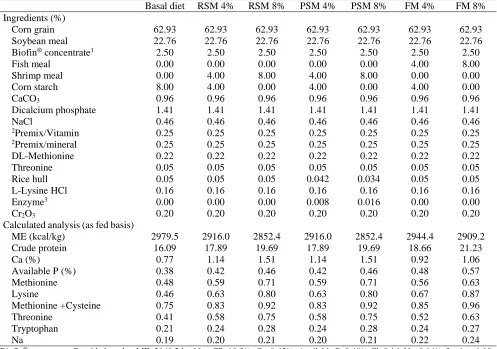
Table 1. Ingredients and chemical composition of the basal, raw shrimp meal (RSM), protease-supplemented shrimp meal (PSM) and fish meal (FM) diets fed to broilers from 28 to 42 d of age.
Basal diet RSM 4% RSM 8% PSM 4% PSM 8% FM 4% FM 8%
Ingredients (%)
Corn grain 62.93 62.93 62.93 62.93 62.93 62.93 62.93
Soybean meal 22.76 22.76 22.76 22.76 22.76 22.76 22.76
Biofin® concentrate1 2.50 2.50 2.50 2.50 2.50 2.50 2.50
Fish meal 0.00 0.00 0.00 0.00 0.00 4.00 8.00
Shrimp meal 0.00 4.00 8.00 4.00 8.00 0.00 0.00
Corn starch 8.00 4.00 0.00 4.00 0.00 4.00 0.00
CaCO3 0.96 0.96 0.96 0.96 0.96 0.96 0.96
Dicalcium phosphate 1.41 1.41 1.41 1.41 1.41 1.41 1.41
NaCl 0.46 0.46 0.46 0.46 0.46 0.46 0.46
2Premix/Vitamin 0.25 0.25 0.25 0.25 0.25 0.25 0.25
2Premix/mineral 0.25 0.25 0.25 0.25 0.25 0.25 0.25
DL-Methionine 0.22 0.22 0.22 0.22 0.22 0.22 0.22
Threonine 0.05 0.05 0.05 0.05 0.05 0.05 0.05
Rice hull 0.05 0.05 0.05 0.042 0.034 0.05 0.05
L-Lysine HCl 0.16 0.16 0.16 0.16 0.16 0.16 0.16
Enzyme3 0.00 0.00 0.00 0.008 0.016 0.00 0.00
Cr2O3 0.20 0.20 0.20 0.20 0.20 0.20 0.20
Calculated analysis (as fed basis)
ME (kcal/kg) 2979.5 2916.0 2852.4 2916.0 2852.4 2944.4 2909.2
Crude protein 16.09 17.89 19.69 17.89 19.69 18.66 21.23
Ca (%) 0.77 1.14 1.51 1.14 1.51 0.92 1.06
Available P (%) 0.38 0.42 0.46 0.42 0.46 0.48 0.57
Methionine 0.48 0.59 0.71 0.59 0.71 0.56 0.63
Lysine 0.46 0.63 0.80 0.63 0.80 0.67 0.87
Methionine +Cysteine 0.75 0.83 0.92 0.83 0.92 0.85 0.96
Threonine 0.41 0.58 0.75 0.58 0.75 0.52 0.63
Tryptophan 0.21 0.24 0.28 0.24 0.28 0.24 0.27
Na 0.19 0.20 0.21 0.20 0.21 0.22 0.24
1Biofin® concentrate Provided per kg: ME, 2949.2 kcal/kg, CP, 18.5%, Ca, 0.65%, Available P, 0.40%,Cl, 0.16, Na, 0.14%, Lysine, 1.10,
Methionine, 0.49, Methionine +Cysteine, 0.80%, Threonine, 0.72, Tryptophan, 0.20.
2 Premix:Provided per kg: vitamin A, 7350 IU; vitamin D
3, 2200 ICU; vitamin E, 8 IU; riboflavin, 5.5 mg; d-pantothenic acid, 13.0 mg;
niacin, 36 mg; choline, 500 mg; vitamin B12, 0.02 mg; menadione, 2 mg; folic acid, 0.5 mg; thiamine mononitrate, 1.0 mg; pyridoxine, 2.2
mg; d-biotin, 0.05 mg; Cu, 6.0 mg; Fe, 54.8 mg; I, 1.0 mg; Mn, 65.3 mg; Se, 0.3 mg; Zn, 55.0 mg.
13
Until 28th d of age all birds received the same
commer-cial broiler diet, and from days 28-42 seven experi-mental finisher diets were fed based on Cobb 500 Man-ual, 2014 recommendation (Table 1). The experimental
diets were, T1: basal diet (0% shrimp meal and 8% corn
starch), T2: basal diet in which 4 % raw shrimp meal was
substituted for corn starch, T3: basal diet in which 8 %
raw shrimp meal was substituted for corn starch, T4:
ba-sal diet in which 4 % protease-supplemented shrimp meal was substituted for corn starch, T5: basal diet in
which 8 % protease-supplemented shrimp meal was
substituted for corn starch, T6: basal diet in which 4 %
fish meal was substituted for corn starch, T7: basal diet
in which 8 % fish meal was substituted for corn starch
in the basal diet. Chromic oxide (Cr2O3) was added to
the diets (0.2%) as an indigestible marker for measuring the prececal digestibility.
Body weight and feed intake were measured weekly on a pen basis, and average daily gain, feed intake, and feed conversion ratio (FCR) calculated. After the birds had been slaughtered at 42nd.d of age the gizzard, ileum,
and pancreas of one bird per pen were dissected out and weighed for calculation of their relative weight. The di-gesta of all birds in each pen were obtained by flushing the last two-third segment of the intestine, between the Meckel’s diverticulum and 2 cm anterior to the ileo-ceca-colonic junction, using distilled water (Rezvani et al., 2008b). The digesta were frozen at -20˚C immedi-ately, and then vacuum-dried and ground before analy-sis. The dried digesta and diets were analyzed for dry matter (DM), ash, ether extract (EE) and crude protein
(CP), according to AOAC (1990). The content of Cr2O3
was measured in the diets and digesta using atomic ab-sorption spectrophotometry (Shimadzu, AA 670, To-kyo, Japan) according to Williams et al. 1962 (Vries et al., 2014). Apparent prececal nutrient (N) digestibility of the diets was calculated using the following equation:
Digestibility (%) = 100 – 100 × [(Cr2O3Diet × NDigesta)/ (Cr2O3Digesta × NDiet)] (1)
in which, Cr2O3Diet and Cr2O3Digesta represent the
concen-trations of Cr2O3 in the diet and digesta samples (g/kg
DM) and NDiet and NDigesta stand for the concentrations
of nutrients in the diet and digesta samples (g/kg DM), respectively.
Statistical analysis
Digestibility and performance data were analyzed by one-way ANOVA, using the General Linear Model pro-cedure of SAS (2004). Linear regression analysis, as
suggestedby Rodehutscord et al. (2004), was used to
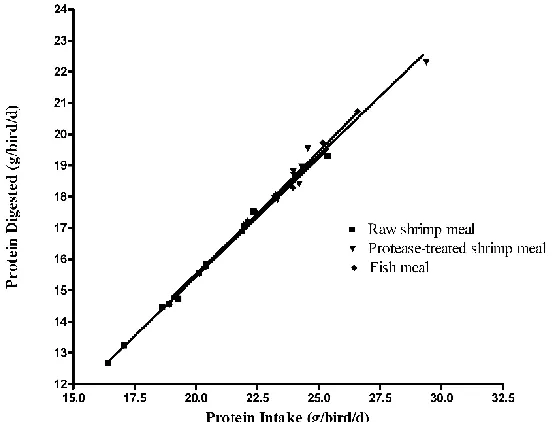
determine the prececal protein and ether extract digesti-bility, where digested protein and ether extract were re-gressed on the protein and ether extract intakes, respec-tively. As basal endogenous loss was included through
the intercept (), no correction was made for basal
en-dogenous losses. The following model was applied to determine the prececal protein and ether exctract digest-ibility of test meal (Rezvani et al., 2008a and 2008b):
Ytij = + tiXti + etij, (2)
where, Ytij = the amount of daily digested protein from
test meal-containing diet (mg/d), = intercept, ti =
prececal digestibility of protein and ether extract
origi-nating from test meal, Xti =daily intake of protein and
ether extract originating from test meal, and etij =error
term with mean 0 and normal distribution. Means were compared using the Duncan’s multiple range test (P<0.05).
Results
No significant differences were observed in broiler per-formance except for feed intake when protease-supple-mented shrimp meal and fish meal was substituted with corn starch in the basal diet. Feed intake was higher in birds that received protease-supplemented shrimp meal and fish meal compared to the 4% raw shrimp meal diet and the basal diet (P<0.05; Table 2). No significant dif-ferences among treatments were observed for carcass percentages, relative weight of digestive organs, and il-eal length (Table 2).
14
Table 2. Effect of substituting shrimp meal and fish meal on performance, carcass percentages, relative weight of digestive organs, and ileal length in Cobb 500 broilers
Measurement Basal Diet RSM
4%
RSM 8%
PSM 4%
PSM 8%
FM 4%
FM
8% SEM P valve
Feed intake (g/bird/d) 114.8 105.4 120.0bc 133.0a 141.1a 131.9ab 133.4ab 5.81 0.008
Average daily gain (g/bird/d) 116.4 113.7 109.6 122.5 111.1 114.4 124.1 9.36 NS
Feed conversion ratio 0.98 0.93 1.16 1.13 1.34 1.17 1.07 0.12 NS
Final body weight (g) 2015.6 1909.3 1959.9 2084.3 1869.7 1977.2 2066.0 70.89 NS
Dressing percentage (%) 61.9 59.8 62.3 62.9 67.4 60.1 58.1 2.07 NS
Gizzard (%) 2.9 2.5 2.6 2.1 2.4 2.6 2.4 0.19 NS
Pancreas (%) 0.42 0.46 0.41 0.44 0.33 0.47 0.42 0.04 NS
Ileum1 (%) 13.1 11.6 12.3 13.3 10.9 15.1 12.3 1.38 NS
Ileal length1 69.6 71.6 73. 77.9 73.8 76.0 73.4 2.46 NS
a-cWithin each row, means with common superscript (s) do not differ (P < 0.05). 1From Meckel’s diverticulum to ileo-ceca-colonic junction.
Raw shrimp meal (RSM, 4%, and 8%), protease-supplemented shrimp meal (PSM, 4% and 8%) and fish meal (FM, 4% and 8%) were substituted the corn starch in the basal diet.
Table 3. Effect of substituting shrimp meal and fish meal on apparent prececal digestibility of crude protein (CP), ether extract (EE), organic matter (OM), dry matter (DM), ash and prececal digestibility of crude protein and ether extract using the linear regression approach in Cobb 500 broilers diet
Apparent digestibility
(%) Basal RSM 4% RSM 8% PSM 4% PSM 8% FM 4% FM 8% SEM P value
CP 77.2 77.2 77.1 77.5 77.4 77.9 77.5 0.45 NS
EE 69.6c 81.4a 74.0b 74.0b 72.6bc 80.5a 73.1bc 1.43 <0.0001
OM 71.2d 75.2a 73.0b 74.4ab 72.5cd 75.4a 74.3ab 0.51 <0.0001
DM 70.3c 71.6ab 70.5bc 72.3a 70.6bc 71.6ab 71.4abc 0.43 0.03
Ash 49.0 49.4 49.5 50.6 47.9 49.8 49.1 0.87 NS
Prececal digestibility
(%) Fish meal
Protease-supplemented shrimp
meal Raw shrimp meal
CP 77.1 76.9 76.6 0.01 NS
EE 83.5 84.5 84.1 0.03 NS
a-dWithin each row, means with common superscript (s) do not differ (P < 0.05).
Raw shrimp meal (RSM, 4%, and 8%), protease-supplemented shrimp meal (PSM, 4% and 8%) and fish meal (FM, 4% and 8%) substituted the corn starch in the basal diet.
15 in comparison to the basal diet. There were no
differ-ences among raw, protease-supplemented shrimp meal and fish meal in prececal protein and ether extract di-gestibility (Table 3; Figure 1).
Discussion
In this study, no significant differences were observed in broiler performance except for feed intake when pro-tease-supplemented shrimp meal and fish meal were substituted with corn starch in the basal diet. These data are in agreement with results found by Rosenfeld et al. (1997) and Ilian et al. (1985) who included shrimp meal in the broiler diet. Shrimp meal up to 10% in broiler di-ets had no any negative effects on broiler performance (Ilian et al., 1985). In the present study, a significant im-provement (P<0.05) in feed consumption was observed with 4 and 8% protease-supplemented shrimp meal compared to the raw shrimp meal. These might be at-tributed to the reduced level of chitin binding proteins by protease. However, Mahata et al. (2008) showed that feed intake was not affected by shrimp meal inclusion in the diet. Because of the non-significant differences in performance and carcass attributes among the treat-ments, it is concluded that shrimp meal can substitute the fish meal in the broiler diet without an adverse ef-fect.
Data on carcass traits confirmed the findings of Okonkwo et al. (2012) and Mahata et al. (2008) that re-ported no significant differences in the relative weight of the digestive organs when shrimp meal was included in broiler diet.
Prececal digestibility measurements are useful in evaluating the feed quality, because of preventing the influence of post-ileal microbial activity. In this experi-ment, substitution of shrimp meal for fish meal in the broiler diet had no adverse effect on apparent prececal dry matter digestibility, but Khempeka et al. (2006) showed that shrimp meal decreased dry matter digesti-bility as result of the presence of chitin. Such discrep-ancy may be due to our shorter duration of feeding in the present study. Protease-supplemented shrimp meal did not improve apparent ether extract digestibility probably due to the kind of enzyme in the current exper-iment.
In this study, the regression method was used to de-termine prececal digestibility in shrimp and fish meal because this method can correct endogenous losses of protein and ether extract (Rezvani et al., 2008a). If dis-crepancies in the basal endogenous gut losses between the experimental diets had existed, they would not have beenrelatedtothe digestibility values calculated for the
protein sources (Rodehutscord et al., 2004). The regres-sion approach proposed by Rodehutscord et al. (2004) in broilers and Rezvani et al. (2008a) in cecetomized laying hens can be a suitable method for estimating the protein digestibility. Data on prececal ether extract di-gestibility are scarce. According to our findings, prece-cal digestibility of crude protein and ether extract of shrimp meal and fish meal was the same. Therefore, it can be concluded that shrimp meal can be used as a suit-able protein source in broiler diets when included up to 8%; with performance traits being more in line with prececal digestibility calculated based on regression ra-ther than apparent digestibility.
References
Aktar, M., Rashid, M., Azam, M.G., Howlider, M.A.R., Hoque, M.A., 2011. Shrimp meal and marine waste as sub-stitutes of fish meal in broiler diet. Bangladesh Journal of Animal Science 4, 18-22.
Aoac, 1990. Official methods of analysis. Association of Of-ficial Analytical Chemists. 15th edition. Washington DC,
USA.
Cobb 500 Manual, 2014. Broiler performance and nutrition supplement, Page: 10. Available at http://www.cobb-van-
tress.com/docs/default-source/cobb-500- guides/Cobb500_Broiler_Performance_And_Nutri-tion_Supplement.pdf [Verified 22 September 2017].
Fan, M.Z., Sauer, W.C, 1997. Determination of true ileal amino acid digestibility in feedstuffs for pigs with the linear relationships between distal ileal outputs and dietary inputs of amino acids. Journal of the Science of Food and Agricul-ture 73, 189-199.
Gernat, A.G., 2001. The effect of using different levels of shrimp meal in laying hen diets. Poultry Science 80, 633-636.
Ibrahim, H.M., Salama M.F., El-Banna H.A., 1999. Shrimp’s waste: Chemical composition, nutritional value and utiliza-tion, Molecular Nutrition and Food Research 43, 418-423.
Ilian, M.A., Bond, C.A., Salam, A.J., Al-Hooti, S., 1985. Evaluation of shrimp by-catch meal as broiler feedstuff. Nu-trition Reports International 31, 487-492.
Kandra, P., Challa, M.M., Jyothi Jyothi, H.K.P., 2012. Effi-cient use of shrimp meal: present and future trends. Applied Microbiology and Biotechnology 93, 17-29.
Khempaka, S., Koh, K., Karasawa, Y., 2006. Effect of shrimp meal on growth performance and digestibility in growing broilers. Journal of Poultry Science 43, 250-254.
16
Nargis, A., Ahmed, K.N., Ahmed, G.M., Hossain, M.A., Munsur, R., 2006. Nutritional value and use of shrimp head waste as fish meal. Bangladesh Journal of Scientific and In-dustrial Research 41, 63-66.
Ngoan, L.D., An, L.V., Ogle, B., Lindberg, J.E., 2000. Ensil-ing techniques for shrimp by-products and their nutritive value for pigs. Asian-Australian Journal of Animal Sciences
13, 1278-1284.
Oduguwa, O.O., Fanimo, A.O., Olayemi, V.O., Oteri, N., 2004. The feeding value of sun-dried shrimp-waste meal based diets for starter and finisher broilers. Archive Zoo-technic 53, 87-90.
Okonkwo, A.C., Akpan, I.P., Isaac, L.I., 2012. Performance and carcass characteristics of finisher broilers fed shrimps waste meal. Agricultural Journal 7, 270-272.
Oxenboll, K.M., Pontoppidan, K., Fru-Nji, F., 2011. Use of protease in poultry feed offers promising environmental benefits. International Journal of Poultry Science 10, 842-848.
Rezvani, M., Kluth, H., Elwert, C., Rodehutscord, M., 2008b. Effect of ileum segment and protein sources on net disap-pearance of crude protein and amino acids in laying hens.
British Poultry Science 49 28-36.
Rezvani, M., Kluth, H., Rodehutscord, M., 2008a. Compari-son of amino acid digestibility determined prececally or based on total excretion of cecectomized laying hens. Poul-try Science 87, 2311-2319.
Rodehutscord, M., Kapocius, M., Timmler, R., Dieckmann, A., 2004. Linear regression approach to study amino acid digestibility in broiler chickens. British Poultry Science 45, 85-92.
Rosenfeld, D.J., Gernat, A.G., Marcano, J.D., Murillo, J.G., Lopez, G.H., Flores, J.A., 1997. The effect of using differ-ent levels of shrimp meal in broiler diets. Poultry Science
76, 581-587.
SAS, 2004: SAS User’s Guide. Statistics. Version 9.2. SAS Institute Inc. Cary, North Carolina. USA.
Septinova, D., Kurtini, T., Tantalo, S., 2010. Evaluation the usage of treated shrimp meal as protein source in broiler diet. Journal of Animal Production 12, 1-5.
Vries, S. de, Kwakkel, R.P., Pustjens, A.M., Kabel, M.A., Hendriks, W.H., Gerrits, W.J.J., 2014. Separation of digesta fractions complicates estimation of ileal digestibility using marker methods with Cr2O3 and cobalt-ethylenediamine
tetraacetic acid in broiler chickens. Poultry Science 93, 2010-2017.
Williams, C.H., David, D.J., Iismaa, O., 1962. The determi-nation of chromic oxide in feces samples by atomic absorp-tion spectrophotometry. Journal of Agricultural Science 59, 381-385.
17
سپ ردوپ يیاذغ داوم يموكس شیپ یریذپ شراوگ نییعت
هدنام
میزنآ اب هدش یروآرف ،ماخ یوگیم ی
هجوج رد نویسرگر شور زا هدافتسا اب يهام ردوپ و زایتورپ
اه
يتشوگ ی
م
.
ر
.
یناوضر
1 *
ع ،
.
درف یمیعن
1
ف ،
.
یمئاص
2
و
م
.
ج
.
یریمض
1
1
،یزرواشک هدکشناد ،یماد مولع شخب .زاریش هاگشناد
2
.نارهت هاگشناد ،یعیبط عبانم و یزرواشک هدکشناد،یماد مولع شخب
*
:کینورتکلا تسپ ،لوئسم هدنسیون [email protected]
هدیکچ يهام ردوپ يارب ماخ يبرچ و نيتورپ يموكس شيپ درادناتسا يریذپ شراوگ يريگ هزادنا روظنم هب شهوژپ نیا
ردوپ ي هدنام سپ و رامش .دش ماجنا نويسرگر شور زا هدافتسا اب وگيم
280 هیوس يتشوگ هجوج هعطق باک ي
500 زا
هب يفداص ت هويش هب سنج ود ره طولخم 7
( راميت هورگ 4
راركت ره يازا هب راركت 10
يفداص ت لاماک حرط کی رد )هدنرپ
ينعم اروخ کرییصم رب راميت ریا .دندییش شيییسقت کرییصم هک يروط هب .دوب راد
ردوپ ياراد ياهراميت رد هنازور اروخ
رف ي هدنامسپ ﻻ
ياراد ي هريج هب تبسن يهام ردوپ و شیزنآ اب هدش يرو 4
رتشيب هیاپ ي هريج و ماخ يوگيم ردوپ دصرد
رب راميت ریا .دوب ،هدنرپ يیاهن نزو ، اروخ لیدبت بیرض ،هنازور نزو شیازفا
مادنا يبس ن نزو موئلیا لوط ،يش راوگ ياه
و ينعم هش ﻻ دص رد شراوگ رب راميت ریا .دوبن راد
ينعم کش خ هدام و يلآ هدام ،ماخ يبرچ يرهاظ يریذپ رتش يب .دوب راد
نی
سپ دص رد راهچ ياراد راميت رد ماخ يبرچ يرهاظ يریذپ شراوگ دص رد هدنام
شراوگ .دش هدید ماخ يوگيم ي يریذپ
سپ يارب ماخ يبرچ و نيتورپ يموكییس شيپ درادناتییسا نام
هد ماخ يهام و زائتورپ شیزنآ اب هدییش يروآرف و ماخ يوگيم ي