18
Effect of partial replacement of cement by fly
ash on compressive and flexural strength of
concrete
Manik Aggarwal
1, Mr. Pardeep
21
M.Tech Student, Department of civil engineering, SPGOI, Rohtak 2
Asst. Professor, Department of civil engineering, SPGOI, Rohtak
ABSTRACT
With the objective of attaining sustainable construction a strong trend favouring the increased use of admixtures in concrete is emerging throughout the world. The mineral admixtures are fundamentally the waste results of modern procedures, delivered to the tune of a huge number of tons whose transfer is an extraordinary concern. Fly cinder from coal based power plants is one such waste which is bounteously accessible in the various pieces of India. Cement can fill in as the most secure home of fly cinder and has a huge potential for its usage. Fly fiery remains or pounded fuel slag, a mechanical misuse of coal based warm power plants, comprises of finely separated circular particles of silicate glass adjusted with aluminum and iron and can be utilized in cement because of financial and specialized points of interest. Fuse of fly powder results in impressive upgrades in solid properties. Fly powder is the most generally utilized pozzolan on the planet. The target of this paper is to investigate the plausibility and impact of supplanting of coarse characteristic totals with impact heater slag and incomplete substitution of bond by silica smoke and fly fiery remains in various rate extents.
Keywords: compressive, flexural, strength, concrete, flyash.
INTRODUCTION
A properly designed concrete mix should have minimum possible cement content without sacrificing the concrete quality in order to make it an economical mix. In general, a fresh concrete must be workable and a hardened concrete must be durable and have the desired strength and appearance. If crisp cement isn't appropriately functional it won't be conceivable to accomplish full compaction hence the subsequent quality and strength of the solidified solid will be essentially influenced. Water-bond proportion is the most basic factor in solid blend plan which straightforwardly hampers the quality of cement. Other significant variables are: total to concrete proportion, reviewing of total, shape and surface of total molecule and measure of entrained air [1].
Air Cooled Blast Furnace Slag
Impact heater slag is tapped from the heater as a fluid , which contains gases held in arrangement . The states of cooling controls the development of mineral gems and the amount and size of gas bubbles that can escape before being caught by hardening of the slag mass. In this way , inside the cutoff points forced by the specific substance organization , the cooling conditions decide the crystalline structure and the thickness and porosity of the slag .Depending upon the cooling techniques utilized , any of three particularly kinds of item to be specific ACBFS , granulated impact heater slag and extended impact heater slag might be produced using the liquid impact heater slag . The four noteworthy oxide stages present in ACBFS are oxides of calcium (CaO) , silica ( SiO2) , aluminum ( Al2O3) and magnesium ( MgO) . These oxides represent roughly 95 percent of the sythesis of ACBFS, with the rest of the 5 percent comprising of sulfur , manganese , iron , titanium , sodium , potassium, vanadium and chromium . The physical properties of ACBFS are to a great extent constrained by how it cools hardens and squashed [2].
ISSN: 2455-6211, Volume 7, Issue 5, May- 2019
19 common totals having a similar degree .ACBFS got from Punjab Hammers ( Mandi Gobindgarh ) was utilized in this examination. Table 1. indicates Summary of Manufacturing Processes and Applications for Iron and Steel Slag [3].
Table: 1: Manufacturing Processes and Applications for Iron Slag.
COMMON
NOMENCLATURE
MANFACTURING PROCCES
APPLICATION
Blast Furnace Iron Slag Rock slag or air cooled slag
Crushing and screening slag, slowly air cooled. Also available as uncrushed slag, spalls or skulls.
Base, Sub-base, Concrete aggregate, Filter aggregate, Construction fill and selected fill, Scour Protection, Rockwool
Granulated slag or slag sand
Rapidly quenching molten slag with high pressure, high volume water sprays.
Sub base, Construction fill Construction sand Stabilizing binder Cement manufacture, Grit blasting, Reinforced earth wall infill, Glass manufacture Ground Granulated
Slag (GGBFS)
Grinding granulated slag to cement fineness.
Cement replacement able to enhance concrete durability and other desirable properties. Stabilizing binder, either alone or blended
Pelletized slag Water quenching molten slag on a sloped table and rotating drum, which throws the pellets into the air for further cooling.
Cement manufacture, Lightweight aggregate for Concrete and masonry products
Expanded slag or lightweight slag
Controlled cooling of slag as a thin layer in a pit followed by crushing and screening.
Lightweight aggregate for masonry products and structural concrete. Skid resistant aggregate.
Heat of Hydration
Replacing Portland cement with fly ash can reduce the exothermic reaction between cement and water (Bremner and Thomas, 2004). Due to the slower pozzolanic response, halfway supplanting of Portland bond with fly fiery remains results in an arrival of warmth over a more drawn out timeframe, because of which the solid temperature remains lower since warmth is disseminated as it is delivered (Joshi and Lohtia, 1997). It has been evaluated that the commitment of fly powder to early age heat age ranges from 15-30% of that of an equal mass of Portland bond (Berry and Malhotra, 1986). Albeit most low calcium fly powder (Class F) will lessen the rate of temperature rise when utilized as Portland concrete substitution, high calcium fly cinders (Class C) don't generally cause diminished warmth development as a result of their self cementitious properties (Joshi and Lohtia, 1997). By and large, the rate of warmth advancement parallels the rate of solidarity improvement. Some high calcium fiery debris respond in all respects quickly with water, producing over the top warmth rather then lessening the warmth of hydration (Berry and Malhotra, 1986). Temperature ascend in cement relies on the accompanying variables: rate of warmth produced by hydration and pozzolanic responses, rate of warmth misfortune and the warm properties of the solid and encompassing condition, and the span of the solid part [4]. Strength
20 at later ages if the solid is kept wet; in this manner, concrete containing fly cinder with equal or lower quality at early ages may have proportionate or higher quality at later ages than cement without fly fiery remains as long as the solid is clammy relieved or presented to adequate amounts of dampness during administration. The quality increase will proceed with time and results in higher later-age quality than can be accomplished by utilizing extra concrete. Anyway [5], Class F fiery debris will add to more prominent long haul quality increase of cement than Class C cinders disregarding its slower rate of solidarity improvement at early age. On account of its fineness and pozzolanic action, fly fiery remains in cement improves the nature of concrete glue and the microstructure of the progress zone between the fastener grid and the total. Because of the consistent procedure of pore refinement, an increase in quality improvement with relieving is accomplished (Joshi and Lohtia, 1997). It is to be noticed that raised temperature restoring is valuable to early quality and ensuing future quality increase of fly slag concrete due to the higher enactment vitality required for pozzolanic responses (ACI Committee 232, 2003). 13 as for HVFA concrete, there is worry inside the business that the low early quality is a potential issue. In any case, an enormous number of studies have been led with respect to this issue and the discoveries are sure [6].
EXPERIMENTAL PROGRAMME
Natural sand is generally used as fine aggregate. But it may contain some impurities therefore before using it, sand should be washed thoroughly. Angular shape particle produces strong concrete because it has better interlocking properties.
Fineness Modulus-The object of determining the fineness modulus is to grade the given aggregate for obtaining a most economical and workable mix with minimum quantity of cement. Certain limits for the fineness modulus of fine and coarse aggregate have been prescribed. A sample under test should satisfy the result so that the aggregate may give good workability under economic conditions. If the test aggregate give higher fineness modulus, the mix will be harsh and if on the other hand gives a lower fineness modulus. It results in an uneconomical mix. For a given workability coarse aggregate requires lesser water cement ratio. Thus the main objective of determining the fineness modulus is to grade the aggregate for obtaining the most economical and workable mix with minimum quantity of cement [7].
Also fineness modulus is only a numerical index of fineness giving some idea of the mean size of the aggregate. Determination of fineness modulus of aggregate may be considered as a method of standardization of the grading of aggregates. It is obtained by sieving a known mass of given aggregate on a set of standard sieves and by adding the cumulative percentage of mass of material retained on all the sieves and dividing by 100.
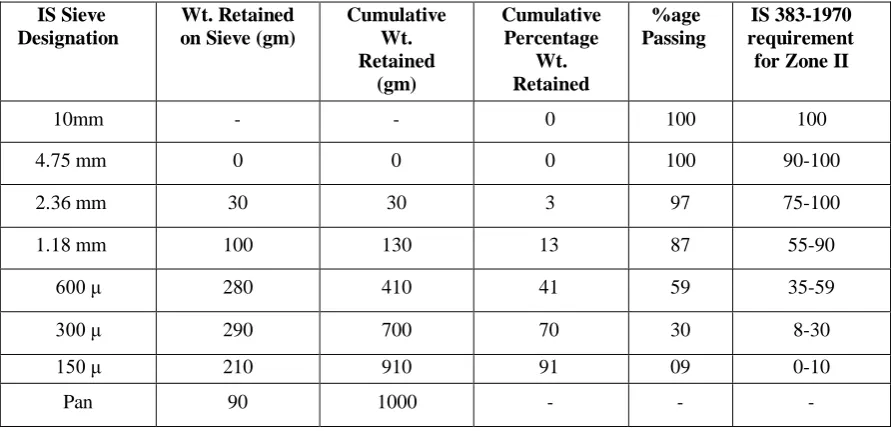
In this experimental program, locally procured sand conforming to grading zone II was used. The sand first was sieved through 4.75mm sieve to remove any particles greater than 4.75mm and then was washed to remove the lumps of clay and other foreign material. After that sieve analysis and other physical properties of fine aggregate were found out and presented in table 2 and table 3. Grading of aggregates is very important as it has effect on workability, uniformity and finishing qualities of concrete [7].
Table 2: Sieve Analysis of Fine Aggregates
IS Sieve Designation
Wt. Retained on Sieve (gm)
Cumulative Wt. Retained
(gm)
Cumulative Percentage
Wt. Retained
%age Passing
IS 383-1970 requirement for Zone II
10mm - - 0 100 100
4.75 mm 0 0 0 100 90-100
2.36 mm 30 30 3 97 75-100
1.18 mm 100 130 13 87 55-90
600 μ 280 410 41 59 35-59
300 μ 290 700 70 30 8-30
150 μ 210 910 91 09 0-10
ISSN: 2455-6211, Volume 7, Issue 5, May- 2019
21 Cumulative percentage weight retained =218
Fineness Modulus (F.M.) = 218 = 2.18 100
Table 3: Physical Properties of Fine Aggregates
Characteristics Results Obtained
Grading Grading Zone II (IS: 383-1970)
Fineness Modulus 2.18
Specific Gravity 2.63
Water Absorption (%) 0.52 %
Free Moisture Content (%) Nil
RESULTS & DISCUSSION
The present section contains the results of various tests conducted on reference mix, binary and ternary concrete mixes. Cubical specimen of size 150X150X150mm were tested for compressive strength test, beam specimens of size 100X100X500mm were used for the measurement of flexural strength [8].
Total number of 102 cubes and 102 beams were cast for compressive strength and drying shrinkage test respectively, using different proportions of fly ash , ACBFS and silica fume. The specimens were tested at different ages of 7 and 28 days. Following aspects of concrete were investigated [9]:
The effect of percentage of fly ash , silica fume and ACBFS as a partial replacement of cement and fly ash and coarse aggregates respectively on compressive strength of concrete.
The effect of percentage of fly ash , silica fume and ACBFS as a partial replacement of cement and fly ash and coarse aggregates respectively on flexural strength of concrete.
The relation between compressive strength and flexural strength of concrete.
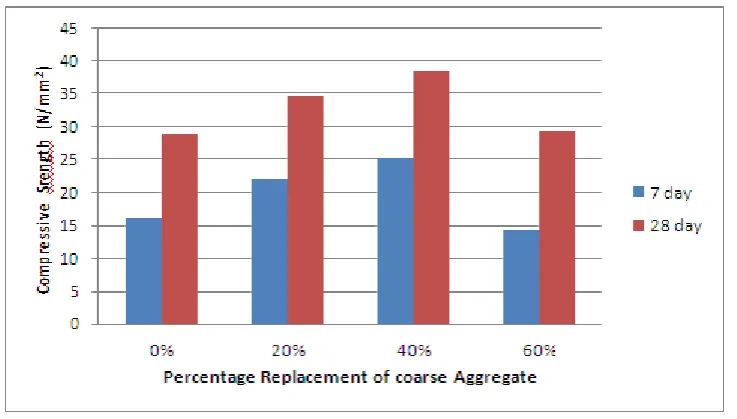
22 Fig. 2: Variation of compressive strength at different replacement levels of coarse aggregate by ACBFS in
fly ash concrete.
It is clear from the figures 1 and 2 that at 7 days compressive strength of binary mixes containing fly ash were substantially lower than that of the reference mix. The compressive strength decreased with increase in dosage of fly ash. The compressive strength at 28 days of binary mixes is also less than that for concrete without fly ash for all replacement levels of ACBFS. However, the compressive strength achieved by binary concrete mixes containing fly ash without silica fume and all replacement level of ACBFS at 28 days of moist curing is in excess of 25MPa, which is suitable for many structural uses [10].
The reference mix achieved a compressive strength of 38.48MPa at 28 days. The fly ash concrete mixes with fly ash contents of 25% and varying percentage of ACBFS i.e. 0%, 20%, 40% and 60% attained strength of 28.92MPa, 34.52MPa, 38.47MPa and 29.23MPa respectively.
The compressive strength is lower at initial ages due to reduction in the quantity of cement by the replacement with fly ash, resulting in weakening the cohesion of cement paste and adhesion to the aggregates particles. As approximately 75% strength rendering primary mineralogical phases is developed at the ultimate hydration of OPC. The balance Ca(OH)2 whose contribution for strength is insignificant as the fly ash is replaced for cement do not contribute for chemical reaction, because of the fact that sufficient cementitious action of fly ash is not activated at the initial stages and thus the unreactive quantity of fly ash at this stage reflect insignificant effect [11-13].
The unreactive portion of fly ash fills up the matrix to render packing effect i.e. physical effect of improving the micro structure of the hydrated cement paste. Lewandowski, R. has reported the presence of as much as 50 percent of unreacted fly ash after one year as the pozzolanic reaction of class F fly ash is slow. So the unreactive portion may also be considered a micro aggregate to contribute for the strength. However, the role played by reactive portion of fly ash is decisive and dominant in comparison to the strength drived out of unreactive portion through packing effect. Therefore, it is anticipated that the compressive strength of fly ash concrete should significantly improve beyond the age of 56 days [14].
CONCLUSIONS
ISSN: 2455-6211, Volume 7, Issue 5, May- 2019
23 REFERENCES
[1]. Davis, R.E., Carlson, R.W., Kelly, J.W. and Davis, H.E. , 1937, Properties of cements and concretes containing fly ash , Journal of the American Concrete Institute, Vol. 33, pp. 577-611.
[2]. Duval, R., Kadri, E.H., 1998, Influence of Silica Fume on the Workability and the Compressive Strength of High-Performance Concretes, Cement and Concrete Research, Vol. 28, Issue 4, January 1998.
[3]. Ghailan A. H., 2015 ,Modified concrete by using a waste material as a coarse aggregate , [4]. Construction Research Congress , pp-10. San Diego , California , United States .
[5]. Gopala Krishnan S., Rajemane N.P., Neelamegam M.M., Pelor J.A., Dattareya, J.K., 2001 , Effect of partial replacement of cement with Fly ash on the strength and durability of HPC, The Indian Concrete Journal, May, pp. 335
[6]. Gunavant K. Kate, Pranesh B. Murnal., 2013, Effect Of Addition Of Fly Ash On Shrinkage Characteristics In High Strength Concrete, International Journal Of Advanced Technology In Civil Engineering, Volume-2, Issue-1.
[7]. Haque M.N., Langan B.W., Ward M.A. ,1984, High fly ash Concretes, ACI journal, pg 54
[8]. Heba A Mohammad, 2011, Effect of fly ash and silica fume on compressive strength of Self-compacting concrete under different curing conditions, Ain Shams Engineering Journal, Vol. 2, pp 79-86
[9]. Hobbs, D.W. ,1983, Influence of Fly Ash on the Workability and Early Strength of Concrete, Proceedings, 1st International Conference on the Use of Fly Ash, Silica Fume, Slag and other Mineral By-Products in Concrete. ACI SP – 79, pp. 289-306.
[10]. Hooton, R.D.; Pun, P.; Kojundic, T.; Fidjestol, P., 1997, Influence of Silica Fume on Chloride Resistance of Concrete, Proceedings of the PCI/FHWA International Symposium on HPC, October 1997.
[11]. IS 10262:1982 (Reaffirmed 2009), Recommended guidelines for concrete mix design, Bureau of Indian Standards, New Delhi.
[12]. IS 4031:1988 (Part XI), Methods of tests for specific gravity of cement, Bureau of Indian Standards, New Delhi. [13]. IS 4031:1988 (Part VI), Methods of tests for compressive strength of cement, Bureau of Indian Standards, New
Delhi.