DOI: 10.15415/cs.2016.32012
Creative Space Vol-3, No-2, January 2016 pp. 185–207
Application of Fractal Growth Patterns in Housing
Layout Design
SUBHADHA BATTINA
Assistant Professor, K.S. School of Architecture, #15, Mallasandra, Off Kanakapura Road, Bengaluru -560109, KARNATAKA, INDIA
Email: [email protected].
Received: November 12, 2015 | Revised: November 25, 2015 | Accepted: December 17, 2015 Published Online: January 04, 2016
The Author(s) 2015. This article is published with open access at www.chitkara.edu.in/publications
Abstract: In early phases of design, during the process of form-exploration, architects -- knowingly or unknowingly -- have used mathematics as their guiding tool to evolve a formal methodology of design. Fundamental compositional principles such as symmetry, rhythm and proportion are based on specific mathematical underpinnings. However, very often the designer comes across a situation where these underlying mathematical principles need to be overlapped or interfaced. Applying fractal concepts to the order can accommodate this complex diversity. Fractals allow us to provide a combination of order and surprise in a rhythmic composition using a specific mathematical geometry. Fractals are typically unit-based and, can thus allow exploration in architectural designs which have a ‘unit’ as a fundamental issue or necessity.
The design of housing layout stands out prominently among such architectural problems and, can thus be one such instance in which fractals may be used as a design tool. Commonly seen organisational patterns in housing layout designs create rigidity and monotony, while others like clustered groups are too inconsistent and can create disorder. The research tries applying fractal ordering principles to strike a balance between these extremes by creating an orderly arrangement of houses with an underlying variation in the pattern. The traditional processes of creating housing layouts is quite cumbersome. With the mathematical power of computers, fractal ordering principles are used as Iterative functions to generate multiple design options. The research investigates the potential of the emergent patterns of fractals as an organisational principle in designing housing layouts, while limiting it based on site constraints, size and the transforming rules. In doing so, the objective is to explore the computational and mathematical basis of repetitive patterns in architectural order and compositions. The study also aims at developing a computer application, based on algorithms using fractals, which offers capabilities as a conceptual and organisational tool for a housing layout. The application is implemented, tested and its results are demonstrated using a live terrain data.
Battina, S 1. INTRODUCTION
In housing layout design, typically, dwelling units are created by the same sequence of rules, based on the form of a generic house. Each of the houses has to meet certain conditions imposed on it by the site topology, its position, its geometry, and so on. Residential projects may also prefer to include pre-defined dwelling units with specific area requirements to provide choice for the buyers. Repetitions of identical or similar forms create a predictable pattern [21]. This configuration is comparable to that of a typical self-similar fractal.
Bovill, in his book, ‘Fractal Geometry in Architecture and Design’, describes Fractal Geometry as a study of mathematical shapes that display a cascade of never-ending, self-similar, meandering detail as one observes them more closely [6]. For example, the pattern of additive formation of leaves, in which, smaller elements are defined by the same morphogenetic rules as the whole. Here, individual leaves are formed by the interaction between these rules and the local conditions that the leaves are subjected to [1]. Organisation of many natural forms found in everyday life is fractal-like. As seen in organic forms, proportional similarity seen in design is a connective mechanism of our perception [15]. Mitchell (1989), in his work, compares the theory of fractal geometry to a system of rules that can manipulate patterns of recursive elements to create architecture [14]. We respond easily to designs that mirror the patterns of nature as these give a better understanding of relationship between elements. The research starts with a premise that when this theory is applied to housing layout patterns, the resulting variation could capture the recursive and the complex rhythms of fractals. The study also aims at developing a computer application, based on algorithms using fractals, which offers capabilities as a conceptual and organisational tool for a housing layout.
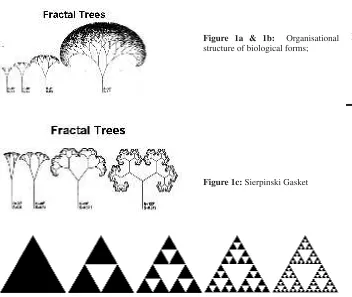
The Sierpinski Gasket, in particular, is one Fractal type in which each of the smaller elements has a scaling similarity with the largest (Figs. 1a, 1b & 1c). Creating housing layouts using principles of a Sierpinski Gasket can make the design more coherent by relating the scale of the overall layout to that of the smaller housing units. Each of the dwelling units can be created recursively with a consistent proportional relationship with the site. The occurrence of the house on the site in the fractal pattern would depend on the organising principles of the Sierpinski Gasket and also the local conditions of the site.
2. SIGNIFICANCE
Application of Fractal Growth Patterns in Housing Layout Design
power, can suitably use Iterative Function Systems as algorithms to generate architectural compositions of fractal character. Using generative systems based on fractal functions can not only further expedite the process of designing housing layouts, it would also formulate the creation of various design solutions, resulting in rapid exploration of alternatives. These emergent patterns of housing layouts are not pre-conceived by the user and can be a mixture of regularity and surprise in an identifiable ratio. This research is an attempt to substantiate the need of familiarising and bringing into light, better understanding and easier applications of mathematical complexity and diversity in architectural order with the help of fractals.
Most of all, the study is intended to contribute to the behavioral understanding and architectural importance of fractal patterns specifically when used as an organisational principle for a housing layout. The research also provides a means to inquire, explore and demonstrate the potential of Fractals as Iterative Function Systems or algorithms in generative systems for housing layout designs.
Figure 1a & 1b: Organisational
structure of biological forms;
Battina, S
3. RESEARCH OBJECTIVES
The first action was the literature study of the broader subjects of architectural order and the design aspects of housing layout patterns in a typical development project. Subsequently, it also became important to understand the various uses and definitions of ‘unit’ in past designs that were created as mathematical systems. Organisational principles of various fractal types were studied in order to understand the applicability of rules to housing layout compositions. Also, in the process, the study attempted to investigate various fractal and biological patterns to study the methods employed for restricting fractal growth.
The study aimed at developing a computer application for a design-based housing layout. In doing so, the sub-objective was to develop a Graphic User Interface which would assist the user to manipulate rules to generate the fractal pattern. In the actual implementation of the application, the idea was to study the emerging issues and requirements.
4.
METHODOLOGYThis study takes a top-down approach by looking broadly at repetitive or rhythmic compositions as a design process of creating instances of mathematical patterns. As part of the literature study, a general understanding is developed of design requirements of housing units and of various organisational patterns in a typical housing layout. Research is then focused on looking at fractals as a
Figure 2 (Above): Whole-Part relationship in design.
Application of Fractal Growth Patterns in Housing Layout Design method to resolve issues that arise during design processes. Previous research in
the use fractal patterns in architectural and urban design is studied. Identifying the analogies between various fractal patterns and architectural compositions leads to development of a conceptual framework for the proposed generative system. These ideas are then focused to the use of the Sierpinski Triangle to create a set of organisational principles that will be applied to the generative system to create the growth patterns in a housing layout design.
The second and the third step, i.e., literature study and developing the conceptual framework, go hand in hand leading to the actual development of the application. Using the algorithm based on the rules developed, a computer application was built in Java. During the development of the application, the use of Sierpinski triangle was extended to create different variations of the fractal pattern. In the process, the concept of Sierpinski triangle as such remained essentially in creating an interface to manipulate the rules in the application. The final step involved evaluating the system internally and externally in terms of its functionality & expected results. Different patterns of the output were tested and the parameters were used to determine feasible housing layouts.
5. BACKGROUND STUDY
5.1 Understanding Architectural Organising Principles
A systematic and controlled arrangement of architectural elements that are manifested within rules creates architectural order. Architectural compositions, typically, are composed of smaller elements or a vocabulary. Intuitively, ordering principles make a visual and an intellectual tool that breaks up various complex solids and voids to harmonise within an ordered and unified whole. Ching (1996), in his book ‘Architecture: Form and Space’ points out that order refers not simply to geometric regularity, but to a condition in which each part of a whole is properly disposed with reference to other parts and to its purpose so as to produce a harmonious arrangement [7]. Ordering principles are a way of relating the part to the whole in design. In such an arrangement there exists a spatial coherence between the parts and the whole. (Fig. 2)
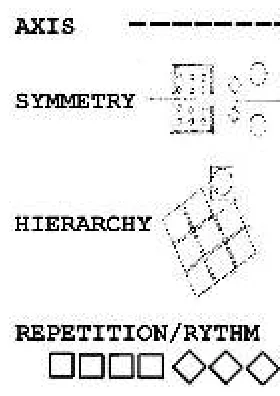
Battina, S The definitions of each provided by Ching(1996) are listed below [7]: • Axis: A line established by two points in space, and about which forms and
spaces can be arranged.
• Symmetry: A balanced distribution of equivalent forms and spaces about a common line (axis) or a point (center).
• Hierarchy: The articulation of the importance or significance of form or space by its size, shape, or placement, relative to the other forms and spaces of the organization.
• Rhythm/repetition: The use of recurring patterns, and their resultant rhythms, to organize a series of forms or spaces.
In this study emphasis is given on studying repetitive and rhythmic patterns. This sort of an arrangement calls for organising principles by which individual parts of a configuration are concatenated. This can be achieved through congruities among parts or through orders by which the parts are organised into subgroups of distinct figural character [18]. The simplest examples of patterns are repetitive geometrical modules arranged in linear or rotational symmetry. Subsequently, a function or an aesthetic requirement may be added to the pattern.
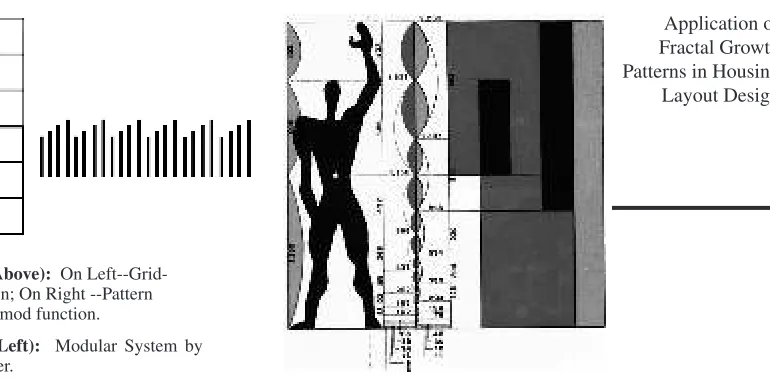
A rhythmic architectural order can be looked at as mathematical systems consisting of various kinds of arrangements or growth patterns of smaller architecturalelements that are mathematically similar. Shown in Figure 4 are two examples of repetitive and rhythmic arrangements. Each portion of the grid (on the left) can be equated to the other. The pattern (on the right) is an example of a rhythmic organisation. It includes some kind of a variation in size to enhance aesthetic perception. Yet, it is an outcome of a simple Mod function.
Rhythmic patterns are founding in modules, where forms occur in different scales. When these modules have geometric similarity and differ in a hierarchal grading of scales, a similar fractal is created. Therefore, self-similar fractals can be used in creating a rhythmic order in design.
5.2 Mathematical designs and ‘Unit’/ Modular systems
Application of Fractal Growth Patterns in Housing Layout Design
into one (Fig. 5). It was based on the Fibonacci sequence and the golden ratio. The principal work of Le Corbusier that exemplified the use of the Modular was his Unite d’Habitation at Marseilles.
In the book, ‘The machine and the unit system’, 1992, it is mentioned that Frank Lloyd Wright defined architecture as ‘sublimated mathematics’. Frank Lloyd Wright employed ‘a unit system’ in his architecture as a way of keeping a relationship between all the parts and the whole in order to create organic architecture. It not only kept the parts of a design inter-related, it also kept a constant source of reference throughout [20].Wright based his designs on polygonal and angular systems, for example the Hanna House and the Audrey House have distinct modifications of a hexagonal geometry. Likewise, Sundt House and the Hotel Part of San show variations on a triangular module.
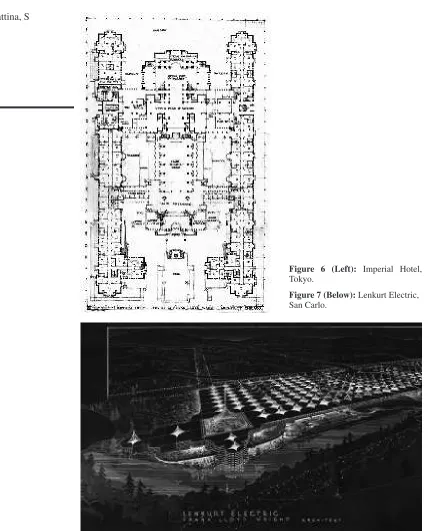
In Imperial hotel, Tokyo, the unit was a rectangle of size 3’x 6’ which was the size of a Japanese mat-tatami (Fig. 6). This formed a grid like pattern which was referenced to place the walls as well as the columns for the structure. In the Lenkurt Electric Building the structure itself is the unit (Fig. 7).
Presently, modular architecture is found to be used everywhere from creating office spaces to putting together houses to build communities. In a contemporary setting, the idea of having a unit measure repeated in a rectangular grid pattern is often sighted, be it a structural column grid or an urban grid-iron pattern. In any such design, arrangement of these mathematical modules can vary. The manner in which these spaces are arranged can reveal a different aesthetic experience. In the context of a housing community, a unit refers to a dwelling space.
Figure 4 (Above): On Left--Grid-Organization; On Right --Pattern governed a mod function.
Battina, S
Figure 6 (Left): Imperial Hotel, Tokyo.
Application of Fractal Growth Patterns in Housing Layout Design In a modular design, the allocation of sizes can be restricted by with an
occurrence of the smallest or the largest possible size of the module or simply by an empty module which cannot be subdivided. One can also find that a certain direction in scaling in not possible. Therefore, the scaling stops at that. Until such a situation occurs, fractals can be created irrespective of scale, which offers a free design process with a certain mathematical understanding. The randomness and ambiguity of having information can be reduced to a large extent. Within such a design, the information and the properties of every module lies connected to the whole hence creating coherence.
The application proposed allows the user to define the unit in two ways. A unit in this study refers to a quadrilateral shape which represents a single transformation in the Sierpinski fractal pattern. In the first case component/s can be used within a unit. Therefore, predefined objects are placed according to fractal distributions on the site. In the second case, the unit is allowed to scale to reach a particular dimension. Here, the scaling information can continue within each unit. Thus, the scaling information is related from the overall growth to each unit. In other words, it is an element that would be repetitively created to construct the layout pattern. The Unit may be defined as a three dimensional volume on the site, a compilation of walls or plains. Therefore, a unit may refer to a livable space, room/s or a house. Therefore, the designer creating further details within the house can reference it to the overall proportional relationship of the layout. In addition to the architectural elements found within a layout, other aspects of the landscape such as trees and shrubs can also be added. The organization of these elements depends on the definition of the units in the application.
5.3 Organizational Patterns of Biological Forms
‘On Growth and Form’, 1992, a book by Thompson studies the mathematical implications of the growth patterns and developmental sequences of biological forms. He discusses various morphological properties and attributes of organisms, which determine or restrict its fractal pattern [17]. Identifying mathematical definitions to such Organic compositions involve complex calculations, both Salingros (1998) and Thompson (1992) mentioned the use of fractals to mathematically track organic growth patterns [16, 17].
Battina, S draws analogies between biological growth and architectural compositions as a way to create architecture that is more natural [16]. He lays down certain mathematical rules to determine the assembly of architectural elements. Here are some of the general rules of growth patterns that are derived from biological forms:
• Anynaturalformismadeupofsmallerinteractingcellsorunitsthatmake the whole.
• Each of these units is characterised by their deinite properties such as size, shape, texture etc.
• Epidermallayeroraboundary,insidewhichthecellaresetfree,restricts the overall growth of the organism. The form is composed of various different scales in the cell sizes.
• Smoothprogressionofthesescalesleadstocoherence. • Thecellsmayexhibitcertainaxesofgrowth.
• Theyareusuallysymmetrical,althoughtheyarealsofoundtohavenon-symmetrical directions of growth.
Each of these rules can be easily related to a housing design layout. It can be compared to similar units within a larger structure or a community. Spaces between the units are also linked by a common ratio of proportion.
5.4 Organisations in housing layout designs
In creating communities, row housing has been used extensively as means to create larger density within a smaller land area. Another fundamental unit of Identifiable Neighborhood is houses organised in a clustered form. Patterns formed by row housing make a design very rigid and compact while the clustered pattern makes it too chaotic (Fig. 8). In this study the idea is to create a design principle, which strikes a balance between the two. Fractal measures can provide us an organising principle, which can capture the benefits of both these arrangements.
Application of Fractal Growth Patterns in Housing Layout Design
Figure 8: Typical Row and Clustered Housing Patterns.
Battina, S without really affecting the character. Very often, in housing development, the project is taken up in parts and finished over a certain time frame in an additive manner. The spaces within the organisation can originate from a focal point or it can be contained within a defined field. But again, aesthetically it is not very often accepted as it consists of too many variations creating disorder and chaos. A clustered layout being an organic system of arrangement requires a complex mathematical understanding.
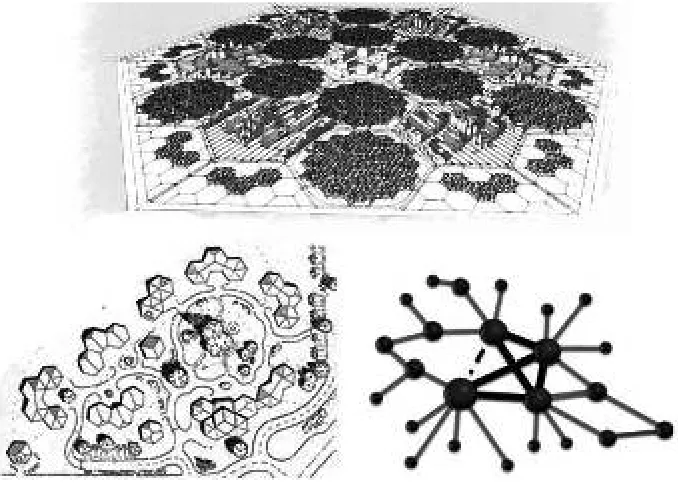
Organising principles of living forms display complex diversity while displaying an overall order. In this study, the idea is to take advantage of the variation created by the clustered layout yet maintain an overall pattern or rule to govern the design of housing layouts. The illustration shown (Fig. 9) is a part of a housing layout in Pennsylvania. The hexagonal units are clustered concentrically around a lawn. The image on the bottom right is a fractal pattern in which there is a similar organisation wherein, smaller units are organised around bigger nodes. One may notice many similarities.
At an urban scale these nodes follow much more complicated fractal patterns of growth. Figure 10 represents the geometric model or organic urban plans of old and new cities. Although some of the new cities followed the grid iron pattern, many of the traditional cities had a more organic evolution. The nodes or the cells represent important landmarks of these cities. The dispositions of these cells causing the homogeneity and wholeness that characterise the organic city are found to be fractal in nature, as found in the geometrical pattern of the leaf. Taking advantage of ability of computers to solve complex mathematical problems, one can easily analyse such complex organisational principles in organic patterns in fractals terms.
5.5 Organisation of a Fractal
Application of Fractal Growth Patterns in Housing Layout Design
Figure 11 shows a sequence of fractal growth within an equilateral rectangle, known as the Sierpinski Triangle or Sierpinski Gasket. The triangle is divided and further sub-divided into similar triangles. The resulting image is similar to the initial. This is called the fractal distribution in self-similar fractals. There are two ways of looking at this process of transformation. The first is to look at the above as a growth pattern in a sub-divisive manner within a very rigid boundary. The other is to look at the growth pattern in the positive or additive manner of creation of larger similar triangles around its perimeter. The Figure 11 also shows various stages of transformation in a fractal pattern. In a mathematical idealisation, this process can be repeated infinitely. In reality a real fractal does not exist, as it cannot be diminished to reach infinity.
The properties of the gasket are such that each of the small triangles are usually referred as the ‘child elements’ in the fractal is geometrically similar to the largest triangle or ‘the parent unit’. Applying the same principle to the context of housing layout design, if the largest unit is the shape of the site, child units can be created in proportional relationship to the site. This would continue the scaling similarity that we spoke about earlier in this study.
Figure 10: The Geometry of the urban structure.
Battina, S
5.6 Configuration of the Sierpinski Gasket
The construction of the Sierpinski Triangle could be achieved by applying certain rules repetitively as an Iterative Function System. Figure 11 illustrates the ‘MRCM construction’ of the Sierpinski fractal. MRCM stands for ‘Multiple Reduction Copy Machine’, a metaphor for a type of iterator. The machine receives an image as input. The processor reduces the size of the input by the scaling factor for the machine. By altering the scale factor, number of copies, and copy placements in the MRCM many unique fractals can be created.
The Sierpinski Gasket’s MRCM has a scaling factor of ½ and makes three copies of the input. It positions two of the copies next to each other on the bottom with the third placed in the middle on top. The three squares are representations of the first or the initial stage of transformation into smaller ‘child objects’ from a ‘parent object’ which is the outermost square. Each child object is recursively or iteratively then transformed further more by the same
Figure 12 (Left): Representing Transformations as MRCM(left).
Application of Fractal Growth Patterns in Housing Layout Design topological rules creating a final fractal image. The IFS (Iterative Function
System) may perform linear transformations (scale, sheer, reflect, rotate, etc.) to each copy. In such a case, to better represent the transformation, a small L is attached to the square. In the Sierpinski Gasket each of the units can be transformed 8 ways - four reflections and four rotations (Fig. 12 & 13). Therefore, the MRCM can be transformed into 8x8x8 = 512 ways.
In this study, the word ‘unit’ refers to the quadrilateral (square or a rectangle) which is the representation of a transforming rule. It is a conceptual representation of the transformations that can be applied to the houses. This provides the user an easy interface in the application by which the rules of transformation can be determined. By using the concept of MRCM, the transformation rules can be easily represented and manipulated. Unlike in many other shape grammars, very few transformation rules in the Sierpinski Gasket can generate numerous outputs.
By using the Sierpinski fractal as a basis to create the housing layout pattern, the user can gauge the overall distribution of the houses by defining the child units. Defining the parent unit determines the extent of pattern and also the geometry of the site. Each of the child units behave like the parent element individually at every stage of the transformation, keeping the same correlation with the entire site. The morphological transformation of form and structure of the houses arise in response to the geometrical and topological specifications of the relationship between the parent and child units. Thus the association of the whole-to-part is unvarying at every stage of the Iterative Function System creating order.
6. FRAMEWORK OF THE SYSTEM
6.1 The Algorithm
In a typical housing layout, houses act like repetitive elements with similar generic characteristics but varying in certain properties such as position, size and orientation. The algorithm in general provides an iterative generation of houses. The multiplicity rule can be applied to fractal geometry. In particular, theIterative Function Systems (IFS) to create fractal patterns of the Sierpinski Gasket is used. In Sierpinski Gasket, the parent unit or the first stage in the IFS is transformed into much smaller child units each consisting of similar transformations. The transformation rules in this application are determined by the user.
Battina, S on a given piece of land until certain specified conditions are met. Houses can extend beyond the actual site if the child units are defined outside the parent unit. When the user opts to stop the pattern at within the site limits, each unit cannot overlap the perimeter of the site. In such a case the iteration stops. Therefore, constraints are attached not only to the algorithm but also to individual units, which can change the overall algorithm. The user can specify the number of houses to be created. Each stage of iteration creates a specific number of child elements. This helps in restricting the pattern to a finite number of iterations and provides a more realistic output.
The terrain data is in the Triangular Integrated Network (TIN) format. The topography of the entire land is converted into triangles conforming to the shape of the site. The altitude of each unit created corresponds to the change in the elevation of the site. Limitations are applied to the placement of units based on the boundaries of the site, min/max size of unit, etc. Therefore, the growth responds to the context of the site and given requirements.
6.2 What makes a fractal Unit?
Figure 14 shows us an image of the ‘child element’ whose geometry defines the progress of the fractal. The parent unit contains smaller the smaller child element and is the ‘XY plain’ of the drawing area. A user interface in the application asks for a reference point and the extent of the parent unit within which all ‘child’ elements form. The angle and orientation can also be specified. Subsequently, the child objects are specified in relationship to the reference point of the parent object. Reference point of the parent unit makes the origin to the smaller unit.
The size and the orientation of the child unit are noted with respect to the parent unit. The same relationship is followed throughout the IFS. The following formula describes the relationship of the child with the parent unit in mathematical terms.
Uc = a * Up + b * Vp; Vc = c * Up + d * Vp; Ref Point = e * Up + f * Vp,
Up & Vp are the directional vectors of the parent unit; Uc & Vc are the directional vectors of the child unit; RefPoint is the reference point from which the directions and the sizes if the vectors are specified; ‘a’, ‘b’, ‘c’, ‘d’, ‘e’ and ‘f ’ are linearly independent constants.
Within this the relationship with other elements such as houses, walls, trees, etc. can be specified.
Application of Fractal Growth Patterns in Housing Layout Design
Figure 14: The Fractal Unit.
6.3 The Application
This application is created in Java, a software language. The user interface has three panels:
a. The 3-dimensional panel which displays the result and gives 3-d views of the same.
b. Rule Definition Panel: A drawing frame for creating pre-created 3D components within the units and to define the rules and transformation. c. The panel which displays the output as a two dimensional image.
To generate results the user needs to go through four simple steps as follows: a. Import a site data in .dxf format as a Triangulated Integrated Network file
(can be changed in any CAD software) (Figs. 15 &16)
b. Specify the stop-conditions or the parameters for the entire IFS (Fig. 17). c. Define the parent and child units inside the Rule Defining Panel. The child
units could consist of one or more houses and 3D elements such as trees, houses, walls, etc.
d. Choose one layout pattern from the two-dimensional outputs & click on it (Fig. 19).
Battina, S
Figure 15: Main Panel(left); User Interface- Opening the site data (right),
Figure 16: User Interface- Viewing Site data in 3D.
Application of Fractal Growth Patterns in Housing Layout Design
Figure 18: Rule Defining Panel (left); Rule Defining Panel- Defining the Parent/child Unit (right).
Figure 19: 2-Dimensional Output-select one (left); Final Output viewed as a 3-d model (right).
Battina, S
The Unit as such can be defined in two ways:
1. ‘Scaling Unit’ - the Unit (the square representing the transformations) acts as volumes, which are scaled until a particular dimension is reached. 2. ‘Static Unit’ - Predefined objects, placed with respect to the reference
point of each unit, are used. Therefore, scaling of the unit determines the distribution of the houses. These objects are placed with the same dimension on the actual units.
In general, as a process of designing the layout, the user can first decide the general organisation of the layout by determining the positions and the scale of the child units with respect to the parent object. Then, by placing the houses within these child units the designer determines the relationship of the houses to each other. The houses are laid out on different locations on the site with the same configuration. Therefore, a consistent whole-to-part, part-to-whole and a part-to-part relationship is established. The application then generates icons of multiple 2D landscape models of the entire housing. The user chooses a layout best suited for his design. This generates a 3D model which can be saved as a .DXF. The Figures 15-21 illustrate the various stages of execution of the application to get the final results. The application overall generates different variations of the Sierpinski Triangle. Therefore, the number of child units may
Application of Fractal Growth Patterns in Housing Layout Design be more than three. Also the transformation rules may be more complex. The
Units may be rotated to angles that may or may not be 90 degrees
7. IMPLEMENTATION AND TESTING
Case studies were used to demonstrate the functioning of the tool. Various types of relationship between the parent and the child units are tested. In the process of implementing the application, the configuration of the Sierpinski Gasket was extended to the incorporation of other iterative affine functions. As a result, multiple methods of defining transformations became possible. To make the process of identifying the transformations and their ramifications easier for the use, 6 categories of transformations were identified, as listed below. The cases were first tested for Basic transformation rules applied to the child elements in the Sierpinski Gasket (4 reflections and 4 perpendicular rotations). Then various other transformations were tested. The outputs were recorded and categorised. These are the six categories:
a. Basic: The houses are transformed by a ninety-degree rotation or a reflection. These transformation rules could be used to create more rigid and symmetric patterns. Also the houses are not densely packed. So they can be used for designs on flat terrain data.
b. Overlapping: Here the Units overlap one another. These rules can be used when a specific area is required to be denser than the rest.
c. Extended: This category can be useful when the housing layout is designed in phases. The designer can get an idea of what the houses would look like in the next phase of design. Here the units are defined beyond the parent unit. d. Scaling: This is a transformation when the unit is scaled. It could be used to
generate houses with a particular configuration over a wide area on the site. Also the transformation rules may be useful for the creation of road patterns. e. Dense: The Units here are more than three. There can be one or more
number of units in the application. It could be used for designs for which houses are required to be placed very close to each other. They are more useful for housing designs on hilly locations.
f. Poor: These are extreme cases of transforming rules which do not generate outputs that are feasible for housing layout designs.
8. DISCUSSION OF RESULTS AND FUTURE WORK
Battina, S the transformation rules that can be added to the Sierpinski Gasket makes the application more flexible. The findings of the study provide a good insight of using an optimal range of transformations that are possible in capturing a feasible housing layout.
Unlike the commonly used organisational principles in housing layouts, this paper offers a design rule for ordering of houses in which the distribution of sub-units are done according to the sub divisive mathematical rules of the Sierpinski Gasket that are not pre-conceived by the user. This research is carried out on the premise that rhythmic or repetitive architectural design can be based on scientific mathematical principles that are analogous to some of the structural laws in biology.
The final outcome is a fractal layout in which there is a consistent relationship between whole-to-part, part-to-whole and part-to-part. The layout is flexible can accept growth without changing the overall character of the pattern. The results of the case studies were closely observed to draw inferences of the impact of the changing parameters and transformation rules. Different patterns are created with changing reference points and orientation of child objects. Creating child units that are far apart from each other creates a more sprawling layout. In case vice versa, it creates a layout that has houses that are closer to one another and the overall layout is denser. The directions of the vectors of the Units can be changed in order to flip or rotate the configuration in parts. By not limiting the fractal to the parent unit, the designer can see the complete layout. These cases may be used to phase a design project for a future development. The paper offers an alternate simpler option to automate an initial phase of housing-layout design. The study provides a method to study and experiment with the concept of imitating nature’s growth patterns.
REFERENCES
[1] ALEXANDER, C. et al (1969) Houses generated by patterns. Berkley, California:
Center for Environmental Structure.
[2] ALEXANDER, C. et al (1977) A Pattern Language: Towns, Buildings, Construction. New York:Oxford University Press.
[3] ARNHEIM, R. (1977) The Dynamics of Architectural Form. Berkeley: University
of California Press.
[4] BATTINA, S. (2004) Exploring non-deterministic growth patterns to generate housing layout designs: Fractals as a framework. Unpublished thesis (M.Arch.)
Arizona State University, Tempe, USA.
[5] BATTY, M. and LONGLEY, P. (1994) Fractal cities: a geometry of form and
Application of Fractal Growth Patterns in Housing Layout Design [6] BOVILL, C. (1996) Fractal Geometry in Architecture and Design. Boston:
Birkhauser.
[7] CHING, F.D.K. (1996) Architecture: Form, Space and Order. New York: Van
Nostrand Reinhold,
[8] DEVANEY, R. L. (1995) Mathematics and Statistics. Boston University.
Available from: http://math.bu.edu/DYSYS/chaos-game/node6.html [Accessed: April 30, 2016]
[9] EASTMAN, C.M. (ed.) (1975) Spatial Synthesis and Computer-aided Building
Design. London: Applied Sciences.
[10] EMDANAT, S., STINY, G. and VAKALÓ, E-G. (1999) Generative Systems in Design. Artificial Intelligence for Engineering Design Analysis & Manufacturing,
13(4). p. 239-240.
[11] KALAY, Y. (ed.) (1987) Computability in Design, New York: Wiley.
[12] KARMILOFF-SMITH, A. (1995) Beyond Modularity: A Developmental Perspective On Cognitive Science: Learning, Development, and Conceptual Change. Cambridge, Massachusetts: MIT Press.
[13] MITCHELL, W., LIGGETT, R. and KVAN, T. (1987) The Art of Computer
Graphics Programming. New York: Van Nostrand Reinhold.
[14] MITCHELL, W.J. (1989) The Logic of Architecture: Design, Computation, Cognition.Cambridge, Massachusetts: MIT Press.
[15] PEITGEN, H.O., JURGENS, H. and SAUPE, D. (2004,1992) Chaos and Fractals -- New Frontiers of Science. New York:Springer Science.
[16] SALINGAROS, N. (1998) A Scientific Basis for Creating Architectural Forms.
Journal of Architectural and Planning. [Online] 15(4). p. 283-293. Available
from: http://www.jstor.org/stable/43030470?seq=1#page_scan_tab_contents [Accessed: April 30, 2016]
[17] THOMSON, D.W. (1945) On Growth and Form. New York: Cambridge University
Press. Available from: https://archive.org/details/ongrowthform00thom [Accessed April 30, 2016]
[18] WEBER, R. (1995) On the Aesthetics of Architecture: A Psychological Approach
to the Structure and the Order of Perceived Architectural Space. Brookfield,
USA: Avebury, Aldershot.
[19] William, J.M. (1990) The Logic of Architecture: Design, Computation and
Cognition. Cambridge and London: The MIT Press.
[20]WRIGHT, F. L. (1992) The machine and the unit system. Unknown Binder
[21]ZELANSKI, P. and FISHER, M.P. (1984) Design Principles and Problems. New