Field screening of few popularly grown and some newly developed rice
varieties against different insect-pests in wet season
1 Dr.Sitesh Chatterjee, 2 Ms.Purnima Halder, 3 Dr.Chirasree Gangopadhyay, 4 Dr.Indrani Dana, 5 Dr.Aparna Halder
1
Assistant Entomologist
, Rice Research Station, Government of West Bengal, P.O. Chinsurah (R.S.) -712 102,Hooghly, West Bengal, India
2
Rice Physiologist
, Rice Research Station, Government of West Bengal, P.O. Chinsurah (R.S.) -712 102, Hooghly,West Bengal, India
3
Assistant Entomologist
, Rice Research Station, Government of West Bengal, P.O. Chinsurah (R.S.) -712 102,Hooghly, West Bengal, India
4 Plant Breeder (Oilseeds), Pulses and Oilseeds Research Station, Government of West Bengal, Berhampore - 742101,
Murshidabad, West Bengal, India
5 Associate Professor, Government College of Engineering and Leather Technology, Block - LB-11, Sector-III, Salt
Lake, Kolkata – 700 098, West Bengal, India
Corresponding author E-mail – [email protected]
1. INTRODUCTION :
Rice (Oryza sativa L.), is one of the most important staple food of family Poaceae. India, the second largest rice growing country, has a production of 104.32 million tonnes and cultivation area of about 44.6 million hectares with average productivity of 2.34 tonnes per hectare (Anon., 2013 and Rajasekar and Jeyakumar, 2014). West Bengal is one of the leading states in total cultivated area, production and productivity. About 78% of the total rice area is concentrated under high and medium productivity groups, which accounts for nearly 84% of the total production of rice in the state.
A critical analysis of the gap between the potential and actual rice yields across the nation would reveal that several factors act as yield constraints. Among these factors, insect-pests contribute substantially to yield loss in rice production and productivity (Chatterjee et al., 2016). In India, approximately 100 insect species feed on rice and 20 of these are considered to be major pests, causing 30% yield loss. Among these, yellow stem borer (YSB), Scirpopagha
incertulas Walker and rice leaf folder, Cnaphalocrocis medinalis Guenee are the dominant and the most destructive
insect-pest occurring throughout the country causing about 10-60 per cent of total yield loss (Chatterjee and Mondal, 2014). The insect, S. incertulas is distributed widely, covering almost all the Asian countries. YSB usually comprised
more than 90% of the borer populations and damage the rice crop from seedling to maturity causing “Dead heart” at tillering stage and “White ear head” at reproductive stage resulting a yield loss of about 10-60% (Chatterjee et al., 2017). The rice leaf folder was considered as a minor or sporadic pest in the past in many Asian countries, but now it has assumed the status of an important pest and has become a major threat to rice production in tropical and subtropical Asia (Pasalu, 2007; Khan and Joshi, 1990). Rice whorl maggot, Hydrellia philippina Ferino begins to infest the rice plant at transplanting and feeds on the central whorl leaf of the vegetative stage of the rice plant.
Host plant resistance is a relationship between the plant-feeding insects and their host plants (Painter, 1951). Host plant resistance enables plants to avoid, tolerate or recover from the effects of insect pest attack and has proved to be a successful tool against insects in many crops (Felkl et al. 2005). Plant genotypes, either due to environmental stress or genetic makeup, possess physiological and biochemical differences which alter the nutritional value (primary metabolites) for plant-feeding insects (Alvim1 et al. 2004). In some cases, the combined nutritional and allelochemical
Abstract: A field experiment was carried out at Rice Research Station, Chinsurah, Hooghly over two seasons, kharif, 2016 and 2017 with twelve rice varieties, of which some are popularly grown in West Bengal and some are newly developed. The results revealed that the variety, Manisha is tolerant/resistant to whorl maggot, leaf folder and stem borer in reproductive stage and the variety, Kaushalya is tolerant/resistant to whorl maggot and stem borer in tillering stage. The variety, Pravat showed tolerance/resistance to leaf folder and stem borer in early stages. The variety, Swarna-Sub 1 is tolerant/resistant to whorl maggot and stem borer in later stages, whereas the variety Swarna showed tolerance/resistance to leaf folder and stem borer in reproductive stage. The experiment will identify tolerant/resistant rice lines against whorl maggot, leaf folder and yellow stem borer which will be helpful to the farmers of the state to choose varieties for better yield and breeders to develop newer enduring rice lines
alterations either improve the quality of the host plant as a source of food and can therefore be considered favorable to herbivorous insects or make the quality of host plant as source of food unfavorable to phytophagous insects (Stadler et al. 2002). This investigation was conducted to determine the level of tolerance or resistance against S. incertulas, C.
medinalis and H. philippina and also to find out the multiple tolerant/resistance rice varieties. The identification of
tolerant/resistant rice variety will help breeders for future use in developing multiple resistant new breeding rice lines, rice varieties, insect-pest resistant responsible gene identification, etc.
Table 1. List of testing rice varieties
Sl. No. Tested variety Special varietal characteristics
1. Pravat Early duration variety
2. Ajit Early maturing newly released variety 3. Satabdi Early maturing popularly grown variety 4. Kaushalya High yielding newly released variety 5. Manisha High yielding newly released variety 6. Sujala High yielding newly released variety 7. Pratiksha High yielding popularly grown variety 8. Amala Newly released variety for semi-deep situation 9. Swarnali Newly released variety for shallow situation 10. Rajdeep Newly released variety for semi-deep situation 11. Swarna High yielding popularly grown variety 12. Swarna-Sub 1 Popularly grown variety for flash flood situation
2. ANALYSIS, DISCUSSION AND RESULT:
During the year 2016 and 2017 observations on incidence of whorl maggot (WM), leaf folder (LF), dead heart (DH) and white ear head (WE) were calculated in percent and have been represented in the table 2 and 3, respectively. From the table 2, it is evident that during 2016, the whorl maggot, leaf folder, dead heart and white ear head attack ranged from 0.92 - 2.63%, 0.14 - 2.39%, 1.55 - 3.15% and 2.97 - 10.50%, respectively. The ranges observed during 2017 were 2.80 - 5.51%, 1.89 - 3.90%, 2.42 - 6.84% and 4.34 - 19.67%, respectively (Table 3). In 2016, the lowest whorl maggot infestation was observed in Rajdeep (0.92) followed by Amala (0.97%) and Swarna-Sub 1 (0.99%). The variety, Manisha (0.14%) showed minimum leaf folder attack followed by Pravat (0.38%) and Swarnali (0.65%). The lowest dead heart attack was observed in Rajdeep (1.55%) followed by Swarna (1.89%) and Amala (1.95%). Whereas, the lowest white heads was recorded in Swarna (2.97%) followed by Pratiksha (4.21%) and Swarna-Sub 1 (4.30%).
Table 2. Insect-pest incidence on rice varieties in new alluvial zone of West Bengal during kharif, 2016
Variety
WM% 30 DAT
WM% 45 DAT
Mean WM%
LF% 30 DAT
LF% 45 DAT
LF% 60 DAT
Mean LF%
DH% 30 DAT
DH% 45 DAT
Mean
DH% WE%
Pravat 1.48 2.76 2.12 0.00 0.29 0.85 0.38 3.25 1.45 2.35 10.26 Ajit 1.75 3.51 2.63 0.72 1.11 1.38 1.07 3.73 1.16 2.45 9.79 Satabdi 1.57 2.66 2.12 0.97 1.72 2.08 1.59 4.49 1.80 3.15 7.43 Kaushalya 0.94 1.29 1.12 1.57 2.33 3.28 2.39 2.76 2.18 2.47 10.50 Manisha 1.54 1.05 1.30 0.00 0.42 0.00 0.14 2.47 3.16 2.82 6.25 Sujala 1.25 2.09 1.67 1.09 1.73 3.40 2.07 0.83 3.44 2.14 8.38 Pratiksha 0.91 2.85 1.88 0.29 1.43 1.50 1.07 1.22 4.26 2.74 4.21 Amala 0.80 1.14 0.97 0.98 1.38 2.83 1.73 1.04 2.86 1.95 6.67 Swarnali 2.05 1.22 1.64 0.00 0.61 1.33 0.65 1.18 3.06 2.12 5.07 Rajdeep 0.84 0.99 0.92 0.60 0.59 1.74 0.98 1.12 1.98 1.55 7.95 Swarna 1.16 1.70 1.43 0.29 0.73 1.17 0.73 1.16 2.61 1.89 2.97 Swarna-Sub 1 1.19 0.79 0.99 0.60 1.40 1.92 1.31 1.79 2.97 2.38 4.30
(2.80%) and Sujala (2.74%). In reproductive stage, the minimum white ear head was recorded in Manisha (4.34%) followed by Swarna-Sub 1 (5.84%) and Rajdeep (8.00%).
Table 3. Insect-pest incidence on rice varieties in new alluvial zone of West Bengal during kharif, 2017
Variety
WM% 30 DAT
WM% 45 DAT
Mean WM%
LF% 30 DAT
LF% 45 DAT
LF% 60 DAT
Mean LF%
DH% 30 DAT
DH% 45 DAT
Mean
DH% WE%
Pravat 3.20 4.89 4.05 1.80 1.29 2.59 1.89 3.59 2.00 2.80 16.49 Ajit 5.30 5.71 5.51 1.56 2.57 3.76 2.63 4.69 3.00 3.85 10.30 Satabdi 2.91 3.29 3.10 1.53 2.87 3.71 2.70 5.25 4.04 4.65 14.00 Kaushalya 2.78 3.00 2.89 1.01 3.00 4.89 2.97 3.31 1.53 2.42 15.96 Manisha 2.08 3.52 2.80 1.00 2.84 2.25 2.03 2.94 4.98 3.96 4.34 Sujala 3.23 4.42 3.83 1.61 3.42 4.17 3.07 2.47 5.00 3.74 19.67 Pratiksha 3.00 3.68 3.34 1.54 1.28 4.74 2.52 7.88 4.45 6.17 8.57 Amala 3.17 4.57 3.87 1.29 3.51 6.90 3.90 3.10 5.16 4.13 10.25 Swarnali 2.83 2.97 2.90 1.77 2.58 4.34 2.90 6.31 6.08 6.20 8.25 Rajdeep 4.24 5.50 4.87 1.00 2.90 3.38 2.43 5.99 7.68 6.84 8.00 Swarna 2.33 5.90 4.12 1.58 2.60 2.61 2.26 6.02 5.23 5.63 9.62 Swarna-Sub 1 3.51 3.17 3.34 1.25 2.00 3.12 2.12 4.00 7.25 5.63 5.84
The table 2 and 3 showed an interesting fact that the early and mid-early and medium duration varieties viz. Pravat, Ajit, Satabdi and Kaushalya were attacked more by stem borer in tillering stage at 30 DAT and the attack was gradually lowered down at 45 DAT. This incidence was happened because the early maturing varieties go for early reproductive stage with a short vegetative stage i.e. tillering phase.
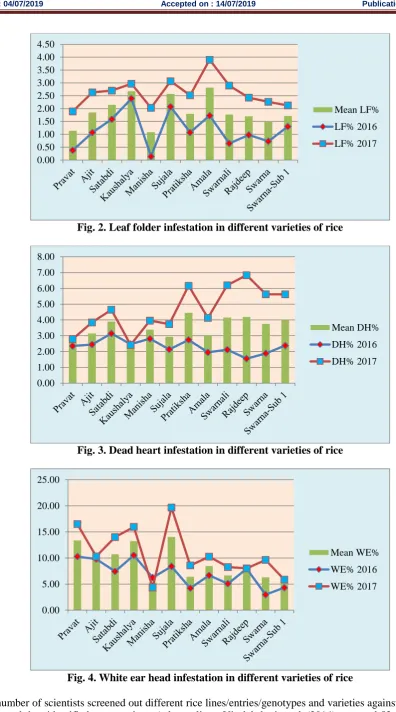
The two years mean per cent attack of whorl maggot, leaf folder, dead heart and white ear head have been represented in figure 1, 2, 3 and 4, respectively. The mean data indicated that the lowest whorl maggot infestation was found in Kaushalya (2.00%) followed by Manisha (2.05%), Swarna-Sub 1 (2.17%) and Swarnali (2.27%) (Fig. 1). The lepidopteran insect, the leaf folder attack was lowest in Manisha (1.09%) followed by Pravat (1.14%), Swarna (1.50%) and Rajdeep (1.70%) (Fig. 2). The variety, Kaushalya (2.45%) has escaped most from dead heart attack at tillering stage followed by Pravat (2.57%), Sujala (2.94%) and Amala (3.04) (Fig. 3). The minimum stem borer attack with the symptoms of white ear head was noticed in Swarna-Sub 1 (5.07%) followed by Manisha (5.30%), Swarna (6.30%) and Pratiksha (6.39%) (Fig. 4). Therefore, from this experiment we have found the variety, Manisha strongly tolerant/resistant to leaf folder and moderately tolerant/resistant to both whorl maggot and stem borer in reproductive stage and the variety, Kaushalya is strongly tolerant/resistant to both whorl maggot and stem borer in tillering stage. The rice variety, Pravat showed moderately tolerant/resistant to both leaf folder and stem borer in early stage. Swarna-Sub 1 strongly tolerant/resistant to stem borer in later stage and moderately tolerant to whorl maggot. Whereas, the variety Swarna showed moderately tolerant/resistant to both leaf folder and stem borer in reproductive stage.
Fig. 1. Whorl maggot infestation in different varieties of rice 0.00
1.00 2.00 3.00 4.00 5.00 6.00
Mean WM%
WM% 2016
Fig. 2. Leaf folder infestation in different varieties of rice
Fig. 3. Dead heart infestation in different varieties of rice
Fig. 4. White ear head infestation in different varieties of rice
A number of scientists screened out different rice lines/entries/genotypes and varieties against different insect-pests of rice and they identified many resistant/tolerant lines. Visalakshmi et al. (2014) screened 53 rice entries under natural field conditions to find out the resistance to stem borer and they recorded that CR 2711-76, CR 3005-230-5 and CR 3005-77-2 were moderately resistant to stem borer. Prasad et al. (2013) evaluated 202 semi deep water rice
0.00 0.50 1.00 1.50 2.00 2.50 3.00 3.50 4.00 4.50
Mean LF%
LF% 2016
LF% 2017
0.00 1.00 2.00 3.00 4.00 5.00 6.00 7.00 8.00
Mean DH%
DH% 2016
DH% 2017
0.00 5.00 10.00 15.00 20.00 25.00
Mean WE%
WE% 2016
genotypes against YSB and concluded that the entries Madak 13, WAB 878-4-2-2-3-P1-HP and NDGR 268 are highly resistant to yellow stem borer and may be used as donors for yellow stem borer resistance in breeding program. Chatterjee et al. (2011) screened out 51 rice entries along with check varieties and recorded that dead heart tolerant promising rice entries were Anjali, Pusa RH 10, ADT 44, JKRH 10, Pant Dhan 19, Gorsa, CSR 27, IC 115737, LF 270 and white ear head tolerant rice entries were CHOORAPUNDY, INRC 3021, PTB 12, CR-MR-1523, LF 256 and AGANNI. They also concluded that CSR 23, TNAU 831311, ARC 6626, IC 115737, AGANNI, IC 155876 and ARC 5982 were tolerant to rice leaf folder. Balasubramanian et al. (2000) screened 178 advanced yield trial genotypes of rice and concluded that IET 15742 and IET 15072 against YSB and IET 16120 against leaf folder were found to be moderately resistant. Singh et al. (2006) screened fifty three cultivars of rice against S. incertulas under natural infestation and the result revealed that eighteen rice varieties were totally free from stem borer damage in terms of DH and WE. Pillai et al. (1979) tested relative susceptibility of 491 genotypes against leaf folder and the lines viz. T 289, J 147, J 147, J1 45-7, Kallada chambavu and T 1340 were found to be the most tolerant ones. Sudhakar et al. (1991) evaluated 24 rice varieties in India for resistance against C. medinalis and recorded that IET 7564, ES 29-3-3-1; Pusa 2-21 and Type-3 were the least susceptible entries. In this present experiment, we have found that the rice varieties, Manisha, Kaushalya, Pravat, Swarna-Sub 1 and Swarna have multiple resistance traits against the test insect-pests namely, leaf folder, whorl maggot and stem borer.
3. CONCLUSION :
Therefore, the present experiment has shown that Manisha is tolerant/resistant against whorl maggot, leaf folder and stem borer; both the varieties, Kaushalya and Swarna-Sub 1 are tolerant/resistant to whorl maggot and stem borer and both the varieties, Pravat and Swarna are tolerant/resistant against leaf folder and stem borer. The rice varieties, Manisha, Kaushalya, Pravat, Swarna-Sub 1 and Swarna are the multiple resistant against leaf folder, whorl maggot and stem borer.
REFERENCES :
1. Anonymous. (2013), Directorate of Economics and Statistics. New Delhi, Govt. of India.
2. Rajasekar, N. and Jeyakumar, P. (2014): Differential response of trifloxystrobin in combination with tebuconazole on growth, nutrient uptake and yield of rice (Oryza sativa L.). International Journal of
Agriculture, Environment and Biotechnology, 6(1): 87-93.
3. Chatterjee S.; Ghose M.; and Gangopadhyay C. 2016; Field screening of different rice entries against different insect-pests of rice during kharif season; International Journal of Agriculture, Environment and Biotechnology, 9(4): 667-671.
4. Chatterjee Sitesh and Mondal Palash (2014): Management of rice yellow stem borer, Scirpophaga incertulas
Walker using some biorational insecticides. Journal of Biopesticides, 7(supp): 143-147.
5. Chatterjee S.; Dana, I.; Gangopadhyay C. and Mondal P., (2017): Monitoring of yellow stem borer, Scirpophaga incertulas(Walker) using pheromone trap and light trap along with determination of field incidence in kharif rice, Journal of Crop and Weed, 13(3):156-159.
6. Pasalu, I.C. (2007). Major insect pest problems in rice and their management; Training Manual – Integrated
Pest Management in Rice, Directorate of Rice Research, Hyderabad:140-147.
7. Khan, Z.R. and Joshi, R.C. (1990): Varietal Resistance to Cnaphalocrocis medinalis (Guenee) in rice, Crop
Protection, 9:243-251.
8. Painter, R. (1951). Insect resistance in crop plants (pp. 168). New-York, MacMillan.
9. Felkl, G., Jensen, E.B., Kristiansen, K. and Andersen S.B. (2005): Tolerance and antibiosis resistance to cabbage root fly in vegetable Brassica species. Ent. Experiment. Appl. 116: 65–71.
10. Alvim, G.S.J., Collevatti, R.G. and Fernandes, G.W. (2004): Effects of genetic variability and habitat of Qualea
parviflora (Vochysiaceae) on Herbivory by Free feeding and Gall-forming Insects, Annals of Botany, 94:
259-268.
11. Stadler, E. (2002). Plant chemical cues important for egg deposition by herbivorous insects. In Hilker, M. and T. Meiners (Eds.), Chemoecology of insect eggs and egg deposition (pp. 171-197), Blackwell, Oxford. 12. Visalakshmi, V., Hari Satyanarayna, N., Jyothula, D.P.B, Raju, M.R.B. and Ramana Murthy, K.V. (2014):
Screening of rice germplasm for resistance to yellow stem borer Scirpophaga incertulas Walker. International
Journal of Plant, Animal and Environmental Sciences, 4(2): 129-133.
13. Prasad S.S., Gupta P.K., Singh, R.V., Prakash, N. and Mishra (2013): Screening of semi deep water rice genotypes against yellow stem borer, Scirpophaga incertulas (Walker). J.P. International Journal of Current
Microbiology and Applied Sciences, 2(11): 62-65.
14. Chatterjee, S., Nayak, U.S., Mandal, P. and Singh, N.J. (2011): Screening of rice cultivars against rice leaf folder
(Cnaphalocrocis medinalis) and rice stem borer (Scirpophaga incertulas) during kharif season in the new
15. Balasubramanian, V., Sadakathulla, S., Subramanian, M. and Ramanathan, S. (2000): Screening Rice Entries of AICRIP in advanced yield trial for Resistance to Insect Pests of Rice, International Plant Resistance to
Insects, 26:52.
16. Singh, R.B., Singh, R.A., Dwivedi, J.L. and Chaudhary, R.K (2006): Reaction of different rice varieties/cultivars against leaf folder, Cnaphalocrocis medinalis Guen. and stem borer, Scirpophaga incertulas Walker under irrigated conditions, Journal of Plant Protection and Environment, 3: 4-16.
17. Pillai, K.B., Nair, N.R. and Thomas, M.J. (1979): Relative susceptibility of some rice varieties to infestation by rice leaf folder, Agricultural Research Journal of Kerala, 17: 298.
18. Sudhakar, G.K., Singh, R. and Mishra, S.B. (1991): Susceptibility of rice varieties of different durations to rice leaf folder, Cnaphalocrocis medinalis Guen. evaluated under varied land situations. Journal of