Identification and study of bacteria from tannery effluent
1 Aparna Halder, 2 Haripada Bhaumik, 3 Purnima Halder 4 Sitesh Chatterjee
1Associate Professor, Government College of Engineering and Leather Technology, Block - LB-11, Sector-III,
Salt Lake, Kolkata – 700 098, West Bengal, India
2 Ex-Principal, Government College of Engineering and Leather Technology, LB Block, Sector-III, Salt Lake,
Kolkata – 700 098, West Bengal, India
3 Rice Physiologist, Rice Research Station, Government of West Bengal, P.O. Chinsurah (R.S.) -712 102,
Hooghly, West Bengal, India
4 Assistant Entomologist, Rice Research Station, Government of West Bengal, P.O. Chinsurah (R.S.) -712 102,
Hooghly, West Bengal, India.
Corresponding author *E-mail: [email protected]
(This is for only example: - Authors may use subtitles/contents as per research work/topic )
1. INTRODUCTION :
The tanning industries, which generates huge quantities of effluent and solid wastes daily, is responsible for the pollution of environment to a great extent. Unscientific method and practices of disposal of wastes have attracted the attention of public and the tanneries are required to take all the appropriate control/management systems for abatement of pollution to meet the standards prescribed by the Pollution Control Boards.
Bioclean cultures are specifically used to resolve problems in wastewater systems receiving high-strength effluents for many industries. They have been selectively adapted through a scientific process that develops the bacteria and allows them to degrade tough and toxic compounds that would normally overwhelm naturally occurring bacteria. The Bioclean culture is designed to operate better and significantly improve conditions in problematic effluent treatment plants1. These microbes increase the efficiency of the plants without the need for increasing plant capacity, thereby
saving electricity costs.
The present work has been taken with a view to :
Identify the more efficient bacteria in secondary treatment process.
Study the percentage organic load decreasing ability of the isolated pure bacteria singly and in combination.
2. MATERIALS & METHODS:
In this investigation few bacterial strains were isolated from secondary treated tannery effluent treatment plant at Bata India Limited, Batanagar, Mokama Ghat, Bihar, India during 2008.
Method of isolating pure culture:
For isolation of pure culture serial dilution and streaking methods were followed as usual in sterile agar media containing (g l-1) beef extract-3, peptone-5, agar agar-15, yeast extract-32. The pH of the solution was adjusted to 7
before adding agar and autoclaving.
Identification of species name of four efficient bacteria:
Abstract: An attempt has been made to identify bacteria from secondary wastewater of existing activated sludge treatment system of effluent treatment plant. The samples were collected from effluent treatment plant at Bata India Limited, Batanagar, Mokama Ghat, Bihar, India. Few strains of bacteria viz. Enterobacter aerogens, Pseudomonas aeruginosa, Bacillus megaterium, Bacillus sp. were isolated in pure form from the effluent of activated sludge plant. The efficiency of each strain of bacteria was evaluated with reference to Biological Oxygen Demand (BOD) reduction of effluent. The bacterial strains were very active in decomposing organic matter when they act in combination. These strains were identified and their morphological tests, physiological tests, biochemical tests etc. were done. From the above study it has been found that if the effluent in activated sludge is treated with specific efficient microbes (Formulated bioculture) then better BOD reduction of effluent could be achieved.
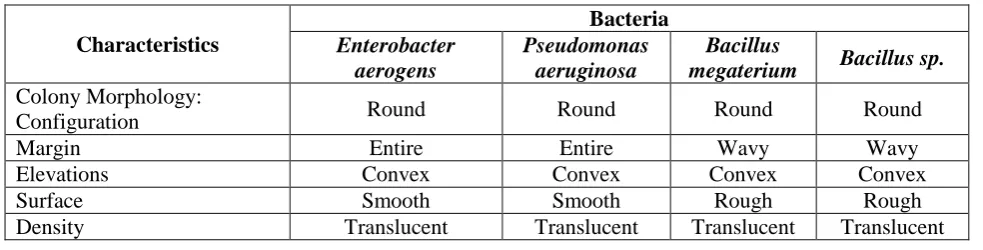
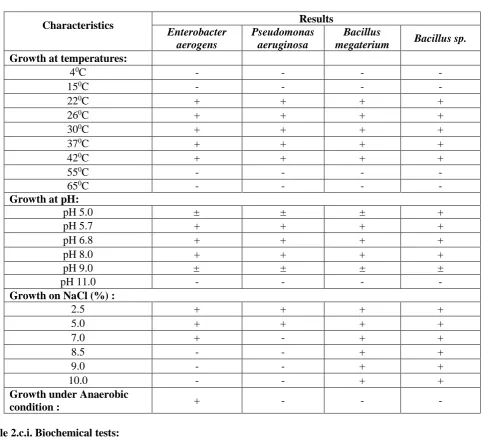
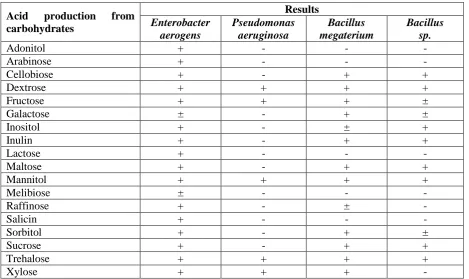
The identification of four pure bacterial strains and their morphological tests, physiological tests, biochemical tests etc. were conducted in the laboratory condition. These tests were carried out following the standard procedures of general characterization2-6. The results of the different tests carried out are shown in table 1 and table 2.
Determination efficiency of four isolated pure strains singly and in combination under atmospheric condition with respect to Biological Oxygen Demand (BOD) reduction:
The Primary treated tannery effluent samples were collected in sterilized bottle and brought back to the laboratory in an ice packed container for determination of relative efficiency of each pure strains so isolated and purified.
Effluent was disinfected with UV light in laminar flow bench. Effluent was taken in sterile BOD bottle. A small amount of a pure culture was added to the effluent. Then aeration was done with the help of sterile aerators. Initial BOD of the tannery effluent was measured following standard method. Then final BOD of effluent after aeration were also measured in the same way and maximum per cent of BOD reduction were calculated.
The BOD data was measured by using the following formula-
Fifty ml of 1% diluted primary treated tannery waste was taken to measure its dissolved oxygen content (D1)
after seeding. A centrifuge tube of 70 ml capacity is filled to the brim with the dilution water containing the sample and the seed microbe. The tube was sealed with cap and kept in the incubation chamber at 200 C for 5 days. The dissolved
oxygen content (D.O.) was measured using an aliquot (D2). The D.O. of the dilution water containing seed was also
measured (B1). The same was also incubated for 5 days at 200 C in the 70 ml centrifuge tube and then also its D.O. was
measured (B2).
(D1– D2) – (B1– B2) x f
BOD520 (mg/l) = ---
P
The value ‘f’ is the ratio of seed in diluted sample to the seed in seed control or the % of seed in diluted
sample/percentage of seed in seed control and P = Decimal fraction of sample used7.
The BOD reduction values by bacteria singly and in combination in atmospheric condition has been tabulated in table 3.
3. RESULTS AND DISCUSSION:
Species name and generation time of four pure bacterial strains were identified and are given in the table 1. The different characteristics of identified four species bacteria viz. Enterobacter aerogens, Pseudomonas aeruginosa, Bacillus megaterium and Bacillus sp. were done. The different tests of the said bacteria viz. morphological, physiological and biochemical tests were studied which are reflected in the table 2. The BOD reduction values by bacteria singly and in combination are given in the table 3.
Table 1. Identified bacteria from the tannery effluent
Bacteria No. Bacteria species Generation time of bacteria at 350 C temperature
1. Enterobacter aerogens 30 minute
2. Pseudomonas aeruginosa 36 minute
3. Bacillus megaterium 35 minute
4. Bacillus sp. 30 minute
Table-2. Characteristics features of isolated four pure bacterial strains through different tests:
Table –2.a. Morphological tests:
Characteristics
Bacteria
Enterobacter aerogens
Pseudomonas aeruginosa
Bacillus
megaterium Bacillus sp.
Colony Morphology:
Configuration Round Round Round Round
Margin Entire Entire Wavy Wavy
Elevations Convex Convex Convex Convex
Surface Smooth Smooth Rough Rough
Pigments - Greenish - -
Gram’s Reaction - - + +
Shape Rods Rods Rods Rods
Size Short Moderate Long Long
Arrangement Single Single Single Single
Spore: Endospore - - + +
Position Central Central
Shape Oval Oval
Motility: + + + +
Fluorescence (UV) - + - -
Table 2.b. Physiological tests:
Characteristics Results
Enterobacter aerogens
Pseudomonas aeruginosa
Bacillus
megaterium Bacillus sp.
Growth at temperatures:
40C - - - -
150C - - - -
220C + + + +
260C + + + +
300C + + + +
370C + + + +
420C + + + +
550C - - - -
650C - - - -
Growth at pH:
pH 5.0 ± ± ± +
pH 5.7 + + + +
pH 6.8 + + + +
pH 8.0 + + + +
pH 9.0 ± ± ± ±
pH 11.0 - - - -
Growth on NaCl (%) :
2.5 + + + +
5.0 + + + +
7.0 + - + +
8.5 - - + +
9.0 - - + +
10.0 - - + +
Growth under Anaerobic
condition : + - - -
Table 2.c.i. Biochemical tests:
Tests
Results
Enterobacter aerogens
Pseudomonas aeruginosa
Bacillus
megaterium Bacillus sp.
Growth on MacConkey agar:
non-Lacfermenter + + - -
Indole Test - - - -
Methyl Red Test - - - -
Voges Proskauer test + - - -
Casein hydrolysis + + + +
Starch hydrolysis - - + -
Urea hydrolysis - - - -
Nitrate Reduction + + - -
Nitrite Reduction + - - -
H2S Production - ± - -
Cytochrome Oxidase test - + - +
Catalase test + + + +
Oxidation/Fermentation (O/F) F O F F
Gelatin liquifaction - + + +
Arginine dihydrolase - + - -
Lysine decarboxylase ± - - -
Ornithine decarboxylase ± - - -
Table 2.c.ii Biochemical tests:
Acid production from carbohydrates
Results
Enterobacter aerogens
Pseudomonas aeruginosa
Bacillus megaterium
Bacillus sp.
Adonitol + - - -
Arabinose + - - -
Cellobiose + - + +
Dextrose + + + +
Fructose + + + ±
Galactose ± - + ±
Inositol + - ± +
Inulin + - + +
Lactose + - - -
Maltose + - + +
Mannitol + + + +
Melibiose ± - - -
Raffinose + - ± -
Salicin + - - -
Sorbitol + - + ±
Sucrose + - + +
Trehalose + + + +
Xylose + + + -
It is explained that single bacterial strain can reduce BOD level to a lower value, but in combination of strains more reduction of the BOD near about 100% is occurred which really means better removal of the organic compounds from the waste water (Table 3). In maximum cases, the combination of four bacteria recorded highest reduction of the BOD whereas, bacteria No. 4 showed lowest reduction of the BOD when they are in single (Fig. 1.).
Table 3. Percentage of Biological Oxygen Demand (BOD) reduction with respect to aeration time in atmospheric condition:
Bacteria No.
6 hrs aeration
24 hrs aeration
48 hrs aeration
72 hrs aeration
96 hrs aeration
120 hrs aeration
240 hrs aeration
Ultimate (480 hrs) aeration
1+2+3+4 28 75 90 98 98 98 98 98
1+2 18 64 82 90 97 98 98 98
2+3 20 57 80 90 98 98 98 98
1+4 21 60 82 92 96 98 98 98
1+3 22 58 84 90 97 98 98 98
4+3 20 56 76 86 95 97 97 97
1 18 53 68 74 88 89 89 89
2 20 50 65 76 85 86 87 87
3 20 52 60 72 86 86 86 86
4 16 50 62 70 83 84 84 84
Fig. 1. Graphical presentation of percentage of Biological Oxygen Demand (BOD) reduction with respect to aeration time in atmospheric condition
4. CONCLUSION:
It will be interesting to study different types of microbes specially bacteria present in activated sludge process and formulate the bio-cultures for utilization in effluent treatment plant for reduction of organic load from tannery effluent to make the leather industry eco-friendly. No doubt the magnitude of the problem is colossal.
5. ACKNOWLEDGEMENT:
The authors wish to acknowledge the cooperation and assistance of Prof. Dr. Buddhadeb Chattapadhyay, Prof. Dr. Sanjoy Chacrabarty and all colleagues of Government College of Engineering and Leather Technology. The author expresses her sincere gratitude and thanks to Mr A. Sahasranaman, Regional Programme coordinator for Pollution Control in the Tanning Industry in South - East Asia, for cooperation, inspiration and the financial support from UNDP through him.
The author also acknowledges with thanks the kind co-operation of Dr. R.K. Jain, Scientist, Institute of Microbial Technology, Chandigarh, Dr. T.B. Samanta, Scientist and Dr. A.K. Halder, Scientist, Bose Institute, Kolkata.
REFERENCES:
1. Jerzy J. Ganczarczyk (1928). Activated sludge process theory and practice (pp. 7-195). Pollution Engineering and Technology/23 Marcel Dekker, Inc, New York. Basel.
2. Sharma Kanika (2007). Manual of microbiology tools & application techniques (pp. 155-238). 1st edi. Anshan
Ltd.
3. Pelczar, Chan, Krieg. (1986). Microbiology, 5th edn. (pp. 261-318). McGraw-Hill, New York.
4. Tanner, F.W. (1947). Practical Bacteriology (pp. 50-161). Jhon Willey & amp; Sons, Inc. New York. 5. Pandalai, N.G. (1961). A textbook of bacteriology (pp. 112-158). Asia Publishing House, New Delhi.
6. Smibert, R.M. and Krieg, N.R. (1981). General characterization. In: Gerdhardt, P., Murray, R.G.E., Costilow, R.N., Nester, E.W., Wood, W.A., Krieg, N.R. and Phillips, G.B., Eds., Manual of methods for general bacteriology (pp. 409-443). American Society for Microbiology, Washington, DC.
7. De, A.K. (1990). Environmental Chemistry (pp. 268-269). 2nd edn. Wiley Eastern Ltd., New Delhi. 0
20 40 60 80 100 120
6 hrs aeration
24 hrs aeration
48 hrs aeration
72 hrs aeration
96 hrs aeration
120 hrs aeration
240 hrs aeration