June 2017
Shareholder Protection Across Time
Brian R. CheffinsSteven A. Bank
Harwell Wells
Follow this and additional works at:http://scholarship.law.ufl.edu/flr
Part of theCommercial Law Commons
This Article is brought to you for free and open access by UF Law Scholarship Repository. It has been accepted for inclusion in Florida Law Review by an authorized editor of UF Law Scholarship Repository. For more information, please [email protected], [email protected].
Recommended Citation
Florida Law Review
Founded 1948
Formerly
University of Florida Law Review
VOLUME 68 MAY 2016 NUMBER 3
SHAREHOLDER PROTECTION ACROSS TIME
Brian R. Cheffins*
Steven A. Bank**
Harwell Wells***
Abstract
This Article offers the first systematic attempt to measure the development of shareholder protection in the United States across time. Using three indices developed to measure the relative strength of shareholder protection across nations, this Article evaluates numerically the protections corporate and securities law have offered shareholders from the beginning of the 20th century to the present day. It accomplishes this by tracking the rights accorded to shareholders across time under three important sources of corporate law: Delaware and Illinois and the Model Business Corporation Act.
This Article’s novel study yields novel results. First, we find that the
protections afforded to shareholders by state corporation law have decreased since 1900 but only modestly so. This indicates that, contrary to the assumptions of many scholars, state competition in corporate law has not significantly eroded shareholder rights. Second, after adding in measures that count protections provided by federal as well as state law, we find that shareholder protection actually improved over time. This implies that federal intervention has played a crucial and perhaps underappreciated role in shaping U.S. corporate law. Beyond its specific findings, this Article illustrates how quantitative analysis of legal trends provides scholars with valuable insights regarding fundamental questions in corporate law.
* J. Berwin Professor of Corporate Law, University of Cambridge, Faculty of Law. ** Paul Hastings Professor of Business Law, UCLA School of Law.
*** I. Herman Stern Professor of Law, James E. Beasley School of Law, Temple University.
INTRODUCTION ... 692
I. METHODOLOGY ... 699
A. Selecting the Indices ... 699
B. Selecting the Legal Regimes ... 704
C. Coding Protocol—In General ... 706
D. The Relevant Variables ... 707
1. ADRI ... 707
2. ASDI ... 709
3. CBR SPI ... 710
E. Which Types of Rules Qualify? ... 712
F. Who Made the Rules? ... 713
II. HYPOTHESES AND FINDINGS ... 718
A. Hypotheses ... 718
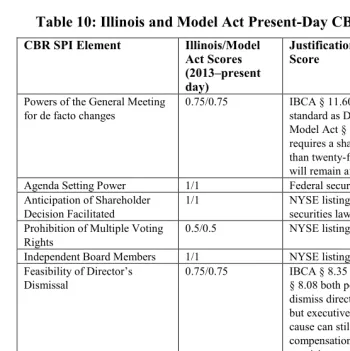
B. Present-Day Scores ... 719
1. ADRI ... 720
2. ASDI ... 723
3. CBR SPI ... 729
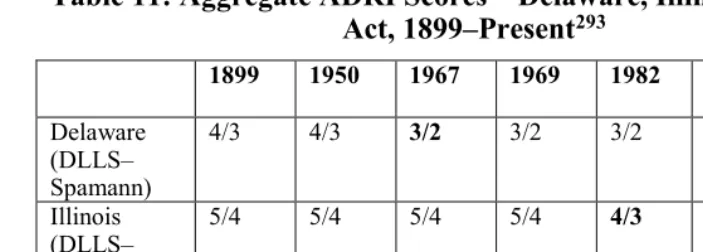
C. Historical Trends ... 734
1. ADRI ... 734
2. ASDI ... 737
3. CBR SPI ... 740
D. Our Hypotheses Revisited ... 745
III. “PRESENT-DAY”BIAS? ... 747
A. Reasons for Concern ... 748
B. What Shareholder Rights Mattered in 1929? ... 750
C. What Shareholder Protections Were Displaced? ... 755
CONCLUSION ... 761
INTRODUCTION
This Article constitutes the first systematic attempt to measure the development of shareholder protection in the United States across time. The study is set against a background of strong presumptions concerning both present levels of protection and trends over time. Corporate law scholars tend to assume that shareholders in U.S. public companies are poorly protected in relation to their peers in comparable countries. In a 2005 article, Professor Lucian Bebchuk argued in favor of increasing
shareholder power in U.S. corporations on the grounds that “the corporate
initiative and intervention.”1 Professor Martin Gelter suggested in 2009
that “U.S. corporate and securities law is highly unusual in the extent to
which it disenfranchises shareholders from both explicit and implicit
influence.”2 Professor Christopher Bruner, in a 2013 book contrasting
U.S. corporate governance arrangements with those in other common law
countries, indicated that among “[t]he defining attributes of U.S. corporate law are the shareholders’ marginal role and very weak governance powers.”3
Underlying this view that U.S. shareholder protection is relatively weak is the assumption that the current situation is the product of a decline in shareholder rights across time. For instance, Professor William Roy observed in a 1997 book that since the rise of the industrial
corporation, “stockholders and directors have gone to battle over many issues, and the directors have usually won.”4 Similarly, Professor Mary
Sullivan argued in 2007 that shareholders’ statutory rights were
substantially diminished between 1885 and 1930.5 Or as Professor Julian
Velasco noted, “[t]he history of corporate law has been one of increasing flexibility for directors and decreasing rights for shareholders.”6
If shareholder protection has indeed eroded over time, the logical culprit is the United States’ state-based system of corporate law. Companies are incorporated under the laws of one of the fifty states rather than under a federal statute, and a business can incorporate in a state other than the one in which it is headquartered.7 States correspondingly can,
and at least to some extent do, compete for incorporation business by altering their corporate laws to attract incorporations, with Delaware being the clear winner.8 The regulatory competition that is a feature of
1. Lucian Arye Bebchuk, The Case for Increasing Shareholder Power, 118 HARV.L.REV.
833, 848 (2005).
2. Martin Gelter, The Dark Side of Shareholder Influence: Managerial Autonomy and Stakeholder Orientation in Comparative Corporate Governance, 50 HARV.INT’L L.J. 129, 134
(2009).
3. CHRISTOPHER M.BRUNER,CORPORATE GOVERNANCE IN THE COMMON-LAW WORLD:
THE POLITICAL FOUNDATIONS OF SHAREHOLDER POWER 37 (2013).
4. WILLIAM G. ROY, SOCIALIZING CAPITAL: THE RISE OF THE LARGE INDUSTRIAL
CORPORATION IN AMERICA 158 (1997).
5. Mary O’Sullivan, The Expansion of the U.S. Stock Market, 1885–1930: Historical Facts and Theoretical Fashions, 8 ENTERPRISE & SOC’Y 489, 529 (2007),
http://dx.doi.org/10.1017/S1467222700006182.
6. Julian Velasco, The Fundamental Rights of the Shareholder, 40 U.C.DAVIS.L.REV.
407, 409 (2006).
7. 1 JAMES D.COX &THOMAS LEE HAZEN,THE LAW OF CORPORATIONS § 3:2 (3d ed.
2010).
8. Lucian Arye Bebchuk & Assaf Hamdani, Vigorous Race or Leisurely Walk: Reconsidering the Competition over Corporate Charters, 112 YALE L.J. 553, 554, 561 (2002);
U.S. corporate law has sparked a widespread and enduring debate among corporate law scholars,9 with one study of leading law journals showing
that more than half of all articles on corporate law discussed the topic.10
There has been vigorous disagreement whether the “race” between the states has been to the “bottom,” in the sense that states have competed by
adopting counterproductive manager-friendly laws, or to the “top,” in the sense that states have competed by adopting laws that served investors’
interests.11 It has been generally accepted, though, that this race has
resulted in a net reduction in shareholders’ rights, either because states
have been cynically watering down existing shareholder protection to appeal to managers—racing to the bottom—or because states have been displacing superfluous or inefficient rules—racing to the top.12
While the general consensus has been that the Delaware-led competition between the states in the corporate law realm has prompted a substantial erosion of shareholder rights and thus shareholder protection, there have been dissenting voices. For example, Professor Walter Werner argued in 1977 that over the previous four decades,
“[s]hareholders’ legal rights within the corporation have been made
see also John Armour, Bernard Black & Brian Cheffins, Delaware’s Balancing Act, 87 IND.L.J.
1345, 1346, 1348 (2012).
9. See, e.g., Robert B. Ahdieh, Trapped in a Metaphor: The Limited Implications of Federalism for Corporate Governance, 77 GEO.WASH.L.REV. 255, 257 (2009) (referring to “corporate [law] literature’s singular emphasis on a race among states”); Lucian A. Bebchuk & Assaf Hamdani, Federal Corporate Law: Lessons from History, 106 COLUM.L.REV. 1793, 1794
(2006); Daniel J.H. Greenwood, Democracy and Delaware: The Mysterious Race to the Bottom/Top, 23 YALE L.&POL’Y REV. 381, 381 (2005) (“Corporate law scholarship has focused on the role of the states as competitive actors in producing corporate law.”); Marcel Kahan, The State of State Competition for Incorporations 3 (European Corp. Governance Inst. Working Paper Series in Law, Working Paper No. 263/2014), http://ssrn.com/abstract=2474658 (“The competition by states for incorporations has long been the subject of extensive scholarship.”).
10. See Robert B. Ahdieh, The (Misunderstood) Genius of American Corporate Law, 77 GEO.WASH.L.REV. 730, 731–32 (2009) (indicating that in a search of articles published in
leading law reviews, almost three-quarters referred to topics relevant to regulatory competition). 11. Compare William L. Cary, Federalism and Corporate Law: Reflections upon Delaware, 83 YALE L.J. 663, 701, 705 (1974) (arguing that there was a race to the bottom
regarding corporate law), with Ralph K. Winter, Jr., State Law, Shareholder Protection, and the Theory of the Corporation, 6 J.LEGAL STUD. 251, 275–76 (1977) (responding to Professor Cary’s
argument with what became known as the race-to-the-top hypothesis), and ROBERTA ROMANO,
THE GENIUS OF AMERICAN CORPORATE LAW 19–22 (1993) (providing support for the
race-to-the-top hypothesis). For further discussion of this debate, see J. Robert Brown, Jr., The Irrelevance of State Corporate Law in the Governance of Public Companies, 38 U.RICH.L.REV. 317, 324
(2004); Roe, supra note 8, at 76–77.
meaningful.”13 Professor Edward Herman suggested similarly in 1984
that “corporate standards of behavior and attention to the welfare of the shareholders are substantially greater . . . than they were in 1925.”14
Bringing the story up to date, activist hedge funds have successfully challenged boards of publicly traded companies in recent years, suggesting shareholders are hardly weaklings under U.S. corporate law. In 2014, the New York Times noted that these shareholder insurgents
“have amassed huge war chests, to take on some of the biggest names in corporate America—and win more often than not.”15
Werner and Herman both drew attention to federal securities legislation, first introduced in the mid-1930s,16 to buttress their claims
that shareholder protection had become more robust during the 20th century.17 More recently, recognition of the federal dimension has
fundamentally shifted the terms of debate on the merits of regulatory competition in the corporate law realm. In particular, Professor Mark Roe reframed the discourse by arguing that the federal government’s actions
on the corporate governance front had done more to shape Delaware corporate law than had potential competition from other states.18
Roe’s contribution, while insightful and influential, raises at least two
significant, and as yet unanswered, questions. First, has the federal contribution to the shape of U.S. corporate law in fact been pivotal or only a side-show? Second, assuming that competition between states has over time diminished the rights corporate statutes provide to shareholders, has federal intervention bolstered shareholder protection sufficiently to cancel out moves in the other direction at the state level?
13. Walter Werner, Management, Stock Market and Corporate Reform: Berle and Means Reconsidered, 77 COLUM.L.REV. 388, 398 (1977).
14. Edward S. Herman, The Limits of the Market as a Discipline in Corporate Governance, 9 DEL.J.CORP.L. 530, 538 (1984).
15. Michael J. de la Merced & Alexandra Stevenson, Sotheby’s Yields to Hedge Fund Mogul and Allies, N.Y. TIMES: DEALBOOK (May 6, 2014, 11:48 PM),
http://dealbook.nytimes.com/2014/05/05/sothebys-and-loeb-end-fight-over-board/.
16. See Securities Act of 1933, Pub. L. No. 73-22, 48 Stat. 74 (codified as amended at 15 U.S.C. §§ 77a–77aa (2012)); Securities Exchange Act of 1934, Pub. L. No. 73-291, 48 Stat. 881 (codified as amended at 15 U.S.C. §§ 78a–78pp).
17. Herman, supra note 14, at 531, 538; Werner, supra note 13, at 398.
18. Mark J. Roe, Delaware’s Competition, 117 HARV. L. REV. 588, 591–93 (2003)
[hereinafter Roe,Delaware’s Competition]; Mark J. Roe, Delaware’s Politics, 118 HARV.L.REV.
2491, 2493–94 (2005). On the nature of Professor Roe’s contribution to the discourse, see Lawrence A. Hamermesh, The Policy Foundations of Delaware Corporate Law, 106 COLUM.L.
REV. 1749, 1767 (2006); Note, The Case for Federal Threats in Corporate Governance, 118
With respect to the first question, Roe argues that “[t]here is a large federal presence in corporate law,”19 but this claim has been contested.
For instance, Professor Roberta Romano has challenged what she has
referred to as the “federal supremacy hypothesis,” saying that the
dynamics of corporate law in the United States can still be explained best by the working of competition between states.20 Professors Marcel Kahan
and Ed Rock struck a middle ground in a 2005 article, suggesting that the
federal “threat” to Delaware is only potent at moments when, due to the
political climate, federal lawmakers can reap populist political dividends by supporting corporate governance reform.21
With the second question, again there is disagreement. According to some observers, the interaction between state-based corporate law and periodic federal intervention provides shareholders with ample and appropriate protection. Professor Brett McDonnell has suggested that
under many circumstances, the United States’ mixed system of state and
federal corporate law produces better results than a pure state or pure national system would yield.22 Leo E. Strine, Jr., Chief Justice of the
Delaware Supreme Court, maintains that investors benefit from a combination of Delaware courts enforcing fiduciary duties expertly and the federal government vigorously policing laws mandating disclosure to investors.23
Other scholars are less sanguine. Bebchuk and Assaf Hamdani argue
that, even when federal intervention is taken into account, “regulatory competition tends to produce insufficient investor protection.”24
Professor J. Robert Brown, Jr., maintains similarly that “neither the states
nor the federal government adequately regulates the behavior of officers
and directors.”25
Empirical analysis of the development of U.S. corporate law across time could help to resolve these controversies. As Professor Todd
19. Mark J. Roe, Delaware and Washington as Corporate Lawmakers, 34 DEL.J.CORP.L.
1, 33 (2009).
20. Roberta Romano, Is Regulatory Competition a Problem or Irrelevant for Corporate Governance?, 21 OXFORD REV.ECON.POL’Y 212, 213, 223 (2005).
21. Marcel Kahan & Edward Rock, Symbiotic Federalism and the Structure of Corporate Law, 58 VAND.L.REV. 1573, 1576 (2005).
22. Brett H. McDonnell, Recent Skirmishes in the Battle over Corporate Voting and Governance, 2 J. BUS.&TECH.L. 349, 353 (2007); see also Kahan & Rock, supra note 21, at 1622 (“[Federal] regulations help ward-off crises and thus provide a lightning rod for a populist backlash that could produce severe harm to Delaware’s position as the creator of our de facto national corporate law.”).
23. Leo E. Strine, Jr., The Delaware Way: How We Do Corporate Law and Some of the New Challenges We (and Europe) Face, 30 DEL.J.CORP.L. 673, 686 (2005).
Henderson has suggested, empirical research could bring “the debate
down to the level of the real-world merits and applicability of . . . conflicting visions of corporate law.”26 Nevertheless, until now
only a tiny handful of studies have attempted to measure quantitatively changes in U.S. corporate law over time, and those studies have typically sought to measure the pace of change rather than to quantify the level of protection afforded to shareholders.27 This Article breaks new ground
with a pioneering empirical analysis that provides insights concerning the evolution of shareholder rights across time. It does so by measuring the evolution of shareholder protection from 1899 to the present day using
“leximetric” tools developed to engage in quantitative measurement of corporate law.28
To execute our historically-based leximetric analysis of the development of shareholder protection we draw upon methodologies developed by academics researching comparative corporate governance. In particular, we rely on three indices constructed to measure aspects of corporate law across national borders: (1) a six-element “anti-director
rights index” (ADRI); (2) an “anti-self-dealing index” (ASDI); and (3) a
ten-variable shareholder protection index constructed by an academic team associated with the Cambridge, U.K.-based Centre for Business Research (CBR SPI).29 We use each of these indices to measure
shareholder protection under three different corporate law regimes: Delaware, Illinois, and the Model Business Corporations Act (Model Act)—the model statute promulgated by the Committee on Corporate Laws of the Section of Business Law of the American Bar Association and adopted in whole or substantial part by more than thirty states.30
To anticipate, our empirical analysis casts doubt on some aspects of the received wisdom concerning regulatory competition in the corporate law realm while affirming other aspects. Some caution is warranted in
26. M. Todd Henderson, Two Visions of Corporate Law, 77 GEO.WASH.L.REV. 708, 713
(2009).
27. See Brian R. Cheffins, Steven A. Bank & Harwell Wells, Law and History by Numbers: Use, but with Care, 2014 U.ILL.L.REV. 1739, 1742–43 (discussing William J. Carney, The Production of Corporate Law, 71 S.CAL.L.REV. 715 (1998) and Roberta Romano, The States as a Laboratory: Legal Innovation and State Competition for Corporate Charters, 23 YALE J. ON
REG. 209 (2006)).
28. Priya P. Lele & Mathias Siems, Shareholder Protection: A Leximetric Approach, 7 J. CORP.L.STUD.17, 18 (2007). The term “leximetrics,” described as the “systematic quantitative”
analysis of law, was coined in a 2003 working paper by Robert Cooter & Tom Ginsburg, Leximetrics: Why the Same Laws Are Longer in Some Countries than Others (UNIV. OF ILL.LAW
&ECON.,Working Paper No. LE03-012, 2003), http://ssrn.com/abstract=456520.
29. Mathias Siems, Shareholder Protection Around the World (Leximetric II), 33 DEL.J.
CORP.L.111,116–19(2008).
drawing inferences from the results. As we have acknowledged in prior related work, deploying leximetrics to measure U.S. corporate law accurately is challenging, particularly when one goes back through time.31 Nevertheless, leximetric analysis can generate sufficiently
accurate scores to identify quantitatively key trends.32 Correspondingly,
this Article’s empirical analysis is a valuable benchmarking exercise that
provides novel insights into the development of shareholder protection over time.
Part I of this Article sets the scene for our leximetric analysis. It explains why we chose the jurisdictions we did. It also describes our leximetric methodology, doing so in part by summarizing who makes law
under the United States’ system of corporate law federalism.
The leximetric analysis occurs in Part II. Here we identify formally the hypotheses we test, we set out the present-day ADRI, ASDI, and CBR SPI scores for Delaware, Illinois, and the Model Act and conclude by describing our historical results. Our core findings are that state law protections of shareholders have diminished since 1900, but not substantially, and that shareholder protection overall increased over time due to a federally prompted surge in shareholder rights.33
With respect to state law trends, ADRI scores, which are governed purely by state law, drop over time but generally only modestly. The downward trend is what would be anticipated, given that competition between states on the corporate law front has reputedly eroded shareholder rights. On the other hand, the modest rate of change indicates
that there was not much of a “race” between states in the period covered. When we take into account federal law trends using the ASDI and the CBR SPI, federal intervention was not only significant, but, contrary to what one would expect if vigorous state competition was eroding shareholder rights generally, more than offset any erosion of shareholder protection at the state level. Specifically, whereas the state-law-based ADRI scores of Delaware, Illinois, and the Model Act dropped—albeit modestly—from 1899 onward, the aggregate ASDI and CBR SPI scores for these jurisdictions, which measure aspects of federal as well as state law, increased over time, dramatically in the case of the CBR SPI. Moreover, after taking into account federal reforms introduced either directly by the federal government or by national stock exchanges working in tandem with federal regulators, the level of shareholder protection the United States currently offers is—contrary to what
31. Cheffins, Bank & Wells, supra note 27, at 1763. 32. Id.
33. See Brian R. Cheffins, Steven A. Bank & Harwell Wells, Questioning ‘Law and
Finance’: U.S. Stock Market Development, 1930–70, 55 BUS.HIST. 598, 605 (2013) (anticipating
observers such as Professors Bebchuk, Bruner, and Gelter imply—quite high by global standards.
Part III offers a robustness check of our findings. One point we make in this Part is that while the indices we focus on have only been developed over the past two decades they provide a suitable departure point for analyzing trends extending back more than a century. Part III demonstrates this in part by using as a benchmark a fourteen-point list of shareholder rights promulgated in 1929, thereby countering the possibility that the variables in the indices we use are too modern to rely upon for historical analysis. Part III also identifies key changes to state law occurring during the 20th century to ascertain whether reform displaced the protection of shareholders in fundamental ways not captured by our indices or by the 1929 fourteen-point list. The analysis suggests, corroborating what the indices reveal about trends concerning state law, that while there was erosion of some forms of shareholder protection arising under state law, there was no decisive curtailing of shareholder rights. It seems that if the rights corporate law provided to shareholders were ever reduced markedly, this occurred primarily as the 19th century drew to a close, rather than continuing during the 20th century.
This Article concludes by underscoring the contributions it makes to theoretical debates concerning corporate law. It also acknowledges that it is left to others to gauge the normative implications of the trends identified.
I. METHODOLOGY
Part I sets the scene for this Article’s leximetric analysis. Sections I.A
and I.B explain why we selected the indices we deploy and the jurisdictions on which we focus. Section I.C explains the coding protocols associated with the indices we deploy, and Section I.D provides an introduction to the variables associated with each index. Section I.E describes the types of rules taken into account with the scoring of each index. Section I.F canvasses the relevance of who makes the rules that potentially could be taken into account.
A. Selecting the Indices
In the mid-1990s, as corporate governance first emerged as a topic of international interest,34 academics began to develop indices to quantify
the protection the corporate laws of various countries offered investors. These efforts have continued to the present day. Here we deploy three
different indices originally developed for cross-country comparison to examine the development of U.S. corporate law over time.
There are several reasons we chose to rely on existing indices rather than constructing an entirely new one. First, there is familiarity. Most readers likely already know of one or more of the indices used, which will increase the accessibility of the results. Second, drawing upon
existing indices means this Article “speaks the same language” as the
modern literature on quantitative analysis of corporate law. Thus, future scholars will be able to compare readily our historically-oriented results with those for a wide range of present-day jurisdictions. Third, relying on existing indices avoids the distraction of defending the effectiveness of a new index and maintains focus on correct historical coding rather than index comparison.
The first of the three indices we deploy is the six element anti-director rights index. It was constructed in the mid-1990s by financial economists Rafael La Porta, Florencio López-de-Silanes, Andrei Shleifer, and Robert Vishny.35 The second is the anti-self-dealing index which La Porta,
López-de-Silanes, and Shleifer developed in the mid-2000s with Simeon Djankov. It focuses on the regulation of transactions between a company and those who control it.36 The third is the CBR SPI, a ten-variable
shareholder protection index Professor Mathias Siems constructed in the late 2000s with the Cambridge, U.K.-based Centre for Business Research.37
Combining discussion of these indices risks deployment of a slew of acronyms referring to both indices and authors. At the risk of some confusion to the reader, this Article uses various acronyms because they have become standard in the scholarly literature. To clarify matters, the key acronyms are set out in Table 1. Drawing the elements together, LLSV produced the ADRI, DLLS produced the ASDI, and Siems–CBR produced the CBR SPI.
Table 1: List of Acronyms
Index or Author Group Acronym
Anti-Director Rights Index ADRI
Rafael La Porta, Florencio López-de-Silanes,
Andrei Shleifer, and Robert Vishny LLSV
Anti-Self-Dealing Index ASDI
35. The ADRI was initially fully deployed in a published paper in Rafael La Porta, Florencio López-de-Silanes, Andrei Shleifer and Robert Vishny (“LLSV”), Law and Finance, 106 J.POL.ECON. 1113 (1998). A working paper version was distributed in 1996 as part of the
NBER Working Paper Series: http://www.nber.org/papers/w5661.pdf.
36. Simeon Djankov, Rafael La Porta, Florencio López-de-Silanes & Andrei Shleifer, The Law and Economics of Self-Dealing, 88 J.FIN.ECON. 430, 442 (2008) [hereinafter DLLS].
Simeon Djankov, Rafael La Porta, Florencio
López-de-Silanes, and Andrei Shleifer DLLS Shareholder protection index constructed by the
Centre for Business Research CBR SPI
Mathias Siems and the CBR academic team that
constructed the CBR SPI Siems–CBR
Why did we choose each index? With the ADRI, its wide acceptance strongly influenced us. The publication of the original ADRI in a 1998 article sparked the development of a rapidly burgeoning “law and finance” literature oriented around quantitative comparative analysis which aims to trace the relationship between nations’ laws and legal
institutions, on the one hand, and corporate governance outcomes, on the other.38 In the law and finance realm, the ADRI has achieved the greatest
prominence with respect to the measurement of corporate law.39 As of
2010, over one hundred academic papers had used the ADRI to test theories concerning the interaction between law and markets.40
Correspondingly, for the quantitative analysis of the historical development of U.S. corporate law, the ADRI was an obvious metric to deploy.
Relying solely on the ADRI, however, could yield a seriously incomplete picture. This index fails to take into account numerous key corporate law topics, including powers shareholders have to remove
directors, the scope of shareholders’ managerial powers, and the legality
of takeover defenses.41 It is hardly surprising that the ADRI is not
comprehensive, given that it only has six components. This problem is compounded, however, because of the component selection process. Several years after the ADRI was first developed, three of its creators, La Porta, López-de-Silanes, and Shleifer, writing in tandem with Djankov,
conceded that the ADRI was “based on an ad hoc collection of
38. See generally John Armour, Simon Deakin, Priya Lele & Mathias Siems, How Do Legal Rules Evolve? Evidence from a Cross-Country Comparison of Shareholder, Creditor, and Worker Protection, 58 AM.J.COMP.L.579, 582–92 (2009) (giving an overview of this literature and its
popularity).
39. Lucian Bebchuk & Assaf Hamdani, The Elusive Quest for Global Corporate Governance Standards, 157 U.PA. L.REV. 1263, 1276 (2009) (stating that the ADRI was, “[a]mong academic researchers, the most influential metric for evaluating governance arrangements worldwide”).
40. Holger Spamann, The “Antidirector Rights Index” Revisited, 23 REV.FIN.STUD. 467,
468 (2010), http://rfs.oxfordjournals.org/content/23/2/467.full.pdf.
41. Lele & Siems, supra note 28, at 20–21; see also Detlev Vagts, Comparative Company Law—The New Wave, in FESTSCHRIFT FÜR JEAN NICOLAS DRUEY 595, 601 (Rainer J. Schweizer,
variables.”42 Thus, the ADRI in isolation is a less than ideal proxy for the
level of protection corporate law has provided for shareholders over time. Djankov, La Porta, López-de-Silanes, and Shleifer (DLLS), when they criticized the original ADRI, were putting forward a second index designed to measure shareholder protections—the ASDI. There are good reasons why the ASDI should be part of a project to code shareholder protection historically.43 First, DLLS explicitly proffered this index as a
superior alternative to the ADRI, saying that the ASDI dealt “with
corporate self-dealing in a more theoretically grounded way.”44 Second,
in empirical tests DLLS ran on the relationship between stock market development and corporate law, the ASDI delivered more robust results than the ADRI.45 Third, the ASDI has proven popular in its own right
among those carrying out empirical law and finance research, and it could indeed be supplanting the ADRI as the most accepted numerical measure of the quality of corporate law.46
Whatever the ASDI’s merits in comparison with the ADRI, because
of its narrowness the ASDI is, in isolation, an insufficient measure of
shareholder protection for this Article’s purposes. The ASDI addresses a solitary legal topic: the regulation of related-party transactions involving a company and its dominant shareholder, who is also a director.47 The
underlying scenario is a classic example of the sort of conflict of interest that can bedevil corporations.48 Nevertheless, it is unrealistic to be
confident that regulation of this particular topic will be broadly representative of the level of protection corporation law affords to shareholders.
Because the ASDI’s narrow scope partly compromises its utility, the broad coverage of the CBR SPI provides a compelling rationale for using it as the third index. The CBR SPI encompasses ten variables, selected
by the index’s creators partly because the variables represented the full
range of shareholder protections used in the countries coded.49 The wide
42. DLLS, supra note 36, at 432.
43. For a more detailed analysis, see generally Cheffins, Bank & Wells, supra note 27, at 1751–52.
44. DLLS, supra note 36, at 432. 45. Id. at 456–61.
46. Cheffins, Bank & Wells, supra note 27, at 1752. 47. Id. at 1741.
48. Mary A. Jacobson, Interested Director Transactions and the (Equivocal) Effects of Shareholder Ratification, 21 DEL.J.CORP.L. 981, 986–87 (1996); Eric G. Orlinsky, Corporate Opportunity Doctrine and Interested Director Transactions: A Framework for Analysis in an Attempt to Restore Predictability, 24 DEL.J.CORP.L.451,453(1999).
range of data taken into account by the CBR SPI potentially makes it a more reliable proxy for shareholder protection levels than either the ADRI or ASDI.
Although the range of issues the CBR SPI addresses is wider than those covered by the ADRI or ASDI, it would be imprudent to use the
CBR SPI as the exclusive measure of corporate law for this Article’s
historically-related leximetric exercise. One consideration is that, whatever the CBR SPI’s merits might be as a corporate law index, it is not as well-known and has not been as influential as the ADRI and ASDI.50Also, the CBR SPI’s designers selected variables thought to form
the core of international corporate governance “best practice” between
1995 and 2005.51 In so doing, they intentionally focused on a period when
proposals to strengthen shareholder protection were high on the policy agenda in numerous countries and deliberately biased the selection of variables in favor of those expected to exhibit a relatively high degree of change during the decade selected.52No explicit equivalent “present-day”
bias affects the ADRI and ASDI, meaning that for a historically oriented study such as the one in this Article, they provide a useful cross-check against this feature of the CBR SPI.
Minimal overlap between the three indices reinforces the utility of each as a cross-check against the others. For example, neither the ADRI nor the CBR SPI explicitly addresses rules governing transactions between a corporation and one of its directors or dominant shareholders, which means these indices cover different ground than the ASDI. There is overlap between the ADRI and the CBR SPI in that they both take into account the extent to which corporate law facilitates shareholder voting by way of proxies and the degree to which the law protects against minority shareholder oppression, defined largely in terms of the
Siems, supra note 29, at 116–19. The initial CBR SPI was a highly detailed sixty-variable index coded for five countries. Lele & Siems, supra note 28, at 23, 45–49.
50. The number of citations for each of the papers where the indices were initially deployed provides an admittedly crude illustration of this point. See Search Results for LLSV, Law and Finance, GOOGLE SCHOLAR,http://scholar.google.com/scholar?q=La+Porta%2C+Lopez-de-Silan
e%2C+Schleifer%2C+Vishny%2C+Law+and+Finance&btnG=&hl=en&as_sdt=0%2C10 (last visited Oct. 17, 2016)(17,321 citations); Search Results for DLLS,The Law and Economics of Self-dealing, GOOGLE SCHOLAR, http://scholar.google.com/scholar?q=Djankov%2C+La+Porta%
2C+Lopez-de-Silanes%2C+Shleifer%2C+The+Law+and+Economics+of+Self-Dealing&btnG= &hl=en&as_sdt=0%2C10(last visited Oct. 17, 2016) (2286 citations); Search Results for Lele & Siems,ShareholderProtection: A Leximetric Approach, GOOGLE SCHOLAR, http://scholar.google.
com/scholar?q=Lele%2C+Siems%2C+Shareholder+Protection%3A+A+Leximetric+Approach&bt nG=&hl=en&as_sdt=0%2C10 (last visited Oct. 17, 2016)(195 citations).
procedure governing shareholder derivative suits.53 However, a majority
of the six topics the ADRI addresses are not components of the CBR SPI.54 Similarly, the bulk of CBR SPI elements lack an ADRI
counterpart.55
In sum, each index used, in isolation, has drawbacks as a mechanism for measuring the historical development of U.S. corporate law. Nevertheless, taken together, the three indices canvass a wide range of mechanisms that afford protection to shareholders and collectively should offer a sufficiently representative picture of shareholder rights to allow for a fruitful historical analysis. This may be the best that can be achieved given the tools at hand. A more exhaustive empirical analysis of corporate law developments impacting shareholder rights is unlikely
to be feasible because fully “[e]valuating the substance of state
corporation laws [is] a daunting task.”56
B. Selecting the Legal Regimes
When seeking to ascertain trends concerning shareholder protection in the United States, it would be unwise to restrict the analysis to one
state. As William Roy has observed, historically “[s]tockholders’ rights
were actively protected in some states and ignored in others.”57 Yet
surveying all fifty states would be extremely difficult. Coding corporate law using the three chosen indices is a labor-intensive process involving not only careful research of the applicable law, but also difficult judgment calls on appropriate coding. The challenges multiply with historically oriented analysis because tracking down relevant statutory provisions, administrative rules, and case law back to 1900 is often far from straightforward.58 We therefore restricted our analysis to three legal
53. The variables comprising both indices are identified individually below. See infra Section III.C. LLSV took account empirically of the regulation of multiple voting rights attached to shares—an element of the CBR SPI—but they did not treat this form of regulation as part of the ADRI. See LLSV, supra note 35, at 1126–27.
54. The elements of the ADRI are set out below. See infra Table 2. To anticipate, the components of the ADRI not addressed in the CBR SPI are the rights individual shareholders have to call shareholder meetings, the ability of companies to block share transfers immediately prior to shareholder meetings, the fostering of a director election system known as cumulative voting, and “preemptive” rights shareholders can be vested with in relation to the issuance of shares.
55. The CBR SPI components are summarized below. See infra Table 3. The CBR SPI components not part of the ADRI are the regulation of shares with multiple voting rights attached, requirements concerning the appointment of independent directors, and rules forcing shareholders to make a takeover offer after acquiring a large minority stake—a “mandatory bid.”
56. Wells M. Engledow, Handicapping the Corporate Law Race, 28 J.CORP.L. 143, 153
(2002).
57. ROY, supra note 4, at 156.
regimes, namely Delaware, the Model Act, and Illinois. These three should nevertheless collectively provide a highly representative sampling of trends affecting U.S. corporate law.
Delaware was an obvious choice, given that, for nearly a century, more publicly traded companies have been incorporated in Delaware than in any other state.59 The Model Act was also a clear choice, given that it
is a highly influential model statute adopted substantially in more than thirty states.60 Due to the high degree of uniformity between the Model
Act and the corporate law statutes of numerous states, it has been referred
to as “the backbone of U.S. statutory corporate law.”61
We chose Illinois primarily to foster continuity in the analysis. We
scored Delaware’s corporate law back to 1899, the year when the state
first enacted a new general incorporation statute intended to attract incorporation business.62 The first Model Act was not produced until
1950, however,63 so we needed a proxy for state law developments
occurring before the Model Act’s promulgation. We chose Illinois
because the Illinois Business Corporations Act of 1933 was the primary precedent for the 1950 Model Act—partly because the principal drafters of the initial Model Act were from Illinois.64 Moreover, the 1933 Illinois
legislation was considered to be innovative and influential in its own right65 and, seemingly contrary to the 20th century trend of states
reducing shareholder rights in corporate law, was ostensibly structured to give shareholders more protections than the laws of Delaware and other
27, at 1748–51, 1759–63 (providing examples of the challenges involved with coding historically).
59. Cheffins, Bank & Wells, supra note 33, at 605.
60. MODEL BUS.CORP.ACT ANN.,intro.xix (AM.BAR ASS’N 2013) (stating that thirty-two
states had adopted all or substantially all of the provisions of the current Model Act and four other states had statutes based on the 1969 version).
61. Mark D. West, The Puzzling Divergence of Corporate Law: Evidence and Explanations from Japan and the United States, 150 U.PA.L.REV. 527, 548 (2001); see also STEPHEN M.
BAINBRIDGE, CORPORATE LAW9 (2d ed. 2009) (“The most important alternative to Delaware law is the American Bar Association’s Model Business Corporation Act.”); Michael P. Dooley & Michael D. Goldman, Some Comparisons Between the Model Business Corporation Act and the Delaware General Corporation Law, 56 BUS.LAW. 737, 738 (2001) (referring to “[t]he relatively greater success of the Model Act in terms of adoptions”).
62. Cheffins, Bank & Wells, supra note 33, at 605.
63. COX &HAZEN, supra note 7, § 2:5, at 140 (“The Model Act first appeared in completed form in 1950.”); Romano, supra note 27, at 236 n.73 (2006) (“[T]he 1950 revision of [a 1946] draft statute is now considered the first Model Act.”).
64. Romano, supra note 27, at 236–37 n.73; West, supra note 61, at 543; Cf. Jeffrey M. Gorris, Lawrence A. Hamermesh & Leo E. Strine, Delaware Corporate Law and the Model Business Corporation Act: A Study in Symbiosis, 74 L. & CONTEMP. PROBS. 107, 109
(acknowledging the Illinois influence but stating that the drafters used Delaware law as their primary departure point).
“chartermongering” states.66 As with Delaware, we score Illinois law
back to 1899.
C. Coding Protocol—In General
For each of the three indices we have deployed the same coding protocol to score shareholder protection going back through time. We began with the present-day score for each of the three corporate law regimes—Delaware, the Model Act, and Illinois. Having ascertained the present-day scores for each, we worked backwards to identify changes to the law that would have caused the score for any of the relevant variables to move up or down.
With one of our indices, the ADRI, our efforts were complicated by the fact that it has been reworked since its initial deployment. The ADRI that LLSV originally promulgated was significantly rescored not once but twice, by DLLS in a 2008 article and by Professor Holger Spamann for a project culminating in an article published the following year.67 The
rationale for recoding and the key differences between the scoring methodologies for each version of this index are discussed below.68 For
present purposes, it suffices to say that we took the scorings by DLLS
and Spamann as our departure point and did not take LLSV’s analysis
into account.
In determining present-day scores for the ADRI, ASDI and CBR SPI, Delaware was the obvious place to start because reliable present-day
66. Harwell Wells, The Modernization of Corporation Law, 1920–1940, 11 U.PA.J.BUS.
L. 573, 576, 594 (2009). While the fact that Illinois has reputedly placed more emphasis on shareholder rights than other states helps to explain the focus on this jurisdiction, continuity with the Model Act was the key consideration. If the primary concern was to trace developments in a state with a reputation for protecting shareholders, California would be a better choice. A significant proportion of the largest U.S. companies are incorporated under California law; as of the mid-2000s, twenty percent of Fortune 500 companies were incorporated in California compared with sixty percent incorporated in Delaware. Matt Stevens, Note, Internal Affairs Doctrine: California Versus Delaware in a Fight for the Right to Regulate Foreign Corporations, 48 B.C.L.REV. 1047, 1049 (2007). Also, California has long had a reputation for having corporate
law that offered significant protection to shareholders. See Andrew J. Collins, Comment, Choice of Corporate Domicile: California or Delaware, 13 U.S.F. L. REV. 103, 106 (1977); Francis G.
Wilmarth, Comment, Choice of a Corporate Domicile, 49 CAL.L.REV.518, 523–27 (1961). On
the other hand, California has never been influential as a source of corporate law nationally in the same way as Delaware and the Model Act. See Lucian Arye Bebchuk & Alma Cohen, Firms’ Decisions Where to Incorporate, 46 J.L. & ECON. 383, 396 (2003) (“California appears unable to ‘sell’ its corporate law system to any significant number of out-of-state firms . . . .”); Guhan Subramanian, The Influence of Antitakeover Statutes on Incorporation Choice: Evidence on the
“Race” Debate and Antitakeover Overreaching, 150 U. PA. L. REV. 1795, 1854 (2002)
(remarking upon California’s “poor showing in the market forcorporate charters”).
scoring for Delaware was readily available for all three indices. The ADRI was already scored for Delaware because the authors who developed or reworked that index—LLSV, DLLS and Spamann—had taken Delaware as representative of U.S. corporate law.69 The ASDI and
CBR SPI were also already scored for Delaware because both DLLS and Siems and his Centre for Business Research co-authors likewise treated Delaware as their proxy for U.S. corporate law.70
With Delaware’s present-day scores we drew verbatim from the work of DLLS, Spamann, and Siems–CBR. Since we adopted the scoring from each source without variation, even if we had qualms about how a particular variable was scored, we refrained from recoding. We scored Illinois and the Model Act ourselves, although whenever the applicable
rule in these jurisdictions was substantially similar to Delaware’s, we
used the Delaware coding of DLLS, Spamann, and Siems–CBR to promote consistency.
Given the extensive borrowing from DLLS, Spamann, and Siems–
CBR, one might assume that ascertaining present-day scores would be a straightforward exercise. On the contrary, identifying the suitable scores posed various challenges that influenced the approach taken with historical scoring. The remaining Sections in this Part illustrate that point in the course of summarizing the key elements of the ADRI, the ASDI, and the CBR SPI and identifying the sources of law that need to be taken into account when coding shareholder protection using each index.
D. The Relevant Variables
To ascertain appropriate present-day coding for the ADRI, ASDI and
CBR SPI, we identified each index’s variables and each variable’s basic
scoring regime. This Section describes each index in detail.
1. ADRI
The ADRI, which was constructed and initially deployed by LLSV in a 1998 Journal of Political Economy article to compare the protection afforded by corporate law to shareholders in forty-nine countries,71 has
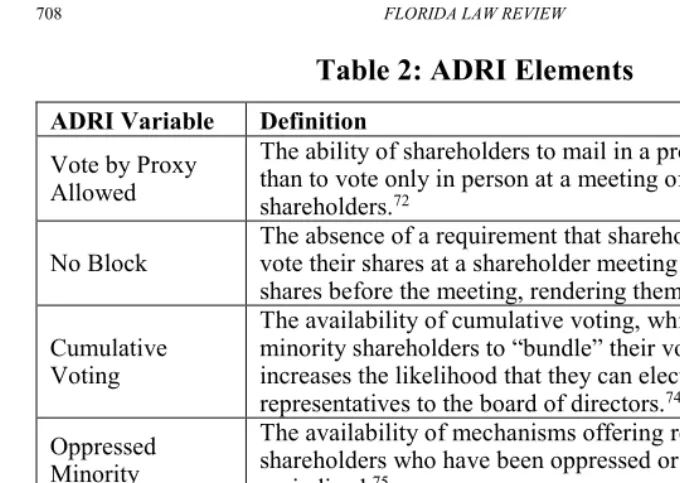
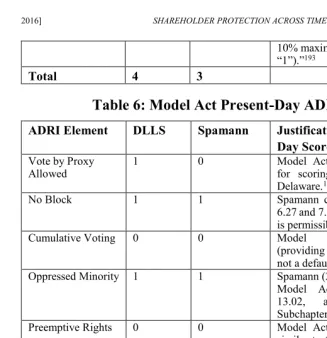
six variables, each described briefly in Table 2.
69. DLLS, supra note 36, at 454; LLSV, supra note 35, at 1119; Spamann, supra note 40, at 472 n.12.
Table 2: ADRI Elements
ADRI Variable Definition Vote by Proxy
Allowed
The ability of shareholders to mail in a proxy vote rather than to vote only in person at a meeting of the
shareholders.72
No Block The absence of a requirement that shareholders intending to vote their shares at a shareholder meeting deposit those shares before the meeting, rendering them nontransferable.73
Cumulative Voting
The availability of cumulative voting, which permits minority shareholders to “bundle” their votes and thereby increases the likelihood that they can elect their
representatives to the board of directors.74
Oppressed Minority
The availability of mechanisms offering relief to minority shareholders who have been oppressed or unfairly prejudiced.75
Preemptive
Rights Rules obliging a company to give existing shareholders a right of first refusal when issuing new shares.76
Ability to Call General Meeting
The ability of shareholders owning ten percent or more of a company’s shares to call an extraordinary shareholders’ meeting.77
LLSV awarded jurisdictions either “0” or “1” for each variable, with
a higher cumulative score for a country signaling a more shareholder-friendly legal regime.78 The maximum score any country could receive
was “6,” although “5” in fact was the highest score that LLSV awarded.79
When DLLS recoded the ADRI for forty-nine countries for the purposes of their 2008 article, they scored the law as of 2003.80 The highest score
they awarded remained “5.”81 The DLLS recoding, however, often
changed the scores awarded to individual countries for particular variables, with the correlation with the original LLSV coding being 0.60.82 Also, while LLSV scored each ADRI variable as either “0” or “1,”
72. Id. at 1127. 73. Id. 74. Id. 75. Id. at 1128. 76. Id. 77. Id. 78. Id. 79. See id.
80. DLLS, supra note 36, at 432.
81. Simeon Djankov, Rafael La Porta, Florencio López-de-Silanes & Andrei Shleifer, The Law and Economics of Self-Dealing: Data, HARVARD UNIV.,Revised Antidir tab(2008), http://scholar.harv
ard.edu/files/shleifer/files/data_for_web.xls?m=1360042200 [hereinafter DLLS, Data] (showing that nine countries were awarded a score of “5”).
DLLS allowed a score of “0.5” for the oppressed minority shareholder
variable where this improved the accuracy of coding.83
2. ASDI
For DLLS the primary purpose of their 2008 article was not to recode the ADRI but rather to deploy a new measure of corporate law, the ASDI, for which they assessed the law of seventy-two countries.84 The departure
point for coding the ASDI is a hypothetical transaction implicating self-dealing.85 This transaction involves Buyer Co., a publicly traded food
manufacturer of which a Mr. James is both a director and sixty-percent shareholder.86 Following a proposal by Mr. James, Buyer Co. agrees to
purchase an unused fleet of trucks from Seller Co., a privately held retailer of which Mr. James is a ninety-percent shareholder.87 Though all
required approvals were obtained and all required disclosures made,
Buyer Co. shareholders sue on Buyer Co.’s behalf the interested parties
and the body that approved the transaction.88
To measure the law governing their hypothetical self-dealing transaction, DLLS compiled two anti-self-dealing indices, one measuring public enforcement—fines and other criminal sanctions—and the other measuring private enforcement—civil remedies.89 They evaluated public
enforcement by assessing whether Mr. James and the approving parties could be fined or imprisoned as a result of what had occurred.90 Though
we have investigated how scoring under the public enforcement index developed over time we do not report the results here.91 This is because
the public enforcement index has attracted considerably less interest than the private enforcement index, due partly to only the latter index being correlated in a meaningful way with measures of stock market development.92
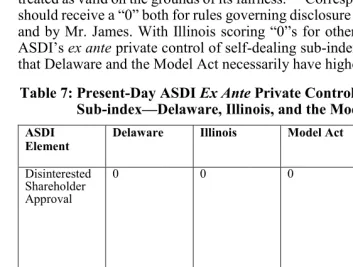
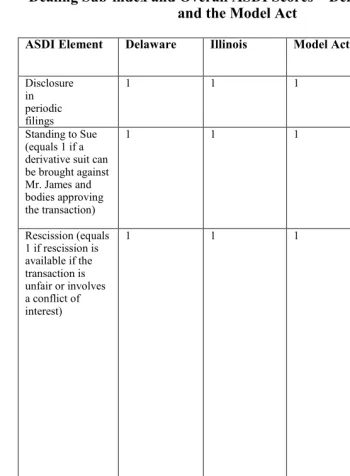
The ASDI private enforcement index is made up of two subindices, one addressing ex ante private control of self-dealing and the other ex post.93 The ex ante index, which focuses on regulation of the process by
which the sale of the trucks could be validated, deals with requirements
83. Id. at 455 tbl.9. 84. Id. at 432. 85. Id. 86. Id. at 433. 87. Id. 88. Id. 89. Id. at 435. 90. Id. at 436.
91. For a discussion of the trends with the public enforcement index, see generally Cheffins, Bank & Wells, supra note 27, at 1754.
for advance disclosure of the proposed transaction by Mr. James and Buyer Co. as well as for an independent review of the transaction by a financial expert or auditor.94 The ex post index, which measures the ease
with which minority shareholders of Buyer Co. could establish potential wrongdoing in the courts after the transaction had been entered into, deals with requirements Buyer Co. would face to disclose the transaction, standing to sue, burden of proof, and access to evidence.95
As with the ADRI variables, the variables in the ASDI private
enforcement index are scored between “0” and “1.”96 In some instances,
such as with a requirement for an independent review, “0” and “1” are
the only possible scores.97 More often, allowance is made for the
possibility of intermediate scores, with the range usually limited to “0,” “0.5,” and “1.”98 For instance, with the advance disclosures Mr. James
had to make for validation of the hypothetical transaction to be possible,
a country would score “0” if no disclosure was required, “0.5” if only the conflict of interest had to be disclosed, and “1” if all material facts had to
be divulged.99
3. CBR SPI
The ten-variable CBR SPI is the third and final index we deploy. Siems–CBR initially deployed the CBR-SPI to score corporate law in twenty countries from 1995 to 2005,100 and then subsequently used it to
score corporate law in thirty countries from 1990 to 2013.101 As shown
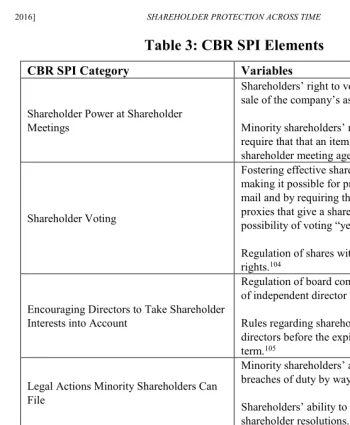
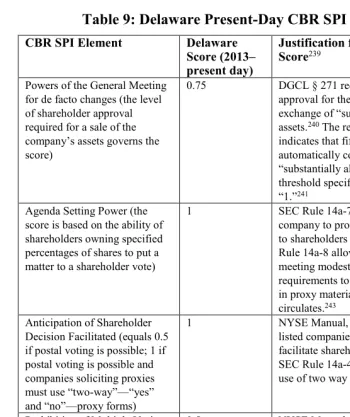
in Table 3, the index addresses five basic categories, each associated with two of the ten variables.102
94. Id. 95. Id. 96. Id. 97. Id. 98. Id. 99. Id.
100. Siems, supra note 29, at 116; Armour et al., supra note 49, at 353.
101. Dionysia Katelouzou & Mathias Siems, Disappearing Paradigms in Shareholder Protection: Leximetric Evidence for 30 Countries, 1990–2013, 15 J.CORP.L.STUD. 127, 129–30
(2015); Mathias M. Siems, The Leximetric Research on Shareholder Protection, in RESEARCH
HANDBOOK ON SHAREHOLDER POWER (Jennifer Hill G. & Randall S. Thomas eds., 2015).
Table 3: CBR SPI Elements
CBR SPI Category Variables
Shareholder Power at Shareholder Meetings
Shareholders’ right to vote collectively on sale of the company’s assets.
Minority shareholders’ rights to require that that an item be put on a shareholder meeting agenda.103
Shareholder Voting
Fostering effective shareholder voting by making it possible for proxies to be sent by mail and by requiring the use of “two way” proxies that give a shareholder the possibility of voting “yes” or “no.”
Regulation of shares with multiple voting rights.104
Encouraging Directors to Take Shareholder Interests into Account
Regulation of board composition in the form of independent director requirements.
Rules regarding shareholder dismissal of directors before the expiration of their term.105
Legal Actions Minority Shareholders Can File
Minority shareholders’ ability to enforce breaches of duty by way of derivative suits.
Shareholders’ ability to challenge shareholder resolutions.106
Change of Corporate Control Protection
Imposing on a shareholder who acquires a large stake in a
corporation an obligation to offer to buy the remaining shares.
Disclosure requirements for acquirers of large-share ownership stakes.107
Consistent with the other indices, each CBR SPI variable is scored on
a range between “0” and “1.”108 Like the revised ADRI and the ASDI,
the CBR SPI forsakes strict binary “0” and “1” coding.109 The CBR SPI
indeed goes further to accommodate intermediate scoring, with the intention being to provide a more accurate picture of the law.110 Although
103. Id. at 119. 104. Id. 105. Id. 106. Id. 107. Id.
the revised ADRI and the ASDI permit non-binary options only when
explicitly identified, such as “0,” “0.5,” and “1,” those coding the CBR
SPI were prepared to give a wide range of intermediate scores for every variable.111 For instance, while the description of the CBR SPI variable
dealing with independent directors indicates that the scoring options are
“1” if at least half of the board must be independent directors, “0.5” if 25% of the board must be independent, and “0” otherwise,112 Siems–CBR
awarded China 0.4 for 2002 and 0.6 for 2003 to 2005.113
E. Which Types of Rules Qualify?
When deciding how to score legal rules going back through time, we had to take into account the form those rules took. Corporate law rules fall into three basic categories: mandatory; default or presumptive
(applicable unless there has been a waiver or other form of “opting out”); and enabling or permissive (inapplicable unless there has been “opting in” by specific election).114 When LLSV coded the original ADRI, they
failed to distinguish explicitly between these categories.115 In contrast,
when DLLS recoded the ADRI in 2008, they ignored enabling rules, meaning that a country would only receive a positive score when its corporate law had a default or mandatory rule providing the relevant protection to shareholders.116 The creators of the CBR SPI similarly
awarded points only for mandatory and default rules.117 DLLS did not
indicate specifically which rules they focused on with the ASDI, but because they were seeking to measure “hurdles” that had to be jumped,118
they should not have taken into account permissive enabling rules.
111. MATHIAS SIEMS ET AL.,CBREXTENDED SHAREHOLDER PROTECTION INDEX 4 (2009),
http://www.cbr.cam.ac.uk/fileadmin/user_upload/centre-for-business-research/downloads/resear ch-projects-output/Shareholder%20protection%20index%20references%2025%20countries.pdf.
112. Siems, supra note 29, at 117. 113. SIEMS ET AL.,supra note 111, at 34.
114. BRIAN R. CHEFFINS, COMPANY LAW:THEORY,STRUCTURE AND OPERATION 217–20
(1997).
115. See DLLS, supra note 36, at 454. 116. Id.
117. SIEMS ET AL.,supra note 111, at 3–4 (indicating that only mandatory laws were counted
with respect to rules precluding shares with multiple voting rights and requiring a shareholder to make a takeover bid for all shares upon acquiring a specified percentage of shares). Professors Dionysia Katelouzou and Mathias Siems, working with CBR SPI data, subsequently categorized legal rules that were elements of the CBR SPI as “enabling” and “paternalistic.” Katelouzou & Siems, supra note 101, at 132. In so doing, they were not attempting to revamp the basic typology of corporate law rules set out here but rather were distinguishing between those CBR SPI rules that automatically imposed the rights in question on shareholders—“paternalistic”—and those where shareholders had to be proactive to exercise the rights they had been given—“enabling.” Seeid.
Changing the types of rules that count can significantly alter scores
awarded. In 1998, LLSV gave the United States an overall score of “5”
for the ADRI, with the only “0” occurring because shareholders lacked
preemptive rights under Delaware law, which LLSV focused on to code the United States.119In Delaware, a corporation is authorized to “opt in”
to give shareholders cumulative voting rights and the right to call an extraordinary meeting.120 LLSV gave the United States a “1” for both
variables, but when DLLS recoded the ADRI in 2008, they coded both as
“0” because the rules governing these areas of the law were enabling
rather than presumptive or mandatory.121 This meant the aggregate score
for the United States dropped from a “5” for LLSV to a “3” for DLLS.122
Since DLLS themselves treated the revised ADRI as superior to the original, we decided to adopt the same approach to enabling rules and excluded laws of this type from consideration when coding the ADRI going back through time.
Given how DLLS scored the ADRI for the United States, it might
seem that “3” would be the obvious present-day baseline for historical
research on Delaware. Spamann’s recoding of the ADRI, however, provides an additional wrinkle. Like DLLS, he discounted enabling rules
and so awarded the United States “0”s for cumulative voting and for the
calling of shareholder meetings.123 Spamann, however, awarded the
United States a “2” rather than a “3” overall because he adopted a tougher standard than DLLS for awarding a “1” for proxy voting, a standard that
Delaware failed to meet.124Spamann’s coding of Delaware law provides
as credible a departure point for our analysis as does DLLS’s coding, so we correspondingly decided to rely on both.
F. Who Made the Rules?
As part of our exercise of determining present-day coding before working backwards, we needed to determine not only the form of the relevant rules but also their source. The ADRI was scored purely by
reference to “company and bankruptcy/reorganization laws” and
excluded securities law and stock exchange listing rules.125 LLSV were
119. LLSV, supra note 35, at 1119, 1130.
120. Cheffins, Bank & Wells, supra note 27, at 1746–47. 121. Cheffins, Bank & Wells, supra note 33, at 607. 122. Id. at 606.
123. Spamann’s article does not provide an element-by-element breakdown of ADRI scores for the United States or any other country. For this data, see Holger Spamann, The “Antidirector
Rights Index” Revisited: Supplementary Data, REV. FIN. STUD. (2010),
http://rfs.oxfordjournals.org/content/suppl/2009/09/24/hhp067.DC1/ADRI_RFS.xls. 124. See Spamann, supra note 40, at 474 & n.22.
prepared, however, to factor in judicial rulings when scoring jurisdictions.126 For instance, they explicitly drew attention to the U.S.
derivative suit as an example of a legal mechanism that afforded shareholders protection against perceived oppression, and its contours are defined primarily by case law.127
At first glance, it seems there is no need to go any further than LLSV did in identifying the laws that offer shareholder protection in the United States. Corporate law constitutes the most obvious source of shareholder rights, and the relevant statutes are promulgated at state level.128 While
proposals to provide for federal incorporation predate the adoption of the U.S. Constitution,129 Congress has consistently resisted calls to provide
for federal incorporation, leaving the matter instead to the states.130 Each
state has in turn promulgated a general corporate statute establishing the procedure for incorporating businesses and providing the ground rules governing the internal affairs of already incorporated companies.131
When a corporation is incorporated under the laws of a particular state,
that state’s corporate law will be applicable notwithstanding where the principal place of business might be. The laws of the state of incorporation will be determinative due to a choice of law rule known as
“the internal affairs doctrine” which does much to sustain Delaware’s
status as the leading supplier of corporate charters.132
The internal affairs doctrine has also formed the basis of an understanding among federal and state lawmakers that has done much to shape U.S. corporate law. The key precept is that the internal affairs of corporations fall within the purview of state law and are not a proper subject for federal regulation.133 Some judicial rulings imply that due to
the nature of the U.S. federal system, the internal affairs doctrine is
126. Id. at 1126.
127. Id. at 1128; see also Armour, Black & Cheffins, supra note 8, at 1349 (describing the prerequisites for bringing a derivative suit in Delaware as a “judicial construct”).
128. Jill E. Fisch, Leave It to Delaware: Why Congress Should Stay out of Corporate Governance, 37 DEL. J.CORP. L. 731, 732 (2013); Stephen M. Bainbridge, The Creeping Federalization of Corporate Law, REG., Spring 2003, at 26, 26 (“For over 200 years, corporate governance has been a matter for state law.”).
129. William W. Bratton & Joseph A. McCahery, The Equilibrium Content of Federalism, 41 WAKE FOREST L.REV. 619, 652–53 (2006).
130. Robert B. Thompson, Delaware, the Feds, and the Stock Exchange: Challenges to the First State as First in Corporate Law, 29 DEL.J.CORP.L. 779, 784 (2004) [hereinafter Thompson, Delaware, the Feds, and the Stock Exchange]; Robert B. Thompson, Delaware’s Disclosure: Moving the Line of Federal-State Corporate Regulation, U.ILL.L.REV. 167, 177 (2009).
131. Wells, supra note 66, at 573.
132. Frederick Tung, Before Competition: Origins of the Internal Affairs Doctrine, 32 J. CORP.L. 33, 39, 42–43 (2006).